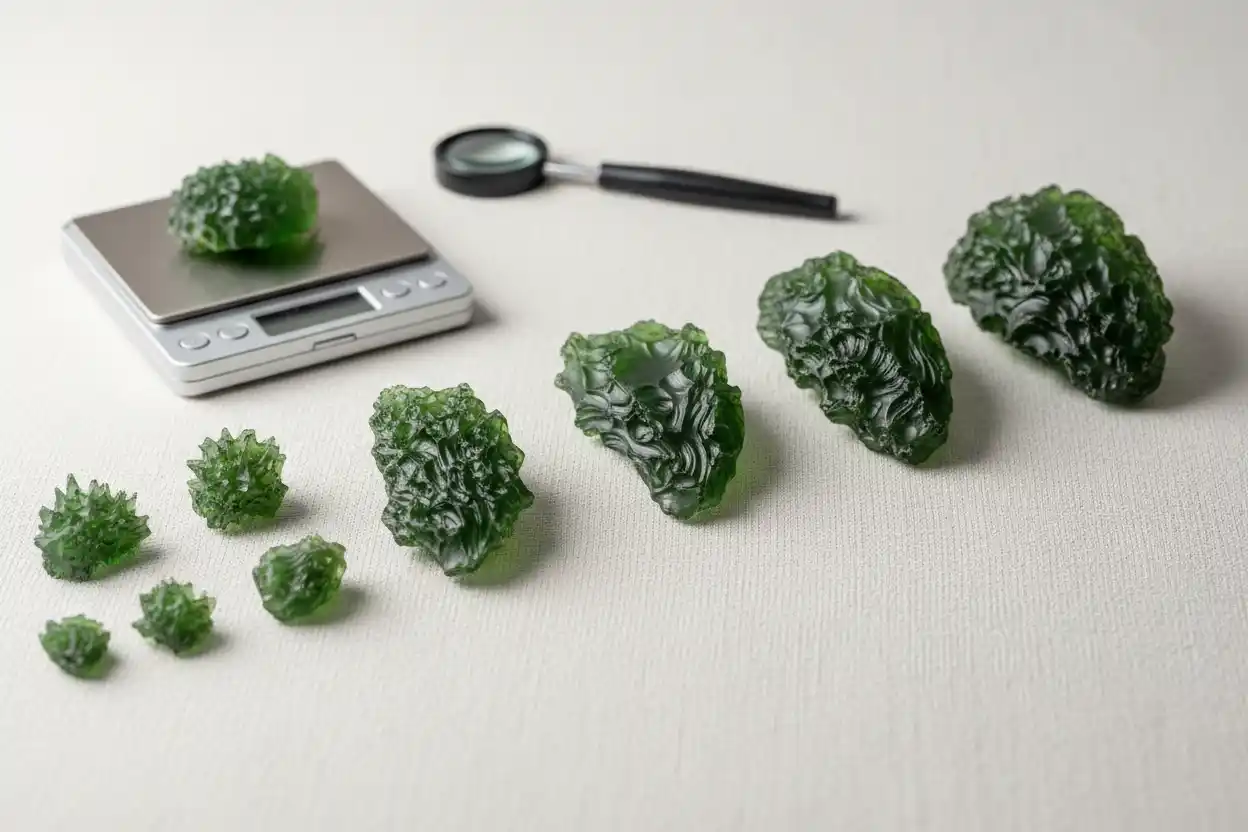
Moldavite Price Guide: Value and Cost in 2026
Genuine Moldavite prices in 2026 commonly range from approximately $30 to $150 per gram. Ordinary chipped or lightly textured pieces may cost less, while deeply sculpted collector specimens from prestigious localities can reach $150 to $500 per gram or more.
Moldavite is normally priced by grams rather than carats. Since one gram equals five carats, a $75-per-gram specimen has a mathematical equivalent of $15 per carat, although per-carat pricing is rarely the most useful way to evaluate natural pieces.
Moldavite Price per Gram in 2026
The following ranges represent broad U.S. and European specialist-retail expectations for genuine Czech Moldavite.
| Moldavite quality | Typical characteristics | Approximate 2026 retail price |
|---|---|---|
| Entry commercial | Small fragments, worn texture, obvious chips or ordinary field pieces | $20–$50 per gram |
| Good commercial | Recognizable natural surface, olive-to-bottle-green color and moderate translucency | $50–$100 per gram |
| Fine collector quality | Strong natural sculpture, attractive form, good translucency and limited damage | $100–$200 per gram |
| Premium locality material | Deeply etched or spiky form, desirable locality and excellent condition | $200–$500 per gram |
| Exceptional museum-grade specimen | Rare large form, outstanding sculpting, documented provenance and minimal damage | $500+ per gram |
Faceted Moldavite follows a different market. Cutting removes the natural surface and substantial weight, so a fine faceted gem may cost more per gram than ordinary raw material even though collectors often prefer intact specimens.
The broader relationship among scarcity, appearance, provenance and demand appears in How Gemstone Prices Are Determined.
What Is Moldavite?
Moldavite is a natural glass associated with the Ries impact event in southern Germany. The impact melted terrestrial material and ejected it over a broad region that includes parts of the modern Czech Republic.
The molten droplets cooled during flight and landed primarily across South Bohemia and Moravia. Weathering and burial later shaped the surface of many specimens.
Moldavite belongs to the wider tektite family. It is not a meteorite and is not composed mainly of extraterrestrial metal or rock.
The completed Tektite guide owns the broader impact-glass family, while the completed Meteorite guide explains the material Moldavite should not be confused with.
The completed Moldavite guide owns geological identity and traditional beliefs. This page remains limited to market pricing.
Why Moldavite Is Expensive
Moldavite comes from a geographically limited strewn field rather than a continuously operating global mining industry.
Individual pieces are finite natural products. Once a specimen is collected, sold or damaged, an identical replacement cannot be manufactured through additional mining investment.
Legal restrictions, land access, deeper deposits and the rising cost of excavation can also reduce the amount of newly collected material reaching the market.
Demand expanded substantially during the early 2020s, especially in crystal, metaphysical and online collector communities. Although prices vary, fine genuine material now trades well above the levels commonly seen before that demand surge.
Counterfeiting adds another cost. Reputable dealers spend time verifying supply, documenting locality and rejecting suspicious material.
Surface Sculpture Is a Major Value Factor
Many collectors prize Moldavite for its natural grooves, pits, ridges, channels and spiky projections.
The finest sculpture forms through complex weathering and chemical etching after deposition. A deeply textured specimen can look dramatically different from a smooth field-worn piece.
Surface sculpture should appear naturally irregular. Repeated, evenly distributed pits can indicate artificial acid etching on manufactured glass.
Fragile points create a tradeoff. Sharp sculpting increases visual value, yet those same points chip easily during digging, cleaning, shipping and handling.
A premium specimen should preserve most of its original form. Fresh bright breaks along several edges reduce value even when the remaining surface is attractive.
Besednice Moldavite Prices
Besednice is the locality most closely associated with deeply sculpted “hedgehog” Moldavite.
Fine Besednice specimens can display thin spikes, sharp ridges and intricate natural etching. Because undamaged examples are scarce, they commonly receive the strongest locality premiums.
Good small pieces may cost $150 to $300 per gram. Exceptional hedgehogs can reach $300 to $500 per gram or substantially more when size, shape and provenance align.
Not every spiky Moldavite is from Besednice, and not every Besednice specimen is premium quality. Locality should be supported by credible dealer records or collection history.
The term “hedgehog” describes form rather than a standardized grade. A heavily chipped specimen should not receive top pricing merely because its label uses the word.
Chlum, Slavče and Other South Bohemian Localities
South Bohemian localities such as Chlum, Slavče, Vrábče and surrounding areas have produced a wide range of Moldavite forms.
Chlum material is frequently encountered in the collector market and may show attractive grooves, elongated shapes and olive-to-bottle-green color.
Slavče specimens can display strong sculpture and command premiums when the natural form remains intact.
Locality affects price through collector recognition and characteristic surface style. Nevertheless, visible quality remains essential.
A fine unidentified South Bohemian specimen may offer better value than a damaged piece carrying a famous locality name.
Moravian Moldavite
Moravian Moldavite often differs in color and form from South Bohemian material. Some pieces appear brownish green, olive, rounded or less deeply sculpted.
Fine Moravian specimens can be collectible, particularly when they have unusual forms, documented fields or historic provenance.
The market generally pays the highest premiums for intensely sculpted South Bohemian material. However, a rare or visually distinctive Moravian specimen can outperform an ordinary Czech field piece.
Origin descriptions should remain specific. “Czech Moldavite” establishes the country but does not identify the collecting region or field.
Color and Translucency
Genuine Moldavite ranges from pale yellow-green and olive to bottle green, forest green and brownish green.
Collectors generally favor attractive green color with enough translucency to reveal internal bubbles, flow structures and depth.
Extremely pale transparent glass can look beautiful but deserves careful authentication because manufactured bottle glass may show a similar initial impression.
Very dark material may appear nearly black until backlit. Darkness does not automatically indicate poor quality, although a specimen should still show enough color and structure to remain visually interesting.
Color uniformity is less important than it is in a faceted gemstone. Natural Moldavite often contains swirls, bubbles and internal variations that support its glassy impact origin.
Size and Weight Premiums
Moldavite does not increase in price through a simple straight-line formula. Large intact pieces are much rarer than small fragments.
| Specimen weight | Broad 2026 retail range | Typical market context |
|---|---|---|
| Below 1 gram | $25–$150 | Small collector piece, jewelry fragment or chip |
| 1–3 grams | $50–$450 | Common wearable and entry-collector range |
| 3–5 grams | $150–$900 | Better specimen range with stronger size premium |
| 5–10 grams | $300–$2,000+ | Large pieces; condition and sculpting become decisive |
| Above 10 grams | $800–$5,000+ | Rare intact specimens, often individually negotiated |
| Exceptional large museum-grade piece | Highly variable | Provenance, form and locality dominate |
A ten-gram smooth and chipped specimen can cost less than a three-gram deeply sculpted Besednice hedgehog.
Price per gram often rises with weight only when the specimen retains desirable surface, shape and condition.
Raw Moldavite vs Faceted Moldavite
Natural raw Moldavite preserves the surface created by weathering and geological history. That surface often holds the greatest collector value.
Faceting removes the natural exterior but can reveal internal color, bubbles and flow lines. The cutting process also removes significant weight and risks chipping the glass.
Commercial faceted Moldavite may cost approximately $50 to $150 per gram equivalent. Fine large gems with strong color, good transparency and precision cutting can cost more.
Collectors of natural forms may prefer an intact raw specimen, while jewelry buyers may appreciate a faceted stone’s brilliance and easier setting.
A polished or faceted piece should not be marketed as having an untouched natural surface.
Chipped and Repaired Moldavite
Small edge chips are common because Moldavite is natural glass. Their effect on value depends on size, location and overall specimen quality.
A minor chip along an otherwise exceptional piece may be acceptable. Large fresh breaks that remove important sculpting can reduce price substantially.
Glue repairs, resin fills and reattached fragments must be disclosed. They can improve display appearance but move the specimen into a repaired category.
Close-up photographs should show the entire perimeter, both faces and any fresh shiny surfaces. Sellers should not position the specimen so the most serious damage remains hidden.
A damaged genuine piece remains authentic, but it should not be priced against intact collector material.
Moldavite Fakes and Their Effect on Price
Manufactured green glass is the primary Moldavite imitation. It can be cast, molded, tumbled or acid etched to create an apparently natural texture.
Low-cost fakes may look glossy, uniformly bright green and filled with simple round bubbles. Better imitations can reproduce grooves, pits and irregular forms more convincingly.
Authentication should consider surface sculpture, internal flow, bubbles, chemical composition, provenance and comparison with verified specimens.
A certificate printed by the seller offers limited protection. Reputable supply history and independent gemological testing carry more weight.
The complete identification process belongs to Real vs Fake Moldavite. The related page Is My Moldavite Real? owns the step-by-step home inspection boundaries.
A second overlapping legacy page, Is My Moldavite Real? How to Spot Fakes, should be used only within its tracker-defined scope rather than repeated throughout this price guide.
Treated and Artificially Etched Material
Routine color treatment is not a normal part of genuine Moldavite’s market. However, artificial modification can still occur.
Acid etching may be used to create a rough surface on manufactured glass. Mechanical carving, sandblasting and molding can produce additional imitations.
Genuine Moldavite can also be tumbled or polished. These processes change the surface but do not make the glass synthetic.
A dealer should state whether the specimen is natural-surface, polished, tumbled, carved or faceted.
The dedicated How to Spot Treated or Synthetic Moldavite page owns modification and artificial-surface detection.
Moldavite vs Other Tektites
Moldavite generally costs more than common black or brown tektites from Southeast Asia, Australia and other strewn fields.
Its green color, established Czech localities and collector demand create a stronger market.
Other tektites can be geologically fascinating and visually attractive but commonly sell for only a few dollars per gram.
The completed Tektite guide owns family-level differences. Purchasing ordinary tektite belongs to Where to Buy Real Tektite.
Libyan Desert Glass is another impact-related natural glass with a separate geographic history and yellow-to-greenish appearance. Its material context appears in the completed Libyan Desert Glass guide.
Moldavite vs Obsidian
Obsidian is volcanic glass produced when silica-rich lava cools rapidly. Moldavite is impact glass linked to a meteorite strike.
Ordinary Obsidian is far more abundant and generally inexpensive. Even attractive Rainbow, Snowflake or sheen varieties usually cost much less than fine Moldavite.
The completed Obsidian guide owns volcanic-glass context, while Types of Obsidian covers its varieties.
A green glass specimen should not be identified as Moldavite merely because it lacks the black appearance associated with ordinary Obsidian.
Moldavite Jewelry Prices in 2026
| Jewelry type | Broad U.S. retail range | Main price drivers |
|---|---|---|
| Small silver pendant with fragment | $75–$300 | Weight, authenticity and silver work |
| Silver pendant with a 2–4 gram specimen | $200–$800 | Surface quality, size and setting |
| Gold pendant or ring | $600–$3,000 | Moldavite quality, gold and custom labor |
| Fine Besednice specimen jewel | $1,000–$5,000+ | Locality, sculpting, condition and design |
| Major collector jewelry piece | $3,000–$15,000+ | Large documented specimen, gold and provenance |
Settings that drill, grind or aggressively clamp the natural surface can reduce specimen value. Wire wrapping may preserve more of the original form but does not provide the same impact protection as a custom metal setting.
Moldavite is glass and can chip when struck. Large spiky specimens may be better preserved as collection pieces rather than worn daily.
Certification and Provenance
A laboratory can distinguish Moldavite from many manufactured glasses through physical, chemical and microscopic testing.
However, not every report can establish the exact Czech collecting field. Locality often depends on documented provenance from the miner, dealer or earlier collection.
For a high-value specimen, useful documentation may include purchase history, old collection labels, miner records and high-resolution photographs.
A generic certificate of authenticity should not justify a premium unless the issuer has an established and traceable reputation.
The broader laboratory framework appears in Gemstone Certification Labs Compared.
Does Moldavite Hold Its Value?
Fine Moldavite has stronger collector potential than many common crystals because the natural supply is geographically limited and cannot be manufactured through new geological production.
However, price growth is not guaranteed. Demand can change, and buyers may avoid specimens with weak provenance or extensive damage.
Commercial fragments purchased during speculative price spikes may resell below their original retail price.
The strongest market position belongs to intact, attractive and well-documented specimens from recognized localities. Even then, seller margins and auction commissions reduce actual proceeds.
The broader resale framework appears in Do Gemstones Hold Their Value?.
Price Guide vs Buying Guide
This page owns Moldavite’s 2026 price-per-gram ranges and value factors. Authentication procedures, seller screening and locality questions belong to the Moldavite Buying Guide.
Moldavite also appears in Rarest Gemstones in the World and Most Expensive Gemstones, although those overview pages should not replace specimen-level pricing.
The completed Gemstones That Start With M and Crystals That Start With M directories connect it to the alphabetical site structure.
The Buying & Value hub connects this guide with certification, fraud prevention and resale content.
Frequently Asked Questions
1. How much does genuine Moldavite cost per gram in 2026?
Most genuine commercial Moldavite costs approximately $30 to $150 per gram. Fine sculpted locality pieces may reach $150 to $500 per gram or more.
2. Why is Moldavite priced by grams?
Natural pieces are irregular and are normally collected as specimens. Grams provide a more practical scale than gemstone carats.
3. How much is a five-gram Moldavite worth?
A five-gram specimen may cost roughly $250 to $1,000. Fine Besednice or unusually sculpted material can cost substantially more.
4. What Moldavite locality is most valuable?
Besednice commonly receives the strongest premium because of its deeply sculpted hedgehog specimens.
5. Is dark Moldavite less valuable?
Not automatically. Color, translucency, surface sculpture, size and condition must be evaluated together.
6. Does a spiky surface increase value?
Deep natural sculpting can increase collector value, especially when delicate projections remain intact.
7. Are chipped Moldavites worthless?
No. Minor chips are common, but serious damage lowers value when it removes important natural form.
8. Is faceted Moldavite more expensive?
It can cost more per unit of finished weight because cutting creates waste. Many specimen collectors still prefer untouched natural surfaces.
9. Is Moldavite a meteorite?
No. It is terrestrial impact glass formed when a meteorite impact melted and ejected Earth material.
10. Can fake Moldavite be acid etched?
Yes. Manufactured glass may be chemically or mechanically textured to imitate a natural Moldavite surface.
11. Does Moldavite need a laboratory report?
A report is useful for expensive or suspicious pieces, although locality provenance may require additional dealer or collection records.
12. Is Moldavite a good investment?
Fine documented specimens may retain collector demand, but prices remain speculative and resale is not guaranteed.
Moldavite Value Lies in an Irreplaceable Natural Form
Moldavite should not be priced as generic green glass or simply by weight. Its strongest value comes from a combination of natural sculpture, attractive color, locality, intact condition and credible provenance.
In 2026, ordinary genuine pieces commonly occupy the $50-to-$100-per-gram market. Prices far above that range should correspond to exceptional sculpting, rare size or locality evidence—not a spiritual claim, generic certificate or artificial texture.
Safety note: Moldavite is natural glass and can chip into sharp edges. Handle delicate sculpted specimens carefully, avoid impact and do not use broken fragments in drinking-water preparations.