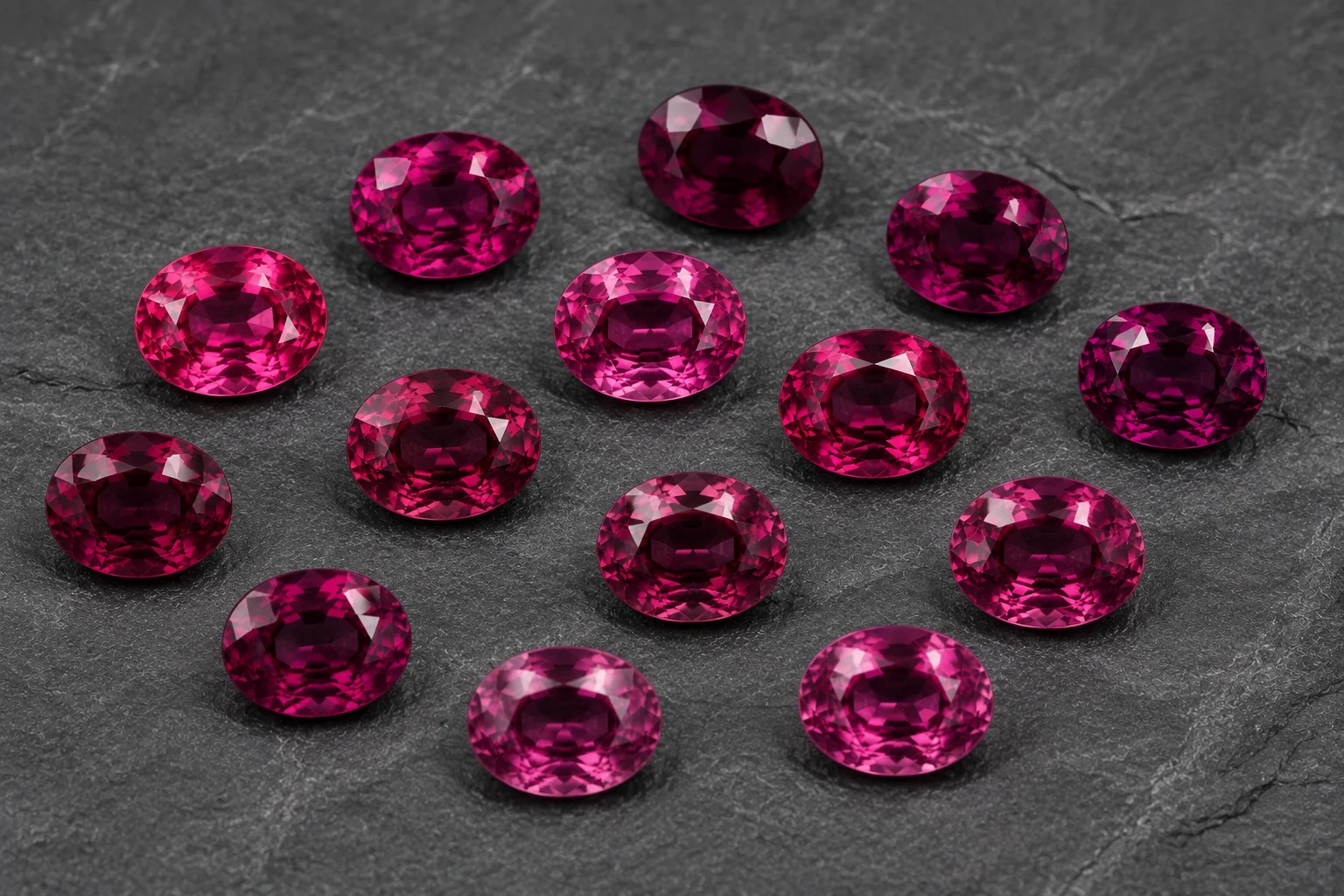
Buy Rhodolite Garnet: Purchase Checklist, Treatments & Value
To buy rhodolite garnet intelligently, look first for an attractive purplish-red to raspberry, rose-red, or pinkish-red face-up color, then judge brightness, eye-visible clarity, cut, size, condition, and correct garnet identification. GIA defines rhodolite as a purplish-red variety within the pyrope-almandine garnet range and notes that red garnets such as pyrope, almandine, and rhodolite typically do not contain eye-visible inclusions. Mindat similarly describes rhodolite as a variety of the almandine-pyrope series, with modern usage covering pink to purple-red gems whose compositions lie between these garnet end members. This mineralogical reality is important because rhodolite is not a separate species, and sellers should not manufacture rarity simply by presenting the trade name as though it identifies an unrelated ultra-rare mineral.
Rhodolite offers one of the more straightforward colored-stone buying markets because attractive natural color and clarity are widely available and routine enhancement is not central to ordinary supply. GIA’s garnet-care guidance states that garnets may rarely receive fracture filling and recommends warm soapy water for filled stones, while GIA’s buyer guidance indicates that garnets generally do not present major treatment-related durability concerns. A buyer can therefore devote more attention to visible quality instead of navigating the complex treatment hierarchies common in sapphire, emerald, ruby, or jade.
Buy Rhodolite Garnet At a Glance
| Buying Factor | What to Examine | Why It Matters |
|---|---|---|
| Identity | Pyrope-almandine garnet correctly described as rhodolite | Red and purple gemstones can imitate rhodolite |
| Color | Raspberry, rose-red, purplish red, violet-red | Color is garnet’s leading quality factor |
| Tone | Rich but not excessively dark | Dark garnet can lose brilliance and appear blackish |
| Saturation | Strong red-purple or pink-red color | Grayish or brownish material receives less demand |
| Clarity | Eye-clean appearance | Rhodolite normally offers high clarity |
| Dark Areas | Persistent extinction | Can make the stone look smaller and less lively |
| Cut | Even brilliance, symmetry, good polish | Poor cuts sell at discounts |
| Windowing | Minimal transparent center | Windows weaken apparent color |
| Size | Compare carat weight with quality and dimensions | Larger rhodolite exists, so size premiums should remain quality dependent |
| Treatment | Usually uncomplicated; ask about fracture filling | Treatment should still be disclosed |
| Origin | Tanzania, Sri Lanka, North Carolina, other documented sources | Source can interest collectors but usually ranks below quality |
| Condition | Sharp facet junctions, no chips | Damage reduces beauty and may require recutting |
| Durability | Garnet group Mohs 6.5–7.5, fair-to-good toughness | Suitable for most jewelry with sensible care |
| Report | Independent identification for important purchases | Confirms garnet variety when needed |
| Seller Grade | Ignore undefined AAA/AAAA terminology | No universal garnet quality scale exists |
Rhodolite Is a Pyrope-Almandine Garnet Variety
GIA describes rhodolite as a purplish-red variety of pyrope-almandine garnet rather than a separate garnet species. Mindat notes that the term originally referred to a rose-red pyrope gem variety but has expanded in modern usage to pink garnets within the almandine-pyrope compositional series, with many examples actually lying within the almandine compositional field.
This means a buyer should be cautious with simplistic descriptions claiming that rhodolite is “pure pyrope” or presenting it as a chemically uniform mineral. Garnets commonly form solid solutions, and the trade name is fundamentally linked to appearance and composition within a range.
The distinction also helps prevent confusion with ordinary dark almandine, pyrope, color-change garnet, and other red garnet varieties that can overlap visually.
Color Is the Most Important Quality Factor
GIA states broadly that color is the most important garnet quality factor and specifically identifies rhodolite as a purplish-red variety capable of spectacular appearance. The strongest commercial stones often show raspberry-red, rose-red, violet-red, or richly purplish-red colors while remaining bright enough to avoid the near-black appearance common in some darker red garnets.
The buyer should look for an appealing relationship between hue, tone, and saturation rather than one particular marketing name. A saturated raspberry stone can be outstanding, while a dark “royal red” garnet that looks almost black away from intense lighting may be less attractive.
Excessive Darkness Can Reduce Value
Many red garnets absorb substantial light, and GIA’s buyer guidance warns that garnets with strong brown components or very dark tone can appear to show black reflections. Rhodolite’s commercial advantage is that its purple and pink modifiers can produce a brighter appearance than many ordinary dark-red garnets.
A stone should retain visible internal red-purple color across most of the face rather than displaying broad black patches. Some contrast is necessary for scintillation, but persistent extinction covering large areas reduces liveliness.
Neutral-light video is especially useful for online purchases because strong spotlights can conceal darkness by creating intense surface flashes.
Brown Modifier Usually Weakens the Raspberry Character
Rhodolite’s appeal comes from pink, rose, purple, and red combinations, while substantial brown can move a stone toward ordinary almandine-like appearance. A mildly warm red may remain attractive, but muddy brownish material usually receives less demand than vivid raspberry or violet-red stones.
Buyers should compare several garnets together because differences that seem subtle in isolated photographs become obvious when stones are placed side by side under the same light.
Eye-Clean Clarity Should Be Expected
GIA states that almandine, pyrope, and rhodolite typically lack eye-visible inclusions. This makes eye-clean appearance a reasonable expectation for most faceted rhodolite, unlike gems such as emerald or certain spessartine garnets where inclusions are more common.
A large black crystal, reflective fracture, or obvious cloud crossing the center of the stone should therefore affect value because cleaner alternatives are generally obtainable.
Microscopic inclusions are not automatically negative and can aid gemological identification. The important commercial question is whether they remain invisible during ordinary wear.
Needle and Healed-Fracture Inclusions Can Occur
GIA’s gem database contains documented rhodolite examples showing intersecting needles and partially healed fingerprint-like fractures, demonstrating that rhodolite is not always internally flawless. The broader quality standard nevertheless remains relatively clean compared with many colored stones.
An attractive natural inclusion can be harmless when small and well positioned, while surface-reaching fractures deserve more caution because they may affect durability or make rare fracture filling relevant.
Cut Quality Makes a Large Difference
GIA’s garnet buyer guidance advises buyers not to compromise on cut because well-cut garnets should return light evenly and sparkle in a lively way, while poorly cut examples are less marketable and sell at discounts. This is especially important for rhodolite because poor proportions can turn rich red-purple color into a dark, heavy-looking face.
A bright oval, cushion, pear, round, or designer cut can emphasize rhodolite’s natural brilliance. The outline itself is less important than symmetry, polish, pavilion proportions, and the avoidance of excessive windowing or extinction.
Windowing Can Make an Otherwise Good Stone Look Weak
A shallow pavilion may allow the observer to see directly through the center of the gemstone, producing a pale or transparent window. The problem becomes more obvious in larger rhodolites because the open central area can dominate the face.
Deep cutting creates the opposite issue by retaining hidden weight and increasing dark extinction.
Compare face-up dimensions with carat weight so the purchase reflects visible beauty rather than carats hidden beneath the girdle.
Size Does Not Create the Same Rarity Curve as Demantoid or Tsavorite
GIA explains that some garnets such as demantoid and tsavorite become much more valuable with size because fine large stones are scarce, whereas common red garnets do not necessarily show the same dramatic increase. Rhodolite can occur in substantial transparent sizes, and GIA’s reference collection includes multi-carat examples from Tanzania and Sri Lanka.
Larger fine rhodolite should still cost more in total and can receive higher per-carat pricing when vivid color and good cut persist. The key is that size does not override the relatively broader availability of red pyrope-almandine material.
Tanzania Is an Important Rhodolite Source
GIA’s reference collection includes multiple rhodolite garnets from Tanzania, and field reporting describes the Umba area as well known for pink-purple rhodolite. More recent GIA field reporting from Tanzania has also documented saturated rhodolite and related color-shifting garnets from deposits in the country.
Tanzanian origin can interest collectors and dealers, especially when associated with a recognized mining region, but the country name should remain secondary to actual color, cutting, clarity, and condition.
Sri Lanka Also Produces Documented Rhodolite
GIA’s gem-reference collection includes pyrope-almandine rhodolite from Sri Lanka, showing that the variety is not restricted to East Africa. Sri Lankan provenance can be appealing when documented, particularly for larger clean stones or old collection material.
As with most rhodolite, a source premium should remain modest unless the provenance itself is unusually important. The visible gem normally determines more value than the country name.
North Carolina Has Historical Significance
Mindat records rhodolite from Macon County, North Carolina, where the original rose-red material played an important role in the variety’s history. Historic American provenance can therefore interest mineral and gemstone collectors independently of ordinary jewelry value.
A seller charging specifically for North Carolina provenance should provide supporting documentation because visual appearance cannot establish locality reliably.
Rhodolite Is Generally an Uncomplicated Treatment Market
GIA states that garnets do not typically present significant treatment-related durability concerns and notes that fracture filling can rarely occur. This gives rhodolite a relatively transparent market compared with gems whose color is routinely altered through heating, diffusion, or irradiation.
The correct description is not that treatment is impossible. Rather, routine enhancement is not what normally creates rhodolite’s commercial color.
A seller should still disclose any identified fracture filling or other modification.
Heat Treatment Is Not a Normal Rhodolite Premium Question
Experimental heat treatment of garnets has been investigated, but ordinary rhodolite commerce is not organized around a heated-versus-unheated hierarchy like ruby or sapphire. Buyers should therefore be cautious when a seller treats “unheated rhodolite” as a rare luxury category.
The money is better directed toward visibly superior color, clarity, cut, and size.
Fracture Filling Changes Care Requirements
GIA states that garnets may rarely be fracture filled and advises using only warm soapy water for such stones. Filling can reduce the visibility of fractures without removing the underlying structural feature, so treatment should be disclosed when present.
A filled rhodolite can remain attractive jewelry, but it should not be compared directly with an untreated stone of similar apparent clarity without acknowledging the enhancement.
Rhodolite Is Durable Enough for Most Jewelry
Garnets range around Mohs 6.5–7.5 depending on type and have fair-to-good toughness. GIA considers them durable enough for all jewelry styles when protected from hard blows and rough wear. Rhodolite’s pyrope-almandine composition places it within the harder red-garnet part of the broader group.
Rings, earrings, pendants, and bracelets are all practical, though frequently worn rings should still be removed for heavy manual work.
Warm Soapy Water Is the Safest Cleaning Choice
GIA recommends warm soapy water for garnets, notes that ultrasonic cleaning is usually safe except for fractured stones, and advises against steam cleaning. Because treatment and hidden fractures may not always be obvious to a consumer, warm water, mild soap, and a soft brush provide the most conservative routine.
Jewelry repair involving heat should also be approached carefully when fractures are present.
Rhodolite Versus Ordinary Red Garnet
The phrase red garnet can refer to almandine, pyrope, rhodolite, and intermediate compositions. Rhodolite receives a separate trade identity because its purplish, pinkish, raspberry, or rose-red appearance differs from the darker brown-red commonly associated with commercial almandine.
Gems Lore’s buy garnet guide and garnet price guide provide the broader group context.
A buyer paying a rhodolite premium should actually prefer the characteristic color rather than assuming the trade name itself guarantees superior quality.
Rhodolite Versus Demantoid Garnet
Gems Lore’s buy demantoid garnet guide and demantoid garnet price guide cover a much rarer green andradite garnet whose dispersion, size scarcity, locality, and inclusion traditions create a stronger premium structure.
Rhodolite usually provides greater size and clarity at substantially more accessible prices.
This illustrates why the garnet group cannot be valued through one generic price hierarchy.
Independent Reports Can Be Useful for Significant Stones
GIA’s garnet buyer guidance recommends an independent laboratory report when there is doubt about what the seller is offering. A report is particularly sensible when an expensive stone has unusual color, is being sold under a rare variety claim, or is represented with important provenance.
For ordinary commercial rhodolite, formal laboratory cost may exceed the economic benefit, making reputable seller disclosure sufficient in many cases.
AAA and AAAA Are Not Standardized Garnet Grades
GIA states directly that no standard quality-grading scale such as AAA, AA, or A exists for garnet. Retailers can use private categories, but buyers should translate those letters into actual hue, tone, saturation, clarity, cut, dimensions, weight, treatment, and condition.
A well-documented stone with no flashy grade can be a better purchase than an inferior gem labeled AAAA.
Common Red Flags When You Buy Rhodolite Garnet
Warning signs include a stone so dark it appears nearly black despite being marketed as vivid raspberry, visible black inclusions hidden by low-resolution photography, a large central window, excessive pavilion depth inflating carat weight, an unsupported claim that rhodolite is a separate ultra-rare garnet species, “unheated” presented as a major rarity premium, fracture filling omitted from disclosure, prestigious origin asserted solely from color, and AAAA described as an official laboratory grade. GIA’s buyer guidance makes clear that color, clarity, cut, and correct garnet type provide much stronger purchase information.
How to Compare Rhodolite Garnet Listings Fairly
Compare stones by pyrope-almandine rhodolite identity, hue, purple or pink modifier, tone, saturation, eye-visible clarity, dark inclusions, cut, windowing, extinction, face-up dimensions, carat weight, origin evidence, treatment disclosure, condition, laboratory documentation where appropriate, setting quality, and return terms. A vivid Tanzanian raspberry cushion, dark commercial almandine-like garnet, pale pink rhodolite, fracture-filled stone, and color-change pyrope should not be treated as equivalent merely because all belong broadly to the garnet family.
Conclusion
To buy rhodolite garnet well, prioritize its defining purplish-red, raspberry, rose, or pink-red color and insist on enough brightness to avoid the overly dark appearance common in many red garnets. GIA identifies rhodolite as a purplish-red pyrope-almandine garnet and notes that rhodolite normally offers high clarity without eye-visible inclusions.
Cut quality matters strongly because even excellent color can become dark, windowed, or lifeless when proportions are poor. GIA specifically advises garnet buyers not to compromise on cut and notes that weakly cut stones sell at discounts. Treatment is generally uncomplicated, with rare fracture filling being the principal care-related concern highlighted by GIA.
The strongest rhodolite purchase therefore combines attractive color, eye-clean transparency, lively cutting, efficient visible size, sound condition, straightforward disclosure, and a price consistent with the broader availability of pyrope-almandine garnet rather than exaggerated rarity claims.
Frequently Asked Questions
What is rhodolite garnet?
Rhodolite is a purplish-red variety within the pyrope-almandine garnet series rather than a separate garnet mineral species.
What color rhodolite is best?
Fine stones commonly show vivid raspberry, rose-red, pinkish-red, or purplish-red color with enough brightness to avoid excessive darkness. Personal preference plays a role, but strong saturation without muddy brown or black extinction generally receives greater demand.
Should rhodolite garnet be eye-clean?
Usually yes. GIA states that rhodolite, pyrope, and almandine typically lack eye-visible inclusions. Large visible dark crystals or fractures therefore deserve closer scrutiny.
Is rhodolite commonly treated?
Routine enhancement is not a defining feature of the market. GIA notes that garnets may rarely be fracture filled and otherwise generally do not present major treatment-related durability concerns.
Is unheated rhodolite more valuable?
Rhodolite is not normally priced through the heated-versus-unheated hierarchy used for ruby or sapphire, so ordinary unheated status should not create a large premium by itself.
Where does rhodolite come from?
Documented rhodolite occurs in Tanzania, Sri Lanka, the United States, and other regions. GIA’s reference collection contains examples from Tanzania and Sri Lanka.
Is Tanzanian rhodolite valuable?
Fine Tanzanian rhodolite can be excellent, particularly from areas known for saturated pink-purple garnet. GIA field reporting documents rhodolite production in Tanzania. Actual color and cut remain more important than the country name.
Does larger rhodolite become much rarer?
Larger high-quality stones can cost more, but rhodolite does not generally show the same dramatic size scarcity as fine demantoid or tsavorite. GIA notes that different garnet varieties have very different size-value relationships.
How durable is rhodolite?
Garnets range from about Mohs 6.5–7.5 and have fair-to-good toughness, making them suitable for most jewelry when protected from hard blows.
How should rhodolite be cleaned?
Warm soapy water is the safest method. GIA advises against steam and recommends avoiding ultrasonic cleaning when fractures are present.
Does AAA rhodolite have an official meaning?
No. GIA states that no standardized AAA garnet grading system exists.
Do I need a laboratory report?
For an ordinary lower-priced stone, probably not, but GIA recommends independent identification when there is doubt or when the purchase is significant.
Is rhodolite a good alternative to ruby?
It can provide rich red-purple color, high clarity, and larger sizes for substantially less than fine ruby, but the stones are different minerals with different rarity and market histories.
Is rhodolite garnet a guaranteed investment?
No. Attractive fine stones can be collectible, but future value depends on quality, size, provenance, condition, demand, transaction costs, and resale liquidity.