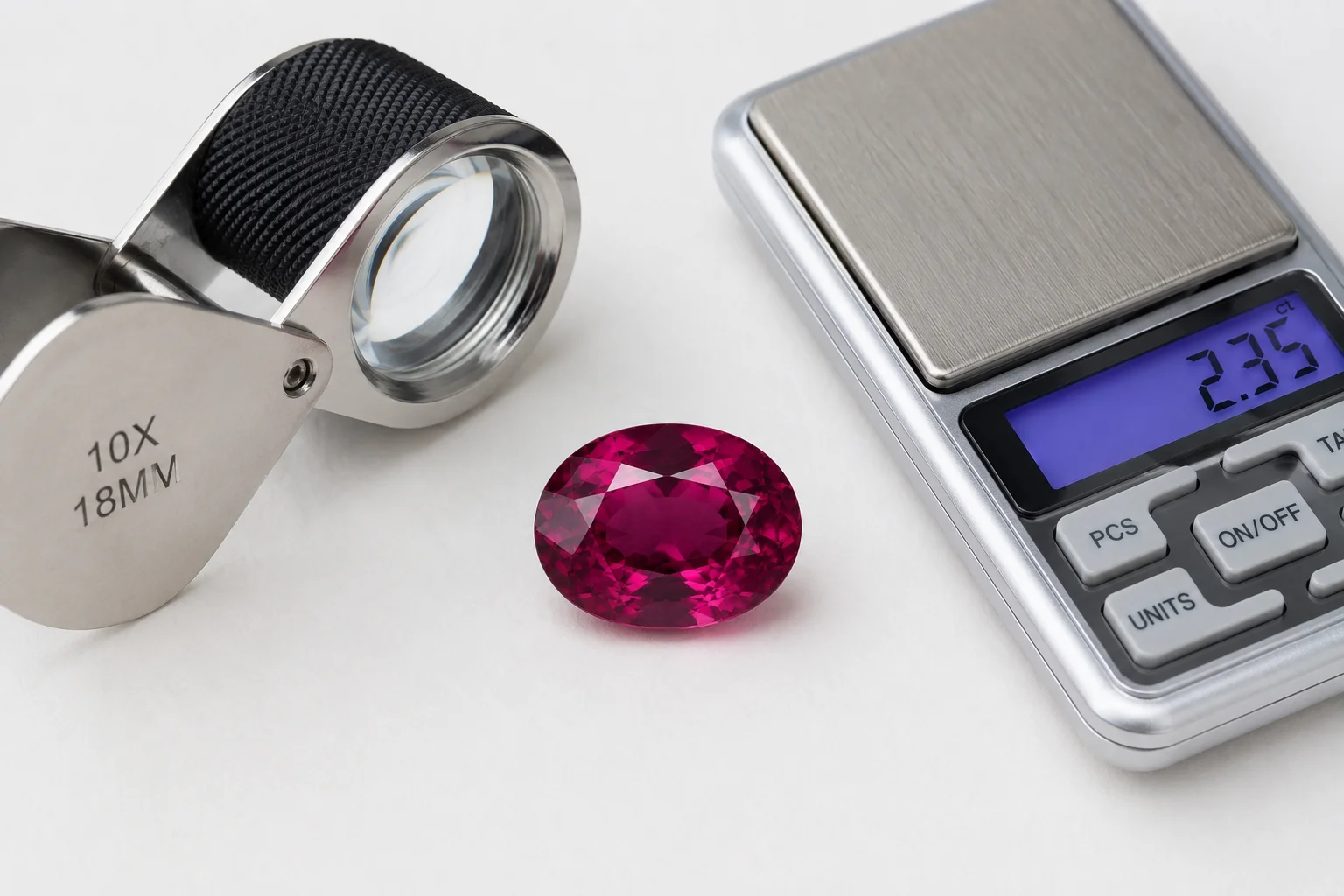
Rhodolite Garnet Price: Typical Value Drivers, Authenticity, Rarity & Size
Rhodolite garnet price is driven primarily by attractive purplish-red to raspberry-red color, brightness, eye-visible clarity, cutting, size, condition, and market presentation rather than by extensive treatment or origin premiums. GIA identifies rhodolite as a purplish-red pyrope-almandine garnet and notes that red garnets in this group normally have high transparency without eye-visible inclusions. Mindat further explains that rhodolite is a trade variety within the almandine-pyrope series rather than a separate mineral species, with modern usage spanning pink to purple-red compositions across that solid-solution range. This broader mineral availability helps explain why fine rhodolite can provide impressive color and substantial size without reaching the extreme price levels associated with rare garnets such as demantoid or tsavorite.
The market therefore rewards quality more than rarity mythology. GIA’s buyer guidance makes color the dominant garnet quality factor and stresses that poor cutting makes garnets less marketable and pushes them to discounts. Treatment is usually a secondary issue: GIA notes that garnets may rarely receive fracture filling but otherwise generally lack major treatment-related durability concerns. A reliable rhodolite garnet price comparison should consequently focus on actual face-up beauty and visible size before paying premiums for vague “unheated,” “investment,” “royal,” or AAAA terminology.
Rhodolite Garnet Price At a Glance
| Value Driver | What Usually Raises Rhodolite Garnet Price | What Can Lower Rhodolite Garnet Price |
|---|---|---|
| Hue | Raspberry, rose-red, vivid purplish-red | Muddy brown-red or ordinary dark red |
| Saturation | Strong rich color | Grayish or weak color |
| Tone | Medium to medium-dark while retaining brightness | Very dark stone that looks blackish |
| Clarity | Eye-clean transparency | Visible black crystals, clouds, fractures |
| Cut | Even brilliance, precise symmetry, good polish | Windowing, extinction, weak proportions |
| Face-Up Size | Efficient dimensions for carat weight | Hidden weight in deep pavilion |
| Carat Weight | Larger fine gem with quality maintained | Large commercial stone with weak color |
| Variety Identity | Correct pyrope-almandine rhodolite description | Generic red garnet marketed as premium rhodolite |
| Origin | Documented source with collector interest | Unsupported source claim |
| Treatment | Straightforward untreated material or full disclosure | Undisclosed fracture filling |
| Condition | Sharp facets and intact girdle | Chips, abrasions, scratches |
| Designer Cut | Skilled precision or artistic cutting | Poorly executed novelty shape |
| Matching | Closely matched pairs or suites | Obvious color or size mismatch |
| Seller Grade | Transparent quality description | Undefined AAAA or investment labels |
| Resale Context | Fine distinctive material | Common calibrated stone sold back immediately |
Color Creates the Largest Everyday Price Spread
GIA identifies color as the leading quality factor across garnet varieties, and rhodolite occupies the purplish-red segment of the pyrope-almandine range. The market generally responds well to lively raspberry, rose-red, pink-red, and violet-red colors because they distinguish rhodolite from the darker brown-red appearance of abundant commercial almandine.
A richly saturated stone can therefore command a meaningful premium over an equally clean garnet of the same weight whose color appears muddy or ordinary. This premium depends on visible beauty rather than one standardized color name, so consumers should compare stones under the same neutral lighting instead of accepting terms such as royal raspberry or imperial purple-red as objective grades.
Excessive Darkness Can Reduce Price Substantially
GIA’s garnet buyer guidance notes that red garnets commonly show dark tones and black-looking reflections when light is strongly absorbed. Rhodolite’s value proposition improves when its purple and pink components remain visible under ordinary lighting rather than disappearing into broad black extinction.
A darker gem can still be attractive when contrast creates lively scintillation, but large dead-looking black areas reduce apparent size and brilliance. A lighter but strongly saturated raspberry stone can therefore outperform a heavier dark garnet substantially on a per-carat basis.
Brown Modifier Usually Pushes Rhodolite Toward Commercial Red Garnet Pricing
Brown can make rhodolite look closer to common dark almandine, weakening the distinctive rose-purple character buyers associate with the variety. A slight warm modifier can remain attractive, but obvious muddy brown generally reduces market demand compared with lively red-purple.
The discount can create good value for everyday jewelry because the stone remains genuine garnet, durable, and naturally colored. Buyers should simply avoid paying top rhodolite pricing for material whose appearance is essentially ordinary dark-red garnet.
Eye-Clean Clarity Is Expected
GIA states that pyrope, almandine, and rhodolite typically lack eye-visible inclusions. This means high clarity by naked-eye standards is not exceptionally rare in rhodolite and should be viewed as part of the normal fine-quality expectation rather than a justification for an extreme premium.
A stone containing a prominent black crystal, reflective fracture, or dense cloud can therefore receive a stronger discount than a comparable inclusion might in naturally included gemstones such as emerald.
Once the gem is eye-clean, paying substantially more for microscopic perfection often adds little visible benefit.
Characteristic Internal Features Can Still Appear
GIA’s reference collection includes rhodolite with straight needle-like inclusions and a partially healed fingerprint-like fracture, confirming that natural stones are not always internally featureless. The economic impact depends on whether the inclusion can be seen face-up and whether it reaches the surface.
Collectors interested in gemology may appreciate unusual inclusions, but conventional jewelry valuation still rewards transparency and minimal visual disruption.
Cut Quality Can Change Rhodolite Price More Than Small Clarity Differences
GIA tells garnet buyers directly not to compromise on cut because a well-cut stone should return light evenly and appear lively, while poor cutting creates a market discount. This is especially important in red garnet because excessive depth or poor pavilion angles can intensify darkness.
A precision-cut rhodolite with vibrant scintillation can therefore command more than an equally clean but poorly proportioned stone of greater weight.
Cut should be judged through face-up brilliance, symmetry, polish, windowing, extinction, and efficiency of visible size rather than shape name alone.
Windowing Lowers Visible Color Concentration
Shallow rhodolite can develop a transparent central window where the background becomes visible through the stone. The effect weakens apparent saturation and can make the gem look larger but less luxurious.
Deep stones create the opposite issue by hiding weight beneath the girdle and sometimes increasing extinction.
The best value normally comes from a balanced cut that distributes rich color while maintaining efficient dimensions.
Size Premiums Are Moderate Until Quality Becomes Exceptional
GIA explains that different garnet varieties behave very differently with size. Rare demantoid and tsavorite can rise sharply in value because fine large stones are difficult to find, while more abundant red garnets can occur in substantial sizes without the same exponential rarity curve. Rhodolite falls closer to the accessible red-garnet side of this spectrum.
Larger high-quality rhodolite still commands more because cutting clean richly colored rough at substantial size becomes increasingly selective. The important point is that a ten-carat stone should not automatically receive an extreme per-carat multiplier simply because it is large.
Very Large Fine Stones Can Still Be Impressive Collector Gems
GIA’s reference project includes rhodolite examples well into multi-carat sizes from Tanzania and Sri Lanka, demonstrating that sizable transparent stones exist. Large examples become more desirable when they remain bright rather than overly dark and preserve eye-clean clarity and strong proportions.
The highest premium belongs to quality retained through size, not to mass alone.
Tanzania Has Strong Market Recognition
GIA documents multiple Tanzanian rhodolites in its reference collection and has reported mining areas producing saturated rhodolite and related color-shifting garnet. The Umba region is especially associated with pink-purple rhodolite in gemological literature.
This provenance can add marketability, but rhodolite generally does not carry the enormous country-of-origin premiums found in Kashmir sapphire, Burmese ruby, or Colombian emerald. Color and cutting remain the stronger economic factors.
Sri Lankan Rhodolite Provides Another Documented Source
GIA’s Gübelin Gem Project includes substantial pyrope-almandine rhodolite from Sri Lanka as well as Tanzania. Sri Lankan stones can therefore be legitimate provenance pieces, especially when accompanied by old collection history or a credible report.
A source claim should still be supported proportionately to the premium. Rhodolite color alone cannot prove origin.
North Carolina Material Has Historical Collector Interest
Mindat records rhodolite from Macon County, North Carolina, and explains the historical use of the rhodolite name in relation to rose-red pyrope material from that region. Documented North Carolina material can appeal to American mineral collectors beyond ordinary jewelry valuation.
This provenance premium applies more naturally to crystals, old cut stones, or specimens with traceable collection history than to anonymous modern jewelry merely described as “North Carolina color.”
Routine Treatment Does Not Drive Rhodolite Price
GIA’s garnet-care guidance notes that fracture filling can occur rarely and recommends gentle cleaning for treated stones, while its buyer guidance indicates no major routine treatment-related durability concerns. This means rhodolite price is not usually separated into elaborate treatment tiers.
The absence of routine enhancement should not be converted into an “unheated premium.” Natural color is normal for the market.
Fracture Filling Can Reduce Comparable Value
When a surface-reaching fracture is filled, apparent clarity can improve without removing the underlying fracture. The stone may still be attractive and useful, but it should be compared with similarly treated material rather than an equivalent untreated eye-clean rhodolite.
GIA advises warm soapy water for fracture-filled garnets because filler durability may differ from the host stone.
Rhodolite Durability Supports Everyday Demand
Garnets range approximately 6.5–7.5 on the Mohs scale and have fair-to-good toughness, making them suitable for most jewelry styles with appropriate care. This practical durability supports rhodolite’s value as an everyday colored gemstone because buyers can obtain rich natural red-purple color in rings, earrings, pendants, and bracelets without the delicacy associated with opal or moonstone.
Condition still affects secondhand value. Abraded facet edges and chips can reduce brilliance even when the stone remains structurally wearable.
Precision Cutting Can Add a Craftsmanship Premium
Because rhodolite rough is not usually as expensive as elite ruby or Paraíba tourmaline, cutters have more freedom to optimize brilliance rather than preserve every fraction of a carat. This makes the variety popular among precision cutters and designer-gem artists.
An unusually well-executed concave, fantasy, Portuguese, or precision brilliant cut can command more than standard commercial material because the buyer is paying partly for lapidary workmanship.
The premium belongs to actual visual improvement rather than merely to an exotic cut name.
Matched Pairs and Suites Can Cost More Per Stone
Matching multiple rhodolites for hue, tone, saturation, size, shape, clarity, and cut requires sorting. A closely matched pair of large vivid raspberry stones can therefore cost more than two random single gems of roughly similar individual quality.
This is particularly relevant for earrings, three-stone rings, bracelets, and necklace suites.
Rhodolite Garnet Price Versus Garnet Price Generally
Garnet is a mineral group rather than one homogeneous gemstone market. Gems Lore’s garnet price guide covers why tsavorite, demantoid, spessartine, almandine, pyrope, rhodolite, and other varieties can have very different value structures.
Rhodolite generally occupies a favorable middle ground: more distinctive than common dark almandine but substantially more accessible than fine demantoid or tsavorite.
Rhodolite Garnet Price Versus Demantoid Price
The Gems Lore demantoid garnet price guide covers a rare green andradite whose small-size scarcity, dispersion, locality, and inclusion traditions can create sharp premiums. Rhodolite is more abundant in transparent larger stones and therefore follows a gentler size curve.
A large rhodolite should not be marketed with demantoid-style rarity simply because both are garnets.
Rhodolite Garnet Price Versus Ruby Price
Rhodolite can provide attractive red to purple-red color for a fraction of fine ruby prices because the mineral supply and global luxury demand are very different. Gems Lore’s buy ruby guide and ruby price guide cover the stronger rarity, treatment, origin, and auction premiums present in corundum.
A rhodolite buyer should value the gem on its own merits rather than view it solely as a cheaper ruby substitute.
Retail Asking Price and Resale Value Are Different
Retail rhodolite price includes cutting, sorting, inventory, jewelry setting, brand, returns, warranty, and seller margin. Because new rhodolite supply exists across many sizes, an immediate dealer resale offer may be substantially below retail.
Exceptional color, precision cutting, unusual provenance, or important signed jewelry can improve secondary-market appeal, but no fixed retention percentage applies.
AAA and AAAA Labels Do Not Establish Market Value
GIA explicitly states that no standardized AAA, AA, or A garnet grading system exists. A seller’s internal grade can be useful only when the criteria are published and consistent.
Actual valuation should return to hue, tone, saturation, clarity, cut, dimensions, weight, treatment, origin evidence, and condition.
What Usually Raises Rhodolite Garnet Price?
Rhodolite garnet price generally rises with vivid raspberry, rose-red, or purplish-red color; attractive medium-to-medium-dark tone; strong saturation; eye-clean clarity; bright precise cutting; efficient face-up dimensions; larger size with quality maintained; matched pairs or suites; exceptional precision cutting; documented locality or historical provenance; and excellent condition.
What Usually Lowers Rhodolite Garnet Price?
Very dark nearly black appearance, muddy brown modifiers, weak saturation, obvious black inclusions, fractures, cloudiness, windowing, excessive pavilion depth, poor polish, chips, fracture filling, unsupported origin stories, “unheated” rarity premiums, and undefined AAAA terminology can all reduce value or create misleading comparisons.
How to Compare Rhodolite Garnet Prices Fairly
Compare stones by confirmed rhodolite identity, hue, tone, saturation, eye-visible clarity, cut, windowing, extinction, dimensions, carat weight, condition, treatment, precision-cut workmanship, matching, origin evidence, laboratory documentation when relevant, setting value, and transaction channel. A three-carat Tanzanian raspberry rhodolite, ten-carat dark red commercial stone, North Carolina collector specimen, precision fantasy cut, and fracture-filled garnet should not be averaged into one universal rhodolite price-per-carat figure.
Conclusion
Rhodolite garnet price is primarily a color-and-cut valuation within an accessible pyrope-almandine garnet market. GIA identifies rhodolite as a purplish-red pyrope-almandine variety and notes that it normally offers high transparency without eye-visible inclusions. These characteristics let buyers obtain substantial clean red-purple gemstones without the extreme rarity premiums associated with fine ruby, demantoid, or Paraíba tourmaline.
The strongest value differences come from face-up color and workmanship. Rich raspberry or violet-red material that remains bright under ordinary light, combined with good proportions and eye-clean clarity, deserves more than an equally large dark or windowed stone. GIA’s explicit advice not to compromise on garnet cut reinforces how strongly fashioning influences marketability.
Treatment usually remains a minor concern rather than the centerpiece of value, with rare fracture filling being the principal issue highlighted by GIA. A fair rhodolite garnet price therefore reflects visible beauty, size, craftsmanship, condition, and documentation—not an invented treatment hierarchy or seller-created grade.
Frequently Asked Questions
How much is rhodolite garnet worth per carat?
There is no universal rhodolite garnet price per carat because color, tone, clarity, cut, size, condition, origin, and craftsmanship vary. Larger fine stones can receive stronger pricing, but the size curve is generally less extreme than in rare garnets such as demantoid.
What rhodolite color is most valuable?
Vivid raspberry, rose-red, pinkish-red, and purplish-red colors with strong saturation and enough brightness to avoid black extinction generally attract the strongest demand. GIA identifies rhodolite as a purplish-red garnet variety.
Does dark rhodolite cost more?
Not automatically. Excessive darkness can make red garnet appear almost black and reduce brilliance. GIA warns that dark tone and black-looking reflections are common issues in red garnet.
Is eye-clean rhodolite rare?
Eye-clean appearance is typical rather than exceptionally rare. GIA states that rhodolite, pyrope, and almandine generally lack eye-visible inclusions.
Does large rhodolite become very expensive?
Large fine stones can cost substantially more, but rhodolite does not normally show the explosive size premium seen in rare demantoid or tsavorite. GIA notes that size-value relationships differ greatly among garnet varieties.
Is Tanzanian rhodolite more valuable?
Tanzania is an important source and produces attractive saturated material, but country name alone does not establish a major premium. GIA documents Tanzanian rhodolite extensively.
Does Sri Lankan rhodolite exist?
Yes. GIA’s reference collection includes pyrope-almandine rhodolite from Sri Lanka.
Is North Carolina rhodolite collectible?
Documented North Carolina material has historical significance in the rhodolite naming tradition and can interest mineral collectors. Provenance should be supported if it materially raises the price.
Is rhodolite garnet usually treated?
Routine treatment is not central to the market. GIA notes that garnets can rarely be fracture filled.
Does unheated rhodolite cost more?
Ordinary rhodolite is not valued through a major heat-treatment hierarchy, so unheated status should not create a substantial premium by itself.
Can cut affect rhodolite price strongly?
Yes. GIA states that poorly cut garnets are less marketable and sell at discounts. A bright precision-cut stone can therefore outperform a heavier weakly cut gem.
Does AAA rhodolite have a standardized meaning?
No. GIA states that no standard AAA garnet grading scale exists.
Does rhodolite hold its retail value?
There is no guaranteed retention percentage. Secondary-market value depends on color, size, cut, condition, provenance, jewelry design, dealer demand, and transaction costs.
Is rhodolite garnet a guaranteed investment?
No. Exceptional stones can be collectible, but broader supply and variable resale demand mean appreciation and liquidity are never guaranteed.