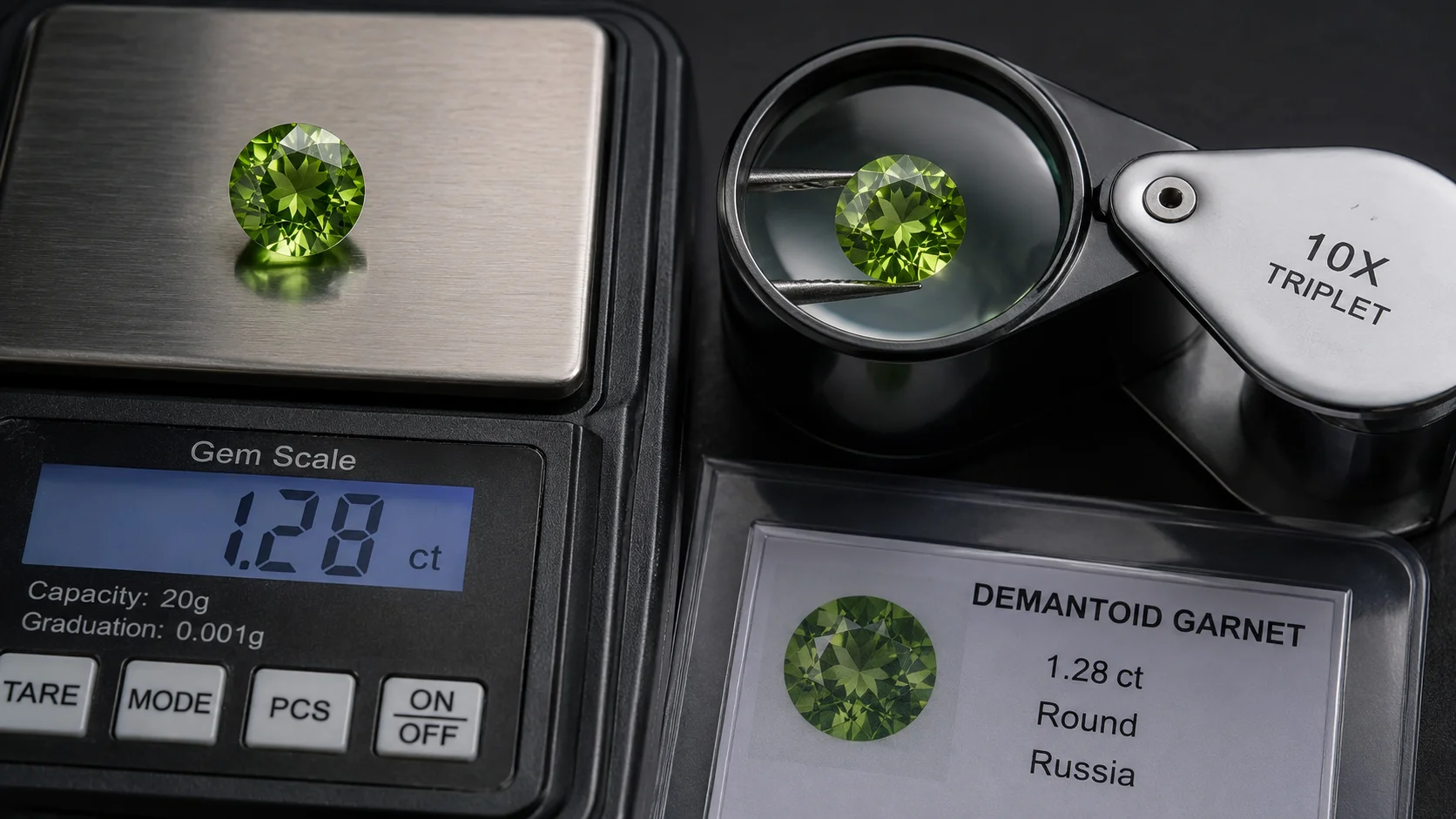
Demantoid Garnet Price: Typical Value Drivers, Market Demand, Grade & Origin
Demantoid garnet price is determined by a rare combination of color, dispersion, size, clarity character, cut, origin, treatment, condition, documentation, and collector demand rather than by carat weight alone. Demantoid is the green variety of andradite garnet, and GIA emphasizes two characteristics that separate it from many other garnets: fine stones can show unusually strong fire because of high dispersion, and high-quality material is commonly found in relatively small sizes, causing value to rise significantly when larger stones retain fine quality.
These features make universal demantoid price-per-carat tables unreliable. A one-carat vivid green stone with excellent fire, strong cutting, attractive horsetail inclusions, and credible Russian origin can occupy a different market from a one-carat yellowish or brownish stone with weak brilliance and uncertain provenance. Anyone preparing to purchase rather than merely research value should first read the Gems Lore guide on how to buy demantoid garnet, because identity, treatment, origin evidence, and seller disclosure directly affect whether two prices are truly comparable.
Demantoid Garnet Price At a Glance
| Value Factor | Stronger Value Signals | Factors That Can Lower Value |
|---|---|---|
| Color | Rich vibrant green or desirable fresh minty green | Strong brown, dull yellow, grayness, or excessive darkness |
| Fire | Visible spectral flashes and lively brilliance | Weak dispersion caused by poor cutting or overly dark color |
| Size | Larger stone retaining fine color, clarity, and fire | Extra weight combined with weaker quality |
| Clarity | Attractive horsetails or limited distracting inclusions | Heavy fractures, dark inclusions, cloudiness |
| Horsetails | Distinctive, aesthetic, well-positioned inclusions | Unattractive inclusion clutter or unsupported Russian-origin claims |
| Cut | Proportions that display fire and brightness | Windowing, extinction, poor symmetry, unnecessary depth |
| Origin | Credibly documented source, especially where market demand favors it | Seller-only origin claim without supporting evidence |
| Treatment | Clearly disclosed heating status | Undisclosed or uncertain treatment when a premium depends on untreated status |
| Condition | Crisp polish, intact girdle, no major chips | Abrasion, chips, scratches, repolishing |
| Documentation | Independent identification and geographic-origin report | Weak or unverifiable paperwork |
| Market Demand | Strong collector interest in rare sizes or recognized origins | Lower demand for ordinary quality |
| Transaction Type | Comparable specialist retail or realized market evidence | Mixing retail asking price, appraisal, and dealer resale value |
Color Is a Major Demantoid Price Driver
GIA field reporting identifies rich jungle green and fresh minty green as especially sought-after appearances in Madagascan demantoid, while yellow and brown modifiers are generally less desirable. Research on Russian production similarly describes pure vibrant green as a particularly fine commercial color, with brown secondary tones reducing desirability unless treatment improves them.
Color should not be judged independently from fire. Demantoid’s strongest distinction from other green gems lies partly in its high dispersion, and very saturated bodycolor can sometimes suppress the visibility of spectral flashes. GIA notes that lighter African demantoid can display fire particularly effectively because its bodycolor does not mask dispersion as strongly.
This means that two buyers can reasonably prefer different stones. One may pay more for the deepest pure green, while another may choose a lighter mint-green demantoid whose fire is more obvious. Market value reflects prevailing preferences, but visual quality remains multidimensional.
Fire Can Add Value When the Cut Reveals It
Demantoid was named for its diamond-like optical effect, and GIA specifically highlights the gem’s exceptionally strong dispersion. Well-cut stones can display conspicuous spectral flashes that distinguish them from many other green gemstones.
A cutter therefore has substantial influence over the finished value. GIA notes that demantoid is often fashioned to precise proportions to show its fire effectively. A stone with excellent rough color but a large window, excessive extinction, or poor symmetry may lose part of the optical character that buyers are paying for.
Price comparisons should consequently include video or in-person inspection whenever possible. Static images can make color look strong while failing to communicate actual fire, brilliance, or dead areas.
Size Can Create a Steep Value Increase
GIA’s general garnet quality guidance states that demantoid is more commonly found in smaller sizes, causing its value to rise significantly as size increases. Russian field reporting gives the same market context, documenting limited production of larger stones and increasing prices in larger size categories.
This does not mean a two-carat demantoid is automatically worth twice or three times as much as a one-carat stone. The relationship can become nonlinear because the larger stone belongs to a scarcer segment of supply. Conversely, if the larger gem has noticeably weaker color, poor cutting, or severe inclusions, it may fail to achieve the premium expected from size alone.
Carat weight therefore acts as a rarity multiplier only after quality is considered.
Millimeter Dimensions Should Be Compared With Carat Weight
Rare gemstones often encourage cutters to retain as much weight as practical. A deep pavilion can preserve valuable rough while causing a stone to face up smaller than another gem of equal weight. That extra depth is not necessarily poor workmanship because natural crystal shape and inclusions constrain the cutter, but buyers should know what the additional weight contributes visually.
Compare length, width, and depth as well as carats. A lighter stone with a broader face-up spread may look larger in a ring than a heavier stone carrying more weight beneath the girdle.
A fair demantoid garnet price comparison therefore matches both weight and visible dimensions rather than treating every one-carat stone as physically equivalent.
Horsetail Inclusions Can Reverse Normal Clarity Logic
Most gemstone buyers learn that fewer inclusions usually mean higher value, but demantoid provides an important exception. GIA explicitly states that horsetail inclusions can increase demantoid value. Their desirability comes from their distinctive appearance, association with classic geological environments, and collector recognition.
An attractive horsetail does not make clarity irrelevant. Large fractures, opaque inclusions, cloudiness, or internal features that suppress brilliance can still reduce value. The strongest premium generally applies when an aesthetically pleasing horsetail appears within a beautiful, lively stone rather than when the gem is simply heavily included.
This nuance makes demantoid valuation more complex than a straightforward “cleaner is always better” formula.
Horsetails Should Not Be Priced as Automatic Proof of Russian Origin
Russian demantoid is famously associated with horsetail inclusions, but GIA warns that the inclusion does not guarantee Russian origin. Horsetails are documented in demantoids from Italy, Iran, and Pakistan as well, while some Russian stones contain no horsetail at all.
A seller may legitimately charge a premium for historically important Russian material when provenance or laboratory origin supports the claim. The problem arises when the premium rests only on the presence of a horsetail.
Current GIA origin services now include natural demantoid, allowing geographic origin to be reported when determinable. That provides a stronger basis for high-value origin premiums than visual assumptions alone.
Russian Origin Can Influence Market Demand
Russian demantoid has exceptional historical recognition because the Ural Mountains produced the classic stones that established the gem’s reputation. GIA field reporting notes strong demand for Russian demantoid in major international markets and documents price increases for larger sizes alongside limited production.
Origin premium should nevertheless be separated from intrinsic quality. A vibrant, beautifully cut stone from Namibia or Madagascar can be more attractive than a weak Russian stone. GIA reporting on Madagascan material notes that lighter African demantoid can exhibit particularly strong fire, while Namibian stones can likewise combine lighter color with high dispersion.
The market may still value Russian history and provenance separately. That is legitimate collector value, but it should be identified as such rather than presented as proof that every Russian stone has superior physical quality.
Namibia and Madagascar Occupy Their Own Market Niches
Namibian demantoid is known for lighter colors that can allow dispersion to show strongly. GIA reporting from the Green Dragon mine describes the combination of lighter bodycolor and high dispersion as a characteristic strength of the material and notes strong demand for fine calibrated melee and exceptional larger stones.
Madagascan demantoid can also occur in impressive larger sizes, and GIA has documented fine material with rich jungle-green or mint-green appearance and strong fire. The market should therefore not be treated as Russian material versus “everything else.” Different sources can appeal to different buyers because their typical color, clarity, inclusion, and size profiles vary.
Geographic origin is one value factor, not an independent quality grade.
Pakistan and Italy Reinforce the Need for Evidence-Based Origin
GIA has examined demantoid from Baluchistan, Pakistan, documenting green to yellowish-green material associated with serpentinite and characteristic chrysotile features. Published research on Italy’s Val Malenco source likewise confirms demantoid with classic horsetail inclusions.
These sources matter commercially because they show why inclusion-based origin shortcuts can fail. A stone can look “Russian” to an experienced observer yet originate elsewhere.
When a seller requests a premium for locality, origin documentation becomes increasingly important as the price rises.
Heat Treatment Can Affect Demantoid Price Comparison
GIA treatment literature documents low-temperature heating of Russian demantoid to reduce brown coloration and improve green appearance. Field reporting from Russian deposits also notes that brownish material may be heated to remove secondary color.
Heated demantoid remains demantoid. The treatment does not change the mineral species, and a beautifully heated stone may remain highly desirable. Market differences depend on disclosure, buyer preference, rarity of comparable untreated material, and confidence in determining treatment status.
An untreated premium should therefore be handled carefully. GIA’s treatment literature notes that low-temperature demantoid heating can be difficult to detect conclusively in some cases. A seller should not promise scientific certainty beyond what the available evidence supports.
AAA and “Collector Grade” Are Not Standardized Price Categories
GIA states that no universal A, AA, or AAA quality-grading scale exists for garnet. “AAA demantoid,” “museum grade,” “collector grade,” and “investment grade” are therefore commercial descriptions unless the seller publishes specific criteria.
Two sellers can apply AAA to very different stones. One may prioritize vivid green color, another may prioritize clean appearance, while a third may include Russian origin or horsetail inclusions in its private system.
A serious price comparison should replace grade labels with measurable or observable characteristics.
Cut Quality Directly Influences What Buyers See
Demantoid’s high dispersion creates enormous potential for a lively finished gemstone, but cutting determines how much of that potential becomes visible. GIA notes that exact proportions are often used to maximize fire.
A strong cut should balance brightness, dispersion, color, face-up size, symmetry, polish, and weight retention. Rare rough may justify compromises, yet a large window or excessive depth should still influence the price.
Precision-cut or historically important antique demantoids may also carry craftsmanship value separate from raw gem quality. Antique Russian jewelry, signed pieces, and notable designer settings can add additional layers that cannot be reduced to price per carat.
Condition Can Matter Greatly in Antique Demantoid Jewelry
Demantoid has a long jewelry history, so the market includes old stones that may have been worn for generations. Garnets have fair to good toughness, but demantoid lies on the softer side of the garnet hardness range.
Facet abrasion, chips, scratches, worn girdles, old repairs, and repolishing can reduce the value of a loose gemstone even when provenance is desirable. In a historically significant jewel, however, original condition and period cutting can themselves have collector importance.
The gem and the jewelry should therefore be appraised separately and then considered together.
Laboratory Origin Reports Can Support Marketability
GIA currently offers its Colored Stone Identification & Origin Report for natural demantoid, including geographic origin when determinable. Standard report information can also include weight, measurements, shape, cutting style, color, identity, detectable treatment information, and a photograph.
Such documentation can improve buyer confidence in a high-value transaction, particularly when Russian origin or another locality supports a premium.
The report does not determine the selling price. It supplies gemological evidence that appraisers, dealers, collectors, and buyers can use in a broader market valuation.
Retail Asking Price, Auction Price and Appraisal Are Different
A specialist dealer’s asking price includes sourcing, expertise, laboratory costs, inventory risk, insurance, photography, overhead, return privileges, and profit margin. An auction result reflects the competition for one specific lot under one sale’s conditions. A dealer cash offer to an owner must leave room for testing, marketing, holding time, and resale margin.
An insurance appraisal can be different again because its purpose may be to estimate replacement cost rather than immediate cash value.
These numbers should not be averaged together casually. The transaction type is part of the valuation.
Historical Price Examples Should Not Become Universal Benchmarks
GIA has published trade observations showing very high wholesale asking or transaction levels for exceptional Russian demantoid, including a reported 4.81-carat rich green stone with a horsetail inclusion that a dealer valued at $15,000 per carat at the time discussed. That example illustrates how fine large Russian material can occupy an elite market, but it should not be converted into a present universal benchmark.
The stone had a specific combination of size, color, origin, and inclusion characteristics, and the figure reflected a particular historical trade context. Ordinary demantoid, different origins, smaller sizes, weaker color, or different market conditions can produce completely different values.
Current valuation should use current, closely comparable evidence rather than recycling one spectacular trade example.
Supply and Demand Can Affect Different Size Categories Unequally
GIA’s reporting on Russian production notes limited quantities of large gem-quality stones and stronger pricing pressure as size increases. Namibian market reporting describes heavy demand for fine melee in some markets while exceptional larger stones attract another buyer segment.
This demonstrates why “market demand” is not one uniform force. Jewelry manufacturers may want calibrated small stones, collectors may pursue large singles, and designers may prefer lighter high-fire material that differs from the saturated green favored by another market.
Demantoid garnet price can consequently vary according to the exact size and quality segment being sold.
Rarity and Monetary Value Should Remain Separate
Demantoid is genuinely rare compared with common red garnets, and fine large stones are particularly scarce. That geological and market scarcity supports high prices but does not make every demantoid expensive.
A poorly cut, brownish, heavily fractured, or undocumented stone may remain less desirable despite belonging to a rare variety. Conversely, an unusually beautiful stone can command a substantial premium because several desirable factors occur together.
The Gems Lore guide to the rarest gemstones in the world explains this distinction broadly, while most expensive gemstones shows how exceptional individual gems can depart dramatically from routine commercial pricing.
What Usually Raises Demantoid Garnet Price?
The strongest premiums generally occur when a stone combines vivid attractive green color, strong visible fire, larger-than-typical size, effective cutting, good condition, attractive clarity, and credible documentation. Beautiful horsetail inclusions can add collector interest, while documented Russian origin may create a separate provenance premium in markets where historical source matters.
Exceptional size becomes especially powerful when those other characteristics remain strong because GIA notes that demantoid’s value rises significantly as size increases.
The highest-value stones are therefore usually combinations of rarity and beauty rather than stones that excel in one variable alone.
What Usually Lowers Demantoid Garnet Price?
Strong brown or undesirable yellow modifiers, weak saturation, poor brilliance, ineffective cutting, large windows, distracting fractures, severe abrasion, unsupported origin claims, uncertain treatment disclosure, or weak documentation can all reduce demand.
A horsetail that overwhelms transparency may not provide the same premium as a delicate attractive example. Large weight can also fail to help if the stone is excessively deep or unattractive.
A lower price can still represent excellent value for a buyer who prefers lighter high-fire material or who does not care about prestigious origin. Price should match the qualities actually present.
How to Compare Demantoid Garnet Prices Fairly
Before comparing numerical prices, align the stones according to:
- Natural demantoid identity.
- Carat weight and millimeter dimensions.
- Hue, tone, saturation, and secondary colors.
- Strength of fire and brilliance.
- Clarity and type of inclusions.
- Presence and attractiveness of horsetails.
- Cut proportions, symmetry, and polish.
- Geographic origin and evidence supporting it.
- Heat-treatment or other treatment disclosure.
- Chips, abrasion, repolishing, and overall condition.
- Laboratory documentation.
- Transaction type and seller protections.
Only then does a price-per-carat comparison become meaningful.
Conclusion
Demantoid garnet price reflects a market where color, fire, size, origin, inclusion character, treatment, cutting, and collector history intersect unusually strongly. GIA confirms that demantoid is commonly found in smaller sizes and rises significantly in value as size increases, while its high dispersion gives properly cut stones the exceptional fire for which the variety is famous.
Russian origin and attractive horsetail inclusions can create important premiums, but neither should be assumed from appearance alone. Horsetails occur outside Russia, low-temperature heating of Russian material is documented, and GIA now offers geographic-origin reporting for natural demantoid when determinable. A reliable valuation therefore compares like with like and keeps laboratory evidence, retail price, appraisal value, and resale value clearly separated.
Frequently Asked Questions
How much is demantoid garnet worth per carat?
There is no universal demantoid garnet price per carat. Color, fire, size, clarity, horsetail inclusions, cut, origin, treatment, condition, documentation, and transaction type can produce major differences between stones of the same weight.
Why is demantoid expensive?
Demantoid combines genuine rarity with unusual dispersion and a strong collector market. GIA notes that fine demantoid is commonly found in smaller sizes and that value rises significantly as size increases.
What color demantoid is most valuable?
Rich vibrant green is strongly prized, while GIA field reporting also identifies attractive fresh minty green material with strong fire. Brown or excessive yellow components are generally less desirable. The best stone still depends on balance between bodycolor and visible dispersion.
Do horsetail inclusions increase demantoid value?
They can. GIA specifically notes that horsetail inclusions are unusual internal features that may increase demantoid value. Their effect depends on attractiveness, position, and the overall quality of the gemstone.
Is Russian demantoid always more expensive?
Russian provenance can command a premium because of historical importance and collector demand, especially in fine larger stones. It does not automatically make every Russian demantoid better than material from other sources. Individual color, fire, size, cut, treatment, clarity, and condition remain essential.
Does a horsetail prove that a demantoid is Russian?
No. GIA reports horsetail-type inclusions from other localities, including Italy, Iran, and Pakistan. A proper geographic-origin conclusion is stronger evidence.
Can demantoid be heat treated?
Yes. GIA documents low-temperature heating of some Russian demantoid to reduce brown coloration. Heated stones can remain attractive and valuable, but disclosure matters.
Does AAA demantoid have an official meaning?
No. GIA states that no standard AAA-style quality-grading scale exists for garnet. Buyers should evaluate actual color, fire, size, clarity, cut, treatment, origin, and condition.
Can GIA report demantoid geographic origin?
Yes. GIA currently offers its Colored Stone Identification & Origin Report for natural demantoid, with geographic origin stated when determinable.
Is a laboratory report the same as an appraisal?
No. A laboratory report establishes gemological information such as identity, measurements, detectable treatments, and potentially origin. An appraisal addresses monetary value for a defined purpose. The two documents serve different functions.
Is demantoid garnet a guaranteed investment?
No. Fine demantoid can be rare and collectible, but future appreciation depends on market demand, quality, condition, provenance, liquidity, and transaction costs. Neither Russian origin nor an “investment grade” seller label guarantees future profit.