7 Hidden Facts About Sphene Meaning: Deep Traditions & True Origins
Sphene meaning begins with a gemstone whose optical beauty is far more dramatic than its modest public recognition suggests. Sphene is the accepted gem-trade name for titanite, a calcium titanium silicate with the formula CaTiSiO5. It crystallizes in the monoclinic system, commonly develops wedge-shaped crystals, and can appear yellow, green, yellow-green, orange, brown, gray, reddish, or nearly colorless.
The name sphene comes from a Greek word meaning wedge, referring to this distinctive crystal form. Titanite was named for its titanium content, and mineralogical study established its identity long before modern crystal traditions began connecting the stone with creativity, insight, learning, transformation, or spiritual awareness.
Modern sphene meaning therefore combines real mineral history with newer personal symbolism. The gemstone can represent perspective, curiosity, confidence, growth, and intellectual development, but it does not scientifically increase intelligence, change memory, activate the nervous system, or produce personal transformation through physical contact.
7 Sphene Meaning Insights at a Glance
The seven ideas below connect visible gemstone features with responsible symbolic interpretation. The mineral science explains what sphene physically is, while personal meaning develops from color, optical behavior, history, and individual experience.
- Perspective is inspired by strong birefringence, which can make facet edges or internal features appear doubled from certain directions.
- Creativity reflects the intense rainbow fire that appears when white light separates into vivid spectral colors inside a well-cut gem.
- Curiosity fits a gemstone whose uncommon optical properties invite close observation and gemological study.
- Transformation can symbolize changing understanding as different colors and reflections become visible when the stone moves.
- Learning reflects titanite’s importance in mineralogy and geology as well as its use in scientific research on rock history.
- Confidence can represent thoughtful action supported by preparation rather than guaranteed success.
- Personal sphene meaning can come from collecting, jewelry, scientific interest, travel, achievement, or a meaningful life transition.
Sphene Meaning Begins With Titanite Mineralogy
The most accurate foundation for sphene meaning is its identity as titanite. The mineral contains calcium, titanium, silicon, and oxygen arranged in a monoclinic structure. Natural crystals can also contain iron, aluminum, fluorine, rare earth elements, and other minor components that influence color and physical behavior.
Sphene normally measures about 5 to 5.5 on the Mohs scale and has good cleavage with brittle tenacity. These properties explain why a gemstone can display exceptional brilliance while still requiring much more care than garnet, spinel, sapphire, or ruby. The practical sphene benefits therefore include optical beauty, geological interest, and collector appeal rather than extreme durability.
The gem-trade name sphene and the mineral name titanite refer to the same species. The two names emphasize different parts of its identity: titanite reflects titanium chemistry, while sphene reflects the wedge-shaped crystal habit.
Sphene Technical Properties
A compact technical summary helps separate measurable features from the symbolic ideas attached to the gemstone.
| Property | Sphene / Titanite |
|---|---|
| Ideal formula | CaTiSiO5 |
| Crystal system | Monoclinic |
| Mohs hardness | About 5–5.5 |
| Cleavage | Good |
| Tenacity | Brittle |
| Typical luster | Adamantine to resinous |
| Typical colors | Yellow, green, yellow-green, orange, brown, gray |
| Optical behavior | Strong birefringence |
| Famous visual feature | High dispersion and rainbow fire |
| Common crystal habit | Wedge-shaped crystals |
| Typical use | Collector gems, protected jewelry, mineral specimens |
These properties show why sphene is valued primarily for optical character rather than toughness. Its brilliance can be exceptional, yet a beautiful stone still needs careful setting, storage, and cleaning.
The Wedge-Shaped Crystal Gives Sphene Its Name
The word sphene comes from Greek terminology associated with a wedge. This refers to the characteristic angular form seen in many natural titanite crystals, particularly well-developed specimens from alpine veins, metamorphic rocks, pegmatites, and igneous settings.
That origin gives sphene meaning a real connection with shape rather than an invented spiritual story. The name itself describes something visible and measurable in the crystal.
A person may still choose to interpret the wedge as a symbol of direction, focus, or making progress through resistance. That interpretation is personal, but it grows naturally from the physical form rather than from a claim that the mineral carries a universal ancient message.
Collectors often value sharp wedge-shaped crystals for exactly this reason. Natural form can be as important as transparency or faceting potential.
Rainbow Fire Makes Perspective a Natural Symbol
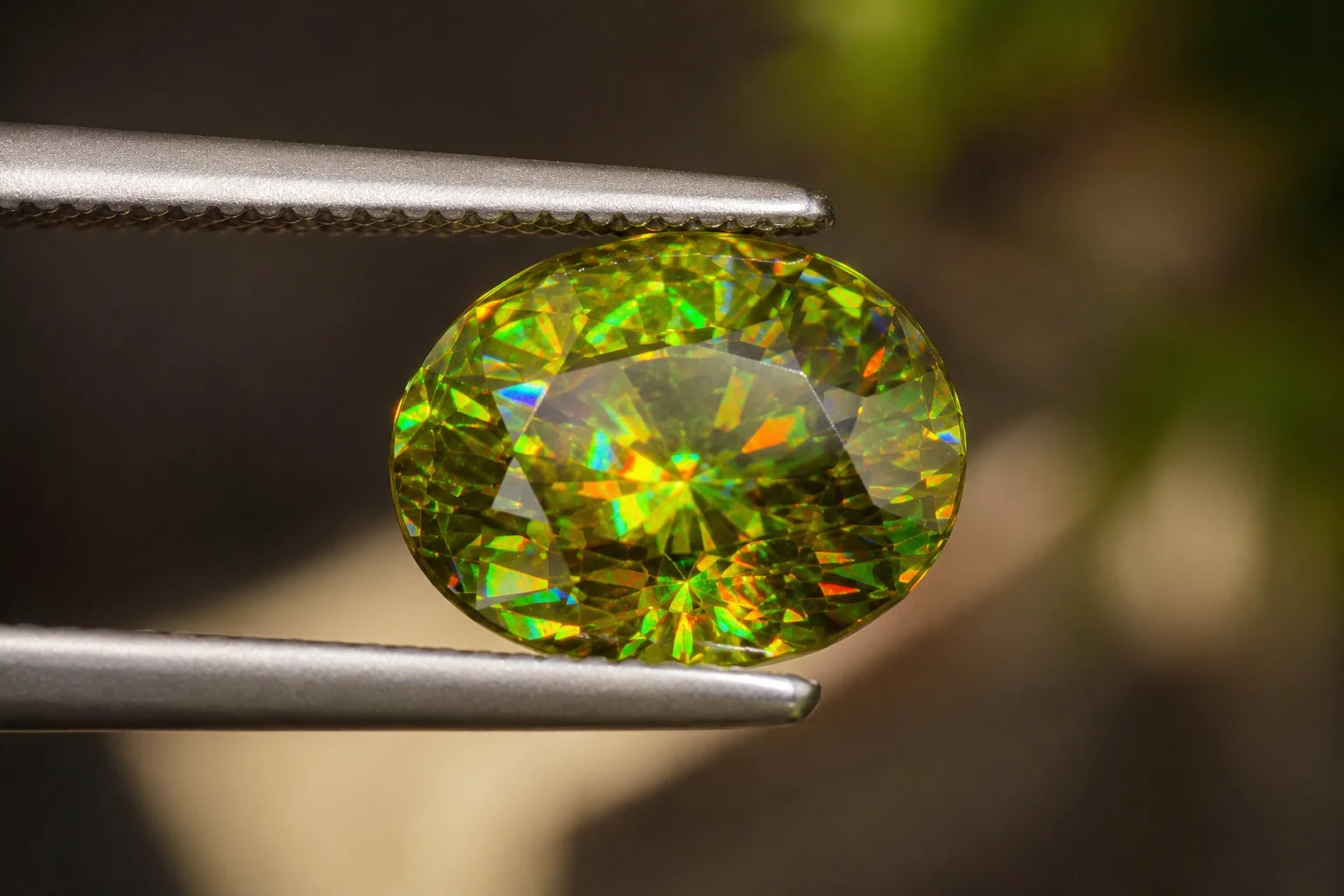
One of the strongest physical influences on sphene meaning is its exceptional dispersion. White light entering a well-cut gem can separate into vivid flashes of red, orange, yellow, green, blue, and violet, creating visual fire that can exceed what many people expect from an unfamiliar gemstone.
Strong birefringence adds another effect. Because light can split into two rays moving differently through the crystal, facet edges and internal features may appear doubled. Looking through one gemstone can therefore reveal more than one visual image of the same structure.
This makes perspective a particularly natural symbol. A situation may appear different after receiving new information even though the underlying facts have not changed.
The gemstone does not create wisdom automatically. Its optics simply provide an unusually clear visual reminder that viewing direction can affect what a person sees.
Green Sphene Meaning and Personal Growth
Green is one of the most desirable sphene colors and is often associated symbolically with growth, learning, nature, renewal, and gradual development. These meanings fit the appearance of vivid yellow-green and green titanite especially well.
Gemologically, color is produced by crystal chemistry rather than emotional energy. Iron and other minor elements influence many titanite colors, while trace constituents can create particularly attractive shades in individual deposits.
A person may choose green sphene to represent a new stage of education, professional development, or a change in personal priorities. The gemstone can become linked with that decision without causing the change itself.
The physical color and the personal interpretation answer different questions. One explains what the eye sees, while the other explains what the owner chooses to remember.
Yellow Sphene Meaning and Curiosity
Yellow sphene naturally invites symbolism involving curiosity, optimism, attention, and intellectual activity. A transparent yellow stone can display especially strong spectral flashes because its bodycolor may allow several rainbow colors to remain visible.
Someone might associate such a gem with beginning a course, conducting research, learning a new skill, or asking better questions before making an important decision. The symbolism can be especially fitting for students, scientists, writers, designers, or collectors who enjoy studying unusual gemstones.
Sphene does not increase memory, intelligence, concentration, or neurological processing speed. Learning still depends on practice, instruction, sleep, repetition, feedback, and experience.
The gemstone can represent curiosity without being treated as a cognitive treatment.
Sphene Meaning and Creativity
Creativity appears frequently in modern sphene meaning because the gemstone can display many colors at once. A single movement under light may reveal several spectral flashes that were invisible only a moment earlier.
Artists and designers may find this visual behavior inspiring because it represents variation, experimentation, and looking at one object in several ways. A person might keep sphene near a workspace to mark the beginning of a creative routine or celebrate the completion of a project.
The stone does not generate ideas through physical contact. Its usefulness is symbolic and aesthetic.
That distinction allows creativity to remain a meaningful part of sphene traditions while keeping neurological claims outside the gemstone’s known properties.
Transformation Without Magical Change
Transformation also fits sphene meaning because rough titanite and a well-cut gem can look dramatically different. Skilled faceting can reveal brightness, rainbow fire, and doubling that may not be obvious in an unpolished crystal.
A person may use this difference as a metaphor for education, practice, or a period of personal change. Abilities often become more visible after time, training, and experience.
The analogy should remain a metaphor. Cutting titanite is a physical process, while human growth develops through choices, relationships, learning, health, circumstances, and time.
Sphene can mark a transformation without causing it.
Titanite Has Real Scientific Importance
Sphene meaning does not have to be spiritual because titanite has genuine importance in geology. Small titanite grains occur in many igneous and metamorphic rocks and can contain uranium, thorium, rare earth elements, and other trace components within their crystal structure.
Researchers can study titanite chemistry and isotopic systems to investigate the ages and thermal histories of rocks. A grain only a fraction of the size of a jewelry gemstone may therefore preserve valuable information about when geological events occurred.
This scientific role makes knowledge and learning especially fitting personal symbols. Titanite literally helps geologists understand the history of rocks.
The “insight” comes from laboratory analysis and careful interpretation rather than secret information stored for spiritual transmission.
Deep Traditions Should Be Separated From True Mineral History
Modern crystal writing sometimes presents sphene as though one continuous ancient tradition assigned it fixed meanings involving manifestation, chakras, spiritual awakening, or psychic ability. Reliable mineral history does not support treating these familiar modern interpretations as one universal ancient belief system.
Titanite was formally described and named for its titanium content in the late eighteenth century. The name sphene was later introduced to reflect its wedge-shaped morphology, and it became established as the familiar gem-trade term.
This real history is enough to make the gemstone interesting. Mineral identification, crystallography, optical study, faceting, and geological research provide a substantial story without requiring invented ancient rituals.
Modern personal symbolism can still be meaningful when it is presented honestly as modern.
Sphene Meaning Through Quality and Cutting
A well-cut sphene can show far more fire than poorly proportioned rough, which makes cutting central to how the gemstone is experienced. Color, transparency, dispersion, facet alignment, polish, inclusions, and durability all influence the final appearance.
The principles behind sphene quality grading therefore help explain why two stones of similar size can look completely different. One may be lively and bright, while another appears dark, windowed, heavily included, or poorly polished.
This creates another useful symbolic lesson: potential and presentation are not the same thing. A gemstone may have strong optical potential, but skilled cutting is needed to reveal it effectively.
That idea can inspire personal reflection without turning the gemstone into a source of supernatural transformation.
Value Does Not Measure Spiritual Strength
The sphene price is influenced by color, transparency, fire, cutting, size, clarity, locality, damage, and collector demand. Fine green stones with strong brilliance can attract substantial interest, while darker or heavily included specimens may be much less expensive.
Commercial value does not measure spiritual importance. A costly stone does not have more personal power than a modest specimen.
One person may care deeply about an inexpensive crystal collected during travel, while another may value a precision-cut gem because it represents years of collecting. Meaning develops from experience rather than price.
This is important because rarity and cost are sometimes incorrectly used as evidence that a gemstone has stronger metaphysical properties.
Buying Sphene Requires Durability Awareness
Anyone planning to buy sphene should understand that exceptional fire comes with physical limitations. Mohs hardness around 5 to 5.5 means harder gems and quartz-bearing dust can scratch polished surfaces, while good cleavage and brittle tenacity increase the risk of damage from impact.
Pendants and earrings are generally easier to protect than exposed rings or bracelets. A carefully designed ring can still work for occasional wear, but it should not be treated like sapphire or spinel.
Magnification can reveal chips, cleavage fractures, scratches, windowing, and polish quality before purchase. This is especially important with larger stones, where repair or repolishing may involve meaningful weight loss.
Realistic expectations protect both the stone and the buyer.
Personal Sphene Meaning Can Be Unique
Sphene meaning does not need to follow one spiritual formula. The gemstone can represent scientific curiosity, education, creative work, a professional milestone, travel, a collection achievement, personal transformation, or simple appreciation of rainbow fire.
A geologist may value titanite because of its research importance. A gem collector may care most about dispersion, while another owner may connect a green sphene with a personal period of growth.
All of these interpretations can coexist without claiming that the mineral forces the same meaning onto every person.
The strongest meaning often develops from the story attached to one particular stone.
Conclusion
Sphene meaning combines titanite mineralogy, wedge-shaped crystals, spectacular dispersion, strong birefringence, geological research value, perspective, creativity, curiosity, learning, and personal transformation. Its most convincing symbolism grows from real optical and geological properties, while its physical identity remains that of a beautiful but comparatively delicate calcium titanium silicate.
FAQs
What does sphene mean?
Sphene meaning commonly includes perspective, creativity, curiosity, learning, transformation, and personal growth in modern gemstone symbolism. These ideas are personal interpretations rather than scientifically established emotional effects.
Is sphene the same as titanite?
Yes. Titanite is the recognized mineral name, while sphene is the widely accepted gem-trade name for gem-quality titanite.
Why is sphene called sphene?
The name comes from a Greek word meaning wedge, referring to the wedge-shaped crystal habit commonly shown by titanite.
Why is sphene associated with perspective?
Strong birefringence can make facet edges and internal features appear doubled, while moving the gemstone changes its rainbow flashes. These real optical effects make perspective an intuitive symbolic theme.
What does green sphene symbolize?
Green sphene may symbolize growth, learning, renewal, curiosity, or personal development in modern traditions. Its physical color comes from mineral chemistry rather than emotional energy.
Does sphene increase intelligence?
No. Sphene has not been shown to increase intelligence, memory, concentration, or neurological processing. It can still represent education or intellectual curiosity as a personal symbol.
Can sphene symbolize transformation?
Yes. The difference between rough titanite and a brilliant faceted gem makes transformation a natural metaphor, although the gemstone does not cause personal change.
Disclaimer: Perspective, creativity, learning, transformation, clarity, healing, chakra, spiritual-awareness, and energetic interpretations of sphene reflect spiritual beliefs and personal practices. Sphene is not a medical or psychological treatment and cannot guarantee cognitive or personal outcomes.