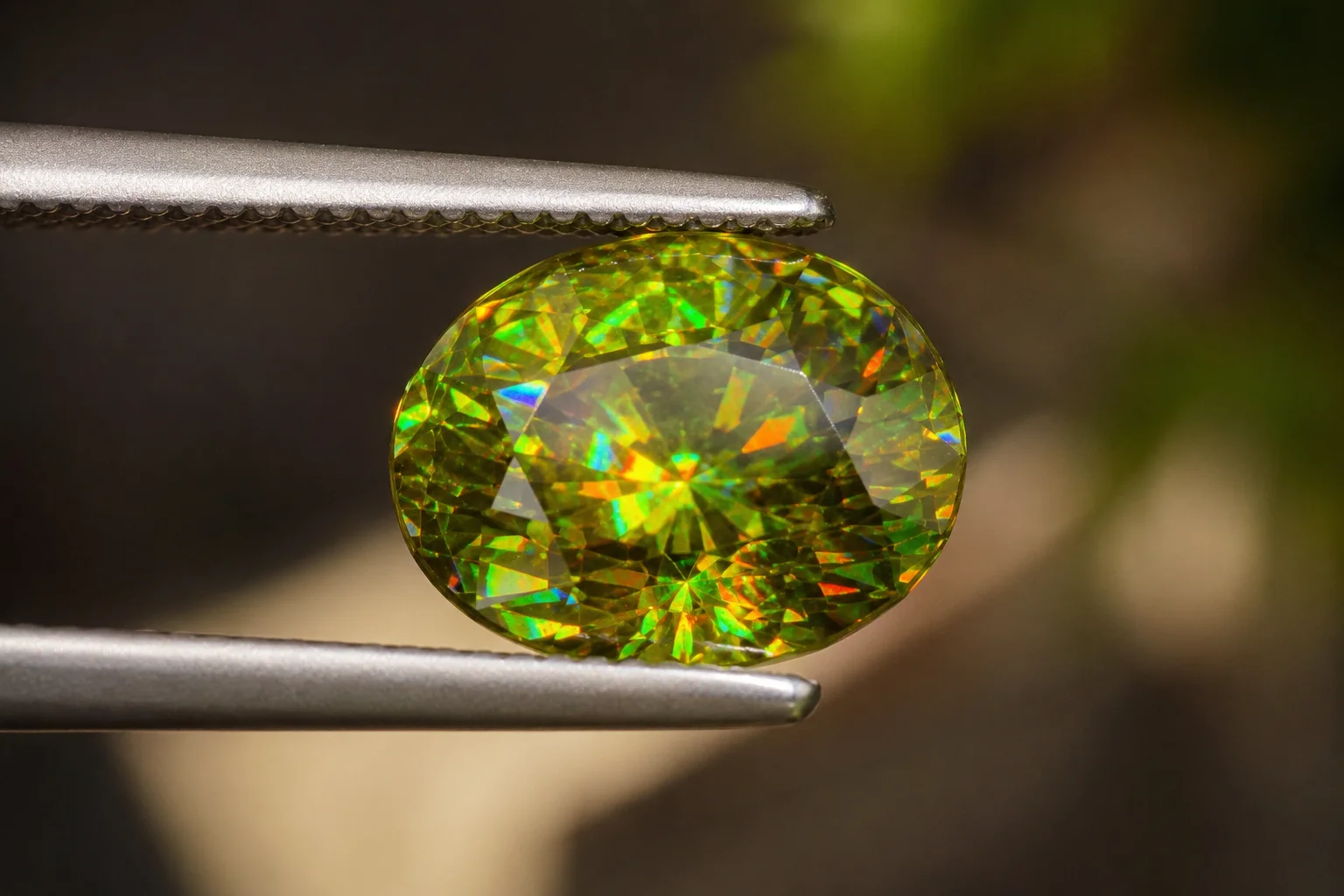
Sphene: Meaning, Properties and Symbolism
Sphene is the traditional gem-trade name for Titanite, a calcium titanium silicate admired for unusually strong dispersion, bright adamantine luster and flashes of doubled facet edges. Fine transparent stones can display more spectral fire than Diamond, although their lower hardness and distinct cleavage make them much less practical for daily jewelry.
The name Titanite is preferred in formal mineralogy, while Sphene remains deeply established among gem dealers, cutters and collectors. Both names refer to the same mineral, and this page serves as the canonical overview for both terms.
Sphene at a Glance
| Property | Sphene |
|---|---|
| Mineralogical name | Titanite |
| Gem-trade name | Sphene |
| Chemical composition | Calcium titanium silicate, CaTiSiO₅ |
| Mineral class | Nesosilicate |
| Crystal system | Monoclinic |
| Typical colors | Yellow, green, yellow-green, brown, orange and reddish brown |
| Crystal habit | Wedge-shaped, tabular or flattened crystals |
| Luster | Adamantine to resinous |
| Transparency | Transparent to opaque |
| Mohs hardness | 5–5.5 |
| Cleavage | Good |
| Tenacity | Brittle |
| Specific gravity | Approximately 3.48–3.6 |
| Notable optical effects | Strong dispersion, high birefringence and pleochroism |
| Main care concern | Scratching, cleavage and impact damage |
Is Sphene the Same as Titanite?
Yes. Sphene and Titanite are two names for the same mineral species.
Titanite refers directly to the mineral’s titanium content and is the preferred scientific name. Sphene comes from a Greek word associated with a wedge, referring to the mineral’s characteristic crystal shape.
Gem dealers often continue to use Sphene because the term is widely recognized in the colored-stone market. Mineral labels, geological reports and scientific publications usually favor Titanite.
The tracker’s alias rules route both names to this page so that the spelling difference does not create competing mineral guides.
Chemical Composition
Sphene has the ideal formula CaTiSiO₅, commonly written structurally as CaTi(SiO₄)O. It contains calcium, titanium, silicon and oxygen.
Natural crystals frequently include iron, aluminum, fluorine and rare-earth elements in minor amounts. These substitutions can influence color and optical behavior.
Iron contributes to many yellow, green and brown shades. Chromium can produce brighter green material in some deposits, while other trace elements create subtler variations.
Titanium appears as an essential structural element rather than as a metallic inclusion. The stone should not be confused with Rutile, Anatase or Brookite, all of which are titanium dioxide minerals with different crystal structures and properties.
Readers comparing titanium-bearing minerals can review Rutile and Anatase.
How Sphene Forms
Titanite occurs as an accessory mineral in many igneous and metamorphic rocks. “Accessory” means it may form in relatively small quantities even when it carries useful geological information.
It can crystallize in granites, syenites and related intrusive rocks. Pegmatites and Alpine-type fissures may produce larger, well-formed crystals.
Metamorphic Titanite develops in gneiss, schist, amphibolite, skarn and calcium-rich rocks altered by heat and chemically active fluids. It may occur with Quartz, Feldspar, Amphibole, Pyroxene, Epidote and Calcite.
Geologists value Titanite because it can incorporate uranium and rare-earth elements while excluding much initial lead. Certain crystals are therefore useful for radiometric dating and for reconstructing the temperature and chemical history of rocks.
Gem-quality transparent material requires a rare combination of suitable color, clarity, crystal size and limited fracturing.
Crystal Habit
Sphene commonly forms flattened, wedge-shaped crystals. The wedge habit inspired its traditional gem name.
Crystals may also appear tabular, prismatic or twinned. Twinning can create re-entrant angles and complex forms that appeal strongly to mineral collectors.
Natural crystal faces often show striations, uneven growth or attached matrix. Sharp, undamaged crystals with documented locality may hold collector value even when they are too included or opaque to facet.
A faceted gemstone removes most obvious evidence of natural crystal habit. Identification must then rely on optical and physical properties rather than shape alone.
Colors
Transparent gem Sphene commonly appears yellow, yellow-green, olive, greenish brown or golden brown. Orange and reddish-brown material also occurs.
Bright green is particularly attractive because the body color contrasts strongly with orange, yellow, red and blue dispersion flashes.
Deep brown stones may show abundant fire under concentrated light but appear dark in normal conditions. Pale yellow material can look brighter, although insufficient body color may reduce contrast with spectral flashes.
Color should be examined under several light sources. Sphene’s pleochroism and dispersion can make the same stone appear noticeably different as it turns.
The green gemstones guide and yellow gemstones guide place Sphene within broader color categories. Brown material appears alongside other options in brown gemstones.
Dispersion and Fire
Dispersion describes the separation of white light into spectral colors. In a well-cut transparent Sphene, this creates flashes of red, orange, yellow, green and blue.
Sphene’s dispersion is greater than Diamond’s, but visible fire depends on more than the numerical property. Body color, clarity, facet proportions, lighting and viewing distance all affect the result.
A dark green or brown stone may conceal some spectral flashes. A bright yellow-green gem with clean facets can show exceptional fire under direct illumination.
Cutters must balance dispersion with the gem’s strong birefringence. Excessively complex faceting may create a visually busy result rather than clean brilliance.
The comparison with Diamond helps illustrate why a higher dispersion value does not automatically make Sphene a more practical or valuable jewelry stone.
Birefringence and Doubled Facets
Sphene has very high birefringence, meaning light entering the crystal splits into two rays traveling at different speeds.
When viewed through a faceted stone, the back facet edges may appear doubled. The effect can be obvious through a loupe and sometimes visible without magnification.
This doubling helps gemologists distinguish Sphene from singly refractive materials such as Garnet and Spinel. However, it can also make facet patterns appear slightly fuzzy.
Cut orientation influences how strongly doubling appears face-up. An experienced cutter attempts to balance brilliance, color and visual sharpness.
Pleochroism
Pleochroism refers to different colors visible along different crystal directions.
Strongly colored Sphene may show combinations of yellow, green, orange, brown or reddish tones as the stone rotates. The effect is usually clearer in transparent material and under controlled lighting.
Pleochroism is different from color change. A pleochroic stone shows directional colors, whereas a color-change gem shifts because the light source changes.
Collectors may appreciate strong pleochroism, while cutters orient the rough to present the most attractive face-up combination.
Hardness and Cleavage
Sphene ranks only 5–5.5 on the Mohs scale. Quartz-rich dust, ordinary household abrasives and many common gemstones can scratch it.
Its good cleavage creates an additional vulnerability. A blow from the wrong direction can cause the stone to split or lose an edge.
Sphene is also brittle, so hardness alone does not describe its durability. Even a clean stone may chip if it strikes a hard surface.
These properties explain why Sphene is primarily a collector gem. Jewelry remains possible, but design and lifestyle need to account for its limitations.
Is Sphene Suitable for Jewelry?
Pendants, earrings and brooches are the safest formats because they receive relatively little impact.
A Sphene ring should be considered occasional-wear jewelry. A low bezel or protective halo is preferable to an exposed, high prong setting.
Bracelets present considerable risk because they strike desks and surrounding objects. Faceted Sphene beads are also uncommon and would rub against one another.
The gem should be removed before exercise, cleaning, cooking, gardening and manual work. Even routine jewelry-box contact with Quartz or Sapphire can scratch it.
The dedicated guide to cleaning Sphene jewelry covers conservative handling in more detail.
Cutting Challenges
Cutting Sphene requires skill because the rough combines low hardness, cleavage, brittleness, high birefringence and strong dispersion.
A cutter must orient the stone to manage color and pleochroism while avoiding cleavage-related failure. Heat from polishing must remain controlled.
Ovals, cushions, rounds and modified brilliant cuts are common. Fancy cuts may reveal spectacular fire, although thin points and corners increase risk.
Facet edges can abrade more readily than those of Sapphire or Spinel. A freshly polished Sphene should show crisp junctions rather than a worn or frosted surface.
A windowed center reduces color and brilliance, while excessive depth may make the stone look dark and small for its weight.
Important Localities
Gem-quality Sphene has come from Madagascar, Pakistan, Brazil, Russia, Mexico and several other countries.
Madagascar is known for yellow-green and green material with strong fire. Pakistan’s mountainous regions have produced transparent yellow, green and brown crystals, including collector specimens.
Brazil supplies both mineral crystals and facetable rough. Russia is associated with attractive green material, including stones historically marketed as chrome-bearing Sphene.
Canada, particularly Ontario, is known for Titanite crystals of mineralogical interest. Additional occurrences are documented throughout Europe, Africa, Asia and the Americas.
Locality should be supported by records rather than inferred from color. Similar-looking material can emerge from several geological settings.
Sphene Meaning and Symbolism
Modern crystal traditions associate Sphene with learning, mental organization, transformation and the ability to connect separate ideas.
Its intense dispersion encourages symbolic links with seeing multiple possibilities within one situation. The wedge-shaped crystal habit is sometimes interpreted as a symbol of direction or focused movement.
Some practitioners use Sphene as a reminder to remain curious rather than defend an outdated assumption. Others connect its titanium content symbolically with strength and purposeful change.
These meanings are modern cultural interpretations. They do not arise from scientifically demonstrated effects on cognition, emotions or physical health.
Spiritual Uses
A collector may keep a natural Titanite crystal near books, research materials or a creative workspace. The object can represent intellectual curiosity without needing to be carried or worn.
During reflection, a person might rotate a faceted Sphene under light and consider how one issue changes when viewed from several perspectives.
Its fragility makes elaborate handling rituals unnecessary. A protected display or short seated meditation presents less risk than carrying a faceted stone loosely in a pocket.
The broader guide to healing crystals explains how symbolic crystal practices differ from evidence-based medical treatment.
Identification
Sphene’s combination of strong dispersion, pronounced doubling, high refractive appearance and relatively low hardness is distinctive.
Under magnification, doubled back facets provide an important clue. The stone may also show strong pleochroism and an adamantine or resinous luster.
A professional gemologist can use refractive index, birefringence, spectroscopy, specific gravity and microscopic features to confirm identity.
Scratch testing is inappropriate for a valuable Sphene because the gem is soft enough to damage easily.
The general guide to identifying crystals explains why identification should combine several observations.
Sphene Versus Demantoid Garnet
Green Sphene and Demantoid Garnet can both show high luster and strong fire.
Demantoid is singly refractive, so it does not display the pronounced facet doubling seen in Sphene. It also belongs to the Garnet group and generally offers greater hardness.
Sphene commonly shows yellow-green, olive or brown modifiers and stronger birefringence. Demantoid may contain characteristic horsetail inclusions, although their absence does not disprove identity.
The dedicated Sphene versus Demantoid Garnet comparison provides the complete side-by-side identification process. The Demantoid Garnet meaning guide covers the comparison stone’s broader identity.
Other Lookalikes
Green Peridot is usually less dispersive and has different refractive properties. Its color tends to remain within a narrower yellow-green to olive range.
Zircon can show doubling and strong dispersion, but it has different density, refractive values and crystal structure.
Sphalerite may exhibit exceptional dispersion and yellow-to-brown colors. It is softer, chemically different and often even less suited to jewelry.
Green Tourmaline can be pleochroic but lacks Sphene’s extreme doubling and distinctive fire.
Yellow or brown Topaz is harder and has perfect cleavage in a different structural direction.
Professional testing remains the safest approach when appearance and value matter.
Treatments
Most Sphene is sold without routine color treatment. Its natural dispersion and body color are the principal attractions.
Coatings, filling or misleading descriptions are still possible in the wider gem market. A seller should disclose any known enhancement.
Because the stone is sensitive to heat and mechanical stress, treatment and repair histories matter. A repaired or filled stone may require even more conservative care.
The Sphene buying guide covers disclosure, seller questions and laboratory documentation. Current market factors belong in the Sphene price guide.
Value Factors
Color, transparency, cutting and size drive value. Bright green and yellow-green stones with visible fire are particularly desirable.
Clarity matters because inclusions and fractures can reduce brilliance and structural safety. However, a small internal inclusion may be acceptable when the stone remains lively.
Cut is critical. Strong dispersion cannot compensate fully for severe windowing, poor symmetry or damaged facet edges.
Large clean gems are uncommon. Price can rise quickly when size increases without sacrificing color or transparency.
Collector crystals are evaluated differently. Crystal shape, twinning, condition, matrix association and locality may matter more than faceting potential.
Care and Storage
Use lukewarm water, a very small amount of mild soap and a soft cloth or brush. Avoid soaking.
Steam and ultrasonic cleaners are unsuitable because heat, vibration and existing fractures can damage the gem.
Do not expose Sphene to acids, abrasive compounds or sudden temperature changes. Jewelry repair should be performed by someone who understands the stone’s cleavage and heat sensitivity.
Store each piece alone in a padded compartment. Harder stones, including Quartz, Spinel, Topaz, Garnet, Sapphire and Diamond, can scratch it.
Sphene appears in the crystals beginning with S and gemstones beginning with S directories. Related color references include green crystals and yellow crystals.
Final Perspective
Sphene offers an optical combination few gems can match: adamantine luster, strong pleochroism, obvious birefringence and dispersion greater than Diamond’s. Those qualities make a fine stone visually extraordinary.
Its fragility is equally important. Sphene is best appreciated as a collector gem, carefully protected pendant or occasional-wear jewel rather than a carefree everyday stone. Understanding both sides of the material preserves its beauty without exaggerating its practicality.
Frequently Asked Questions
1. Is Sphene the same as Titanite?
Yes. Titanite is the preferred mineralogical name, while Sphene remains the established gem-trade name.
2. What is Sphene made of?
It is calcium titanium silicate with the formula CaTiSiO₅.
3. Why is Sphene so sparkly?
It has very strong dispersion, separating white light into vivid spectral colors. High luster and a well-proportioned cut enhance the effect.
4. Does Sphene have more fire than Diamond?
Its numerical dispersion is greater than Diamond’s. Visible fire still depends on body color, clarity, cut and lighting.
5. Why do Sphene’s facets look doubled?
The mineral has high birefringence, which splits light into two rays and can make back facet edges appear doubled.
6. Is Sphene suitable for daily rings?
Generally not. Its hardness of 5–5.5, good cleavage and brittleness make exposed daily rings risky.
7. Which jewelry formats are safest?
Pendants, earrings and brooches provide the lowest impact exposure. Rings should have protective settings and be worn occasionally.
8. What colors can Sphene be?
Common gem colors include yellow, yellow-green, green, brown, orange and reddish brown.
9. Where is gem-quality Sphene found?
Notable material has come from Madagascar, Pakistan, Brazil, Russia, Mexico and several other countries.
10. Is green Sphene the same as Demantoid Garnet?
No. They are different minerals. Sphene is doubly refractive and softer, while Demantoid is a singly refractive Garnet.
11. Is Sphene normally treated?
Most is sold without routine treatment, but buyers should still request written disclosure for significant purchases.
12. How should Sphene be cleaned?
Use lukewarm water, mild soap and very gentle handling. Avoid steam, ultrasonic cleaning, abrasives and sudden temperature changes.
Sphene’s associations with learning, transformation and mental clarity come from modern spiritual traditions and are not scientifically established health effects. The gem is soft, brittle and cleavage-prone, so handle it carefully and do not use crystal practices in place of professional healthcare.