10 Hidden Sphene Benefits: Helpful Traditions, Verified Facts, Safe Limits
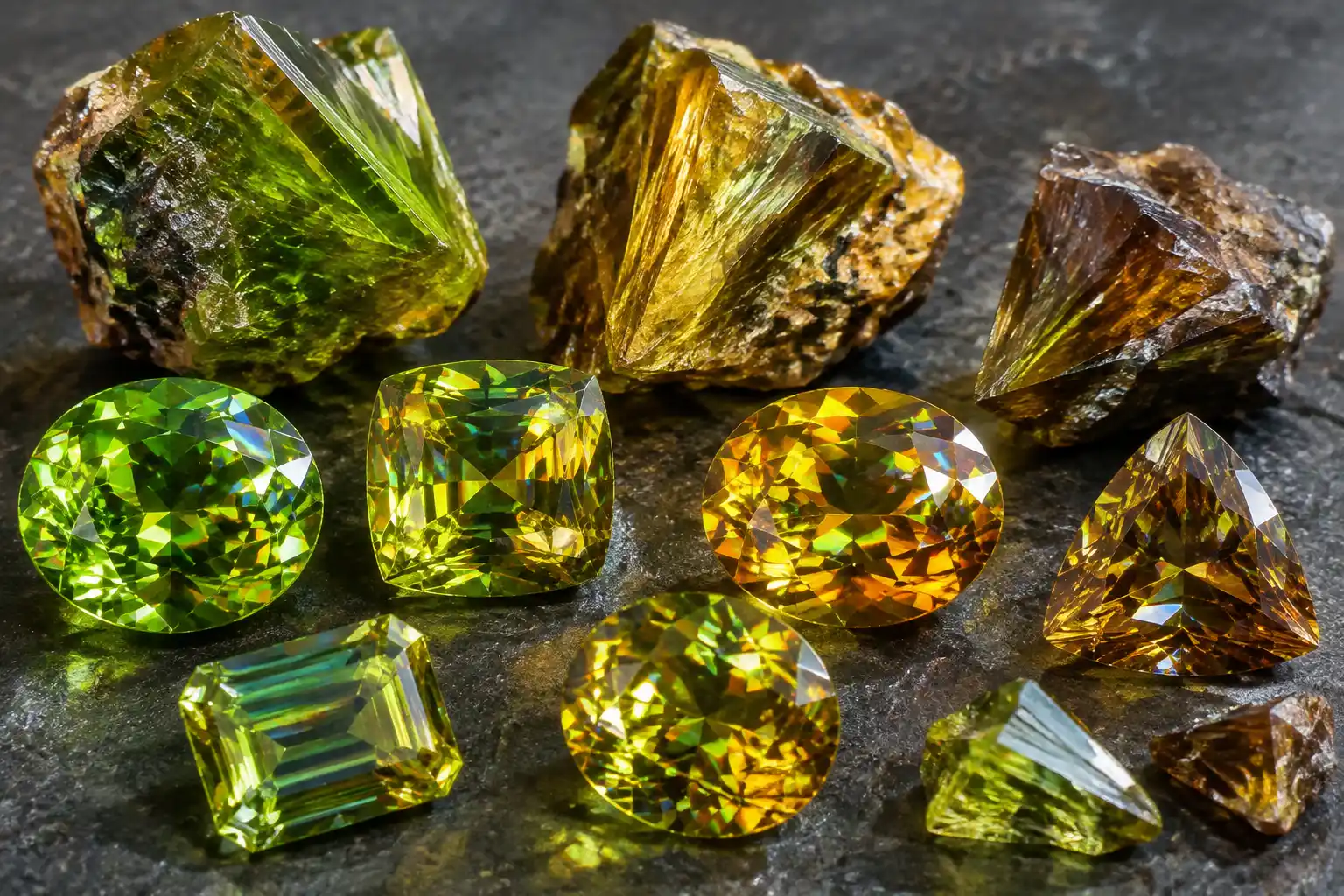
Sphene benefits begin with one of the most optically dramatic collector gemstones in the mineral world. Sphene is the widely accepted gem-trade name for titanite, a calcium titanium silicate with the formula CaTiSiO5. Titanite crystallizes in the monoclinic system, frequently develops distinctive wedge-shaped crystals, and can appear yellow, green, yellow-green, orange, brown, gray, reddish, or nearly colorless.
Its most famous gemological feature is extraordinary fire. Sphene has very high dispersion, a high refractive index, and strong birefringence, so a carefully cut transparent stone can show vivid spectral flashes together with visible doubling of facet edges. GIA continues to use sphene as the familiar gemstone name while noting that mineralogists generally call the species titanite.
These optical advantages come with durability limits. Titanite is only about 5 to 5.5 on the Mohs scale, is brittle, and has good cleavage, which means fine gems need more protection than quartz, garnet, spinel, sapphire, or ruby. Modern traditions may associate sphene with creativity, clarity, confidence, learning, and personal transformation, but those ideas should remain separate from medical or neurological claims.
10 Sphene Benefits at a Glance
The ten points below combine real gemological value with responsible personal symbolism. Sphene is impressive enough on its physical properties alone, so its spiritual appeal does not need exaggerated claims.
- Exceptional dispersion produces intense rainbow fire in transparent, well-cut gems.
- High refractive index gives sphene strong brilliance and bright facet reflections.
- Strong birefringence can create visible doubling of facet edges and internal features.
- Yellow, green, orange, and brown colors provide attractive variety for collectors and jewelry.
- Wedge-shaped natural crystals give titanite distinctive mineralogical character.
- Titanium-rich silicate chemistry makes sphene useful for mineral and geological study.
- Accessory titanite in igneous and metamorphic rocks can preserve valuable geological information.
- Modern creativity and clarity symbolism can support reflective routines without implying neurological effects.
- Mohs hardness of only about 5 to 5.5 teaches why brilliance and durability must be judged separately.
- Careful setting, cleaning, storage, and buying decisions allow sphene to be enjoyed without ignoring its cleavage and brittle tenacity.
Sphene Is Titanite
One of the most important sphene benefits is educational because two familiar names refer to the same mineral species. Titanite is the recognized mineral name, while sphene remains the generally accepted gemstone name in the gem trade. The name titanite refers to the mineral’s titanium content, whereas sphene comes from the Greek word for wedge, describing the common wedge-shaped crystal form.
Titanite has the formula CaTiSiO5 and crystallizes in the monoclinic system. It commonly contains minor iron, aluminum, fluorine, and other elements that can influence color and optical properties. Natural crystals may be sharply wedge-shaped, flattened, twinned, or embedded as accessory minerals in igneous and metamorphic rocks.
Understanding this identity prevents a common mistake in gemstone marketing. Sphene is not a separate species with different chemistry from titanite. It is the gemstone name used for transparent to translucent titanite suitable for cutting or ornamental use.
Sphene Technical Properties
The table below shows why sphene can be visually spectacular while remaining a gemstone that needs careful wear.
| Property | Sphene / Titanite |
|---|---|
| Ideal formula | CaTiSiO5 |
| Crystal system | Monoclinic |
| Mohs hardness | About 5–5.5 |
| Cleavage | Good |
| Tenacity | Brittle |
| Typical luster | Adamantine to resinous |
| Typical colors | Yellow, green, yellow-green, orange, brown, gray |
| Optical character | Strongly doubly refractive |
| Famous feature | Very high dispersion and rainbow fire |
| Natural crystal habit | Commonly wedge-shaped |
| Jewelry suitability | Protected occasional wear and collector jewelry |
This combination explains the central trade-off in sphene. The gemstone can produce extraordinary color flashes and brilliance, but it cannot tolerate the same level of abrasion and impact as harder stones.
Exceptional Dispersion Creates Sphene’s Famous Fire
The strongest visual sphene benefit is dispersion. White light entering the gem separates into its component colors, and sphene can display vivid flashes of red, orange, yellow, green, blue, and violet when facet angles and transparency allow the effect to develop.
GIA describes sphene as well known for exceptional fire caused by high dispersion. A recent 6.28 ct yellow specimen displayed strong spectral colors together with pronounced eye-visible doubling, demonstrating how several optical features can interact in one stone.
Bodycolor influences how easily the fire can be seen. A light yellow or yellow-green stone may reveal spectral flashes readily, while an extremely dark brown or heavily included stone can absorb enough light to reduce the effect.
Cut quality matters just as much. A well-proportioned gem can return light efficiently, while poor angles may create windowing, dark zones, or weak brilliance even when the rough had strong optical potential.
High Refractive Index Gives Sphene Strong Brilliance
Sphene also benefits from a high refractive index, which increases the amount of light reflected from polished facets and contributes to a bright, lively appearance. Combined with high dispersion, this can make even a relatively small transparent stone appear visually active.
Strong luster is particularly noticeable on well-polished facet surfaces. A poor polish can reduce brilliance because microscopic scratches scatter light rather than returning it cleanly to the observer.
The principles behind sphene quality grading therefore need to include color, transparency, cutting, polish, dispersion, inclusions, durability, and overall appearance. A saturated green stone may be attractive for color, while a lighter yellow gem may show stronger fire.
No single quality factor should be judged alone because sphene’s visual appeal comes from the interaction between several properties.
Strong Birefringence Produces Visible Doubling
Sphene is strongly doubly refractive. Light entering the crystal can split into two rays traveling at different speeds, and this difference can become large enough that facet edges or internal inclusions appear doubled when viewed through the stone.
Visible doubling is an important identification clue. Under magnification, back-facet junctions may look as though they occur twice, especially in stones cut in favorable orientations.
This effect should not be mistaken for poor cutting or double vision in the observer. It arises from the crystal’s anisotropic optical structure.
For students, this is one of the most useful sphene benefits because it turns an abstract gemological concept into something that may be visible directly through the gemstone.
Green and Yellow Sphene Offer Strong Color Appeal
Gem-quality sphene commonly appears yellow, yellow-green, green, orange, or brown. Minor iron and other chemical substitutions influence the final color, while chromium can contribute attractive green shades in some specimens.
Human color symbolism naturally affects modern interpretations. Green may suggest growth, learning, renewal, or nature, while yellow can suggest optimism, curiosity, confidence, or intellectual activity.
These symbolic ideas should remain separate from mineral chemistry. Color does not prove that one sphene activates a specific chakra or changes emotional state more strongly than another.
A person can still prefer green sphene because the color feels personally meaningful. Aesthetic preference is enough reason to choose a gemstone without creating a medical mechanism for it.
Wedge-Shaped Crystals Give Sphene a Distinctive Identity
The word sphene comes from a Greek term meaning wedge, referring to the wedge-like shape frequently shown by titanite crystals. This crystal habit gives natural specimens a recognizable appearance even before cutting.
Collectors often value sharp crystal form, twinning, luster, transparency, associated minerals, locality, and condition. A natural wedge-shaped crystal may therefore be more desirable to a mineral collector than a piece of transparent rough intended for faceting.
This creates two different ways to appreciate sphene. Jewelry collectors may focus on fire and color, while mineral collectors may value crystallography and provenance.
Neither use is inherently superior. The right choice depends on why the specimen is being collected.
Titanite Is Valuable in Geological Research
Titanite is not important only because transparent crystals can be faceted. It occurs as an accessory mineral in many igneous and metamorphic rocks, including granites, syenites, gneisses, schists, and related geological settings.
Its crystal structure can incorporate uranium, thorium, rare earth elements, and other trace components. Because of this, titanite can be useful in geochronology and studies of metamorphic or magmatic history when analyzed with specialized laboratory methods.
A small grain inside a rock may therefore carry scientific information that far exceeds its visual importance. Geologists can study titanite chemistry and isotopic systems to investigate when rocks formed or changed.
This is one of the most significant real sphene benefits from a scientific viewpoint. The gem trade values fire, while geology values the mineral as a recorder of Earth processes.
Creativity as a Helpful Modern Symbol
Creativity is one of the most common modern symbolic sphene benefits because the gemstone can display so many colors at once. A single faceted stone may flash red, yellow, green, and blue as it moves, making artistic expression and imaginative thinking natural personal associations.
A writer, designer, artist, musician, or student may keep sphene nearby as a reminder to begin work, experiment with an idea, or look at a problem from another angle. The useful part of the ritual lies in the behavior that follows.
Sphene does not neurologically generate ideas or increase creativity through titanium or calcium absorption. Its chemistry remains locked inside the mineral structure during ordinary handling.
The symbolism can still be useful because an unusual gemstone may become associated with a creative routine that the owner deliberately repeats.
Clarity and Learning Without Cognitive Claims
Clarity and learning also appear frequently in modern sphene traditions. Strong brilliance and multiple spectral colors can make the gem feel visually sharp and mentally stimulating, which explains why some people connect it with concentration, study, or intellectual curiosity.
A practical interpretation might involve wearing sphene during an examination period or keeping a collector gem near a study area as a reminder to begin a planned session. The stone does not increase IQ, memory, attention span, or processing speed.
Learning still depends on repetition, sleep, practice, instruction, feedback, and appropriate study methods. A gemstone may support a routine symbolically, but it should not replace the actions that actually develop knowledge.
This keeps clarity symbolism useful without turning titanite into a neurological treatment.
Personal Transformation Through Changing Light
Transformation is another intuitive sphene benefit because the gemstone’s appearance changes significantly as it moves. Different facets catch light, spectral flashes appear and disappear, and doubled internal features may become more or less visible according to viewing angle.
A person may use that behavior as a metaphor for changing perspective. One situation can look different after new information appears even though the underlying facts remain the same.
The sphene meaning can therefore include growth, learning, adaptability, and personal transformation without claiming that the stone forces those changes.
As with other symbolic uses, the gem becomes a reminder. The actual development comes from choices, circumstances, experience, and time.
Durability Is the Main Limit for Jewelry
Sphene’s low hardness compared with common jewelry gems is one of the most important practical limits. At about 5 to 5.5 on the Mohs scale, it can be scratched by quartz-rich dust and by many gemstones stored beside it.
Good cleavage and brittle tenacity add further risk. A direct impact can chip or split a stone even if the surface previously appeared flawless.
Pendants and earrings are generally easier to protect than rings or bracelets. A ring can still be made, especially for occasional wear, but protective settings and careful habits are essential.
This is why visual beauty should never be confused with toughness. Sphene can outperform many gems in fire while remaining far less suitable for rough daily wear.
Sphene Price Depends on More Than Carat Weight
Fine transparent sphene is uncommon enough that value can rise significantly when attractive color, strong fire, large size, good cutting, and limited damage occur together. The sphene price can therefore vary greatly between dark included stones and bright transparent gems.
Green stones often attract strong demand, but color preference is only one factor. A yellow gem with exceptional fire and precision cutting can be more visually impressive than a darker green stone that absorbs much of the incoming light.
Large clean stones deserve careful inspection because inclusions, cleavage fractures, and edge damage can influence both durability and value. Provenance may also matter to collectors when a gem comes from a recognized locality.
Commercial value remains separate from spiritual symbolism. A higher price does not indicate stronger metaphysical energy.
Buying Sphene Requires Careful Inspection
Anyone planning to buy sphene should inspect the stone under good lighting and magnification when possible. Color, fire, facet doubling, clarity, chips, cleavage fractures, polish, windowing, and setting security all deserve attention.
The name titanite may appear on mineral labels while sphene appears on jewelry descriptions, so buyers should understand that both names refer to the same species. A seller using one term instead of the other is not automatically describing a different gemstone.
Very inexpensive large “sphene” with unusually perfect clarity should receive extra scrutiny. Professional identification becomes more valuable when a stone is costly, unusually large, or sold with strong claims about rarity or origin.
Safe Cleaning and Storage
Warm water, mild soap, and a very soft cloth are appropriate for most clean, sound sphene. Aggressive scrubbing is unnecessary because the polished surface can scratch more easily than quartz or garnet.
Ultrasonic cleaners are not a good default choice for stones with cleavage, fractures, or significant inclusions, and steam should be avoided when the internal condition is uncertain. Sudden temperature changes are also unnecessary.
Separate storage is especially important. Quartz, topaz, garnet, spinel, sapphire, ruby, and diamond can all scratch sphene if pieces rub against one another.
A padded compartment or individual pouch helps preserve facet edges and polish, allowing the optical beauty to remain visible for much longer.
Conclusion
Sphene benefits include exceptional rainbow fire, high refractive index, strong birefringence, distinctive wedge-shaped titanite crystals, attractive yellow and green colors, geological research value, and strong collector appeal. Creativity, clarity, learning, and transformation can provide meaningful personal symbolism, but sphene remains a soft, brittle, cleavable gemstone whose real physical limits should shape how it is worn, cleaned, stored, and valued.
FAQs
What are the main sphene benefits?
Sphene benefits include exceptional dispersion, strong brilliance, visible birefringence, attractive green and yellow color, collector appeal, distinctive titanite crystals, and important geological research value. Modern traditions also connect it with creativity, clarity, learning, and transformation.
Is sphene the same as titanite?
Yes. Titanite is the recognized mineral name, while sphene is the familiar gem-trade name for transparent or attractive titanite used as a gemstone.
Why is sphene called sphene?
The name comes from a Greek word meaning wedge because titanite frequently develops wedge-shaped crystals.
Why does sphene show so much rainbow fire?
Sphene has very high dispersion, which separates white light strongly into spectral colors. Good transparency and skilled cutting allow the effect to become especially visible.
Is sphene durable?
Sphene is only about Mohs 5 to 5.5, is brittle, and has good cleavage. It can be used in jewelry, but protected occasional wear is safer than demanding everyday use.
Is green sphene valuable?
Fine transparent green sphene can be highly desirable, especially when it combines attractive color, strong fire, good cutting, useful size, and limited damage. Value still depends on the complete quality of the individual gem.
Does sphene improve creativity?
There is no scientific evidence that sphene changes neurological creativity. A person may use it symbolically as a reminder to begin, experiment, or approach a problem differently.
Does sphene improve mental clarity?
Sphene has not been shown to increase concentration, intelligence, memory, or processing speed. It can still be part of a study or reflective routine as a personal symbol.
Is sphene suitable for everyday rings?
It is not an ideal choice for rough everyday ring wear because of its modest hardness, brittleness, and cleavage. Pendants, earrings, or carefully protected occasional rings are generally easier to preserve.
Can sphene have personal meaning?
Yes. Sphene can represent creativity, learning, scientific curiosity, travel, a collection milestone, career growth, or an important transition. Personal symbolism does not require one universal metaphysical explanation.
Disclaimer: Creativity, clarity, learning, transformation, healing, chakra, confidence, and energetic descriptions of sphene reflect spiritual beliefs and personal practices. Sphene is not a medical or psychological treatment and should not replace professional healthcare.