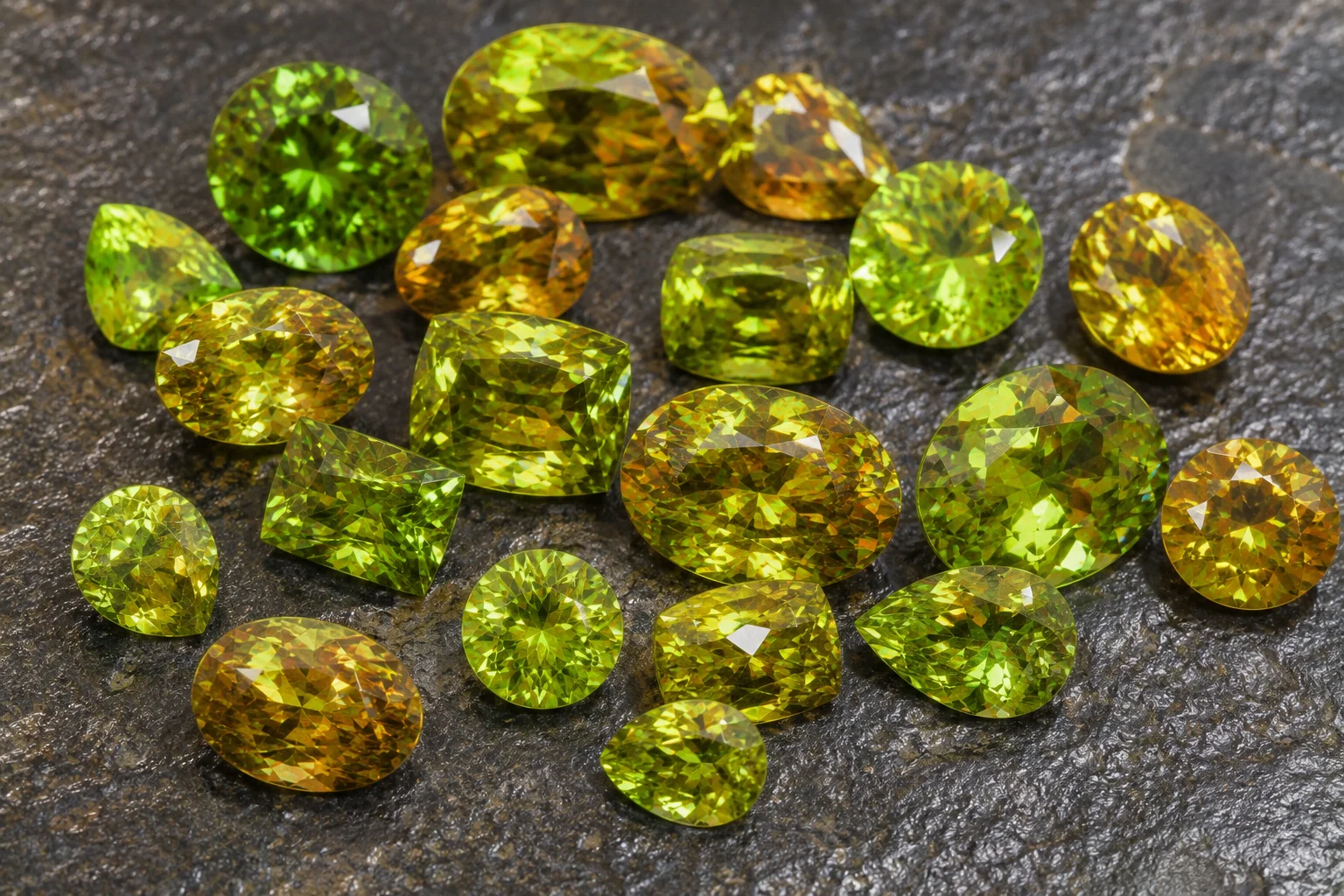
Buy Sphene: Quality & Authenticity, Value Factors & Seller Claims
To buy sphene intelligently, begin by understanding that sphene and titanite refer to the same mineral, CaTiSiO₅, and that the material’s extraordinary optical performance is one of its defining attractions. GIA describes sphene as the gem name commonly used for titanite and notes that yellow, green, orange, and brown are typical colors, while well-cut transparent stones can display intense fire because of their high dispersion together with conspicuous facet doubling caused by strong double refraction. A recent GIA examination of a 6.28 ct yellow sphene documented both remarkable fire and obvious eye-visible doubling, illustrating why fine sphene can look more optically animated than many better-known gemstones.
Gemdat gives titanite a dispersion of approximately 0.051, higher than diamond’s roughly 0.044, which helps explain the spectral flashes that make fine sphene distinctive even when its bodycolor is comparatively restrained. The buying challenge is that this optical beauty comes in a mineral with only moderate hardness, brittle tenacity, and good cleavage, so color and fire must be evaluated together with structural condition and realistic jewelry use rather than treating sphene like sapphire, spinel, or garnet.
Buy Sphene At a Glance
| Buying Factor | What to Inspect | Why It Matters |
|---|---|---|
| Identity | Titanite/sphene confirmed gemologically | Visual appearance can overlap with other yellow-green gems |
| Color | Green, yellow-green, golden-yellow, orange, brown | Color strongly affects desirability |
| Saturation | Lively visible color without muddy brown | Stronger clean color generally attracts more demand |
| Transparency | Transparent faceting material | Fine fire is best displayed in transparent stones |
| Dispersion | Strong rainbow fire during movement | One of sphene’s defining optical attractions |
| Doubling | Visible doubled facet edges | Normal result of strong birefringence, not poor cutting |
| Clarity | Healed fissures, crystals, clouds, twin planes | Inclusions can affect transparency and durability |
| Cut | Brilliance, symmetry, limited windowing | Precise cutting unlocks fire and color |
| Carat Weight | Size together with transparency and cut | Large gems exist, so weight alone is not extreme rarity |
| Color Change | Genuine lighting-dependent shift where present | Vanadium-bearing material can show color change |
| Treatment | Ask about heating and other known modification | Heating to red/orange has been reported |
| Durability | Mohs about 5–5.5, brittle, good cleavage | Requires careful setting and wear |
| Origin | Madagascar, Pakistan/Afghanistan, India, Mexico, others | Provenance can interest collectors but does not replace quality |
| Condition | Chips, scratches, cleavage damage, polish | Important because sphene is relatively soft and brittle |
| Documentation | Independent identification for significant purchases | Useful for rare color, origin, or high-value stones |
Sphene and Titanite Are the Same Gem Material
Mineralogists generally use titanite, while the jewelry and gemstone trade has long used sphene, a name derived from the Greek word for wedge in reference to the mineral’s characteristic crystal shape. GIA explicitly describes sphene as better known mineralogically as titanite and gives the formula CaTiSiO₅, while Gemdat treats sphene as the traditional gem name for titanite. Buyers should therefore not pay extra simply because a seller presents sphene and titanite as two different grades or supposedly distinct minerals. A faceted stone advertised as “premium titanite, rarer than sphene” is using terminology rather than mineralogy to create artificial differentiation. The meaningful questions concern color, transparency, fire, cutting, size, treatment, structural condition, and documentation.
Fire Is One of Sphene’s Strongest Quality Signals
Fine sphene is famous for unusually strong dispersion, the optical property that separates white light into spectral colors. Gemdat places titanite’s dispersion around 0.051, above diamond’s approximately 0.044, while GIA repeatedly describes sphene as notable for intense fire. This does not mean every sphene automatically looks more brilliant than every diamond because bodycolor, transparency, cut, tone, inclusions, polish, and lighting determine how much dispersion is actually visible. A transparent yellow-green or golden stone cut with well-designed pavilion angles can erupt with red, green, orange, and blue flashes as it moves, whereas an overly dark, heavily included, or windowed stone may suppress much of the same intrinsic optical potential. When buying online, request movement video under a small directional light as well as diffuse neutral lighting so you can judge both spectral fire and the actual bodycolor honestly.
Strong Doubling Is Normal and Can Help Confirm the Visual Character
Sphene is strongly doubly refractive, and GIA notes that eye-visible doubling of pavilion facet edges can be conspicuous in faceted material. This effect can make the internal facet pattern appear slightly doubled or fuzzy when viewed through the crown, particularly in larger transparent stones. Buyers unfamiliar with sphene sometimes mistake this characteristic for poor polishing, cracking, or defective cutting, but the phenomenon is inherent to the material’s birefringence. Cutting quality still matters greatly, yet a fine sphene may retain obvious doubling even when polished superbly. The most successful stones balance this characteristic with bright light return and strong dispersion so the doubling contributes to an animated optical appearance rather than simply making the gem look hazy.
Green and Yellow-Green Sphene Can Be Especially Desirable
Sphene occurs in a broad yellow-to-green-to-brown spectrum, and fine green material attracts strong collector interest because clean green is less common than the more typical yellowish-brown or olive range. Historical GIA field reporting from Madagascar described northern Madagascar as an important source of large facet-grade sphene and specifically noted that “pure” green was the rarest color among the material examined, with yellowish-brown and intermediate green shades more common. A fine green gem should remain lively rather than so dark that its brilliance disappears, and the strongest specimens combine transparent bodycolor with enough yellow or green saturation to complement the stone’s rainbow fire. Buyers should therefore distinguish genuinely clean green from dark olive-brown material photographed under green-enhancing backgrounds or lighting.
Yellow and Golden Sphene Can Offer Exceptional Fire
Yellow and golden sphene can be visually spectacular because the lighter bodycolor allows dispersion to remain highly visible. GIA’s documentation of Afghan sphene describes transparent brownish-yellow to greenish-yellow stones showing strong dispersion with prominent red and green flashes, and the material was compared visually with yellow diamond because of its bright color and fire. A rich golden or yellow-green stone can consequently provide outstanding optical performance without needing the rarer pure-green appearance. The buyer should focus on whether yellow looks bright and clean rather than muddy or heavily brown, whether the stone remains transparent, and whether the cutter has preserved enough light return to show the fire that makes sphene distinctive.
Brown and Olive Modifiers Are Not Automatically Poor Quality
Titanite naturally occurs in brown, brownish yellow, olive, yellow-green, and orange as well as cleaner green and yellow colors. GIA describes yellow, green, orange, and brown as normal sphene colors, so a warm olive or cognac-like stone can be entirely natural and attractive. The commercial discount generally appears when brown becomes sufficiently strong to suppress brilliance or make the gem look muddy rather than because brown is mineralogically abnormal. Buyers who prefer autumnal colors can therefore find excellent value in olive-green or brownish-yellow sphene, especially when the cut is bright and transparent, but should avoid paying a pure-green rarity premium for a substantially brown-modified stone.
Color-Change Sphene Is a Genuine Specialist Category
GIA has documented vanadium-bearing sphene from the Pakistan/Afghanistan border showing a slight-to-moderate color change from vivid green or yellowish green in daylight-equivalent illumination toward brownish orange or brown under incandescent light. Chemical analysis found vanadium and no chromium in the tested samples, supporting vanadium as the likely cause of the change. A genuine color-change sphene can therefore deserve a collector premium, but the effect should be demonstrated under controlled lighting rather than described vaguely from one photograph. Ask for side-by-side images or video under daylight-equivalent and warm incandescent-type illumination, and judge the percentage of visible change, saturation in both states, transparency, cut, and size rather than paying simply for the words “color change.”
Clarity Requires Balance Because Natural Inclusions Are Common
GIA has documented sphene containing healed fissures, internal growth features, reflective particle clouds, fluid fingerprints, apatite crystals, amphibole inclusions, twin planes, and other natural internal structures. This means a natural sphene does not need to be microscopically flawless to be fine, but inclusions should not suppress the transparency necessary for strong fire. A small healed fissure that disappears during ordinary viewing may have little impact, while a broad reflective crack crossing the table can reduce brilliance and raise durability concerns because sphene is already brittle and cleavable. The best clarity assessment therefore asks whether inclusions are visually distracting, whether they interrupt dispersion, and whether they reach vulnerable edges or the surface.
Eye-Clean Transparency Can Command a Combined Premium
Transparent clean sphene displays its optical properties much more effectively than heavily included material, so a stone combining lively bodycolor, high transparency, strong dispersion, and relatively unobtrusive inclusions belongs to a stronger quality category. Large clean transparent material is especially selective because crystal shape and structural features can restrict cutting yield. Historical GIA reporting on Afghan sphene described low yield from substantial rough when cutters attempted to produce clean small brilliants, emphasizing that attractive finished gems can represent a small fraction of the starting material. The strongest premium should still be holistic: an eye-clean pale stone with weak cutting can be less desirable than a slightly included vivid gem whose fire dominates face-up.
Cut Quality Determines Whether Sphene Looks Spectacular or Merely Unusual
Sphene’s high dispersion creates extraordinary potential but does not guarantee a beautiful finished gemstone. A shallow pavilion can produce a large transparent window that eliminates much of the light return, while excessive depth can hide carat weight and make already saturated material appear too dark. Strong double refraction also means the cutter needs to consider orientation carefully so the stone retains attractive brilliance despite visible doubling. GIA’s reference material includes sphene in cushion, round, oval, pear, and other shapes, demonstrating that no single outline is inherently superior. Buyers should therefore prioritize even brightness, attractive color distribution, crisp polish, balanced proportions, and visible fire rather than assuming that an exotic cut name or unusually high carat weight guarantees quality.
Large Sphene Exists, So Size Must Be Interpreted Carefully
Gemdat states that most cut titanites fall around one to two carats, with larger stones less common, but its contributed data include examples well above ten carats and reaching over forty carats. GIA’s Gübelin Gem Project likewise documents titanites of 20.86 ct from India, 13 ct from Madagascar, and multiple multi-carat stones from Mexico and other localities. Historical GIA field reporting also documented Madagascar faceted stones above twenty and thirty carats. Large transparent sphene is therefore legitimately more selective than ordinary small commercial stones, but size alone should not be described as impossible rarity. A fifteen-carat muddy windowed gem can remain less desirable than a five-carat vivid transparent stone with exceptional fire.
Madagascar Has Strong Recognition for Large Facet-Grade Material
GIA field reporting identified northern Madagascar as a major source of large facet-grade sphene and described green to yellowish-brown transparent material, including faceted stones above twenty carats. This history gives Madagascar strong recognition among sphene buyers, particularly for substantial transparent stones, but origin should remain secondary to visible quality. The same report emphasized a range of colors and noted pure green as comparatively rare, meaning a Madagascar label does not guarantee elite green color. A documented Madagascar stone with superb transparency and fire can deserve a premium, while a weakly colored or damaged specimen should still be priced according to its actual characteristics.
Pakistan and Afghanistan Produce Distinctive Material
GIA has documented yellow sphene from Afghanistan and vanadium-bearing green color-change material from the Pakistan/Afghanistan border region. Mindat also records gemmy titanite specimens from Khyber Pakhtunkhwa in Pakistan, illustrating the region’s continuing importance for collector-quality titanite. This provenance can add interest when well documented, particularly for color-change stones or exceptional natural crystals, but country names should not be treated as quality grades. A seller claiming Pakistani or Afghan origin solely from green-yellow color is offering weaker evidence than a stone accompanied by credible locality history or laboratory documentation.
Heat Treatment Has Been Reported and Should Be Disclosed
Gemdat lists heating as a treatment capable of changing titanite toward red or orange coloration. The sphene market does not revolve around a large heated-versus-unheated hierarchy comparable with ruby or sapphire, so buyers should avoid paying a major “unheated sphene” premium simply because untreated status sounds luxurious. The practical rule is to ask for written disclosure of any known treatment, treat unusually modified red or orange color with appropriate scrutiny, and focus the bulk of the purchase decision on identity, transparency, color, cut, condition, and durability. When treatment materially affects the asking price, an independent gemological report is more useful than a seller’s unsupported guarantee.
Sphene Is Too Soft and Brittle for Carefree Everyday Wear
Gemdat places titanite around Mohs 5–5.5, with brittle tenacity and good cleavage. These properties make sphene substantially less durable than spessartite garnet, tourmaline, spinel, sapphire, or diamond. Hardness concerns scratching, while cleavage and brittleness create a separate breakage risk, meaning a sharp impact can damage the stone even if the surface has not been heavily abraded. Fine sphene is consequently better suited to earrings, pendants, collector displays, or carefully protected occasional-wear rings than to exposed everyday engagement rings. A seller recommending a large sphene for unrestricted rough daily wear without discussing durability is understating one of the mineral’s most important limitations.
Cleaning Should Be Conservative
Because sphene is relatively soft, brittle, and cleavable, conservative hand cleaning is the sensible ownership approach. GIA’s general jewelry-care guidance warns against ultrasonic cleaning for gemstones whose durability, fractures, or treatment make vibration risky, while titanite’s documented physical properties give additional reason to avoid aggressive techniques. Use lukewarm water, mild soap, a very soft brush or cloth, and minimal pressure, then dry carefully. Steam, ultrasonic vibration, abrasives, sudden heat, and harsh handling offer little benefit to a collector gemstone whose strongest features are optical rather than durability related.
Sphene Versus Sphalerite
Both sphene and recently drafted sphalerite are collector-oriented gemstones celebrated for extraordinary dispersion, but their physical and optical profiles differ significantly. Sphalerite can display even higher dispersion but is only Mohs 3.5–4 with perfect cleavage, while sphene is somewhat harder at roughly 5–5.5 but remains brittle and cleavable. The sphalerite price guide therefore should not be used as a direct sphene valuation benchmark merely because both gems show intense fire. Sphene normally offers yellow-green, green, brown, and orange colors with strong visible doubling, while sphalerite follows a different chemistry, refractive behavior, durability, and source market.
Sphene Versus Peridot
Green and yellow-green sphene can resemble peridot in bodycolor, but their optics are dramatically different. Peridot has strong double refraction and fresh green color but substantially lower dispersion, while sphene can produce much more obvious spectral fire. Peridot is also somewhat harder, around Mohs 6.5–7, making it more practical for jewelry. The peridot price guide consequently follows a different market in which pure green color, eye-clean clarity, and large fine size dominate rather than extreme dispersion.
Sphene Versus Heliodor and Citrine
Golden sphene can resemble heliodor or citrine at first glance, but beryl and quartz have different hardness, refractive behavior, and dispersion. Sphene should show much stronger fire and visible doubling when transparent and well cut, while heliodor and citrine are generally more practical for everyday wear. Buyers should never accept color alone as proof of species when an expensive yellow or yellow-green stone is being sold as rare sphene.
AAA and AAAA Sphene Are Seller Labels
No universal laboratory AAA, AAAA, 5A, “fire grade,” or “investment sphene” scale exists. A seller can create an internal system, but buyers should translate every grade into actual hue, saturation, tone, transparency, inclusions, dispersion display, cut, dimensions, weight, treatment, origin, and condition. An independently identified five-carat transparent green-yellow sphene with superb fire can be a stronger purchase than a dark, windowed ten-carat stone carrying an elaborate proprietary grade.
Common Red Flags When You Buy Sphene
Major warning signs include a seller treating sphene and titanite as different minerals, a dark olive stone priced as rare pure green without honest photographs, extreme fire shown only under specialized point lighting while ordinary transparency is concealed, large carat weight presented as impossible rarity despite documented large faceted stones, visible cracks ignored despite sphene’s brittleness and cleavage, a daily-wear engagement-ring recommendation without durability warnings, red or orange material carrying a major untreated premium without documentation, locality inferred solely from color, “AAA” presented as an official laboratory grade, and a high-value stone sold without a reasonable return period for independent identification.
How to Compare Sphene Listings Fairly
Compare stones by confirmed titanite identity, hue, tone, saturation, transparency, inclusions, visible dispersion, degree of doubling, cut, windowing, extinction, dimensions, carat weight, color-change behavior where applicable, treatment disclosure, condition, provenance, report status, and intended use. A five-carat vivid green Madagascar sphene, six-carat Afghan yellow stone, color-change Pakistan/Afghanistan gem, twenty-carat brownish-yellow titanite, sphalerite, peridot, heliodor, and citrine should never be collapsed into one price comparison merely because several share yellow-green bodycolor.
Conclusion
To buy sphene successfully, prioritize the qualities that make titanite genuinely distinctive: transparent bodycolor, extraordinary dispersion, visible optical character, skilled cutting, and collector-worthy rarity balanced against significant durability limitations. GIA identifies sphene as titanite, CaTiSiO₅, and documents typical yellow, green, orange, and brown colors together with intense fire and eye-visible doubling. Gemdat places its dispersion above diamond’s while also documenting only moderate Mohs hardness, brittle tenacity, and good cleavage.
Large stones are documented from Madagascar, India, Mexico, and other sources, so carat weight should amplify fine quality rather than substitute for it. Treatment through heating has been reported, and unusual color claims should be disclosed honestly, but the sphene market remains primarily a quality-and-optics market rather than a treatment hierarchy. The strongest purchase is therefore an accurately identified, transparent, lively stone whose cut unlocks fire without excessive windowing, whose condition suits a brittle cleavable mineral, and whose price reflects the specific combination of color, size, workmanship, provenance, and collectability rather than seller-created rarity language.
Frequently Asked Questions
Is sphene the same as titanite?
Yes. Titanite is the accepted mineralogical name, while sphene remains widely used in the gem trade. GIA describes sphene as titanite with the formula CaTiSiO₅. A seller should not charge a premium by presenting the two names as separate mineral species.
Why does sphene show so much fire?
Sphene has unusually high dispersion, which separates white light into spectral colors as the gem moves. Gemdat gives titanite dispersion around 0.051, higher than diamond’s approximate 0.044, while GIA describes its fire as a defining characteristic. Cut, transparency, bodycolor, and lighting determine how much of that potential becomes visible.
Why do facets look doubled inside sphene?
Sphene is strongly doubly refractive, so pavilion facet edges can appear doubled when viewed through the crown. GIA specifically notes eye-visible doubling in faceted sphene. This is a natural optical characteristic rather than automatic evidence of poor polish.
What sphene color is most valuable?
Fine clean green can be especially desirable and was described as relatively rare in historical GIA reporting from Madagascar, although vivid yellow-green and golden stones can also be outstanding because lighter colors show dispersion strongly. The best color is one that remains attractive, transparent, and lively rather than merely dark.
Is color-change sphene natural?
Natural color-change sphene exists. GIA documented vanadium-bearing material from the Pakistan/Afghanistan region changing from green or yellowish green in daylight-equivalent illumination toward brownish orange or brown under incandescent light. A premium should depend on the strength and attractiveness of the actual change.
Can sphene be heat treated?
Heating to modify titanite toward red or orange coloration has been reported. The market is not generally organized around a major heated-versus-unheated hierarchy, so treatment should be disclosed without allowing “unheated” language to replace normal quality evaluation.
Is large sphene rare?
Large transparent stones are less common than small ones, but substantial faceted titanites are documented, including examples above twenty carats. A large stone deserves a strong premium only when good color, transparency, cutting, and condition remain intact.
Is Madagascar sphene the best?
Madagascar has produced important large facet-grade material, including green to yellowish-brown stones, but origin does not guarantee quality. The individual stone’s color, transparency, fire, cut, and condition remain more important than the country name alone.
How hard is sphene?
Titanite is only about Mohs 5–5.5 and is brittle with good cleavage. It therefore requires more protection than quartz, garnet, spinel, sapphire, or diamond.
Can sphene be worn in a ring?
It can be set in a carefully protected occasional-wear ring, but earrings and pendants are safer choices because sphene is relatively soft, brittle, and cleavable. A high exposed setting intended for unrestricted daily wear is a poor match for the material’s physical properties.
How should sphene be cleaned?
Gentle hand cleaning with lukewarm water, mild soap, and a soft cloth or brush is the conservative approach. Given sphene’s brittleness and cleavage, avoid unnecessary ultrasonic vibration, steam, abrasives, and sharp temperature changes.
Does AAA sphene have an official meaning?
No universal AAA or AAAA sphene standard exists. Buyers should compare actual color, transparency, dispersion, inclusions, cut, size, treatment, origin, and condition rather than relying on proprietary letters.
Is sphene a guaranteed investment?
No. Fine sphene can be rare and collectible, but future appreciation, market demand, and resale liquidity are never guaranteed.