
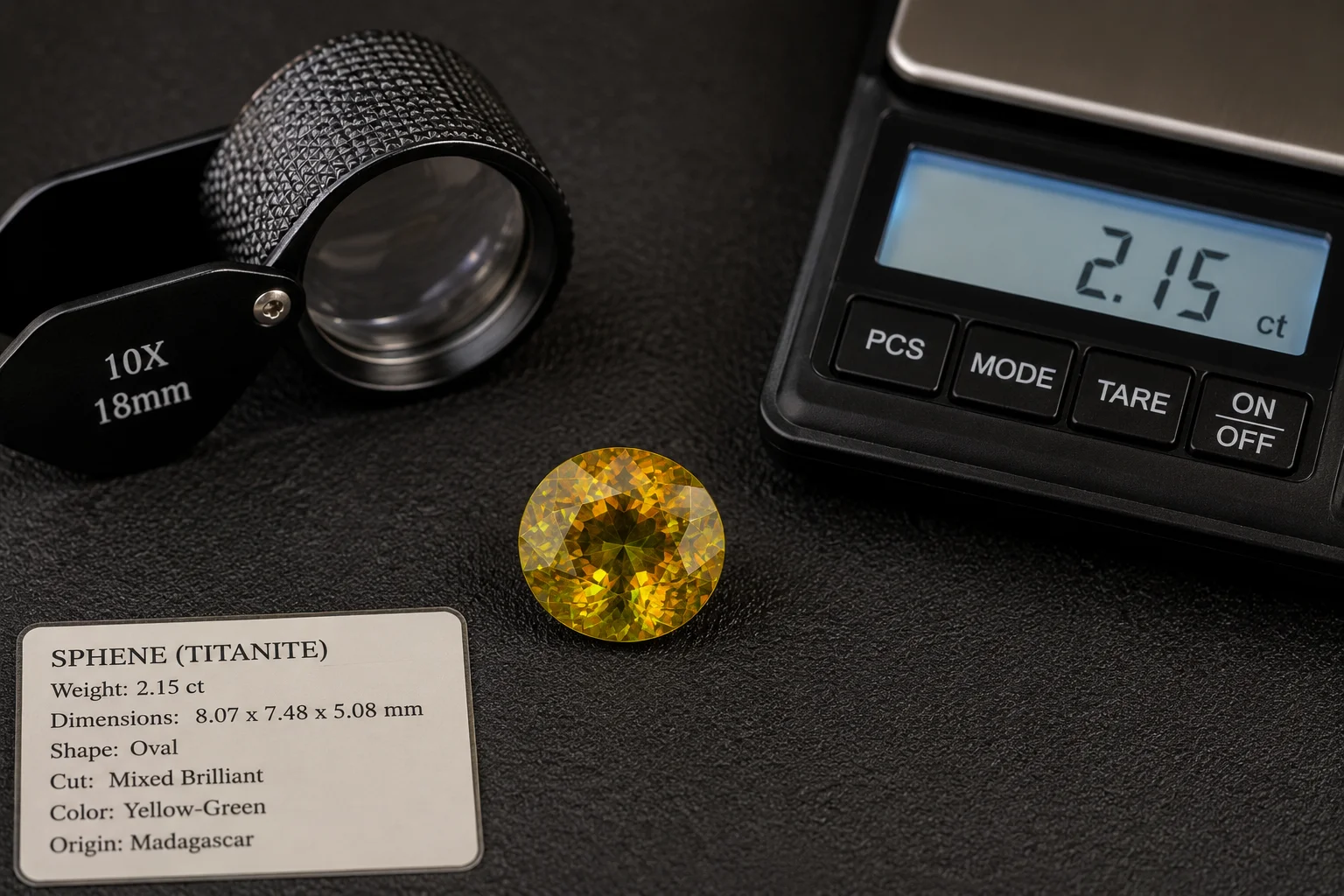

Sphene prices in 2026 commonly range from approximately $30 to $600 per carat. Yellow, brown and pale-green commercial stones often sit below $150 per carat, while fine lime-green and yellow-green gems with strong dispersion commonly reach $200 to $600 per carat.
Premium chrome-bearing Sphene, precision-cut stones and rare clean gems above five or ten carats may cost $600 to $1,500 per carat. However, Sphene remains a collector-oriented gemstone because its moderate hardness and cleavage make it less practical than Sapphire, Spinel or Garnet.
Sphene Price per Carat in 2026
The following ranges represent broad U.S. specialist-retail expectations for loose natural Sphene.
| Sphene quality | Typical characteristics | Approximate 2026 retail price |
|---|---|---|
| Entry commercial | Brownish yellow, dark, visibly included, windowed or weakly polished | $20–$75 per carat |
| Good commercial | Attractive yellow-green or golden color with visible fire | $75–$200 per carat |
| Fine | Bright lime, greenish yellow or golden green with strong transparency and dispersion | $175–$500 per carat |
| Premium chrome Sphene | Vivid green, excellent brilliance, clean appearance and rare size | $400–$1,000 per carat |
| Exceptional collector quality | Large chrome-rich gem, unusual precision cut or documented important provenance | $1,000–$1,500+ per carat |
Current July 2026 market charts confirm an active specialist retail market, although the available public chart data is limited. Current dealer guidance places fine chrome-green stones substantially above ordinary brown and yellow material.
The broader relationship among color, cut, size and rarity appears in How Gemstone Prices Are Determined.
Sphene and Titanite Are the Same Mineral
Sphene is the established gem-trade name for titanite, a calcium titanium silicate.
Mineralogists generally prefer titanite because the name refers directly to the mineral’s titanium content. Gem dealers continue to use Sphene because it is familiar within the jewelry market.
The two names should not be treated as separate gemstone species.
Sphene can occur yellow, green, brown, orange, reddish brown and, more rarely, gray or near-colorless.
The completed Sphene guide owns its mineral composition, formation, sources and traditional symbolism.
Why Sphene Shows Exceptional Fire
Sphene has high dispersion, meaning it separates white light into spectral colors.
Its dispersion exceeds Diamond’s, so a properly cut stone can display vivid red, orange, yellow, green and blue flashes.
Body color determines how easily those flashes can be seen. Bright yellow-green material often creates the strongest balance between color and fire.
Dark brown stones may contain the same optical potential but conceal much of the dispersion.
Cut quality is equally important. A poorly proportioned Sphene can look dull or windowed despite its favorable optical properties.
Sphene’s fire invites comparisons with Demantoid Garnet pricing, Zircon pricing and highly dispersive Sphalerite pricing.
Color Is the Main Value Factor
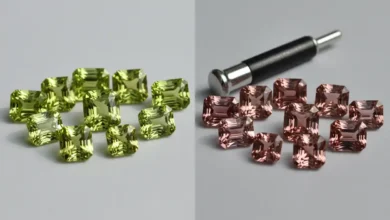
The most popular Sphene colors are bright yellow-green, lime green, golden green and vivid grass green.
Medium tone normally provides the best display. Very pale stones can look washed out, while dark olive or brown material may suppress brilliance.
Yellow stones can still be attractive when the color is clear and lively. Brown modifiers generally reduce value unless the gem has unusually strong fire.
Vivid green material receives the strongest broad premium. Fine examples may resemble Demantoid or Peridot while showing greater spectral dispersion.
Color should be judged under neutral lighting. Warm lamps can make a yellow-brown stone appear more golden, while cool digital editing can exaggerate green.
The site’s Green Gemstones and Yellow Gemstones pages provide broader color context.
Chrome Sphene
Chrome-bearing Sphene displays vivid green color linked to chromium, sometimes with vanadium also contributing.
Fine Chrome Sphene occupies the highest mainstream price tier.
One- to three-carat gems may cost several hundred dollars per carat, while clean stones above five carats can exceed $750 or $1,000 per carat.
The term chrome should not be used merely because a stone looks green. Chemical or spectroscopic testing may be necessary when the coloring cause creates a significant premium.
Visual quality still matters more than chemistry alone. A dull included chrome-bearing gem can cost less than a bright non-chrome yellow-green stone.
Trichroism and Color Direction
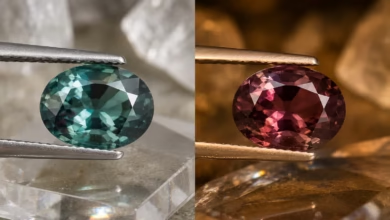
Sphene is strongly pleochroic and can display different colors from different crystal directions.
Depending on the gem, those directions may appear yellow, green, orange, brown or red-brown.
Cutters must orient the rough to place the most attractive direction face-up. Poor orientation can leave one side green and another brown or dark.
Pleochroism can create an appealing mix of green body color with yellow or orange flashes.
However, uneven zoning and one-sided darkness reduce value when they interrupt the overall design.
A rotating video is more useful than one still image because it reveals how the pleochroic colors interact during normal movement.
Birefringence and Facet Doubling
Sphene has strong birefringence.
When viewed through the crown, back-facet edges may appear doubled. This effect can make the internal pattern look busy or slightly fuzzy.
Some collectors enjoy the visual complexity, while others prefer cuts that minimize distracting doubling.
The doubling also provides a useful identification clue under magnification.
Cutters must balance dispersion, brilliance and birefringence. A design that maximizes fire without controlling facet doubling can appear less crisp than expected.
Clarity and Inclusions
Faceted Sphene is commonly expected to show reasonable transparency, although natural inclusions are accepted.
Possible internal features include crystals, needles, healed fractures, growth features and liquid inclusions.
Fine green stones may receive greater inclusion tolerance because vivid color is uncommon.
Nevertheless, dense clouds, dark crystals and open fissures reduce brilliance and durability.
Surface-reaching fractures are especially important because Sphene has moderate hardness and cleavage.
A small natural inclusion can confirm character without affecting beauty. A large reflective fracture beneath the table should create a meaningful discount.
Cut Quality
Sphene is difficult to cut and polish because it is relatively soft, brittle and cleavable.
Ovals, cushions, pears, rounds and freeform cuts appear in the market.
A shallow pavilion creates windowing and weakens color. Excessive depth adds hidden weight and can produce dark extinction.
Larger facets may display broad flashes of fire, while precision designs can create intense scintillation.
Facet junctions should remain crisp. Abrasion, polishing drag and rounded edges reduce value.
Because high-quality rough is limited, cutters may accept unusual outlines to preserve color and weight. Minor asymmetry is reasonable, but a poorly balanced face should still be discounted.
Detailed selection belongs to the Sphene Buying Guide.
Sphene Prices by Carat Weight
Fine Sphene receives stronger premiums when vivid color and clean transparency continue into larger sizes.
| Carat weight | Commercial quality | Fine quality | Premium quality |
|---|---|---|---|
| Under 2 ct | $25–$125 per carat | $125–$350 per carat | $300–$700 per carat |
| 2–5 ct | $40–$175 per carat | $175–$500 per carat | $400–$900 per carat |
| 5–10 ct | $50–$225 per carat | $225–$600 per carat | $500–$1,200 per carat |
| 10–20 ct | $50–$200 per carat | $200–$550 per carat | $500–$1,200+ per carat |
| Above 20 ct | Often priced individually | Color and cut dominate | Collector evaluation required |
Large brown or included stones can remain affordable.
A clean ten-carat lime-green gem is much more difficult to replace and can command a substantial premium.
Madagascar Sphene
Madagascar has produced yellow, green, brown and strongly dispersive Sphene.
Fine Madagascan material can show bright greenish-yellow color and good transparency.
Commercial stones may cost below $200 per carat, while vivid green and precision-cut examples can enter the higher tiers.
Country alone does not create the premium. A dark or poorly cut Madagascan gem remains commercial.
However, well-documented material from an important deposit can interest mineral collectors in addition to jewelry buyers.
Pakistani Sphene
Pakistan supplies yellow-green, olive-green, brown and vivid green Sphene, including substantial crystals.
Fine gems can combine bright color with strong dispersion and useful size.
Current specialist inventories include Pakistani stones from commercial quality through high-end precision cuts.
Clean green material above five carats can command several hundred dollars per carat.
The country name should support provenance rather than act as a quality grade. Color, clarity, cut and condition remain decisive.
Russian, Indian and Other Localities
Russia has produced green Titanite crystals, including vanadium-colored material of mineralogical interest.
India supplies Titanite from several metamorphic regions, while Brazil, Sri Lanka, Mexico, Austria, Canada and the United States have also yielded gem or specimen material.
Locality premiums are more common in crystal specimens than ordinary faceted stones.
A natural crystal with sharp wedge-shaped form and documented provenance may be worth more intact than as cutting rough.
Sphene vs Demantoid Garnet
Green Sphene and Demantoid can both show strong dispersion and vivid green color.
Demantoid is harder and more established in fine jewelry. Top Russian Demantoid also receives premiums for locality and characteristic horsetail inclusions.
Sphene can show even stronger dispersion but is softer and more vulnerable.
Fine Chrome Sphene may cost hundreds to more than $1,000 per carat, while premium Demantoid can rise much higher.
The full identification boundary belongs to Sphene vs Demantoid Garnet.
Sphene vs Peridot
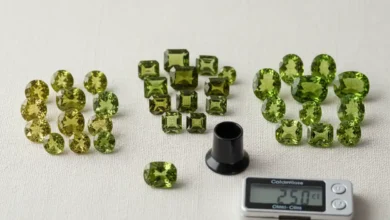
Peridot commonly shows yellow-green to olive-green color and is more familiar in jewelry.
Sphene usually has stronger dispersion and visible facet doubling, while Peridot offers better general wearability.
Fine Peridot pricing appears in the Peridot Price Guide.
Commercial price ranges can overlap, but premium value comes from different features. Peridot is judged mainly by pure green color and clean size; Sphene gains more value from fire, green saturation and cutting.
Sphene vs Zircon
Zircon can also show strong brilliance and dispersion.
Blue Zircon occupies a larger consumer market, while colorless and golden Zircon appeal to collectors.
Sphene’s birefringence is normally stronger and its hardness lower.
Current market comparisons belong to the Zircon Price Guide.
Neither material should be confused with Cubic Zirconia, which has its separate market in the Cubic Zirconia Price Guide.
Treatments
Routine treatment is not central to most Sphene trading.
Heating can alter the color of some Titanite material, and coatings or other modifications are possible, though uncommon.
Known treatment should be disclosed because color stability and collector value may differ from untreated material.
Misidentification presents a more frequent concern than treatment. Peridot, Demantoid, Zircon, glass and other yellow-green stones may be confused with Sphene.
The broad enhancement framework appears in Gemstone Treatments Explained.
Jewelry Prices and Suitability
| Jewelry type | Broad U.S. retail range |
|---|---|
| Silver pendant with commercial Sphene | $150–$750 |
| Gold pendant or earrings | $700–$4,000 |
| Protected ring with a fine one- to three-carat gem | $1,000–$5,000 |
| Large chrome or precision-cut designer jewel | $4,000–$20,000+ |
Pendants and earrings are safer than rings or bracelets.
A ring should use a protective setting and be reserved for occasional wear. Exposed high settings increase the risk of scratches and chips.
Complete maintenance guidance belongs to How to Clean Sphene Jewelry Safely.
Certification and Appraisal
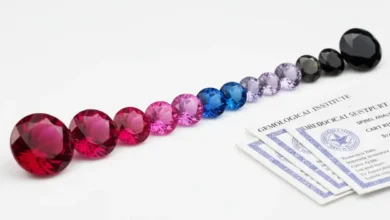
Most ordinary yellow Sphene does not require an expensive report.
Documentation becomes more useful when:
- Chrome or vanadium color creates a premium
- The gem is unusually large and clean
- Treatment is uncertain
- The stone may be Demantoid, Peridot, Zircon or glass
- A documented locality is commercially important
A laboratory can identify Titanite and record the gem’s characteristics. A report does not assign a universal quality grade.
The Gemstone Certification Labs comparison explains report scope.
Does Sphene Hold Its Value?
Fine green Sphene, rare Chrome Sphene and recognized precision cuts can attract collectors.
However, the resale market is small, and many jewelers do not maintain an active secondary market for it.
Commercial brown and yellow stones commonly resell below retail.
Condition is especially important because facet abrasion and chips are difficult to hide. The strongest resale position belongs to undamaged, vivid, well-cut stones with documentation.
The broader framework appears in Do Gemstones Hold Their Value?.
Price Guide vs Buying Guide
This page owns Sphene’s 2026 prices and value factors.
The dedicated buying guide owns the detailed inspection of dispersion, color, doubling, fractures and setting risks.
Online buyers should request movement video under neutral light, dimensions, side views and treatment disclosure using How to Buy Gemstones Online Without Getting Scammed.
The Gemstones That Start With S and Crystals That Start With S directories connect Sphene with the site structure.
The Buying & Value hub connects this guide with Demantoid, Peridot, Zircon and certification content.
Frequently Asked Questions
1. How much is Sphene worth per carat in 2026?
Most Sphene costs approximately $30 to $600 per carat. Premium Chrome Sphene and rare large stones may reach $600 to $1,500 per carat.
2. Is Sphene the same as Titanite?
Yes. Titanite is the mineralogical name, while Sphene remains widely used in the gem trade.
3. What Sphene color is most valuable?
Bright lime green, vivid yellow-green and Chrome Sphene generally receive the strongest prices.
4. Why does Sphene show so much fire?
It has high dispersion, which separates white light into strong rainbow flashes.
5. How much is a five-carat Sphene?
A five-carat stone may cost approximately $500 to $3,000. Fine Chrome Sphene can cost more.
6. Does large Sphene cost more per carat?
Only when strong green color, transparency and cutting continue at the larger size.
7. Is Chrome Sphene valuable?
Yes. Fine vivid-green chromium-bearing material occupies the highest mainstream Sphene tier.
8. Is Sphene suitable for a ring?
It can be set in a protective occasional-wear ring, but pendants and earrings are safer because Sphene scratches and chips relatively easily.
9. Is Sphene more valuable than Demantoid?
Usually not at the top end. Fine Demantoid has a stronger collector market, though premium Sphene can still be expensive.
10. Is Sphene normally treated?
Most material is sold without routine treatment, but known heat, coating or other modification should be disclosed.
11. Does Sphene need a laboratory report?
Ordinary stones generally do not. A report is useful for Chrome Sphene, rare colors, large stones and identity questions.
12. Is Sphene a good investment?
Its resale market is small. Fine chrome-green and precision-cut stones may interest collectors, but appreciation is not guaranteed.
Sphene Value Comes From Fire That Remains Visible Through Green
Sphene’s strongest gems combine a lively green or yellow-green body with broad rainbow flashes that remain visible during ordinary movement.
In 2026, fine stones commonly fall between $175 and $500 per carat. Prices above that range should correspond to exceptional chrome-rich color, rare clean size or precision cutting—not simply the claim that Sphene has more dispersion than Diamond.