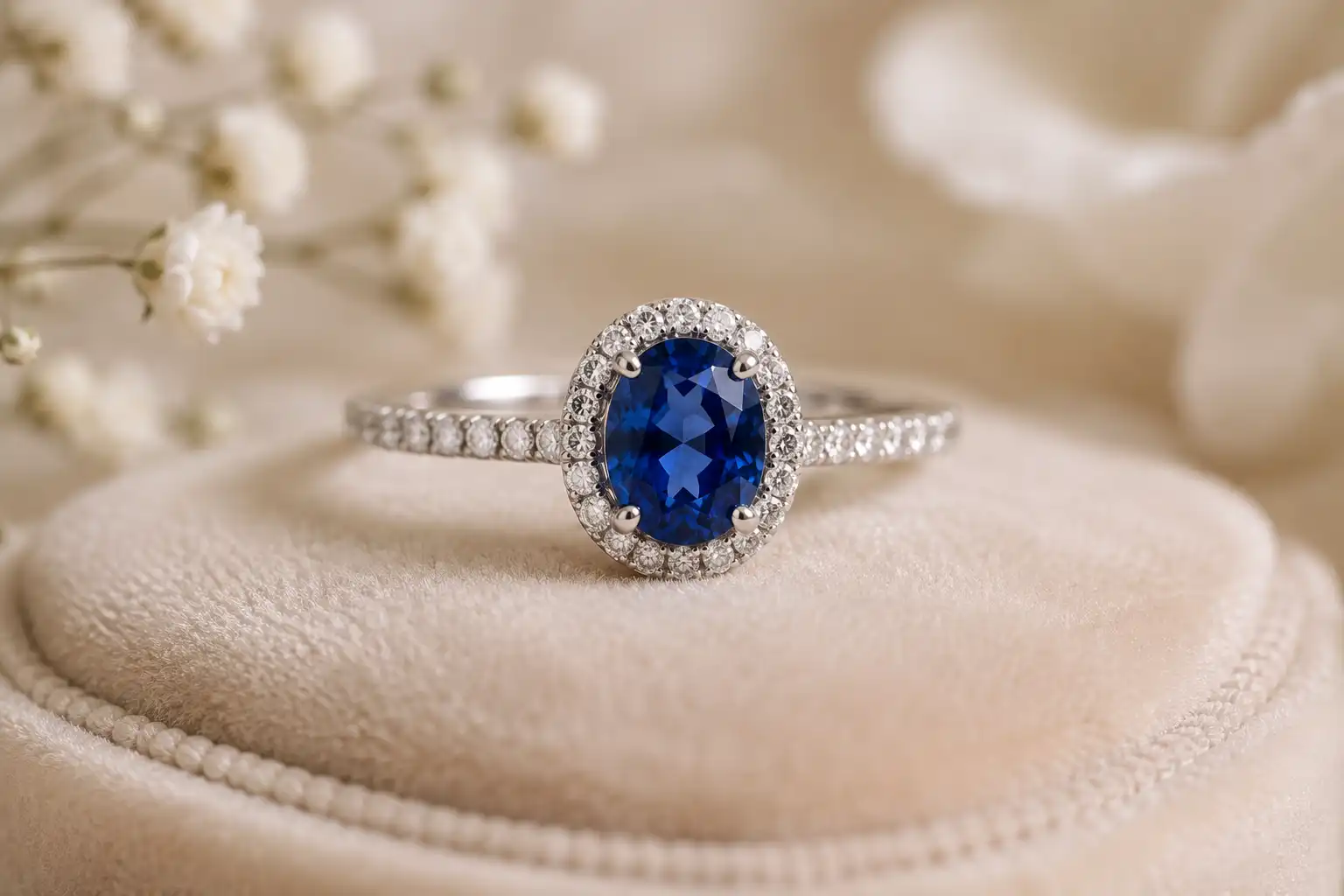
Sapphire Engagement Rings: Quality, Settings and Buying Guide
A sapphire engagement ring combines exceptional durability with far more color choice than a conventional diamond center. Blue sapphire remains the classic option, yet pink, yellow, white, green, purple, parti-colored, color-change and padparadscha sapphires can create highly individual rings.
Sapphire is corundum and ranks 9 on the Mohs scale. It has excellent toughness and no cleavage, making sound stones suitable for jewelry worn every day.
However, treatment and construction remain decisive. A conventionally heated natural sapphire can provide decades of wear, while an extensively fracture-filled stone may have serious cleaning and repair limitations. Likewise, a durable sapphire mounted in thin worn prongs is not a secure ring.
The best purchase begins with the desired color, origin category and treatment boundary. Size, setting and accents can then be selected within a realistic budget.
For loose-stone quality, see the Sapphire Buying Guide. Current value factors remain within the Sapphire Price Guide.
Sapphire Engagement Rings at a Glance
| Decision | Strong starting point |
|---|---|
| Daily-wear suitability | Excellent for sound sapphire in a secure setting |
| Hardness | Mohs 9 |
| Cleavage | None |
| Classic color | Medium to medium-dark vivid blue or violetish blue |
| Alternative colors | Pink, yellow, white, green, purple, parti and padparadscha |
| Common treatment | Conventional heating |
| Major disclosure concerns | Lattice diffusion, filling, coating and laboratory growth |
| Strong protective setting | Low bezel or secure six-prong basket |
| Classic accent | Diamond or white sapphire |
| Budget alternative | Heated natural or clearly disclosed lab-grown sapphire |
| Report priority | Natural versus laboratory origin and treatment |
| Main buying principle | Choose brightness and disclosure before carat weight alone |
Is Sapphire a Good Engagement-Ring Stone?
Sapphire is one of the strongest natural colored gemstones available for engagement rings.
Its hardness provides excellent resistance to scratching. Its lack of cleavage reduces the risk of splitting along one structural plane.
Corundum remains brittle enough to chip after a sharp concentrated impact, but its overall wear performance is superior to emerald, tanzanite, topaz, moonstone, opal and many other popular colored stones.
The Best Gemstones for Engagement Rings and Best Gemstones for Everyday Wear guides compare sapphire with other durable options.
Sapphire is particularly suitable for someone who wants color without accepting the maintenance level required by softer or strongly cleavable gems.
Natural Versus Lab-Grown Sapphire
Natural sapphire formed within geological environments.
Lab Sapphire is manufactured corundum with essentially the same composition, crystal structure, hardness and basic optical properties.
Lab-grown sapphire can provide vivid color, high clarity and a larger center for a lower price.
Natural sapphire carries geological rarity and may receive premiums for untreated status, documented locality, unusual color or historic provenance.
Neither category is universally better. The decision depends on budget, origin preference, rarity and disclosure.
The Lab Sapphire Buying Guide explains manufactured-stone selection, while Lab Sapphire Rings covers setting and wear decisions.
Heated Versus Unheated Sapphire
Conventional heating is common.
Heat can improve color, reduce unwanted modifiers, alter inclusions and improve apparent clarity.
A heated sapphire remains natural corundum.
Fine unheated stones may command substantial premiums when their color and transparency are already attractive.
An unheated claim should be supported by an independent laboratory report whenever it materially affects the price.
A vivid well-cut heated sapphire can be a better engagement-ring stone than a dark, poorly cut or heavily included unheated gem.
Lattice-Diffused Sapphire
Lattice diffusion introduces color-causing elements during high-temperature treatment.
Titanium diffusion commonly creates blue near the surface, while beryllium diffusion can modify yellow, orange and pink-orange colors.
The depth of color penetration depends on the process.
Shallow surface-related color can be altered by repolishing or recutting.
Diffusion-treated sapphire remains corundum, but its market value generally differs from sapphire colored without added elements.
The completed How to Spot Treated or Synthetic Sapphire guide explains heat, diffusion, filling and laboratory growth.
Fracture-Filled Sapphire
Surface-reaching fractures or cavities may be filled with glass or another substance.
Filler can improve the apparent clarity of lower-quality material.
However, it may be vulnerable to heat, acids, aggressive cleaning and jewelry repair.
An extensively filled sapphire is a weak choice for a valuable lifetime ring expected to undergo resizing, prong work and decades of cleaning.
The seller should disclose filling prominently rather than describing the stone simply as natural sapphire.
Filled material can remain attractive in lower-cost jewelry, but its care and price must reflect the treatment.
Choosing Blue Sapphire Color
Fine blue sapphire commonly shows strong-to-vivid blue or violetish blue in a medium to medium-dark tone.
The stone should remain visibly blue under ordinary indoor light.
Excessively dark sapphire may look nearly black once mounted. Closed settings can deepen that effect further.
Very light blue can be attractive but will not create the traditional saturated appearance.
Trade terms such as royal blue and cornflower blue are used inconsistently. Evaluate the actual gemstone rather than paying for a color name alone.
The completed Sapphire Color Meaning and Types of Sapphire guides explain the wider color range.
Pink Sapphire Engagement Rings
Pink sapphire ranges from pale blush to vivid magenta and purplish pink.
It offers a durable alternative to morganite, pink tourmaline and rose quartz.
Pale pink stones create a delicate look, while saturated pink provides greater visual presence.
Rose gold gives a tonal result, whereas platinum and white gold create sharper contrast.
The classification boundary between pink sapphire and ruby depends on whether red becomes dominant and can vary among laboratories.
A buyer should select the color they actually prefer rather than paying more solely for a ruby label near the boundary.
Yellow and Green Sapphire Rings
Yellow sapphire ranges from lemon to gold and orangish yellow.
Green sapphire may appear yellowish green, blue-green, olive or forest green.
Both colors can create distinctive rings at prices below the finest blue and padparadscha material.
Treatment disclosure is particularly important because heat and beryllium diffusion can alter yellow and orange appearances.
The completed Yellow Sapphire guide explains the mineral variety and symbolism.
Green and yellow sapphires should be evaluated for brightness because gray or brown modifiers can reduce visual life.
White Sapphire Engagement Rings
White Sapphire is colorless or near-colorless corundum.
It offers excellent hardness but less brilliance, scintillation and fire than diamond or moissanite.
A well-cut white sapphire can create an understated engagement ring, particularly for buyers who value natural corundum over diamond-like optical performance.
Windowing and surface residue become noticeable because the stone has no strong bodycolor.
The ring should be selected as a white-sapphire design rather than promoted as visually identical to diamond.
Padparadscha Sapphire Engagement Rings
Padparadscha sapphire combines pink and orange in a narrow, delicate color range.
The designation is subject to laboratory interpretation, and not every peach or salmon sapphire qualifies.
The completed Padparadscha Sapphire guide explains the variety, while the Padparadscha Sapphire Buying Guide covers color, treatment and reports.
Fine stones can be extremely valuable.
A substantial purchase should have independent documentation addressing natural origin, treatment, color stability and whether the laboratory applies the padparadscha name.
Parti-Colored and Color-Change Sapphire
Parti-colored sapphire displays separate zones, commonly blue with yellow or green.
Each stone is individual because the cut determines how the zones appear face-up.
Color-change sapphire shifts between different hues under different light sources, often blue or violet in daylight-equivalent light and purple or reddish purple under incandescent illumination.
Both varieties suit buyers who value individuality over uniform traditional color.
They should be examined under several lighting conditions before purchase.
A minor shift does not necessarily qualify as a strong color-change effect.
Sapphire Clarity
Natural sapphire commonly contains crystals, needles, fingerprints, healed fissures and color zoning.
Small inclusions can be acceptable when they do not reduce brightness or threaten durability.
A surface-reaching fracture near a prong deserves closer attention.
Eye-clean sapphire becomes less common as size, color quality and rarity increase, but a clean stone can still be natural.
Laboratory-grown sapphires also have diagnostic growth features and may contain inclusions.
Clarity must be interpreted with origin and treatment rather than used as a simple authenticity test.
Cut Quality
Cut controls brightness, visible color and apparent size.
Deep sapphires retain weight but can create dark extinction. Shallow stones may show pale windows.
Ovals and cushions are common because they preserve color and use rough efficiently.
Rounds provide balanced brilliance but can command premiums because more rough is lost during cutting.
Pears and marquises add length but need protected points.
The sapphire should return color across most of its face rather than appearing bright only around the edge.
Carat Weight and Millimeter Dimensions
Carat measures weight.
Sapphire is dense, so a one-carat sapphire may appear smaller than a one-carat diamond or beryl.
Millimeter dimensions provide a clearer indication of visible size.
The completed Carat vs Millimeter Size Chart explains how density and cut depth change face-up appearance.
Price rises rapidly as natural sapphire becomes larger while retaining fine color, clarity and treatment status.
A smaller vivid stone frequently looks more impressive than a larger dark sapphire.
Solitaire Sapphire Engagement Rings
A solitaire places one sapphire at the center.
Four prongs expose more stone, while six offer additional redundancy.
A low basket reduces snagging and leverage.
Cathedral shoulders create an elegant profile but often raise the sapphire higher above the finger.
The girdle should remain supported evenly without direct pressure on a fracture.
Solitaire designs also make it easier to inspect color, treatment-related features and cut than heavily decorated settings.
Bezel-Set Sapphire Engagement Rings
A bezel surrounds all or part of the girdle with metal.
It provides excellent edge protection and a smooth profile.
Full bezels suit active wearers and people who frequently use gloves.
A thick closed bezel can darken a deep sapphire, so the center should show sufficient brightness before setting.
An open back improves cleaning and admits light.
Partial bezels create more visible gemstone surface but protect fewer sides.
Halo Sapphire Engagement Rings
A halo surrounds sapphire with diamonds, white sapphires or moissanite.
The border enlarges the visual footprint and strengthens contrast.
A low halo can protect part of the center’s perimeter.
The sapphire should not sit excessively high above the halo.
Diamond girdles must remain separated from the sapphire because diamond can abrade corundum.
Pavé and shared prongs require inspection, while an open gallery allows cleaning beneath the center.
Three-Stone Sapphire Rings
A three-stone design can represent past, present and future or another personal sequence.
A sapphire center commonly appears with diamonds, white sapphires or smaller colored sapphires.
Side stones should not touch the exposed center girdle.
Trapezoids, half-moons and pears can frame an oval or cushion center efficiently.
The side stones should support the sapphire rather than overwhelm it.
Review the ring from the side to ensure the three stones sit at compatible heights.
Vintage-Inspired Sapphire Rings
Sapphire suits Victorian, Edwardian, Art Deco and revival designs.
Milgrain, engraving, filigree and geometric diamond accents can create historical character.
An antique ring may contain natural sapphire, early synthetic corundum, a later replacement stone or an undisclosed treatment.
The age of the mounting does not establish the gemstone’s origin.
Fine metalwork wears gradually and may have limited resizing options.
A valuable period piece should be examined before restoration, polishing or stone removal.
Star Sapphire Engagement Rings
Star Sapphire displays asterism across a cabochon.
A moving star creates a distinctive engagement-ring alternative to faceted brilliance.
The effect should move beneath a focused light.
Synthetic star sapphire and diffusion-treated asterism occur, making laboratory documentation important.
A bezel or substantial prongs protect the cabochon’s perimeter.
High domes remain exposed at the top and should be kept away from sharp impact.
Diamond Side Stones
Diamond creates the strongest classic contrast with blue and fancy sapphire.
It is harder than sapphire, so settings must prevent exposed girdles from rubbing together.
Accent quality should remain proportionate to what can be seen in small stones.
A Diamond Engagement Ring uses different quality priorities from a sapphire-centered ring.
Lab-grown diamonds can provide the same physical properties with another origin and price structure, as explained in Lab Diamond Engagement Rings.
Moissanite and White-Sapphire Accents
Moissanite provides strong brilliance and fire and can create an active halo around sapphire.
Its engagement-ring characteristics appear in Moissanite Engagement Rings.
White sapphire produces a quieter corundum-based accent.
The choice depends on desired brilliance, budget, origin preference and replacement availability.
Highly dispersive accents should not overwhelm the sapphire’s color.
Sapphire Versus Ruby and Emerald
Ruby shares sapphire’s corundum structure and daily-wear durability.
Emerald offers distinctive green color but commonly contains fractures and requires more cautious maintenance.
The completed Sapphire vs Emerald vs Ruby guide compares durability, treatment, color and price.
Sapphire provides the broadest color range, ruby supplies classic red and emerald offers an appearance that corundum cannot duplicate.
The choice should reflect preferred color and maintenance expectations rather than prestige alone.
Sapphire Versus Diamond
Sapphire provides color and can carry significant natural rarity.
Diamond offers greater hardness, brilliance and fire.
A sapphire may show more individuality through zoning, inclusions and unusual color, while diamond follows a more standardized grading framework.
The Best Diamond Alternatives guide places sapphire among other center-stone choices.
Neither gemstone is universally superior. The ring should suit the wearer’s visual preferences, budget and attitude toward treatment and documentation.
Setting Height and Daily Wear
A low profile is generally more practical.
High settings catch on clothing, transfer greater leverage to prongs and strike surfaces more easily.
The gallery should admit enough light and cleaning access while supporting the girdle securely.
A top-heavy ring that rotates continually may need resizing, sizing beads or a wider shank.
The setting should match actual daily activities rather than an idealized photograph.
Wedding-Band Compatibility
A low basket or broad halo may prevent a straight wedding band from sitting flush.
Curved, contoured and open bands can accommodate the engagement-ring profile.
Diamond-set bands should not press exposed diamond girdles against the sapphire.
Direct ring-to-ring rubbing also wears metal.
Try the complete set together before purchase.
Soldering can reduce movement but limits future flexibility and separate wear.
Ring Sizing and Resizing
Measure the finger at a normal temperature and more than once.
Wide bands feel tighter than narrow bands.
Pavé, eternity and heavily engraved designs can have limited resizing ranges.
Treatment status must be known before torch work.
Fracture-filled sapphire can be damaged by heat and chemicals during repair.
Ask about resizing and stone-removal procedures before buying a design intended for decades of wear.
Laboratory Reports
A report is important when natural versus laboratory origin, treatment or geographic origin affects the price.
The document should identify natural or lab-grown corundum and disclose detectable heat, diffusion, filling or other treatment.
Geographic origin is a separate opinion and may remain inconclusive.
Use Gemstone Certification Labs Compared to compare report types.
How to Read a Gem Lab Report explains dimensions, report numbers, treatment wording and whether an origin conclusion is present.
A retailer appraisal is not equivalent to independent gemological identification.
Geographic Origin
Kashmir, Myanmar and Sri Lanka have strong historical reputations for blue sapphire.
Madagascar, Australia, Montana, Thailand, Cambodia, Tanzania and other regions also produce sapphire.
Origin can affect market value when supported by laboratory evidence and demand.
Color alone cannot prove locality.
Descriptions such as Kashmir blue, Ceylon color or Burmese style may be marketing language rather than documented provenance.
Pay an origin premium only when the report and seller history support it.
Budget Priorities
Decide whether the budget should emphasize natural origin, no-heat status, geographic provenance, size, unusual color or an elaborate setting.
For many buyers, a vivid well-cut heated sapphire provides greater visible benefit than paying primarily for an origin label.
Lab-grown sapphire offers substantially larger size and stronger clarity for the same budget.
Avoid choosing a dark, heavily filled or poorly cut stone solely because its carat weight appears impressive.
The ring should be judged from normal viewing distance as well as under magnification.
Buying Online
Request exact-item photographs and video under daylight-equivalent and warm light.
Ask for dimensions, weight, treatment, report number, metal specifications and return conditions.
Confirm whether the report applies to the loose sapphire before setting or to the completed ring.
Check whether resizing voids the return policy.
Follow How to Buy Gemstones Online and preserve sufficient time for independent verification.
Unsupported labels such as investment grade, royal quality or AAA should not replace measurable details.
September Birthstone and Symbolism
Sapphire is September’s traditional birthstone and is also associated with fifth and forty-fifth anniversaries.
Its calendar history appears in September Birthstone.
Traditional symbolism includes loyalty, wisdom, truth and commitment.
A sapphire engagement ring may carry birthstone, family, cultural or personal meaning.
The gemstone does not guarantee fidelity or relationship success. Its value as a symbol comes from the couple’s intentions and actions.
Coordinating Sapphire Jewelry
A Sapphire Earring pair can repeat the center color near the face.
A Sapphire Necklace adds a separate focal point, while a Sapphire Bracelet creates a more formal matching set.
The general Sapphire Rings guide covers non-bridal styles and buying decisions.
Matching metal often creates enough visual unity. Separate sapphires do not need identical origin or hue unless the set is specifically sold as matched.
Cleaning and Maintenance
Warm water, mild soap and a soft brush are suitable for sound untreated, heat-treated and lattice-diffused sapphire.
Filled, cavity-filled, dyed or uncertain stones require gentler care.
The complete procedure appears in How to Clean Sapphire Jewelry.
Remove the ring before exercise, gardening, household cleaning and manual work.
Inspect prongs and the shank periodically.
Store sapphire away from diamond, which can scratch it, and away from softer gems that sapphire can scratch.
Frequently Asked Questions
1. Is sapphire durable enough for an engagement ring?
Yes. Sapphire’s hardness of 9, excellent toughness and lack of cleavage make it one of the strongest colored-gemstone choices.
2. Is natural sapphire better than lab-grown sapphire?
Neither is universally better. Natural sapphire offers geological rarity, while lab sapphire offers greater size and clarity at a lower cost.
3. Is heated sapphire suitable for lifelong wear?
Yes. Conventional heat treatment is common, stable and compatible with daily jewelry when disclosed.
4. Should fracture-filled sapphire be used in an engagement ring?
It is generally a weaker choice for a valuable lifetime ring because filler can be damaged during cleaning, repair and resizing.
5. What blue sapphire color is most valuable?
Strong-to-vivid blue or violetish blue in a medium to medium-dark tone with good brightness is typically most prized.
6. Which setting protects sapphire best?
A low full or partial bezel provides excellent edge protection and reduced snagging.
7. Does a sapphire engagement ring need a laboratory report?
A report is strongly advisable when natural origin, treatment, locality or substantial value depends on the claim.
8. Can sapphire be paired with a diamond wedding band?
Yes, provided the setting prevents exposed diamond edges from rubbing directly against the sapphire.
9. Is white sapphire a good diamond alternative?
It is durable and colorless but shows less brilliance and fire than diamond or moissanite.
10. Can sapphire engagement rings be resized?
Many can, though pavé, eternity, unusual metals and filled stones may limit safe resizing.
11. Is padparadscha sapphire suitable for daily wear?
Yes. It is corundum, but its treatment, color classification and setting should be documented carefully because of its value.
12. How should a sapphire engagement ring be cleaned?
Use warm soapy water for sound untreated, heated or diffusion-treated stones. Filled, dyed or uncertain sapphire needs gentler care.
A sapphire engagement ring should be purchased as a lifetime object rather than as a loose stone attached to any available mounting. Color and rarity create the attraction, but treatment disclosure, laboratory documentation, setting protection, fit and repairability determine whether the ring remains suitable for decades of wear.
Sapphire is indexed in Crystals That Start With S and Gemstones That Start With S.