
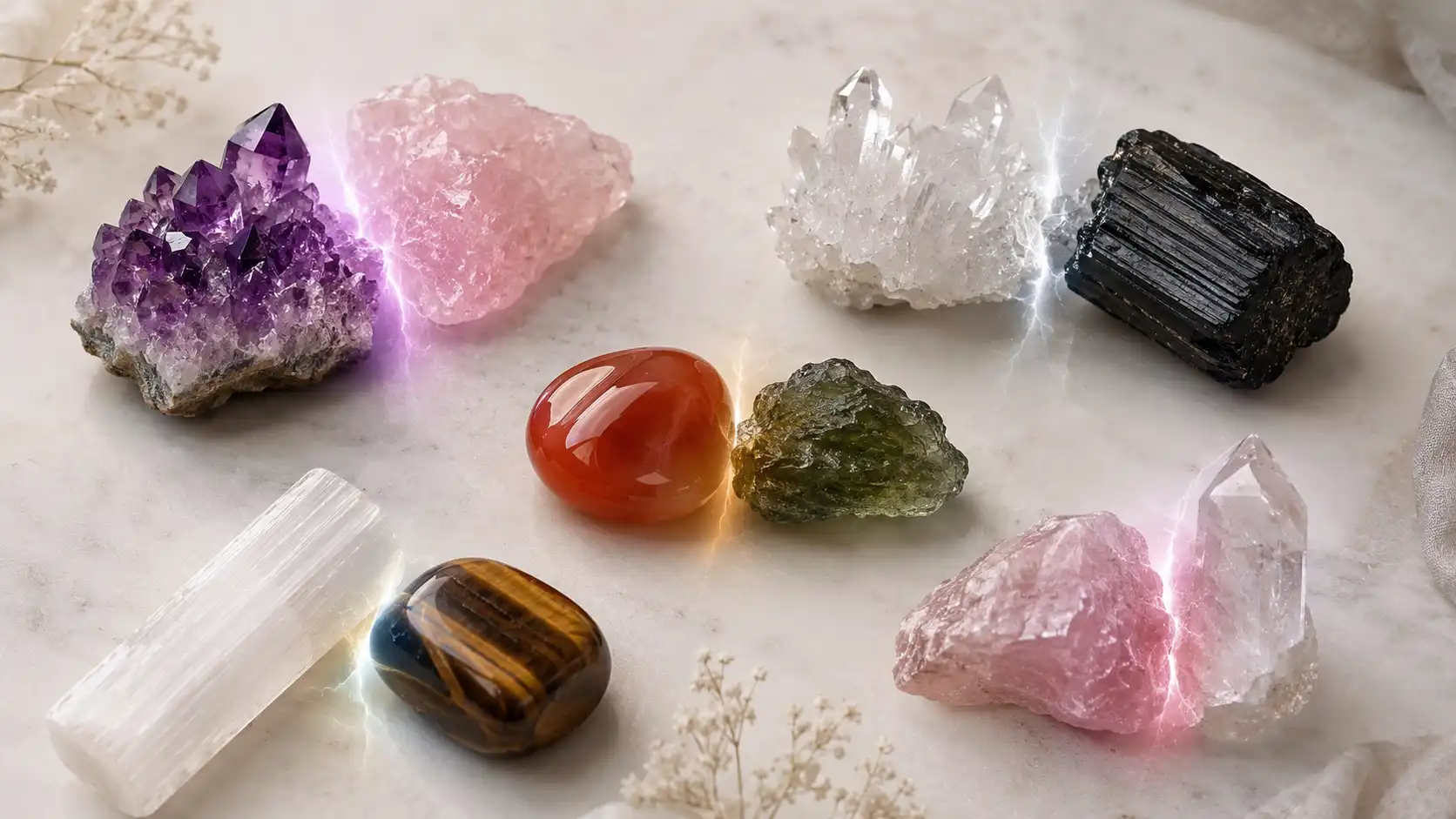

Most crystals can be used together. There is no scientific evidence that two stones become dangerous because their spiritual “energies” conflict.
However, some crystals should not be stored, cleansed, soaked or worn together because their physical properties are incompatible.
The main risks are:
- Hard stones scratching softer ones.
- Fragile crystals chipping against heavier stones.
- Water-sensitive minerals being soaked with water-safe crystals.
- Fade-prone stones being placed in prolonged sunlight.
- Mixed minerals being used in unsafe drinking-water elixirs.
- Combining too many symbolic intentions until the practice becomes unclear.
For positive, intention-based combinations, see the separate guide to crystal pairings. This article focuses only on combinations to avoid or manage carefully.
Crystal Combinations to Avoid at a Glance
| Combination | Main concern | Safer approach |
|---|---|---|
| Quartz with selenite | Quartz can scratch soft selenite | Store separately in padded compartments |
| Quartz with calcite | Hardness difference may cause scratches | Use individual pouches |
| Diamond or sapphire with softer gems | Very hard stones can damage most other materials | Separate jewelry during storage |
| Heavy tumbled stones with crystal clusters | Impact may chip points | Keep clusters in stable display boxes |
| Water-safe and water-sensitive crystals | Group soaking may damage sensitive minerals | Check every stone before using water |
| Sun-stable and fade-prone crystals | Shared sunlight exposure may fade some stones | Use indirect light or separate them |
| Unknown mixed stones in drinking water | Some minerals, treatments or residues may be unsafe | Do not drink direct crystal-infused water |
| Many unrelated intention stones | The purpose may become unfocused | Choose one goal and a small group |
Hard and Soft Crystals Should Not Be Stored Loose Together
Hardness describes resistance to scratching. A harder mineral can scratch a softer one when the pieces rub together.
Common examples include:
- Quartz: approximately 7 on the Mohs scale.
- Fluorite: approximately 4.
- Calcite: approximately 3.
- Selenite or gypsum: approximately 2.
- Diamond: 10.
- Ruby and sapphire: 9.
A quartz point stored loose with selenite, calcite or fluorite may leave scratches or chips.
Combinations Requiring Separate Storage
Clear Quartz and Selenite
Clear quartz is significantly harder than selenite. The quartz may scratch the selenite, while the selenite can chip or flake.
They may still be displayed together if neither stone touches or moves against the other.
Quartz and Calcite
Clear quartz, amethyst, citrine and smoky quartz can scratch softer calcite varieties.
Examples include:
- Orange calcite.
- Green calcite.
- Blue calcite.
- Honey calcite.
- Mangano calcite.
Use separate pouches or padded compartments.
Quartz and Fluorite
Fluorite is softer and has distinct cleavage, meaning it can break along flat internal planes.
Avoid carrying fluorite loose with quartz points or other hard stones.
Diamond, Ruby or Sapphire With Softer Gemstones
Diamond can scratch nearly every other gemstone. Ruby and sapphire can also scratch many common materials.
Store these stones separately from:
- Opal.
- Turquoise.
- Moonstone.
- Fluorite.
- Calcite.
- Pearls.
- Amber.
The risk is physical—not metaphysical.
Fragile Crystals Should Not Be Mixed With Heavy Tumbled Stones
Hardness is not the same as toughness.
A mineral may resist scratching but still fracture when struck.
Avoid storing heavy polished stones loose with:
- Quartz clusters.
- Geodes.
- Needle-like formations.
- Delicate natural points.
- Thin blades.
- Fragile carvings.
A bag of tumbled stones can behave like several small hammers when moved.
Use:
- Padded boxes.
- Individual pouches.
- Compartment trays.
- Stable display stands.
Beginners can review suitable forms and handling considerations in the Crystals 101 category.
Water-Safe and Water-Sensitive Crystals Should Not Be Soaked Together
A common mistake is placing an entire crystal collection in one bowl of water.
Even if some stones tolerate brief rinsing, another mineral in the same group may dissolve, oxidize, weaken or lose its surface treatment.
Avoid group soaking when the collection includes:
- Selenite or other gypsum varieties.
- Halite.
- Pyrite or other moisture-sensitive metallic minerals.
- Porous stones.
- Dyed or coated materials.
- Fracture-filled gemstones.
- Jewelry containing adhesives or reactive metals.
Do not assume that a stone is water-safe because it appears hard or polished.
Check every material individually using the guide to crystals that can and cannot go in water.
When the collection contains mixed or unidentified stones, use a dry cleansing method instead.
Crystals With Different Sunlight Tolerance Should Not Be Charged Together
Placing a mixed group in direct sunlight may fade or overheat sensitive stones.
Crystals commonly associated with fading after prolonged strong exposure include:
- Amethyst.
- Rose quartz.
- Fluorite.
- Kunzite.
- Some forms of citrine.
- Certain dyed or treated stones.
A sunlight-resistant stone in the same group does not protect the others.
If you do not know every stone’s stability, use:
- Indirect daylight.
- Short exposure.
- Sound.
- Visualization.
- A secure indoor resting place.
Consult the guide to crystals that fade in sunlight before placing a mixed collection near a window.
Do Not Combine Unknown Crystals in Drinking Water
Do not place a collection of mixed stones directly into water intended for drinking.
Some minerals may contain:
- Copper.
- Lead.
- Arsenic.
- Iron compounds.
- Soluble salts.
- Surface treatments.
- Dyes.
- Polishing residues.
- Contamination from mining or handling.
A polished appearance does not prove that a stone is food-safe.
The safest rule is:
Do not drink water that has been in direct contact with unidentified crystals or mixed mineral specimens.
A separate sealed container can be used as a symbolic indirect method, but it should not be presented as a medical treatment.
Crystals With Oils, Salt or Chemical Sensitivity Should Be Separated
Some cleansing practices combine crystals with salt, essential oils or household products.
These methods can damage:
- Soft minerals.
- Porous stones.
- Coated crystals.
- Dyed materials.
- Jewelry settings.
- Organic gems such as pearl, amber and coral.
Salt grains may scratch softer surfaces or enter fractures. Oils can stain porous materials or damage adhesives.
Use the crystal cleansing guide before applying one method to several different stones.
Can Opposite Crystal Energies Cancel Each Other?
There is no scientific evidence that crystals cancel, overpower or fight one another through metaphysical energy.
Claims such as these are belief-based:
- Amethyst cancels carnelian.
- Clear quartz makes another crystal dangerously powerful.
- Protective crystals block love stones.
- Grounding stones prevent manifestation.
- Two crystals create “bad energy” when placed together.
People may still prefer different stones for different purposes.
For example:
- Carnelian is traditionally associated with energy and motivation.
- Amethyst is commonly associated with calm and reflection.
Using both is not physically or scientifically harmful. However, a person seeking a simple bedtime ritual may find one focused intention easier to follow than several contrasting themes.
The issue is clarity—not energetic danger.
Common Pairs Often Claimed to Be Incompatible
Carnelian and Amethyst
These stones are sometimes described as conflicting because carnelian symbolizes activation while amethyst symbolizes calm.
Both belong to the quartz family and can usually be stored together without a major hardness concern.
Use them separately only when their symbolic purposes make your routine confusing.
Clear Quartz and Malachite
Some sources claim clear quartz amplifies malachite too strongly. This is not scientifically established.
The practical concern is that quartz is harder and may scratch malachite. Malachite should also not be placed in drinking water.
Store the stones separately or prevent direct contact.
Selenite and Black Tourmaline
These stones are often paired for cleansing and protection. There is no proven energetic conflict.
The practical issue is that selenite is much softer and more fragile. Black tourmaline’s rough edges may scratch or chip it.
Moldavite and Clear Quartz
Some spiritual sources describe this combination as extremely intense.
There is no scientific evidence that the pair produces dangerous energetic effects. Moldavite is natural glass and can chip, so physical protection is more important than metaphysical warnings.
Can You Wear Several Crystal Bracelets Together?
You can wear multiple crystal bracelets, but check:
- Bead hardness.
- Metal clasps.
- Bracelet tightness.
- Total weight.
- Skin sensitivity.
- Whether beads rub against watches or jewelry.
Hard beads may scratch softer stones over time. Elastic strands can also wear faster when several bracelets rub together.
Remove any bracelet that causes:
- Numbness.
- Tingling.
- Deep pressure marks.
- Skin irritation.
- Restricted movement.
The guide to how many crystals you can carry at once covers quantity and practical comfort in more detail.
Can You Keep All Crystals in the Same Room?
Yes. Crystals do not need to be separated into different rooms because of alleged energetic conflict.
Focus on physical safety:
- Keep fade-prone stones away from direct sunlight.
- Place heavy spheres on secure stands.
- Keep fragile points away from shelf edges.
- Separate hard and soft stones.
- Protect pieces from children and pets.
- Avoid humid areas for moisture-sensitive minerals.
Display compatibility is mainly a matter of stability, care and protection.
How to Choose Compatible Crystal Combinations
Before combining crystals, check four factors.
1. Physical Compatibility
Can one stone scratch, chip or crush the other?
2. Care Compatibility
Can every stone tolerate the same water, light and cleaning method?
3. Placement Compatibility
Are the pieces stable, secure and appropriately stored?
4. Purpose Compatibility
Does each stone support a clear personal intention, or are you combining many unrelated ideas?
A simple combination of two or three stones is usually easier to protect and use than a large collection carried loose.
Frequently Asked Questions
What crystals should never be together?
No crystal pairing is scientifically proven to be energetically dangerous. Physically, avoid storing hard stones loose with soft or fragile minerals and avoid cleansing mixed collections without checking each material.
Can clear quartz be combined with every crystal?
Clear quartz can be displayed with most stones, but its hardness may scratch selenite, calcite, fluorite, malachite and other softer materials.
Do protective and love crystals conflict?
There is no scientific evidence that they conflict. You may use both if the combination supports a clear personal purpose.
Can I cleanse all my crystals together?
Only when every stone and jewelry component can tolerate the chosen method. Dry, non-contact methods are safer for mixed collections.
Can too many crystals cause bad energy?
There is no scientific evidence that quantity creates harmful crystal energy. Too many stones may become heavy, difficult to protect or confusing within an intention-based practice.
Should crystals be stored separately?
Fragile, valuable, soft, treated or polished stones should generally have individual compartments or pouches.
Final Answer
Most crystals can be combined symbolically, but not every crystal should be stored, soaked, exposed to sunlight or worn together.
Avoid combinations where:
- A hard stone can scratch a softer one.
- Heavy stones can chip fragile formations.
- One crystal cannot tolerate the shared cleansing method.
- Fade-prone stones are placed in prolonged sunlight.
- Unknown minerals are put into drinking water.
- Too many intentions make the practice unclear.
Choose combinations according to physical compatibility first. Spiritual meanings can then be used as optional personal symbolism rather than warnings of dangerous or conflicting energy.