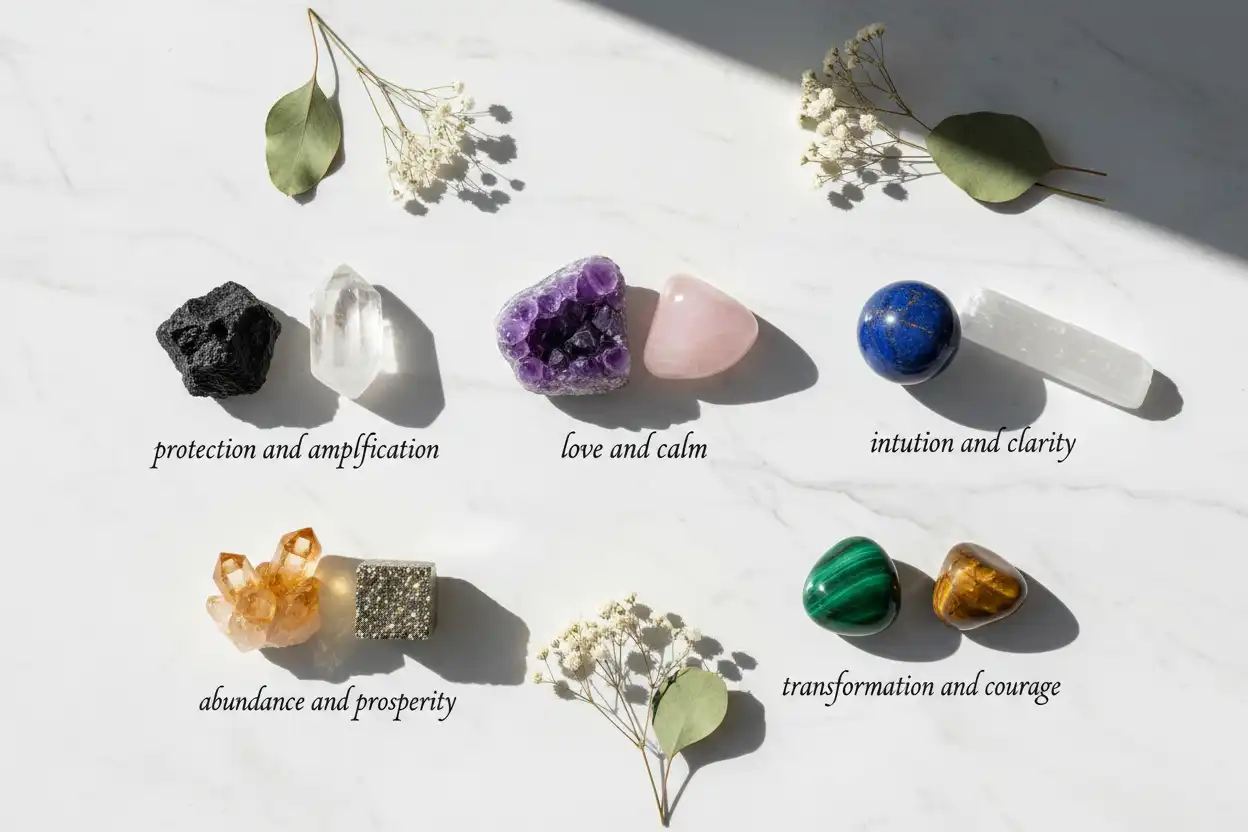
Crystal Pairings: 9 Practical Combinations, Symbolic Themes & Safe Use
Crystal pairings combine two or more stones within meditation, journaling, decoration, jewelry, or personal intention-setting. Popular combinations often match colors or modern symbolic themes, such as rose quartz with green aventurine for compassion and optimism, or black tourmaline with smoky quartz for grounding. These combinations can make a ritual easier to remember or create an attractive collection, but there is no established scientific evidence that two crystals merge invisible energies, amplify one another’s healing power, or create a measurable therapeutic effect.
The best crystal pairings therefore depend on the purpose of the activity and the physical properties of the stones. If two specimens will remain on a desk, almost any visually pleasing combination can work. If they will be carried in the same pouch, made into jewelry, placed in water, or exposed to sunlight, hardness, cleavage, porosity, toxicity, treatments, and chemical stability matter more.
Personal symbolism can remain part of the experience. The key is to distinguish chosen meaning from verified mineral behavior and avoid assuming that one combination guarantees sleep, love, money, protection, fertility, healing, or another outcome.
9 Crystal Pairings for Practical Intention-Setting
- Clear quartz + amethyst for focused reflection and a calmer routine.
- Rose quartz + green aventurine for compassion and constructive optimism.
- Black tourmaline + smoky quartz for grounding and stronger boundaries.
- Citrine + carnelian for motivation, creativity, and starting tasks.
- Sodalite + blue lace agate for deliberate communication and composure.
- Moonstone + labradorite for reflection during change and uncertainty.
- Fluorite + clear quartz for organization and concentrated work.
- Red jasper + hematite for steadiness and practical action.
- Tiger’s eye + pyrite for planning, confidence, and disciplined decision-making.
Clear Quartz + Amethyst for Focused Reflection
Among the most familiar crystal pairings, clear quartz and amethyst work visually because both belong to the quartz family while offering very different appearances. Clear quartz is colorless, while amethyst receives its purple coloration from iron-related color centers modified by natural irradiation.
Modern crystal culture often associates clear quartz with clarity and amethyst with calmness or reflection. Someone might place both beside a notebook before planning the day, then define one priority and one distraction to reduce. This gives the pairing a practical role without suggesting that the stones medically improve concentration or anxiety.
Both are Mohs 7 quartz, so their physical properties are relatively compatible. They can still abrade one another if polished pieces rub repeatedly in a pouch, and amethyst deserves protection from prolonged strong light if preserving color is important.
Crystal pairings work most defensibly when the symbolism points toward a behavior the person controls.
Rose Quartz + Green Aventurine for Compassion and Constructive Optimism
Rose quartz and green aventurine form one of the more visually harmonious crystal pairings because soft pink and green naturally contrast. Both are quartz-based stones, although aventurine contains mineral inclusions that produce its characteristic aventurescence.
Modern symbolism often connects rose quartz with compassion and green aventurine with optimism, growth, or opportunity. A person might use the combination while reflecting on a difficult relationship, asking where greater kindness is appropriate and where clearer boundaries are equally necessary.
The stones cannot attract a particular partner, repair a relationship without communication, or guarantee good fortune. Their value lies in supporting an intentional ritual. A practical exercise could involve writing one action that expresses care and another that protects an important personal limit.
Because both have useful scratch resistance, they are easier to handle than many softer crystal pairings, although normal jewelry and storage precautions still apply.
Black Tourmaline + Smoky Quartz for Grounding and Boundaries
Black tourmaline and smoky quartz are frequently paired around themes of grounding, protection, and stability. Schorl, the black tourmaline most often sold under this name, belongs to the tourmaline group. Smoky quartz is quartz whose brown-to-gray color relates to irradiation interacting with trace aluminum-related defects in the crystal structure.
Modern belief often describes this combination as absorbing or blocking negative energy. There is no evidence that these crystals create a protective field against radiation, electromagnetic exposure, illness, accidents, or harmful behavior. A more useful interpretation is to let the pairing remind you to check boundaries and respond to actual risks.
Before a stressful event, the stones might prompt questions such as: What can I control? What boundary needs to be stated? What practical preparation is missing? These questions turn symbolic crystal pairings into deliberate behavior.
Black tourmaline is somewhat softer than quartz, so carrying rough pieces together may eventually abrade the tourmaline.
Citrine + Carnelian for Motivation and Creative Action
Citrine and carnelian are warm-colored quartz-family gems commonly connected with creativity, motivation, confidence, and action. Citrine is yellow-to-orange crystalline quartz, while carnelian is orange-to-reddish chalcedony.
As crystal pairings go, this combination works naturally for a desk or creative space because the symbolism can be translated into starting rather than waiting. A writer might choose one section to draft. An artist might produce an imperfect first sketch. Someone managing administrative work might begin with the task they have been postponing.
The crystals do not increase metabolism, create physical energy, guarantee productivity, or produce financial success. Motivation remains affected by health, sleep, goals, environment, resources, and personal circumstances.
Both stones are close to Mohs 7, making them reasonably compatible physically, though polished pieces still benefit from separate compartments instead of loose rubbing.
Sodalite + Blue Lace Agate for Deliberate Communication
Sodalite and blue lace agate are popular blue crystal pairings associated with communication and composure. Blue lace agate is banded chalcedony, while sodalite is a feldspathoid mineral usually seen in blue masses with white or lighter veining.
Rather than treating these crystals as tools that automatically improve speech, someone might use them before an important conversation to clarify what needs to be said, what information remains uncertain, and what the other person may need an opportunity to explain.
Sodalite is significantly softer than agate. Keeping them loose together can therefore allow the harder chalcedony to scratch sodalite over time. This physical difference illustrates why symbolic compatibility and mineral compatibility are not the same thing.
When deciding which crystals not to combine, real concerns such as scratching, chemical sensitivity, water exposure, heat, and toxicity matter more than claims that two stones possess conflicting invisible energies.
Moonstone + Labradorite for Reflection During Change
Moonstone and labradorite both belong to the feldspar family, although their optical effects arise differently. Moonstone is known for adularescence, while labradorite can display strong flashes of blue, green, gold, or other colors known as labradorescence.
These crystal pairings are often associated with transitions, intuition, reflection, and adapting to change. A practical ritual might involve identifying what has actually changed, what remains stable, and which decision can reasonably be made with the information currently available.
Neither mineral predicts the future or provides supernatural intuition. Reflective practices can still make uncertainty easier to organize without claiming that the stones reveal hidden facts.
Both fall around Mohs 6 to 6.5 and possess cleavage, so hard impacts deserve attention. Smooth pieces placed on a desk are less vulnerable than thin, exposed crystal edges carried loosely with harder quartz or topaz.
Fluorite + Clear Quartz for Organization and Concentration
Fluorite and clear quartz create attractive crystal pairings because transparent or translucent fluorite can show purple, green, blue, yellow, or multicolored zoning beside colorless quartz. Modern symbolism frequently links fluorite with organization and quartz with clarity.
The pairing can become a visual start signal for focused work. Choose one task, remove avoidable distractions, work for a defined period, and review progress afterward. The routine itself has practical value even though the crystals have not been shown to improve attention medically.
Physical care is especially important here. Fluorite has Mohs hardness 4 and perfect cleavage, while quartz is Mohs 7. Quartz can readily scratch fluorite, so the stones should not be shaken together in a pouch or jewelry box.
This is a useful reminder that crystal pairings appropriate for a desk are not automatically appropriate for storage in direct contact.
Red Jasper + Hematite for Steadiness and Practical Action
Red jasper and hematite are commonly combined around grounding and practical action. Jasper is an opaque microcrystalline quartz, while hematite is iron oxide with a metallic to earthy appearance depending on form.
A person could use these crystal pairings while planning something concrete such as household tasks, exercise scheduling, study sessions, or financial administration. The symbolism becomes a reminder to turn an abstract intention into a specific next action.
Hematite is not magnetic in the strong way some commercial products suggest. Strongly magnetic items sold under names such as magnetic hematite are often manufactured products rather than ordinary natural hematite.
Neither stone increases blood iron, improves circulation, or creates physical stamina through skin contact. The red and metallic colors may support personal symbolism, but physiological claims require actual medical evidence.
Tiger’s Eye + Pyrite for Planning and Confident Decisions
Tiger’s eye and pyrite form visually distinctive crystal pairings. Tiger’s eye is chatoyant quartz whose silky optical effect relates to aligned fibrous structures and their alteration, while pyrite is iron sulfide with a metallic brass-yellow appearance.
Modern crystal traditions may connect both stones with confidence, prosperity, determination, or success. A safer interpretation is planning. Before a financial or professional decision, use the pairing as a cue to review costs, evidence, downside risk, assumptions, and the next practical step.
The crystals do not guarantee money, investment gains, employment, business success, or favorable negotiations. Confidence without information can lead to poor decisions, so the symbolic association works best when paired with verification.
Pyrite can tarnish or oxidize under unfavorable moisture conditions, while tiger’s eye is harder. They are better displayed together than repeatedly rubbed against each other in a damp pouch.
Do Crystal Pairings Amplify Each Other?
There is no established scientific evidence that crystal pairings amplify healing energy or create an effect greater than either stone alone. Controlled research on crystal healing has not demonstrated a specific therapeutic effect attributable to genuine crystals rather than expectation.
That does not make a pairing meaningless. Humans regularly use objects, colors, photographs, jewelry, music, and routines as reminders of intentions. Two chosen stones may make a personal ritual more memorable because each represents a different part of the same goal.
Clear quartz and amethyst might represent focus and calm. Rose quartz and green aventurine might represent compassion and optimism. The meaning comes from the framework the person assigns to them rather than a measurable transfer of energy between minerals.
This distinction keeps crystal pairings compatible with personal spirituality without presenting belief as clinical evidence.
How Many Crystal Pairings Can You Use at Once?
There is no scientifically established maximum number of stones that can be used together. If you are considering how many crystals can you carry, comfort, weight, size, scratching, fragility, and the simplicity of the ritual matter more than a fixed energetic limit.
Two or three stones are often easier to associate with specific intentions than a large collection carried simultaneously. Too many objects can make the ritual less clear simply because there are more things to remember, not because their energies are fighting.
Physical compatibility becomes increasingly important as the number rises. Hard quartz can scratch fluorite, calcite, turquoise, and many other softer stones. Delicate clusters can lose points. Lead-bearing or otherwise hazardous collector minerals should not be carried casually in pockets with loose fragments.
The simplest crystal pairings are often the easiest to use and protect.
How to Build Crystal Pairings Around One Clear Intention
Start with an intention that describes a behavior rather than a guaranteed outcome. “Prepare carefully for tomorrow’s meeting” is actionable. “Make everyone agree with me” is not. “Follow my bedtime routine” is realistic. “Guarantee eight hours of sleep” is not.
Choose one or two crystals whose appearance or modern symbolism makes the intention easy to remember. Place them somewhere appropriate for the activity, such as beside a journal or on a desk. You can program crystals as a personal intention-setting ritual by assigning each stone a simple reminder and returning to that reminder during the chosen practice.
Then protect the specimens according to their real physical properties. Pairing fluorite with quartz does not mean they belong loose in the same bag. Pairing pyrite with another stone does not make water exposure sensible. Symbolism and mineral care remain separate considerations.
Crystal Pairings for Jewelry Need Extra Physical Care
Crystal pairings used in jewelry face abrasion and impact that stationary specimens avoid. Stones with widely different hardness values can wear differently over time, while high settings or exposed points may catch on clothing.
Durability also depends on cleavage. A harder gemstone with strong cleavage can still chip. Treatments add another variable because coatings, fillers, dyes, or stabilized stones may require cleaning methods different from untreated neighbors in the same piece.
Design can solve many problems. Bezel settings can protect vulnerable edges, metal spacers can reduce bead-on-bead rubbing, and pendants generally receive less impact than rings.
Choose jewelry combinations for appearance and meaning if you enjoy them, but let gemological care determine how the finished piece is worn and cleaned.
Conclusion
Crystal pairings can create attractive collections and meaningful rituals built around focus, compassion, grounding, creativity, communication, reflection, or practical action. Nine useful combinations include clear quartz with amethyst, rose quartz with green aventurine, black tourmaline with smoky quartz, and other pairings chosen for complementary symbolism.
No pairing has been proven to create amplified healing energy or guaranteed outcomes. The most responsible approach combines personal interpretation with real knowledge of hardness, cleavage, chemical stability, treatments, and safe handling.
FAQs
What Are the Best Crystal Pairings?
There is no single best combination. Useful crystal pairings depend on your purpose, visual preference, and how the stones will be stored or worn.
Can Clear Quartz Be Paired With Any Crystal?
Clear quartz is commonly used symbolically with many stones. Physically, its Mohs 7 hardness means it can scratch softer minerals kept in direct contact.
Do Crystal Pairings Amplify Energy?
There is no established scientific evidence that combining two crystals amplifies a therapeutic energy. Any symbolic meaning comes from personal or spiritual interpretation.
Can Amethyst and Rose Quartz Be Used Together?
Yes. They are physically similar quartz-family gems and are commonly combined symbolically around calm reflection and compassion.
Can Black Tourmaline and Smoky Quartz Be Paired?
Yes. Modern crystal practice often associates both with grounding. Smoky quartz is harder, so rough specimens should not be allowed to rub repeatedly against softer tourmaline.
Are There Crystals That Should Never Be Paired?
There is no evidence of dangerous energetic incompatibility. Physical concerns are more important, including scratching, toxic dust, solubility, chemical reactions, treatments, and fragile crystal structures.
Can I Carry Several Crystal Pairings at the Same Time?
Yes, but weight, comfort, fragility, and stone-on-stone abrasion deserve attention. There is no scientifically established energetic maximum.
Should Crystal Pairings Match the Same Chakra?
They do not need to. Chakra correspondences are spiritual frameworks rather than anatomical or mineralogical rules, so pairing choices remain personal.
Can Crystal Pairings Treat Anxiety or Other Health Conditions?
No crystal combination has been established as a medical treatment for anxiety, depression, pain, insomnia, hormonal disorders, or other health conditions.
Crystal pairings are personal and spiritual practices rather than medical treatments and should not replace qualified healthcare when physical or mental health concerns require attention.