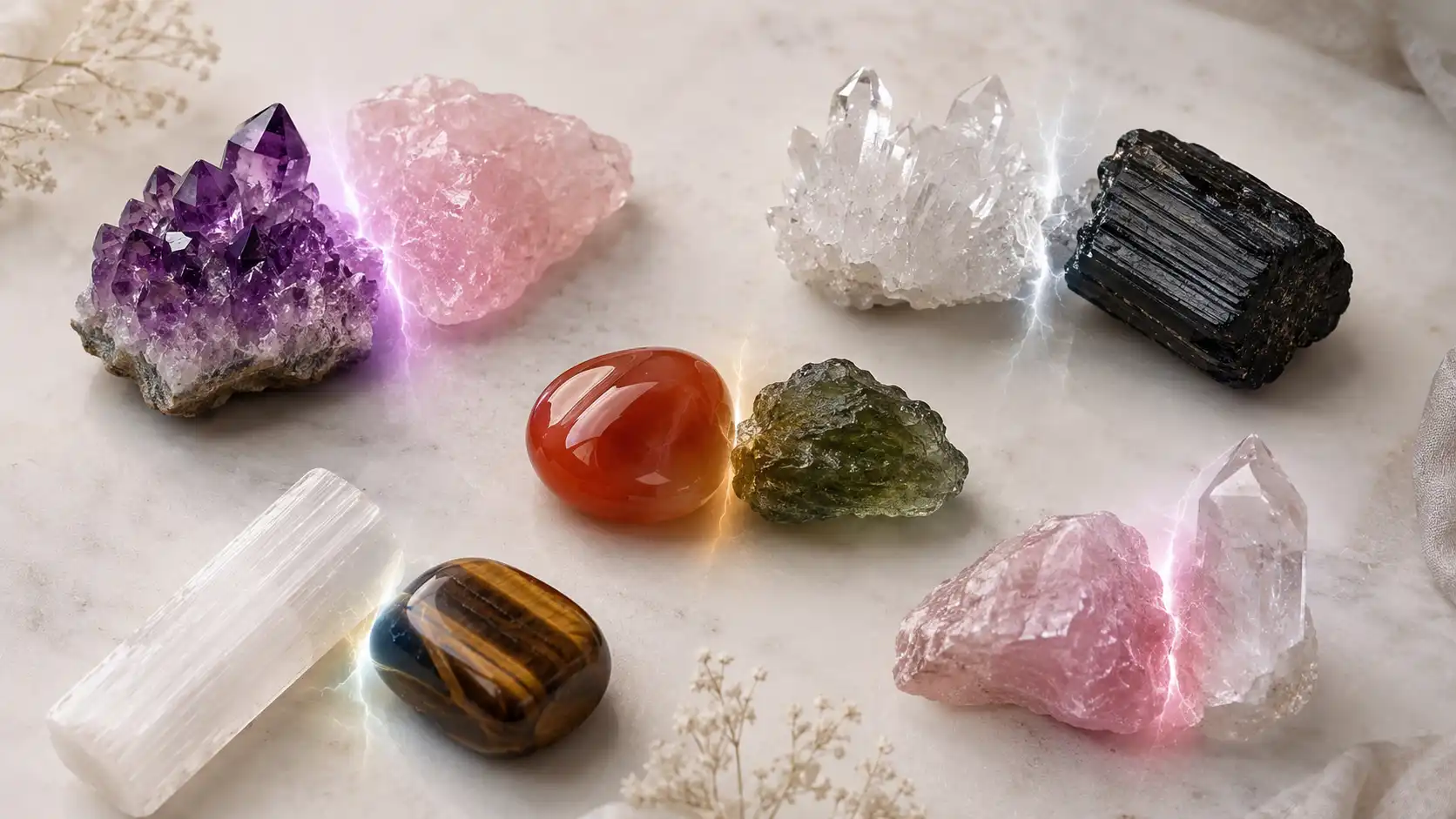
Crystals Not to Combine: 9 Real Compatibility Risks & Safer Pairings
Crystals not to combine are best identified by real physical risks rather than claims that two gemstones have incompatible energies. There is no established scientific evidence that amethyst fights carnelian, clear quartz overwhelms another crystal, or one gemstone spiritually cancels another. Most supposed energetic conflicts come from modern metaphysical interpretations and personal preference rather than mineralogy.
Real compatibility problems do exist. A Mohs 7 quartz crystal can scratch fluorite at Mohs 4. Water used safely with quartz can damage halite or gradually affect gypsum. Lead-bearing vanadinite should not share an elixir bowl with drinking water at all. A delicate crystal cluster can lose terminations when carried beside dense polished stones. Coatings, fracture fillings, dyes, and porous stones can also react differently to the same cleaning method.
The useful question is therefore not simply which crystals not to combine spiritually. It is which stones should remain separated during storage, cleaning, water rituals, carrying, jewelry wear, or direct handling.
9 Crystals Not to Combine in Specific Storage, Water, and Care Situations
- Quartz and fluorite should not rub loosely together because quartz can scratch fluorite.
- Quartz and calcite need separation during storage because their hardness differs substantially.
- Diamond or corundum should not touch most softer polished gems in a jewelry box.
- Selenite and other gypsum varieties should not join crystals in prolonged water cleansing.
- Halite should never enter a water-based crystal combination because it readily dissolves.
- Pyrite should not remain in prolonged damp storage with stones that require frequent soaking.
- Lead-, arsenic-, or mercury-bearing collector minerals should never join drinking-water crystal mixtures.
- Fragile clusters should not travel loose with heavy tumbled stones or dense specimens.
- Coated, filled, dyed, porous, and untreated stones should not automatically share the same aggressive cleaning process.
Quartz and Fluorite Are Crystals Not to Combine Loosely in One Pouch
Quartz and fluorite can look beautiful together on a display shelf, and no evidence suggests they possess conflicting spiritual energies. The physical problem appears when the specimens rub against one another.
Quartz has a Mohs hardness of 7, while fluorite is only 4 and also has perfect cleavage. A quartz point or rough edge can therefore scratch a polished fluorite surface relatively easily. Repeated movement inside a pouch, backpack, drawer, or jewelry box increases the risk.
This example explains why crystals not to combine depends heavily on context. Quartz and fluorite can sit several centimeters apart on a desk without difficulty. They can also be used together symbolically. They simply should not knock or grind against each other during transport.
Popular crystal pairings can remain personally meaningful while physical storage follows mineral hardness rather than metaphysical compatibility.
Quartz and Calcite Need Protection From Direct Rubbing
Quartz and calcite provide an even larger hardness contrast. Quartz sits at Mohs 7, while calcite is 3. A rough quartz surface can scratch calcite readily, and calcite also has perfect cleavage that makes impacts undesirable.
These are crystals not to combine loosely in a container where they can shift during movement. A polished calcite sphere, tower, or carving can develop scratches that dull its surface long before the quartz beside it shows comparable wear.
Calcite also reacts with acids much more readily than quartz. A cleaning method that seems harmless for one stone may therefore be inappropriate for the other. Vinegar and acidic household cleaners should stay away from calcite.
A crystal hardness chart makes these storage differences easier to predict. Harder stones belong in separate compartments when they could repeatedly contact softer polished specimens.
Diamonds, Rubies, and Sapphires Can Scratch Softer Stones
Some of the most important crystals not to combine physically are extremely hard gemstones stored loose with softer pieces. Diamond ranks 10 on the Mohs scale, while ruby and sapphire are corundum at 9. Both can scratch a wide range of other gemstones.
A diamond ring tossed into a box beside topaz, quartz, tourmaline, turquoise, opal, fluorite, or many other stones can create surface damage. Corundum can similarly scratch topaz, quartz, and softer gems. Even two stones with similar hardness may abrade each other over time.
This does not mean these gemstones cannot appear together in professionally designed jewelry. Jewelers control spacing, settings, contact points, and movement. The risk is different when loose pieces repeatedly grind together.
When identifying crystals not to combine, think about how the stones move rather than assuming proximity itself is harmful.
Selenite and Water-Cleansed Crystals Need Different Care
Selenite is a transparent crystalline variety of gypsum, a mineral with Mohs hardness about 2 and perfect cleavage. Gypsum is also slightly soluble in water. Repeated soaking can dull, etch, weaken, or otherwise damage its surface.
That makes selenite one of the crystals not to combine with water-based cleansing routines simply because another stone in the group tolerates water. Quartz may survive a rinse easily, but sharing the same bowl does not make the gypsum equally stable.
Satin spar, another common fibrous gypsum variety frequently sold under the name selenite, deserves the same basic caution. Its silky surface can scratch easily and does not benefit from prolonged soaking.
Sound, a dry cloth, meditation, or another dry symbolic practice avoids the problem entirely. Spiritual cleansing does not require identical physical treatment for every mineral in a collection.
Halite Should Never Join Water-Based Crystal Combinations
Halite is natural sodium chloride, the mineral form of common salt. It dissolves readily in unsaturated water, which makes it an obvious example among crystals not to combine with water rituals.
Putting halite into the same water bowl as quartz, agate, or another water-resistant stone does not protect it. Dissolution follows chemistry, not the symbolic meaning assigned to neighboring crystals. Surface edges can round, crystal faces can deteriorate, and enough exposure can destroy the specimen.
The same principle applies to other crystals that dissolve in water. One durable stone does not make the entire group water-safe.
If a ritual calls for several crystals, place water-sensitive specimens outside the bowl and keep the symbolic arrangement dry. There is no requirement for every stone to touch water.
Pyrite and Frequently Soaked Stones Need Different Storage Habits
Pyrite is iron sulfide and often appears as metallic cubes, pyritohedra, nodules, or crystalline masses. Good specimens can remain stable for long periods under suitable conditions, but moisture is not something collectors should introduce unnecessarily. Some pyrite, particularly unstable specimens, can oxidize under humid conditions and produce acidic sulfate products that damage the specimen and nearby collection components.
That makes pyrite one of the crystals not to combine casually with routines built around regular soaking or damp storage. A wet quartz pebble returned to a closed box beside pyrite can raise local moisture even though quartz itself is unaffected.
Keep pyrite dry, allow neighboring stones to dry completely before shared storage, and monitor specimens for powdery alteration, cracking, or unusual acidic residue.
The concern is preservation rather than spiritual conflict. Pyrite and quartz can occur together naturally and can be displayed together safely when environmental conditions remain appropriate.
Hazardous Collector Minerals Should Never Join Crystal Water or Elixirs
Some of the most serious crystals not to combine with drinking water are minerals containing lead, arsenic, or mercury. Vanadinite contains lead. Galena is lead sulfide. Realgar and orpiment contain arsenic, while cinnabar is mercury sulfide.
These are legitimate and fascinating mineral specimens, but they do not belong in beverages, drinking-water bowls, baths, food areas, or rituals that involve licking, grinding, crushing, or intentional ingestion. Lead exposure is particularly concerning when dust or particles enter the body.
An intact display specimen is different from powdered mineral dust, but unnecessary exposure still serves no purpose. Keep hazardous specimens clearly identified, avoid creating dust, wash hands after handling when appropriate, and store them away from children, pets, and food preparation areas.
Crystals not to combine should therefore include a safety category, not just a list of supposed energetic disagreements.
Fragile Clusters and Heavy Tumbled Stones Should Travel Separately
A quartz cluster can rank Mohs 7 and still lose a delicate termination when a heavy tumbled stone strikes it. Hardness does not measure resistance to every kind of breakage. Crystal habit, cleavage, fractures, thin points, matrix stability, and overall construction matter.
This makes delicate clusters and dense loose stones another practical example of crystals not to combine during transport. Apophyllite clusters, calcite crystals, fluorite, delicate quartz sprays, celestite geodes, and other fragile formations deserve padded support instead of a pouch filled with rolling stones.
A large hematite or polished jasper piece may not scratch a quartz point, yet its mass can still break that point during a drop or sudden movement. Physical force matters independently of Mohs hardness.
Use fitted boxes, divided trays, tissue or suitable soft padding, and enough space to prevent terminations from bearing weight. A visually compatible collection does not need to travel as one pile.
Treated and Untreated Stones May Need Different Cleaning Methods
Treatments create another group of crystals not to combine automatically during cleaning. A stone may be coated, dyed, fracture-filled, stabilized, impregnated with resin, or assembled from multiple layers. The underlying mineral’s normal care instructions may not protect the treatment.
Coated topaz, for example, has a surface layer that can be damaged by abrasion. Fracture-filled gems may respond poorly to heat or certain solvents. Stabilized turquoise contains resin or polymer that changes its care profile, while porous untreated turquoise can absorb oils and chemicals.
An ultrasonic cleaner also should not become a universal batch-cleaning solution. Fractured, filled, coated, heat-sensitive, or delicate gemstones can be damaged by vibration or temperature.
When treatment history is unknown, clean each stone conservatively rather than assuming all crystals in a group can share one process.
Are Amethyst and Carnelian Really Crystals Not to Combine?
Metaphysical lists sometimes describe combinations such as amethyst with carnelian, clear quartz with certain calming stones, or protective crystals with supposedly stimulating stones as incompatible. There is no established scientific evidence that these combinations create dangerous energetic conflicts.
The symbolism may feel mismatched to an individual. Someone might associate amethyst with winding down and carnelian with activity, then prefer using them at different times because the intentions feel clearer that way. That is a personal organizational choice, not a mineral reaction.
The same applies to claims that clear quartz makes another stone’s energy overwhelmingly strong. Quartz can physically scratch softer stones, but amplification in the spiritual sense has not been demonstrated as a measurable therapeutic process.
Crystals not to combine should therefore be separated into personal symbolic preferences and genuine physical incompatibilities.
Do Opposite Chakra Associations Make Crystals Incompatible?
No scientific rule says stones assigned to different chakras cannot be used together. Chakra systems are spiritual frameworks rather than anatomical structures or measurable mineral interactions.
Someone may intentionally combine a stone associated with grounding and another associated with communication because the two themes fit one goal. Another person may prefer one theme at a time. Neither choice changes the chemistry of the crystals.
Problems arise only when symbolic pairing distracts from real safety. A soft stone can still be scratched, a water-soluble mineral can still dissolve, and a lead-bearing specimen still requires responsible handling regardless of chakra assignment.
The useful list of crystals not to combine is therefore based on what happens to actual stones and people, not on claims that spiritual colors or chakra categories repel one another.
How to Combine Crystals Without Damaging Them
Start by identifying each stone accurately. Check hardness, cleavage, toughness, water stability, chemical sensitivity, treatments, coatings, and any hazardous elements that affect handling. Unknown stones deserve conservative care until identification improves.
For display, many crystals can sit near one another safely as long as they do not rub or fall. For storage and travel, separate hard stones from soft polished pieces and protect fragile terminations. During cleaning, group only stones with genuinely compatible care requirements.
Never assume that an entire collection can be submerged because one quartz specimen tolerates water. Avoid drinking-water crystal mixtures altogether when the chemistry or treatment of every stone is not known with confidence.
These precautions make the idea of crystals not to combine practical rather than superstitious.
Conclusion
Crystals not to combine are mainly stones that create physical problems when stored, soaked, cleaned, carried, or handled together. Quartz can scratch fluorite and calcite, halite and gypsum do poorly with prolonged water exposure, delicate clusters can break beside heavy stones, and potentially hazardous minerals never belong in drinking-water mixtures.
There is no established evidence that ordinary gemstones become dangerous because their spiritual energies conflict. Let symbolism guide personal ritual if you enjoy it, but let mineralogy and safety determine physical compatibility.
FAQs
What Are the Main Crystals Not to Combine?
The most important crystals not to combine are those with incompatible hardness, water stability, chemical sensitivity, treatment, toxicity, or structural fragility when they will physically contact one another.
Are There Crystals That Cannot Be Together Spiritually?
There is no scientific evidence that two ordinary crystals create a harmful energetic conflict simply by being placed together. Spiritual compatibility remains a matter of personal belief.
Can Quartz and Fluorite Be Combined?
They can be displayed or used symbolically together, but quartz at Mohs 7 can scratch fluorite at Mohs 4. Keep them separated during loose storage or transport.
Can Selenite Be Combined With Other Crystals in Water?
Selenite is gypsum and should not undergo prolonged water soaking. It can remain outside the water while other compatible stones are cleaned separately.
Can Amethyst and Carnelian Be Used Together?
Yes. There is no established physical or energetic danger from placing them together. Someone may still prefer different symbolic intentions at different times.
Can Pyrite Be Combined With Quartz?
Yes for dry display, including natural specimens where the minerals occur together. Avoid unnecessary damp storage because pyrite can deteriorate under unfavorable moisture conditions.
Should Toxic Minerals Be Combined With Healing Crystals?
Potentially hazardous collector minerals can share a properly managed display, but they should not enter drinking water, baths, food areas, or practices involving dust or ingestion.
Does Clear Quartz Amplify Other Crystals?
Clear quartz is often described that way in modern spiritual practice, but no scientific evidence demonstrates measurable amplification of another crystal’s therapeutic energy.
How Do I Know Which Crystals Not to Combine in Storage?
Compare hardness, cleavage, toughness, size, shape, and fragility. Keep harder minerals from rubbing against softer polished stones and protect delicate clusters from heavy loose specimens.
Crystal combinations can carry personal spiritual meaning, but real handling decisions should follow mineral chemistry, durability, and safety rather than unsupported healing claims.