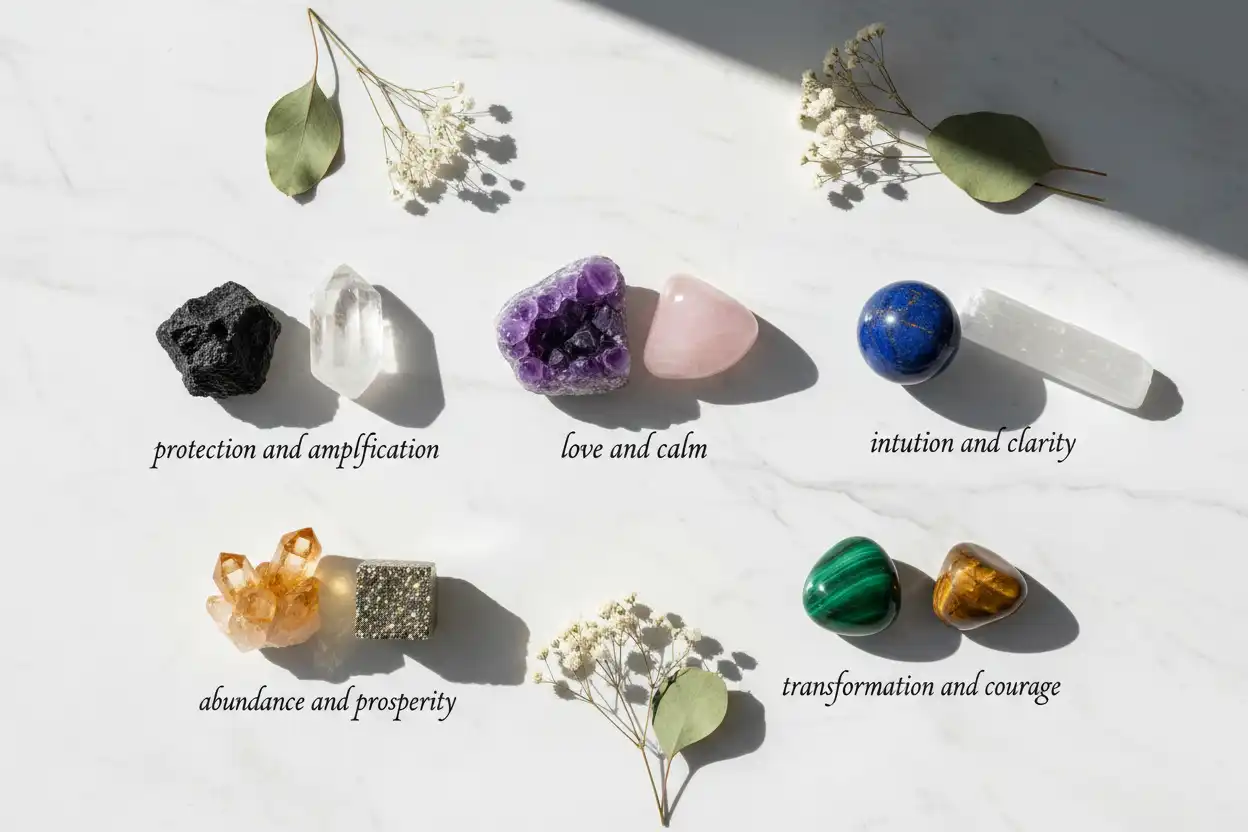
Crystal Pairings: Which Stones Work Together?
Crystal pairing means using two or more stones together because their traditional symbolism, colors or practical purpose support the same intention.
There is no scientifically proven energetic formula that makes one pairing universally correct. A useful combination should feel coherent, remain physically safe and support a clear real-world goal.
Good pairings are usually simple. Two or three thoughtfully selected stones are often easier to understand and maintain than a large collection used without a clear purpose.
How to Choose a Crystal Pairing
Use four questions:
- What is the main intention?
- What traditional role does each stone have?
- Are their care requirements compatible?
- Does the combination support a practical action?
For example, a pairing for confident communication might combine one stone traditionally associated with calm expression and another linked with courage.
A pairing should not include several materials merely because they are popular.
Traditional Meaning vs. Physical Compatibility
Two stones may seem symbolically compatible but still need different physical care.
Examples include:
- A hard quartz stone stored beside soft calcite.
- Water-tolerant quartz paired with water-soluble selenite.
- Sun-stable jasper combined with light-sensitive fluorite.
- A polished stone placed beside a sharp crystal cluster.
- A safe jewelry gem mixed with a toxic collector mineral.
Always separate symbolic pairing from cleaning, storage and handling decisions.
Clear Quartz and Amethyst
This is a popular pairing for reflection, mental clarity and intentional routines.
Clear quartz is traditionally associated with:
- Focus.
- Clarity.
- Intention.
- Amplification.
- Direction.
Amethyst is traditionally associated with:
- Reflection.
- Restraint.
- Calm.
- Thoughtful decision-making.
- A peaceful environment.
Together, they may suit:
- Meditation.
- Journaling.
- Study.
- Evening reflection.
- A simple bedside display.
Both are quartz varieties and have similar scratch resistance. However, amethyst can fade after prolonged strong sunlight.
Rose Quartz and Green Aventurine
This pairing is traditionally used for compassion, optimism and healthy emotional growth.
Rose quartz is commonly linked with:
- Affection.
- Self-respect.
- Gentleness.
- Compassion.
- Emotional openness.
Green aventurine is associated with:
- Opportunity.
- Growth.
- Optimism.
- Confidence.
- Practical renewal.
This pairing may be used when working on:
- Building self-confidence.
- Creating healthier relationship habits.
- Recovering from disappointment.
- Remaining open without ignoring boundaries.
- Beginning a new social or creative project.
Both materials are quartz-rich and generally practical for beads, bracelets and polished displays.
Carnelian and Citrine
Carnelian and citrine are often paired for motivation, creativity and visible action.
Carnelian is traditionally associated with:
- Courage.
- Creative energy.
- Initiative.
- Confidence.
- Taking the first step.
Citrine is linked with:
- Optimism.
- Productive thinking.
- Personal value.
- Generosity.
- Following through.
This pairing may support intentions involving:
- Starting a project.
- Preparing a presentation.
- Applying for an opportunity.
- Completing delayed work.
- Building a consistent creative routine.
Both belong to the quartz family and can be worn together easily. Strong heat and prolonged light exposure should still be avoided when color origin is uncertain.
Black Tourmaline and Smoky Quartz
This is a common pairing for grounding, boundaries and remaining practical during stress.
Black tourmaline is traditionally associated with:
- Protection.
- Boundaries.
- Self-control.
- Grounding.
- Awareness of personal limits.
Smoky quartz is traditionally linked with:
- Practical judgment.
- Focus.
- Stability.
- Releasing distraction.
- Remaining present.
Together, they may suit:
- A workspace.
- Difficult conversations.
- Travel.
- Boundary-setting practices.
- Reducing an overstimulating collection.
Black tourmaline crystals may fracture along internal weaknesses, while smoky quartz can chip around points and existing fractures. Store the pieces so they do not strike each other.
Lapis Lazuli and Sodalite
Lapis lazuli and sodalite are traditionally paired for communication, learning and thoughtful expression.
Lapis lazuli is associated with:
- Wisdom.
- Truthful expression.
- Confidence.
- Perspective.
- Historical symbolism.
Sodalite is linked with:
- Logic.
- Clear thinking.
- Organization.
- Communication.
- Evaluating information.
This pairing may suit:
- Writing.
- Studying.
- Preparing for a meeting.
- Speaking more clearly.
- Balancing logic with self-expression.
Both stones are softer and more chemically sensitive than quartz. Avoid acids, perfume and prolonged soaking.
Moonstone and Labradorite
Moonstone and labradorite belong to the feldspar family and are traditionally paired for change, intuition and self-reflection.
Moonstone is associated with:
- New beginnings.
- Emotional awareness.
- Reflection.
- Adaptability.
- Natural cycles.
Labradorite is traditionally linked with:
- Transformation.
- Creativity.
- Recognizing hidden strengths.
- Confidence during change.
- Perspective.
The combination may support:
- Moving into a new role.
- Beginning a personal project.
- Adjusting to a changing routine.
- Journaling through uncertainty.
- Reflecting before making a decision.
Both stones have feldspar cleavage and should be protected from sharp impacts, pressure and ultrasonic cleaning.
Fluorite and Tiger’s Eye
This pairing combines traditional themes of organization and practical confidence.
Fluorite is associated with:
- Focus.
- Learning.
- Organization.
- Recognizing patterns.
- Reducing mental clutter.
Tiger’s eye is traditionally linked with:
- Discipline.
- Practical courage.
- Balanced risk.
- Follow-through.
- Clear priorities.
This pairing may suit:
- Exam preparation.
- Financial planning.
- Complex work.
- Decision-making.
- Creating a more structured routine.
Fluorite is significantly softer and more cleavable than tiger’s eye. Do not store them loose together, and do not use one cleaning method for both without checking their requirements.
Blue Lace Agate and Aquamarine
This gentle blue pairing is traditionally used for calm communication.
Blue lace agate is associated with:
- Patient expression.
- Listening.
- Thoughtful speech.
- Reducing tension.
- Speaking at a measured pace.
Aquamarine is linked with:
- Composure.
- Communication.
- Confidence.
- Safe travel.
- Emotional clarity.
Together, they may support:
- Preparing for a difficult conversation.
- Public speaking.
- Writing a sensitive message.
- Setting a boundary respectfully.
- Asking for help clearly.
Aquamarine is harder than blue lace agate, so separate storage compartments are preferable.
Red Jasper and Hematite
Red jasper and hematite are traditionally paired for endurance and practical grounding.
Red jasper is associated with:
- Stability.
- Persistence.
- Gradual progress.
- Physical confidence.
- Practical action.
Hematite is linked with:
- Grounding.
- Determination.
- Clear judgment.
- Personal responsibility.
- Staying focused on facts.
This pairing may suit:
- Long projects.
- Consistent exercise habits.
- Managing a demanding schedule.
- Building routine.
- Returning attention to practical priorities.
Hematite should be dried after cleaning, and magnetic imitation products should not automatically be treated as natural hematite.
Rhodonite and Rhodochrosite
These pink manganese minerals are traditionally paired for self-respect, emotional honesty and constructive relationships.
Rhodonite is associated with:
- Forgiveness.
- Boundaries.
- Conflict resolution.
- Emotional balance.
- Responding constructively.
Rhodochrosite is linked with:
- Self-worth.
- Compassion.
- Emotional openness.
- Reflection.
- Recognizing repeated patterns.
The pairing may be meaningful during:
- Relationship reflection.
- Recovery from conflict.
- Boundary-setting.
- Journaling.
- Personal growth work.
Rhodochrosite is softer and more acid-sensitive than rhodonite. Keep both away from vinegar, perfume and harsh cleaning agents.
Obsidian and Onyx
Obsidian and onyx are visually similar dark materials but belong to different categories.
Obsidian is natural volcanic glass traditionally associated with:
- Self-awareness.
- Protection.
- Truth.
- Reflection.
- Recognizing hidden concerns.
Onyx is chalcedony traditionally linked with:
- Discipline.
- Stability.
- Boundaries.
- Self-control.
- Consistency.
Together, they may suit a personal boundary or focus practice.
Obsidian can chip into sharp edges, while onyx generally offers greater toughness. Store them separately to reduce edge damage.
Sunstone and Moonstone
Sunstone and moonstone are often paired as complementary feldspar gems.
Sunstone is associated with:
- Confidence.
- Optimism.
- Independence.
- Visibility.
- Creative expression.
Peach, white and rainbow moonstone varieties are linked with reflection, transition and emotional awareness.
The pairing may symbolize:
- Action and reflection.
- Confidence and intuition.
- Visibility and privacy.
- Beginning and reviewing.
- Giving and receiving.
Both materials have cleavage and should be worn or stored with impact protection.
How Many Crystals Should You Pair?
Two stones are enough for most intentions.
Use three when each material has a clear role, such as:
- One central intention stone.
- One supportive stone.
- One grounding stone.
Large combinations are not automatically stronger. Too many stones can make the purpose unclear or create storage and care complications.
The guide to how many crystals you can carry explains practical limits for jewelry, pockets and travel.
Crystal Pairings for Common Intentions
| Intention | Example pairing |
|---|---|
| Focus | Fluorite + tiger’s eye |
| Creativity | Carnelian + citrine |
| Calm communication | Blue lace agate + aquamarine |
| Compassion | Rose quartz + green aventurine |
| Grounding | Black tourmaline + smoky quartz |
| Reflection | Clear quartz + amethyst |
| Change | Moonstone + labradorite |
| Discipline | Red jasper + hematite |
| Boundaries | Obsidian + onyx |
| Emotional growth | Rhodonite + rhodochrosite |
These associations are traditional rather than scientifically established effects.
Pairing Crystals by Color
Color can provide a simple visual theme.
Red and Orange
Often used to symbolize:
- Confidence.
- Motivation.
- Creativity.
- Action.
- Visibility.
Yellow and Gold
Often associated with:
- Optimism.
- Clarity.
- Personal value.
- Learning.
- Purpose.
Green and Pink
Commonly linked with:
- Growth.
- Relationships.
- Compassion.
- Renewal.
- Emotional balance.
Blue
Frequently associated with:
- Communication.
- Calm.
- Reflection.
- Logic.
- Listening.
Purple and Clear
Often used for:
- Introspection.
- Focus.
- Spiritual symbolism.
- Mental organization.
- Meditation.
Black and Brown
Commonly associated with:
- Grounding.
- Stability.
- Boundaries.
- Protection.
- Practical thinking.
Color does not identify a mineral or guarantee that two stones share the same care requirements.
Pairing by Mineral Family
Stones within the same mineral family may share some physical characteristics.
Examples include:
- Amethyst and citrine as quartz varieties.
- Ruby and sapphire as corundum.
- Aquamarine and morganite as beryl.
- Moonstone and labradorite as feldspar.
- Pyrope and grossular as garnets.
However, inclusions, treatments, crystal structure and jewelry settings can still change care requirements.
Pairings That Need Extra Care
Some combinations are not spiritually “bad,” but they are physically inconvenient.
Hard and Soft Stones
A harder stone can scratch a softer one during storage.
Check comparative scratch resistance with the gemstone hardness chart.
Water-Tolerant and Water-Sensitive Stones
Do not soak an entire pairing simply because one stone tolerates water.
Review which crystals can and cannot go in water before cleaning a bracelet or grid containing mixed materials.
Light-Stable and Light-Sensitive Stones
Fluorite, amethyst, kunzite and some other colored stones may fade or change after prolonged light exposure.
Consult the guide to crystals that fade in sunlight before placing a combination near a window.
Stable Gems and Hazardous Minerals
Do not pair wearable gems with arsenic-, lead- or mercury-bearing collector minerals in jewelry, pockets or bedside displays.
Smooth Stones and Sharp Clusters
A quartz point, zeolite spray or rough obsidian edge may damage other stones or skin.
Do Any Crystals Cancel Each Other Out?
There is no scientific evidence that one crystal cancels another crystal’s energy.
People may still find some symbolic combinations confusing. For example:
- A calming intention paired with many stones associated with intense action.
- A focus practice using a visually distracting collection.
- A sleep display containing sharp, stimulating or uncomfortable pieces.
- A boundary intention paired with stones chosen only to please someone else.
The issue is usually clarity, physical compatibility or personal preference rather than cancellation.
The article on crystals you should not combine explains practical reasons some combinations need separation.
How to Use a Crystal Pairing
You can use two or three stones as:
- A bracelet combination.
- A pendant and pocket stone.
- A desk display.
- A meditation arrangement.
- A journaling prompt.
- A small grid.
- A visual reminder near a goal list.
A step-by-step layout appears in the crystal grid guide.
How to Set an Intention for a Pairing
Hold or place the stones together and state one clear purpose.
For example:
“These stones remind me to communicate calmly and speak honestly.”
Then identify a practical action, such as:
- Preparing notes.
- Scheduling focused work.
- Setting a boundary.
- Asking a direct question.
- Taking a break before responding.
The stones function as reminders. They do not remove the need for action.
Frequently Asked Questions
What is the best crystal pairing?
There is no universal best pairing. The most useful combination supports one clear intention and remains physically safe.
Can I pair any two crystals?
You can place most stable stones together symbolically, but consider hardness, toxicity, solubility, light sensitivity and sharp surfaces.
Can I wear several crystal bracelets together?
Yes, provided the bracelets are comfortable, do not damage one another and do not contain unsafe materials.
Is clear quartz compatible with every stone?
Clear quartz is commonly paired with many materials, but it can scratch softer stones during loose storage.
Can two calming stones make me too tired?
There is no scientific evidence that a crystal combination causes sedation. Personal expectations and associations can still influence how a display feels.
Do crystals need to touch to work together?
No. They may be placed near each other, worn separately or used at different times.
Should paired crystals be cleansed together?
Only when the selected method is safe for every material. Otherwise, clean each stone separately.
Can I change a pairing?
Yes. Adjust the combination when your intention, preferences or practical needs change.
Continue Exploring
Use your chosen combination with the intention-setting steps in How to Program Crystals, or explore more guides in the Crystals 101 collection.