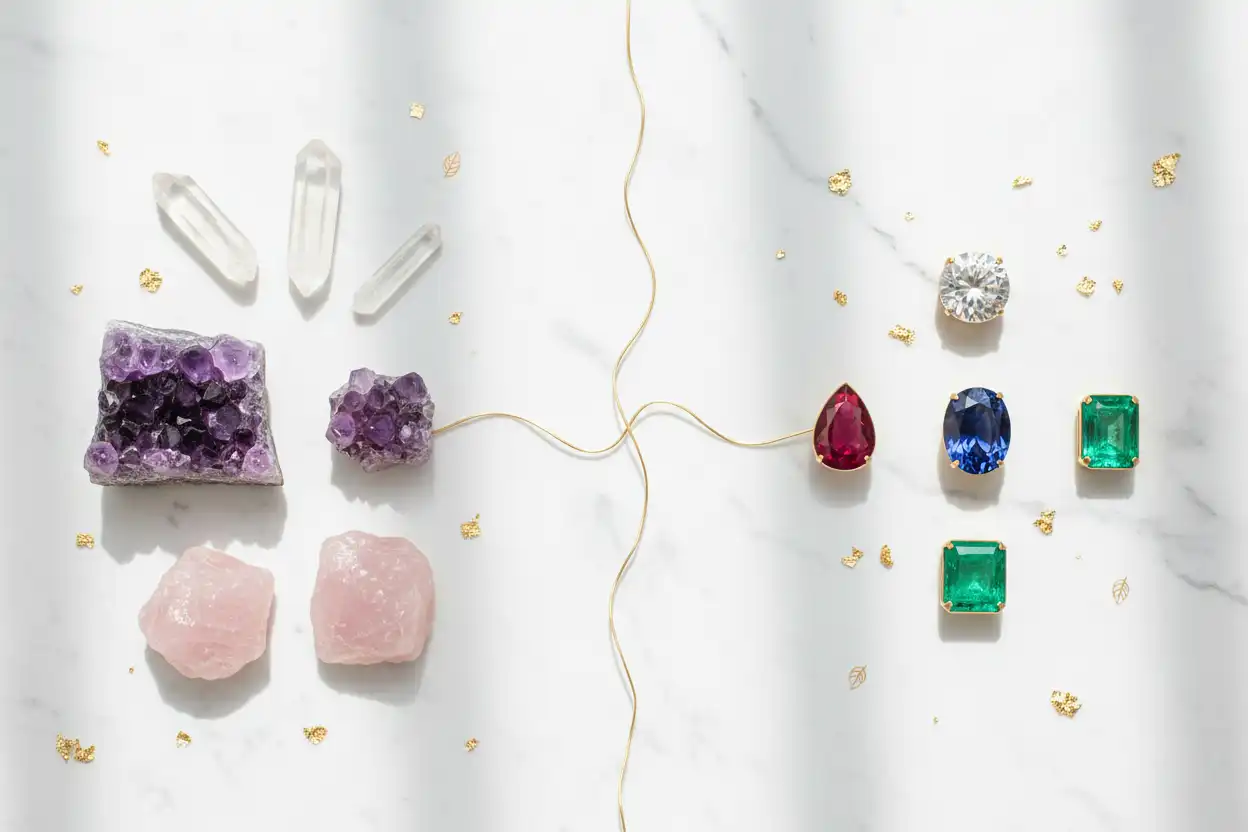
Crystals vs Gemstones Difference: Facts, Tests & Value
The crystals vs gemstones difference is not a simple choice between two separate families of natural objects, because “crystal” and “gemstone” describe different kinds of classification. In mineralogy, a crystal is a solid whose atoms, ions, or molecules are arranged in an ordered structure, and the word can refer to an individual crystal, crystalline material, or—in less precise commercial language—almost any attractive mineral specimen. A gemstone, by contrast, is a material valued for ornamental use because qualities such as beauty, rarity, durability, polish, color, optical effect, cultural significance, or craftsmanship make it suitable for jewelry, carving, collecting, or decorative work. Many gemstones are crystalline minerals, but not every crystal is considered a gemstone, and some recognized gem materials are not mineral crystals at all.
That distinction explains why the crystals vs gemstones difference cannot be determined by sparkle, transparency, price, spiritual use, or whether an object has a pointed termination. A natural quartz point is a crystal. The same quartz cut into a faceted stone can be a gemstone. Halite can form excellent natural crystals while rarely functioning as a practical gemstone because it is soft and water-soluble. Opal is widely treated as a gemstone even though precious opal lacks the long-range crystalline structure expected of an ordinary mineral crystal and is classified as a mineraloid. Amber, pearl, coral, lapis lazuli, jade aggregates, glass, synthetic gems, and other materials make the boundary still more nuanced.
Within Gems Lore’s Crystals 101 reference system, the useful crystals vs gemstones difference is therefore functional rather than hierarchical. “Crystal” primarily tells you something about structure or specimen form when used precisely, while “gemstone” tells you that a material is being selected and evaluated for gem or ornamental use. Neither term automatically means natural, rare, untreated, valuable, healing, durable, or superior.
Crystals vs Gemstones Difference at a Glance
| Question | Crystal | Gemstone |
|---|---|---|
| What does the term primarily describe? | Ordered atomic structure or an individual crystalline specimen | Material selected for ornamental, gemological, jewelry, carving, or collector use |
| Must it be a mineral? | A natural mineral crystal commonly is, but synthetic crystals also exist | No; gemstones can include minerals, mineraloids, rocks, organic or biogenic materials, and manufactured materials |
| Must it have visible crystal faces? | No; crystalline material can be massive or microscopic | No |
| Can it be natural? | Yes | Yes |
| Can it be synthetic? | Yes | Yes |
| Can a crystal also be a gemstone? | Yes; quartz, sapphire, topaz, emerald, and many others are examples | Yes, if the gem material is crystalline |
| Can a gemstone be noncrystalline? | The category “crystal” would not apply precisely | Yes; opal and glass are familiar examples |
| Is every natural crystal valuable? | No | No |
| Is every gemstone rare? | No | No |
| Does either word prove treatment status? | No | No |
| Does either word prove durability? | No | No |
| Does either word prove metaphysical effects? | No | No |
| Best way to evaluate it | Identify the material and structure | Identify material, treatment, quality, durability, workmanship, and market context |
The crystals vs gemstones difference becomes especially easy to remember through three examples. A terminated quartz specimen can be both a natural crystal and collectible mineral without ever being cut into jewelry. A faceted sapphire is simultaneously a crystal-derived mineral material and a gemstone. A precious opal cabochon is clearly a gemstone but is not an ordinary mineral crystal. Those examples show why “crystal versus gemstone” is not a strict either-or classification.
What Does “Crystal” Mean Scientifically?
In scientific usage, a crystal possesses an ordered internal arrangement repeated through three-dimensional space. That atomic organization influences properties such as symmetry, cleavage, optical behavior, crystal habit, diffraction patterns, and—in some materials—anisotropy. The recognizable external faces of a natural crystal can reflect this internal structure, but a crystal does not need to grow into a perfect geometric specimen to remain crystalline.
Quartz provides an accessible example. Its internal silicon-oxygen framework has ordered crystallographic structure whether the material appears as a beautifully terminated point, a massive vein, microscopic grains in a rock, or a faceted transparent gemstone. Cutting away every natural crystal face does not erase the internal crystalline structure.
This distinction is helpful when learning raw crystals, because “raw” usually describes the degree of cutting or polishing rather than crystallinity itself. A raw specimen may preserve natural crystal faces, but rough massive material can also be crystalline without showing obvious points.
What Does “Gemstone” Mean?
Gemstone is primarily a gemological, commercial, ornamental, and cultural category rather than one structural mineral class. Gem materials are selected because people value them for appearance, rarity, durability, optical effects, workmanship, tradition, collectibility, or some combination of these qualities. Many gemstones are cut and polished, but exceptional natural crystals can also be valued as gems or collectors’ specimens without conventional faceting.
The gemstone category consequently includes materials that mineralogy separates sharply. Diamond is crystalline carbon. Ruby and sapphire are crystalline corundum. Emerald is crystalline beryl. Opal is a mineraloid. Lapis lazuli is a rock composed of multiple minerals. Amber is fossilized organic resin. Pearl is biogenic material formed by mollusks. Coral is biologically produced skeletal material. Glass and synthetic cubic zirconia can function as gem materials even though their origins differ completely from mined mineral crystals.
The crystals vs gemstones difference therefore rests less on appearance than on what question the term answers. “What is this structurally?” invites mineralogical terminology. “Is this material used and evaluated as a gem?” invites gemological terminology.
Identity Table: Examples That Break the Simple Either-Or Model
| Material or object | Crystal? | Gemstone? | Why |
|---|---|---|---|
| Natural clear quartz point | Yes | Sometimes | Crystalline quartz; can be collected as a mineral specimen or used ornamentally |
| Faceted rock crystal quartz | Yes | Yes | Same crystalline quartz, cut specifically for gem use |
| Sapphire | Yes | Yes | Crystalline corundum widely used as a gemstone |
| Emerald | Yes | Yes | Crystalline beryl valued as a gemstone |
| Halite cube | Yes | Usually not practical as a gem | Natural crystal, but very soft and water-soluble |
| Calcite crystal | Yes | Occasionally ornamental | Crystalline mineral, but softness and cleavage limit jewelry use |
| Precious opal | Not a conventional mineral crystal | Yes | Mineraloid widely accepted as a gemstone |
| Amber | No | Yes | Organic fossil resin used as a gem material |
| Pearl | No in the ordinary mineral-crystal sense | Yes | Biogenic gem material |
| Precious coral | No as a mineral crystal object | Yes | Biogenic skeletal gem material |
| Lapis lazuli | Made of crystalline minerals but is a rock | Yes | Gem rock rather than one mineral crystal |
| Jadeite jade | Crystalline aggregate | Yes | Polycrystalline mineral aggregate used as a gem |
| Glass imitation | No crystalline structure in ordinary glass | Can function as imitation gem material | Manufactured amorphous material |
| Synthetic sapphire | Yes | Yes | Laboratory-grown crystalline corundum used as a gemstone |
This table is the clearest answer to the crystals vs gemstones difference because it shows that the categories overlap rather than exclude each other. A material can belong to both, one, or—in ordinary decorative objects—neither.
Visual Clues Cannot Reliably Separate Crystals From Gemstones
Visual appearance is useful for describing an object, but it is a poor way to divide crystals from gemstones. A pointed transparent specimen may look obviously “crystal-like,” yet the same mineral can be cut into an oval cabochon or faceted gem and lose every visible trace of its original growth form. Conversely, a carved object can be cut into a point or tower even when the rough material never naturally formed that geometry.
The marketplace adds further confusion because “crystal” is often used as a lifestyle or retail term. Polished spheres, hearts, palm stones, glass ornaments, agate slabs, mineral clusters, and carved towers may all be called crystals even when that wording is scientifically broad. Learning palm stones and tumbled stones makes the distinction particularly clear: polishing style tells you how an object was shaped, not whether its constituent material has crystalline structure.
Likewise, faceting does not turn an object into a mineral crystal. Faceted glass remains glass. A cut opal remains opal. The finished shape describes workmanship, while structure and composition establish material identity.
An Original Same-Light, Same-Scale Comparison Framework
A practical crystals vs gemstones difference comparison can be photographed using four carefully selected objects: a natural quartz point, a faceted colorless quartz gem, a polished opal cabochon, and a halite crystal. Place all four objects on the same neutral background, include a scale reference, keep camera distance fixed, and photograph them under identical diffused illumination. This prevents one object from appearing more brilliant or transparent merely because it received stronger lighting or closer macro photography.
The first comparison should focus on exterior form. The quartz point preserves natural growth faces and termination geometry, whereas the faceted quartz shows human-designed planes created through cutting. Despite their radically different appearance, both can share the same underlying mineral species. This pair demonstrates that natural crystal shape and gemstone presentation are separate variables.
The second comparison should focus on category boundaries. Precious opal can be an important gemstone even without ordinary crystalline structure, while an excellent halite cube can be unquestionably crystalline but poorly suited to ordinary gem wear because of its softness and water sensitivity. This pair demonstrates that crystallinity is neither necessary nor sufficient for gemstone status.
A third photograph under transmitted light can compare transparency, inclusions, play-of-color, facet reflections, and crystal boundaries without implying that any of these effects define the category. A final macro image can show natural quartz growth surfaces beside faceted polish, reinforcing the difference between geological morphology and lapidary workmanship.
Optical Data Belong to the Material, Not the Label
There is no universal refractive index for “crystals” and another for “gemstones.” Optical properties belong to specific materials. Quartz has its own refractive indices and birefringence, sapphire has different values, diamond behaves differently again, and amorphous opal has another optical profile. Two gemstones can therefore differ more optically from each other than a rough crystal and faceted gem of the same mineral.
The same logic applies to optic character. Some crystalline gem materials are singly refractive, some doubly refractive, and others show more complex behavior according to crystal system and composition. Glass and many amorphous gem materials behave differently because they lack the same long-range crystallographic order.
Optical testing is consequently useful for identifying a substance, but not for deciding whether an object deserves the commercial word gemstone. A refractometer might help establish quartz, corundum, topaz, or another material, yet gemstone status still depends on how that material is being used and evaluated.
A Natural Quartz Crystal and a Quartz Gem Can Be the Same Substance
The strongest illustration of the crystals vs gemstones difference is quartz because one mineral can move between the categories without changing chemical identity. A transparent natural quartz point composed of SiO₂ may be collected because its termination, inclusions, locality, matrix, or growth form is attractive. A cutter can take another piece of transparent quartz and facet it into an ornamental gemstone.
The second object has lost its natural exterior crystal faces, but it has not stopped being crystalline internally. Both objects remain quartz. The difference is presentation and use.
This explains why learning how to choose a crystal should begin with the user’s actual objective. Someone choosing a mineral specimen may prioritize natural habit, matrix, locality, and preservation. Someone choosing a gemstone may prioritize cut, polish, optical appearance, durability, treatment disclosure, and suitability for a setting. Neither set of criteria is universally superior.
Natural, Synthetic, and Imitation Are Separate Questions
The crystals vs gemstones difference should never be confused with natural versus synthetic. Scientists and industry can grow genuine crystals in controlled environments. Synthetic sapphire, synthetic ruby, synthetic quartz, synthetic diamond, and numerous other materials possess crystalline structures and may have essentially the same fundamental composition as their natural counterparts.
A synthetic sapphire can therefore be both a crystal and a gemstone. What it is not is naturally formed geological sapphire. “Synthetic” describes origin, not automatically chemical falseness.
Imitation is different. Glass cut to resemble sapphire may function visually as a sapphire simulant while remaining glass. Cubic zirconia can imitate diamond’s appearance while being a different material with its own structure and composition. Correct disclosure separates identity, origin, and intended resemblance rather than using the vague word fake for every manufactured object.
Treatments Do Not Decide Whether Something Is a Crystal or Gemstone
Heat treatment, irradiation, fracture filling, dyeing, diffusion treatment, impregnation, coating, bleaching, and other processes can modify gem materials without changing the basic meaning of crystal versus gemstone. A heated sapphire is still crystalline corundum and remains a gemstone. Dyed agate remains silica-rich gem material while its color history has changed. A coated quartz crystal remains quartz underneath the coating even though its surface appearance has been altered.
Treatment matters primarily for disclosure, value, durability, identification, and consumer expectations. The broader gemstone treatments explained framework is useful because it keeps treatment separate from identity rather than assuming “treated” means non-gem or noncrystalline.
The crystals vs gemstones difference therefore needs three independent questions: What is the material? How did it originate? What has happened to it since formation or manufacture?
Durability Depends on Species, Not Whether the Seller Calls It a Crystal
A common misconception is that gemstones are durable while crystals are fragile. In reality, both words cover materials with an enormous range of mechanical behavior. Diamond is extremely hard but can still cleave. Corundum is hard and generally durable. Quartz has good hardness and no true cleavage. Fluorite is softer and has strong cleavage. Calcite is soft. Gypsum is softer still. Halite scratches easily and dissolves readily in water.
The same range exists inside the gemstone category. Opal can be vulnerable to impact and environmental changes, pearl surfaces abrade more easily than sapphire, and amber requires different care from quartz. Calling these materials gemstones does not standardize their hardness.
Durability should therefore be assessed through hardness, toughness, cleavage, fracture, porosity, sensitivity to heat or chemicals, treatments, inclusions, and the intended use. A material’s name matters far more than whether it was placed under a “crystals” or “gemstones” menu.
Wear and Jewelry Suitability
When the crystals vs gemstones difference is being asked because someone wants jewelry, the relevant question is not “Is a gemstone better than a crystal?” It is “What is the material, and is this particular material suitable for this type of wear?” A quartz crystal and faceted quartz gem have essentially the same inherent hardness, but the shape and setting can make one far more vulnerable than the other.
An exposed natural point on a ring may snag, chip at the termination, or receive direct impact even though quartz itself has useful hardness. A low-profile faceted or cabochon quartz stone in a protective setting may perform much better. Conversely, a beautiful fluorite gemstone remains relatively soft and cleavage-prone despite expert cutting.
This is why jewelry suitability should always be evaluated material by material. Commercial labels cannot substitute for physical engineering.
Care Also Follows the Material
There is no universal “crystal cleaning method” that is safe for every crystal, and there is no universal gemstone cleaning method either. Water, salt, sunlight, steam, ultrasonic cleaners, acids, alkalis, heat, alcohol, and household chemicals affect different materials differently.
Quartz may tolerate conditions that damage gypsum. Pearl and coral require care very different from sapphire. Opal should not be treated as though it were chemically identical to agate. Fracture-filled gems may have care limits that untreated specimens of the same mineral do not share.
For unwanted objects, the same principle applies to how to dispose of crystals: identify the material before choosing disposal, recycling, donation, reuse, or handling methods. A heavy-metal-bearing ore specimen and an ordinary quartz pebble should not automatically receive the same advice simply because both were sold as crystals.
Value: Neither “Crystal” Nor “Gemstone” Guarantees High Price
The crystals vs gemstones difference is especially misunderstood when price enters the discussion. A spectacular natural crystal specimen can be worth considerably more than an ordinary faceted gemstone, while an exceptional gemstone can be worth far more than most mineral specimens. Market value follows the specific object and market rather than the category label.
For mineral crystals, value may reflect crystal size, perfection, rarity of habit, matrix aesthetics, associated minerals, locality, provenance, historical collection history, damage, and scientific significance. For gemstones, value may depend on species, variety, color, transparency, optical phenomena, cut, size, treatment, origin documentation, rarity, craftsmanship, and market demand.
These valuation systems overlap but are not identical. Cutting a valuable natural crystal can even destroy much of its specimen value, while cutting unattractive rough into a well-proportioned gemstone can dramatically increase its ornamental usefulness. Value follows the intended market.
A Decision Matrix: Crystal, Gemstone, or Both?
| Your goal | What to prioritize | Why the crystals vs gemstones difference matters |
|---|---|---|
| Collect natural mineral growth | Natural crystal habit, matrix, locality, provenance, condition | A polished gem may remove the geological features you want |
| Buy everyday jewelry | Material durability, treatment, cut, setting, workmanship | “Crystal” terminology tells you almost nothing about wear |
| Buy a faceted stone | Species, optical quality, cut, treatment, dimensions, documentation | Gemological criteria matter more than natural external crystal shape |
| Buy a display specimen | Crystal aesthetics, stability, matrix, provenance | A crystal may be valuable without being suitable for jewelry |
| Buy a carved object | Material identity, carving quality, fractures, treatment | The carved form can hide natural crystal habit |
| Study crystallography | Natural faces, symmetry, growth, twinning, structure | Gem cutting may remove much of the visible crystallographic evidence |
| Choose a symbolic object | Material, practical safety, personal symbolism | Metaphysical labels should remain separate from identification |
| Buy for resale | Comparable market, documentation, treatment, provenance, condition | Neither word alone predicts liquidity or future value |
| Verify authenticity | Test the material itself | Category labels are insufficient |
| Compare prices | Compare equivalent objects | A collector crystal and a calibrated faceted gem are different markets |
This matrix shows why the crystals vs gemstones difference should lead to a better purchasing question rather than an argument over which category is superior. The right category depends on the reader’s objective.
When a Crystal Is the Better Choice
A natural crystal is usually the more appropriate choice when the objective is to preserve geological formation, study crystallography, collect locality material, observe matrix relationships, or appreciate natural growth surfaces. An intact crystal can retain evidence about twinning, dissolution, contact faces, inclusions, zoning, overgrowth, and associated minerals that polishing may remove permanently.
Collectors may also value uniqueness. Two naturally formed crystal groups are rarely identical because each records a particular growth environment. A calibrated gemstone, by contrast, may intentionally be cut toward standardized dimensions and symmetry.
Lists such as crystals that start with V, crystals that start with W, crystals that start with X, crystals that start with Y, and crystals that start with Z are useful for discovering mineral names, but each material still needs its own identification and use criteria. Alphabetical placement never determines whether it is a practical gem.
When a Gemstone Is the Better Choice
Gemstone-oriented material is usually the better fit when predictable jewelry dimensions, polished appearance, controlled shape, optical presentation, matching, or setting compatibility matter. Faceting can increase brilliance, cabochon cutting can emphasize color or phenomena, and calibrated dimensions make replacement or standardized mounting easier.
A gemstone can also offer more complete commercial disclosure when sold through serious gemological channels. Weight, measurements, treatment status, material identity, cutting style, and sometimes laboratory documentation may be available in a format designed specifically for jewelry decisions.
That does not make a gemstone inherently more natural. In fact, gem cutting is an intentional transformation of raw material. The benefit is not untouched geology but controlled ornamental performance.
Laboratory Testing: What Can Actually Be Determined?
A gemological or mineralogical laboratory can often identify the material underlying the crystals vs gemstones difference. Depending on the object, testing may include refractive index, specific gravity, magnification, spectroscopy, polarized-light behavior, fluorescence, Raman spectroscopy, infrared spectroscopy, X-ray diffraction, chemical analysis, or other methods.
These tests can help determine whether an object is quartz, corundum, topaz, glass, opal, synthetic material, composite, or another substance. In some cases they can also identify treatments or distinguish natural from laboratory-grown origin.
What a laboratory cannot do is determine gemstone status through one universal scientific threshold. A laboratory can identify a halite crystal, but whether someone chooses to market or collect it as a gem is partly a use and market question. Likewise, it can identify opal even though opal does not fit the ordinary mineral-crystal definition.
Visual inspection alone is often insufficient when material identity, synthetic origin, treatment, or substantial value is at stake.
When Photographs Are Not Enough
Photographs can show color, transparency, crystal habit, cutting style, polish, visible inclusions, matrix, damage, and approximate dimensions when scale is included. They are especially useful for distinguishing a natural termination from an obviously polished point or for seeing whether an object is a faceted gem rather than a raw specimen.
They cannot directly measure refractive index, density, hardness, chemical composition, crystal structure, or many treatments. A colorless faceted object could be quartz, glass, synthetic spinel, topaz, sapphire, cubic zirconia, diamond, or another material depending on its properties.
This limitation should be stated plainly whenever the crystals vs gemstones difference becomes an identification problem. Appearance begins the investigation; testing finishes it when the stakes justify stronger evidence.
Does a Crystal Become a Gemstone When It Is Cut?
Sometimes, but cutting is not the only requirement. A natural quartz crystal cut and polished for ornamental use can reasonably be described as gemstone material. The transformation changes presentation and market role while the material remains crystalline quartz.
However, cutting an unsuitable mineral does not automatically make it a commercially meaningful gemstone. Halite can be faceted experimentally, but its softness and water solubility limit practical use. Calcite can produce fascinating faceted stones, yet strong cleavage and low hardness restrict ordinary wear.
Gemstone status is therefore practical and contextual. The material must be considered together with use, attractiveness, workmanship, durability, and market convention.
Are Polished Stones Still Crystals?
If the underlying material is crystalline, polishing does not remove its internal crystal structure. A quartz sphere is still composed of crystalline quartz after every natural external face has been ground away. A polished fluorite object remains crystalline fluorite. A tumbled amethyst remains crystalline quartz.
What polishing removes is external geological morphology. This matters because a mineral collector may distinguish between a natural crystal specimen and a polished object even though both contain the same crystalline material.
The crystals vs gemstones difference therefore depends partly on whether “crystal” is being used scientifically to describe structure or casually to describe a particular natural-looking object.
Are All Gemstones Minerals?
No. This is one of the most important facts in understanding the crystals vs gemstones difference. Many famous gemstones are minerals, but the gem category extends beyond mineral species.
Opal is a mineraloid. Amber is organic fossil resin. Pearl is biogenic. Coral is biologically produced skeletal material. Lapis lazuli is a rock containing multiple minerals. Some commercial gem products are manufactured or synthetic.
Gemstone is consequently a broader ornamental category than mineral crystal.
Are All Minerals Crystals?
Minerals are generally characterized by ordered structures, although the way crystallinity appears macroscopically varies dramatically. A mineral does not need to display a beautiful geometric crystal form visible to the eye. Massive quartz, microscopic crystalline aggregates, and fine-grained minerals remain structurally ordered.
This is another reason retail language can be confusing. A customer may say “this stone isn’t a crystal because it has no point,” while mineralogy may describe its constituent material as crystalline. External shape and internal structure are separate issues.
Crystals, Gemstones, and Symbolic Meaning
Modern metaphysical practice often uses “crystal” broadly for gemstones, minerals, mineraloids, glass-like materials, and carved objects. Within that cultural vocabulary, the term functions differently from strict mineralogical usage. A person may therefore call rose quartz, obsidian, opal, amber, or a polished agate “crystals” when discussing symbolism even though the scientific categories are more precise.
That language can be accommodated as long as the physical identity remains accurate. Symbolic use does not change mineral structure, treatment, durability, provenance, or safety.
Likewise, neither crystals nor gemstones have scientifically demonstrated universal healing powers merely because they are crystalline, rare, transparent, or aesthetically attractive. Personal ritual can use them as reminders, meditation objects, gifts, cultural symbols, or prompts for reflection without presenting the material as medical treatment.
Buying Tradeoffs: What the Label Can Hide
A product described simply as “natural crystal” may omit treatment, locality evidence, repair, coating, synthetic origin, or even precise mineral identity. A product described as a gemstone may still omit those same facts. The wording sounds informative while sometimes answering very little.
A stronger listing identifies the material first. It then explains whether it is natural, synthetic, treated, assembled, coated, carved, polished, faceted, repaired, or matrix-bearing as appropriate. Measurements and weight should be provided, while provenance should be distinguished from visual assumption.
This reader-first approach is part of Gems Lore’s About framework: material identity, observable evidence, treatment disclosure, cultural interpretation, and uncertainty should not be collapsed into one marketing label.
Value Tradeoffs Between Specimen and Gem Markets
One of the most important crystals vs gemstones difference tradeoffs appears when valuable rough is being considered for cutting. A transparent mineral crystal can potentially produce a beautiful faceted gem, but if the natural specimen has rare crystal habit, exceptional matrix, historic provenance, unusual inclusions, or important locality evidence, cutting may destroy value that cannot be recovered.
The reverse situation also occurs. Broken or unattractive rough with limited specimen value may contain clean gem-quality areas that become significantly more useful after cutting. Lapidary skill can reveal color, optical effects, and internal features that were poorly presented in the rough.
The decision should therefore compare two markets rather than assuming polished always means more valuable. Specimen value and gem value reward different attributes.
Practical Limits of the Comparison
The crystals vs gemstones difference cannot replace species-specific identification. Knowing that an object is a gemstone does not tell you whether it is sapphire or glass, while knowing that it is a natural crystal does not tell you whether it is quartz, calcite, fluorite, barite, gypsum, or another mineral.
The distinction also cannot predict price. A common quartz point, an exceptional museum-grade mineral specimen, a commercial amethyst cabochon, and a fine ruby are all governed by different markets.
Finally, it cannot determine treatment or provenance. Those require separate evidence. Category labels are the beginning of an evaluation, not its conclusion.
Frequently Asked Questions About the Crystals vs Gemstones Difference
What is the main crystals vs gemstones difference?
The main crystals vs gemstones difference is that crystal primarily describes ordered internal structure or a crystalline specimen, while gemstone describes a material selected and valued for ornamental, jewelry, carving, or gemological use. The categories overlap extensively.
Can a crystal also be a gemstone?
Yes. Quartz, sapphire, ruby, emerald, topaz, tourmaline, and many other crystalline minerals can also function as gemstones.
Can a gemstone not be a crystal?
Yes. Precious opal is a well-known mineraloid gemstone, while amber, pearl, and coral are examples of gem materials that are not ordinary mineral crystals.
Are gemstones more valuable than crystals?
Not automatically. Some natural mineral crystals are extremely valuable collector specimens, while many commercial gemstones are inexpensive. Value depends on the specific material, quality, rarity, treatment, condition, provenance, workmanship, and market.
Are crystals always natural?
No. Crystals can be grown synthetically. Laboratory-grown quartz, sapphire, ruby, diamond, and many other crystalline materials exist.
Are gemstones always natural?
No. Gemstones can be natural, laboratory-grown, assembled, reconstructed, or manufactured depending on the material and how the term is being used. Proper disclosure is essential.
Does polishing a crystal make it a gemstone?
Polishing can turn suitable mineral material into a gem or ornamental object, but there is no rule that every polished crystal automatically becomes a valuable gemstone. Material suitability and market use still matter.
Are tumbled stones gemstones?
Some can reasonably be considered polished gem materials, particularly when made from recognized ornamental stones. Others are sold primarily as decorative or metaphysical objects. The underlying material matters more than the tumbled shape.
Is quartz a crystal or a gemstone?
It can be both. Quartz is a crystalline mineral, and transparent, colored, patterned, or otherwise attractive quartz varieties can also be used as gemstones.
Is opal a crystal or a gemstone?
Opal is a gemstone but is generally classified as a mineraloid rather than a conventional crystalline mineral.
Are diamonds crystals or gemstones?
Natural and laboratory-grown diamonds are crystalline carbon, and gem-quality diamond is also a gemstone. Diamond therefore fits both categories.
Can you tell crystals from gemstones by looking at them?
Not reliably, because the categories overlap. A natural quartz point and a faceted quartz gem are the same mineral in different forms, while some gemstones do not have visible crystal faces at all.
Which is better, crystals or gemstones?
Neither category is inherently better. Natural crystals may be preferable for mineral collecting and studying geological growth, while gemstones may be preferable for jewelry, calibrated cutting, optical presentation, or ornamental use.
Do crystals have stronger energy than gemstones?
There is no established scientific evidence that natural crystal shape creates stronger metaphysical energy than cut gemstone form. Such claims belong to spiritual or personal belief systems rather than demonstrated mineral physics.
When should I get laboratory testing?
Consider professional testing when identity, synthetic origin, treatment, provenance-related value, or a substantial purchase cannot be resolved through reliable documentation and non-destructive observation.
Crystals vs Gemstones Difference: The Most Useful Conclusion
The crystals vs gemstones difference is not that crystals are raw and gemstones are polished, nor that crystals are spiritual while gemstones are jewelry, nor that one group is natural and the other manufactured. Those popular shortcuts fail because the categories answer different questions. Crystal describes internal structural order or a crystalline specimen when used scientifically; gemstone describes a material’s role as an ornamental, jewelry, carving, or gemological material.
Once that distinction is understood, many confusing objects become straightforward. A natural quartz point can be both a crystal and collectible gem material. A faceted quartz stone remains crystalline after cutting. Opal can be a gemstone without being an ordinary mineral crystal. Halite can form beautiful crystals while remaining impractical for most jewelry. Synthetic sapphire can be both crystalline and a gemstone without being naturally mined.
The practical lesson is to stop asking which label sounds more valuable and start asking what the object actually is. Identify the material, establish whether it is natural or synthetic, determine treatments, assess durability, consider whether natural growth or lapidary workmanship creates its value, and evaluate provenance only through evidence. That framework makes the crystals vs gemstones difference useful for collectors, jewelry buyers, crystal enthusiasts, and anyone trying to distinguish mineral science from marketing language.
For readers comparing a specific object whose identity, treatment, or category remains uncertain, the most useful correction is the evidence itself: photographs from multiple angles, dimensions, seller disclosures, laboratory documentation, or provenance records can be submitted through Contact when they reveal a material distinction that a category label alone cannot resolve. The site’s Disclaimer also sets the boundary between general educational comparison and identification or valuation of an unexamined individual specimen, while the Privacy Policy explains how information shared through the site is handled.