Anatase Meaning: Physical Evidence, History & Symbolism
Anatase meaning begins with a material definition rather than a symbolic interpretation. Anatase is a naturally occurring titanium dioxide mineral with the chemical formula TiO₂ and a tetragonal crystal structure. It is one of several natural structural forms, or polymorphs, of titanium dioxide, sharing its basic chemistry with minerals such as rutile and brookite while arranging titanium and oxygen differently within the crystal lattice. That structural difference gives anatase its own crystal habits, density, optical properties, and geological behavior.
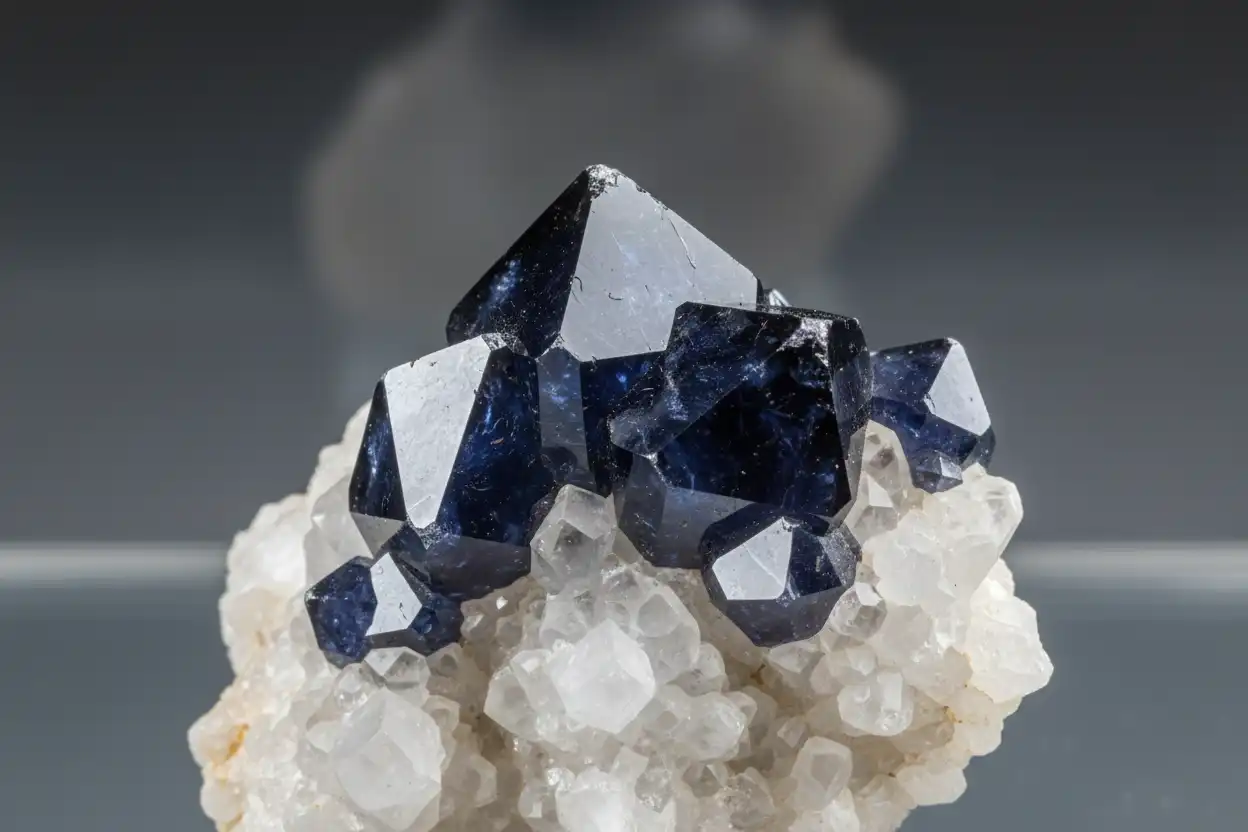
Fine anatase is particularly recognizable for sharply developed dipyramidal crystals that can look like elongated or compressed double pyramids. Natural crystals occur in black, brown, reddish-brown, yellow, indigo-blue, gray, pale green, pale lilac, and occasionally very pale or nearly colorless material. Their strong surface luster can make even a small crystal visually prominent against quartz, chlorite, feldspar, or dark host rock.
Those measurable features provide the defensible foundation of anatase meaning. Modern crystal traditions sometimes add themes such as clarity, transformation, perspective, or personal growth, but those interpretations belong to symbolism rather than mineralogy. No physical test used to identify anatase establishes an emotional, medical, spiritual, or predictive effect.
The broader Gemstone Guides collection follows the same evidence boundary: define the material first, document what can be measured or historically supported, and clearly label later symbolic interpretations for what they are.
Anatase Identity at a Glance
| Property | Anatase |
|---|---|
| Mineral class | Oxide mineral |
| Chemical formula | TiO₂ |
| Principal elements | Titanium and oxygen |
| Crystal system | Tetragonal |
| Relationship | Titanium dioxide polymorph |
| Common crystal habit | Acute dipyramidal, tabular, modified pyramidal |
| Common colors | Brown, reddish-brown, yellow, indigo-blue, black, gray; occasionally paler colors |
| Transparency | Transparent in some pale crystals to nearly opaque in deeply colored material |
| Luster | Adamantine to splendent; sometimes approaching metallic |
| Mohs hardness | About 5.5–6 |
| Specific gravity | Approximately 3.79–3.97 |
| Cleavage | Well developed on characteristic crystallographic directions |
| Fracture | Commonly subconchoidal |
| Tenacity | Brittle |
| Optical character | Uniaxial negative in typical material |
| Identification caution | Crystal shape, color, or locality alone cannot prove anatase |
Anatase is chemically simple on paper, but natural specimens rarely tell their entire story through the formula TiO₂. Trace impurities, defects, inclusions, alteration, intergrowths, and growth conditions can influence color and appearance, while crystals from different geological environments may differ significantly in habit.
That distinction is important because visually attractive mineral specimens often accumulate trade descriptions that sound more specific than the evidence supports.
Anatase, Rutile, and Brookite Share Chemistry but Not Structure
Anatase, rutile, and brookite can all have the formula TiO₂, yet they are distinct minerals because their atoms are arranged differently. Mineral species are not defined by chemistry alone; crystal structure matters.
Anatase and rutile are both tetragonal, but their unit-cell structures differ. Brookite has another structural arrangement entirely. These structural differences influence density, optical behavior, crystal form, and stability under particular geological or thermal conditions.
This is why calling anatase “a type of rutile” is incorrect even though the two minerals share the same ideal chemical formula. Anatase is its own mineral species.
The distinction becomes especially useful when working with small titanium-oxide crystals whose color and luster overlap. A black anatase crystal and a dark rutile crystal may both appear highly reflective, while morphology can become difficult to interpret when crystals are incomplete or embedded in matrix. Strong identification therefore combines several observations rather than relying on chemistry or color alone.
For more detailed discussion of refractive behavior, birefringence, pleochroism, and how dark crystals interact with light, those subjects belong on Anatase optical properties and color behavior.
How Anatase Forms
Anatase commonly develops as a secondary titanium mineral. Rather than requiring large bodies of molten material to crystallize directly into gem-sized masses, it often forms when titanium already present in rocks or earlier minerals is mobilized, altered, and redeposited under suitable geological conditions.
Classic specimens occur in Alpine-type fissures and veins cutting metamorphic rocks such as gneiss and schist. Fluids moving through fractures can redistribute titanium and allow small but exceptionally well-formed crystals to grow in open spaces. Anatase may occur with quartz, chlorite-group minerals, feldspar, rutile, brookite, and other minerals associated with these fissure environments.
It also occurs in igneous and metamorphic rocks, pegmatitic environments, carbonatites, altered rocks, weathering products, and sedimentary concentrations. Because anatase is relatively dense and chemically resistant under many surface conditions, individual grains can survive erosion and become part of heavy-mineral sediment assemblages.
A crystal collected from an Alpine cleft therefore does not represent every possible anatase formation pathway. Detailed questions about host rocks, hydrothermal alteration, weathering, detrital survival, paragenesis, and deposit interpretation are separated into Anatase formation and deposit geology.
For the meaning reference, the important conclusion is that anatase can record several geological processes even when its chemical formula remains simply TiO₂.
Why Anatase Forms Sharp Pyramidal Crystals
Among mineral collectors, crystal habit is one of anatase’s strongest visual signatures. Well-developed crystals commonly form tetragonal dipyramids, meaning two pyramidal forms meet around the middle of the crystal. Some crystals are slender and strongly elongated, while others are short, broad, tabular, or modified by additional crystal faces.
Those geometric differences are not separate mineral varieties. They reflect the relative rates at which different crystal faces grew under specific chemical and physical conditions.
Growth habit can vary even within one locality. Fluid chemistry, temperature, available space, supersaturation, impurities, and interactions with the host surface can influence whether a crystal develops as a sharp elongated pyramid, a flattened form, or a heavily modified individual.
This is one reason photographs should be interpreted carefully. A perfect-looking dipyramid is strongly compatible with anatase, but morphology is supporting evidence rather than proof. Other tetragonal or superficially similar minerals can produce misleading shapes, especially when only one viewing angle is available.
What Causes Anatase Color?
Natural anatase has a much wider color range than the formula TiO₂ might suggest. Pale yellow, brown, reddish-brown, blue, black, gray, greenish, lilac, and nearly colorless crystals are all documented, with strongly colored specimens often appearing darker and less transparent.
The safest explanation is that anatase color can arise from several mechanisms rather than a single universal chromophore. Trace impurities can modify absorption, while titanium oxidation states, oxygen-related defects, vacancies, charge compensation, microscopic inclusions, and other lattice imperfections may also affect visible color.
Experimental work on anatase demonstrates that defect-related electronic states can create substantial changes in color. Blue coloration, for example, can be associated with reduced titanium and free-carrier effects in appropriate material, while oxygen-related defect states can contribute to yellow coloration under different conditions. These mechanisms show how sensitive TiO₂ can be to crystal chemistry.
They do not prove that every natural blue crystal obtained from a mineral locality has exactly the same cause.
A responsible specimen description therefore begins with what is visible: “deep blue anatase,” “reddish-brown anatase,” or “black crystal with translucent brown edges.” Assigning a precise atomic color mechanism requires analytical evidence specific to the specimen.
Readers interested primarily in color mechanisms, lighting response, transmitted versus reflected appearance, and optical observations should use the dedicated Anatase optical properties and color behavior reference rather than treating color symbolism as mineral science.
Anatase Diagnostic Traits
Anatase identification becomes stronger when several independent traits agree. The mineral is relatively dense for its size, typically has a hardness around 5.5–6, displays strong adamantine to splendent luster on good crystal faces, and commonly develops characteristic tetragonal dipyramids. Pale crystals may be transparent, whereas deeply colored specimens can appear nearly opaque.
Its refractive indices are unusually high compared with many familiar silicate minerals. That high optical density contributes to the bright reflective appearance of clean crystal faces, particularly on well-developed specimens.
Anatase is also brittle. Crystal edges and terminations can chip, and cleavage can influence how a damaged crystal breaks. This means pristine specimens should not be subjected to casual hardness testing merely because hardness is listed as an identification property.
Microscopic observation may reveal growth zoning, surface features, internal fractures, included minerals, coatings, or damage that helps distinguish original characteristics from later alteration. Those features are explored more systematically in the Anatase microscope inclusion notebook.
When reliable species identification is important, Raman spectroscopy or X-ray diffraction can distinguish anatase from other titanium dioxide polymorphs far more convincingly than appearance alone.
Original Anatase Specimen and Photo Evaluation Checklist
The following framework is designed to prevent a common collecting error: turning a plausible visual identification into a claim that exceeds the evidence.
| Observation | What it can reasonably support | What it cannot establish alone |
|---|---|---|
| Sharp tetragonal dipyramid | Habit compatible with anatase | Definitive species identification |
| Strong adamantine luster | Consistent with anatase | Chemical composition |
| Dark blue or black body color | Documented anatase appearance | Specific color-producing defect |
| Brown transparent edges | Compatible with natural color zoning or thickness effects | Geographic origin |
| High apparent density for a small crystal | Supports a heavy oxide mineral | Distinction among TiO₂ polymorphs |
| Quartz or chlorite matrix | Plausible Alpine-type association | Exact deposit or mine |
| Seller label naming a famous locality | A provenance statement worth preserving | Independent proof of locality |
| Flat or modified crystal habit | Possible anatase morphology | Synthetic versus natural origin |
| Surface iridescence or film | Possible alteration or coating requiring investigation | A natural anatase color variety |
| Raman or XRD match to anatase | Strong species-level analytical evidence | Full geographic provenance |
This checklist is intentionally conservative. Its purpose is not to make identification impossible but to mark the point at which observation should stop and analytical interpretation should begin.
For old labels, claimed mines, collector pedigrees, seller descriptions, and documentary origin evidence, use the separate Anatase provenance and disclosure checklist.
Anatase Names and Claims That Need Reconciliation
Historical terminology creates another source of confusion. Anatase has been described under older mineral names, while modern mineral marketing sometimes invents labels based on color or metaphysical interpretation.
| Name or claim | Evidence status | More accurate interpretation |
|---|---|---|
| Anatase | Accepted mineral name | Natural TiO₂ mineral with tetragonal structure |
| Octahedrite | Historical name | Older synonym associated with its crystal form |
| Rutile | Separate mineral | Same ideal chemistry, different crystal structure |
| Brookite | Separate mineral | Another natural TiO₂ polymorph |
| Blue anatase | Descriptive color term | Blue anatase, not a separate mineral species |
| Black anatase | Descriptive color term | Dark-colored anatase, not a separate species |
| Anatase quartz | Ambiguous trade or specimen wording | Usually needs clarification about whether anatase occurs on or within quartz |
| Titanium crystal | Too vague | Could refer to several titanium-bearing minerals or manufactured materials |
| “High-energy anatase” | Unsupported mineralogical claim | Metaphysical or marketing language |
| “Healing anatase” | Unsupported medical implication | Symbolic belief, not an established treatment |
“Octahedrite” is particularly useful to recognize because the name appears in older mineralogical literature and specimen records. It refers to the strongly pyramidal appearance historically associated with the mineral and should not be interpreted as a separate modern species.
The accepted name anatase comes from a Greek term associated with extension, referring to the elongated proportions of characteristic crystal forms. This origin concerns morphology, not metaphysical expansion, spiritual ascension, or personal transformation.
Documented History of Anatase
The scientific history of anatase is closely tied to the development of crystallography and the recognition that minerals with the same chemistry can possess different structures. Early descriptions emphasized the sharp pyramidal forms of crystals from Alpine environments, and the name anatase became established through mineralogical work focused on their unusual proportions.
Older texts may use names such as octahedrite, while later structural studies clarified anatase’s relationship to other titanium dioxide minerals. That distinction eventually became important far beyond specimen collecting because different TiO₂ structures have different physical and technological behavior.
None of that documented history establishes an ancient universal spiritual tradition for anatase.
Claims that civilizations used anatase specifically for manifestation, psychic protection, emotional healing, energy activation, or similarly precise metaphysical purposes require traceable historical or archaeological evidence. Without such evidence, those ideas should be categorized as modern symbolism rather than inherited historical fact.
The same distinction is useful when reading other mineral traditions. Analcime meaning separates a documented mineralogical naming history from modern crystal associations, while Ammolite meaning requires additional care because fossil material can intersect with culturally specific traditions.
What Anatase Symbolism Can Responsibly Mean
Modern symbolic interpretations often connect anatase with perspective, transformation, focus, independence, or intellectual clarity. These ideas are understandable as metaphor because the mineral combines simple chemistry with structural complexity and can develop remarkably precise geometric forms from geological processes that are not visible in the finished crystal.
A person might use an anatase specimen as a reminder to distinguish structure from appearance, to question first impressions, or to approach a complicated problem methodically. Its sharp geometry can symbolize focus. Its existence as one structural form of TiO₂ among several can serve as a metaphor for different arrangements producing different outcomes.
Those are human interpretations.
There is no established scientific evidence that anatase generates a healing field, removes illness, increases intelligence, attracts money, changes another person’s emotions, guarantees success, protects against physical danger, or produces supernatural effects.
Symbolic use can coexist with mineralogical accuracy as long as these categories are not blended. The broader evidence boundary applied by Gems Lore is described in the site’s disclaimer.
Anatase Color Symbolism Is Interpretation, Not Mineral Science
Crystal symbolism sometimes gives separate meanings to blue, black, brown, yellow, or pale anatase. Blue may be associated with communication or calm, black with grounding, yellow with confidence, and brown with stability.
These associations come from broader color symbolism, modern crystal traditions, or personal interpretation. They are not properties demonstrated by the crystal lattice.
This distinction is especially important with anatase because physical color itself can involve defects and variable crystal chemistry. A blue anatase crystal may have a different electronic absorption mechanism from a brown one, but that does not imply a measurable difference in emotional or spiritual function.
Readers interested in a gemstone where color is itself the primary editorial subject can compare the evidence-focused approach used in Andalusite color meaning. The same principle applies: first establish why a material looks the way it does, then clearly separate cultural or symbolic interpretations.
Anatase Is Primarily a Collector Mineral
Although transparent anatase can be faceted, it is far more familiar as a mineral specimen than as conventional jewelry. Good crystals are often small, brittle, and valuable for their natural form, locality, matrix, or crystal quality rather than their ability to produce a large cut stone.
Its hardness of roughly 5.5–6 is sufficient for careful handling but lower than many everyday jewelry gems, and the combination of brittleness and cleavage makes exposed crystal edges vulnerable to damage. A collector-grade natural crystal may therefore lose much of its interest if unnecessarily removed from matrix or fashioned simply to increase apparent polish.
When transparent rough is intentionally cut, orientation, cleavage awareness, retention of color, and optical behavior become specialized lapidary decisions. Those subjects belong in Anatase cutting, orientation, and polish.
Likewise, the practical mechanics of protecting a brittle stone in wearable designs are covered separately in Anatase setting and wear engineering. The meaning page only needs to establish that faceting is possible without implying that anatase behaves like a durable mainstream jewelry stone.
Safe Ownership and Handling
An intact anatase specimen does not require dramatic handling precautions. For most collectors, the primary risks are mechanical rather than chemical: chipped terminations, scratched surfaces, broken matrix, detached crystals, or loss of provenance information through careless cleaning.
Because anatase is brittle and has a hardness below quartz, do not store fine loose crystals where harder specimens can rub against them. Avoid aggressive brushing around delicate terminations, and do not perform scratch testing on an important specimen when less destructive identification methods are available.
Heat should not be used casually as a cleaning method. Apart from potential effects on associated minerals or adhesives, thermal conditions can affect TiO₂ defect states and, under sufficiently strong conditions, structural behavior. There is no practical reason to expose a collectible anatase specimen to high heat merely to clean it.
Cutting, grinding, sanding, or crushing changes the safety context because those processes generate fine mineral dust. Appropriate wet methods, local extraction, respiratory protection, and ordinary lapidary dust-control practices should be used rather than deliberately inhaling particulate material.
Long-term storage, repairs, old labels, matrix stabilization, and documentation are addressed more fully in the Anatase specimen conservation record.
Why Locality Labels Matter
A small anatase crystal may appear visually similar to specimens from several famous collecting regions. Color and habit can suggest possibilities, but neither reliably proves geographic origin.
An original handwritten label, dealer label, collection number, acquisition record, matrix association, or well-documented collection history can therefore be important. Even an unattractive old card should not be discarded simply because a modern printed label looks cleaner.
Locality matters scientifically because formation environment, associated minerals, crystal habit, chemistry, and mineral assemblage can vary between deposits. It also matters historically because older collections can preserve evidence about where and how specimens entered the mineral trade.
A claim such as “Alpine anatase,” “Brazilian anatase,” or “Pakistan anatase” should therefore be treated as a provenance claim, not as something that can always be established from color alone.
Comparing Anatase With Other Collector Minerals
Anatase is useful for understanding why mineral identification requires more than visual resemblance. Its sharply geometric crystals can look dramatically different from pale pseudocubic Analcime meaning specimens, yet both minerals demonstrate how external morphology can dominate a collector’s first impression.
Its titanium-rich oxide chemistry also creates a different material identity from aluminosilicate gems such as those discussed in Andalusite meaning. Andalusite may show prominent pleochroism and is better established as a faceted gemstone, whereas anatase is usually valued for natural crystal form and mineralogical significance.
Likewise, Ammolite meaning describes an iridescent fossil-shell gem whose visual effect depends on preserved layered structure. Anatase achieves its visual impact through crystal geometry, high refractive behavior, color-producing defects or impurities, and strong luster rather than fossil architecture.
These comparisons are useful because the word “gemstone” can obscure fundamentally different material categories.
What a Photograph Can Tell You
A clear photograph can reveal crystal habit, apparent color, matrix relationships, visible damage, associations, surface coatings, transparency at edges, and whether a specimen appears naturalistically proportioned.
A photograph cannot directly measure refractive index, determine the TiO₂ polymorph with certainty, identify a specific trace impurity, establish whether a locality label is truthful, or demonstrate a metaphysical effect.
Magnification can improve observation but does not remove that boundary. A crystal may look exactly like classic anatase and still require Raman spectroscopy or X-ray diffraction when species-level identification matters.
That evidentiary distinction reflects the editorial approach described on About Gems Lore: observation should be described as observation, analytical results as analytical results, historical interpretation as history, and symbolism as symbolism.
Is Natural Anatase Ever Treated?
Anatase is not a mainstream commercial gemstone for which a single standardized treatment narrative applies to every specimen. Collectors may encounter cleaned specimens, repaired matrix, glued crystals, surface coatings, dyed associated material, or synthetic TiO₂ presented ambiguously, but none of these possibilities should be assumed without evidence.
Statements such as “untreated,” “natural color,” or “completely natural specimen” have to be interpreted according to what the seller is actually claiming. A naturally formed anatase crystal can still have been repaired to matrix. A genuine mineral can still carry a coating. A specimen can be natural while its locality information remains uncertain.
This is another reason provenance and disclosure should be evaluated as separate questions rather than compressed into one word such as “natural.”
Responsible Ownership of Valuable Specimens
When an anatase specimen has strong crystal quality or credible locality documentation, preserving information can be as important as preserving the mineral itself. Photograph the specimen from several angles, retain original labels, record repairs or adhesives that are already present, and avoid removing matrix unless there is a defensible conservation or research reason.
Do not silently restore a specimen and later present it as untouched. Repairs are not automatically unacceptable, but transparency preserves trust and scientific usefulness.
If a crystal is detached accidentally, preserve both parts and the documentation rather than attempting an irreversible repair without understanding the materials involved. For provenance questions that cannot be resolved from existing documentation, contact Gems Lore with clear photographs and the exact claim being evaluated.
Frequently Asked Questions
What is anatase?
Anatase is a naturally occurring titanium dioxide mineral with the formula TiO₂. It crystallizes in the tetragonal system and is one of several natural TiO₂ polymorphs.
Is anatase the same as rutile?
No. Anatase and rutile share the ideal chemical formula TiO₂, but their crystal structures differ, making them separate mineral species with different physical and optical properties.
Is anatase a gemstone?
Transparent anatase can be faceted, but the mineral is much better known as a collector specimen. Natural crystals are often small, brittle, and valued for their habit, luster, color, matrix, and locality.
What colors can anatase be?
Natural anatase can be brown, reddish-brown, yellow, indigo-blue, black, gray, pale green, pale lilac, and occasionally nearly colorless. Transparency usually decreases as coloration becomes stronger.
What causes blue anatase?
Blue color can involve titanium-related electronic states and structural defects, including effects associated with reduced titanium and oxygen balance. Natural specimens can contain additional impurities, so the precise cause should not be assigned without analytical evidence.
Is black anatase a separate variety?
No. “Black anatase” is a descriptive color term rather than a separate mineral species. Deep coloration and opacity can result from the crystal’s chemistry, defects, inclusions, or combinations of factors.
What does octahedrite mean?
Octahedrite is an older name historically used for anatase because of its strongly pyramidal crystal form. It is not treated as a separate modern mineral species.
How can anatase be identified?
Crystal habit, high luster, hardness, density, optical properties, matrix associations, and locality can support identification. Raman spectroscopy or X-ray diffraction provides much stronger evidence when distinction from other titanium oxides is important.
Where does anatase form?
Anatase occurs in several environments, including Alpine-type hydrothermal fissures, metamorphic and igneous rocks, pegmatitic settings, altered titanium-bearing minerals, weathering environments, and sedimentary heavy-mineral concentrations.
Is anatase fragile?
It has moderate hardness but is brittle and has cleavage, so sharp crystal edges and terminations can chip. Fine specimens should be protected from impacts and contact with harder minerals.
What is the spiritual meaning of anatase?
Modern symbolic traditions may associate anatase with focus, perspective, transformation, clarity, or independence. These are interpretive associations rather than scientifically demonstrated mineral properties.
Does anatase have healing properties?
There is no established scientific evidence that anatase treats disease, changes bodily function, or provides medical healing. Health decisions should not be based on crystal-healing claims.
Can anatase attract money or luck?
No scientific evidence demonstrates that anatase changes financial outcomes or probability. Prosperity and luck interpretations belong to modern symbolic belief rather than mineralogical fact.
Is anatase safe to handle?
Normal handling of an intact specimen requires mainly sensible protection against breakage. Cutting, sanding, or grinding can generate fine dust, so appropriate lapidary dust controls should be used.
Can a photo prove a specimen is anatase?
A photograph can provide useful supporting observations but normally cannot establish species identity with certainty. Analytical testing may be necessary when accurate identification is important.
Anatase meaning is strongest when its different layers are kept distinct. Mineralogically, anatase is a tetragonal titanium dioxide mineral whose sharp crystal forms, high luster, varied colors, and geological occurrence make it an important collector species. Historically, its name and older terminology reflect the development of mineral classification rather than a documented ancient spiritual doctrine. Modern symbolism can use the crystal as a personal metaphor for perspective, structure, focus, or change, but those meanings remain interpretations rather than measurable effects.
That evidence boundary preserves rather than diminishes the mineral’s interest. A small anatase crystal already records crystal structure, titanium chemistry, geological fluids, defect behavior, erosion history, and human classification without requiring unsupported healing or supernatural claims.