Analcime Meaning: Identity, History & Modern Symbolism
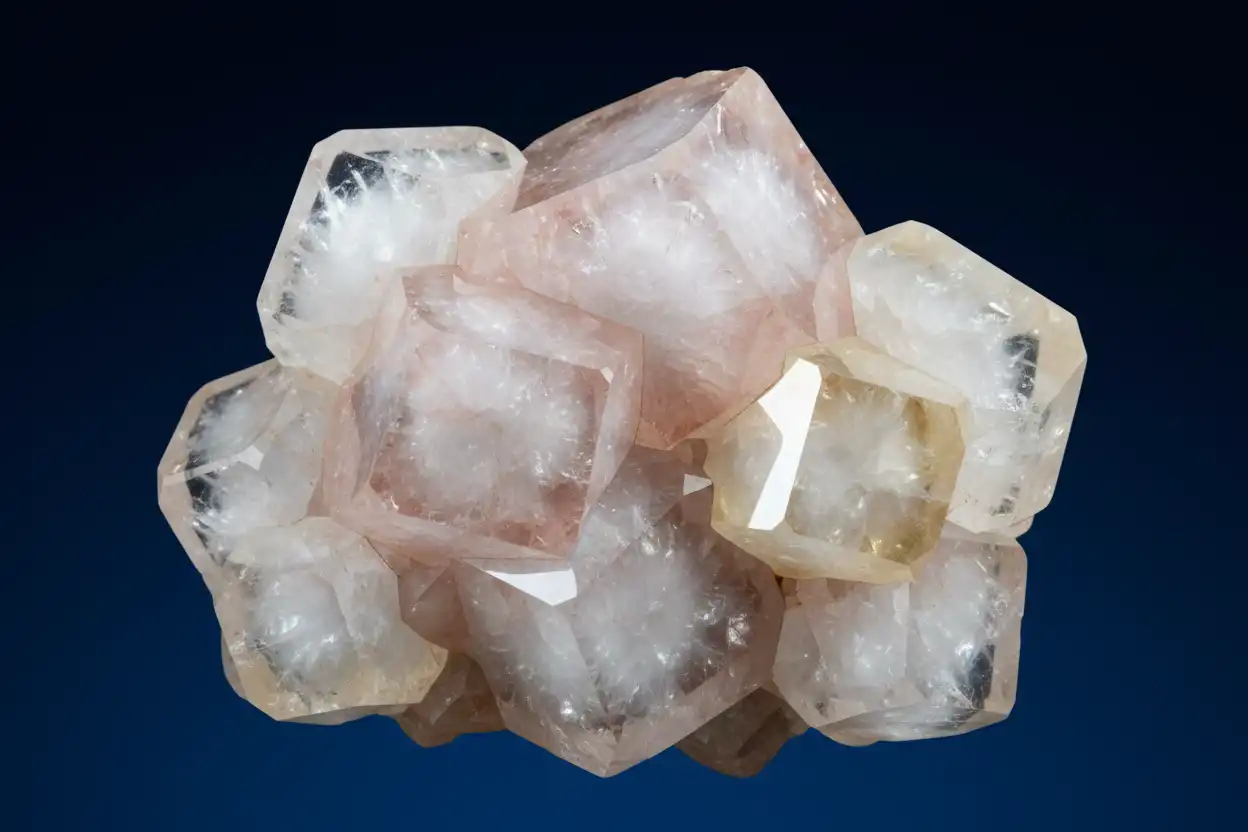
Analcime meaning is easiest to understand when the mineral itself comes first. Analcime is a hydrated sodium aluminosilicate with the ideal formula NaAlSi₂O₆·H₂O and belongs to the zeolite group of framework silicates. It commonly forms pale, glassy crystals whose external geometry can look strikingly cubic even though the mineral’s internal symmetry is more complicated than that appearance suggests. Colorless and white specimens are especially familiar, while gray, pink, greenish, and yellowish material also occurs.
That factual identity needs to remain separate from the symbolic language sometimes attached to analcime in modern crystal culture. Mineralogy can establish composition, structure, hardness, density, optical behavior, geological occurrence, and diagnostic limitations. It cannot demonstrate that analcime controls emotions, heals disease, changes luck, or transmits a measurable spiritual force.
This distinction is central to the wider Gemstone Guides collection: observable mineral properties deserve one evidentiary standard, while personal symbolism and belief require another.
Analcime Identity at a Glance
| Property | Analcime |
|---|---|
| Mineral class | Tectosilicate |
| Mineral group | Zeolite group |
| Ideal composition | NaAlSi₂O₆·H₂O |
| Main elements | Sodium, aluminum, silicon, oxygen, hydrogen |
| Typical appearance | Transparent to translucent crystals or granular and massive material |
| Common colors | Colorless, white, gray, pale pink, greenish, yellowish |
| Luster | Usually vitreous on fresh crystal faces |
| Typical crystal habit | Commonly trapezohedral and visually pseudocubic |
| Structural character | Framework aluminosilicate containing zeolitic water |
| Mohs hardness | About 5–5.5 |
| Measured density | About 2.24–2.29 |
| Cleavage | Very poor |
| Fracture | Commonly subconchoidal |
| Tenacity | Brittle |
| Refractive index | Approximately 1.479–1.493 in reported natural material |
| Identification caution | External shape alone does not establish analcime |
Standard mineral references describe analcime as relatively moderate in hardness and low in density compared with many familiar jewelry gems. Its combination of zeolitic structure, brittle behavior, weak cleavage, modest refractive index, and commonly pale coloration explains why exceptional crystals are better known among mineral collectors than in mainstream jewelry.
Analcime Is a Zeolite, but Its Crystal Structure Needs Careful Language
Calling analcime a zeolite is mineralogically appropriate. Its aluminosilicate framework contains channels and cavities associated with sodium and water, placing it within the broader zeolite family. The simple formula is useful for identification, although natural analcime can show compositional variation rather than behaving as a perfectly fixed synthetic compound.
Its crystal symmetry is more interesting. Many analcime crystals look almost perfectly cubic at hand-specimen scale, especially when they develop their characteristic trapezohedral form. Structural investigations, however, have documented symmetry lowering related to ordering of silicon and aluminum and subtle distortions within the framework. Different natural specimens have consequently been described with several crystallographic symmetries even when their outward form remains convincingly pseudocubic.
For practical identification, this means a collector should not write “cubic analcime” simply because a crystal looks geometrically cubic in a photograph. External morphology is evidence, but it is not a complete crystallographic determination.
Readers interested in the finer optical consequences of this structural complexity can continue to Analcime optical properties and color behavior, where birefringence anomalies and optical observations belong in greater depth.
How Analcime Forms
Analcime occurs in more than one geological setting, which is one reason simplified descriptions such as “a volcanic cavity mineral” are incomplete. Well-developed crystals are familiar from cavities and altered zones in volcanic rocks, where analcime may grow with other zeolites and secondary minerals. It can also form through alteration of volcanic glass and occur as an authigenic mineral in sedimentary rocks, where crystals or fine-grained analcime develop during post-depositional chemical change.
Some analcime-bearing rocks have also generated long-running discussion over whether particular occurrences are primary, secondary, or products of replacement. That debate matters geologically because crystal shape alone does not always reveal the sequence of mineral formation. An apparently well-formed analcime crystal can have a very different geological history from another specimen of similar appearance.
This article therefore uses formation only to establish material context. Depositional environments, alteration pathways, volcanic hosts, sedimentary analcime, and evidence used to distinguish possible origins are better handled in Analcime formation and deposit geology.
Why Analcime Can Be Colorless, White, Pink, Green, or Yellow
Analcime does not have one defining saturated body color. Standard mineral references record colorless, white, gray, pink, greenish, and yellowish examples, and transparent crystals may appear almost water-clear where inclusions, surface alteration, and matrix interference are limited.
It would be inaccurate, however, to assign one universal trace element to every pink or green analcime specimen. Color in natural minerals can involve trace impurities, microscopic inclusions, alteration products, associated minerals, surface coatings, structural defects, or combinations of these factors. In some documented specimens, apparent colored zones are visibly influenced by the surrounding matrix or mineral inclusions rather than by a uniformly colored analcime lattice.
A responsible description should therefore say what is observed before claiming why it is present. “Pale pink analcime crystal” is an observation. “Pink caused by element X” is an analytical conclusion that requires evidence.
This evidentiary boundary is especially useful when comparing analcime with strongly colored minerals such as Amber or structurally complex gems discussed in Andalusite color meaning, where the mechanisms responsible for visible color are materially different.
Diagnostic Traits of Analcime
A good analcime identification begins with a group of mutually supporting observations rather than one attractive crystal shape. Well-formed specimens commonly show glassy trapezohedral crystals, relatively low density, moderate hardness, white streak, brittle behavior, and color ranging from colorless to subdued pastel tones. Fresh crystals can be transparent to translucent, while aggregates or altered material may appear opaque or duller.
Optically, analcime has historically created confusion because a crystal that looks cubic can show anomalous optical behavior under polarized light. Reported refractive indices are relatively low, and slight birefringence or complex twinning may become apparent in some material even when the specimen appears externally high-symmetry.
These properties are useful but not individually diagnostic. Other pale zeolites, leucite-like crystals, pollucite, and unrelated light-colored minerals can overlap with analcime in outward appearance. When identification matters scientifically or commercially, methods such as powder X-ray diffraction, Raman spectroscopy, and chemical analysis provide a much stronger basis than a photograph. RRUFF, for example, records analcime samples whose identity has been confirmed through diffraction and chemistry.
A specimen-focused approach to crystal faces, inclusions, growth features, altered zones, and visually misleading look-alikes belongs in the Analcime microscope inclusion notebook.
An Original Analcime Specimen and Photo Checklist
A mineral photo can support an identification hypothesis, but it cannot substitute for analytical testing. The following checklist separates visible evidence from conclusions that require stronger support.
| What you can observe | What it may support | What it cannot prove by itself |
|---|---|---|
| Trapezohedral, pseudocubic crystal form | Compatibility with common analcime habit | Mineral identity |
| Colorless or white transparent crystal | Compatibility with common analcime appearance | Purity or chemical composition |
| Pale pink, greenish, or yellowish tint | Natural color variation may be present | Specific chromophore |
| Vitreous fresh faces | Compatibility with reported luster | Absence of coating |
| Crystal in volcanic cavity | Geological setting compatible with many analcime occurrences | Exact locality or formation mechanism |
| Association with other zeolites | Supports a plausible zeolite paragenesis | Analcime identification |
| Fine internal lamellae under magnification | May relate to twinning or structural complexity | Exact crystallographic symmetry |
| Seller locality label | Provides provenance information to investigate | Independent proof of origin |
| A faceted transparent stone | Shows material suitable for cutting | Species identity or lack of treatment |
The strongest use of a photograph is therefore descriptive: document crystal shape, color, transparency, matrix, associations, damage, and any visible alteration. Assertions about chemistry, provenance, treatment, or precise symmetry should be reserved for evidence capable of answering those questions.
For locality labels, acquisition history, old collection cards, and seller-origin statements, use the more specialized Analcime provenance and disclosure checklist.
Analcime, Analcite, and Other Naming Problems
Mineral names accumulate historical spellings, obsolete labels, translations, and commercial reinterpretations. Analcime is no exception.
| Name or claim | Evidence assessment | Better interpretation |
|---|---|---|
| Analcime | Accepted mineral name | Appropriate modern mineralogical name |
| Analcite | Historical alternative found in older literature | Best treated as an older synonym rather than a separate mineral |
| “Cubic analcime” | Potentially oversimplified | Crystals may look pseudocubic while internal symmetry can be lower |
| “Weak stone” | Misreading of the name’s history | The name refers to weak electrical behavior noted historically, not unusually low mechanical strength |
| “Analcime crystal healing stone” | Belief or marketing language | Not a mineralogical property |
| “Pink analcime has a different mineral meaning” | Symbolic interpretation | Color does not establish a scientifically different emotional function |
| “Gem-quality analcime” | Reasonable descriptive trade phrase when transparent material is cut | Does not create a separate mineral variety |
This distinction is particularly important with “analcite.” Older mineralogical papers often use that spelling, but contemporary references use analcime. Encountering “analcite” on an antique specimen label therefore does not necessarily indicate an identification error; it may simply reflect historical nomenclature.
Where the Name Analcime Came From
Analcime entered mineralogical literature through material from the Cyclopean Islands near Sicily. French geologist Déodat de Dolomieu initially described the material under an earlier zeolite description, and René Just Haüy later introduced the name analcime from the Greek word analkimos, meaning weak or without strength. The reference was to the weak electrical effect observed when the mineral was heated or rubbed rather than to its hardness.
That detail is useful because modern retellings can distort the etymology into a symbolic story about weakness, emotional vulnerability, or fragile energy. There is no mineralogical basis for those interpretations. The name belongs to the history of physical observation.
Analcime subsequently became important well beyond specimen collecting because its unusual framework structure, variable symmetry, geological occurrence, and relationship to other zeolitic minerals made it a useful subject for crystallographic and petrological study.
Is Analcime a Gemstone?
Transparent analcime can be cut, and gemological references recognize facetable material, but it is not a conventional everyday jewelry gem. Its moderate hardness, brittle tenacity, relatively modest refractive index, and rarity in suitably transparent material make collector specimens far more familiar than mass-market faceted stones.
When analcime is fashioned, orientation and preservation of fragile rough become more important than maximizing size at any cost. Detailed lapidary choices belong in Analcime cutting, orientation, and polish, while the mechanical implications of mounting a brittle, moderately soft material are covered in Analcime setting and wear engineering.
The key point for analcime meaning is simply that “gemstone” describes a possible use of some material; it does not change the mineral’s identity.
Documented History Is Not the Same as Ancient Symbolism
Analcime has a documented scientific history, but that does not automatically provide a documented ancient symbolic tradition. Modern crystal websites sometimes attach meanings such as mental clarity, emotional balance, communication, memory, intuition, or inner calm to the mineral. These interpretations belong to contemporary spiritual or personal-symbolic practice unless a traceable historical source demonstrates otherwise.
There is no need to manufacture an ancient lineage to make a mineral interesting. Analcime already has a distinctive history through its Sicilian type material, zeolite classification, unusual structural symmetry, pseudocubic morphology, and role in geological studies.
Readers who encounter confident claims that analcime was universally used by ancient cultures for a specific spiritual purpose should therefore ask a simple question: what primary historical or archaeological evidence supports that claim?
Without such evidence, the statement belongs in modern symbolism rather than documented history.
Responsible Analcime Symbolism
Modern symbolic use can still be meaningful when it is clearly identified as interpretation. The mineral’s restrained colors and deceptively simple external geometry can make it a useful personal symbol for looking beyond first impressions. Its seemingly cubic shape conceals more complicated structural ordering, providing an unusually appropriate metaphor for complexity beneath an orderly surface.
Someone might therefore use analcime as a reminder to examine assumptions, slow down before drawing conclusions, or separate appearance from evidence. A transparent crystal could symbolize clarity; a complex pseudocubic specimen might symbolize nuance; a crystal grown in a cavity could represent gradual development within constraints.
Those are metaphors, not mineral properties.
Analcime has not been scientifically demonstrated to heal anxiety, improve memory, balance hormones, remove toxins, protect against disease, alter another person’s behavior, guarantee spiritual awakening, or produce a measurable energetic field. The evidence boundary applied to such claims is explained more broadly in the Gems Lore disclaimer.
Analcime Meaning Should Not Be Assigned by Color as Science
Modern symbolic guides sometimes divide crystals into separate emotional meanings according to color: pink for affection, white for cleansing, green for growth, or yellow for confidence. People are free to use those associations personally, but mineralogy does not show that a pink analcime crystal possesses a different psychological function from a colorless specimen.
Color is an observable optical property. Symbolic interpretation is a human layer placed on that property.
This distinction matters because pale coloration in analcime may be influenced by trace chemistry, inclusions, alteration, or associated material. Assigning rigid spiritual functions to those colors adds a second unsupported inference on top of an often-unconfirmed color mechanism.
A similar evidence-first distinction between physical material and interpretation underpins the discussion of fossil gem material in Ammolite meaning and other mineral references across Gems Lore.
Safe Ownership of Analcime
An intact analcime specimen is generally suited to ordinary responsible mineral-collection handling, but its physical properties justify some care. With hardness around 5–5.5 and brittle tenacity, crystal edges and terminations can chip if knocked against harder minerals or display surfaces. Heat also deserves restraint because analcime is a hydrated zeolite whose structure contains water.
For collector specimens, aggressive scrubbing can damage delicate crystals or associated matrix, while strong heat is unnecessary. Storage should prevent harder specimens from rubbing against analcime, and loose crystals should be supported so that protruding faces do not carry the weight of the specimen.
If a specimen has scientifically or historically useful labels, do not discard them during cleaning or rehousing. A modest-looking locality card can carry more provenance value than an aggressively polished surface. Longer-term documentation and stabilization practices belong in the Analcime specimen conservation record.
Cutting or grinding creates a different exposure situation from simply owning an intact mineral specimen. As with mineral lapidary work generally, avoid breathing generated dust and use appropriate workshop dust control rather than assuming a natural mineral powder is harmless.
What Analcime Can Be Confused With
Pale analcime can visually overlap with other zeolites, especially when crystal development is poor. Its pseudocubic form can also invite comparison with leucite, while compositional relatives such as pollucite add another layer of mineralogical similarity.
Color alone is weak evidence. So is the statement that a crystal “came from a zeolite locality,” because several zeolite species can share the same cavity. Even crystal shape can become unreliable when individuals are incomplete, altered, intergrown, or coated.
A photograph can narrow possibilities; it cannot always resolve them.
The practical lesson is to combine habit, hardness, density, optical observations, matrix relationships, locality information, and analytical results where the stakes justify it. This evidence-first approach is part of the editorial standard described on About Gems Lore.
Analcime as a Collector Mineral
Analcime’s appeal is often quieter than that of strongly colored gemstones. A fine specimen may derive its interest from crisp geometric form, transparency, subtle surface luster, unusual matrix contrast, locality significance, or associations with other zeolites rather than from saturated color.
That makes specimen integrity especially important. An undamaged crystal with an original collection label may communicate more mineralogical information than a heavily cleaned crystal detached from its geological context.
Collectors building broader suites can compare analcime’s subdued zeolitic character with minerals such as Anatase, where crystal habit, luster, composition, and geological setting create a very different visual identity despite both materials attracting strong specimen interest.
Questions about documenting matrix, repaired crystals, adhesives, old labels, and storage history belong to specimen conservation rather than to the meaning page itself.
What Analcime Meaning Ultimately Owns
The defensible core of analcime meaning is material identity. Analcime is a hydrated sodium aluminosilicate zeolite with a distinctive framework structure, commonly pseudocubic crystal habit, moderate hardness, low density, variable pale coloration, and a geological history spanning volcanic, alteration, and sedimentary environments. Its apparently simple crystal geometry conceals enough structural complexity that visual assumptions can be misleading.
Its documented human history begins with mineralogical observation and naming, not with proven ancient crystal-healing doctrine. Modern symbolism can treat analcime as a metaphor for clarity, complexity, reflection, or seeing beyond appearances, but those interpretations remain personal and cultural rather than measurable properties of the mineral.
That boundary is not a limitation on the subject. It is what allows analcime to remain scientifically interesting without turning an unusual zeolite into a collection of unsupported claims.
Readers with a specimen that needs identification, locality clarification, or documentation can use the appropriate specialist pages rather than forcing those separate questions into a general meaning reference. For questions not covered by those resources, contact Gems Lore with the specimen context and the specific information you are trying to verify.
FAQs
What is analcime?
Analcime is a hydrated sodium aluminosilicate mineral in the zeolite group. Its ideal formula is NaAlSi₂O₆·H₂O, and it commonly forms transparent to translucent pale crystals with a pseudocubic or trapezohedral appearance.
Is analcime the same as analcite?
Analcite is an older alternative name encountered in historical mineralogical literature. Analcime is the accepted modern name, so an old label reading “analcite” may refer to the same mineral rather than a different species.
Is analcime really cubic?
Its crystals often look cubic or pseudocubic externally, but natural analcime can show lower internal symmetry related to silicon-aluminum ordering and subtle structural distortion. Visual shape alone should not be used to assign precise crystallographic symmetry.
What color is natural analcime?
Colorless and white are common, while gray, pale pink, greenish, and yellowish specimens also occur. A particular color should not be assigned to one trace element without analytical evidence.
What causes pink analcime?
There is no safe universal answer for every pink specimen. Trace impurities, inclusions, alteration, associated minerals, or other microscopic features can influence apparent coloration. Establishing a specific cause requires more evidence than visual inspection.
Where does analcime form?
Analcime occurs in volcanic rocks, particularly as a secondary mineral in cavities and altered material, but it is also documented in sedimentary environments and other geological settings. The exact formation mechanism varies between deposits.
How hard is analcime?
Analcime has a Mohs hardness of roughly 5–5.5. It is also brittle, so well-formed crystals can still chip despite having moderate scratch resistance.
Can analcime be faceted?
Transparent material can be faceted, but analcime is much better known as a collector mineral than as a mainstream jewelry stone. Its brittleness, moderate hardness, and limited availability of clean rough restrict everyday gem use.
How can I identify analcime?
Crystal habit, hardness, density, optical properties, locality, and associated minerals can support an identification, but visual inspection alone is not definitive. X-ray diffraction, Raman spectroscopy, or suitable chemical analysis can provide much stronger confirmation.
Does analcime have healing properties?
No scientifically established evidence shows that analcime treats disease or changes physiological health. Crystal-healing claims should be understood as spiritual or personal beliefs rather than medical facts.
What does analcime symbolize?
Modern interpretations sometimes associate analcime with clarity, self-reflection, calm, communication, or seeing beyond appearances. These associations are symbolic and are not measurable mineralogical properties.
Is analcime safe to own?
An intact specimen can be handled as an ordinary mineral collectible with sensible care. Because analcime is brittle and hydrated, avoid unnecessary impacts and strong heat. Cutting or grinding should use proper dust control.
Why is analcime interesting to mineral collectors?
Its attraction lies in well-formed pseudocubic crystals, transparent or softly colored material, varied geological occurrences, association with other zeolites, and unusual crystallographic behavior. Good locality documentation can add substantial scientific and collecting interest.
Can a photo prove that a crystal is analcime?
Usually not by itself. A photograph can show habit, color, luster, matrix, and associations, but several minerals may overlap visually. Analytical confirmation is appropriate when reliable species identification is important.
Should an old analcime specimen be removed from its matrix?
Not automatically. Matrix can preserve geological context, associated minerals, specimen stability, and provenance information. Removal should have a clear reason, particularly for scientifically documented or historically collected material.