Andalusite Color Meaning: Symbolism, Uses & Color Guide
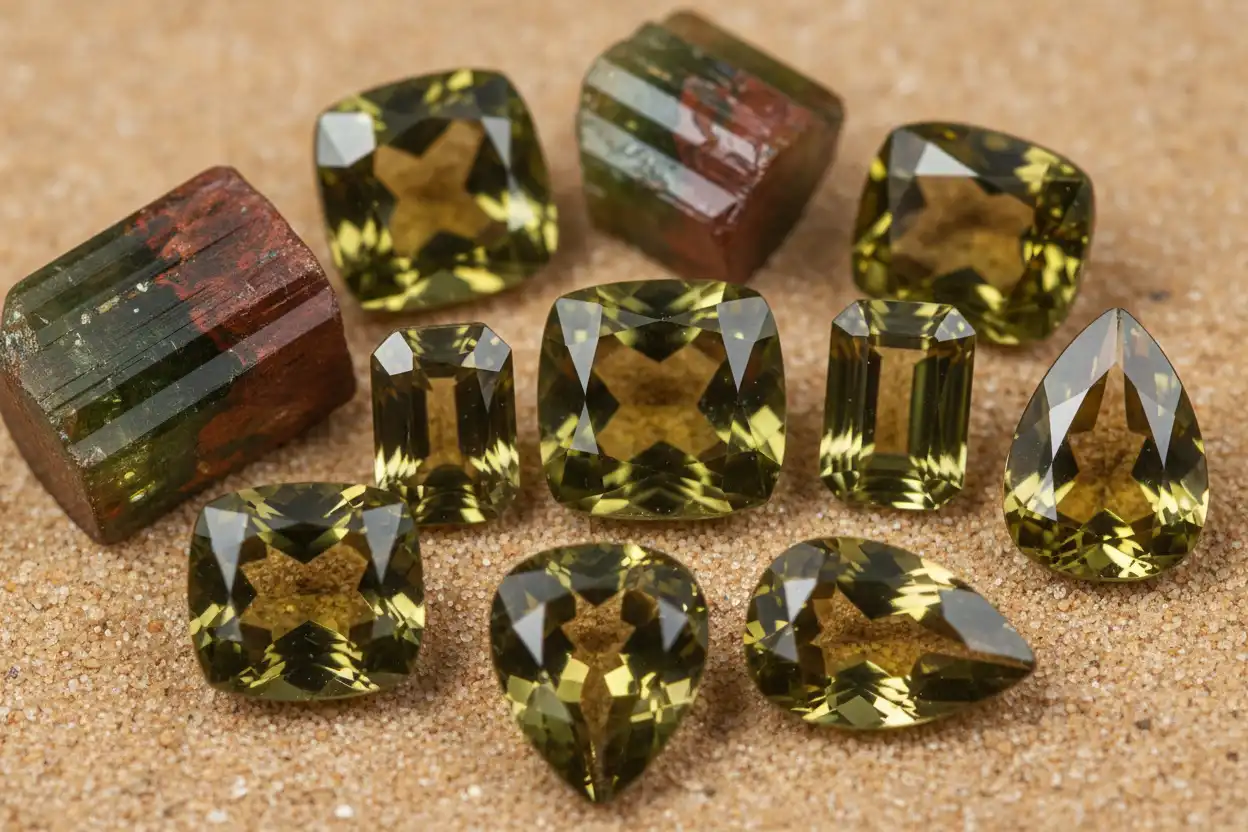
Andalusite color meaning is unusually connected to a real optical property rather than to one fixed body color, because transparent andalusite can show green, yellow, olive, brown, orange, reddish brown, and pinkish-red directions within the same gemstone as the viewing angle changes. This strong pleochroism is one of andalusite’s defining gemological features, and a well-oriented faceted stone can display two or more contrasting colors simultaneously even when it remains under the same light source.
That distinction matters because andalusite color meaning should not be built around the assumption that a green stone, brown stone, and reddish stone are always separate varieties. In many examples, several of those colors coexist inside one crystal and become more or less visible according to crystallographic orientation, cutting style, viewing direction, tone, and iron-related absorption.
Symbolically, the shifting palette makes perspective, adaptability, balanced judgment, resilience, and recognizing more than one side of a situation particularly coherent themes for andalusite color meaning. Those interpretations remain cultural or personal symbolism rather than scientifically proven healing effects, while the green, brown, red, yellow, and orange appearances themselves are measurable consequences of mineral chemistry, crystal structure, light absorption, and cutting orientation.
For the mineral’s full geology, formation, durability, localities, identification, treatment, and broader symbolism, the andalusite meaning guide covers the complete species. This guide stays focused on color—what the colors actually are, why they change, how cutters influence them, what different shades can symbolize, and what buyers should examine before paying for a particular appearance.
Andalusite Color Meaning at a Glance
| Color or appearance | Gemological context | Common symbolic interpretation |
|---|---|---|
| Olive green | Common pleochroic direction in transparent material | Adaptability, practical growth, perspective |
| Yellow-green | Common pleochroic component | Discernment, learning, reconsideration |
| Golden yellow | Warm face-up component in some cuts | Confidence, attention, purposeful action |
| Orange | Often blended with yellow, brown or red | Creativity, engagement, momentum |
| Brown | Common overall appearance in many faceted stones | Stability, realism, grounded judgment |
| Reddish brown | Characteristic warm pleochroic direction | Resilience, commitment, deliberate action |
| Pinkish red | Can occur as a distinct pleochroic component | Emotional honesty, openness, perspective |
| Green and pink together | Natural bicolor material or strongly oriented pleochroism | Integration, complexity, holding two perspectives |
| Chiastolite brown/cream with dark cross | Inclusion-defined andalusite variety | Structure, protection traditions, transition |
| Bright green viridine | Manganese-rich andalusite variety | Renewal, individuality, focused growth |
The most important point is that andalusite color meaning follows a gemstone whose appearance may contain several colors at once. A single-word color label often describes only the dominant face-up impression rather than everything present within the crystal.
Why Does Andalusite Show Different Colors?
Andalusite is an aluminum silicate with the composition Al₂SiO₅ and an orthorhombic crystal structure. Transparent colored material is strongly pleochroic, which means light traveling through different crystallographic directions can be absorbed differently and emerge with noticeably different colors.
In gem-quality andalusite, common pleochroic components include reddish pink or reddish brown together with yellowish green, olive green, yellow, or related warm tones. The exact appearance varies with composition, transparency, saturation, path length, crystal orientation, and the way a cutter positions the rough.
This is the physical foundation of andalusite color meaning.
The gem does not need to change chemically while you rotate it. Instead, a different optical direction becomes more prominent, allowing another part of the existing color response to reach your eye.
A transparent andalusite can therefore look green from one direction and considerably warmer from another while remaining the same natural gemstone.
Pleochroism Is Not the Same as Color Change
One of the most important distinctions in andalusite color meaning is the difference between pleochroism and true color change.
Pleochroism depends primarily on viewing direction through an anisotropic crystal. Rotate an andalusite beneath the same light and different colors can become dominant.
A true color-change gemstone changes its overall appearance primarily because the spectral composition of the illumination changes. Alexandrite is the classic example: its appearance can differ significantly under different types of light.
Andalusite can certainly look somewhat different under different illumination, as almost every colored gemstone can, but its signature multicolor effect is fundamentally directional.
This means a seller should not automatically describe andalusite as an “alexandrite-like color-change stone” merely because green and red-brown appear within the gem.
Its optical identity is more accurately described through strong pleochroism.
Why Several Colors Can Appear at the Same Time
Andalusite color meaning becomes especially interesting in a faceted gemstone because the wearer may not need to rotate the stone deliberately to see several colors.
Light entering through the table can reflect from pavilion facets oriented in different directions, and those different paths can return different pleochroic components toward the viewer. As a result, one part of a faceted andalusite may look olive green while another looks reddish brown or golden.
This is not necessarily color zoning.
Color zoning describes actual variations in color-producing material across different areas of a crystal. Pleochroism occurs because the same anisotropic material absorbs light differently along different crystallographic directions.
Andalusite can have both phenomena, so careful examination matters.
For andalusite color meaning, this simultaneous display is one reason perspective is a particularly appropriate symbolic theme: several appearances can be genuine at once rather than one color invalidating the others.
Green Andalusite Color Meaning
Green andalusite can range from yellow-green and olive to deeper forest-like or grayish green, although many stones combine green with brown, gold, or red.
Green andalusite color meaning is commonly associated symbolically with adaptation, practical growth, renewal, patience, and looking for workable alternatives rather than forcing one predetermined solution.
The strongest visual green does not necessarily occur throughout the entire gemstone. A cutter may orient rough to emphasize a green direction through the table, while reddish or warmer pleochroic components remain visible near the ends or corners.
That mixture is often desirable.
A pure-looking green stone is not automatically superior to one showing olive, brown, and red accents because andalusite is valued partly for its complex optical character rather than for behaving like emerald.
Readers comparing it with other naturally green materials can place the stone in the broader green gemstones family without assuming those gems share its optical properties.
What Green Andalusite Actually Looks Like
Green andalusite tends to be more earthy than the vivid chrome green associated with emerald, tsavorite, or chrome diopside. Yellow, gray, brown, or olive components are common and can move across the face as the gemstone changes orientation.
A well-cut green andalusite may therefore look sophisticated rather than intensely saturated.
When evaluating green material, rotate the gemstone slowly and watch what happens to the face-up color. If attractive green remains visible through useful angles while warm red-brown or yellow flashes add contrast, the gem is using its pleochroism effectively.
If the green disappears almost completely in normal viewing and the stone becomes muddy or excessively dark, the cutting orientation may not be as successful.
Olive Andalusite Color Meaning
Olive is one of the most characteristic andalusite colors because it sits naturally between yellow-green and brown.
Olive andalusite color meaning can symbolize measured growth, realism, adaptability, patience, and making progress within real limitations rather than expecting perfect circumstances.
This interpretation suits the gem’s visual complexity. Olive rarely looks isolated; it often exists beside golden, reddish, or brownish areas.
Commercial photographs can exaggerate the green component, especially when the seller chooses a background or white balance that suppresses brown. An accurate assessment requires seeing the gemstone under neutral illumination and through movement.
For buyers, an olive face-up appearance should be judged on liveliness, saturation, and pleochroic contrast rather than penalized simply because the green is not emerald-like.
Yellow Andalusite Color Meaning
Yellow and yellow-green are important components of andalusite’s pleochroic palette.
Yellow andalusite color meaning is often associated with discernment, intellectual curiosity, attention, optimism grounded in evidence, and recognizing useful information within complexity.
Gemologically, yellow may appear as one direction within a stone whose dominant overall appearance is green or brown. It can also produce golden flashes between stronger olive and reddish areas.
A pale yellow component is not automatically undesirable. When cutting is good, a lighter area can provide contrast that prevents a strongly colored andalusite from looking too dark.
The broader yellow gemstones guide includes many materials whose yellow color mechanisms differ completely, so shared hue should never be treated as proof of shared identity.
Golden Andalusite Color Meaning
Golden andalusite sits between yellow, orange, and warm brown, often appearing as honey, bronze-gold, or muted amber-like flashes within a pleochroic gem.
Golden andalusite color meaning commonly centers on purposeful action, confidence, constructive attention, resourcefulness, and recognizing opportunities without assuming that every opportunity should be pursued.
This shade can be particularly attractive in yellow-gold jewelry because the metal reinforces the warm portion of the gemstone’s palette.
White metal creates a different effect, often increasing visual separation between green, reddish, and golden components.
Neither metal changes the mineral’s inherent pleochroism. The setting simply changes the visual context around it.
Orange Andalusite Color Meaning
Orange is usually part of a broader warm color range rather than a perfectly isolated hue in andalusite.
Orange andalusite color meaning can symbolize creativity, engagement, movement, willingness to experiment, and converting an idea into something practical.
The warm color may blend with golden yellow, reddish brown, or olive areas, especially in rounded or cushion-shaped cuts where pleochroic colors mix across numerous pavilion reflections.
Longer stones can sometimes show stronger color separation between central and end facets.
For readers comparing warm stones, orange gemstones provides broader context, but andalusite remains unusual because an orange-looking region can coexist naturally with clearly green or red-brown reflections inside the same gem.
Brown Andalusite Color Meaning
Brown is one of the most common overall impressions of faceted andalusite, yet describing the stone simply as brown can underestimate what is happening optically.
Many brown-looking examples reveal olive, gold, yellow, orange, or reddish flashes when moved.
Brown andalusite color meaning is commonly associated with stability, realism, patience, grounded decision-making, and attention to what can actually be verified.
This symbolism works particularly well when the stone shows warm and green components together. Rather than representing immobility, brown becomes a visual foundation beneath a changing set of directional colors.
The brown gemstones guide places andalusite beside smoky quartz, zircon, tourmaline, tiger’s eye, and other brown materials while keeping their different optical effects separate.
Reddish-Brown Andalusite Color Meaning
Reddish brown is one of the characteristic warm pleochroic colors seen in transparent andalusite.
Reddish-brown andalusite color meaning can represent resilience, persistence, deliberate action, personal responsibility, and remaining engaged with a situation after the initial excitement has passed.
Gemologically, this direction may become strongest when the stone is viewed through a particular crystallographic orientation. In another direction, the same material can look yellowish or green.
That directional relationship is valuable for identification.
A reddish-brown stone that remains exactly the same hue through every orientation may still be andalusite, particularly if its pleochroism is difficult to observe because of cutting or saturation, but strongly colored transparent examples often reveal at least some variation when examined carefully.
Pink and Reddish Andalusite Color Meaning
Pinkish and reddish tones occur in some gem-quality andalusite and can be especially striking when paired with green.
Pink andalusite color meaning is often interpreted through emotional honesty, openness, empathy combined with discernment, and recognizing that understanding another perspective does not require abandoning personal boundaries.
Reddish areas can appear as dusty rose, pinkish brown, orangy red, or brownish pink rather than the pure spectral red associated with fine ruby.
That subtlety is normal.
A muted reddish component does not make the stone defective when it combines attractively with green or gold. In fact, strong contrast between the warm and cool pleochroic directions is part of what gives exceptional andalusite its distinctive appearance.
The broader red gemstones category includes materials with much purer red body color, which helps show why andalusite should be judged as a multicolor pleochroic gem rather than as a ruby substitute.
Green and Pink Bicolor Andalusite
Some andalusite contains genuine green and brownish-pink color zoning in addition to strong pleochroism.
This creates a more complicated optical situation because the gemstone contains both spatial color differences and directional color differences.
Green-and-pink andalusite color meaning naturally lends itself to integration, balancing competing perspectives, accepting complexity, and understanding that two apparently contradictory qualities can coexist.
From a gemological standpoint, bicolor rough requires thoughtful orientation. The cutter may deliberately position the green and pink areas so both remain visible through the table, while also managing the pleochroism of each region.
A poorly planned cut can hide much of the attractive zoning.
A successful one can produce an unusually complex gemstone where green, pink, gold, and warm brown reflections interact across a single face.
Viridine and Bright Green Andalusite
Viridine is a manganese-bearing green variety of andalusite whose appearance can be noticeably greener than typical iron-influenced olive or brownish gem material.
This deserves separation from ordinary green andalusite because the stronger green relates to compositional differences rather than simply cutting orientation.
Viridine andalusite color meaning can symbolically emphasize individuality, renewal, independent thinking, and growth that does not need to follow the most common path.
The name should still be used carefully.
Not every green andalusite is viridine, and a seller should not apply the term solely because a photograph looks greener than average. Material represented as an unusual compositional variety may warrant stronger gemological documentation when the distinction materially affects price.
Chiastolite Color and Cross Pattern
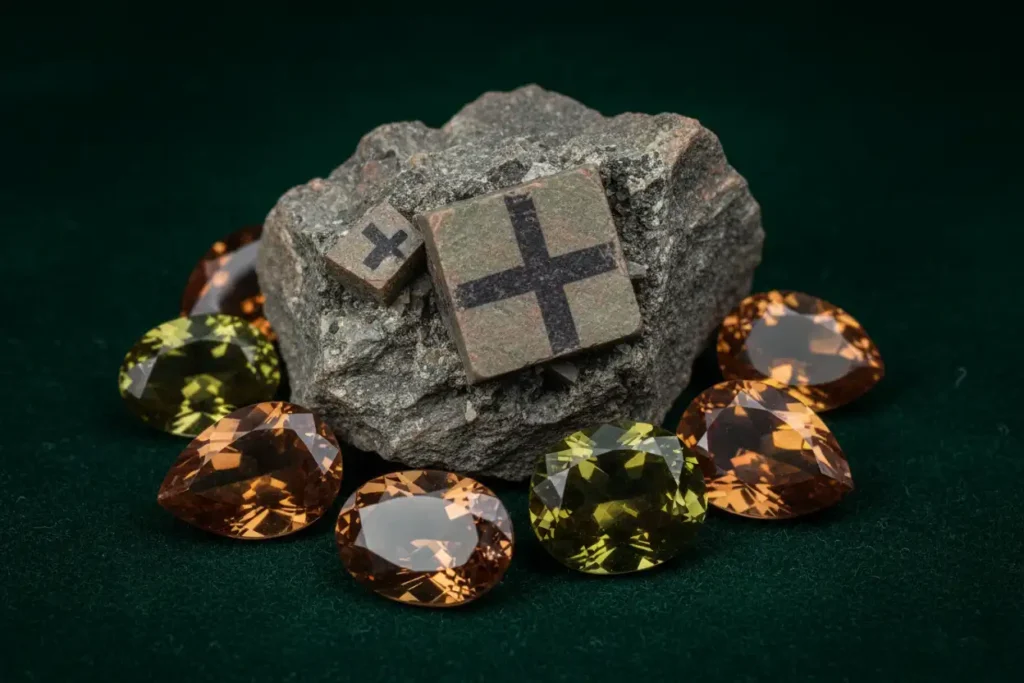
Chiastolite is an opaque-to-translucent variety of andalusite famous for dark carbonaceous inclusions arranged in a cross-like pattern through sections of the crystal.
Its appearance is completely different from transparent pleochroic faceted andalusite.
Brown, cream, gray, pinkish, and off-white areas commonly surround a dark cross or X-shaped pattern. The pattern forms naturally during crystal growth as inclusion material becomes concentrated along particular regions rather than being painted, engraved, or carved onto the stone.
The dedicated chiastolite meaning guide covers that variety in depth.
Within andalusite color meaning, chiastolite is best treated as a pattern-defined form whose symbolism commonly involves structure, transition, protection traditions, and finding orientation during change rather than assigning separate metaphysical effects to each brown or black segment.
Why Cutting Changes Andalusite Color So Much
Cut orientation is one of the most important factors in andalusite color meaning because the cutter decides which crystallographic directions will contribute most strongly to the face-up appearance.
In many gemstones, cutters try to minimize unwanted pleochroic components and maximize one dominant hue.
Andalusite is different.
Its appeal often comes from displaying contrasting colors simultaneously, so the cutter may deliberately orient the rough to preserve green and reddish-brown reflections across the face.
A long rectangular or oval cut can emphasize color separation, with one tone appearing more strongly through the center and another becoming visible toward the ends.
Rounds and square cushions may mix the colors into a more mosaic-like appearance.
Neither approach is automatically superior.
The best cut is the one that makes the pleochroism attractive rather than muddy.
Windowing, Extinction, and Color
Poor cutting can weaken even excellent rough.
A large transparent area through the center where light escapes instead of returning to the viewer is called windowing. In andalusite, windowing can make colors look washed out and reduce the visual interaction between the pleochroic directions.
Extinction is the opposite visual problem: large portions remain excessively dark from normal viewing angles.
Because many andalusites already contain brown or deep olive components, severe extinction can make an otherwise strongly colored stone look almost black.
When judging andalusite color meaning and quality, do not assume that darkness means stronger saturation.
A slightly lighter stone with balanced reflections may display the gem’s multicolor character much more successfully.
Does Lighting Change Andalusite Color?
Lighting affects how every colored gemstone looks because different light sources contain different distributions of wavelengths, but this should not be confused with andalusite’s main pleochroic effect.
Under one stable light source, rotate an andalusite and watch the color distribution. If green, yellow, orange, or reddish-brown directions change prominence as the angle changes, you are observing pleochroism.
Then compare the stone under other neutral lighting environments. Its overall warmth or saturation may shift, but the directional optical character remains.
This practical test is more useful than relying on a seller’s statement that the stone “changes color.”
Is Andalusite Color Natural?
Most gem-quality andalusite is encountered with natural color, and extensive routine treatment is not a defining feature of its mainstream gem market.
That does not mean treatment is impossible.
Research on gem-quality material has shown that heating may produce only subtle color effects in some specimens, while resin filling can improve the apparent clarity of fractured material.
For buyers, the practical rule is simple: treatment disclosure should be specific.
A seller should distinguish natural color from clarity enhancement, filling, coating, backing, or another process rather than using the word “natural” ambiguously.
The buy andalusite guide provides a fuller purchasing checklist for origin, treatment, quality, seller claims, and return terms.
Does Origin Determine Andalusite Color?
No single locality guarantees one specific color.
Gem-quality andalusite is known from several regions, and material can vary within one source according to trace chemistry, transparency, zoning, and crystal orientation.
Brazil has produced important transparent material showing yellowish green, green, brownish pink, and bicolored green-pink appearances. Other gem sources have produced brown, green, reddish, and yellowish stones.
Origin can be interesting for collectors, but color should not be used as geographic proof.
A dealer claiming that a certain shade proves Brazilian, Sri Lankan, or another origin should provide stronger evidence if locality materially affects the price.
Andalusite Color vs Tourmaline
Brown and green tourmaline can resemble andalusite, which is one reason strong directional color deserves attention during identification.
Both minerals can be pleochroic, but their optical behavior and crystallography differ. Andalusite is biaxial and may show strong contrasting green-yellow-red-brown directions, while tourmaline is uniaxial and commonly shows different strengths or shades related to its principal body color.
The exact distinction can be difficult with a mounted gemstone.
Refractive index, optic character, pleochroism observed with appropriate instruments, density, inclusions, and other gemological tests provide stronger evidence than color alone.
Do not use destructive scratch testing on finished jewelry simply because andalusite has useful hardness.
Andalusite Color vs Alexandrite
Andalusite and alexandrite are sometimes compared because both can present green and reddish appearances, but the optical causes differ.
Andalusite’s most characteristic visual variation is strong pleochroism tied to crystallographic viewing direction.
Alexandrite is famous for color change associated primarily with different lighting spectra.
A green-and-red appearance therefore does not make andalusite an inexpensive form of alexandrite, nor does it mean the two stones should be valued through the same criteria.
The distinction is particularly important when sellers use dramatic “color changing” terminology without explaining what actually changes.
Andalusite Color vs Kyanite and Sillimanite
Andalusite, kyanite, and sillimanite share the same ideal chemical formula, Al₂SiO₅, but their crystal structures differ because they form under different metamorphic pressure-temperature conditions.
The kyanite meaning guide shows how dramatically different one chemical composition can appear when crystal structure changes.
Kyanite is especially associated with blue, although other colors occur. Sillimanite can be colorless, gray, brown, greenish, or other shades depending on material.
Andalusite is distinctive in the gem trade for its particularly strong, visible pleochroic interplay of warm and green colors.
Shared chemistry does not produce identical color behavior.
Andalusite Hardness and Color Durability
Andalusite has useful jewelry hardness, generally around 6.5–7.5 depending on direction and material, which allows transparent gems to be worn in rings, earrings, necklaces, and other jewelry when settings are appropriate.
The gemstone hardness chart helps put that scratch resistance into context.
Hardness does not tell the whole durability story, because andalusite also has cleavage and can chip after sufficiently hard impact. The difference between abrasion resistance and breakage is covered in gemstone toughness vs hardness.
Normal wear does not cause pleochroism to disappear. Surface abrasion, however, can reduce polish and make the colors appear less lively because damaged facets return light less effectively.
Which Andalusite Color Is Most Valuable?
There is no single highest-value color that overrides every other quality factor.
Strong green can attract interest, and unusual bicolor green-pink material may be especially distinctive, but andalusite value depends on the complete face-up effect.
Buyers should consider:
- intensity of the pleochroic colors;
- attractiveness of the combination;
- brightness;
- cutting orientation;
- windowing;
- extinction;
- clarity;
- visible zoning;
- size;
- treatment disclosure;
- rarity of an unusual variety;
- overall craftsmanship.
The dedicated andalusite price page should be used for detailed value analysis rather than assuming one hue automatically deserves the highest price.
Choosing Andalusite by Color
If you prefer a cooler appearance, look for material where green and yellow-green dominate but reddish or golden reflections remain visible enough to reveal its character.
If you prefer warmer gems, brown, reddish-brown, orange, and golden-dominant stones may suit you better.
For the strongest classic andalusite appearance, look for a stone where contrasting green and reddish or golden components remain visible simultaneously or appear readily as the gemstone moves.
Do not judge color from one seller photograph.
A rotating video under ordinary neutral light is far more useful because it reveals whether the pleochroism remains attractive from practical viewing positions.
Andalusite Color Meaning in Jewelry
Jewelry setting can change the way andalusite color is perceived without changing the gemstone itself.
Yellow gold tends to reinforce golden, brown, orange, and reddish components.
White gold, platinum, or silver can create stronger contrast with olive and yellow-green directions.
Rose-toned metal can emphasize pink, red-brown, and coppery areas.
The stone should still be evaluated outside the influence of strongly colored backgrounds whenever possible.
A warm mounting can make a borderline brown-green stone appear more golden, while photography against foliage or green fabric may exaggerate its cooler component.
Andalusite Color Meaning for Perspective
Perspective is the most distinctive symbolic interpretation of andalusite color meaning because the gemstone can reveal genuinely different colors from different directions.
A grounded way to use that symbolism is to ask:
What does this situation look like from another reasonable viewpoint?
Then examine whether the additional perspective reveals information rather than simply confirming what you already believe.
Andalusite does not provide the alternative viewpoint itself.
The gem serves as a visible reminder that the same underlying situation can sometimes be experienced or interpreted differently depending on position.
Andalusite Color Meaning for Adaptability
Green, gold, brown, and red interacting in one gemstone also make adaptability a natural andalusite color meaning.
Adaptability does not require abandoning principles whenever conditions change. It means recognizing which part of a plan is essential and which part can be adjusted.
A practical reflection might ask:
What outcome matters, and which method can change?
That approach turns symbolic adaptability into something observable.
The mineral does not alter circumstances through a proven energetic mechanism, but it can serve as a personal cue to reconsider a method that is no longer working.
Andalusite Color Meaning for Balance
Balance within andalusite color meaning does not need to mean equal amounts of everything.
A gemstone can be predominantly olive with a smaller reddish component and still appear visually coherent. Likewise, practical balance often means giving each priority the amount of attention it actually requires rather than dividing attention perfectly in half.
This makes multicolor andalusite a useful symbol for proportional thinking.
It can represent balancing analysis with action, stability with change, individual needs with shared responsibilities, or patience with necessary decisions.
Andalusite Color Meaning for Resilience
Brown and reddish-brown components often support symbolic associations with resilience and endurance.
A useful interpretation of resilience is not simply tolerating difficulty indefinitely. It includes recognizing when persistence is productive and when adaptation is necessary.
Because andalusite can show different appearances without changing its identity, andalusite color meaning can represent maintaining a stable foundation while responding differently to changing conditions.
This remains symbolism rather than a medical or psychological treatment.
Color Symbolism Is Not a Medical Property
Green andalusite does not scientifically heal the heart, brown andalusite does not regulate the nervous system, yellow andalusite does not medically improve digestion, and red or pink andalusite does not alter circulation or hormones.
Color symbolism can still be meaningful as part of meditation, journaling, jewelry choice, cultural practice, or personal intention.
The boundary is causation.
A person may associate green with growth and use the stone as a reminder to work on a goal. That is different from claiming that green wavelengths within andalusite directly cause personal growth.
Keeping this distinction clear makes andalusite color meaning more credible and more useful.
How to Identify Andalusite Color Safely
Color is an important clue but should never be used alone to identify an unknown stone.
Look for strong directional pleochroism, then consider the gemstone’s luster, refractive properties, density, hardness context, inclusions, cut, and seller provenance.
Transparent andalusite is biaxial and has refractive indices broadly around the mid-1.63 to mid-1.65 range, which helps professional testing distinguish it from several lookalikes.
The broader how to identify crystals guide explains why multiple non-destructive observations are more reliable than scratches, heat, chemicals, or other damaging home tests.
Do not deliberately scratch finished andalusite simply to prove that it is harder than glass.
FAQs About Andalusite Color Meaning
What is the main andalusite color meaning?
Andalusite color meaning primarily symbolizes perspective, adaptability, balance, resilience, and recognizing that more than one valid aspect of a situation can exist at the same time. These meanings are symbolic rather than scientifically proven effects.
What colors does andalusite come in?
Transparent andalusite can show olive green, yellow-green, yellow, gold, orange, brown, reddish brown, pinkish red, grayish tones, and combinations of these colors. Opaque chiastolite commonly shows brown or pale material with dark cross-shaped inclusions.
Why does andalusite show several colors?
Andalusite is strongly pleochroic. Its orthorhombic structure absorbs light differently along different crystallographic directions, so different colors can become visible when the stone or viewing angle changes.
Does andalusite really change color?
It can appear to change color as viewing direction changes, but this is primarily pleochroism rather than the classic light-source-dependent color change seen in alexandrite.
What is green andalusite color meaning?
Green andalusite color meaning is commonly associated with adaptability, practical growth, renewal, patience, and finding workable alternatives.
What is brown andalusite color meaning?
Brown andalusite color meaning is associated symbolically with stability, realism, patience, grounded judgment, and attention to practical evidence.
What is golden andalusite color meaning?
Golden andalusite color meaning commonly represents confidence, purposeful action, resourcefulness, attention, and recognizing useful opportunities.
What is orange andalusite color meaning?
Orange andalusite color meaning is often linked symbolically with creativity, engagement, experimentation, and converting ideas into action.
What is red andalusite color meaning?
Red or reddish-brown andalusite color meaning commonly centers on resilience, commitment, emotional honesty, and deliberate action.
Is pink andalusite natural?
Yes, pinkish and brownish-pink appearances can occur naturally in andalusite, and some material combines pink with green through zoning and pleochroism.
Is green andalusite called viridine?
Not every green andalusite is viridine. Viridine refers specifically to manganese-bearing green andalusite, so the name should not be applied to ordinary olive or yellow-green material based on color alone.
What is chiastolite?
Chiastolite is a variety of andalusite containing dark carbonaceous inclusions that form a characteristic cross-like pattern through sections of the crystal.
What color andalusite is most valuable?
No single color determines value. Attractive saturation, strong pleochroism, balanced face-up color, successful cutting, clarity, unusual zoning, size, treatment status, and rarity of a particular variety all contribute.
Is blue andalusite common?
Blue is not a typical commercial andalusite color. Unusual blue-appearing material deserves careful identification rather than being accepted from color alone.
Is andalusite naturally brown?
Yes. Brown and reddish-brown appearances are common in gem-quality andalusite, frequently combined with green, yellow, gold, or orange pleochroic directions.
Can cutting change andalusite color?
Cutting does not normally create the color, but orientation strongly influences which pleochroic directions dominate the face-up appearance. Skilled cutting can emphasize green, warm tones, or an attractive mixture.
Why does my andalusite look green in one area and brown in another?
Different pavilion facets can return light traveling through different crystallographic directions, allowing several pleochroic colors to appear simultaneously. Actual color zoning can also contribute in some stones.
Is darker andalusite better?
Not necessarily. Excessive darkness can create extinction and hide the gem’s pleochroism. A lighter but lively stone may show much more attractive color interaction.
Is andalusite color treated?
Most gem andalusite is encountered with natural color, although treatments and clarity enhancement are possible. Sellers should disclose known heating, filling, coating, or other modifications.
Does andalusite color have scientifically proven healing effects?
No. Andalusite color meaning belongs to symbolic and spiritual interpretation. There is no reliable evidence that particular andalusite colors treat medical or psychological conditions.
What should I look for when buying andalusite by color?
Rotate the gemstone under neutral lighting and examine color range, brightness, pleochroism, face-up balance, windowing, extinction, clarity, zoning, cut orientation, treatment disclosure, dimensions, and return terms.
Understanding Andalusite Color Meaning Through Pleochroism
Andalusite color meaning is most distinctive when it remains connected to the gemstone’s real optical behavior. Transparent andalusite does not have to choose between being green, yellow, brown, orange, or reddish; several of those appearances can exist within one crystal because light is absorbed differently along its crystallographic directions.
That makes perspective a particularly natural symbolic interpretation. One viewing direction can emphasize olive green while another reveals reddish brown, and a carefully cut stone can return several of those colors simultaneously without any of them being artificial or contradictory.
Green can symbolize practical growth, brown stability, gold purposeful action, orange creativity, and red-brown resilience, but these meanings remain interpretive frameworks rather than physical effects produced by the mineral. The measurable facts are the crystal’s pleochroism, chemistry, cutting orientation, color zoning, optical properties, and durability.
When those two layers are kept separate, andalusite color meaning becomes more useful rather than less meaningful. Buyers can understand why a stone looks different as it moves, collectors can appreciate uncommon green-pink or chiastolite material, cutters can evaluate orientation, and anyone drawn to the symbolism can use the changing colors as a grounded reminder that perspective can reveal information that one fixed viewpoint misses.