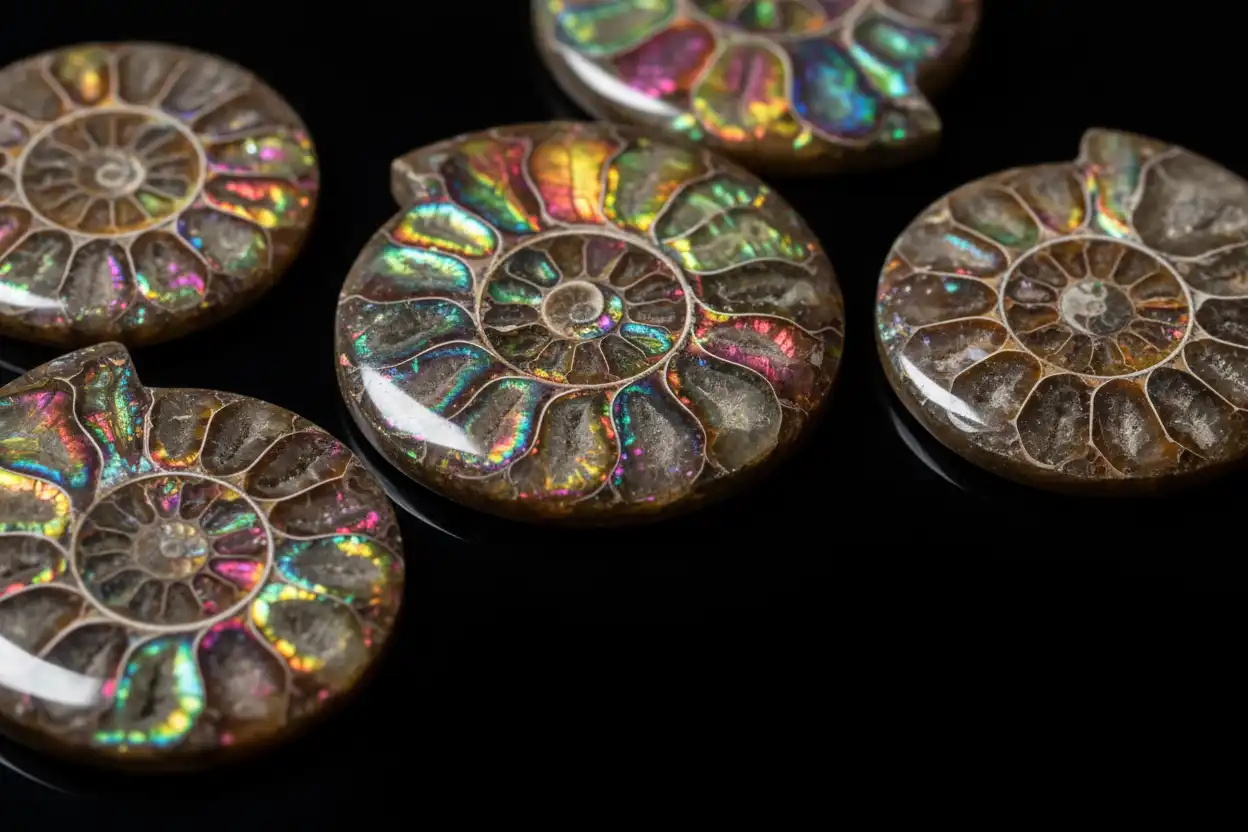
Ammolite Meaning: Mineral Identity, History & Symbolism
Ammolite meaning begins with an important distinction: Ammolite is not a standalone mineral species and it is not simply another name for every ammonite fossil. It is an iridescent gem material derived from the preserved shell layers of fossil ammonites, with the colored portion composed principally of aragonite, a calcium carbonate mineral. The extraordinary reds, greens, blues, and other hues visible on fine material arise mainly from the interaction of light with microscopic layers in the preserved shell rather than from strongly colored mineral pigments.
That material identity matters because Ammolite sits at the intersection of paleontology, mineralogy, gemology, and cultural history. It began as the shell of a marine organism, became part of the geological record, and only later entered the gem trade as polished iridescent material. Understanding those layers of identity provides a more useful foundation for discussing Ammolite meaning than treating the material as a generic colorful stone.
Readers exploring other mineral and fossil-gem references can browse the broader Gemstone Guides, while the sections below stay focused on what Ammolite is, why it displays color, how its identity can be evaluated, what its documented history supports, and where symbolic interpretations must remain separate from measurable evidence.
Ammolite Identity at a Glance
| Property | Ammolite |
|---|---|
| Material type | Iridescent fossil ammonite shell used as gem material |
| Principal mineral | Aragonite |
| Principal chemistry | Calcium carbonate, CaCO₃ |
| Mineral status | Not a separate mineral species |
| Structural origin | Preserved layered shell or nacreous microstructure |
| Typical transparency | Usually opaque as fashioned gem material; very thin layers may transmit some light |
| Optical phenomenon | Structural iridescence produced primarily by multilayer interference |
| Common colors | Red, orange, yellow, green, blue, violet, and combinations |
| Typical structure | Thin iridescent layer, frequently associated with fractures and fossil matrix |
| Durability | Relatively soft and structurally delicate compared with many conventional jewelry gems |
| Important identification limit | Appearance alone cannot reliably prove geographic origin, treatment status, or construction |
Gemological studies describe Ammolite as predominantly aragonitic fossil-shell material, while minor minerals or alteration products may occur within individual fossils. More recent microscopic research has also identified small amounts of materials such as calcite, apatite, pyrite, and siderite in studied iridescent ammonites. This variation is one reason Ammolite is best described as a natural gem material with a complex fossil history rather than as a perfectly homogeneous mineral crystal.
Aragonite itself has an orthorhombic crystal structure, but a polished piece of Ammolite does not normally resemble a free-growing aragonite crystal. Its useful gemological structure is inherited from the thin, tightly organized mineral plates of the ammonite shell. Those microscopic layers are central to both the material’s appearance and its vulnerability.
How Ammolite Forms
Ammolite ultimately begins with ammonites, extinct marine cephalopods that produced mineralized shells. In the material most strongly associated with the modern gem trade, ammonite remains were preserved within marine sediments of the Bearpaw Formation in southern Alberta. Alberta geological authorities describe the commercially important material as the vivid iridescent aragonite layer preserved in fossil ammonite shells occurring within dark marine shale.
The useful gem layer is remarkably thin relative to the entire fossil. Burial, compaction, mineral interaction, and preservation affected the shell after the animal died, while portions of the original layered aragonitic architecture survived well enough to interact with light. Fracturing is common, which explains why many pieces display networks, patches, or mosaic-like divisions rather than a perfectly uninterrupted sheet of color.
The fossilization process should not be simplified into the claim that an ammonite shell merely “turned into Ammolite.” Preservation differs from specimen to specimen, and current microscopic work indicates that questions remain about exactly how alteration of the original shell’s organic components changed its optical behavior. Researchers can observe the surviving aragonite platelets, but some details of how fossilization modified the interfaces between those layers are still being investigated.
A more detailed treatment of the host rocks, fossil horizons, depositional setting, and deposit formation belongs in Ammolite formation and deposit geology. Here, the essential point is that Ammolite’s gem character depends on exceptional preservation of shell microstructure, not merely on the presence of an ammonite fossil.
Why Ammolite Shows So Many Colors
The most important fact behind Ammolite color is that its iridescence is structural. White light interacts with many closely spaced aragonite layers, and reflected light waves reinforce or cancel one another according to the dimensions and organization of those layers. The result is intense interference color that can change when the stone, viewer, or light source moves. Detailed GIA research favors multilayer interference as the principal optical explanation rather than treating the material as a conventional pigment-colored gem.
This explains why a piece can look fiery red from one direction and shift toward green or another hue as its viewing geometry changes. Differences in platelet thickness, spacing, organization, internal alteration, and interruptions within the layered shell affect which wavelengths are reinforced strongly enough to be seen.
Color therefore should not be interpreted as evidence for different chemical varieties in the way chromium may distinguish the coloration of certain other gems. A green area and a red area of Ammolite can belong to the same basic aragonitic shell system while displaying different optical responses.
For readers who want the physics of angular color change, layer structure, directional behavior, and related observations in greater depth, those subjects are separated into Ammolite optical properties and color behavior.
A Source-Reconciliation Guide to Ammolite Names and Claims
Ammolite terminology becomes confusing because mineral names, fossil names, commercial terminology, cultural language, and marketing descriptions are frequently mixed together. The following framework separates claims that are strongly supported from those that require qualification.
| Name or claim | Evidence assessment | More accurate interpretation |
|---|---|---|
| “Ammolite is a mineral” | Unsupported as a strict mineralogical statement | Ammolite is a gem material composed principally of aragonitic fossil shell |
| “Ammolite and ammonite mean the same thing” | Too broad | Ammonite refers to the fossil organism or its remains; Ammolite refers to iridescent gem material derived from ammonite shell |
| “Every ammonite fossil is Ammolite” | Unsupported | Only appropriately iridescent ammonite shell material is described as Ammolite in gem use |
| “Ammolite is opal” | Unsupported for ordinary Ammolite | Its classic iridescence comes from layered aragonitic shell rather than the silica structure responsible for precious opal |
| “Ammolite color is caused by pigment” | Misleading | Structural interference is the dominant explanation for its spectral iridescence |
| “Ammolite color is simply diffraction” | Technically imprecise | Detailed gemological work supports multilayer interference as the principal mechanism |
| “Ammolite exists only in Alberta” | Requires qualification | Southern Alberta is the classic and commercially important source, but iridescent ammonite material is also documented elsewhere |
| “Ammolite is automatically an iniskim” | Culturally inaccurate | Iniskim is a Blackfoot cultural and ceremonial concept associated with buffalo calling stones, including certain ammonite fossils; it is not merely a commercial synonym for polished Ammolite |
One especially important naming issue concerns geographic exclusivity. Southern Alberta remains the locality most strongly associated with exceptionally bright commercial Ammolite, yet gemological literature documents iridescent ammonite from other regions as well. GIA also notes that “Ammolite,” once used as a protected commercial designation, is now a public-domain term that may be applied more broadly to iridescent ammonite.
That does not make origin irrelevant. Geographic provenance can influence historical context, disclosure, collecting significance, and commercial representation, but origin should be established through documentation and appropriate gemological evidence rather than inferred solely from color. The practical questions to ask a seller are covered more fully in the Ammolite provenance and disclosure checklist.
Diagnostic Traits You Can Observe Without Overclaiming
Ammolite can be visually distinctive, yet visual recognition should not be confused with full gemological identification. Strong iridescence across a thin fossil-shell surface, directional color changes, irregular fracture mosaics, preserved shell curvature, and a dark underlying matrix can all be useful observations. None of those features, by itself, proves a claimed mine, geographic origin, treatment history, or assembled construction.
Under magnification, the relationships between the iridescent surface, fractures, underlying matrix, possible coatings, and assembled layers become easier to study. Readers who want a structured observation approach can use the Ammolite microscope inclusion notebook rather than relying on broad visual assumptions.
Ammolite Specimen and Photo Evaluation Checklist
When examining a specimen directly or assessing seller photographs, record observations rather than jumping immediately to conclusions:
Does the color change as the viewing angle changes, or does it remain visually flat?
Is the iridescent layer visibly thin compared with the material beneath it?
Does the surface show a coherent sheet, fractured mosaic, or irregular patches?
Are fossil shell contours, sutures, or matrix relationships visible?
Can you see a transparent cap, backing, bonding line, or other evidence of assembled construction?
Does the seller distinguish natural shell color from stabilization, coating, backing, or assembly?
Is geographic origin documented, or merely assumed from appearance?
Are unusual names such as “opalized Ammolite” supported by mineralogical evidence?
Do photographs show the piece from several angles rather than only under one favorable light?
Are color, origin, treatment, and construction described as separate attributes?
This checklist cannot replace laboratory identification. Its purpose is to separate direct observations from marketing conclusions, which is particularly important for a gem whose most dramatic feature can vary strongly with lighting and orientation.
Ammolite, Ammonite, and the Fossil Shell
The ammonite identity should remain visible in any serious definition of Ammolite. The spiral shell, chambers, sutures, and other paleontological features belong to the fossil organism, while the term Ammolite concentrates attention on the iridescent shell layer that can be fashioned or displayed as gem material.
A small polished cabochon may preserve almost none of the recognizable spiral outline of a complete ammonite. Conversely, an entire ammonite fossil can show impressive morphology while containing little or no gem-quality iridescent shell. The two objects therefore overlap but are not interchangeable.
This distinction also helps explain why cutting choices matter. Removing or orienting only a small amount of material can change how much color is visible because the optical layer is thin and directional. Detailed lapidary decisions, however, belong on the dedicated Ammolite cutting, orientation, and polish guide rather than in this meaning reference.
Documented Cultural History Requires Precise Language
Ammolite’s human history did not begin with the modern jewelry trade. Ammonite fossils have documented significance within Blackfoot cultural traditions, and museum collections preserve objects identified as iniskim, or buffalo calling stones. Smithsonian records, for example, identify an ammonite fossil associated with Siksika Blackfoot ceremonial use, while Blackfoot cultural resources describe the buffalo calling stone as a sacred object connected with ceremony and relationships with buffalo.
That history deserves more precision than the common marketing phrase that Ammolite was simply a “good-luck stone.” Iniskim is a culturally specific concept, not a decorative label to place on every piece of iridescent ammonite offered for sale. Commercial Ammolite may come from the same broader fossil landscape, but cultural meaning should not be detached from the people, practices, and protocols to which it belongs.
Modern gem-trade history is separate. The name Ammolite developed as iridescent ammonite was cut and promoted as a gem material, particularly from southern Alberta. Its commercial identity subsequently expanded beyond the original branding context, while its fossil and mineralogical identities remained unchanged.
What Ammolite Meaning Can Responsibly Mean
In a mineralogical sense, Ammolite meaning is straightforward: it refers to iridescent gem material derived from fossil ammonite shell, principally composed of layered aragonite. Its observable properties can be investigated with microscopy, optical analysis, spectroscopy, mineralogical methods, and geological context.
Symbolic meaning operates differently. Modern crystal and gemstone communities sometimes associate Ammolite with transformation, adaptability, continuity, prosperity, protection, creativity, or changing perspective. These ideas are interpretations rather than scientifically measurable properties.
The material lends itself naturally to metaphor. A shell preserved through geological change can represent continuity. Iridescent colors that change with viewing angle can suggest perspective. The ammonite’s spiral form can be used as a personal symbol of cycles, growth, or reflection. Those meanings can be personally useful without being presented as facts about the mineral.
There is no established gemological evidence that Ammolite emits healing energy, changes health outcomes, attracts money, predicts events, protects someone from physical danger, or produces supernatural effects. Anyone using Ammolite symbolically should keep those beliefs separate from medical, financial, safety, or relationship decisions. Broader boundaries for such claims are explained in the Gems Lore disclaimer.
Ammolite in Jewelry Without Confusing Material and Design
Because its iridescent layer can be thin and delicate, Ammolite used in jewelry may appear as a solid piece, stabilized material, a doublet, a triplet, or another supported construction. That construction affects how the finished object behaves, but it does not change the basic definition of the natural colored material at the heart of the gem.
Different jewelry formats also impose different physical demands. Readers considering pieces worn close to the ears can continue to the dedicated Ammolite earrings guide, while those comparing pendants and larger focal pieces can use the Ammolite necklace guide. Questions about protection, mounting geometry, exposed edges, and everyday wear belong in Ammolite setting and wear engineering.
These distinctions prevent a material reference from turning into a general jewelry-buying page.
Treatment, Assembly, and Disclosure
Natural Ammolite can be fragile, and gemological literature documents the use of stabilization and assembled constructions to make thin iridescent material more practical for jewelry. The presence of such work is not something that should be guessed from a single photograph, nor should “natural color” automatically be interpreted to mean “untreated and unassembled.”
Buyers should ask separately about the natural origin of the iridescent layer, stabilization, surface coating, backing, transparent caps, adhesives, and geographic provenance. For a transaction-focused evaluation rather than a material definition, use the guide to buying Ammolite.
Price is also a separate question. Color range, brightness, directional performance, pattern, durability, construction, workmanship, size, provenance, and market presentation can all influence commercial evaluation. Those factors are examined on the dedicated Ammolite price guide rather than assigning market values here.
Safe Ownership of Ammolite
Ammolite should be treated as a comparatively delicate gem material. Its aragonitic shell layer is relatively soft, thin, and potentially vulnerable to scratching, impact, chemicals, excessive heat, or separation along weakened areas. Assembled stones may be more resistant to some forms of wear because the iridescent layer is protected by other materials, but their durability depends on how the piece was constructed.
Routine ownership therefore calls for restraint rather than aggressive cleaning or polishing. Before cleaning jewelry, identify whether the piece is solid, stabilized, coated, backed, capped, or assembled, then follow the more detailed Ammolite jewelry cleaning guide.
Collector fossils and display specimens have different priorities from wearable gems because retaining original matrix, surface condition, labels, and provenance may be more important than increasing shine. Long-term handling and documentation practices are addressed in the Ammolite specimen conservation record.
What Ammolite Does—and Does Not—Tell You by Appearance
A bright full-spectrum surface can tell you that an optical phenomenon is present. A mosaic pattern can tell you something about physical disruption of the shell layer. A dark backing visible at the edge may suggest matrix or assembly. None of those observations alone can tell you everything a seller may claim.
Color cannot reliably establish a mine. Pattern cannot prove a particular fossil species. A photograph cannot always distinguish stabilization from an untreated surface. A transparent cap may be difficult to see from a face-up image. Even the term “Canadian Ammolite” should be supported by provenance rather than inferred because the piece looks similar to well-known Alberta material.
That distinction between observation and conclusion is central to responsible gemology. Gems Lore’s broader approach to material definitions and evidence boundaries is described on the About Gems Lore page.
Frequently Asked Questions
Is Ammolite a mineral?
No. Ammolite is a gem material rather than a separate mineral species. Its iridescent shell layer is composed principally of aragonite, a calcium carbonate mineral, with minor associated mineral phases possible in individual fossil material.
Is Ammolite the same as ammonite?
Not exactly. An ammonite is the fossilized remains of an extinct marine cephalopod. Ammolite refers specifically to iridescent ammonite shell material used or recognized as a gem. An ammonite fossil can exist without gem-quality Ammolite.
Is Ammolite an opal?
Ordinary Ammolite is not precious opal. Its characteristic rainbow colors are produced primarily by the layered aragonitic structure of fossil shell, whereas precious opal has a different composition and microscopic mechanism for its play-of-color.
What causes Ammolite’s rainbow colors?
The dominant mechanism is structural interference. Light reflects within microscopic aragonite layers, and differences in their thickness, spacing, organization, and viewing geometry determine which wavelengths are reinforced strongly enough to be seen.
Does Ammolite naturally change color?
The material itself is not rapidly changing chemical color as you turn it. Instead, its visible hue can shift because the optical path through its layered microstructure changes with illumination and viewing angle.
Does every Ammolite come from Alberta?
Southern Alberta is the classic and commercially important source of highly iridescent Ammolite, but iridescent ammonite material has also been documented outside Canada. A claimed geographic origin should therefore be supported by provenance rather than appearance alone.
Is Ammolite always untreated?
No. Natural iridescent material may be stabilized or incorporated into assembled stones because the shell layer can be thin and fragile. Treatment and construction should be disclosed separately from statements about whether the visible color itself is natural.
Is Ammolite fragile?
Compared with harder jewelry gems, Ammolite requires more careful handling. The aragonitic layer is relatively soft and can be structurally delicate, although protective construction can improve the practical durability of a finished piece.
What does Ammolite symbolize?
Modern symbolic interpretations often connect Ammolite with transformation, changing perspective, continuity, creativity, or abundance. Those associations are cultural or personal interpretations rather than scientifically demonstrated properties.
Does Ammolite have healing properties?
There is no established scientific evidence that Ammolite treats disease, changes bodily function, or provides medical healing. It may be used as a personal or symbolic object, but health decisions should rely on appropriate professional care.
Is iniskim another word for Ammolite?
Not simply. Iniskim is a Blackfoot cultural term associated with buffalo calling stones and ceremonial traditions, and ammonite fossils can be part of that tradition. It should not be reduced to a commercial synonym for every polished Ammolite gemstone.
Ammolite is most accurately understood as a layered fossil gem: ammonite shell in biological origin, principally aragonite in mineral composition, iridescent through microscopic structure, and culturally significant in contexts that extend beyond modern jewelry. Its measurable identity and optical behavior can be studied scientifically, while its symbolic meanings remain interpretive. Keeping those categories distinct preserves what is genuinely remarkable about the material without asking it to support claims that the evidence does not.