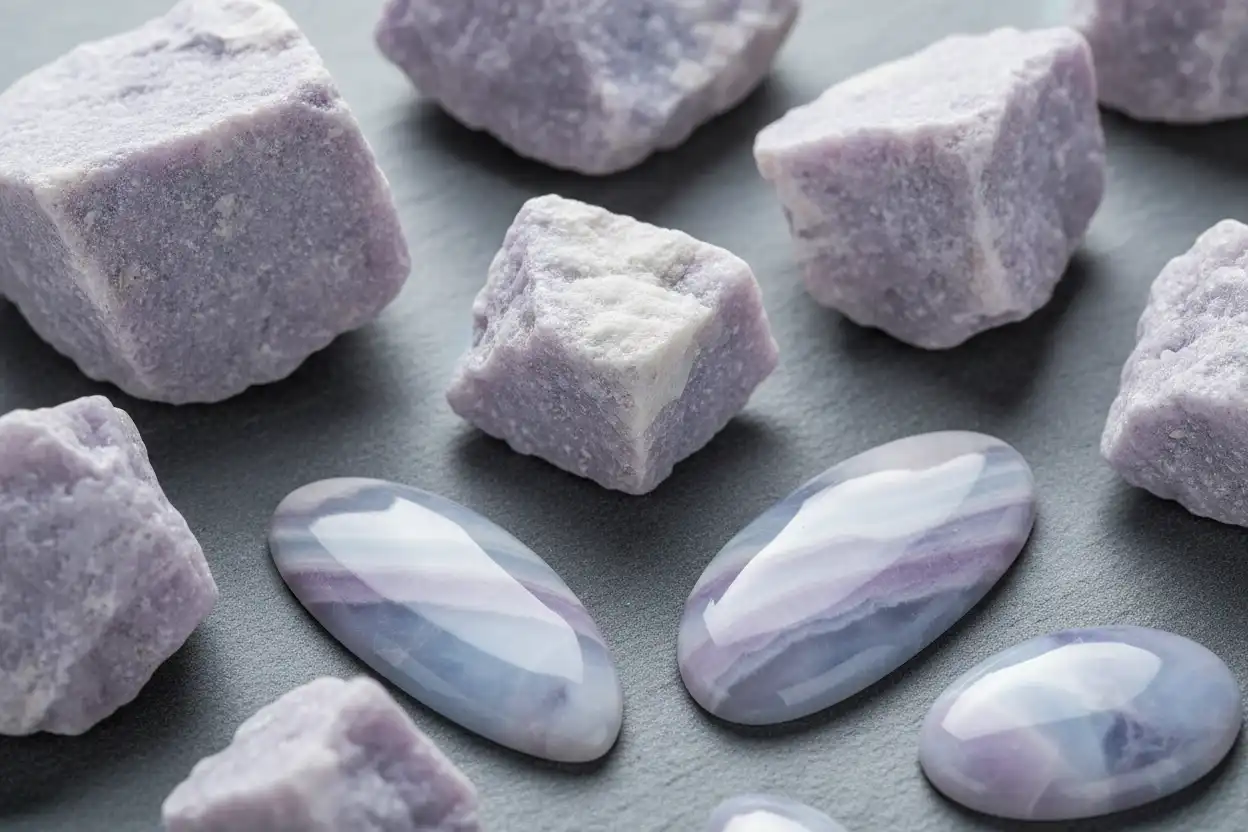
Anhydrite Meaning: Mineral Identity, History & Symbolism
Anhydrite meaning begins with calcium sulfate mineralogy. Anhydrite is a naturally occurring sulfate mineral with the ideal chemical formula CaSO₄. It crystallizes in the orthorhombic system and is distinguished chemically from gypsum because anhydrite contains no structural water, whereas gypsum has the formula CaSO₄·2H₂O. This apparently small difference changes the minerals’ crystal structures, densities, hardnesses, stability relationships, and behavior in geological environments.
Natural anhydrite is commonly colorless, white, gray, bluish, violet, reddish, or brownish, although many large geological occurrences are massive rather than composed of attractive free-standing crystals. It is typically around 3–3.5 on the Mohs hardness scale, has a specific gravity close to 3, possesses strong cleavage in several directions, and is brittle. Fresh cleavage surfaces may show vitreous to pearly luster, while massive or altered specimens can appear much duller.
These measurable properties form the factual basis of anhydrite meaning. They should remain distinct from modern symbolic interpretations that associate the mineral with stability, acceptance, emotional balance, communication, or personal transformation. Such meanings can be used as personal metaphors, but mineralogical analysis does not demonstrate that CaSO₄ produces emotional, medical, spiritual, or supernatural effects.
Readers looking for other fact-first mineral references can browse the broader Gemstone Guides. The purpose here is to define anhydrite as a mineral first, explain its geological and historical context, establish practical identification limits, and then address symbolism without duplicating the specialist pages that own its optics, geology, cutting, setting, provenance, or conservation.
Anhydrite Identity at a Glance
| Property | Anhydrite |
|---|---|
| Mineral class | Sulfate |
| Ideal formula | CaSO₄ |
| Principal elements | Calcium, sulfur, and oxygen |
| Crystal system | Orthorhombic |
| Structural water | None in the ideal formula |
| Closely related mineral | Gypsum, CaSO₄·2H₂O |
| Common colors | Colorless, white, gray, blue-gray, violet, reddish, brownish |
| Transparency | Transparent to translucent in crystals; massive material may appear opaque |
| Luster | Vitreous to pearly on suitable surfaces |
| Mohs hardness | About 3–3.5 |
| Specific gravity | Approximately 2.9–3.0 |
| Cleavage | Strong in several crystallographic directions |
| Tenacity | Brittle |
| Common occurrence | Evaporites, salt deposits, replacement bodies, veins, and altered sulfate sequences |
| Typical commercial form | Mineral specimens, massive material, occasional ornamental use |
| Important trade relationship | Pale blue massive anhydrite may be sold as Angelite |
| Main identification limit | Appearance alone cannot prove anhydrite, locality, treatment, or purity |
Anhydrite may look simple because its formula contains only calcium sulfate, yet specimens can preserve complicated histories of precipitation, burial, dehydration, hydration, replacement, deformation, and fluid movement. An apparently plain white mass can therefore carry substantial geological information.
Anhydrite and Gypsum Are Related but Distinct
The most important comparison for understanding anhydrite is gypsum. Both minerals contain calcium sulfate, but gypsum incorporates two water molecules into its crystal structure while ideal anhydrite does not. Gypsum is consequently softer and less dense, while anhydrite has a different crystal system and different structural organization.
Calling anhydrite “gypsum without water” is useful as a first chemical comparison, but it should not imply that the mineral is merely dried-out gypsum in every occurrence. Anhydrite can form directly under suitable conditions, can develop through dehydration of earlier gypsum during burial, and can participate in more complicated replacement histories. Conversely, anhydrite exposed to appropriate water-rich conditions can hydrate toward gypsum.
Those transformations are genuine mineral reactions controlled by temperature, pressure, water availability, permeability, texture, and geological history. They should not be turned into symbolic claims that the mineral literally “absorbs emotional water” or “dehydrates negativity.”
The specialized geological mechanisms belong in Anhydrite formation and deposit geology. For this reference, the essential distinction is structural: anhydrite and gypsum are chemically related minerals, not interchangeable names for the same material.
How Anhydrite Forms in Evaporite Systems
Large quantities of anhydrite occur in evaporite sequences formed from saline waters. When seawater, restricted marine water, saline lake water, or subsurface brines become concentrated, sulfate minerals can precipitate along with carbonates and salts. Anhydrite may occur with gypsum, halite, dolomite, calcite, clay-rich sediments, and other minerals characteristic of evaporitic environments.
The exact mineral originally precipitated is not always the mineral preserved today. A sulfate bed may have begun partly as gypsum and later converted to anhydrite during burial as temperature and pressure increased and water was removed from the structure. Later uplift and groundwater circulation can reverse parts of that history by hydrating anhydrite back toward gypsum.
As a result, geological anhydrite bodies may display nodules, massive beds, replacement textures, fracture networks, veins, brecciation, and complex contacts with gypsum. These textures can reveal multiple stages rather than one uninterrupted episode of crystal growth.
That complexity is important because a hand specimen cannot always tell you whether the anhydrite crystallized directly from brine, replaced gypsum, formed through hydrothermal activity, or experienced several of these processes. Geological context is needed.
Anhydrite Also Occurs Outside Classic Salt Beds
Evaporites are central to anhydrite geology, but they are not the only setting. The mineral can occur in hydrothermal veins, volcanic and geothermal environments, metamorphosed rocks, contact-altered carbonate systems, and other fluid-rich geological settings.
Anhydrite can precipitate where calcium-rich and sulfate-bearing fluids interact under conditions favorable to the water-free calcium sulfate structure. It may also coexist with sulfides, carbonates, quartz, or other hydrothermal minerals depending on fluid chemistry and temperature.
This range of occurrences explains why matrix matters. A transparent anhydrite crystal associated with hydrothermal minerals should not automatically be interpreted through the same formation model as a massive gray layer from a sedimentary evaporite deposit.
The mineral species remains CaSO₄, but the geological story can differ substantially.
Why Anhydrite Can Be White, Blue, Violet, or Reddish
Pure ideal anhydrite does not require a strong body color. Colorless and white specimens are therefore unsurprising, while gray, blue, violet, pinkish, reddish, and brownish examples demonstrate that natural material can acquire additional optical character.
There is no responsible single-element explanation for every colored anhydrite specimen. Trace impurities, structural defects, microscopic inclusions, radiation-related color centers, alteration products, grain boundaries, and associated minerals can all potentially influence appearance. Different specimens displaying similar blue or violet colors need not share exactly the same microscopic cause.
This evidence boundary matters especially for blue material. A pale blue anhydrite specimen should not automatically be described as copper-bearing, irradiated, or chemically identical to every other blue example based on color alone.
Likewise, rusty or reddish surfaces may reflect iron-bearing alteration or staining rather than a uniform chromophore distributed through the anhydrite lattice.
A technically defensible description begins with observation: “pale blue translucent anhydrite” or “white anhydrite with reddish surface staining.” A statement identifying the precise color mechanism requires evidence capable of testing that mechanism.
Detailed questions about refractive behavior, transparency, birefringence, color centers, and how different surfaces affect apparent color belong in Anhydrite optical properties and color behavior.
Angelite Is Related to Anhydrite Because It Is Anhydrite
The commercial name Angelite is commonly applied to pale blue-gray massive anhydrite used for carvings, cabochons, beads, and ornamental objects. It is not a separate mineral species with a different formula.
This relationship is worth stating clearly because commercial gemstone terminology can create the impression that Angelite and anhydrite are only vaguely related materials. Mineralogically, Angelite’s underlying species is anhydrite.
The dedicated Angelite meaning guide owns the trade name, pale blue ornamental material, its modern symbolic associations, and the specific claims surrounding that commercial identity. This anhydrite page remains broader and includes the full mineral species across its colors, crystal forms, geological settings, and scientific history.
A label reading “Angelite — anhydrite” is therefore coherent. A label describing Angelite as an unrelated mineral species is not.
Anhydrite’s Crystal Structure and Cleavage
Anhydrite crystallizes in the orthorhombic system. Well-formed crystals may be tabular, prismatic, or blocky, although large geological occurrences frequently consist of massive or granular material instead of isolated display crystals.
Its cleavage is a particularly important physical characteristic. Anhydrite has strong cleavage in several directions, producing blocky fragments and smooth reflective surfaces when the mineral breaks along crystallographic planes. Those surfaces can show different lusters depending on orientation.
Cleavage also affects durability. A material can resist scratching reasonably well for its hardness yet still split or chip readily when force is applied in a favorable direction. That is why Mohs hardness alone should not be used to predict how safely anhydrite will behave in jewelry, carvings, or specimen handling.
A closer study of grain boundaries, cleavage traces, fractures, inclusions, alteration fronts, and possible repairs belongs in the Anhydrite microscope inclusion notebook.
Diagnostic Traits of Anhydrite
Anhydrite identification becomes more convincing when several properties agree. Moderate softness, a specific gravity close to 3, orthorhombic crystallography, strong multi-directional cleavage, commonly pale coloration, and characteristic optical behavior can all contribute to the identification.
The comparison with gypsum is especially useful. Gypsum is substantially softer, has a lower density, contains structural water, and belongs to a different crystal system. However, destructive hardness tests should not be performed casually on valuable specimens merely to separate the two.
Other pale sulfate minerals can also cause confusion. Celestite is strontium sulfate and barite is barium sulfate; both are chemically different and generally denser than anhydrite. Massive carbonate minerals and pale feldspars can overlap visually in photographs despite having very different physical properties.
When reliable species identification matters, visual appearance should be supplemented with suitable analytical evidence such as Raman spectroscopy or X-ray diffraction. Chemical analysis can answer additional questions about impurities or unusual composition.
Original Anhydrite Specimen and Photo Checklist
A strong photograph can document visible properties, but it cannot provide chemical composition or geological history by itself. The following checklist separates observation from interpretation.
| Observation | What it may support | What it cannot prove alone |
|---|---|---|
| Colorless, white, gray, blue, violet, or reddish material | Appearance compatible with documented anhydrite colors | Mineral species |
| Blocky crystal or cleavage fragment | Habit compatible with anhydrite | CaSO₄ composition |
| Several smooth cleavage directions | Strong support for a cleavable mineral | Exact sulfate identity |
| Vitreous or pearly reflective surfaces | Compatible with fresh anhydrite | Absence of coating |
| Massive occurrence with gypsum or halite | Plausible evaporite association | Whether anhydrite or gypsum formed first |
| Pale blue massive material | Compatible with material sold as Angelite | Peruvian origin |
| Reddish surface patches | Possible staining or natural color variation | Specific chromophore |
| Seller label naming a mine | Provenance statement worth preserving | Independent locality verification |
| Crystal described as “untreated” | Commercial disclosure claim | Laboratory proof of no treatment |
| Raman or XRD result consistent with anhydrite | Strong mineral-identity evidence | Geographic provenance |
| Geological matrix with documented collection record | Useful contextual evidence | Exact formation pathway without further study |
This framework prevents common leaps in reasoning. A blue color does not establish the Angelite trade provenance. Association with gypsum does not reveal which mineral formed first. A seller’s locality label does not become analytical proof simply because the specimen looks plausible.
For collection records, original labels, invoices, locality documentation, or unusual mine claims, use the Anhydrite provenance and disclosure checklist.
Anhydrite Names and Claims That Need Reconciliation
| Name or claim | Evidence assessment | Better interpretation |
|---|---|---|
| Anhydrite | Accepted mineral name | Orthorhombic CaSO₄ |
| “Anhydrous gypsum” | Useful chemical shorthand but mineralogically imprecise | Anhydrite and gypsum are separate mineral species |
| Angelite | Commercial or lapidary name | Pale blue massive anhydrite, not a separate species |
| Blue anhydrite | Descriptive color term | Does not automatically prove Angelite provenance |
| “Gypsum crystal without water” | Oversimplified | Related chemistry, different mineral structure |
| “Every anhydrite began as gypsum” | Unsupported | Formation pathways vary |
| “Every gypsum deposit contains primary anhydrite” | Unsupported | Deposit histories differ |
| “Anhydrite dissolves immediately in water” | Exaggerated | Water interaction is more complex; prolonged exposure is still unnecessary |
| “Anhydrite cannot exist near the surface” | Too absolute | Surface and near-surface occurrences exist, although hydration can affect stability |
| “Anhydrite healing crystal” | Modern belief language | Not a scientifically demonstrated therapeutic property |
| “Blue anhydrite communicates with angels” | Spiritual interpretation | Not a measurable mineralogical effect |
| “Calcium sulfate strengthens bones when worn” | Unsupported medical inference | Mineral composition does not create nutritional delivery through skin |
The table provides a practical evidence filter: mineralogical terminology should describe mineral identity, geological statements should be supported by geological evidence, and symbolism should remain labeled as symbolism.
The Name Anhydrite Refers to Its Lack of Structural Water
The mineral’s name comes from language meaning “without water.” That naming choice reflects the chemical contrast between anhydrite and hydrated calcium sulfate minerals, especially gypsum.
Its documented history is therefore strongly connected with mineral chemistry and classification. Early mineralogists recognized that material occurring in salt deposits could resemble gypsum while differing in density, hardness, cleavage, and water content. The eventual distinction between gypsum and anhydrite became increasingly important as mineral chemistry and crystallography developed.
That history does not support claims that ancient cultures universally recognized anhydrite as a healing crystal or assigned it a fixed spiritual meaning. Such statements require independent historical evidence.
The absence of an ancient metaphysical tradition does not leave the mineral without a story. Its genuine history includes salt mining, evaporite geology, crystal chemistry, industrial mineralogy, groundwater interactions, deformation, and the long scientific effort to understand transformations between gypsum and anhydrite.
Anhydrite and Water: What the Mineral Relationship Actually Means
Because anhydrite lacks structural water while gypsum contains it, discussions of anhydrite frequently become exaggerated into claims that the mineral must never touch water.
The mineralogical situation is more nuanced.
Hydration of anhydrite to gypsum is a real reaction, but the rate and extent depend on factors such as temperature, fluid access, porosity, grain size, surface condition, dissolved ions, fractures, and time. Large geological bodies can undergo substantial hydration during uplift and groundwater circulation, sometimes producing volume changes, deformation, brecciation, or replacement textures.
That geological behavior does not mean an intact collector specimen disintegrates the instant it encounters humidity or a brief accidental splash.
For ownership, the sensible approach is conservative rather than dramatic: do not soak anhydrite unnecessarily, avoid repeated wetting and drying, and do not use water-based cleaning simply because a specimen looks dirty when its matrix, coatings, repairs, or alteration state are unknown.
Safe Ownership of Anhydrite
Anhydrite’s principal everyday vulnerability is mechanical. At roughly 3–3.5 on the Mohs scale, it can be scratched by many common minerals and household materials. Its strong cleavage and brittle tenacity also make corners, thin sections, crystal edges, and unsupported projections vulnerable to impact.
Store specimens away from quartz and other harder minerals that could rub against them. Use padded support for delicate crystals and avoid gripping a specimen by a protruding termination.
Cleaning should begin with the least invasive method that addresses the actual problem. Loose dust can often be removed with gentle dry techniques rather than immersion. Strong acids, aggressive household cleaners, steam, and ultrasonic equipment are inappropriate default choices for an unidentified or delicate anhydrite specimen.
The detailed storage, repair, old-label preservation, matrix stabilization, and documentation decisions belong in the Anhydrite specimen conservation record.
Anhydrite in Jewelry Is a Specialist Use
Transparent anhydrite can occasionally be cut, and attractive massive material can be polished, but the mineral is not a conventional everyday jewelry gem. Its combination of moderate softness, brittle behavior, and strong cleavage places significant limits on exposed wear.
A pendant or protected collector jewel presents less abrasion than an everyday ring. Thin edges, sharp corners, drill holes, and prong pressure require particular caution because cleavage can propagate from damaged or stressed areas.
The lapidary decisions involved in orienting rough, controlling cleavage, polishing, and minimizing breakage belong to Anhydrite cutting, orientation, and polish.
For mounting decisions, including how bezel support, exposed edges, prongs, and impact directions affect risk, use Anhydrite setting and wear engineering.
The relevant meaning-page conclusion is simply that ornamental use does not change the mineral’s physical limitations.
Cutting Dust Requires Normal Mineral-Workshop Controls
Handling an intact specimen is different from sawing, grinding, drilling, or sanding it. Mechanical processing creates fine mineral and matrix dust that should not be deliberately inhaled.
Appropriate wet methods where suitable, local extraction, respiratory protection matched to the operation, and careful cleanup are sensible workshop practices. Matrix minerals should also be considered because a rough piece may contain more than anhydrite.
There is no need to characterize ordinary handling of a polished anhydrite specimen as inherently hazardous. Safety guidance should match the actual exposure pathway.
Treatment, Repair, and Surface Modification
Anhydrite does not have the same standardized treatment market as major commercial gemstones, but individual specimens and ornamental objects can still be repaired, coated, impregnated, dyed, polished, assembled, or glued to matrix.
A highly polished blue carving could be natural blue anhydrite and still contain a surface coating or repair. Conversely, an untreated specimen can have uncertain provenance.
These are separate questions:
Is the mineral natural?
Is the color natural?
Has the surface been coated?
Have fractures been filled?
Has the specimen been repaired?
Is the stated locality documented?
A responsible seller should not use the single word “natural” as an answer to all six.
This page introduces that distinction but does not duplicate transaction-specific buying advice.
Provenance Cannot Be Determined From Blue Color
Blue-gray anhydrite is well known, and the commercial Angelite identity is particularly associated with Peruvian material. Nevertheless, blue color does not constitute geographic evidence.
A pale blue anhydrite from one locality may resemble material from another region closely enough that photographs cannot distinguish them. Provenance instead relies on original labels, supplier documentation, mine information, collection records, geological matrix, or other credible chain-of-custody evidence.
This principle is important for all collector minerals. A mineral species can occur in many regions, while commercial names can spread beyond their original narrow use.
Preserve old specimen labels even when they are visually unattractive. A small handwritten card may contain information impossible to reconstruct after it is discarded.
Responsible Anhydrite Symbolism
Modern interpretations of anhydrite sometimes associate it with acceptance, stability, emotional balance, patience, release, communication, or adapting to change. These ideas can be developed into personally meaningful metaphors without claiming that the mineral physically produces those outcomes.
The gypsum-anhydrite relationship offers an obvious symbolic image. The same overall calcium sulfate system can exist in different structural forms depending on environmental conditions. Someone might use that as a reminder that circumstances can change how something is expressed without erasing its underlying continuity.
Anhydrite’s association with thick evaporite sequences can similarly inspire metaphors of endurance or preservation, while its cleavage can suggest that strength and vulnerability can coexist.
These are interpretations created by people.
There is no established scientific evidence that anhydrite treats anxiety, cures disease, regulates calcium levels, heals bones, balances hormones, removes toxins, changes brain chemistry, attracts money, protects against accidents, or emits therapeutic energy.
The distinction between symbolic practice and health or supernatural claims is explained in the Gems Lore disclaimer.
Blue Anhydrite and Spiritual Communication Claims
Blue anhydrite, particularly material marketed as Angelite, is frequently associated with communication, intuition, angels, spirit guides, prayer, or other spiritual themes. Much of this symbolism reflects the color blue and the commercial name Angelite rather than an ancient mineralogical tradition attached to CaSO₄.
A person may choose a blue specimen as a meditation object or as a reminder to communicate calmly. That is a legitimate personal use.
There is no laboratory evidence showing that blue anhydrite establishes supernatural communication, transmits messages from non-physical beings, activates a measurable chakra structure, or changes another person’s thoughts.
The scientific position does not need to invalidate personal spirituality. It simply prevents a mineral identification page from certifying claims mineralogical methods cannot test.
Anhydrite Does Not Deliver Calcium Through the Skin
Because anhydrite contains calcium, it can attract wellness claims suggesting that wearing the stone benefits bones, teeth, muscles, or calcium balance.
The chemical formula does not support that inference.
Calcium in CaSO₄ is incorporated into a mineral crystal structure. Wearing a polished specimen does not establish a biologically meaningful dose, absorption pathway, efficacy, or medical treatment.
Likewise, ingesting mineral powder or preparing an elixir is not justified merely because one element in the formula is nutritionally important in another chemical and dietary context.
Mineral composition and medical usefulness are separate questions.
Anhydrite, Anorthite, and Andalusite Are Completely Different Minerals
Similar names can create surprising identification errors. Anorthite meaning describes a calcium-rich plagioclase feldspar with the formula CaAl₂Si₂O₈. Anhydrite is calcium sulfate, CaSO₄. Despite the resemblance between their names, the two minerals differ in chemistry, hardness, crystal structure, geological occurrence, and physical behavior.
Andalusite meaning concerns an aluminium silicate, Al₂SiO₅, known for its metamorphic significance and strong pleochroism in transparent gem material. It is unrelated to anhydrite beyond both being naturally occurring minerals.
Even Anatase meaning provides a useful neighboring comparison because anatase is titanium dioxide, TiO₂, with substantially greater hardness and a completely different geological and crystallographic identity.
Names are therefore navigation aids, not identification tools.
Anhydrite and Fossil or Organic Gem Materials
The contrast becomes even clearer when compared with Ammolite meaning. Ammolite is an iridescent gem material derived from fossil ammonite shell and composed principally of aragonitic material, whereas anhydrite is an inorganic sulfate mineral.
Both materials can display attractive color, but those colors arise from fundamentally different structures and histories. Anhydrite color is a property of a crystalline sulfate material and its impurities or defects, while Ammolite’s celebrated iridescence arises principally from preserved layered shell microstructure interacting with light.
The comparison demonstrates why visual beauty alone does not place natural materials into the same mineralogical category.
Anhydrite as a Collector Mineral
Collectors may value anhydrite for crystal form, unusual color, transparency, matrix associations, deposit context, historical labels, or representative value within an evaporite collection. Massive specimens can also be scientifically informative when they preserve replacement textures, nodular structures, deformation, or relationships with gypsum.
A perfectly transparent crystal is therefore not automatically more important than a less attractive geological specimen. The relevant question depends on the purpose of the collection.
A crystallographic collection may prioritize sharp crystal form. A sedimentological collection may prioritize original evaporite textures. A historical collection may value an old label and documented mine more than aesthetic perfection.
Removing matrix, polishing a natural surface, or discarding documentation can destroy information even when the resulting specimen looks cleaner.
A Practical Evidence Ladder for Anhydrite Claims
The following hierarchy shows what level of evidence is appropriate for different conclusions.
Level 1 — Direct visual observation: color, transparency, luster, crystal form, cleavage surfaces, matrix, obvious fractures, and visible alterations.
Level 2 — Basic physical properties: hardness, density, cleavage behavior, streak, and carefully measured optical characteristics.
Level 3 — Microscopic evidence: grain structure, inclusions, twinning where relevant, coatings, alteration fronts, repairs, fluid-related textures, and fracture relationships.
Level 4 — Mineral identification: Raman spectroscopy or X-ray diffraction supporting anhydrite rather than gypsum or another sulfate.
Level 5 — Chemical or structural investigation: suitable analytical methods used to examine trace composition, unusual coloration, substitutions, or defect-related questions.
Level 6 — Geological interpretation: field relationships, petrography, stratigraphy, host-rock context, fluid history, and other evidence needed to establish how a particular occurrence formed.
Level 7 — Provenance: original labels, collection records, supplier chain, geological documentation, and other evidence supporting a mine or geographic claim.
This evidence ladder prevents one common error: asking Level 1 evidence to answer a Level 6 question. A photograph can show that a specimen is blue and cleavable; it cannot reveal its complete deposit history.
What Anhydrite Meaning Ultimately Represents
Mineralogically, anhydrite meaning is anchored in an orthorhombic calcium sulfate without structural water. Its strong cleavage, moderate softness, density, pale color range, relationship with gypsum, and occurrence in evaporite and fluid-related systems make it a distinctive mineral with substantial geological significance.
Geologically, anhydrite can record concentrated brines, burial, dehydration, hydration, replacement, fluid migration, uplift, and deformation. A simple CaSO₄ formula can therefore be associated with surprisingly complex rock histories.
Historically, the mineral’s name describes its water-free structural identity rather than an ancient spiritual doctrine. Modern symbolism arrived later and can frame anhydrite as a metaphor for adaptation, patience, stability, or structural change.
Those symbolic uses do not become scientific properties simply because they are meaningful to an individual. Keeping the categories separate preserves the most interesting parts of both: the mineral can remain scientifically accurate while personal interpretations remain personal.
The editorial distinction between evidence, interpretation, and belief used throughout Gems Lore is described on About Gems Lore. Questions involving a particular specimen, uncertain identification, or provenance record can be submitted through Contact Gems Lore.
Frequently Asked Questions
What is anhydrite?
Anhydrite is a naturally occurring calcium sulfate mineral with the ideal formula CaSO₄. It crystallizes in the orthorhombic system and contains no structural water in its ideal composition.
What does anhydrite meaning refer to?
In a scientific context, anhydrite meaning refers to the mineral’s identity, properties, geological formation, and relationship with other calcium sulfate minerals. Modern spiritual meanings are later symbolic interpretations rather than measured mineral properties.
Is anhydrite the same as gypsum?
No. Anhydrite is CaSO₄, while gypsum is CaSO₄·2H₂O. They are closely related calcium sulfate minerals but have different crystal structures, densities, hardnesses, and stability relationships.
Can anhydrite turn into gypsum?
Yes. Anhydrite can hydrate toward gypsum when suitable water-rich conditions allow the structural transformation. The process depends on environmental conditions and should not be simplified into instant transformation after brief contact with water.
Can gypsum turn into anhydrite?
Gypsum can lose structural water and convert toward anhydrite under appropriate geological or thermal conditions. Such transformations are important in buried evaporite sequences.
What color is natural anhydrite?
Natural anhydrite can be colorless, white, gray, blue-gray, bluish, violet, pinkish, reddish, or brownish. Many geological occurrences are pale or gray-white.
What causes blue anhydrite?
There is no one safely applicable explanation for every blue specimen. Structural defects, trace impurities, inclusions, color centers, grain effects, or combinations of these factors may influence appearance, and specific causes require appropriate analysis.
Is Angelite anhydrite?
Yes. Angelite is a commercial name commonly used for pale blue-gray massive anhydrite employed as an ornamental and metaphysical stone.
Is every blue anhydrite Angelite?
Not necessarily in strict historical or trade usage. Angelite is a commercial designation associated especially with particular blue ornamental anhydrite, while anhydrite itself occurs in multiple blue or gray-blue forms and localities.
How hard is anhydrite?
Anhydrite is about 3–3.5 on the Mohs hardness scale. It can be scratched relatively easily compared with quartz and many mainstream jewelry stones.
Is anhydrite fragile?
It can be. Anhydrite is brittle and has strong cleavage, so crystals and polished objects may chip or split after impact even though hardness describes only moderate scratch resistance.
Where does anhydrite form?
Anhydrite is especially important in sedimentary evaporite and salt deposits but can also occur in hydrothermal, metamorphic, geothermal, and other fluid-related settings.
Is anhydrite rare?
Anhydrite is widespread as a geological mineral, particularly in subsurface evaporite deposits. Attractive transparent crystals or unusual collector-quality specimens can be considerably less common than massive material.
Can anhydrite be faceted?
Transparent material can be faceted, but its softness and strong cleavage make cutting difficult and limit practical jewelry use. It is far better established as a collector and geological mineral.
How can anhydrite be identified?
Useful properties include hardness, density, cleavage, crystal structure, optical behavior, and comparison with gypsum and other sulfates. Raman spectroscopy or X-ray diffraction can provide stronger species-level confirmation when necessary.
Can a photograph prove a mineral is anhydrite?
No. A photograph can show color, crystal habit, cleavage surfaces, matrix, and visible condition, but it cannot reliably determine composition or distinguish every visually similar mineral.
Does anhydrite dissolve in water?
Anhydrite is not accurately described as instantly disappearing on contact with water. Water can participate in dissolution and hydration processes, however, so prolonged soaking is unnecessary for collectible specimens.
Should anhydrite be kept completely dry?
Ordinary ambient humidity is different from deliberate immersion. Conservative ownership avoids prolonged water exposure and repeated soaking, especially when a specimen is porous, fractured, repaired, coated, or associated with water-sensitive minerals.
Does anhydrite have healing properties?
There is no established scientific evidence that anhydrite treats disease, regulates bodily functions, or produces medical healing. Crystal-healing descriptions should be understood as belief or symbolic practice rather than medical fact.
What does anhydrite symbolize?
Modern symbolic interpretations may associate anhydrite with stability, acceptance, patience, communication, resilience, or adapting to change. These associations are personal or cultural meanings rather than measurable physical properties.
Can anhydrite improve calcium levels or bone health?
There is no scientific basis for treating anhydrite jewelry or specimens as calcium therapy. Calcium in the mineral formula does not establish biological delivery, dosage, or medical benefit.
Is anhydrite safe to handle?
Routine handling of an intact specimen generally calls for normal mineral-collection care. Protect it from impacts and abrasion. Cutting or grinding requires ordinary professional controls to avoid inhaling generated mineral and matrix dust.
How should an anhydrite specimen be stored?
Keep it separated from harder minerals, support fragile crystal projections, avoid unnecessary moisture exposure, preserve original labels, and document repairs or unusual specimen history.
Why should original anhydrite labels be preserved?
Color and appearance usually cannot prove geographic origin. Original labels, collection records, and associated documentation may provide provenance information that cannot be reconstructed once discarded.
Can anhydrite have symbolic meaning without scientific proof?
Yes. A person can use anhydrite as a personal symbol of patience, structural change, adaptation, or stability while clearly recognizing that these interpretations are not experimentally demonstrated properties of CaSO₄.
Anhydrite meaning is therefore best understood through several clearly separated layers. The mineral itself is orthorhombic calcium sulfate without structural water. Its geological record can preserve evaporation, burial, dehydration, hydration, and fluid movement. Its documented name reflects chemistry rather than ancient metaphysics. Its modern symbolism reflects the meanings people have chosen to attach to the material.
None of those layers needs to replace another. Anhydrite is already scientifically interesting without unsupported healing claims, and symbolic interpretation can remain personally meaningful without being presented as mineralogical evidence.