Bismuth Meaning: Native Metal, Crystals & Symbolism
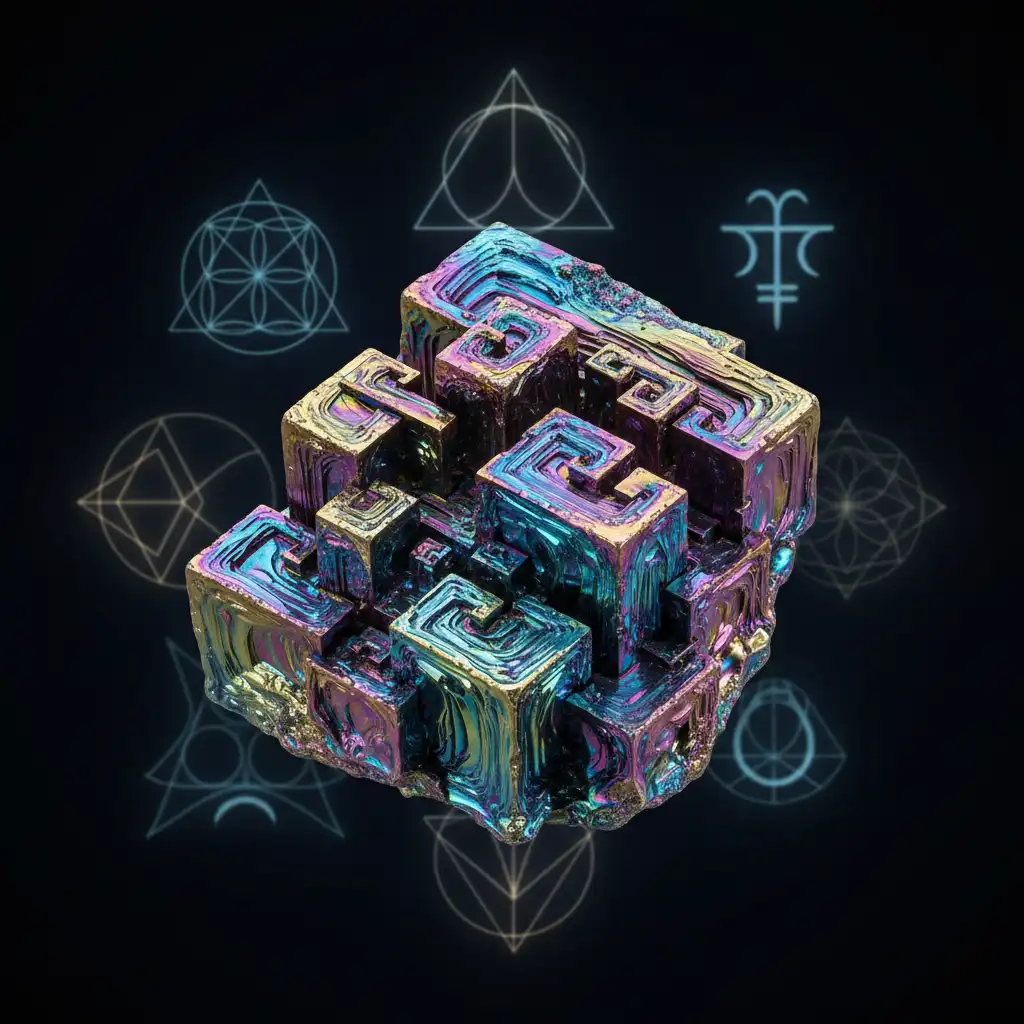
Bismuth meaning is unusually easy to misunderstand because the spectacular rainbow staircase crystals most people recognize as “bismuth crystals” are generally not natural mineral specimens. Bismuth is a chemical element, Bi, that can occur naturally as the mineral native bismuth, but natural specimens usually look silvery white to faintly pinkish, metallic, dense, irregular, granular, foliated, or modestly crystalline. The intensely iridescent geometric hopper crystals commonly sold in gift shops and crystal collections are usually produced by melting refined bismuth and allowing crystals to grow during controlled cooling.
That distinction does not make laboratory-grown bismuth fake. A grown hopper crystal can consist of genuine elemental bismuth and can display real crystallization and oxidation phenomena. It simply has a manufactured growth history rather than a geological one. Natural native bismuth has the formula Bi, crystallizes in the trigonal system, has a Mohs hardness of roughly 2–2.5, and has an unusually high specific gravity around 9.7–9.8. It is therefore very soft, brittle, metallic, and remarkably heavy for its size.
The rainbow surface is also easier to explain physically than metaphysically. Fresh bismuth is essentially silvery with a subtle pinkish cast. As the surface oxidizes, extremely thin oxide layers interact with reflected light. Different film thicknesses reinforce different wavelengths, creating yellow, gold, magenta, violet, blue, cyan, and green colors through thin-film interference. The shifting color is therefore produced at the surface rather than by a rainbow-colored interior.
Modern bismuth meaning often includes transformation, individuality, creativity, structure, change, cooperation, and moving through complex situations. These themes are understandable when inspired by stepped crystal growth and changing oxide colors, but they are symbolic interpretations rather than demonstrated effects of the element. Bismuth has not been shown to reorganize human energy, heal illness, guarantee transformation, attract communities, improve neurological function, or change external events through crystal contact.
Readers exploring other evidence-led mineral references can browse the broader Gemstone Guides.
Bismuth Identity at a Glance
| Property | Native Bismuth |
|---|---|
| Material identity | Native metallic element and mineral species |
| Chemical symbol / formula | Bi |
| Atomic number | 83 |
| Crystal system | Trigonal |
| Mineral group | Arsenic group |
| Natural color | Reddish-white, creamy-white, silvery with a faint pinkish tone |
| Tarnish | May become yellowish, pinkish, bluish, or iridescent |
| Luster | Metallic |
| Transparency | Opaque |
| Mohs hardness | Approximately 2–2.5 |
| Specific gravity | Approximately 9.7–9.8 |
| Tenacity | Brittle |
| Common natural forms | Granular, foliated, reticulated, arborescent, massive, crystalline |
| Familiar commercial form | Laboratory-grown stepped hopper crystals |
| Melting point | About 271°C |
| Major visual clue | Extreme density combined with soft brittle metallic character |
| Main identification limitation | A rainbow hopper shape usually tells you about growth history, not geological provenance |
The properties of natural native bismuth are very different from those of transparent gemstones. It is an opaque metal rather than a silicate, carbonate, oxide gemstone, or crystal aggregate.
Natural Bismuth and Lab-Grown Bismuth Are Not the Same Collecting Category
The most useful distinction in bismuth meaning is between material identity and origin.
A natural native-bismuth specimen formed through geological processes within Earth’s crust.
A laboratory-grown hopper crystal formed when elemental bismuth crystallized from molten metal under human-controlled conditions.
Both may genuinely be Bi.
Only one is a naturally crystallized mineral specimen.
This distinction matters because commercial descriptions sometimes use phrases such as “natural rainbow bismuth crystal” for a strongly iridescent staircase specimen whose form almost certainly reflects artificial melt growth. Calling such material genuine bismuth may be chemically accurate while calling the crystal naturally formed can be misleading.
For collectors, the right question is therefore not simply “Is this real bismuth?”
Ask whether it is natural native bismuth, refined metal, or a crystal grown from refined bismuth.
Original Natural-vs-Grown Bismuth Matrix
| Feature | Natural Native Bismuth | Common Lab-Grown Bismuth |
|---|---|---|
| Composition | Bi, sometimes with natural impurities | Usually refined Bi |
| Growth environment | Geological | Human-controlled cooling from molten metal |
| Common appearance | Massive, granular, foliated, irregular or modest crystals | Dramatic stepped hopper crystals |
| Rainbow tarnish | Can occur | Extremely common and often intentionally developed |
| Matrix | May occur with natural ore minerals | Normally no natural geological matrix |
| Surface perfection | Usually weathered, fractured or irregular | Often crisp geometric terraces |
| Provenance | Mine or geological locality | Maker, laboratory or hobby growth source |
| Collector interest | Mineralogical and locality based | Crystal-growth and visual-interest based |
| Historical geological information | Preserved in matrix and associations | None from natural deposit formation |
| “Real bismuth”? | Yes | Yes, if elemental bismuth was used |
| “Natural crystal”? | Yes when naturally crystallized | No |
| Best disclosure | Native bismuth + locality | Lab-grown / melt-grown bismuth |
This distinction is more useful than dismissing grown crystals as fake. Laboratory crystallization can produce genuine bismuth crystals while still requiring accurate origin disclosure.
Why Bismuth Hopper Crystals Form Steps
The word hopper describes a crystal whose edges and corners grow more rapidly than the centers of its faces. Instead of filling each face evenly, growth concentrates around the margins, leaving recessed centers and producing a stepped or skeletal architecture.
Bismuth is especially famous for this effect in crystals grown from the melt.
Successive layers form geometric terraces that can resemble staircases, square-edged spirals, architectural blocks, or miniature metallic cities. Although the overall forms can look almost cubic, native bismuth is not a cubic mineral; its underlying crystal structure is trigonal. The striking commercial geometry reflects crystallographic growth behavior and repeated hopper development rather than a simple cubic lattice.
The distinction matters because appearance can otherwise lead to a false structural conclusion.
A crystal can look square-edged without belonging to the cubic crystal system.
Why Rainbow Bismuth Is Not Naturally Rainbow Inside
Fresh metallic bismuth is primarily silvery-white with a faint pinkish cast. The saturated colors appear predominantly because the exposed surface develops an oxide film.
Light reflects from both the top of that film and the interface beneath it.
The two reflected waves can reinforce or cancel particular wavelengths depending on the film’s thickness and the viewing geometry. This produces thin-film interference—the same broad optical principle responsible for colors in soap films and some oil films.
The result is a metallic surface that can move through gold, magenta, violet, blue, cyan, and green even though the underlying bismuth remains essentially metallic.
A scratch or newly exposed surface can therefore reveal much less colorful metal beneath the iridescent layer.
The oxide is part of the object’s surface history.
It is not a rainbow pigment distributed through the crystal.
More detailed surface optics, oxide-film thickness, reflectance, and color behavior are explored in Bismuth optical properties and color behavior.
The Brightest Rainbow Bismuth Is Usually Manufactured
Natural bismuth can tarnish and develop iridescence, but the spectacular multicolored hopper specimens widely circulated online are commonly grown from melted refined metal. Bismuth’s comparatively low melting point makes controlled crystallization practical, and slow cooling can produce the recognizable stepped forms.
This is important when interpreting photographs.
A large, perfectly geometric, intensely rainbow staircase crystal sitting without geological matrix should not automatically be presented as something mined in that form.
Natural specimens tend to preserve different morphological and geological evidence.
A seller can accurately describe a melt-grown object as a “bismuth crystal” while still disclosing that it is laboratory grown.
Native Bismuth Is a Mineral Species
Bismuth is unusual because the element itself can occur naturally in sufficiently concentrated metallic form to qualify as a native-element mineral.
Its ideal composition is simply Bi.
Native bismuth belongs to the arsenic group and crystallizes in the trigonal system. Natural crystals may show hopper development, but specimens are also commonly granular, foliated, reticulated, arborescent, or massive. Iron, tellurium, arsenic, sulfur, antimony, and other components can occur as impurities or associated phases.
The elemental identity separates bismuth from bismuthinite, bismutite, tellurobismuthite, and many other minerals that contain bismuth chemically but are not native bismuth. The broader mineralogy of bismuth includes sulfides, tellurides, carbonates, oxides, and complex sulfosalts.
Finding bismuth in an elemental analysis therefore does not automatically mean the specimen is native bismuth.
The chemical phase must still be identified.
How Native Bismuth Forms
Native bismuth occurs particularly in hydrothermal ore systems where hot fluids transport metals through fractures and chemically reactive rocks. As temperature, pressure, sulfur availability, oxidation state, and fluid chemistry change, elemental bismuth may precipitate alongside other metallic and sulfide minerals.
It can occur in veins associated with cobalt, nickel, silver, arsenic, tin, tungsten, copper, and gold mineralization, although the precise assemblage differs from deposit to deposit. Quartz and various sulfides, arsenides, tellurides, and other bismuth-bearing minerals can occur nearby.
Some bismuth becomes incorporated into minerals such as bismuthinite rather than precipitating as native metal.
The presence of native bismuth therefore records a particular chemical state within the ore-forming environment rather than merely a high total concentration of bismuth.
Host rocks, fluid evolution, associated ores, replacement textures, and native-metal precipitation are explored in Bismuth formation and deposit geology.
Bismuth Is Extremely Dense
Bismuth metal has a density close to 9.8 g/cm³, making a small piece feel unexpectedly heavy compared with most common rocks, silicates, and gemstones.
For comparison, quartz is only about 2.65 g/cm³.
Beryl is generally below 3.
Even many visibly substantial collector minerals are far lighter than bismuth.
The tactile difference can therefore be dramatic.
Density by itself does not identify native bismuth because lead, silver, some sulfides, tungsten-bearing minerals, and other dense materials can also feel unusually heavy. The strongest identification comes from combining density with metallic luster, softness, brittleness, chemistry, and structural testing.
Bismuth Is Surprisingly Soft and Brittle
High density can create an impression of mechanical strength, yet bismuth is only about 2–2.5 on the Mohs hardness scale and is brittle.
That means the surface scratches easily.
Thin hopper-crystal terraces can break.
Sharp projecting steps can chip during handling or storage.
A dense crystal dropped onto a hard surface can damage itself because its own mass increases the impact energy.
This makes commercially grown bismuth crystals much more appropriate for display than for exposed jewelry.
Metallic does not mean tough.
Heavy does not mean hard.
Bismuth Expands as It Solidifies
Bismuth displays another unusual physical behavior: the solid is less dense than the liquid near its melting transition, so it expands on solidification rather than contracting in the ordinary way expected of many metals.
This behavior belongs to material physics, not symbolism.
It nevertheless provides an interesting metaphor because most people intuitively expect cooling metal to shrink.
The fact can inspire themes involving unconventional behavior or changing structure, but a physical expansion during crystallization does not demonstrate emotional expansion, consciousness change, or personal transformation.
Material properties should remain material properties until a person deliberately uses them as metaphor.
Bismuth’s Low Melting Point Helps Explain Grown Crystals
Bismuth melts at roughly 271°C, far below the melting temperatures of many familiar structural metals.
That relatively accessible melting behavior makes bismuth popular for controlled crystal-growth demonstrations and artistic casting.
The process still involves molten metal capable of causing severe burns.
Commercial hopper crystals should therefore be appreciated as finished specimens rather than treated as an invitation to casually remelt the material without proper equipment, heat-resistant handling, ventilation, and appropriate technical knowledge.
The fact that bismuth melts more readily than iron does not make molten bismuth harmless.
Original Bismuth Specimen and Photo Checklist
| Observation | What it may reasonably support | What it cannot prove alone |
|---|---|---|
| Dense silvery metallic mass | Compatible with native bismuth | Species identity by appearance alone |
| Faint pinkish metallic cast | Characteristic bismuth appearance | Natural origin |
| Yellow-blue iridescent tarnish | Compatible with oxidized bismuth | Laboratory growth |
| Perfect multicolored staircase hopper | Strongly suggests melt-grown commercial material | Exact purity |
| Irregular granular material on ore matrix | More compatible with natural native bismuth | Geographic locality |
| Natural sulfide-rich matrix | Plausible hydrothermal occurrence | Bismuth identity automatically |
| Very high measured density | Strong supporting clue | Elemental composition |
| Soft scratched surface | Compatible with bismuth | Reason to scratch a valuable specimen |
| Brittle broken terrace | Consistent physical behavior | Natural-versus-grown status |
| XRF showing high Bi | Strong elemental evidence | Native bismuth rather than another Bi phase |
| Raman/XRD or suitable phase analysis | Strong mineral evidence | Provenance |
| Original mine label | Valuable locality evidence | Independent identity confirmation |
| Maker documentation | Strong evidence for grown origin | Geological locality |
| Color removed by surface abrasion | Supports thin-film color | Exact oxide composition |
The checklist emphasizes one recurring principle: composition and origin are different questions.
A specimen can be genuine bismuth but not natural native bismuth.
Detailed microtextures, oxidation layers, growth steps, impurities, fracture surfaces, matrix relationships, and manufactured-growth clues are examined in the Bismuth microscope inclusion notebook.
Claims About Bismuth That Need Qualification
| Claim | More accurate interpretation |
|---|---|
| “All rainbow bismuth is natural” | Most dramatic commercial hopper crystals are laboratory grown |
| “Lab-grown bismuth is fake” | It can be genuine elemental bismuth with artificial growth origin |
| “Bismuth is naturally rainbow throughout” | Strong rainbow colors are mainly thin surface oxidation effects |
| “The square steps mean bismuth is cubic” | Native bismuth crystallizes in the trigonal system |
| “Every bismuth-containing mineral is native bismuth” | Many distinct minerals contain Bi in compounds |
| “Heavy means hard” | Bismuth is extremely dense but very soft and brittle |
| “Metal means it is ideal for jewelry” | Surface scratching and brittle hopper steps limit wearability |
| “Bismuth has zero radioactivity” | Natural bismuth is extraordinarily weakly radioactive, not perfectly stable |
| “Bismuth’s lower toxicity makes every compound safe” | Toxicity depends on chemical form, dose, route, and impurities |
| “Rainbow bismuth changes the aura” | Thin-film interference explains the visible color |
| “Bismuth automatically transforms your life” | Transformation is symbolic rather than a demonstrated mineral effect |
| “Natural-looking matrix proves geological origin” | Artificial mounting and assembled specimens can exist |
These distinctions preserve the real fascination of bismuth without turning its unusual appearance into unsupported claims.
Bismuth Is Not the Same as Bismuthinite
Bismuthinite is a bismuth sulfide with the formula Bi₂S₃.
Native bismuth is elemental Bi.
Both can occur in mineralized ore environments, and alteration or intergrowth relationships may bring them into close physical contact.
Their chemistry and crystal structures differ.
A metallic-looking bismuth-rich specimen therefore requires phase identification rather than relying exclusively on elemental composition.
This is especially relevant when portable elemental analysis detects bismuth but cannot by itself tell whether the element occurs as native Bi, sulfide, telluride, oxide, carbonate, or another phase.
Bismuth Oxides Are Also Separate Minerals and Compounds
Bismite is bismuth oxide, Bi₂O₃, and has different properties from native metallic bismuth. It can occur in yellowish to greenish material rather than the dense silvery appearance associated with the native element.
Surface oxide on a rainbow hopper crystal should also not be confused casually with a large crystalline mass of a separate oxide mineral.
One is a very thin alteration film coating metallic bismuth.
The other is a distinct oxide phase.
Scale and structural context matter.
Bismuth Alongside Bixbyite
Bixbyite meaning concerns a manganese-iron oxide mineral rather than a native metal.
Both can appear dark and dense in mineral collections, but bixbyite forms opaque black cubic crystals, whereas natural bismuth has metallic silvery-to-pinkish appearance and trigonal structure.
The distinction is straightforward once chemistry and crystal structure are considered.
Color alone provides far less information.
Bismuth and Beryl Represent Opposite Material Types
Beryl meaning concerns a hard, often transparent beryllium aluminum silicate capable of producing emerald, aquamarine, morganite, and other gems.
Bismuth is an opaque native metal.
Beryl’s identity depends on a complex silicate framework.
Native bismuth’s formula is simply Bi.
The contrast demonstrates how broadly the word crystal can be used. Transparent gemstones and opaque metallic elements can both crystallize, but their chemistry and physical behavior can be completely different.
Bismuth and Benitoite Should Not Be Linked by Rarity Alone
Benitoite meaning concerns a transparent barium titanium silicate known for blue color, high dispersion, and distinctive triangular crystals.
Bismuth can also produce striking collector crystals, but the familiar rainbow hopper form generally reflects laboratory melt growth rather than the specialized natural geological setting associated with benitoite.
Both are visually memorable.
Their collecting logic is very different.
Bismuth and Black Kyanite Differ in Every Major Property
Black kyanite meaning concerns an aluminum silicate mineral often occurring in bladed aggregates.
Native bismuth is metallic, extremely dense, soft, opaque, and elemental.
Black kyanite is nonmetallic and structurally unrelated.
This is useful when discussing modern symbolic categories because both may be marketed under terms such as grounding, transformation, or protection even though there is no mineralogical relationship between them.
Symbolic similarity is not chemical similarity.
Natural Bismuth Is More Important Geologically Than a Rainbow Hopper Crystal
A natural specimen can preserve information about an ore deposit: which minerals formed together, which fractures carried hydrothermal fluids, whether bismuth replaced an earlier phase, and how later alteration affected the assemblage.
A laboratory-grown hopper crystal preserves a different kind of information.
It demonstrates crystallization from a melt, growth kinetics, hopper development, oxidation, and thin-film color.
Both can be educational.
They simply answer different questions.
This is why provenance should be preserved rather than treating all bismuth objects as interchangeable.
The Bismuth provenance and disclosure checklist provides a structured way to record natural locality, grown origin, matrix, repairs, coatings, and seller descriptions.
Most Rainbow Bismuth Has Little Geological Provenance
A laboratory-grown crystal may have excellent maker provenance but no mine-level crystal provenance.
The raw refined bismuth originally came from mined material somewhere, yet that is not the same as saying the hopper crystal grew underground at that mine.
The crystal itself grew later during processing.
This distinction resembles the difference between natural and laboratory-grown gemstones: composition can be genuine while growth history differs.
For collectors who value geology, that history matters.
For collectors who simply enjoy color and geometry, a well-grown artificial crystal may be entirely satisfying.
Neither preference requires misleading terminology.
Bismuth’s Industrial History Is More Extensive Than Its Crystal-Shop History
Bismuth is used in alloys, metallurgical applications, pigments and compounds, and specialized products where properties such as density, relatively low melting behavior, or chemical characteristics are useful. Certain bismuth compounds also have established pharmaceutical uses, although those controlled compounds and doses should never be equated with placing a raw metal crystal against the body.
The element was historically confused with metals such as lead, tin, and antimony before chemistry distinguished it more clearly.
That history gives bismuth meaning an unusually strong science-and-technology foundation.
It does not require an invented ancient tradition involving rainbow hopper crystals, especially because the familiar commercial forms are commonly grown from refined metal.
The History of Rainbow Hopper Symbolism Is Modern
Claims that ancient civilizations worked extensively with brilliant rainbow staircase bismuth crystals deserve particular skepticism.
The characteristic specimens sold today are strongly associated with controlled growth from purified molten bismuth.
Ancient people may have encountered bismuth-bearing ores or metallic bismuth, but that is a different claim from saying they used modern-looking iridescent hopper crystals for chakra work, manifestation, or energy healing.
Historical symbolism should follow evidence.
Modern symbolism can simply be described as modern.
It does not become less meaningful because it lacks an ancient origin story.
Modern Bismuth Meaning and Transformation
Transformation is perhaps the most natural modern bismuth meaning because the visual change from dull silvery metal to a geometric iridescent crystal can be dramatic.
In a grown specimen, molten metal reorganizes into an ordered solid, stepped faces develop, and surface oxidation adds changing interference colors.
A person may interpret this as a metaphor for restructuring a difficult situation or becoming more organized after disorder.
The physical phase change is real.
The personal transformation is symbolic.
Holding the crystal does not cause the transformation automatically.
Bismuth Meaning and Structure
The stepped architecture of hopper crystals naturally suggests structure, organization, and building something progressively.
Each visible terrace records growth occurring preferentially along particular parts of the developing crystal.
Someone may use that appearance as a reminder to divide a complicated goal into smaller stages rather than treating the whole project as one task.
That is a practical interpretation of the visual form.
The crystal does not organize schedules, decisions, or thoughts on its own.
Bismuth Meaning and Individuality
Bismuth’s appearance is difficult to confuse with most other commercial crystal-shop specimens. Metallic geometry combined with rainbow oxidation makes it visually distinctive.
That uniqueness can support symbolism involving individuality or being comfortable with unconventional characteristics.
The idea becomes even more interesting because the apparently futuristic object consists of a simple element rather than an elaborate gemstone compound.
A person may connect that contrast with the idea that complexity of appearance does not always require complexity of identity.
This remains personal symbolism rather than a psychological effect produced by bismuth.
Bismuth Meaning and Change of Perspective
Thin-film colors vary with oxide thickness, lighting, and viewing angle. A surface that appears strongly blue from one orientation may reveal gold, pink, or green elsewhere.
This can provide a useful metaphor for perspective.
The underlying metal remains bismuth even while its surface appearance changes dramatically.
Someone may use the object as a reminder that one situation can look different when viewed from another position or when additional information becomes available.
The metaphor is grounded in a real optical phenomenon.
It does not demonstrate an energetic mechanism.
Bismuth Meaning and Community
Some modern metaphysical descriptions connect bismuth with community, cooperation, or reducing isolation.
The association may be inspired by the complex interconnected terraces visible in hopper crystals, but there is no established evidence that bismuth causes social bonds, attracts supportive people, or changes interpersonal behavior through emitted energy.
A symbolic use can still be translated into action.
A person might keep the crystal as a reminder to contact a friend, participate in a group, ask for help, or contribute to a shared project.
The social behavior creates the connection.
The mineral acts only as a cue.
Bismuth Does Not Have Established Healing Properties
There is no established scientific evidence that wearing or holding a bismuth crystal treats medical or psychological conditions.
The existence of medically used bismuth compounds does not change this conclusion.
A pharmaceutical compound has a defined chemical form, preparation, dose, route, indication, and safety profile. A native-bismuth specimen or grown hopper crystal is not interchangeable with a medicine containing a specific bismuth compound.
Statements that bismuth crystals heal digestion, remove infections, restore organs, regulate nerves, or detoxify the body should therefore not be inferred from legitimate pharmaceutical uses of particular bismuth compounds.
The broader distinction between mineral symbolism and health claims is explained in the Gems Lore Disclaimer.
Bismuth Is Not a Nutritional Supplement
Bismuth is not an essential nutrient that a person needs to absorb from jewelry or mineral specimens.
Metal contact does not provide a controlled therapeutic dose.
Similarly, the presence of a medically useful bismuth compound in a formulated product does not mean consuming metallic bismuth, soaking crystals in water, or applying hobby-grown material to the skin reproduces the same chemistry.
Chemical form matters.
Dose matters.
Route matters.
Purity matters.
Do Not Put Bismuth Crystals in Drinking Water
Natural or laboratory-grown bismuth specimens should not be used to prepare ingestible crystal remedies.
A natural specimen can include arsenic-, sulfur-, tellurium-, lead-, silver-, or other ore-related phases depending on its origin. A grown specimen can contain impurities from feed metal, crucibles, handling, surface oxidation, or post-growth treatment.
The ideal elemental formula Bi does not describe everything present on every specimen.
Keeping the crystal external preserves both the object and a clear safety boundary.
Heating Bismuth Creates Different Risks From Owning It
A finished bismuth specimen sitting on a shelf presents a different situation from molten-metal crystal growth.
Bismuth’s low melting point makes hobby growth possible, but molten metal remains hot enough to cause severe thermal injury. Heating can also alter surface chemistry and can expose the user to contaminants present in impure feed material.
Collectors do not need to remelt a crystal simply to appreciate how it formed.
If growth or casting is undertaken, it belongs to controlled metalworking practice rather than ordinary mineral handling.
Jewelry Use Is Limited by Softness
Bismuth’s Mohs hardness of roughly 2–2.5 is far below that of conventional jewelry gemstones.
A polished or grown bismuth surface scratches easily.
Thin hopper steps are especially vulnerable to snagging and breakage.
Rings and bracelets therefore provide poor environments for elaborate bismuth crystals.
Protected pendants, artistic objects, enclosed display pieces, or occasional-wear designs are more realistic, but even then mechanical protection matters.
Detailed design tradeoffs are covered in Bismuth setting and wear engineering.
Polishing Can Remove the Rainbow Surface
Because the most vivid rainbow colors are associated with a thin oxide film, grinding or polishing can remove that surface and expose relatively plain silvery metal beneath.
New oxidation may develop later, but the exact color pattern may not return in the same way.
This makes surface preservation important.
A collector who buys a vividly colored hopper crystal should not treat polishing as routine maintenance.
The oxidation pattern is part of the specimen’s visual state.
Cutting, polishing, surface preparation, and the consequences of removing oxide are explored in Bismuth cutting, orientation and polish.
Cleaning Should Preserve Fragile Steps and Oxide Colors
Dust removal is usually more important than aggressive cleaning.
A soft air stream, very gentle brush, or careful nonabrasive method can preserve fragile terraces better than scrubbing.
Harsh abrasives can scratch the soft metal.
Polishing compounds can remove oxidation.
Strong chemical cleaners may alter the surface.
Thin steps can snap under mechanical force.
A natural matrix specimen may require still different treatment because associated minerals can be chemically or mechanically more sensitive than the native bismuth.
Long-term support, surface preservation, oxidation records, and fragile hopper structures are covered in the Bismuth specimen conservation record.
Original Evidence Ladder for Bismuth Claims
Direct observation can establish metallic luster, visible tarnish, hopper growth, surface color, matrix, fractures, brittleness, repairs, and whether the object appears natural or manufactured.
Physical measurement can establish extreme density, softness, melting behavior in controlled materials work, and other properties consistent with bismuth.
Microscopy can reveal oxide layers, stepped growth, granular natural textures, intergrowths, tool marks, coatings, fracture surfaces, and matrix relationships.
Elemental analysis can establish that bismuth is the dominant element but may not independently determine which bismuth-bearing mineral phase is present.
Structural or phase analysis can distinguish native bismuth from bismuthinite, bismite, bismutite, tellurides, and other bismuth minerals.
Growth-origin interpretation requires morphology, matrix, surface textures, provenance, and sometimes maker information. Composition alone cannot determine natural versus melt-grown origin.
Geological interpretation requires host rock, ore associations, vein relationships, alteration textures, and deposit context.
Provenance requires mine labels, collection history, maker documentation, dealer records, or another traceable chain.
Historical claims require documentary or archaeological evidence tied to the actual material form being discussed.
Metaphysical effects remain belief-based even where modern symbolism is well documented.
This evidence ladder is especially useful for bismuth because a chemically genuine specimen can still have an incorrectly described growth history.
What Bismuth Meaning Can Responsibly Represent
Bismuth offers some of the strongest evidence-based metaphors among modern crystal-shop materials. Crystallization from a melt can symbolize reorganization. Hopper terraces can symbolize building in stages. Surface oxidation can symbolize changing appearance without changing underlying identity. Unusual expansion during solidification can symbolize an outcome that contradicts simple expectations, while the difference between natural and laboratory-grown bismuth can represent the importance of understanding origin rather than judging authenticity from appearance alone.
None of these interpretations requires invented healing mechanisms.
A person can choose a bismuth crystal as a reminder to reorganize a project, approach change deliberately, consider another perspective, or value an unconventional appearance.
The mineral does not perform those actions.
The owner does.
The evidence-led approach used throughout Gems Lore is described on About Gems Lore. Questions about an individual specimen can be submitted through Contact Gems Lore.
Frequently Asked Questions
What is bismuth?
Bismuth is the chemical element Bi. It can occur naturally as the mineral native bismuth and can also be refined and grown into artificial crystals.
What is bismuth meaning?
Bismuth meaning can refer to the element’s mineral identity and history or to modern symbolism involving transformation, structure, individuality, perspective, creativity, and change.
Is bismuth a mineral?
Native bismuth is a recognized native-element mineral species composed primarily of Bi.
Are rainbow bismuth crystals natural?
The spectacular rainbow staircase hopper crystals commonly sold commercially are usually grown from melted refined bismuth rather than mined in that form.
Is lab-grown bismuth fake?
No. A grown crystal can consist of genuine elemental bismuth. Its composition can be real while its growth origin is artificial.
What color is natural bismuth?
Fresh native bismuth is generally silvery-white to reddish-white or creamy-white with a faint pinkish cast. Tarnishing can add yellow, pink, blue, or iridescent colors.
Why is bismuth rainbow colored?
A thin oxide film on the surface causes optical interference that produces different reflected colors according to film thickness and viewing conditions.
Is bismuth rainbow inside?
No. Removing the oxidized surface usually reveals comparatively plain metallic bismuth underneath.
Why do bismuth crystals look like staircases?
Rapid growth at edges and corners relative to face centers can create hopper crystals with recessed faces and repeated terraces.
Is bismuth cubic?
No. Native bismuth crystallizes in the trigonal system even though grown hopper crystals can display square-edged geometric patterns.
How hard is bismuth?
Native bismuth is approximately 2–2.5 on the Mohs hardness scale.
Is bismuth heavy?
Yes. Its density is roughly 9.7–9.8 g/cm³, making it dramatically heavier than most common gemstones of comparable volume.
Is bismuth brittle?
Yes. Despite being a metal, bismuth is brittle, and thin crystal steps can break readily.
Does bismuth melt easily?
Its melting point is low compared with many familiar metals, at roughly 271°C. Molten bismuth is still hazardous and should be handled as hot metal.
Where does native bismuth form?
Native bismuth occurs in various hydrothermal and ore-deposit settings, often associated with other metallic, sulfide, arsenide, telluride, or vein minerals.
Is bismuthinite the same as bismuth?
No. Bismuthinite is Bi₂S₃, whereas native bismuth is elemental Bi.
Is bismite the same as bismuth?
No. Bismite is bismuth oxide, Bi₂O₃, and is a distinct mineral.
Can elemental testing prove native bismuth?
Detecting abundant Bi is strong evidence for bismuth-rich material but may not distinguish elemental bismuth from every bismuth-bearing compound. Phase identification may still be needed.
Can a photograph tell whether bismuth is natural?
Photographs can provide strong clues. Perfectly geometric rainbow hopper crystals without geological matrix are commonly grown, while natural specimens tend to preserve ore-matrix relationships and less regular morphology. Provenance remains stronger evidence.
Does bismuth fluoresce?
Fluorescence is not the defining visual phenomenon of ordinary metallic bismuth. Its famous rainbow colors are primarily associated with surface oxidation and thin-film interference.
Is bismuth good for jewelry?
Its softness and brittleness make elaborate bismuth crystals poorly suited to exposed everyday jewelry.
Can bismuth be polished?
Yes, but polishing can remove the colorful oxide surface and expose silvery metal beneath.
How should a bismuth crystal be cleaned?
Use gentle, nonabrasive methods that do not scratch the soft metal, break hopper steps, or remove the oxide coloration.
Is bismuth radioactive?
Natural bismuth is extraordinarily weakly radioactive, but the effect is so slight that it is not a practical radiological concern for ordinary specimen ownership.
Is bismuth safer than lead?
Bismuth metal and many bismuth compounds are generally discussed as having lower toxicity than lead, but safety still depends on chemical form, purity, dose, and exposure route. A mineral specimen should not be treated as food or medicine.
Can bismuth go in drinking water?
Bismuth specimens should not be used to prepare ingestible crystal remedies. Natural and grown specimens may contain impurities or surface materials not represented by the ideal formula.
Does bismuth have healing properties?
There is no established scientific evidence that holding or wearing a bismuth crystal treats medical or psychological conditions.
But aren’t some bismuth compounds medicines?
Yes, specific formulated bismuth compounds have legitimate medical uses. That does not make raw metallic bismuth crystals medically interchangeable with those products.
What does bismuth symbolize?
Modern symbolism commonly includes transformation, individuality, structure, creativity, perspective, cooperation, and adapting to change.
Does bismuth help with transformation?
A crystal can serve as a personal reminder of transformation, particularly because melt crystallization and oxidation visibly change the material. No established evidence shows that bismuth itself causes life changes.
Why does bismuth symbolize structure?
The repeated terraces of hopper crystals provide a natural visual metaphor for organization, staged development, and building progressively.
Why is provenance important for bismuth?
Provenance distinguishes naturally mined native bismuth from laboratory-grown hopper crystals and preserves mine, matrix, maker, and collection history.
Bismuth meaning becomes much clearer once the rainbow staircase crystal is separated from the natural mineral. Native bismuth is an exceptionally dense, soft, brittle trigonal metal that occurs naturally in certain ore deposits. Its ordinary appearance is silvery to faintly pinkish, while tarnish can create iridescent colors. The spectacular geometric specimens familiar from crystal shops are usually genuine bismuth grown from refined molten metal rather than naturally mined crystals.
That distinction makes bismuth more interesting rather than less. A natural specimen preserves ore geology, mineral associations, and locality history. A grown hopper crystal demonstrates crystallization, skeletal growth, thin-film interference, and the dramatic visual consequences of surface oxidation.
Those real phenomena also provide a better foundation for symbolism. Bismuth can represent transformation because its physical appearance changes during crystallization and oxidation, structure because hopper terraces grow in repeated stages, and perspective because different surface films produce different colors. These are human interpretations of genuine material behavior—not proof that the metal heals illness, changes destiny, or transmits invisible energy.