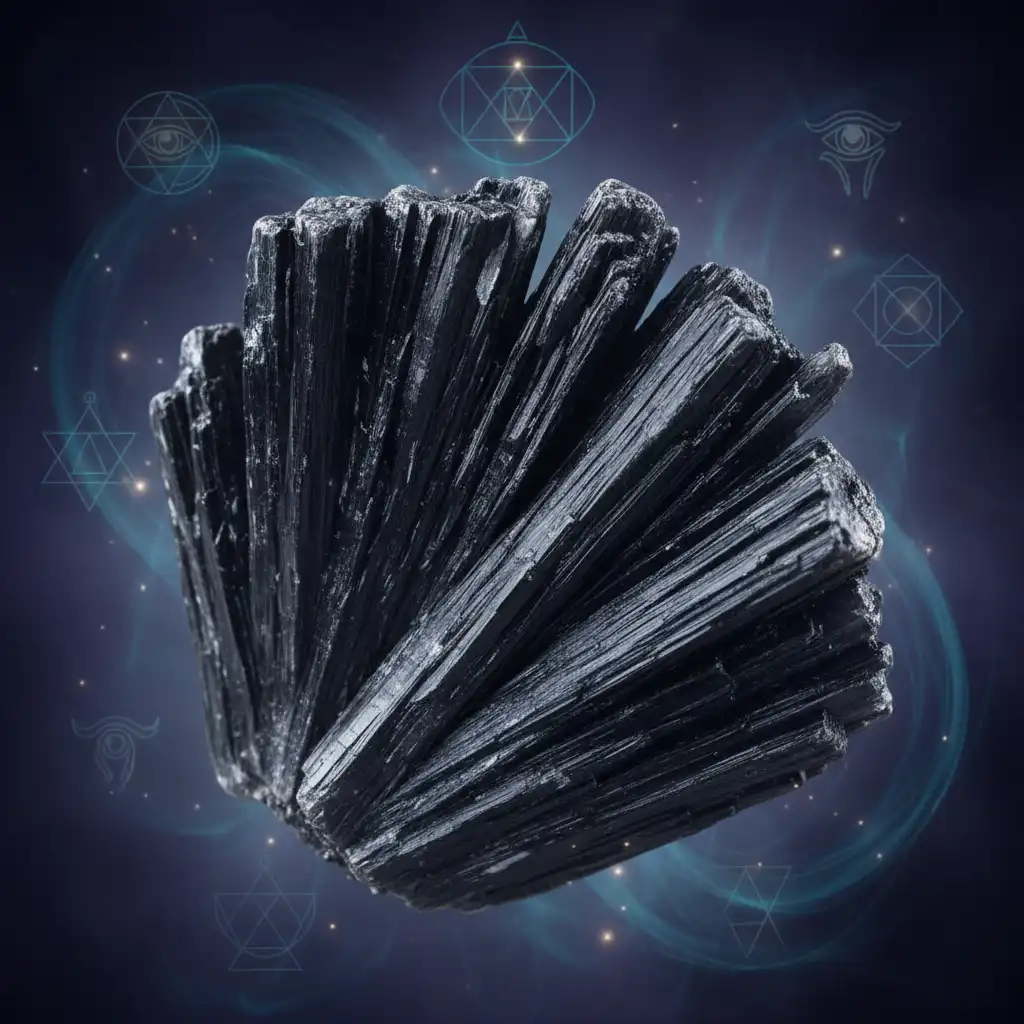
Black Kyanite Meaning: Mineral Facts & Symbolism
Black kyanite meaning begins with mineral identity rather than with the protective or energetic claims commonly attached to dark crystals. Black kyanite is not a separate mineral species from blue, green, gray, or colorless kyanite. It is a dark variety or trade description for kyanite, an aluminum silicate with the formula Al₂SiO₅. Kyanite crystallizes in the triclinic system and is especially recognizable by its flattened, elongated blades, strong cleavage, and unusually directional hardness.
The black color is not caused by one universal ingredient. Dark kyanite can contain graphite or other carbonaceous material, iron-bearing inclusions, oxide particles, fine mineral inclusions, structural imperfections, or combinations of these features. Some specimens are uniformly charcoal black, while others show gray, silver, brownish, blue-black, or patchy areas between reflective blade surfaces. Because several mechanisms can darken natural kyanite, color alone cannot identify the exact inclusion responsible in an individual specimen.
Black kyanite meaning is also closely tied to the mineral’s metamorphic origin. Kyanite forms under relatively high-pressure conditions in aluminum-rich rocks and is one of three familiar Al₂SiO₅ polymorphs, alongside andalusite and sillimanite. All three share the same overall chemical formula, yet differences in crystal structure make them stable under different pressure-temperature conditions. This makes kyanite useful to geologists reconstructing the metamorphic history of rocks.
Modern black kyanite meaning commonly includes grounding, boundaries, protection, clearing, resilience, self-reflection, and cutting away unwanted habits. These ideas can function as personal symbolism, particularly because the mineral often forms dark blades with sharp visual geometry. They are not measurable properties of Al₂SiO₅. Black kyanite has not been demonstrated to remove negative energy, cut energetic cords, align chakras, protect a person through an invisible field, treat illness, or change another person’s behavior.
Readers exploring evidence-led mineral references can browse the broader Gemstone Guides.
Black Kyanite Identity at a Glance
| Property | Black Kyanite |
|---|---|
| Mineral species | Kyanite |
| Black material classification | Dark variety / trade description |
| Chemical formula | Al₂SiO₅ |
| Mineral class | Silicate |
| Crystal system | Triclinic |
| Common habit | Flattened blades, elongated prisms, radiating aggregates |
| Typical color | Black, charcoal gray, blue-black, dark gray, locally brownish |
| Transparency | Commonly opaque to translucent |
| Luster | Vitreous to pearly, especially on cleavage surfaces |
| Mohs hardness | Strongly directional; roughly 4.5–5 along one direction and about 6.5–7 across another |
| Specific gravity | Approximately 3.5–3.7 |
| Cleavage | Strong and important to durability |
| Tenacity | Brittle |
| Geological significance | High-pressure metamorphic index mineral |
| Related polymorphs | Andalusite and sillimanite |
| Common host rocks | Schist, gneiss and other aluminous metamorphic rocks; some quartz-rich veins |
| Main identification clue | Bladed morphology plus strongly directional hardness |
| Main ownership concern | Cleavage, brittle blade edges and variable durability |
| Main interpretive limit | Black color does not identify its exact cause |
This identity table gives black kyanite meaning a much firmer foundation than classifying it only as a “black protection crystal.” The same mineral structure that creates its blades and unusual hardness also records information about metamorphic pressure.
Black Kyanite Is Kyanite, Not a Separate Mineral Species
A black specimen and a blue kyanite specimen share the same basic Al₂SiO₅ mineral identity when both are genuinely kyanite. The color difference does not justify treating black kyanite as a separate species.
This distinction matters because commercial naming often makes color varieties sound mineralogically independent.
“Black kyanite” is useful because it tells the buyer what the specimen looks like.
It does not establish a different crystal system, chemical formula, or fundamental structure.
Exact identification should therefore begin by confirming kyanite. After that, the dark appearance can be investigated separately through microscopy, spectroscopy, chemistry, or inclusion analysis if the cause matters.
Kyanite Has the Same Formula as Andalusite and Sillimanite
Kyanite, andalusite, and sillimanite all have the formula Al₂SiO₅.
They are not the same mineral.
Their atoms are arranged differently, making them polymorphs. Those structural differences change their stability under pressure and temperature, as well as their crystal habits and several physical properties.
Kyanite is favored under comparatively higher-pressure metamorphic conditions.
Andalusite is characteristically associated with lower-pressure conditions.
Sillimanite becomes important at higher metamorphic temperatures.
Geologists can therefore use these minerals, together with surrounding assemblages and textures, to constrain the metamorphic conditions a rock experienced.
This is one of the strongest evidence-based ideas behind black kyanite meaning: the mineral can genuinely preserve information about pressure.
That does not mean it transfers emotional pressure out of the body.
Kyanite’s Directional Hardness Is Unusual
One of kyanite’s most distinctive properties is that its hardness changes substantially with crystallographic direction.
Along the length of a blade, kyanite is relatively soft, commonly around Mohs 4.5–5.
Across the blade, it can approach about 6.5–7.
The exact measurement varies somewhat with orientation and specimen, but the large directional contrast is diagnostic enough that kyanite has historically attracted attention for this property.
This is called anisotropic hardness.
It reflects crystal structure rather than a surface treatment.
A stone therefore cannot be described accurately with one simple hardness number without acknowledging direction.
The same feature complicates cutting and polishing because different portions of a surface can resist abrasives differently.
Directional Hardness Does Not Mean One Side Is Indestructible
A hardness near 7 in one direction does not make black kyanite equivalent to quartz in overall durability.
Hardness measures resistance to scratching.
Kyanite also has important cleavage and brittle tenacity.
A blade can split or chip after impact even where the surface is relatively resistant to abrasion.
This combination explains why black kyanite meaning should never equate “hardness” with invulnerability.
The mineral itself demonstrates that strength is multidimensional: a material can resist one type of damage while remaining vulnerable to another.
That physical reality creates a useful metaphor without requiring any metaphysical mechanism.
Why Black Kyanite Forms Blades
Kyanite’s crystal structure favors elongated flattened habits. Natural crystals commonly grow as blades or flattened prisms, sometimes embedded individually in schist and sometimes arranged in radiating clusters.
Many black kyanite specimens sold commercially display fan-like or broom-like groups of blades.
These aggregates can be natural, but their apparent symmetry varies widely.
Real specimens commonly have broken ends, uneven blade lengths, overlapping crystals, matrix between blades, varying thickness, and irregular orientations.
A flawless radial fan with every blade identical should therefore not be treated as the standard natural appearance.
Mineral growth responds to available space, fluid pathways, surrounding minerals, deformation, and the direction of crystal growth.
Natural geometry can be beautiful without being perfect.
Why Black Kyanite Is Black
The phrase “black kyanite” describes appearance rather than one universal chemical variety.
Fine graphite or other carbonaceous inclusions can darken metamorphic minerals.
Iron-bearing mineral inclusions and iron oxides can also contribute dark gray, brownish, or black appearance.
Dense clouds of microscopic inclusions may reduce transmitted light enough to make a crystal appear opaque even if cleaner kyanite would be translucent.
Several of these mechanisms can occur together.
The precise explanation should therefore be tied to the individual specimen.
A dark blade should not automatically be described as “graphite-rich” merely because graphite is plausible in metamorphic rocks.
Likewise, black color does not prove high iron content.
The detailed relationship among inclusions, reflected light, opacity, and color is explored in Black Kyanite optical properties and color behavior.
Surface Reflections Can Make Black Kyanite Look Silver
Black kyanite frequently shows silvery, gray, or even bluish highlights when blade surfaces catch the light.
That appearance does not necessarily mean the stone has a metallic coating.
Cleavage and crystal surfaces can produce directional reflections, while mica or graphite in or around the specimen may add further sparkle.
A photograph taken under intense directional lighting can exaggerate these reflections and make the specimen look metallic.
Under softer neutral light, the same blades may appear much more matte and charcoal colored.
This is why identification photographs should include several lighting angles.
One dramatic photograph can misrepresent the material’s ordinary appearance.
How Black Kyanite Forms
Kyanite commonly develops during metamorphism of aluminum-rich rocks under comparatively elevated pressure. Sedimentary rocks rich in clay minerals can be buried, heated, compressed, and recrystallized until their original mineral assemblage is replaced by new metamorphic minerals stable under the changed conditions.
Kyanite may grow with mica, quartz, garnet, staurolite and other metamorphic minerals depending on the bulk chemistry and pressure-temperature history.
In some rocks, elongated kyanite crystals cut across an earlier foliation.
In others, they align partly with the metamorphic fabric.
Deformation can bend, fracture, rotate, or recrystallize surrounding minerals while kyanite grows.
The resulting specimen is therefore a record of both chemistry and metamorphic history.
Detailed pressure-temperature relationships, host rocks, metamorphic reactions, associated minerals, and vein occurrences belong in Black Kyanite formation and deposit geology.
Kyanite Is an Index Mineral
An index mineral is useful because its presence helps constrain metamorphic conditions when interpreted together with rock composition and other minerals.
Kyanite is especially important in metamorphosed aluminum-rich rocks.
Its presence can indicate that the rock reached pressure-temperature conditions within the kyanite stability field rather than conditions favoring andalusite or sillimanite.
This does not mean every kyanite-bearing rock formed under one exact pressure.
Whole-rock chemistry, associated minerals, reaction history, and later metamorphic overprinting also matter.
A geologist therefore does not look at one black blade and calculate an exact burial depth automatically.
The specimen is one part of a larger metamorphic record.
Black Kyanite Can Occur With Graphite-Rich Metamorphic Rocks
Some dark kyanite specimens occur in rocks containing graphite or carbonaceous material inherited from carbon-rich sedimentary precursors.
During metamorphism, organic carbon can transform progressively toward more ordered graphite while clay-rich material recrystallizes into new silicates.
This makes graphite a plausible contributor to black appearance in some kyanite.
It is not universal.
Other dark inclusions or surface coatings can produce similar visual results.
Microscopy is especially useful because reflective graphite plates, opaque oxide grains, included micas, fractures, and external coatings can behave differently under magnification.
The Black Kyanite microscope inclusion notebook addresses those specimen-level distinctions separately.
Black Kyanite Is Not Black Tourmaline
Black tourmaline, usually schorl, is a complex borosilicate mineral commonly forming elongated prismatic crystals with prominent longitudinal striations.
Black kyanite is Al₂SiO₅ and commonly forms flattened blades.
Both may be black.
Both can occur in metamorphic or pegmatitic geological environments under certain circumstances.
Both are marketed heavily with grounding and protection symbolism.
Mineralogically, however, they are unrelated.
Tourmaline generally has more uniform hardness than kyanite, different density, different fracture and cleavage behavior, different optical properties, and much more chemically complex composition.
Color cannot bridge those differences.
Black Kyanite Is Not Obsidian
Obsidian is volcanic glass.
Kyanite is crystalline aluminum silicate.
Black obsidian usually breaks with pronounced conchoidal fracture and can produce extremely sharp curved edges.
Black kyanite breaks according to a very different bladed and cleavable structure.
The two materials also form in almost opposite geological contexts: obsidian forms through rapid cooling of silica-rich molten material, whereas kyanite forms during solid-state metamorphic recrystallization at elevated pressure.
The dedicated Black Obsidian meaning reference covers that volcanic material separately.
Black Kyanite and Bixbyite Are Unrelated
Bixbyite meaning concerns an opaque cubic manganese-iron oxide mineral.
Black kyanite is an aluminum silicate that forms blades rather than cubes.
Bixbyite is much denser.
Kyanite has strongly directional hardness.
Bixbyite has a different luster, different structure, and entirely different chemical identity.
Both can be presented commercially as black collector minerals, but their similarities are mostly visual and symbolic.
Black Kyanite and Black Moonstone Are Different Materials
Black Moonstone meaning concerns feldspar material rather than Al₂SiO₅ kyanite.
Moonstone is typically polished into cabochons because internal lamellar structures and scattering can create adularescence or related optical effects.
Black kyanite is more often collected in its natural bladed form.
A polished dark oval sold without identification could theoretically create confusion for an inexperienced buyer, but raw morphology makes the difference much easier to see.
Mineral identity should be confirmed before symbolism is compared.
Original Black Kyanite Specimen and Photo Checklist
| Observation | What it may reasonably support | What it cannot prove alone |
|---|---|---|
| Flattened black blades | Strong visual compatibility with black kyanite | Definitive species identity |
| Radiating fan-like aggregate | Common commercial habit | Natural origin without context |
| Strong longitudinal blade structure | Useful morphology | Exact color mechanism |
| Pearly or silvery blade reflection | Compatible surface behavior | Metallic coating |
| Dark graphite-like inclusions | Possible carbonaceous component | Graphite without examination |
| Uneven blue-black areas | Compatible natural variation | Separate kyanite species |
| Mica-rich schist matrix | Plausible metamorphic context | Exact metamorphic grade |
| Garnet association | Plausible metamorphic assemblage | Geographic locality |
| Directional hardness | Strong diagnostic evidence | Reason to scratch a valuable specimen |
| Strong cleavage | Consistent with kyanite | Exact color variety |
| SG around mid-3s | Useful supporting evidence | Black kyanite automatically |
| Raman identification as kyanite | Strong species evidence | Cause of black color |
| Inclusion analysis | Can identify specific dark phases | Geographic provenance by itself |
| Original locality label | Strong provenance evidence | Independent mineral confirmation |
| Artificially glued fan arrangement | Condition or assembly evidence | Fake kyanite composition |
This checklist is particularly useful because the word “black” can tempt buyers to group many unrelated minerals together.
Claims About Black Kyanite That Need Qualification
| Claim | More accurate interpretation |
|---|---|
| “Black kyanite is a separate mineral species” | It is dark kyanite, not a separate species |
| “All black kyanite is colored by graphite” | Several darkening mechanisms are possible |
| “Black kyanite has one hardness of 7” | Kyanite hardness varies strongly by direction |
| “The blades are naturally perfect fans” | Natural aggregates are commonly irregular |
| “Every black blade is kyanite” | Tourmaline, amphiboles and other minerals can be dark and elongated |
| “Black kyanite never needs identification because the shape is obvious” | Morphology is helpful but not definitive |
| “Kyanite cuts negative cords scientifically” | Cord-cutting belongs to metaphysical symbolism |
| “Black kyanite cleans itself” | No mineralogical mechanism makes it exempt from ordinary physical cleaning |
| “Black kyanite absorbs unlimited negative energy” | No measurable form of such energy has been established |
| “Aluminum in kyanite strengthens the body” | Wearing the mineral does not provide nutritional aluminum |
| “Black kyanite heals the nervous system” | No established clinical evidence supports this claim |
| “High-pressure formation means the stone transfers resilience” | Geological pressure provides metaphor, not psychological energy |
Separating these statements prevents black kyanite meaning from mixing genuine geology with unsupported health or supernatural claims.
An Original Evidence Test for Black Kyanite Identification
Black kyanite is best approached through converging evidence rather than one visual clue.
First, examine morphology. Natural kyanite should show flattened bladed development consistent with its crystal structure, although broken or polished material may obscure this.
Second, evaluate luster and cleavage. Vitreous-to-pearly reflections along blade surfaces and pronounced cleavage support kyanite.
Third, consider directional hardness only when testing can be done without damaging a valuable specimen. The unusual difference between lengthwise and crosswise hardness is highly informative.
Fourth, measure density when a suitable loose specimen is available. Results in the expected mid-3 range support kyanite and help exclude lighter dark materials.
Fifth, inspect the black coloration microscopically. Determine whether darkness comes from included grains, graphite-like plates, coatings, dense fractures, or another feature.
Sixth, use Raman spectroscopy or another appropriate mineral-identification method when commercial value or uncertainty justifies it.
This sequence separates the question “Is it kyanite?” from the different question “Why is this particular kyanite black?”
Laboratory Identification Has Limits Too
A Raman spectrum can establish kyanite confidently in suitable material.
It may not automatically explain the black coloration if the instrument measures a clean kyanite area rather than the dark inclusions responsible for the visual effect.
Conversely, elemental analysis may detect iron but not prove that iron is the principal cause of the black color.
A complete explanation can therefore require multiple observations.
This is a useful general lesson in gemology: identifying the host mineral and explaining its appearance are related but separate tasks.
Black Kyanite in Jewelry Requires Care
Black kyanite can be mounted as jewelry, especially when blades are stabilized or incorporated into pendants and artistic designs.
Its directional hardness and strong cleavage make it more complicated than stones with uniform mechanical behavior.
Thin blades can split.
Exposed ends can chip.
Drilling can initiate fractures.
Pressure from prongs or wire wrapping can exploit cleavage if applied poorly.
Pendants generally experience less impact than rings or bracelets, making them more practical for natural blades.
Detailed decisions about mountings, edge protection, orientation, adhesives, and wear exposure are covered in Black Kyanite setting and wear engineering.
Cutting Black Kyanite Is Technically Uneven
Kyanite’s anisotropic hardness can make grinding and polishing challenging because an abrasive behaves differently as the cutting direction changes relative to the crystal.
One direction can abrade more quickly.
Another can resist the same abrasive.
A poorly chosen orientation may lead to undercutting, uneven polish, chipped blade edges, or persistent surface differences.
Opaque black material usually offers little reason to facet in the conventional transparent-gem sense, although cabochons, tablets, polished blades, carvings, or experimental collector cuts are possible.
Natural crystal form often preserves more of the material’s identity.
Orientation and polishing tradeoffs are explored in Black Kyanite cutting, orientation and polish.
Safe Cleaning Should Respect Cleavage
Gentle manual cleaning is the safest default for an intact black kyanite specimen.
A soft brush can remove loose dust from sound blades.
Aggressive scrubbing should be avoided when edges are thin.
Steam cleaning is unnecessary, and ultrasonic cleaning is a poor general default for cleavable, fractured, repaired, or matrix specimens.
Strong acids and household chemicals may also attack associated minerals even if the kyanite itself appears resistant.
If a fan-like specimen has been stabilized or repaired, prolonged immersion could affect adhesives.
The individual specimen’s construction matters more than the generic stone name.
Natural Fan Specimens May Be Repaired or Assembled
Radiating black kyanite clusters can be naturally attractive, but mineral specimens in commercial circulation may also contain repaired blades, stabilized matrix, reattached crystals, or constructed arrangements.
A repair does not make genuine kyanite chemically fake.
It changes the condition and disclosure requirements of the specimen.
Signs to inspect include adhesive around blade bases, improbably clean break contacts, repeated glue-like films, mismatched weathering between blades and matrix, or a cluster whose components appear mechanically arranged rather than naturally intergrown.
Important specimens should be documented before cleaning or restoration.
Long-term handling, matrix support, repair records, blade stability, and label preservation are addressed in the Black Kyanite specimen conservation record.
Provenance Cannot Be Determined From Black Color
Black kyanite occurs in more than one geological region.
A seller should not assign a specimen to a country, mine, or famous locality solely because similar photographs appear online.
Matrix can provide clues.
Associated minerals can narrow geological possibilities.
Exact trace chemistry may sometimes provide supporting evidence.
None of these replaces a reliable collection history when provenance is commercially important.
Original mine labels, dealer records, field notes, collection history, and analytical documentation should be preserved together.
The Black Kyanite provenance and disclosure checklist separates locality evidence from visual assumption.
Buying Black Kyanite Requires Identity Before Symbolism
A commercial listing may focus heavily on grounding, protection, chakra alignment, or energetic clearing while providing almost no information about whether the specimen is actually kyanite.
Material identity should come first.
Look for bladed morphology, credible locality information where available, natural surface texture, reasonable color variation, and disclosure of repairs or stabilization.
Polished pieces require stronger identification because the diagnostic blade form may have been removed.
Seller-specific questions, specimen checks, disclosure issues, and transaction decisions belong in where to buy black kyanite.
Ordinary Handling and Mineral Dust Are Different
An intact black kyanite specimen on a shelf does not present the same exposure situation as grinding, drilling, crushing, or dry sanding the mineral.
Mechanical processing generates fine aluminosilicate dust and can also release particles from quartz, mica, graphite, iron minerals, or other matrix components.
Where lapidary work is performed, use wet methods where practical, suitable local extraction, eye protection, appropriate respiratory controls, and careful cleanup.
Quartz-bearing matrix deserves particular attention because respirable crystalline silica should not be inhaled.
This is a workshop-control issue.
It is not a reason to fear ordinary ownership of a stable specimen.
Black Kyanite Should Not Be Used as an Ingestible Remedy
Black kyanite is a geological material rather than a supplement.
Do not grind it into powder for ingestion or deliberately soak rough specimens in drinking water for supposed healing effects.
The ideal Al₂SiO₅ formula does not describe every inclusion, matrix mineral, surface contaminant, repair adhesive, coating, or alteration product present on an individual specimen.
Aluminum in the structure does not provide a nutritional benefit.
Symbolic use works perfectly well without ingestion.
The Name Kyanite Originally Refers to Blue
The name kyanite derives from a Greek-rooted term associated with blue, reflecting the color historically associated most strongly with the mineral.
Black kyanite therefore presents an interesting naming contrast.
The species name references blue even though natural kyanite occurs in black, green, gray, orange, white, colorless, and other appearances.
This is another reminder that a mineral name does not always describe every specimen’s visible color.
The black variety did not receive its name because it was historically associated with shadow work, energetic cord cutting, or protection.
Those are later symbolic interpretations.
Black Kyanite Meaning and Grounding
Grounding is one of the most widespread modern black kyanite meaning themes.
Dark color and dense bladed structure make the association intuitive, particularly within contemporary crystal traditions where black minerals are frequently grouped with stability and protection.
A person may use black kyanite as a visual reminder to return attention to practical facts, physical surroundings, immediate responsibilities, or a defined next action.
That can be a useful reflective practice.
No established evidence shows that the mineral electrically grounds the human body or transfers invisible negative energy into the Earth.
Black Kyanite Meaning and Boundaries
The blade-like shape makes boundaries another natural black kyanite meaning.
A person may interpret a sharp blade as a reminder to define where one responsibility ends and another begins, decline an unreasonable demand, protect work time, or separate a decision into manageable parts.
Those actions can create real boundaries.
The stone does not force other people to respect them.
This distinction is especially useful because metaphysical descriptions sometimes imply that simply wearing black kyanite blocks unwanted people or circumstances.
Practical boundaries still require communication and behavior.
Black Kyanite Meaning and “Cord Cutting”
Black kyanite is frequently described as an energetic cord-cutting crystal because its blades visually resemble cutting tools.
There is no established physical evidence for invisible energetic cords that can be severed by Al₂SiO₅.
The symbolism can still be interpreted constructively.
Someone might use the blade shape during reflection as a reminder to end an unhealthy routine, reduce an unwanted commitment, stop revisiting an unproductive argument, or establish emotional distance from a situation.
The change comes from the decision and follow-through.
The mineral serves as a symbol.
Black Kyanite Meaning and Protection
Protection is often assigned to black crystals, and black kyanite is no exception.
A scientific claim that the mineral creates a protective energetic barrier is unsupported.
A practical symbolic interpretation is more useful.
Black kyanite can represent checking risk, maintaining boundaries, securing personal information, leaving unsafe situations, or choosing appropriate protective equipment.
Those behaviors have measurable consequences.
The stone’s role is mnemonic rather than supernatural.
Black Kyanite Meaning and Resilience
Kyanite’s geological history gives resilience symbolism an unusually concrete metaphorical basis.
The mineral forms in rocks subjected to substantial pressure during metamorphism.
It can preserve evidence of those conditions long after the metamorphic event has ended.
That does not mean geological pressure turns into psychological resilience when the stone is worn.
It can simply remind someone that difficult conditions can alter structure and that adaptation does not require pretending stress is harmless.
The comparison becomes more meaningful when the metaphor preserves the mineral’s actual science.
Black Kyanite Meaning and Self-Reflection
Dark minerals are frequently used in modern reflective practices concerned with uncomfortable emotions, habits, or personal patterns.
Black kyanite can be incorporated into journaling or meditation as a visual focal point if the user finds that meaningful.
The crystal does not diagnose trauma, uncover repressed memories reliably, or provide psychological treatment.
Reflective practices can sometimes bring difficult feelings to the surface, and significant distress is better handled with appropriate professional support.
Symbolic self-reflection and mental-health treatment should not be presented as interchangeable.
Black Kyanite Meaning and Energy Clearing
Claims that black kyanite clears rooms, people, chakras, or other crystals of negative energy belong to metaphysical belief systems.
No accepted mineralogical measurement demonstrates that a kyanite blade absorbs or removes such an energy.
Physical cleaning and symbolic cleansing are also different activities.
Dust is removed mechanically.
A ritual may change how a person experiences an object.
Neither proves the existence of a measurable energetic contaminant.
The distinction between mineral science, symbolic practice, and health claims is explained further in the Gems Lore Disclaimer.
Black Kyanite Does Not Have Established Healing Properties
There is no established scientific evidence that black kyanite treats physical or psychological illness.
Claims involving pain, muscles, nerves, inflammation, blood pressure, hormones, sleep, anxiety, trauma, immune function, or detoxification require medical evidence rather than analogy with the mineral’s structure.
Its aluminum content does not provide a therapeutic pathway through skin.
Its high-pressure metamorphic origin does not create a biological resilience field.
Its blades do not physically cut emotional attachments.
A person can value black kyanite emotionally or spiritually without using it as a replacement for qualified healthcare.
An Original Claim-vs-Evidence Matrix
| Black kyanite claim | Evidence status |
|---|---|
| It is Al₂SiO₅ kyanite | Measurable mineralogical fact |
| It forms blades | Observable crystallographic fact |
| Its hardness varies by direction | Measurable physical property |
| It forms under relatively high metamorphic pressure | Established geological interpretation |
| Dark color may involve inclusions such as graphite or iron-bearing phases | Plausible and testable specimen-specific explanation |
| Every black specimen is colored by graphite | Unsupported generalization |
| It electrically grounds the body | Not established |
| It cuts invisible energetic cords | Metaphysical symbolism |
| It protects from negative energy | Metaphysical belief |
| It helps establish personal boundaries | Reasonable symbolic use when connected with behavior |
| It heals the nervous system | Not established medically |
| It never needs cleansing because it cleans itself | Symbolic claim, not mineral science |
| It removes trauma | Not established and should not replace appropriate care |
| Its blades can symbolize separation or decisiveness | Human interpretation |
| High-pressure formation can symbolize resilience | Human interpretation grounded in real geology |
This matrix keeps black kyanite meaning usable without asking symbolism to perform the role of mineralogy or medicine.
Original Evidence Ladder for Black Kyanite Claims
Direct observation can establish black color, blade shape, translucency, luster, fractures, matrix, visible inclusions, edge condition, and whether an aggregate appears naturally intergrown.
Basic mineral examination can assess directional hardness, specific gravity, cleavage, and other physical properties consistent with kyanite.
Microscopy can identify graphite-like plates, oxide grains, mica, fractures, coatings, surface treatments, and evidence of repairs or assembled clusters.
Raman spectroscopy or diffraction can establish that the host mineral is kyanite.
Inclusion analysis may then investigate why an individual specimen appears black.
Geological interpretation requires matrix, associated minerals, metamorphic fabric, host-rock composition, and pressure-temperature context.
Provenance requires labels, dealer records, collection history, field notes, or other traceable evidence.
Historical claims require documentary or archaeological support connecting actual kyanite with the stated cultural use.
Modern symbolism can be documented as belief or personal practice but remains different from an experimentally measured material property.
Healing claims require appropriate clinical evidence and cannot be inferred from black color, chemical composition, or metamorphic pressure.
This evidence ladder protects both science and symbolism by assigning each claim the type of evidence it actually requires.
What Black Kyanite Meaning Can Responsibly Represent
Black kyanite has several real characteristics that make unusually coherent metaphors possible. Its blades can represent division, boundaries, or making a decisive cut between alternatives. Its strongly directional hardness can represent the idea that strength depends on direction and context. Its formation under elevated metamorphic pressure can symbolize adapting under demanding conditions, while its tendency to cleave provides a useful reminder that visible strength can coexist with specific vulnerabilities.
These interpretations are more distinctive than generic promises that every black crystal protects, grounds, or heals.
Someone may use black kyanite as a reminder to define a boundary, focus on the next practical action, examine a difficult habit, or accept that resilience includes understanding where one is vulnerable.
The stone does not perform those actions.
The symbolism can support the person who does.
The evidence-led approach used throughout Gems Lore is described on About Gems Lore. Questions about an individual specimen can be submitted through Contact Gems Lore, with submitted information handled according to the site’s Privacy Policy.
Frequently Asked Questions
What is black kyanite?
Black kyanite is dark-colored kyanite, an aluminum silicate mineral with the formula Al₂SiO₅.
Is black kyanite a separate mineral?
No. It is a color variety or trade description of kyanite rather than a separate mineral species.
What is black kyanite meaning?
Black kyanite meaning commonly combines its real mineral identity with modern symbolism involving grounding, boundaries, protection, resilience, self-reflection, and decisiveness.
Why is black kyanite black?
Different specimens may be darkened by graphite or other carbonaceous matter, iron-bearing inclusions, oxides, dense microscopic inclusions, structural features, or combinations of these factors.
Is all black kyanite colored by graphite?
No. Graphite is a plausible cause in some specimens, but the color mechanism should not be generalized without examination.
What is black kyanite made of?
The host mineral is Al₂SiO₅, the same fundamental composition as other kyanite colors.
Is black kyanite the same as blue kyanite?
Both are kyanite. Their primary difference is appearance and the specific impurities or structural features influencing color.
What crystal system is black kyanite?
Kyanite crystallizes in the triclinic system.
Why does black kyanite form blades?
Its crystal structure favors flattened elongated growth, producing characteristic bladed or prismatic forms.
How hard is black kyanite?
Kyanite is unusual because hardness changes strongly with direction, roughly around 4.5–5 in one orientation and about 6.5–7 in another.
Why does kyanite have two hardness values?
Its crystal structure resists scratching differently along different crystallographic directions, a property known as hardness anisotropy.
Is black kyanite fragile?
It can be. Strong cleavage, brittleness, thin blades, and natural fractures make sharp aggregates vulnerable to impact.
What is black kyanite’s specific gravity?
Kyanite commonly has specific gravity around 3.5–3.7.
Where does black kyanite form?
It forms mainly in aluminum-rich metamorphic rocks under pressure-temperature conditions favorable to kyanite and can also occur in some quartz-rich veins and related metamorphic settings.
Why is kyanite important to geologists?
Kyanite is an important metamorphic index mineral that helps constrain the pressure-temperature history of suitable rocks.
Is black kyanite related to andalusite?
Yes. Kyanite, andalusite, and sillimanite are polymorphs with the same Al₂SiO₅ composition but different crystal structures.
Is black kyanite black tourmaline?
No. Tourmaline is a complex borosilicate with different chemistry, structure, physical properties, and typical crystal habit.
Is black kyanite obsidian?
No. Obsidian is volcanic glass, whereas kyanite is a crystalline metamorphic aluminum silicate.
Can black kyanite be polished?
Yes, but directional hardness and cleavage can make polishing difficult and uneven.
Is black kyanite good for jewelry?
It can be used, particularly in protected pendants or artistic pieces, but natural blades need protection from impact and cleavage-related breakage.
Can black kyanite be worn every day?
Exposed everyday wear increases the risk of chipped or split blades. A protected design is more appropriate than an exposed ring for most natural specimens.
How should black kyanite be cleaned?
Use gentle manual methods and protect thin blade edges. Avoid aggressive cleaning when fractures, repairs, adhesives, or delicate matrix are present.
Can black kyanite clusters be repaired?
Yes. Broken blades can be reattached or aggregates stabilized. Repairs should be disclosed rather than treated as proof that the underlying kyanite is fake.
How can black kyanite be identified?
Bladed morphology, directional hardness, cleavage, density, microscopy, and Raman or other mineralogical analysis can establish identity.
Can a photograph prove black kyanite?
A photograph can strongly suggest it when characteristic blades are visible, but a polished or unusual specimen may require physical or instrumental testing.
Where can I buy black kyanite?
Identity checks, seller disclosure, cluster construction, provenance, and purchase considerations are covered in where to buy black kyanite.
Is black kyanite safe to handle?
Ordinary handling of an intact specimen is different from dust-generating work. Normal mineral hygiene is generally appropriate.
Can black kyanite go in drinking water?
It should not be deliberately used to prepare ingestible crystal remedies. Natural specimens may include additional minerals, coatings, repairs, or contaminants.
Does black kyanite contain aluminum?
Yes. Aluminum is an essential component of its Al₂SiO₅ structure.
Does the aluminum in black kyanite benefit the body?
Wearing or holding the mineral does not provide a controlled nutritional or therapeutic aluminum dose.
Does black kyanite have healing properties?
There is no established scientific evidence that black kyanite treats medical or psychological conditions.
Is black kyanite a grounding crystal?
It is widely used symbolically as one. No measurable metaphysical grounding mechanism has been established.
Does black kyanite protect against negative energy?
That is a metaphysical belief rather than a demonstrated physical effect.
Does black kyanite cut energetic cords?
Its blade shape has inspired modern cord-cutting symbolism, but invisible energetic cords are not an established mineralogical phenomenon.
Why can black kyanite symbolize boundaries?
Its blade-like morphology provides an intuitive visual metaphor for separation, defining limits, and making clear distinctions.
Why can black kyanite symbolize resilience?
Kyanite forms under significant metamorphic pressure, making pressure and adaptation natural metaphors when clearly separated from claims of transmitted psychological energy.
Black kyanite meaning becomes much clearer when the material is first recognized as kyanite rather than as a generic black protection crystal. It is Al₂SiO₅, a triclinic aluminum silicate whose bladed habit, strong cleavage, remarkable directional hardness, and high-pressure metamorphic occurrence make it physically and geologically distinctive. Its black appearance can reflect several types of inclusions or structural features and should not be assigned one universal color mechanism without examining the individual specimen.
Those measurable characteristics also provide unusually useful symbolism. Blades can represent boundaries and deliberate separation, directional hardness can represent strength that depends on context, and high-pressure formation can symbolize adaptation while cleavage reminds us that resilience does not eliminate vulnerability.
That framework gives black kyanite meaning without requiring unsupported healing claims or invisible energetic mechanisms. The mineral’s real crystallography, metamorphic history, physical anisotropy, inclusions, and natural bladed form already provide a strong foundation for understanding why people find the material distinctive.