Bixbyite Meaning: Mineral Identity, Geology & Symbolism
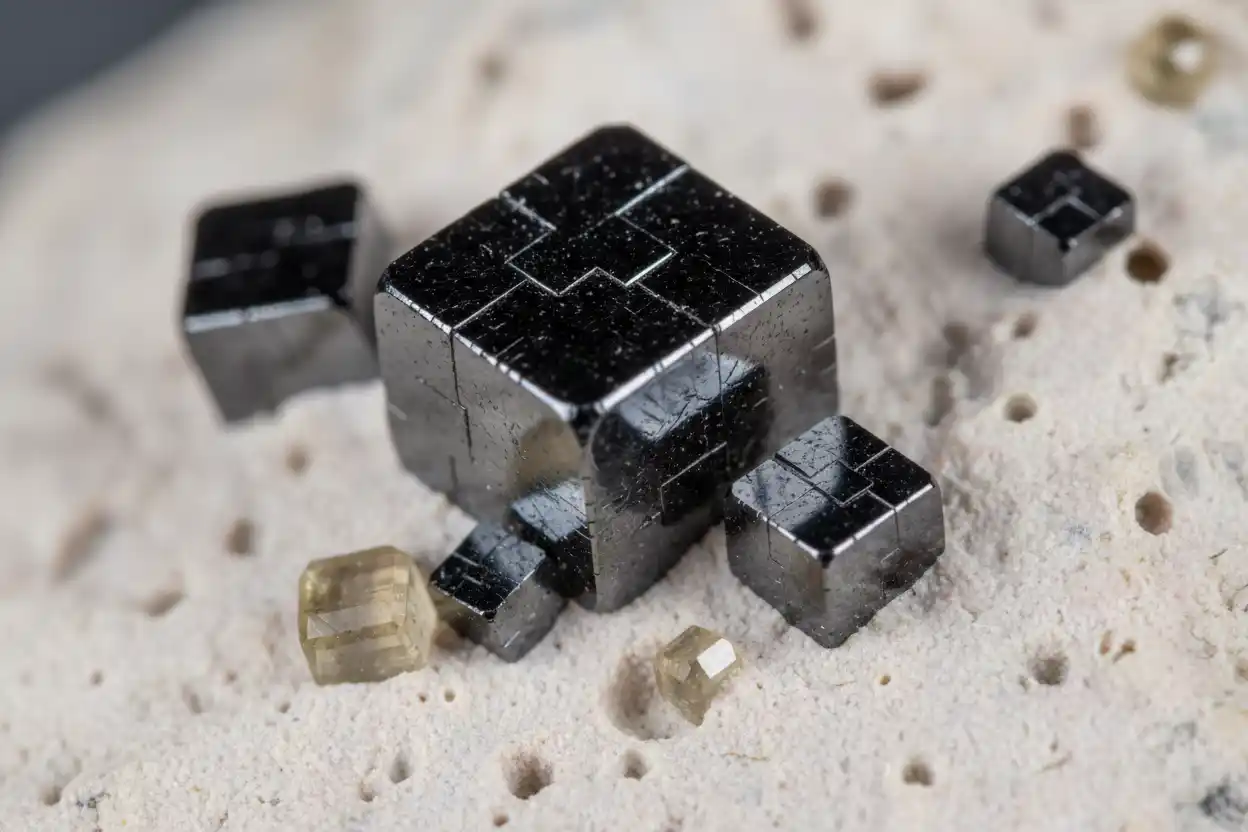
Bixbyite meaning begins with a dense, opaque manganese-iron oxide mineral rather than with the metaphysical language often attached to black crystals. Bixbyite is commonly represented by the formula (Mn,Fe)₂O₃, reflecting a cubic sesquioxide structure in which manganese and iron can substitute for one another to varying degrees. Natural bixbyite is usually black to very dark brown, opaque, and metallic to submetallic in luster, with sharp cubic or modified cubic crystals providing some of its most recognizable collector specimens.
The mineral belongs to the isometric, or cubic, crystal system and commonly occurs as small but sharply formed crystals. Its Mohs hardness is approximately 6–6.5, while specific gravity is commonly close to 5, making it noticeably heavier than quartz, feldspar, or most transparent silicate gemstones of the same volume. Bixbyite is brittle rather than malleable, and its dark appearance comes from strong absorption associated with its manganese-iron oxide chemistry rather than from an external black coating.
Bixbyite meaning is therefore most useful when mineral facts come first. Its genuine identity includes manganese and iron chemistry, high density, opaque cubic crystals, volcanic and manganese-rich geological environments, and close relationships with other oxide minerals. Modern symbolic interpretations commonly connect bixbyite with structure, grounding, resilience, focus, decisiveness, and protection, but those associations are personal or metaphysical interpretations rather than experimentally demonstrated properties of the mineral.
Bixbyite has not been shown to remove negative energy, protect the body through an invisible field, increase manganese or iron nutrition through skin contact, regulate emotions, treat disease, or guarantee resilience. Its real mineralogy is distinctive enough without assigning biological or supernatural effects to a dense black oxide.
Readers exploring other evidence-led mineral references can browse the broader Gemstone Guides.
Bixbyite Identity at a Glance
| Property | Bixbyite |
|---|---|
| Mineral species | Bixbyite |
| Simplified composition | (Mn,Fe)₂O₃ |
| Mineral class | Oxide |
| Essential chemistry | Manganese and iron in an oxygen framework |
| Crystal system | Isometric / cubic |
| Common crystal habit | Cubic, modified cubic, combinations with small additional faces |
| Typical color | Black, brownish black, very dark brown |
| Transparency | Opaque |
| Luster | Metallic to submetallic |
| Mohs hardness | Approximately 6–6.5 |
| Specific gravity | Approximately around 5, varying with composition |
| Tenacity | Brittle |
| Streak | Dark brown to blackish brown |
| Common geological settings | Volcanic cavities, especially silicic volcanic rocks; manganese-rich metamorphic or hydrothermal environments |
| Notable visual clue | Sharp black cubic crystals with relatively high density |
| Main identification limit | Black cubic appearance alone does not prove bixbyite |
| Main ownership concern | Brittle edges and dust generated during cutting or grinding |
These characteristics establish the physical foundation for bixbyite meaning. The mineral is not a generic black stone but a specific oxide whose manganese-iron chemistry and cubic structure distinguish it from tourmaline, obsidian, kyanite, hematite, magnetite, and other dark materials.
Bixbyite Is a Manganese-Iron Oxide
The simplest way to understand bixbyite is as a manganese-dominant oxide in which iron can substitute significantly within the same general structural framework. The traditional formula (Mn,Fe)₂O₃ captures that natural compositional variability without implying that every specimen contains exactly the same manganese-to-iron ratio.
Both manganese and iron can occur in oxidation states compatible with the sesquioxide structure.
Natural substitution is important because mineral formulas are idealized descriptions rather than recipes for perfectly uniform crystals. One bixbyite crystal can contain more iron than another while both remain recognizably bixbyite.
This chemical variation can influence density, reflected color, microscopic appearance, associated minerals, and analytical results.
It does not mean that dark crystals with manganese and iron automatically qualify as bixbyite. Crystal structure remains essential to species identification.
The Cubic Structure Is Central to Bixbyite Identity
Bixbyite crystallizes in the isometric system, producing some remarkably sharp cubes.
At first glance, this geometry can make the mineral look artificially manufactured, particularly when small black crystals display flat faces and nearly right-angled edges inside pale volcanic cavities.
Natural crystal growth can be extremely geometric.
Cubic symmetry means the crystallographic axes are equal in length and meet at right angles, allowing repeated equivalent directions to generate visually balanced forms. Bixbyite cubes can also be modified by additional faces, bevels, growth irregularities, or contact surfaces where neighboring minerals restricted crystal development.
A perfect cube is therefore not required for identification.
Broken corners, stepped surfaces, partial crystals, and intergrown groups are entirely compatible with natural growth.
Bixbyite Is Usually Black Because It Absorbs Visible Light Strongly
Bixbyite is normally opaque and black to brownish black because its transition-metal-rich oxide structure absorbs much of the visible light entering its surface.
Manganese and iron both possess electronic configurations capable of producing strong absorption.
Instead of transmitting light through the crystal as aquamarine or quartz can, bixbyite reflects a relatively small portion from an opaque surface. Depending on surface quality and lighting, that reflection may look metallic black, dark steel-gray, reddish brown, or subtly bronze-toned.
The visible appearance is therefore controlled partly by composition and partly by surface texture.
A smooth crystal face can look considerably more metallic than a rough fracture.
Oxidation, weathering, microscopic coatings, and associated minerals can alter the apparent surface color further.
The details of reflected-light behavior and the limits of interpreting black mineral color are explored in Bixbyite optical properties and color behavior.
Bixbyite Is Opaque Rather Than a Conventional Gemstone
Unlike beryl, benitoite, aquamarine, or many stones described as gems, bixbyite does not normally owe its collector appeal to transparency or brilliance.
Its beauty comes from crystal geometry, luster, matrix contrast, association, locality, and preservation.
Sharp black cubes against pale rhyolite can be visually striking precisely because the material is opaque.
This distinction matters when bixbyite meaning is presented in gemstone language. Calling every mineral a gemstone can blur meaningful differences between facetable transparent material, ornamental rock, collector crystals, and ore minerals.
Bixbyite is principally a collector mineral.
Its natural crystal form often carries more interest than anything that might be produced by cutting it.
How Bixbyite Forms
Bixbyite occurs in more than one geological setting, but some of its best-known collector crystals develop in cavities within silica-rich volcanic rocks such as rhyolite.
Volcanic cavities can provide open space where late-stage gases, fluids, and mineral-forming components circulate after the host magma has already crystallized substantially. Under suitable chemical conditions, manganese and iron become concentrated enough for oxide minerals such as bixbyite to form on cavity walls.
The open space is important.
A crystal buried tightly within a solid rock cannot develop the same free-standing faces as one growing into a cavity.
This helps explain why some rhyolitic specimens show small but exceptionally sharp bixbyite cubes perched on pale matrix alongside topaz, hematite, pseudobrookite, quartz, or other late-stage minerals.
Bixbyite can also occur in manganese-rich metamorphic and hydrothermal environments where oxidation and mineral reactions concentrate manganese and iron into appropriate oxide assemblages.
The mineral’s geological context is therefore broader than one famous volcanic locality.
Detailed host-rock relationships, cavity mineralization, manganese chemistry, associated phases, and deposit interpretation belong in Bixbyite formation and deposit geology.
Rhyolite Cavities Can Produce Exceptional Crystals
Silicic volcanic rocks may contain cavities created by gas bubbles, lithophysal growth, fractures, or other late-stage processes. These spaces can later host unusual mineral assemblages.
In certain highly evolved volcanic systems, uncommon elements and volatile components become concentrated during the final stages of crystallization.
That chemical concentration can produce minerals that are uncommon in the bulk rock.
Bixbyite crystals found in such cavities can be surprisingly well formed despite their small size.
The pale color of rhyolitic matrix also creates strong visual contrast with black bixbyite, making even millimeter-scale crystals aesthetically prominent.
A specimen with several isolated cubes may therefore be more desirable to a collector than a much larger mass lacking recognizable crystal form.
Bixbyite Is Closely Associated With Manganese Geochemistry
Manganese is capable of occurring in several oxidation states and participating in many oxide, silicate, carbonate, and hydroxide minerals.
The exact phase that forms depends on oxygen availability, temperature, pressure, associated elements, fluid chemistry, and geological history.
Bixbyite represents one particular manganese-rich oxide structure.
That distinction is important because black manganese minerals can be visually difficult to separate. Pyrolusite, hausmannite, braunite, manganite, cryptomelane-group material, and other manganese-bearing phases can appear dark or metallic.
Mineral chemistry alone may also be insufficient if several manganese oxides occur together.
Crystal structure and appropriate analytical testing provide stronger identification.
Iron Substitution Can Vary
Iron commonly substitutes for manganese within bixbyite.
That does not convert every iron-rich bixbyite into hematite.
Hematite is also an Fe₂O₃ oxide, but it has a different crystal structure under normal mineralogical conditions. This is an excellent example of why formulas cannot be interpreted without structural information.
Two minerals may contain similar elements and oxidation states while remaining distinct because their atoms are arranged differently.
A portable elemental analyzer might show manganese and iron abundantly in a specimen.
That information supports an Mn-Fe oxide interpretation.
It does not by itself prove bixbyite.
Bixbyite and Hematite Are Different Oxides
Hematite is one of the most familiar iron oxides and commonly appears steel-gray, black, metallic, earthy red, or reddish brown. Bixbyite can overlap with hematite in dark metallic appearance, particularly when crystal shape is poorly developed.
The easiest distinction in a good specimen may be crystallography.
Sharp bixbyite cubes strongly suggest cubic symmetry, while hematite forms trigonal crystals, plates, rhombohedral shapes, rosettes, or massive material rather than true bixbyite-style cubes.
Streak can also help. Hematite is famous for a red to reddish-brown streak, while bixbyite commonly gives a darker brownish streak.
Destructive streak or scratch tests should not be performed casually on valuable crystals when nondestructive analytical methods are available.
Bixbyite Is Denser Than It Looks
Specific gravity close to 5 makes bixbyite noticeably heavy for a nonmetallic-sized crystal.
Quartz is only around 2.65.
Most beryl is below 3.
This difference can be useful when dealing with a loose compact specimen, although millimeter-sized crystals are too small for reliable hand-heft.
Density also reflects the presence of relatively heavy transition metals packed into a compact oxide structure.
That physical heaviness has contributed indirectly to modern grounding symbolism, but density does not establish metaphysical grounding.
A crystal has measurable mass.
“Energetic heaviness” is a symbolic interpretation.
Hardness Is Moderate but Brittleness Still Matters
Bixbyite’s hardness around 6–6.5 provides moderate resistance to scratching.
That is substantially harder than calcite, fluorite, bismuth, or many soft collector minerals.
It is still softer than quartz, beryl, topaz, spinel, sapphire, and diamond.
Brittle tenacity means a sharp crystal can chip even when its surface resists moderate abrasion.
Natural cubes with crisp corners should therefore be protected from impacts.
Small edge chips can materially change specimen aesthetics because much of bixbyite’s collector appeal comes from geometric perfection.
Hardness should never be interpreted as immunity to breakage.
Original Bixbyite Specimen and Photo Checklist
| Observation | What it may reasonably support | What it cannot prove alone |
|---|---|---|
| Sharp black cube | Strong visual compatibility with bixbyite | Species identity |
| Modified cubic crystal | Consistent with bixbyite morphology | Exact Mn/Fe chemistry |
| Metallic-to-submetallic luster | Expected appearance | Geological origin |
| Dark brown reflected highlights | Compatible surface response | Iron concentration |
| Pale rhyolite cavity matrix | Classic geological context | Exact locality |
| Association with topaz | Plausible specialized volcanic assemblage | Bixbyite automatically |
| Association with hematite or pseudobrookite | Plausible oxide assemblage | Exact formation sequence |
| High density | Supporting evidence for a heavy oxide | Species identity |
| Hardness around 6–6.5 | Compatible physical property | Reason to scratch a good specimen |
| Brownish-black streak | Supporting evidence | Definitive identification |
| Mn-Fe-rich elemental analysis | Strong chemical evidence | Crystal structure |
| Raman match | Strong mineral evidence | Geographic provenance |
| X-ray diffraction match | Strong structural confirmation | Collector locality |
| Original mine label | Strong provenance evidence | Independent mineral identification |
| Reattached crystal | Condition information | Fake mineral identity |
This checklist is useful because bixbyite is often recognizable before it is proven.
The sharp cube, black metallic surface, and pale volcanic matrix can form a convincing visual pattern, but analytical evidence remains stronger than resemblance.
Microscopic growth steps, intergrowths, coatings, fractures, edge damage, attached minerals, and surface alterations are explored in the Bixbyite microscope inclusion notebook.
Claims About Bixbyite That Need Qualification
| Claim | More accurate interpretation |
|---|---|
| “Every black cube is bixbyite” | Several minerals can form dark cubic crystals |
| “Bixbyite is pure manganese oxide” | Natural material commonly contains significant iron substitution |
| “Iron means bixbyite is hematite” | Similar chemistry does not erase structural differences |
| “Bixbyite is magnetic because it contains iron” | Magnetic response depends on mineral structure and composition, not simply the presence of Fe |
| “Black color proves high manganese content” | Color alone cannot quantify composition |
| “Bixbyite is a black gemstone like tourmaline” | It is primarily an opaque collector oxide mineral |
| “High density means the crystal is tough” | Bixbyite is brittle despite moderate hardness |
| “Manganese in bixbyite feeds the body” | Wearing a crystal does not deliver controlled nutritional manganese |
| “Iron in bixbyite treats anemia” | Mineral iron is not a therapeutic iron supplement through skin contact |
| “Bixbyite protects against negative energy scientifically” | Protection belongs to modern symbolic belief |
| “Bixbyite grounds electricity in the body” | No electrical grounding mechanism is established through crystal contact |
| “Rare black cubes are automatically expensive” | Value still depends on crystal quality, size, locality, damage, matrix, and demand |
These distinctions protect bixbyite meaning from becoming a collection of claims disconnected from the actual mineral.
Bixbyite and Magnetite Should Not Be Confused
Magnetite is Fe₃O₄ and commonly forms black octahedral crystals, although other habits occur.
It is strongly magnetic.
Bixbyite has different chemistry and structure and should not be identified through black color alone.
A small handheld magnet can provide useful preliminary information when a dark oxide is suspected, but magnetism still should not replace complete identification.
A dark crystal that responds strongly to a magnet deserves a different diagnostic pathway from typical bixbyite.
Bixbyite Is Not Black Tourmaline
Black tourmaline, commonly schorl, is a complex borosilicate that usually forms elongated striated prismatic crystals.
Bixbyite is an oxide and commonly forms cubes.
Tourmaline has a very different internal structure, density, fracture style, geological setting, and elemental chemistry.
The two may be grouped together commercially because both appear black and receive similar metaphysical descriptions.
Mineralogically, they are unrelated.
This distinction demonstrates why symbolic categories such as “protection crystals” do not represent scientific mineral groups.
Bixbyite and Black Kyanite Are Also Unrelated
Black kyanite meaning concerns an aluminum silicate with strongly directional hardness and a characteristic bladed habit.
Bixbyite is a dense cubic manganese-iron oxide.
Black kyanite typically forms elongated blades or radiating aggregates, while bixbyite’s classic specimens are compact cubes or modified cubes.
Their chemistry, symmetry, hardness behavior, density, and geological formation differ.
The shared color provides only a superficial similarity.
Bixbyite and Bismuth Differ in Luster, Structure, and Density
Bismuth meaning concerns a native metallic element that is much softer and significantly denser than bixbyite.
Commercial bismuth is famous for rainbow laboratory-grown hopper crystals, whereas bixbyite commonly appears as naturally occurring opaque black cubes.
Bismuth’s specific gravity approaches 10 and its hardness is only around 2–2.5.
Bixbyite is about half as dense and substantially harder.
The two demonstrate how little the word “metallic-looking” tells us about mineral identity.
Bixbyite and Black Moonstone Differ Fundamentally
Black moonstone meaning concerns feldspar material valued for optical effects and usually fashioned as cabochons or polished stones.
Bixbyite is an opaque manganese-iron oxide collector mineral.
Black moonstone’s appeal depends on feldspar structure, inclusions, light scattering, and adularescent or related visual effects.
Bixbyite’s appeal comes primarily from crystal geometry, luster, matrix, and mineral rarity.
Calling both “black stones” obscures more than it explains.
Bixbyite and Beryl Show Opposite Collector Characteristics
Beryl meaning concerns a beryllium aluminum silicate capable of producing transparent emerald, aquamarine, morganite, golden beryl, and other varieties.
Bixbyite is normally opaque.
Beryl commonly forms elongated hexagonal prisms.
Bixbyite commonly forms cubes.
Beryl has lower density but greater hardness.
The two minerals can both occur in highly evolved geological environments, yet their chemistry and crystallography remain entirely different.
Bixbyite’s Name Has a Specific Mineralogical History
Bixbyite was named for Maynard Bixby, a mineral collector and prospector closely associated with important mineral discoveries in Utah.
The name therefore reflects a person connected with mineral exploration rather than a symbolic concept.
It does not derive from words meaning grounding, protection, courage, shadow work, or transformation.
This historical distinction is worth preserving because modern crystal descriptions sometimes invent meanings from a mineral name that never carried them.
The mineral’s documented history is already meaningful through collecting, mineralogy, and the study of unusual volcanic deposits.
Utah Is Closely Associated With Classic Bixbyite
The Thomas Range and other mineral-rich volcanic areas of Utah are particularly well known among collectors for sharp bixbyite crystals in rhyolitic cavities.
These occurrences can also contain topaz and other interesting late-stage minerals.
The locality relationship gives well-documented specimens additional collector context.
It should not be assigned from appearance alone.
A black cube on pale rhyolite may look characteristic of a famous Utah occurrence, but similar chemistry and morphology can appear elsewhere.
Original labels, trusted collection records, field documentation, and mineral associations provide stronger evidence.
The Bixbyite provenance and disclosure checklist provides a structured way to separate locality claims from visual assumption.
Locality Can Matter More Than Size
A large damaged bixbyite crystal without locality information may be less interesting to a specialist than a smaller sharp crystal from a well-documented classic occurrence.
This is because mineral specimens carry information as well as visual appeal.
Locality can help researchers understand composition, associated minerals, deposit type, morphology, and regional mineral evolution.
Collectors may also seek specimens from historically important locations.
A crystal is therefore not valued solely as a black object of a particular size.
Its context can matter greatly.
Bixbyite Is Usually Better Preserved Than Cut
Bixbyite is opaque, and much of its collector appeal comes from natural cubic geometry.
Cutting a sharp crystal removes exactly the feature that makes it distinctive.
Massive material could theoretically be polished, shaped, or used ornamentally, but this does not create the same optical reward obtained from transparent gemstones.
A polished black surface may look attractive while losing natural crystal morphology.
For most high-quality specimens, preservation is the stronger choice.
The tradeoffs involving sawing, polishing, orientation, surface finish, and preservation of natural faces are addressed in Bixbyite cutting, orientation and polish.
Jewelry Use Is Possible but Specialized
Bixbyite is hard enough to resist moderate abrasion better than many collector minerals, but its brittleness, opacity, rarity, and specimen-focused market make it an unusual jewelry material.
A polished piece can be mounted.
A natural sharp cube could theoretically be incorporated into an artistic setting, but exposed corners would remain vulnerable to impact.
Protective designs are more sensible than allowing a crystal to project from a frequently worn ring.
Jewelry should also preserve enough material for future identification and avoid unnecessary adhesives or irreversible modifications when the specimen has collector importance.
Construction choices, mounting pressure, exposed edges, and wear risk are examined in Bixbyite setting and wear engineering.
Safe Cleaning Should Protect Crystal Faces
Bixbyite’s hardness allows more resistance to scratching than soft minerals such as calcite or bismuth, but natural crystal faces can still be damaged by aggressive abrasion.
A soft brush and conservative cleaning are preferable when a specimen is dusty.
Strong acids or reactive chemical cleaners should not be applied casually to matrix specimens because associated minerals may respond differently even if bixbyite remains stable.
Ultrasonic and steam cleaning provide little benefit for most collector specimens and may worsen hidden fractures, repairs, or fragile matrix.
Cleaning should preserve geological context rather than trying to make every crystal unnaturally glossy.
Preserve Matrix and Labels
A bixbyite crystal attached to rhyolite preserves information that a detached crystal cannot.
Matrix shows the growth surface.
Nearby minerals can document the assemblage.
A cavity wall can reveal how much space was available during crystallization.
Old labels can preserve a locality that may otherwise be impossible to reconstruct.
This makes specimen conservation more than simple damage prevention.
It preserves evidence.
Long-term storage, matrix support, broken edges, repairs, labels, and environmental documentation are addressed in the Bixbyite specimen conservation record.
Manganese Requires Context Rather Than Alarm
Bixbyite contains manganese, and excessive manganese exposure can be harmful under certain occupational or environmental conditions.
That does not mean an intact bixbyite crystal is inherently dangerous to own or touch.
Exposure pathway matters.
A stable solid specimen on a shelf is fundamentally different from repeatedly breathing fine manganese-containing dust generated by industrial processing, grinding, or pulverizing.
The same distinction applies to iron.
Chemical composition should inform sensible handling without creating unnecessary fear.
Cutting and Grinding Change the Exposure Situation
Sawing, drilling, sanding, crushing, or dry grinding bixbyite creates fine particles that can enter the air.
Appropriate lapidary practice should minimize dust through wet methods where practical, local extraction, suitable eye protection, respiratory protection appropriate to the operation, and careful cleanup.
Matrix composition matters as well.
A rhyolitic host can contain abundant silica-bearing minerals, which adds another reason to control respirable dust.
Workshop precautions should therefore be based on the complete specimen rather than one mineral name.
Do Not Use Bixbyite as a Mineral Supplement
The manganese and iron in bixbyite are parts of an oxide crystal structure.
They are not nutritional supplements delivered through skin.
Wearing a bixbyite pendant does not provide a controlled manganese dose.
Holding an iron-bearing oxide does not treat iron deficiency.
Grinding the mineral into powder would increase exposure while providing no established crystal-healing benefit.
Element names inside a mineral formula should never be converted automatically into health claims.
Bixbyite Should Not Be Used in Drinking Water Remedies
Bixbyite specimens should remain external rather than being intentionally soaked in drinking water or ground into ingestible preparations.
Natural samples may include matrix, coatings, other manganese minerals, iron oxides, silica-bearing rock, surface contaminants, adhesives, or restoration materials.
The simplified formula cannot describe everything on an individual specimen.
There is also no established medical benefit from preparing “bixbyite water.”
Symbolism does not require ingestion.
Modern Bixbyite Meaning and Grounding
Grounding is one of the most common modern bixbyite meaning themes.
The symbolism probably arises from several obvious physical features: the mineral is dark, dense, compact, and commonly geometric. Those traits can make it visually and tactilely suggest stability.
Someone may keep bixbyite nearby as a reminder to focus on immediate facts, physical surroundings, practical responsibilities, or the next concrete action in a complicated situation.
That practice can be useful as a personal cue.
The crystal has not been shown to electrically ground the body or drain invisible negative energy into the Earth.
Bixbyite Meaning and Structure
Structure is an especially fitting bixbyite meaning because the mineral’s natural cubes make crystallographic order visible.
A well-formed bixbyite cube can look almost engineered even though it developed through natural atomic-scale organization.
This provides a strong metaphor for creating order from many small repeated components.
Someone might use the mineral as a reminder to establish routines, organize a project, clarify responsibilities, or build a complicated task from smaller steps.
The structure belongs physically to the crystal.
Human organization still requires human action.
Bixbyite Meaning and Resilience
Bixbyite meaning is also sometimes linked with resilience or persistence.
Its dark dense appearance can feel visually durable, while its occurrence within volcanic and mineralized environments provides a geological context involving heat, fluid movement, oxidation, and chemical differentiation.
Those characteristics can inspire a metaphor about remaining organized during changing conditions.
Bixbyite itself is brittle, however.
That fact is useful because it prevents an overly simplistic symbolic story.
Something can appear strong while still having specific vulnerabilities.
Human resilience likewise does not mean being immune to damage.
Bixbyite Meaning and Focus
The clean geometry of a cubic crystal can symbolize focus, boundaries, and defined priorities.
A collector may use bixbyite as a visual reminder to decide what belongs inside a task and what does not.
This is particularly useful when a project becomes diffuse or filled with competing goals.
The symbolism comes from the geometric form.
No established neurological mechanism shows that bixbyite improves concentration, attention, memory, or executive function through mineral energy.
A visual cue can support an intention without being the biological cause of focus.
Bixbyite Meaning and Protection
Protection is another modern theme assigned to many black minerals, including bixbyite.
No scientific evidence demonstrates that a bixbyite crystal creates an invisible protective field around a person.
A more practical interpretation is possible.
The stone can symbolize setting boundaries, checking risks, protecting time, or preparing before entering a difficult situation.
Those actions can produce real protective effects.
The mineral functions only as a reminder.
This distinction allows protective symbolism without presenting metaphysical claims as established mineral science.
Bixbyite Meaning and Shadow Work
Dark stones are sometimes associated with “shadow work,” a modern term used in several self-reflective and spiritual contexts for examining uncomfortable emotions, habits, memories, or aspects of identity.
A bixbyite crystal can serve as a personal object during journaling or reflection if someone finds the practice meaningful.
The mineral does not retrieve memories, diagnose psychological conditions, or provide psychotherapy.
Difficult trauma, persistent distress, or mental-health symptoms require appropriate professional support rather than relying on a mineral.
The wider separation between symbolic use and health claims is described in the Gems Lore Disclaimer.
Bixbyite Does Not Have Established Healing Properties
There is no established scientific evidence that bixbyite treats physical or psychological disease.
Claims involving blood, iron deficiency, circulation, bones, nervous-system function, detoxification, inflammation, immunity, depression, anxiety, or neurological health should not be inferred from its manganese and iron content.
Mineral chemistry describes atoms inside the crystal.
It does not establish a therapeutic dose, absorption route, biological target, clinical outcome, or safety profile.
Someone can value bixbyite during a difficult period without using it as a substitute for appropriate healthcare.
Modern Symbolism Should Not Be Presented as Ancient Tradition
Bixbyite is a mineralogical name linked with modern mineral collecting and exploration.
Claims that ancient civilizations universally used bixbyite cubes for protection, grounding, chakra work, or healing require evidence and should not be repeated merely because similar statements circulate online.
A black manganese mineral discovered archaeologically would first need to be identified accurately.
Its cultural context would then need to demonstrate how it was used.
Even a confirmed historic object made of bixbyite would establish cultural use, not supernatural effectiveness.
Historical evidence and metaphysical claims answer different questions.
Original Evidence Ladder for Bixbyite Claims
Direct observation can establish black color, opacity, cubic habit, luster, crystal size, matrix, visible associations, edge damage, fractures, and surface alteration.
Physical examination can add hardness context, specific gravity, streak, and magnetic behavior where appropriate.
Microscopy can reveal growth steps, intergrowths, coatings, fracture surfaces, tiny associated minerals, weathering, reattachment, and artificial surface treatments.
Elemental analysis can establish manganese and iron abundance but cannot independently determine crystal structure.
Raman spectroscopy or X-ray diffraction can provide strong species-level evidence and distinguish bixbyite from visually similar oxides.
Geological interpretation requires host rock, cavity structure, manganese source, associated minerals, and deposit relationships.
Provenance requires collection labels, mine information, field records, trusted dealer history, or other traceable documentation.
Historical-use claims require actual archaeological, documentary, or collection evidence.
Symbolic traditions can be documented as cultural beliefs, but documentation of belief does not establish the claimed physical effect.
Health claims require medical evidence and cannot be inferred from mineral composition.
This hierarchy gives bixbyite meaning a clear boundary between what a photograph can suggest and what stronger evidence must establish.
What Bixbyite Meaning Can Responsibly Represent
Bixbyite’s genuine properties offer more specific symbolism than generic descriptions of a “powerful black crystal.” Its cubes can represent structure, boundaries, and deliberate organization. High density can symbolize giving appropriate weight to important matters. Its volcanic cavity growth can represent creating order within limited space, while the contrast between hard surfaces and brittle tenacity can symbolize the difference between appearing strong and understanding one’s actual vulnerabilities.
These interpretations come from real mineral characteristics.
They remain metaphors.
Bixbyite does not need to neutralize energy, provide nutritional manganese, heal the nervous system, or guarantee emotional resilience to be meaningful.
A person can use the stone as a reminder to organize priorities, maintain practical boundaries, or approach a difficult problem systematically.
The evidence-led approach used throughout Gems Lore is described on About Gems Lore. Questions about an individual specimen can be submitted through Contact Gems Lore.
Frequently Asked Questions
What is bixbyite?
Bixbyite is a manganese-iron oxide mineral commonly represented by the formula (Mn,Fe)₂O₃.
What is bixbyite meaning?
Bixbyite meaning can refer to its mineral identity and geological history or to modern symbolic themes such as grounding, structure, resilience, focus, boundaries, and protection.
What color is bixbyite?
Natural bixbyite is typically black, brownish black, or extremely dark brown.
Is bixbyite transparent?
No. It is normally opaque.
What luster does bixbyite have?
Bixbyite commonly has metallic to submetallic luster.
What crystal system is bixbyite?
It crystallizes in the isometric, or cubic, crystal system.
Does bixbyite form cubes?
Yes. Sharp cubic and modified cubic crystals are among its characteristic collector forms.
Are natural bixbyite cubes really that geometric?
Yes. Mineral crystallization can produce remarkably regular cubes without human shaping.
How hard is bixbyite?
Bixbyite is approximately 6–6.5 on the Mohs hardness scale.
Is bixbyite heavy?
Yes. Its specific gravity is commonly close to 5, so compact material is considerably denser than quartz or beryl.
Is bixbyite fragile?
It is brittle, meaning sharp edges and corners can chip after impact despite moderate hardness.
What is bixbyite made of?
It is an oxide containing manganese and iron, with natural variation in the relative proportions of those elements.
Is bixbyite pure manganese oxide?
Natural bixbyite commonly contains significant iron substitution, so describing every specimen as chemically pure Mn₂O₃ is too simplistic.
Is bixbyite the same as hematite?
No. Both can contain trivalent iron, but bixbyite and hematite have different crystal structures and mineral identities.
Is bixbyite magnetic?
Magnetic behavior can vary with composition and associated material. The presence of iron alone is not enough to predict a strong magnetic response.
Where does bixbyite form?
It occurs in several settings, including cavities in silicic volcanic rocks and manganese-rich metamorphic or hydrothermal mineral assemblages.
Why is Utah associated with bixbyite?
Mineral-rich rhyolitic areas in Utah are famous among collectors for sharp bixbyite crystals and related cavity minerals.
What minerals occur with bixbyite?
Depending on locality, associations can include topaz, hematite, pseudobrookite, quartz, feldspar, and other volcanic or manganese-bearing minerals.
Can a photograph identify bixbyite?
A sharp black cube on appropriate matrix can strongly suggest bixbyite, but exact identification may require density, microscopy, spectroscopy, or diffraction.
How is bixbyite identified?
Useful evidence includes crystal form, density, hardness, streak, reflected appearance, elemental chemistry, Raman spectroscopy, and X-ray diffraction.
Can elemental testing prove bixbyite?
Detecting manganese and iron supports an Mn-Fe oxide interpretation, but structural testing may still be required to distinguish the exact mineral.
Is bixbyite a gemstone?
It is primarily an opaque collector mineral rather than a conventional transparent gemstone.
Can bixbyite be polished?
Massive or suitable material can be polished, although cutting often removes the natural cubic morphology that gives fine specimens their collector appeal.
Is bixbyite good for jewelry?
It can be used in specialized jewelry, but brittleness, rarity, and vulnerable cubic edges make protected designs preferable to exposed daily-wear settings.
How should bixbyite be cleaned?
Use conservative nonabrasive cleaning and avoid methods that could damage crystal edges, hidden fractures, repairs, or associated matrix minerals.
Is bixbyite safe to handle?
Normal handling of an intact specimen is different from grinding or ingesting it. Ordinary mineral hygiene is generally appropriate.
Is manganese in bixbyite dangerous?
Exposure depends on form and route. Repeated inhalation of fine manganese-bearing dust is very different from ordinary handling of a stable intact crystal.
Can bixbyite go in drinking water?
It should not be deliberately used to prepare ingestible crystal remedies. Natural specimens can include additional minerals and contaminants not described by the simplified formula.
Does bixbyite provide iron or manganese to the body?
Wearing or holding bixbyite does not provide a controlled nutritional dose of either element.
Does bixbyite have healing properties?
There is no established scientific evidence that bixbyite treats medical or psychological conditions.
What does bixbyite symbolize?
Modern bixbyite meaning commonly includes grounding, structure, focus, resilience, boundaries, protection, and deliberate organization.
Is bixbyite a grounding stone?
It can be used symbolically as one, particularly because it is black, dense, and geometrically compact. No measurable metaphysical grounding field has been established.
Does bixbyite protect against negative energy?
There is no established evidence for an invisible protective effect. It can instead be used as a personal reminder to establish practical boundaries.
Why is provenance important for bixbyite?
Locality can affect crystal habit, associated minerals, scientific context, and collector interest. Appearance alone cannot reliably establish origin.
How should an important bixbyite specimen be stored?
Protect sharp cubes from impact, separate them from harder minerals, support matrix securely, and preserve original locality labels and repair information.
Bixbyite meaning becomes much more distinctive once the mineral is understood as a manganese-iron oxide rather than simply another black crystal. Its opaque cubic structure, high density, moderate hardness, metallic-to-submetallic luster, and occurrence in specialized volcanic and manganese-rich geological environments provide a clear physical identity.
Those measurable properties also provide useful symbolism without requiring unsupported claims. Cubic geometry can represent structure and boundaries, density can symbolize giving weight to important matters, and the combination of a relatively hard surface with brittle behavior can serve as a reminder that visible strength and actual vulnerability are not opposites.
That is a more grounded basis for bixbyite meaning than promises of healing or supernatural protection. The mineral’s chemistry, crystallography, geological formation, collector history, and sharply geometric natural crystals already make it significant.