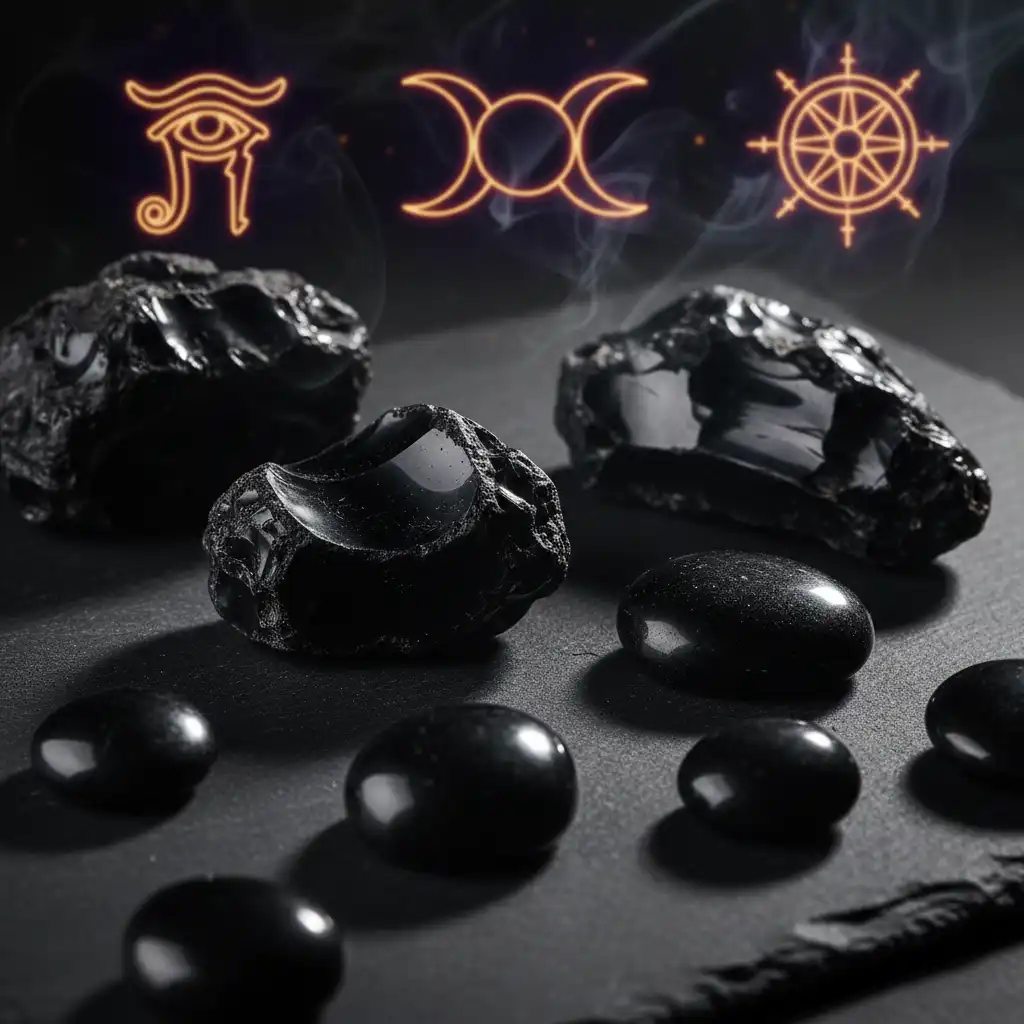
Black Obsidian Meaning: Volcanic Glass & Symbolism
Black obsidian meaning begins with one of the most important distinctions in gemstone terminology: obsidian is natural volcanic glass, not a crystalline mineral species. It forms when silica-rich molten rock cools under conditions that suppress extensive crystal growth, leaving a largely amorphous solid whose atoms lack the long-range repeating arrangement found in quartz, feldspar, kyanite, or other true minerals. Black obsidian can therefore look glossy and gemlike while belonging more accurately to the category of mineraloids or natural glasses.
Its familiar black appearance is also more complex than simply saying “obsidian is black.” Thick pieces can absorb so much visible light that they appear nearly opaque, while thin edges may transmit brown, smoky gray, olive-brown, or reddish-brown light. Microscopic iron-bearing particles, magnetite or other oxide phases, tiny crystallites, bubbles, flow structures, and overall thickness can all influence appearance. Individual specimens should therefore be examined rather than assigning one universal coloring mechanism to every black obsidian.
Black obsidian has a Mohs hardness of roughly 5–5.5 and specific gravity commonly near 2.3–2.6. It is brittle and lacks mineral cleavage because it has no ordered crystal lattice capable of producing regular cleavage planes. Instead, it breaks with exceptionally smooth conchoidal fracture, producing curved shell-like surfaces and potentially razor-sharp edges. That fracture behavior made obsidian technologically important wherever people had access to suitable volcanic sources, because skilled knappers could deliberately control breakage to create cutting edges, points, blades, scrapers, and other tools.
Modern black obsidian meaning commonly includes grounding, protection, truth, self-reflection, boundaries, release, and confronting uncomfortable patterns. Those interpretations can function as personal symbolism, especially because the glass is dark, reflective when polished, and capable of breaking into sharply defined forms. They are not demonstrated physical effects of volcanic glass. Black obsidian has not been shown to absorb negative energy, reveal hidden truths supernaturally, heal trauma, detoxify the body, protect against psychic attack, or alter another person’s intentions.
Readers exploring evidence-led stone references can browse the wider Gemstone Guides.
Black Obsidian Identity at a Glance
| Property | Black Obsidian |
|---|---|
| Material identity | Natural volcanic glass |
| Formal mineral species? | No |
| Material class | Mineraloid / natural glass |
| Chemistry | Silica-rich volcanic composition; exact chemistry varies |
| Crystal system | None for the amorphous glass itself |
| Common color | Black, brown-black, smoky black; thin edges may transmit brownish light |
| Transparency | Commonly opaque in thick pieces, translucent at thin edges |
| Luster | Vitreous |
| Mohs hardness | Approximately 5–5.5 |
| Specific gravity | Commonly about 2.3–2.6 |
| Cleavage | None |
| Fracture | Strong conchoidal fracture |
| Tenacity | Brittle |
| Common textures | Massive glass, flow-banded, vesicular locally, fractured |
| Geological setting | Silica-rich volcanic lava and shallow volcanic environments |
| Main diagnostic clue | Natural glass with conchoidal fracture and volcanic context |
| Major handling concern | Extremely sharp fresh fracture edges |
| Main identification limitation | Black color and glassy luster alone do not prove natural obsidian |
This identity explains why black obsidian meaning should begin with volcanic processes rather than with a list of crystal-healing claims. The material records what happens when a silicate melt solidifies without developing the extensive crystal framework found in ordinary igneous rock.
Obsidian Is Glass, Not a Crystal
The phrase “obsidian crystal” is common in retail language, but it is mineralogically imprecise.
A crystal possesses long-range atomic order.
Obsidian does not.
Its internal structure resembles a frozen silicate liquid more closely than an ordered quartz or feldspar crystal. The atoms are bonded into a solid network, but the arrangement does not repeat periodically over large distances.
This distinction affects how the material breaks, how it interacts with polarized light, how it weathers, and how it should be classified.
Obsidian may contain microscopic crystals, mineral particles, or crystallites within the glass, so calling the material amorphous does not mean every atom in a specimen belongs to perfectly homogeneous glass.
The bulk material remains glass even when small crystalline components are present.
How Black Obsidian Forms
Obsidian develops from silica-rich magma or lava whose viscosity makes atomic rearrangement into crystals comparatively difficult. If the melt loses heat while remaining sufficiently viscous, much of its structure can become locked into place before large mineral crystals develop.
Cooling rate matters, but “instant cooling” is too simplistic as a universal explanation.
Composition matters as well.
Silica-rich melts are highly polymerized and viscous, which slows movement of ions through the melt. Water and other volatile contents, temperature history, nucleation sites, eruption conditions, flow thickness, and later reheating can all influence whether a volcanic melt becomes glassy or crystalline.
This is why some lava flows contain obsidian beside pumice, rhyolite, perlite, spherulitic material, or partially crystallized zones rather than forming one uniform glass mass.
The detailed relationship among silica-rich magma, viscosity, cooling, degassing, flow structure, crystallization, and later alteration is explored in Black Obsidian formation and deposit geology.
Obsidian Is Commonly Associated With Rhyolitic Volcanism
Many obsidians have chemical compositions broadly associated with rhyolitic volcanic systems, although natural glass can span somewhat different silica-rich compositions.
Rhyolitic magma contains abundant silica and tends to be viscous.
That viscosity contributes both to the possibility of glass formation and to potentially explosive volcanic behavior when dissolved gases cannot escape easily.
Obsidian itself should not be described as simply “frozen rhyolite” without qualification because rock classification depends on chemistry and texture, but the connection is useful.
A glassy volcanic material and a fully crystalline volcanic rock can originate from chemically comparable melts yet develop different textures because their cooling and crystallization histories differ.
The contrast demonstrates why texture is as important as chemistry in igneous geology.
Why Black Obsidian Is Black
Thick black obsidian absorbs and scatters enough visible light to appear opaque or nearly opaque. The exact blackening mechanism varies between specimens and deposits, so assigning one impurity universally is misleading.
Iron-bearing phases can contribute.
Tiny magnetite or other oxide particles can contribute.
Microscopic crystallites, suspended particles, bubbles, structural heterogeneity, and overall thickness can affect transmission.
A thin flake often reveals information that a thick hand specimen hides.
When light passes through a sufficiently thin edge, nominally black obsidian may show smoky brown, reddish brown, dark olive, or gray-brown transparency.
This does not mean the stone has changed color.
The optical path through the glass has simply become short enough for some light to emerge.
Detailed transmission, absorption, reflectance, thin-edge color, and inclusion effects are treated in Black Obsidian optical properties and color behavior.
Black Obsidian Can Contain Flow Banding
Molten volcanic glass can move before solidification, and differences in bubble content, crystallites, composition, oxidation, or viscosity may become stretched into bands.
Some black obsidian therefore shows subtle parallel, curved, folded, or swirling structures.
These patterns may be difficult to see in ordinary diffuse light but become obvious when a polished slab is tilted or illuminated from an appropriate direction.
Flow banding is geological information.
It records motion and heterogeneity within the volcanic material.
It should not be described automatically as an “energy current” or evidence that mystical forces remain trapped in the glass.
The pattern arose from movement of melt and suspended material before solidification.
Obsidian Can Contain Microscopic Crystals
Although the bulk material is glass, natural obsidian can contain microlites, nanolites, tiny feldspar or oxide phases, and other crystalline particles.
Their abundance affects appearance and physical behavior.
If crystallization progresses sufficiently, the rock may become increasingly devitrified and eventually lose much of the homogeneous glassy character associated with fresh obsidian.
This creates a continuum rather than a perfectly binary division between “zero crystals” and “fully crystalline rock.”
The observation is important when comparing natural glass with manufactured black glass.
Real obsidian can preserve tiny geological features that reflect crystallization beginning but not becoming dominant.
Microscopic particles, bubbles, crystallites, flow bands, fractures, weathering, and polishing evidence are examined more closely in the Black Obsidian microscope inclusion notebook.
Conchoidal Fracture Is One of Obsidian’s Defining Features
Fresh obsidian commonly breaks with conchoidal fracture, creating smooth curved surfaces resembling part of a shell.
This fracture develops because glass lacks the regular weakness planes that create cleavage in many crystals.
Stress propagates through the amorphous material along curved paths instead.
The same process can produce remarkably sharp edges.
A fresh obsidian flake can be far sharper than its moderate Mohs hardness might suggest because edge sharpness depends on fracture geometry rather than simply scratch resistance.
This combination—moderate hardness, brittleness, and exceptionally sharp conchoidal fracture—is central to both obsidian’s technological history and its handling requirements.
Sharp Does Not Mean Hard
Obsidian offers an excellent demonstration of why hardness and sharpness should never be confused.
Quartz is harder than obsidian.
Sapphire is much harder.
Neither fact prevents freshly fractured obsidian from developing an extremely fine cutting edge.
Hardness measures resistance to scratching.
Sharpness describes edge geometry.
Toughness concerns resistance to fracture.
Obsidian is capable of exceptional sharpness precisely because it fractures in a controlled glass-like manner, yet that same brittleness means an edge can chip readily.
This distinction is essential when evaluating jewelry, carvings, archaeological objects, or rough specimens.
Fresh Edges Require Respect
An unbroken polished cabochon is straightforward to handle.
A freshly broken rough piece is different.
Edges can be difficult to see against the black surface and may cut skin deeply with relatively little pressure. A collector examining broken material should therefore support the specimen from blunt surfaces rather than gripping fresh margins.
Loose flakes should not be left where children, pets, or bare feet can encounter them.
This is a physical hazard, not a toxicity issue.
The same fracture property that made obsidian useful for tools makes damaged specimens capable of behaving like broken glass.
Obsidian Does Not Have One Exact Formula
Unlike quartz, SiO₂, or kyanite, Al₂SiO₅, obsidian is not defined by one ideal chemical formula.
It is a volcanic glass whose composition reflects the melt from which it formed.
Silica typically dominates, accompanied by aluminum, sodium, potassium, iron, calcium, magnesium, and other elements in varying proportions.
Water can also be present in the glass, including water incorporated during formation and water introduced gradually through hydration.
This variability is another reason obsidian should not be described as simply “pure silica glass.”
Quartz-rich chemistry and quartz mineral identity are not the same thing.
Obsidian Hydrates From the Surface
Volcanic glass is thermodynamically less stable than many crystalline silicates over geological time.
Water can gradually diffuse into obsidian from exposed surfaces, producing a hydrated layer whose depth increases under conditions controlled by factors such as temperature, composition, environment, and water availability.
This process has scientific and archaeological relevance because hydration can sometimes be studied to understand surface history.
It is not a universal clock that produces an exact age from one simple measurement.
Different obsidian compositions and environmental histories hydrate at different rates.
The existence of hydration is nevertheless important because it shows that a glassy stone can continue to change microscopically long after solidification.
Obsidian Can Devitrify
Glass is metastable.
Given suitable geological conditions, atoms can reorganize into crystalline phases, a process called devitrification.
Natural obsidian may therefore develop spherulites, fine crystalline aggregates, perlitic fractures, alteration products, or other textures over time.
Snowflake obsidian is a familiar example of obsidian containing pale spherulitic structures dominated by silica minerals such as cristobalite.
Black obsidian meaning should not absorb the detailed identities of every obsidian variety, but this transformation is relevant because it demonstrates that natural volcanic glass is not permanently frozen in one perfect state.
Its internal structure can evolve.
Black Obsidian Is Not Black Onyx
Black onyx belongs to the chalcedony/quartz family and is crystalline at a microscopic scale.
Obsidian is volcanic glass.
Polished pieces of both can appear uniformly black, making visual confusion easy when diagnostic features have been removed by cutting.
Onyx has greater hardness and lacks the classic glassy conchoidal behavior of fresh obsidian in exactly the same material context.
Commercial black onyx may also be treated to achieve uniform black color, creating another reason not to identify a polished black cabochon by appearance alone.
Instrumental or physical testing can distinguish the materials efficiently.
Black Obsidian and Black Moonstone Are Fundamentally Different
Black Moonstone meaning concerns dark feldspar material whose appeal commonly comes from a floating structural sheen.
Black obsidian is amorphous volcanic glass.
Moonstone possesses crystalline feldspar cleavage and a repeating crystal structure.
Obsidian does not.
A polished black moonstone can sometimes look plain until its sheen becomes visible, while polished obsidian commonly shows a more uniform vitreous surface.
The geological histories differ as much as the internal structures.
Black Obsidian and Black Opal Should Not Be Confused
Black Opal meaning concerns hydrated amorphous silica material capable of displaying play-of-color when silica spheres are arranged appropriately.
Obsidian is also amorphous and silica-rich, but its structure, water content, formation, optical behavior, and physical characteristics differ substantially from opal.
Black opal can display spectral flashes arising from diffraction.
Ordinary black obsidian does not produce opal-style play-of-color.
Both may be described broadly as mineraloids, but that shared classification is only a starting point.
Black Obsidian Is Not Black Kyanite
Black Kyanite meaning concerns crystalline Al₂SiO₅ formed under metamorphic conditions.
Kyanite commonly forms blades and has strongly directional hardness.
Obsidian is glassy, lacks a crystal system, and fractures conchoidally.
Their black appearance is therefore one of the least important similarities between them.
The comparison is useful because retail symbolism often groups both materials under grounding and protection even though they have no close geological relationship.
Original Black Obsidian Specimen and Photo Checklist
| Observation | What it may reasonably support | What it cannot prove alone |
|---|---|---|
| Deep black vitreous surface | Compatible with obsidian | Natural volcanic origin |
| Brown-translucent thin edge | Strong obsidian-style clue | Exact locality |
| Curved conchoidal fracture | Strong support for natural or manufactured glass | Obsidian specifically |
| Razor-sharp fresh flake | Typical fracture capability | Ancient tool use |
| Subtle flow bands | Compatible volcanic-glass texture | One particular eruption source |
| Tiny bubbles | Compatible volcanic glass | Natural origin by themselves |
| Microlites or small oxide particles | Plausible natural inclusions | Exact color mechanism |
| Rhyolitic volcanic matrix/context | Strong geological support | Exact chemical composition |
| No visible crystals | Compatible with glass | Proof of obsidian |
| RI consistent with natural volcanic glass | Strong gemological evidence | Geographic origin |
| Density in expected range | Useful support | Natural versus manufactured glass alone |
| Raman or compositional glass analysis | Strong material evidence | Provenance automatically |
| Trace-element fingerprint matching source | Potential provenance evidence | Archaeological context by itself |
| Original field label | Valuable provenance evidence | Independent material confirmation |
| Mold seam or artificial surface | Possible manufactured-glass clue | Definitive composition |
The checklist deliberately separates glass identification from geological origin. Manufactured black glass can share hardness, conchoidal fracture, transparency, and vitreous luster with obsidian, so geological or compositional context can become important.
Claims About Black Obsidian That Need Qualification
| Claim | More accurate interpretation |
|---|---|
| “Obsidian is a black crystal” | It is natural volcanic glass rather than a true crystal |
| “Obsidian is pure SiO₂” | Its silica-rich chemistry includes multiple additional components |
| “All obsidian is completely opaque” | Thin edges can transmit brownish or smoky light |
| “Black color comes from one mineral” | Several particles, oxides, crystallites, and optical factors can contribute |
| “Obsidian has cleavage” | It lacks mineral cleavage and breaks conchoidally |
| “Sharp means very hard” | Edge sharpness and Mohs hardness are different properties |
| “Every black glassy stone is obsidian” | Manufactured glass and other materials can imitate it |
| “Obsidian absorbs negative energy scientifically” | No measurable mechanism establishes this claim |
| “Obsidian detoxifies the body” | No established medical evidence supports this |
| “Obsidian reveals lies automatically” | Truth symbolism does not produce supernatural detection |
| “Black obsidian protects against psychic attack” | This is metaphysical belief rather than measured mineral behavior |
| “Ancient tool use proves healing power” | Technological history and medical efficacy are unrelated questions |
These boundaries allow black obsidian meaning to include history and symbolism without converting geology into unsupported health claims.
Black Glass Is Not Automatically Natural Obsidian
Manufactured glass can be colored black, shaped into beads, carved into figures, polished into cabochons, or broken to imitate natural obsidian.
Because both materials are glass, many simple observations overlap.
Both can show vitreous luster.
Both can fracture conchoidally.
Both can transmit light at thin edges.
Both can have similar hardness.
Identification therefore may require more than a scratch test.
Suspicious clues can include molds, seams, perfectly repeated shapes, abundant round gas bubbles inconsistent with the claimed material, unusual uniformity, artificial coatings, or chemistry inconsistent with natural volcanic glass.
No one feature should be overinterpreted.
Microscopy Can Separate Several Possibilities
Under magnification, natural black obsidian may show flow structures, microlites, mineral particles, bubbles, devitrification textures, hydration-related surfaces, or natural fractures.
Manufactured glass can show its own bubbles, flow lines, devitrification, or surface features, so microscopy is not always definitive by itself.
Context matters.
A bubble is evidence of gas entrapment.
It is not automatically evidence of artificial glass.
Likewise, the absence of visible inclusions does not prove manufactured origin.
The strongest identification comes from combining optical behavior, microscopy, chemistry, and provenance where needed.
Obsidian Can Be Geochemically Sourced
One of obsidian’s most important archaeological properties is that separate volcanic sources can possess distinctive trace-element compositions.
Portable or laboratory analytical methods can compare an artifact’s chemistry with known geological source material.
This allows archaeologists to reconstruct movement of obsidian across landscapes, revealing procurement networks, exchange, mobility, and technological choices.
The result is much stronger than visually saying an artifact “looks like” material from a famous volcano.
Geochemical sourcing demonstrates how a stone’s composition can preserve human history without requiring mystical interpretation.
It also explains why reliable provenance matters to collectors.
The Black Obsidian provenance and disclosure checklist provides a structured approach to locality, natural origin, treatment, replicas, and source claims.
Obsidian Has a Deep Toolmaking History
Humans valued obsidian because controlled fracture can produce extremely sharp edges.
Knappers learned to strike cores at deliberate angles and forces so fractures propagated predictably, producing flakes suitable for cutting, scraping, piercing, and projectile technologies.
The skill required is substantial.
A carefully made artifact records knowledge of stone selection, platform preparation, percussion or pressure technique, intended form, and practical use.
This history should not be reduced to the generic claim that ancient people used obsidian because it was “protective.”
Its cutting performance was directly useful.
Archaeological Obsidian Should Not Be Modified
A genuine archaeological artifact is not ordinary lapidary rough.
Cleaning, repolishing, reshaping, drilling, or removing residues can destroy surface information, use-wear evidence, hydration surfaces, adhered materials, or context relevant to interpretation.
Ownership and collection laws also vary by jurisdiction and provenance.
A stone sold as an ancient artifact should therefore have much stronger documentation than an ordinary modern cabochon.
A suspicious story should not be upgraded into authenticity merely because the object is made from genuine obsidian.
Material identity and artifact authenticity are separate questions.
Obsidian Mirrors Have a Real Material Basis
A sufficiently smooth polished obsidian surface can become strongly reflective.
This physical property helps explain why polished obsidian has sometimes been used for mirrors and reflective objects.
The reflection can be dark compared with a modern metal-backed mirror, giving the image a visually unusual appearance.
Modern symbolic traditions sometimes reinterpret obsidian mirrors as tools for divination or supernatural revelation.
A person may use a dark reflective surface for ritual or contemplation if that practice is meaningful to them.
The physical mirror effect itself is simply reflected visible light.
It does not establish supernatural information transfer.
Buying Black Obsidian Starts With Material Identity
Black obsidian is common enough that most pieces do not justify expensive laboratory testing, but misleading descriptions can still occur.
A buyer should ask whether the object is claimed to be natural volcanic glass, manufactured glass, reconstructed material, dyed material, or an archaeological artifact.
The appropriate evidence depends on the claim.
A simple polished bead requires less documentation than a rare locality specimen or culturally important artifact.
Transaction-specific checks, seller descriptions, identification questions, and purchasing decisions are covered in where to buy black obsidian.
Cutting Obsidian Is Technically Straightforward but Physically Sharp
Obsidian can be sawn, ground, polished, flaked, carved, and shaped effectively.
Its homogeneous glassy structure can take an excellent polish.
The challenge is controlling fractures and edges.
Fresh chips generated during cutting can be extremely sharp, and fine fragments may be difficult to see.
Lapidary work should therefore use eye protection, controlled wet methods where appropriate, careful cleanup, and procedures that prevent sharp flakes from accumulating around the workspace.
Cut orientation, flow banding, fractures, polish quality, edge finishing, and preservation of interesting rough are explored in Black Obsidian cutting, orientation and polish.
Obsidian Jewelry Needs Protection From Impact
A polished obsidian cabochon can perform well in pendants, earrings, beads, and carefully designed rings, but its brittleness remains important.
A direct strike can chip an edge or fracture the stone.
Thin carvings are more vulnerable than compact cabochons.
A bezel can protect the perimeter better than an exposed setting, while secure backing can reduce localized pressure.
Bracelets and rings experience more impact than pendants.
Construction choices, vulnerable edges, setting pressure, stone thickness, and wear exposure are addressed in Black Obsidian setting and wear engineering.
Obsidian Scratches More Easily Than Quartz
With hardness around 5–5.5, black obsidian is softer than quartz and common airborne or household silica-rich grit.
A polished surface can therefore accumulate fine scratches.
The effect is especially visible on uniformly black material because reflected light highlights surface damage.
Store polished obsidian away from harder gemstones.
Avoid dropping multiple loose stones together in one container.
A high-gloss black surface is visually unforgiving of abrasion, making preventive storage more effective than repeated repolishing.
Cleaning Black Obsidian Is Usually Simple
Sound untreated polished obsidian can generally be cleaned gently with mild soap, water, and a soft cloth.
The greater concern is impact rather than ordinary brief water contact.
Collector specimens may need a more conservative approach when they contain fragile matrix, weathered surfaces, archaeological context, repairs, coatings, or attached labels.
Aggressive abrasives should be avoided because they can dull polish.
An archaeological or provenance-important object should not be treated like an ordinary commercial cabochon.
Preserve Natural Fracture and Context
A rough obsidian specimen can preserve flow texture, weathering rind, bubbles, natural fractures, perlitic structure, matrix, and source-specific information.
Polishing transforms the object into a decorative surface but removes some geological evidence.
Both forms have legitimate value.
The decision depends on whether the material is common cutting rough or a specimen whose geological context matters.
Before modifying an unusual piece, photograph its original form and preserve any locality information.
Long-term storage, sharp edges, weathered surfaces, labels, archaeological sensitivity, and collection records are addressed in the Black Obsidian specimen conservation record.
Ordinary Obsidian Is Not a Toxic Black Stone
Normal handling of intact black obsidian does not require unusual chemical precautions.
The material is a stable silicate glass rather than a soluble chemical preparation.
The most immediate hazards are cuts from fresh edges and dust generated during mechanical processing.
Cutting or grinding creates fine silicate particles, so lapidary work should use wet methods and appropriate dust control rather than assuming a natural stone is harmless simply because it contains no obvious toxic metal.
The complete exposure situation matters more than a crystal-shop safety label.
Do Not Use Obsidian as an Ingestible Remedy
Black obsidian should not be ground into powder or deliberately placed in drinking water to create supposed therapeutic preparations.
There is no established health benefit from ingesting volcanic glass.
Rough pieces can carry surface residues, matrix material, polishing compounds, contaminants, or microscopic sharp fragments.
The fact that obsidian is largely silicate does not turn it into food.
Symbolic use remains external.
Black Obsidian Meaning and Grounding
Grounding is one of the most familiar modern black obsidian meaning themes.
The symbolism is understandable because the stone is dark, dense-looking, glassy, and directly associated with volcanic rock.
A practical interpretation is to use black obsidian as a reminder to return attention to observable facts, physical surroundings, finances, schedules, or immediate responsibilities when thoughts become diffuse.
That behavior can be genuinely useful.
The glass itself has not been demonstrated to electrically ground the body or drain invisible negative energy into the Earth.
Black Obsidian Meaning and Protection
Protection symbolism likely draws partly from black color and partly from obsidian’s long technological history as a cutting material.
Modern metaphysical traditions often describe the stone as a shield against psychic attack, harmful intentions, or negative energy.
No established measurement demonstrates such a field.
A more practical interpretation can connect black obsidian with checking risks, maintaining boundaries, recognizing hazards, securing belongings, leaving unsafe situations, or protecting personal time.
Those actions can create real protection.
The stone can serve as the reminder rather than the mechanism.
Black Obsidian Meaning and Truth
Truth is another common black obsidian meaning, particularly in descriptions that call it a “stone of truth.”
A polished black surface can work as a metaphor for looking directly at uncomfortable information, while the extreme sharpness of broken obsidian can symbolize cutting through confusion.
Neither characteristic allows the stone to detect lies.
A person can use obsidian during reflection as a prompt to ask what evidence supports a belief, what information is missing, what assumptions are being made, and whether a conclusion changes when new facts appear.
That process may improve judgment.
The stone does not reveal hidden information automatically.
Black Obsidian Meaning and Self-Reflection
Polished obsidian’s mirror-like surface gives self-reflection symbolism an unusually direct physical basis.
Historically and culturally, reflective dark surfaces have also acquired ritual significance in different contexts.
Modern users may incorporate an obsidian mirror or polished stone into journaling, meditation, or contemplative practice.
That use can be meaningful without assuming supernatural vision.
A reflective object can focus attention.
It cannot diagnose trauma, reveal another person’s thoughts, or replace psychological care.
Black Obsidian Meaning and Release
Obsidian’s ability to fracture into sharply separated flakes has inspired modern symbolism involving release, severing old patterns, or removing what is no longer useful.
A constructive interpretation is behavioral.
A person might use the stone as a reminder to cancel an unnecessary commitment, remove a recurring distraction, change a damaging routine, or end contact that consistently violates a boundary.
The decision causes the change.
The glass does not sever invisible attachments.
Black Obsidian Meaning and Shadow Work
Black obsidian is frequently associated with “shadow work,” a broad modern term used for introspection involving uncomfortable emotions, habits, fears, or parts of identity someone would rather avoid examining.
An obsidian object can be used symbolically during journaling if that practice feels useful.
It does not retrieve memories reliably, force hidden truths into consciousness, diagnose mental-health conditions, or treat trauma.
Intense self-reflection can sometimes increase distress.
Persistent or serious psychological difficulties deserve qualified professional care rather than escalating crystal practices.
The distinction between symbolism and health claims is explained in the Gems Lore Disclaimer.
Black Obsidian Does Not Have Established Healing Properties
There is no established scientific evidence that black obsidian treats physical or psychological illness.
Claims involving digestion, circulation, pain, inflammation, infection, anxiety, trauma, depression, detoxification, blood pressure, or nervous-system regulation require appropriate medical evidence.
Silica-rich volcanic glass does not provide a therapeutic pathway through skin contact.
Its black color does not create a biological shielding effect.
Its conchoidal fracture does not remove emotional wounds.
Someone can value obsidian spiritually or culturally while keeping medical decisions grounded in healthcare evidence.
Ancient Use Does Not Prove Modern Metaphysical Claims
Obsidian has an extraordinarily important human history because its fracture properties made it useful for practical technologies.
Evidence of cutting tools, blades, points, ornaments, mirrors, and exchange networks shows that people valued the material.
It does not automatically show that every community believed obsidian absorbed negative energy, balanced chakras, or healed disease.
Specific cultural beliefs require specific historical or archaeological evidence.
A documented ritual use proves that people assigned meaning to an object.
It does not prove the physical effectiveness of the supernatural claim attached to that ritual.
Original Claim-vs-Evidence Matrix
| Black obsidian claim | Evidence status |
|---|---|
| It is natural volcanic glass | Testable geological fact |
| It lacks a crystal structure | Established material property |
| It breaks conchoidally | Directly observable |
| Fresh edges can be extremely sharp | Measurable physical behavior |
| Thin pieces may transmit brownish light | Observable |
| Its exact composition varies by source | Established geological principle |
| It was widely useful for cutting technology | Documented archaeological fact |
| Source chemistry can reveal exchange networks | Established analytical application |
| It absorbs negative energy | Metaphysical belief |
| It detects lies | Not established |
| It creates psychic protection | Metaphysical belief |
| It detoxifies the body | Not established medically |
| A polished surface can symbolize self-reflection | Human interpretation |
| Conchoidal fracture can symbolize decisive separation | Human interpretation |
| Dark appearance can symbolize grounding | Human interpretation |
This matrix gives black obsidian meaning a clear boundary between material facts, documented human history, and modern symbolism.
Original Evidence Ladder for Black Obsidian Claims
Direct observation can establish black color, vitreous luster, transparency at thin edges, flow banding, bubbles, fractures, polish, weathering, and condition.
Basic physical examination can establish hardness context, specific gravity, lack of cleavage, and characteristic conchoidal fracture.
Microscopy can reveal microlites, nanolites, bubbles, oxide particles, flow structures, devitrification, artificial coatings, polishing features, and manufactured-glass clues.
Optical or spectroscopic testing can establish behavior consistent with natural volcanic glass and help separate some imitations.
Chemical analysis can characterize the glass composition and distinguish broad source groups.
Trace-element sourcing can sometimes associate archaeological or geological material with a known volcanic source when suitable reference datasets exist.
Geological interpretation requires lava-flow context, chemistry, textures, neighboring volcanic rocks, and alteration relationships.
Artifact authenticity requires archaeological context, technological analysis, provenance, and appropriate specialist assessment rather than material identity alone.
Historical symbolism requires evidence tied to the specific culture and use being described.
Modern metaphysical claims can be documented as beliefs but remain distinct from measurable properties.
Health claims require clinical evidence and cannot be inferred from volcanic origin, ancient use, black color, or glass chemistry.
This hierarchy prevents genuine archaeological importance from being used as evidence for unrelated modern healing claims.
What Black Obsidian Meaning Can Responsibly Represent
Black obsidian possesses several real characteristics capable of supporting distinctive symbolism without requiring supernatural claims. Its origin from molten volcanic material can represent rapid transition into a new state. Its reflective polish can symbolize self-examination, while conchoidal fracture can represent making a clean distinction or ending a pattern deliberately. The ability of thin edges to reveal brown translucency beneath an apparently opaque black surface can represent the idea that first appearances do not contain all available information.
Its archaeological history adds another grounded layer. Humans valued obsidian because careful observation and skill could transform brittle volcanic glass into highly effective tools. That can symbolize precision, intentional action, or learning how to work with a material’s actual properties rather than wishing those properties were different.
These meanings remain interpretations.
Black obsidian does not need to absorb negativity, expose lies supernaturally, cure illness, or create an invisible shield to be significant.
The evidence-led approach used throughout Gems Lore is described on About Gems Lore. Questions about an individual specimen can be submitted through Contact Gems Lore, with submitted information handled according to the site’s Privacy Policy.
Frequently Asked Questions
What is black obsidian?
Black obsidian is naturally occurring volcanic glass formed from silica-rich molten rock that solidified without developing extensive crystalline structure.
Is black obsidian a mineral?
Strictly, no. It is generally classified as a mineraloid or natural volcanic glass rather than a mineral species.
Is black obsidian a crystal?
No. Its bulk structure is amorphous rather than crystalline, although tiny mineral crystals or crystallites can occur inside natural obsidian.
What is black obsidian meaning?
Black obsidian meaning combines its volcanic-glass identity and human history with modern symbolism involving grounding, protection, truth, self-reflection, boundaries, and release.
What is black obsidian made of?
It is silica-rich volcanic glass containing variable amounts of aluminum, sodium, potassium, iron, calcium, magnesium, water, and other components depending on source.
Why is black obsidian black?
Strong light absorption combined with microscopic particles, iron-bearing phases, crystallites, bubbles, and thickness can contribute to its dark appearance.
Is black obsidian completely opaque?
Thick pieces often appear opaque, but sufficiently thin edges can transmit brown, smoky, reddish-brown, or dark gray light.
What crystal system does obsidian have?
None. Obsidian is amorphous glass and therefore lacks a crystal system.
How hard is black obsidian?
Its Mohs hardness is generally around 5–5.5.
Why is obsidian so sharp?
Its amorphous structure allows smooth conchoidal fracture that can produce extremely thin, sharp edges.
Is obsidian sharper than steel?
Freshly fractured obsidian can produce extremely fine edges, but sharpness, durability, and overall tool performance are different properties. Obsidian edges are also brittle.
Does black obsidian have cleavage?
No. It lacks mineral cleavage and typically breaks conchoidally.
Is black obsidian brittle?
Yes. A strong impact can chip or fracture it readily.
How dense is black obsidian?
Specific gravity commonly falls roughly around 2.3–2.6, depending on composition and bubbles.
Where does black obsidian form?
It forms in silica-rich volcanic environments where molten material becomes glassy rather than fully crystallizing.
Is all obsidian rhyolite?
Many obsidians are associated with rhyolitic compositions, but the exact chemical classification should be determined from individual material rather than assumed universally.
Can black obsidian contain crystals?
Yes. Microscopic crystallites or mineral particles can occur even though the bulk material remains volcanic glass.
What is flow-banded obsidian?
It is obsidian containing visible or subtle bands created by movement and heterogeneity within the molten material before solidification.
Is black obsidian the same as onyx?
No. Onyx is chalcedony/quartz, while obsidian is volcanic glass.
Is black obsidian the same as black moonstone?
No. Black moonstone is feldspar material with a crystalline structure, while obsidian is amorphous volcanic glass.
Is black obsidian the same as black opal?
No. Both are mineraloid-type materials, but their formation, composition, water content, structure, and optical behavior differ.
Is black obsidian black kyanite?
No. Kyanite is crystalline Al₂SiO₅ formed through metamorphism.
How can black obsidian be identified?
Useful evidence includes vitreous luster, conchoidal fracture, thin-edge transmission, hardness, density, microscopy, glass chemistry, and geological provenance.
Can a photograph prove black obsidian?
A photograph can strongly suggest it, but manufactured black glass can resemble natural obsidian. Strong claims may require physical examination or analytical testing.
Can black obsidian be fake?
Manufactured glass, molded products, coatings, and other black materials can be sold as obsidian. Material testing and seller disclosure help when authenticity matters.
Where can I buy black obsidian?
Material identity, natural-versus-manufactured concerns, seller claims, locality documentation, and transaction checks are covered in where to buy black obsidian.
Was obsidian used for tools?
Yes. Its predictable conchoidal fracture allows skilled production of very sharp flakes and blades, making obsidian technologically important in many archaeological contexts.
Can scientists identify where archaeological obsidian came from?
Often, trace-element chemistry can be compared with known geological sources to investigate provenance and exchange networks.
Can black obsidian be polished?
Yes. It can take a high vitreous polish and is commonly made into cabochons, beads, carvings, spheres, mirrors, and ornamental pieces.
Is black obsidian good for rings?
It can be used, but protected settings are preferable because obsidian scratches more easily than quartz and can chip after impact.
How should black obsidian be cleaned?
Sound polished material can generally be cleaned gently with mild soap, water, and a soft cloth. Important archaeological or matrix specimens require more conservative handling.
Is black obsidian dangerous?
Intact polished obsidian is generally straightforward to handle, but freshly fractured pieces can have extremely sharp edges.
Can black obsidian go in drinking water?
It should not be deliberately used to prepare ingestible crystal remedies. There is no established health benefit, and natural specimens may carry contaminants or sharp microscopic fragments.
Does black obsidian have healing properties?
There is no established scientific evidence that black obsidian treats physical or psychological illness.
Is black obsidian a grounding stone?
It is widely used symbolically for grounding. No measurable metaphysical grounding mechanism has been established.
Does black obsidian absorb negative energy?
That is a metaphysical belief rather than a demonstrated physical property of volcanic glass.
Does black obsidian reveal truth?
It may serve as a personal reminder to examine evidence and uncomfortable information directly, but it does not detect lies or reveal hidden facts supernaturally.
Does black obsidian protect against psychic attack?
No scientifically established protective field has been demonstrated. Protection remains a symbolic interpretation.
Why does black obsidian symbolize self-reflection?
Its dark polished surface can function as a literal reflective surface, making self-examination a natural metaphor.
Why does black obsidian symbolize release?
Its ability to fracture cleanly into separated flakes provides a physical metaphor for making distinctions, ending patterns, or letting something go deliberately.
Why is provenance important for black obsidian?
Different volcanic sources can look similar while having distinct chemical signatures. Reliable provenance can add geological, archaeological, and collector context.
Black obsidian meaning becomes much clearer once the material is identified correctly as volcanic glass rather than a black crystal. Its amorphous structure explains its lack of cleavage and extraordinary conchoidal fracture, while its silica-rich volcanic origin explains how molten rock can solidify without developing the extensive crystal framework found in most ordinary igneous rocks. Its apparent opacity can also be deceptive, because thin edges often reveal brown or smoky transmitted light beneath the black exterior.
Those genuine characteristics provide unusually strong symbolic possibilities. A reflective surface can represent self-examination, an extremely sharp fracture can represent making a clear distinction, volcanic transformation can represent change, and thin-edge transparency can symbolize looking beyond an initial impression. Its archaeological history adds themes of precision and intentional skill because people learned to transform brittle glass into effective tools by understanding exactly how it breaks.
These meanings are human interpretations of real material properties. Black obsidian does not need unsupported claims about detoxification, psychic shielding, lie detection, or supernatural energy absorption to be meaningful; its volcanic formation, fracture physics, archaeological importance, source chemistry, and long practical relationship with people already give it a substantial identity.