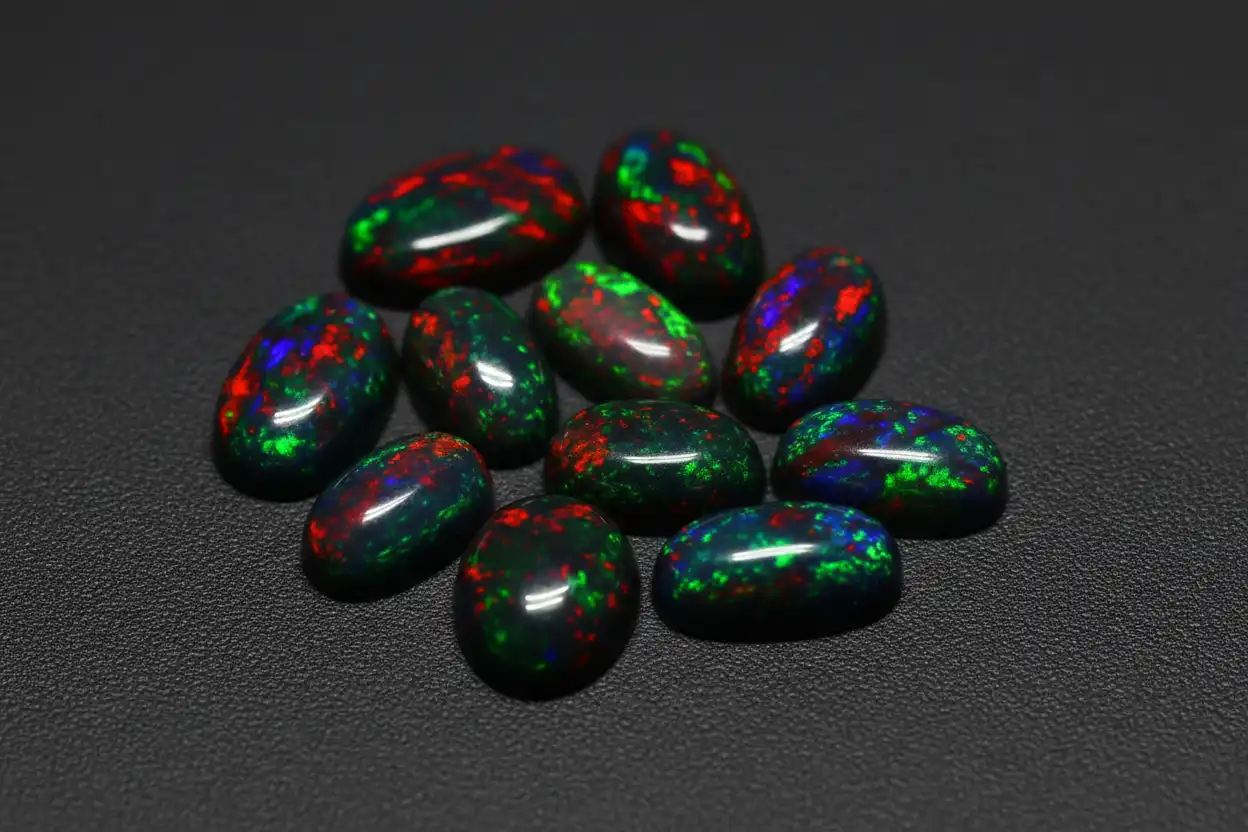
Black Opal Meaning: Dark Body, Play-of-Color & Symbolism
Black opal meaning begins with a gemological distinction: black opal is precious opal whose play-of-color appears against a black, dark gray, blue-gray, brown-black, or otherwise dark body or background. The word “black” describes the darkness behind the spectral color rather than requiring the entire gem to be uniformly jet black. A fine stone can show brilliant red, orange, green, blue, violet, or several colors simultaneously while still being classified commercially as black opal because the underlying body tone is dark.
Opal itself is hydrated amorphous silica, commonly represented as SiO₂·nH₂O. Unlike quartz, it lacks the long-range repeating crystal lattice of a conventional mineral species, so it is usually classified as a mineraloid. Precious opal displays play-of-color because extremely small silica spheres can be arranged with enough regularity for visible light to diffract through the structure. Different wavelengths emerge in different directions as the stone, observer, or light source moves, producing the changing spectral colors for which opal is famous.
The dark background is especially important because contrast makes play-of-color appear more saturated. A green flash that looks subdued against pale opal may appear dramatically brighter against a nearly black body. This contrast contributes to black opal’s visual reputation, but it should not be confused with an internal light source. The gem reflects and diffracts external illumination; it does not glow with stored energy.
Modern black opal meaning commonly includes transformation, creativity, confidence, individuality, perspective, emotional reflection, mystery, grounding, and protection. These ideas can function as personal symbolism inspired by the contrast between dark body tone and shifting spectral color. They are not measurable physical effects of hydrated silica. Black opal has not been demonstrated to heal illness, regulate emotions, increase psychic perception, predict events, protect against invisible forces, or transmit beneficial energy through contact.
Readers exploring other evidence-led mineral and gem references can browse the broader Gemstone Guides.
Black Opal Identity at a Glance
| Property | Black Opal |
|---|---|
| Material identity | Precious opal with dark body tone/background |
| Material class | Hydrated amorphous silica / mineraloid |
| Simplified composition | SiO₂·nH₂O |
| Crystal system | None; amorphous |
| Main optical effect | Play-of-color |
| Common body tones | Black, dark gray, blue-gray, brown-black |
| Play-of-color hues | Red, orange, yellow, green, blue, violet |
| Transparency | Translucent to opaque in many black opals |
| Luster | Vitreous to resinous |
| Mohs hardness | Approximately 5–6.5 |
| Specific gravity | Commonly near 2.15, with variation |
| Refractive index | Commonly around 1.37–1.47 |
| Cleavage | None |
| Fracture | Conchoidal to uneven |
| Water content | Variable |
| Main valuation advantage | Strong color contrast against dark body tone |
| Main identification concern | Natural dark body must be separated from dye, smoke treatment, backing, doublets, triplets, and imitations |
| Main durability concern | Scratching, impact, crazing, thermal stress, and variable porosity |
The identity table shows why black opal meaning should begin with structure and color behavior rather than with mystical interpretations. The gem’s visual effect can be explained through measurable optical organization on a scale far smaller than the eye can resolve.
Black Opal Is Precious Opal, Not Simply Any Black Opal-Like Material
The term precious opal refers to opal that displays play-of-color.
Common opal lacks this spectral effect.
A uniformly dark opal without play-of-color may still be natural opal, but it does not fit the same gemological category as a black precious opal whose red, green, or blue flashes move with illumination and viewing angle.
This distinction becomes important in online listings because “black opal” can be used loosely for dark common opal, treated material, assembled stones, synthetic products, or other black gems with colorful surface effects.
A dark base is only one part of the identity.
Precious-opal structure and genuine play-of-color must also be considered.
Play-of-Color Is a Structural Optical Effect
Precious opal is built from extremely small hydrated-silica particles. When those particles have sufficiently regular size and arrangement, gaps between them form a three-dimensional structure capable of interacting with visible light.
The result is diffraction.
Certain wavelengths reinforce in particular directions while others emerge elsewhere, creating red, orange, yellow, green, blue, and violet flashes as the geometry changes.
This is why play-of-color moves.
The colored areas are not ordinary pigment patches embedded like paint.
A stationary stone illuminated from a different angle can show a different pattern, and moving the observer can produce another change again.
The detailed relationship among sphere size, arrangement, diffraction, body tone, transparency, and viewing direction is explored in Black Opal optical properties and color behavior.
Why Red Play-of-Color Is Visually Significant
Producing red diffraction generally requires an ordered internal structure capable of interacting with longer visible wavelengths. Green and blue are frequently encountered in opal, while strong red combined with other spectral colors can create especially striking contrast against a dark background.
That does not mean red automatically makes every black opal superior.
Brightness matters.
Pattern matters.
The proportion of the face showing color matters.
Viewing-angle range matters.
A tiny dull red speck does not necessarily outperform a brilliant green-blue stone with excellent coverage.
The complete visual performance should be considered rather than treating one hue as a universal quality grade.
Black Body Tone Increases Contrast
Imagine the same bright green patch viewed against white paper and then against black paper.
The darker background makes the green appear more intense because surrounding light is reduced.
Black opal benefits from a similar contrast relationship.
Its dark body suppresses much of the background brightness, allowing spectral flashes to stand out dramatically.
This is one reason black opal can look unusually vivid even when the physical mechanism producing play-of-color is shared with other precious opal.
The dark body does not generate extra spectral wavelengths.
It changes the visual context in which those wavelengths are seen.
“Black” Does Not Always Mean Jet Black
Natural black opal spans a body-tone range.
Some material is genuinely near black.
Other stones are dark charcoal, dark gray, blue-gray, brownish gray, or smoky.
Commercial grading systems may divide body tone into increasingly dark categories, but the broader gemological idea remains simple: the darker background distinguishes black or dark opal from light or white opal.
Photographs can complicate this distinction because exposure, background, lighting, camera processing, and screen brightness affect perceived darkness.
A stone should therefore be judged under controlled neutral illumination rather than from one high-contrast photograph.
Black Opal Can Be Opaque or Translucent
A dark stone does not have to be completely opaque.
Some black opal allows limited light transmission, especially around thinner edges.
Others are effectively opaque face-up.
Transparency interacts with body tone and play-of-color in complex ways.
A translucent stone may show depth because spectral color seems suspended beneath the surface, while an opaque stone may create stronger direct contrast.
Neither condition alone establishes quality or authenticity.
The observed result depends on the complete internal structure.
Black Opal Is Amorphous
Unlike quartz, sapphire, beryl, or kyanite, opal lacks a conventional crystal lattice.
It is therefore isotropic in the broad optical sense rather than birefringent like many crystalline gemstones.
Individual silica particles inside precious opal can possess their own structure, but the bulk gem does not behave like one large crystal.
This amorphous identity explains why “black opal crystal” is technically imprecise when used as a mineralogical description.
“Black opal gemstone” is more appropriate.
How Black Opal Forms
Opal forms when silica-bearing solutions move through cracks, pores, cavities, sedimentary layers, or weathered rock and eventually deposit hydrated silica.
The geological details vary significantly between deposits.
In some major opal fields, silica moves through sedimentary rocks and accumulates in fractures, voids, fossils, or replacement zones.
Elsewhere, volcanic rocks, cavities, fractures, or altered volcanic material provide the host environment.
The microscopic organization required for precious play-of-color does not develop automatically in every silica deposit. Most opal lacks sufficiently ordered sphere arrangements and therefore remains common opal.
This makes precious black opal a special outcome of both chemistry and microstructure rather than merely the presence of silica and water.
Deposit types, host rocks, silica transport, potch formation, color-bar development, volcanic versus sedimentary settings, and geological replacement are examined in Black Opal formation and deposit geology.
Dark Potch Can Influence the Face-Up Appearance
Natural opal rough can contain precious color bars alongside common opal known in the trade as potch.
When dark potch lies beneath a precious-opal layer, it can create a dark natural background that strengthens face-up contrast.
A cutter may deliberately preserve enough dark natural backing to support the color bar while removing excess material that adds unnecessary thickness.
This can still be a solid natural opal rather than an assembled stone.
The distinction depends on whether the dark backing is naturally continuous with the opal rough or has been artificially attached later.
That boundary becomes important when black opal is compared with doublets and triplets.
Solid Black Opal, Doublets, and Triplets Are Different Constructions
A solid black opal is cut from one naturally connected piece of opal-bearing material.
An opal doublet normally combines a thin precious-opal layer with a darker attached backing that increases strength or visual contrast.
A triplet adds a transparent protective cap above the thin opal layer.
Doublets and triplets can be attractive legitimate products when disclosed accurately.
They should not be represented as solid black opal.
A side view can often reveal straight glue boundaries, layered construction, or an artificial backing, although well-made assemblies may require magnification.
The distinction is about construction and disclosure rather than declaring assembled opal worthless.
Boulder Opal Is Also Different
Boulder opal naturally remains attached to its host rock, commonly iron-rich matrix.
The dark natural rock behind thin precious-opal seams can produce exceptional contrast.
That does not automatically make the material black opal in the strictest trade sense.
Boulder opal is commonly classified separately because the host rock is an integral part of the finished stone.
A polished gem can therefore have dark backing and vivid play-of-color while belonging to a different opal category.
Understanding the natural relationship between precious opal and backing material prevents legitimate boulder opal from being mistaken for an assembled doublet.
Hydrophane Is a Porosity Property, Not an Opal Color
Hydrophane opal is sufficiently porous to absorb water readily.
When water enters its pore structure, transparency, body appearance, and play-of-color can change temporarily. Drying may take substantial time depending on porosity and stone size.
Not every black opal is hydrophane.
Not every hydrophane opal is black.
The term describes absorption behavior rather than color category.
This distinction is particularly important when evaluating dark opal because porous material can potentially absorb dyes or other liquids more readily than dense non-hydrophane material.
Dark body color therefore deserves treatment evaluation when provenance and material type make such modification plausible.
Water Absorption Is Not a Safe Home Authenticity Test
Putting an unknown opal into water to see whether it changes appearance is not a good default identification method.
Porous opal can absorb liquid.
Existing microfractures can respond unpredictably.
Treatments can also be affected.
An assembled stone may contain adhesives.
A negative water response would not prove that the material is natural black opal, while a positive response would establish only that the material absorbs water readily.
Gemological observation should avoid introducing unnecessary risk simply to satisfy curiosity.
Natural Dark Body Color and Dyed Dark Opal Need Separation
Porous opal can accept artificial coloring agents.
Darkened material may therefore enter the market under descriptions that resemble black opal.
Microscopy can sometimes reveal suspicious color concentrations around pits, fractures, pores, drill holes, or surface irregularities.
Spectroscopy and other analytical methods can provide stronger evidence when value warrants testing.
A dark appearance alone cannot prove treatment.
Natural dark opal exists.
The correct approach is to look for treatment evidence rather than assuming either natural or artificial color from appearance alone.
Smoke and Carbon Treatments Can Darken Opal
Some opal can be intentionally darkened so its play-of-color appears stronger against a darker background.
Treatment methods may use smoke, carbon-rich substances, chemical processes, or other approaches depending on the material.
The resulting stone can display genuine play-of-color because the opal structure itself remains capable of diffraction.
What changed is the body appearance or background.
This is why visual beauty does not answer the treatment question.
A treated opal can be genuinely attractive while still requiring disclosure because natural-color black opal and artificially darkened opal occupy different identity and market categories.
Synthetic Opal Can Display Genuine-Looking Play-of-Color
Laboratory-grown opal can reproduce ordered silica structures capable of creating spectral play-of-color.
The optical phenomenon is therefore not proof of natural geological origin.
Synthetic material may show growth textures, pattern organization, structural regularity, or other diagnostic features that differ from natural opal.
Some imitations use entirely different materials while copying only the visual effect.
Identification must distinguish three questions:
Is it opal?
Is it natural or laboratory grown?
Has its body color or appearance been treated or assembled?
Those questions should not be collapsed into one authenticity label.
Original Black Opal Specimen and Photo Checklist
| Observation | What it may reasonably support | What it cannot prove alone |
|---|---|---|
| Dark gray to black body tone | Compatible with black opal | Natural body color |
| Moving spectral flashes | Genuine play-of-color-type behavior | Natural origin |
| Bright color against dark potch | Compatible with solid natural black opal | Lack of treatment |
| Thin color bar over attached backing | Possible doublet | Construction without side examination |
| Transparent cap over thin opal | Possible triplet | Exact cap material |
| Irregular natural potch boundary | Supports solid natural rough relationship | Locality |
| Red, green and blue play-of-color | Precious opal structure | Geographic origin |
| Pattern changes with viewing angle | Supports diffraction-based optical effect | Natural versus synthetic origin |
| Sand or host-rock inclusions | Useful geological context | Exact mine |
| Pores absorbing liquid | Hydrophane behavior possible | Natural dark color |
| Color concentrated in pits | Possible dye clue | Treatment without further testing |
| Microscopic ordered pattern | Important structure evidence | Natural origin automatically |
| Lab report identifying natural black opal | Strong identity evidence | Historical provenance |
| Original mine or parcel records | Strong provenance evidence | Treatment status automatically |
| Straight adhesive boundary | Strong assembled-stone clue | Quality of the opal layer |
This checklist separates appearance, construction, treatment, natural origin, and provenance. One attractive photograph cannot establish all five.
Microscopic structure, inclusions, sand grains, potch boundaries, dye concentrations, assembly lines, fractures, crazing, and synthetic-growth features are explored in the Black Opal microscope inclusion notebook.
Claims About Black Opal That Need Qualification
| Claim | More accurate interpretation |
|---|---|
| “Black opal must be jet black” | Dark gray and other dark body tones can qualify |
| “The rainbow colors are pigments” | Precious-opal color comes from diffraction |
| “Play-of-color proves natural origin” | Synthetic opal can also produce organized spectral color |
| “Dark body proves natural black opal” | Dye, smoke treatment, backing, or assembly can create dark appearance |
| “Every dark-backed opal is a doublet” | Natural potch or boulder matrix can also create dark backing |
| “All black opal is hydrophane” | Hydrophane describes porosity, not body color |
| “Water testing is harmless” | Immersion can change or stress porous or treated material |
| “Black opal is a crystal” | Opal is amorphous hydrated silica |
| “Opal has one fixed water percentage” | Water content varies |
| “A valuable-looking pattern guarantees high value” | Color, pattern, brightness, condition, size, treatment and provenance all matter |
| “Black opal heals emotional trauma” | No established medical evidence supports this |
| “Black opal predicts future events” | Divination belongs to symbolic or spiritual belief |
These boundaries preserve both black opal’s gemological complexity and the distinction between documented properties and personal interpretation.
Play-of-Color Patterns Have Descriptive Value
Opal patterns are described with trade terms such as pinfire, broad flash, rolling flash, ribbon, flagstone, mosaic-like, floral, and harlequin-like arrangements.
These names describe visual organization rather than separate mineral species.
A pattern can appear differently when the cabochon is rotated because some color domains become active while others disappear.
Pattern terminology is useful when comparing stones, but it should not become an excuse for invented precision.
Natural opal can create irregular arrangements that do not fit one named pattern cleanly.
A descriptive phrase is often more accurate than forcing every gem into a famous pattern category.
Cutting Determines How Much Color the Viewer Sees
Black opal rough can contain thin precious-opal bars, potch, sand, fractures, and irregular color zones.
The cutter must determine where the strongest play-of-color lies, how thick the usable layer is, which orientation produces the brightest face-up effect, and how much supportive natural backing can remain.
Cutting too deep can remove valuable color.
Cutting too shallow can leave unstable material or poor polish.
An irregular freeform shape may preserve far more exceptional color than forcing the stone into a conventional oval.
The tradeoffs among color-bar orientation, potch, thickness, dome shape, sand removal, fractures, polishing, and yield are covered in Black Opal cutting, orientation and polish.
A High Dome Is Not Automatically Better
Cabochon height affects visual performance and durability.
Some rough supports an attractive dome that allows color to move broadly under light.
Other material has such a thin color bar that attempting a high dome would destroy much of the precious layer.
A relatively flat stone can still be exceptional if brightness and pattern are strong.
The correct shape follows the rough.
Black opal should not be judged by diamond-style symmetry rules when those rules would sacrifice its most important natural optical feature.
Black Opal Is Softer Than Many Everyday Gemstones
With hardness generally around 5–6.5, opal can be scratched by quartz and by many common jewelry stones.
Its structure can also contain natural fractures or internal stresses.
Hardness is therefore only one part of durability.
A black opal ring may survive years of careful use, while a badly struck or already stressed stone can chip or crack much sooner.
Pendants and earrings usually experience less mechanical exposure.
Setting design, backing support, bezel protection, ring use, impact risk, and stone thickness are examined in Black Opal setting and wear engineering.
Crazing Is Different From an Ordinary Scratch
Crazing describes networks of cracks that can develop in some opal as internal stress changes.
The tendency varies significantly among opal materials and individual stones.
Surface scratches affect polish.
Crazing involves cracking within the opal itself.
The distinction is important because repolishing may remove shallow abrasion but cannot simply erase a network of deeper structural cracks.
A stable stone with old wear should not automatically be treated as unstable, but visible crazing deserves careful evaluation before mounting or purchasing.
Temperature Extremes Are Unnecessary Risks
Rapid or severe temperature changes can create stress in a material containing water and possessing relatively low thermal conductivity.
Leaving opal against intense heat, exposing it to open flame, using steam without need, or moving it abruptly between extreme temperatures creates risk without benefit.
Ordinary wear does not require treating the gemstone as impossibly fragile.
The more useful approach is to avoid extremes and sudden changes.
Black opal should be worn as a gemstone, not subjected to durability experiments.
Cleaning Depends on the Individual Opal
A solid, stable black opal and an assembled doublet do not necessarily tolerate identical cleaning conditions.
Hydrophane material introduces another variable because it can absorb liquids.
Treatments may introduce still more.
This is why one universal cleaning rule is unreliable.
The dedicated how to clean black opal jewelry guide covers cleaning methods, drying, hydrophane precautions, assembled stones, and jewelry-specific decisions without turning the meaning page into a care manual.
Preserve Rough and Provenance Together
Black opal rough can contain information that disappears when the stone is cut: host rock, dark potch, sand, color-bar thickness, fracture orientation, natural surfaces, and relationships among precious and common opal.
Photographing valuable rough before cutting can preserve part of that context.
Original parcel labels and source records should stay with resulting stones whenever possible.
Long-term documentation, crazing records, storage, loose specimens, rough fragments, and condition changes are covered in the Black Opal specimen conservation record.
Provenance Cannot Be Read From Color Alone
Black opal is strongly associated with particular mining regions, especially Australian fields famous for naturally dark material, but a stone cannot be assigned confidently to a specific locality merely because its appearance resembles online examples.
Body tone is not provenance.
Pattern is not provenance.
One red flash is not provenance.
Trace-element chemistry, inclusions, deposit-specific structures, mine records, seller documentation, parcel history, and laboratory interpretation can contribute depending on the case.
The Black Opal provenance and disclosure checklist provides a structured way to separate source claims, treatment disclosure, solid versus assembled construction, and documentation strength.
Australian Association Does Not Make Every Dark Opal Australian
Fine dark opal is strongly connected in the gem trade with Australian production, but commercial naming should not turn a visual association into an origin claim.
Dark or treated opal can come from other sources.
A seller who knows the origin should be able to explain the basis for the statement.
An undocumented assumption remains an assumption even when the proposed locality is plausible.
This matters because origin can affect buyer expectations, treatment risk, porosity expectations, and market interpretation.
Black Opal Price Is a Separate Question
Black opal can range from modest commercial material to exceptional gems, but a meaning-reference page should not reduce the stone to speculative price figures.
Value depends on body tone, brightness, dominant colors, pattern, coverage, viewing range, clarity, size, condition, natural versus treated status, solid versus assembled construction, and provenance.
A spectacular red-green stone and a weak blue pinfire stone cannot be valued from weight alone.
The dedicated Black Opal price guide owns the detailed methodology and market-value discussion.
Buying Requires More Than Looking for Rainbow Color
A vivid online photograph can hide cracks, assembled construction, treatment, poor viewing-angle range, weak side appearance, or extreme editing.
Material identity should be established first.
Then evaluate whether the stone is solid or assembled, whether body color is natural or modified, whether treatment is disclosed, and whether photographs show the same stone under useful neutral lighting.
Seller-specific checks, documentation, return terms, identity questions, and purchase decisions are covered in buy black opal.
Black Opal and Black Obsidian Are Both Dark but Structurally Opposite
Black obsidian is volcanic glass without precious-opal play-of-color.
Black opal is hydrated amorphous silica whose ordered submicroscopic structures can generate diffraction.
Both are amorphous overall.
Their formation and optical behavior are nevertheless very different.
Obsidian originates as molten volcanic material that solidifies into glass.
Opal precipitates from silica-bearing fluids or gels within geological spaces.
The comparison is a useful reminder that “amorphous” describes structural order, not one shared origin.
Black Opal and Black Moonstone Produce Color Differently
Black moonstone is crystalline feldspar whose moving sheen results from internal feldspar structures and light scattering.
Black opal produces spectral play-of-color through diffraction associated with ordered silica particles.
Both can show a moving luminous effect against a dark body.
The mechanisms differ.
Moonstone commonly creates a broad white, silver, or blue glow.
Black opal can split visible light into multiple spectral colors.
A moving flash should therefore be identified by its optical behavior rather than by the broad description “iridescent black gemstone.”
Dark Backing Does Not Automatically Mean Deception
One of the most useful distinctions in black opal identification is whether the backing is natural, integral host rock, or artificially attached.
Dark natural potch can belong to the same opal mass.
Boulder-opal matrix can be natural host rock.
A doublet uses an attached backing.
A triplet adds multiple assembled layers.
All four can be legitimate products when named accurately.
The problem is not the presence of dark backing.
The problem is incorrect disclosure.
Modern Black Opal Meaning and Transformation
Transformation is a natural symbolic theme because ordinary-looking dark material can reveal an extraordinary spectrum when light reaches its internal structure from a favorable direction.
A person may use black opal as a reminder that conditions and perspective affect what becomes visible.
That can translate into practical behavior: reassess an assumption, request more information, examine an overlooked option, or approach a difficult problem from another angle.
The stone does not transform external circumstances automatically.
Its optical effect simply provides the metaphor.
Black Opal Meaning and Creativity
The irregularity of play-of-color makes creativity another fitting black opal meaning.
No two stones display precisely identical arrangements of spectral color.
A pattern can shift dramatically across a few millimeters, and changing illumination may reveal combinations that were not visible before.
Someone may use the gemstone as a reminder that creative work can emerge from experimenting with perspective rather than repeating one fixed approach.
No established evidence shows that opal directly increases artistic ability or alters brain function.
The connection is symbolic.
Black Opal Meaning and Individuality
Black opal’s visual uniqueness makes individuality an especially coherent interpretation.
The combination of body tone, color distribution, pattern, transparency, potch, inclusions, and cut creates an appearance difficult to duplicate exactly.
This can symbolize personal identity without implying that the gemstone determines personality.
A person may choose black opal because no two stones look quite alike.
The individuality belongs first to the material’s structure and then, by personal interpretation, to what the owner wishes it to represent.
Black Opal Meaning and Perspective
Perspective is perhaps the strongest evidence-based metaphor available from precious opal.
A stone may appear dominated by green from one angle and suddenly show red from another.
A dark patch can become bright when illumination changes.
Other color may disappear entirely.
The object has not transformed chemically between those views.
The relationship among stone, light, and observer changed.
As symbolism, this can represent the value of checking whether a different viewpoint reveals information hidden from the first.
It does not mean every perspective is equally correct.
The metaphor encourages examination rather than relativism.
Black Opal Meaning and Mystery
A nearly black gemstone carrying shifting color naturally lends itself to themes of mystery, uncertainty, and discovery.
The symbolism can be useful when uncertainty is treated realistically.
A person can use black opal as a reminder that not knowing everything immediately is different from knowing nothing.
More observation may reveal additional information.
Some uncertainty remains unresolved.
The stone does not answer hidden questions or provide supernatural knowledge.
Black Opal Meaning and Protection
Dark gemstones are commonly associated with protection in modern crystal traditions, and black opal is sometimes included in that category.
No established evidence shows that opal blocks psychic attack, absorbs hostile intentions, or forms an invisible energetic shield.
A practical symbolic interpretation is more defensible.
The gem can remind someone to establish boundaries, check risk, protect important information, or leave an unsafe situation.
The action provides protection.
The stone marks the intention.
Black Opal Meaning and Emotional Reflection
The contrast between darkness and color can provide a metaphor for emotions becoming more visible when circumstances change.
A person might use black opal during journaling as a prompt to distinguish what happened, what was felt, what is known, what is assumed, and what response remains possible.
This can support structured reflection.
The gemstone does not regulate emotional chemistry, diagnose trauma, or replace mental-health care.
Persistent distress deserves appropriate professional support.
Black Opal Does Not Have Established Healing Properties
There is no established scientific evidence that black opal treats physical or psychological disease.
Claims involving vision, fertility, hormones, circulation, sleep, depression, anxiety, trauma, inflammation, immunity, detoxification, neurological function, or chronic pain require clinical evidence rather than gemstone symbolism.
Hydrated silica does not establish a therapeutic mechanism through skin contact.
Play-of-color does not represent biological energy.
The broader distinction between symbolic use, spiritual belief, and medical claims is explained in the Gems Lore Disclaimer.
Black Opal Should Not Be Used as an Ingestible Remedy
Black opal is a gemstone rather than a food or supplement.
Rough and polished material can contain host rock, sand, treatments, dyes, adhesives, polishing residues, fracture fillers, or other substances not represented by the simplified silica formula.
Hydrophane material may absorb liquids readily.
Assembled stones may contain adhesive layers.
There is no demonstrated health benefit from soaking black opal in drinking water or consuming opal powder.
Symbolic use does not require ingestion.
Historical Opal Symbolism and Black Opal Need Separation
Opal as a broad gemstone category has accumulated extensive cultural symbolism across different societies and periods.
Black opal should not automatically inherit every historical statement made about any opal-like material.
Old gemstone terminology was often based on appearance rather than modern laboratory identification.
A historical source describing a flashing pale opal, an unidentified iridescent stone, or opal generally does not prove a specific cultural tradition surrounding modern gemological black opal.
Documented history should distinguish the material actually described from later interpretations.
This prevents modern black opal symbolism from being presented as universally ancient.
Modern Symbolism Can Still Be Meaningful
A symbolic interpretation does not become invalid simply because it is modern.
The more important question is whether it is described accurately.
Someone may genuinely associate black opal with creativity because the changing patterns inspire artistic thought.
Another person may connect it with transition because its appearance changes dramatically with perspective.
A third may see the dark background and bright color as a reminder to search for information during uncertain circumstances.
These are personal meanings.
They do not need an invented ancient origin or scientific healing mechanism to be worthwhile.
Original Claim-vs-Evidence Matrix
| Black opal claim | Evidence status |
|---|---|
| It is hydrated amorphous silica | Established material identity |
| Precious black opal displays play-of-color | Observable gemological property |
| Play-of-color results from diffraction | Established optical mechanism |
| Dark body tone increases visible contrast | Observable optical relationship |
| Water content varies | Established material characteristic |
| Some opal is hydrophane | Testable porosity behavior |
| Dark body color can sometimes be treated | Established treatment possibility |
| A dark backing always means a doublet | False |
| Every black opal comes from one locality | False |
| It stores rainbow energy | Not established |
| It predicts future events | Not established |
| It regulates emotions biologically | Not established |
| It can symbolize perspective | Human interpretation grounded in directional color change |
| It can symbolize individuality | Human interpretation grounded in natural visual variation |
| It can symbolize transformation | Human interpretation |
This matrix separates what can be measured from what can be personally interpreted.
Original Evidence Ladder for Black Opal Claims
Direct observation can establish dark body tone, transparency, brightness, play-of-color, pattern, coverage, fractures, surface condition, and apparent construction.
Side-view examination can reveal natural potch relationships, matrix, attached backing, transparent caps, adhesive boundaries, and some assembled structures.
Microscopy can reveal sand grains, potch interfaces, dye concentrations, pores, crazing, artificial layers, synthetic patterns, inclusions, and surface treatments.
Basic gemological testing can establish refractive properties, specific gravity, and optical behavior consistent with opal.
Spectroscopic and structural analysis can help identify treatments, synthetic material, or unusual compositions when routine testing is insufficient.
Porosity assessment can establish hydrophane behavior but should be performed by appropriate methods rather than risky home immersion tests.
Geological interpretation requires rough relationships, host rock, potch, sedimentary or volcanic context, inclusions, and deposit evidence.
Provenance requires mine or parcel documentation, traceable dealer records, laboratory interpretation, or another defensible evidence chain.
Historical claims require documentary or archaeological evidence connected to the material actually being described.
Modern symbolism can be documented as personal or cultural interpretation.
Healing claims require clinical evidence and cannot be inferred from body tone, water content, diffraction, rarity, or cultural symbolism.
This evidence ladder is particularly useful for black opal because spectacular appearance can distract from equally important questions about construction, treatment, origin, and stability.
What Black Opal Meaning Can Responsibly Represent
Black opal has genuine physical characteristics that support unusually specific symbolism. Dark body tone increasing spectral contrast can represent seeing important information more clearly when background noise is reduced. Moving play-of-color can represent perspective because different angles reveal different features. Irregular natural patterns can symbolize individuality, while precious color emerging from ordinary-looking rough can represent the distinction between surface appearance and internal structure.
These interpretations remain metaphors.
Black opal does not need to predict the future, heal emotional wounds, balance hormones, attract luck, or create invisible protection to be meaningful.
A person can use the gemstone as a reminder to examine another perspective, work creatively, maintain a boundary, or remain curious when a situation initially appears unclear.
The evidence-led approach used throughout Gems Lore is described on About Gems Lore. Questions about an individual stone can be submitted through Contact Gems Lore, with submitted information handled according to the site’s Privacy Policy.
Frequently Asked Questions
What is black opal?
Black opal is precious opal displaying play-of-color against a black or other dark body tone or background.
What is black opal made of?
Opal is hydrated amorphous silica, commonly represented as SiO₂·nH₂O.
Is black opal a mineral?
Opal is generally classified as a mineraloid because it lacks the long-range crystal structure required for a conventional mineral species.
Is black opal a crystal?
No. The bulk material is amorphous, although its microscopic silica structures can be sufficiently organized to produce play-of-color.
What is black opal meaning?
Black opal meaning commonly combines its gemological identity with modern symbolism involving transformation, creativity, individuality, perspective, mystery, reflection, grounding, and protection.
Why is black opal black?
The dark appearance can result from natural body tone, dark potch, inclusions, matrix relationships, or in some cases artificial darkening. The exact explanation depends on the stone.
Does black opal have to be jet black?
No. Dark gray, blue-gray, brown-black, and other sufficiently dark body tones can occur.
Why does black opal show rainbow colors?
Ordered submicroscopic silica structures diffract visible light, separating wavelengths into spectral play-of-color.
Are the colors inside black opal pigments?
Not in the ordinary sense. Precious-opal play-of-color is primarily a structural optical phenomenon.
Why does the color move?
The diffraction geometry changes when the stone, light source, or viewer moves, causing different spectral colors and pattern areas to become visible.
What colors can black opal show?
Red, orange, yellow, green, blue, and violet can occur, either individually or in combinations.
Is red black opal always the most valuable?
Red can be highly desirable, but brightness, pattern, color coverage, size, condition, treatment, body tone, and overall appearance also matter.
Is black opal always opaque?
No. Some stones are translucent while others are effectively opaque.
How hard is black opal?
Opal generally ranges around 5–6.5 on the Mohs hardness scale.
Does black opal contain water?
Yes. Opal contains structurally associated water, but the amount varies among materials.
Is all black opal hydrophane?
No. Hydrophane describes porosity and water absorption rather than black body color.
Should I soak black opal to test whether it is hydrophane?
No. Immersion can change appearance or introduce risk in porous, cracked, treated, or assembled stones.
Can black opal be dyed?
Some porous opal can be artificially colored. Natural dark opal also exists, so treatment should be identified from evidence rather than assumed.
Can black opal be smoke treated?
Some opal material can be artificially darkened to increase contrast. Disclosure is important because treated dark opal is not equivalent to naturally dark black opal.
Is synthetic black opal possible?
Yes. Laboratory-grown opal can reproduce play-of-color and can be manufactured in dark-appearing varieties.
Does play-of-color prove an opal is natural?
No. Synthetic opal can also produce spectral play-of-color.
What is a black opal doublet?
A doublet combines a thin precious-opal layer with an attached backing, commonly darkened to improve contrast or support the opal.
What is a black opal triplet?
A triplet usually combines a thin opal layer with a dark backing and a transparent protective cap.
Are doublets fake opal?
Not necessarily. They can contain genuine opal and be legitimate products when their assembled construction is disclosed accurately.
Is dark potch the same as an artificial backing?
No. Potch can be naturally connected to the precious-opal layer within the same rough.
Is boulder opal black opal?
Boulder opal is generally classified separately because natural host rock remains part of the finished gem, although the dark matrix can create similarly strong play-of-color contrast.
How can black opal be identified?
Body tone, play-of-color, side construction, microscopy, refractive properties, density, treatment evidence, and laboratory analysis can all contribute.
Can a photograph prove black opal is natural?
No. Photographs can show body tone and optical appearance but cannot reliably establish natural origin, treatment, solid construction, or provenance by themselves.
Where can I learn about black opal value?
Market methodology, body tone, brightness, pattern, size effects, treatments, origin claims, and comparison limits are covered separately in the Black Opal price guide.
How should black opal be cleaned?
Cleaning depends on whether the stone is solid, hydrophane, treated, fractured, or assembled. Aggressive heat and inappropriate immersion should be avoided when the material is uncertain.
Is black opal good for jewelry?
Yes, but it requires more impact and scratch protection than harder gemstones such as sapphire.
Can black opal be worn in a ring?
It can, particularly in a protective setting, but daily exposure increases abrasion and impact risk.
Can black opal craze?
Some opals can develop internal cracking. Stability varies by material and individual stone.
Is black opal safe to handle?
Normal handling of a stable polished stone is straightforward. The principal concerns are mechanical damage, treatments, and appropriate care rather than unusual toxicity.
Can black opal go in drinking water?
It should not be deliberately used to prepare ingestible crystal remedies. There is no established medical benefit, and stones can contain treatments, host material, adhesives, or contaminants.
Does black opal have healing properties?
There is no established scientific evidence that black opal treats physical or psychological conditions.
Does black opal increase creativity?
A person may use its changing colors as a symbolic prompt for creative thinking, but no established evidence shows that the gemstone directly changes creative ability.
Does black opal improve intuition?
It can symbolize noticing different perspectives or subtle information, but supernatural enhancement of intuition has not been demonstrated.
Is black opal protective?
Protection is a modern symbolic association rather than a measured energetic property.
Why can black opal symbolize transformation?
Its dark appearance can change dramatically as spectral colors become visible under different lighting and viewing angles, providing a natural metaphor for changing perspective and revealing previously unseen features.
Why is provenance important for black opal?
Origin can affect geological interpretation, treatment expectations, collector interest, and commercial description. Appearance alone cannot establish a mine or country.
Black opal meaning becomes much clearer once the dark background and play-of-color are understood as separate but interacting properties. The gem is hydrated amorphous silica whose ordered microscopic structures can diffract visible light into spectral colors. A dark natural body or backing increases contrast, allowing those colors to appear unusually intense without creating or storing light.
Its structure also explains why black opal demands careful identification. Natural dark body tone must be distinguished from artificial darkening, natural potch from attached backing, solid opal from doublets and triplets, and natural material from synthetic opal. Hydrophane behavior, treatment, provenance, and stability are separate questions that cannot be answered from one vivid photograph.
Those measurable characteristics provide a stronger foundation for black opal meaning than unsupported healing claims. Changing play-of-color can symbolize perspective, irregular patterns can represent individuality, and brilliant spectral color appearing against darkness can represent creativity or discovery during uncertainty. These interpretations remain human symbolism, while the gem’s hydrated silica structure, diffraction, geological formation, treatments, and physical durability remain matters of gemological evidence.