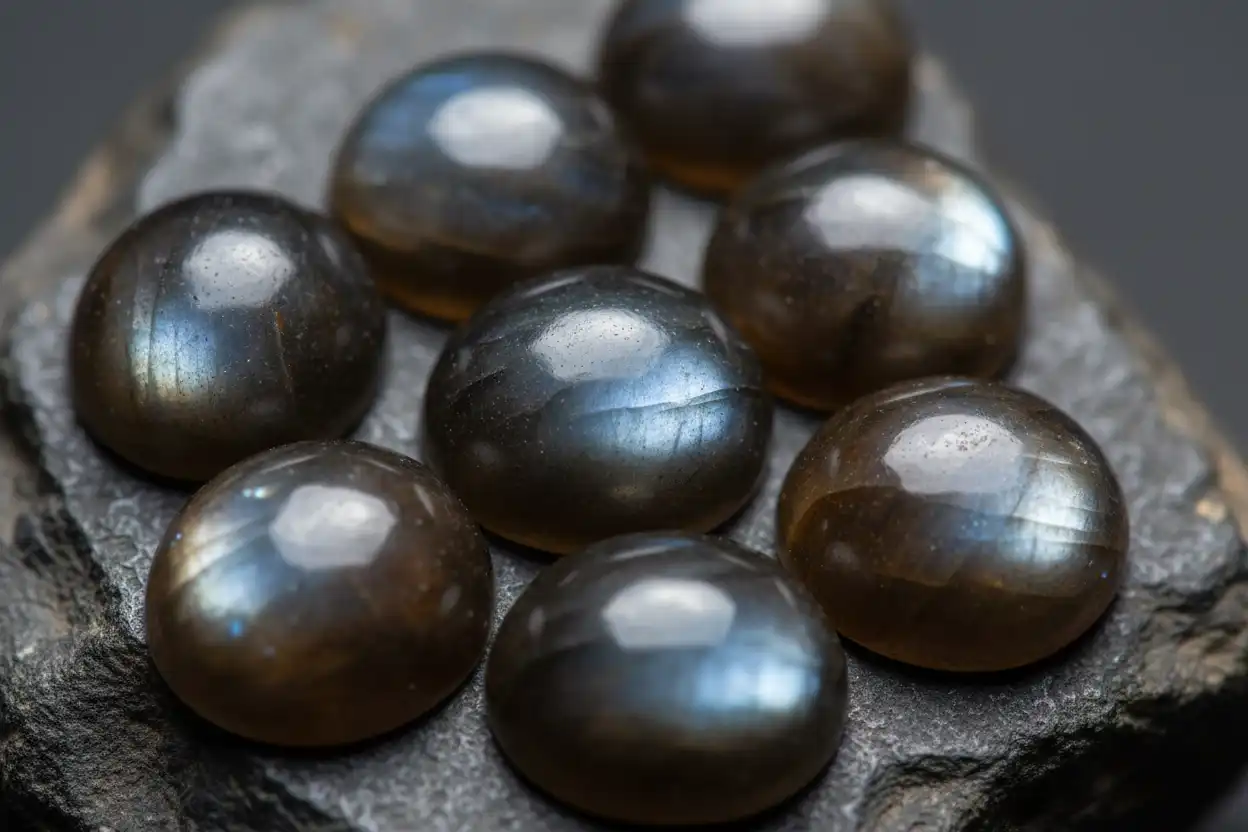
Black Moonstone Meaning: Feldspar, Sheen & Symbolism
Black moonstone meaning begins with a naming distinction that is especially important in the feldspar trade: “black moonstone” is generally a commercial or descriptive name for dark feldspar material showing a moonstone-like floating sheen, not a separate mineral species with one universal chemical formula. The material sold under this name may differ in exact feldspar composition, internal intergrowth structure, body-color cause, and optical behavior, so a responsible identification starts with feldspar and then determines which feldspar phases and microscopic structures are actually present.
Traditional moonstone belongs to the feldspar family and is valued for adularescence, a soft floating light effect produced when light interacts with very fine internal intergrowths or lamellae between feldspar phases. In dark material, this sheen can appear white, silver, gray, or sometimes bluish against a charcoal, smoky brown, dark gray, or near-black body. The contrast between a dark background and a moving light effect is what gives black moonstone much of its visual character.
That appearance does not mean the stone contains stored moonlight or produces its own illumination. The effect depends on light entering the feldspar, interacting with microscopic internal structures, and scattering or reflecting back toward the observer. When the stone or light source moves, the bright area seems to glide across the cabochon because the geometry between the light, internal lamellae, polished surface, and viewer has changed.
Modern black moonstone meaning commonly includes intuition, transition, reflection, emotional balance, new beginnings, boundaries, and accepting uncertainty. These interpretations can function as personal symbolism, particularly because the stone’s sheen becomes visible only from favorable directions. They are not established physical effects of feldspar. Black moonstone has not been demonstrated to predict events, regulate hormones, enhance psychic perception, heal emotional trauma, improve fertility, alter sleep cycles, or transmit lunar energy into the body.
Readers exploring evidence-led mineral references can browse the wider Gemstone Guides.
Black Moonstone Identity at a Glance
| Property | Black Moonstone |
|---|---|
| Material classification | Dark feldspar trade variety |
| Separate mineral species? | No |
| Mineral family | Feldspar |
| Exact feldspar composition | Can vary; requires specimen-specific identification |
| Common body colors | Charcoal, gray, smoky brown, dark gray, near-black |
| Main optical attraction | White, silver, gray, or occasionally bluish floating sheen |
| Typical cut | Cabochon, bead, freeform or polished slab |
| Transparency | Commonly translucent to opaque; locally more transparent |
| Luster | Vitreous to pearly when polished |
| Mohs hardness | Typically around 6–6.5 for common feldspars |
| Specific gravity | Commonly around the mid-2.5 to upper-2.7 range depending on feldspar composition |
| Cleavage | Important feldspar cleavage; direction and quality depend on composition |
| Tenacity | Brittle |
| Common internal features | Lamellae, cleavage, fractures, mineral inclusions, cloudy zones |
| Main identification challenge | Trade name may cover more than one precise feldspar composition |
| Main ownership concern | Cleavage, impact damage, scratching and misidentification |
The most important part of this table is that black moonstone meaning does not begin with a fixed formula. The correct mineral name depends on the actual feldspar phases present rather than the commercial color label printed on a listing.
Black Moonstone Is a Trade Name Before It Is a Mineral Name
Terms such as quartz, calcite, kyanite, and benitoite identify defined mineral species.
“Black moonstone” does not function in exactly the same way.
It describes a visually distinctive dark feldspar material marketed for a moonstone-like sheen. Two stones sold under the same name may have different relative feldspar compositions or slightly different optical mechanisms.
This distinction becomes particularly important when comparing black moonstone with traditional orthoclase-rich moonstone, labradorite, peristerite-type feldspar, and other feldspar materials capable of producing optical effects.
A seller can use the trade name accurately at the commercial level while still leaving the exact mineralogical identification unresolved.
For an inexpensive decorative cabochon, that level of naming may be sufficient for the buyer.
For a scientific specimen, expensive piece, or provenance-sensitive object, more precise identification is preferable.
Moonstone Belongs to the Feldspar Family
Feldspars are among the most abundant mineral groups in Earth’s crust. They occur in igneous, metamorphic, and sedimentary geological contexts and form important parts of granite, pegmatite, syenite, gneiss, and many other rocks.
The feldspar family includes potassium-rich and sodium-calcium-rich members whose compositions and structures can overlap through solid-solution relationships.
Moonstone’s visual effect is tied to internal feldspar structure rather than to one pigment.
During cooling, a feldspar that originally formed more homogeneously can separate at microscopic scales into intergrown phases with slightly different compositions and optical properties.
Those tiny structures can interact with light strongly enough to become visible as adularescence.
The effect is therefore created by architecture too small to see individually with the unaided eye.
What Adularescence Actually Is
Adularescence is the characteristic floating light associated with moonstone.
Instead of producing isolated glitter points like aventurine or a sharp band like cat’s-eye material, adularescence usually appears as a broad, soft, billowing light that shifts beneath the polished surface.
The effect develops because light encounters microscopic feldspar layers or intergrowths with slightly different refractive properties.
Some wavelengths scatter more effectively than others depending on lamella thickness and spacing.
Fine-scale structures can produce bluish effects, while coarser structures can create whiter or more diffuse sheen.
The exact behavior depends on the individual material.
This is why not every black moonstone displays identical flash.
Some stones show a broad silver cloud.
Others show a smaller white area.
Some may display limited blue.
Others have only a soft gray glow.
The detailed optical mechanisms belong in Black Moonstone optical properties and color behavior.
The Sheen Moves Because the Viewing Geometry Changes
A polished black moonstone can appear almost plain from one angle and dramatically luminous from another.
This is expected.
The internal structures responsible for the sheen have particular orientations. When the incident light, lamellae, polished surface, and observer align favorably, light is scattered back strongly enough for the effect to become prominent.
Rotate the stone and the geometry changes.
The bright region can disappear, move sideways, broaden, narrow, or reappear elsewhere.
That behavior is useful diagnostically because genuine structural sheen should respond coherently to movement.
A painted or foil-backed imitation may produce a much more fixed appearance.
Black Moonstone Does Not Glow in Darkness
The floating light can look almost luminous in photographs, especially when a strong directional source is used against a dark background.
The stone is not generating light.
Remove the illumination and the optical sheen disappears.
This distinction matters because highly edited product photographs can make black moonstone look as if an internal beam is glowing continuously.
A realistic photograph should show the optical effect from only those directions where the lighting geometry produces it.
Several viewing angles are more informative than one dramatic image.
Why Black Moonstone Looks Black
The body color can result from several factors rather than one universal coloring element. Dark mineral inclusions, microscopic particles, structural scattering, iron-bearing phases, dense clouds of inclusions, alteration, and combinations of these features may all contribute depending on the specimen.
Some material is better described as smoky brown or charcoal than truly black.
Thin edges may transmit more light than the center.
Polished stones can also look darker against a black backing or under directional photography.
The exact cause of darkness should therefore not be guessed from appearance.
A statement such as “all black moonstone is colored by iron” is too broad without analysis.
Likewise, a stone that appears black does not automatically contain one specific dark inclusion mineral.
Black Moonstone Can Show Internal Layers
Feldspar intergrowths can create layered or lamellar appearances visible under magnification.
Some may look like fine planes, streaks, cloudy bands, or repeating internal structures.
These should not automatically be called cracks.
Cleavage and fractures can also be present, so magnification is useful for separating optical intergrowths from actual damage.
The most informative internal examination considers the direction of the sheen relative to visible lamellae and the cabochon’s orientation.
If the floating light aligns consistently with underlying feldspar structure, the observation supports a structural optical effect.
Detailed inclusion morphology, internal layers, fractures, cleavage, and possible treatment clues are examined in the Black Moonstone microscope inclusion notebook.
Black Moonstone and Labradorite Require Careful Naming
Labradorite is a plagioclase feldspar known for labradorescence, an optical phenomenon that can produce vivid blue, green, gold, orange, or multicolored flashes.
Some dark feldspar materials marketed as moonstone can overlap visually with labradorite-related materials.
Trade terminology can therefore become confusing.
A broad floating silver or white sheen is commonly associated with moonstone-style adularescence, whereas labradorescence often produces stronger spectral or colored flashes, but appearance alone is not always enough to resolve exact feldspar composition.
“Rainbow moonstone” adds further confusion because that commercial name commonly refers to a labradorite-type feldspar material rather than traditional orthoclase moonstone.
Black moonstone should therefore be identified from its actual properties instead of assuming every commercial moonstone name represents the same feldspar.
Black Moonstone Is Not Simply Dyed White Moonstone
Natural dark feldspar exists.
A black or charcoal body does not automatically indicate dye.
At the same time, treatments, coatings, backing materials, resin impregnation, or assembled objects can occur in the broader gemstone market.
A polished dark cabochon should therefore be examined for color concentrations in fractures, unusually uniform surface color, coatings around drill holes, backing layers, resin, or inconsistencies between damaged and intact areas.
Testing should follow evidence.
Neither “all black moonstone is natural” nor “all black moonstone is dyed” is defensible as a universal claim.
How Black Moonstone Forms
Black moonstone begins with feldspar crystallization in an igneous or related geological system. Feldspar compositions formed at elevated temperature can become unstable in their original homogeneous state as the crystal cools, allowing microscopic exsolution or intergrowth structures to develop.
Those structures are central to moonstone-type optical effects.
The dark body color may arise during original growth, through included minerals, through later alteration, or through combinations of features that developed at different stages.
The resulting material therefore carries more than one history.
The host feldspar records crystallization.
Its internal lamellae record cooling and structural reorganization.
Dark inclusions may record the chemical environment during growth.
Fractures and alteration can document later geological events.
Detailed igneous settings, feldspar exsolution, cooling history, inclusions, host rocks, and deposit relationships are explored in Black Moonstone formation and deposit geology.
Cooling History Is Essential to the Optical Effect
Moonstone is a useful example of why gemstone appearance cannot always be explained only by bulk chemistry.
Two feldspars with broadly comparable chemistry can display very different optical effects if their internal structures developed differently during cooling.
Fine intergrowth structures can scatter light effectively.
Coarser or differently oriented structures may produce a weaker or altered appearance.
Rapid versus slow cooling, composition, exsolution behavior, deformation, and later geological changes can therefore affect the final optical result.
The stone’s sheen is partly a record of how its internal structure evolved.
That makes black moonstone meaning far more interesting scientifically than simply calling it a “lunar stone.”
Feldspar Cleavage Matters
Feldspars possess well-developed cleavage directions, and those planes influence how black moonstone breaks, cuts, and wears.
A cabochon can appear smooth and solid while still containing cleavage-related weaknesses beneath the surface.
A hard blow at an unfavorable angle can produce a chip or split.
This is why hardness and toughness need to be separated.
A feldspar hardness around 6–6.5 provides moderate scratch resistance.
It does not make the stone immune to impact.
For jewelry, cleavage orientation, pre-existing fractures, setting pressure, and stone thickness can be more important than the Mohs number alone.
Black Moonstone Is Softer Than Quartz
Quartz has Mohs hardness 7.
Common feldspars fall around 6–6.5.
That difference means quartz-rich dust, sand, countertop materials, and harder gemstones can scratch black moonstone over time.
The risk is especially relevant for rings and bracelets because these pieces frequently contact hard surfaces.
Pendants and earrings usually experience less abrasion.
A polished moonstone worn regularly may gradually lose its crisp surface polish and require professional refinishing.
Repeated repolishing also removes material, so prevention is preferable.
Cabochon Cutting Reveals the Sheen
Black moonstone is commonly cut en cabochon because a domed polished surface allows the floating optical effect to travel visibly across the stone.
Orientation is critical.
A cutter must identify how the internal feldspar layers are arranged and position the cabochon so the strongest sheen appears through the top.
Poor orientation can place the optical effect near the edge, hide it at normal viewing angles, or eliminate much of it altogether.
A high dome can sometimes strengthen the visual movement but adds thickness and exposed surface.
A very shallow cabochon may preserve spread while reducing the quality of the optical presentation.
The relationship among rough orientation, lamellae, dome height, cleavage, polishing, and optical effect is covered in Black Moonstone cutting, orientation and polish.
Original Black Moonstone Specimen and Photo Checklist
| Observation | What it may reasonably support | What it cannot prove alone |
|---|---|---|
| Dark gray feldspar-like rough | Compatible with black moonstone | Exact feldspar species |
| Floating white or silver sheen | Strong moonstone-style optical clue | Exact mineral composition |
| Sheen moves as the stone rotates | Supports structural optical effect | Natural origin automatically |
| Charcoal body with translucent edges | Compatible natural appearance | Cause of dark color |
| Blue-white flash | Possible feldspar optical effect | Moonstone rather than labradorite automatically |
| Broad soft glow rather than sharp stripe | Compatible with adularescence | Exact lamellar structure |
| Visible cleavage | Supports feldspar identity | Reason to damage-test a stone |
| Fine internal lamellae | Strong structural clue | Geographic origin |
| Dark included particles | Possible color contributors | Specific mineral identity |
| SG in expected feldspar range | Useful support | Moonstone variety |
| RI consistent with feldspar | Strong identification evidence | Exact trade-name classification |
| Raman result matching feldspar | Strong mineral-family evidence | Optical mechanism by itself |
| Spectroscopic or structural analysis | Can refine feldspar identification | Provenance |
| Original mine or dealer label | Useful source evidence | Independent gem identification |
| Coating around drill hole | Possible treatment clue | Entire stone necessarily artificial |
The best identification asks several questions in sequence: Is the stone actually feldspar? What feldspar is present? What produces its optical effect? Why is the body dark? Has the material been treated? Those questions should not be collapsed into one commercial name.
Claims About Black Moonstone That Need Qualification
| Claim | More accurate interpretation |
|---|---|
| “Black moonstone is one defined mineral species” | It is a dark feldspar trade variety whose exact composition may vary |
| “All black moonstone is orthoclase” | Exact feldspar identification should be established specimen by specimen |
| “Every dark feldspar with flash is black moonstone” | Labradorite and other feldspars can overlap visually |
| “The stone stores moonlight” | The floating effect comes from interaction between light and internal structure |
| “Blue sheen means the stone is labradorite” | Color helps but does not establish species alone |
| “Black color comes from one element” | Several inclusions and structural factors may contribute |
| “Black moonstone glows in darkness” | It requires external illumination |
| “Moonstone is too soft for jewelry” | It can be worn, but cleavage and moderate hardness require care |
| “Black moonstone controls hormones” | No established medical mechanism supports this claim |
| “It improves fertility because it is associated with the Moon” | Symbolic lunar association is not reproductive medicine |
| “It predicts the future” | Intuition symbolism is not evidence of precognition |
| “It protects sleepers from nightmares” | This is a belief rather than a demonstrated physical effect |
These boundaries let black moonstone meaning include symbolism without misrepresenting feldspar optics or human physiology.
Black Moonstone and Black Obsidian Can Look Similar When Polished
A polished Black Obsidian meaning specimen can appear glossy black and superficially similar to a dark moonstone when the latter’s sheen is not visible.
The materials are fundamentally different.
Obsidian is volcanic glass and lacks a long-range crystalline feldspar structure.
Black moonstone is crystalline feldspar.
Obsidian commonly develops conchoidal fracture.
Feldspar shows cleavage.
Obsidian lacks genuine moonstone-style adularescence produced by feldspar exsolution.
A dramatic flash in a polished black stone should therefore be examined rather than assumed.
Black Moonstone and Black Kyanite Are Unrelated
Black Kyanite meaning concerns Al₂SiO₅ kyanite, a metamorphic mineral famous for flattened blades and directional hardness.
Black moonstone belongs to the feldspar family.
Kyanite typically has a bladed crystal habit and strong anisotropy.
Moonstone is usually encountered as blocky rough, polished cabochons, beads, or feldspar fragments.
Their black color provides a superficial similarity, while nearly every important mineralogical property differs.
Original Identification Decision Matrix
| Question | If yes | If no |
|---|---|---|
| Does a floating diffuse sheen move across the stone? | Moonstone-type optical structure becomes plausible | Consider ordinary dark feldspar or another material |
| Does the effect show strong multicolored spectral flashes? | Investigate labradorite-type feldspar carefully | Moonstone-style adularescence remains plausible |
| Is the stone crystalline feldspar by RI/Raman testing? | Continue feldspar classification | The black moonstone label is questionable |
| Are internal lamellae visible? | Supports structural sheen | Effect may still be too fine to resolve microscopically |
| Is the black color concentrated in fractures? | Investigate dye or treatment | Natural inclusions/body color remain plausible |
| Does the material show glassy conchoidal fracture? | Investigate glass or obsidian | Feldspar remains possible |
| Does the piece show blade-like kyanite structure? | Consider kyanite instead | Moonstone remains possible |
| Does the optical effect vanish when lighting changes? | Normal directional optical behavior | Investigate fixed backing or coating if effect remains artificial-looking |
| Is locality documented? | Provenance can be assessed | Do not infer origin from appearance |
| Are treatment claims absent? | Treat status as unknown | Use disclosed information as part of evaluation |
This decision matrix avoids the common mistake of treating the commercial name as the end of identification.
Microscopy Is Especially Useful
Under magnification, black moonstone can reveal lamellae, cleavage planes, fractures, dark mineral particles, cloudy growth zones, surface-reaching fissures, polish features, coatings, or resin.
A diffuse optical effect caused by structures below the resolution of ordinary microscopy may still be understood through the direction in which the sheen moves.
Microscopy can also help distinguish a genuinely internal effect from a surface film.
If a flash remains tied to one external coating rather than moving coherently through the feldspar, the visual mechanism deserves further investigation.
No single microscopic feature proves every aspect of identity, but the combined pattern can become highly informative.
Seller Terminology Should Be Read Carefully
A listing that says only “natural black moonstone” leaves several unanswered questions.
Is the material confirmed as feldspar?
What feldspar composition is present?
Does the stone show adularescence or another feldspar optical effect?
Is the body color natural?
Has the piece been coated, dyed, filled, backed, or assembled?
Where was it mined?
Not every inexpensive cabochon requires a full laboratory report, but commercial claims should remain proportionate to the evidence provided.
Transaction-specific identity checks and seller questions belong in where to buy black moonstone.
Provenance Is Separate From Appearance
Dark feldspar from different deposits can overlap considerably in polished appearance.
A charcoal cabochon with silver sheen cannot be assigned reliably to a country or mine because a similar-looking stone appears in online photographs from that locality.
Provenance requires records.
Original parcel information, mine documentation, dealer chain, older collection labels, laboratory data, and consistent mineralogy can all contribute.
A claimed origin can still be true without documentation.
It simply carries a different level of evidence.
The Black Moonstone provenance and disclosure checklist provides a structured way to record origin, treatment, seller terminology, repairs, and identification confidence.
Black Moonstone Works Better in Some Jewelry Than Others
Its moderate hardness makes black moonstone usable in jewelry, but setting design matters.
Pendants and earrings receive relatively little impact.
Cabochon rings are more exposed to knocks, countertop contact, sand, and harder jewelry.
Bracelets experience frequent abrasion.
A protective bezel can shield edges better than an exposed setting, although pressure during setting must still respect feldspar cleavage and existing fractures.
Large thin cabochons may flex poorly under pressure and deserve secure support.
Construction, bezel geometry, backing, girdle protection, and wear exposure are addressed in Black Moonstone setting and wear engineering.
Everyday Wear Can Dull the Polish
Black moonstone’s dark surface can make small scratches particularly visible under reflected light.
A cabochon that begins with a glossy surface may acquire a network of fine abrasions after repeated contact with harder materials.
The optical sheen may still remain visible because it originates internally, but the surface can become hazy enough to reduce contrast.
Storage therefore matters.
Keep moonstone separate from harder gems such as quartz, topaz, sapphire, spinel, and diamond rather than allowing pieces to rub together inside one jewelry box.
Cleaning Should Be Gentle
Warm water, mild soap, and a soft cloth or soft brush are reasonable defaults for sound untreated black moonstone jewelry.
Avoid aggressive ultrasonic cleaning when fractures, fillings, treatments, or mounting condition are uncertain.
Steam also introduces unnecessary thermal stress.
Abrasive powders can dull the polish.
Acidic or alkaline household cleaners can affect mountings, fracture fillings, coatings, or associated materials even when feldspar itself survives brief contact.
A heavily included cabochon deserves more caution than a clean compact stone.
The individual specimen determines the safest method.
Preserve Rough Specimens Differently From Cabochons
Rough black moonstone can preserve matrix, crystal surfaces, alteration, weathering, internal orientation, and locality context that polishing removes.
A specimen with scientifically interesting associations should not automatically be sliced into cabochons simply because the polished material is saleable.
Photographing the original piece before cutting preserves some of that information.
Original labels should remain with any fragments created during lapidary work.
Long-term storage, labels, fractures, polished surfaces, matrix support, and specimen records are addressed in the Black Moonstone specimen conservation record.
Ordinary Handling Is Straightforward
Black moonstone does not require extraordinary precautions for ordinary handling as intact jewelry or mineral specimens.
The more immediate risks are physical: dropping a cabochon, striking a cleavage-sensitive edge, scratching the polished surface, or losing provenance information.
Dust-generating work is different.
Sawing, grinding, or polishing feldspar produces fine mineral particles, and rough material may also contain quartz or other silica-rich matrix.
Lapidary work should therefore use appropriate wet methods, local extraction, eye protection, respiratory controls suited to the task, and good cleanup.
These are normal workshop practices rather than evidence that a polished moonstone is dangerous to wear.
Do Not Use Black Moonstone in Drinking Water Remedies
A natural cabochon or rough feldspar specimen is not a food or medical preparation.
It may contain inclusions, treatment materials, polishing residues, adhesives, matrix fragments, or surface contaminants.
There is no established health benefit from soaking black moonstone in drinking water.
If someone values the stone symbolically, external use provides the same symbolic function without introducing unnecessary ingestion concerns.
Black Moonstone Meaning and the Moon
The lunar association comes partly from moonstone’s floating white or blue-white sheen, which people have long compared visually with moonlight.
That comparison is understandable.
The optical effect does not depend on actual lunar radiation.
A moonstone displays its sheen under artificial lamps, sunlight, and other suitable light sources because the phenomenon is controlled by feldspar structure and viewing geometry.
The Moon provides the metaphor.
The mineral provides the optical effect.
Neither establishes a special energy transfer between the two.
Black Moonstone Meaning and Intuition
Intuition is one of the most common modern black moonstone meaning themes.
The shifting sheen offers a natural visual metaphor because important details appear from some viewing angles and disappear from others.
A person may use the stone as a reminder to examine a situation from more than one perspective, notice subtle information, or allow additional evidence to emerge before making a decision.
This can be a useful reflective practice.
No established evidence shows that black moonstone increases extrasensory perception, predicts the future, or provides supernatural information.
Black Moonstone Meaning and New Beginnings
Moonstone is frequently associated with beginnings, transitions, and changing phases.
The lunar metaphor contributes strongly to this symbolism, since the visible Moon appears to move through repeated phases.
Black moonstone’s dark body can add themes involving uncertainty, unfamiliar circumstances, or beginning before every answer is available.
A person might keep the stone as a reminder to define a first practical step during a transition.
The stone does not initiate the transition.
It marks an intention.
Black Moonstone Meaning and Emotional Reflection
Dark body color combined with a bright moving sheen can inspire symbolism involving emotions that become visible only when attention shifts.
That idea can work well for journaling or quiet reflection.
A person might use the stone to prompt questions such as what changed, what evidence is available, what remains uncertain, and what response is actually within their control.
The gemstone does not regulate emotion directly.
Emotional processing depends on human cognition, experience, relationships, circumstances, and, when needed, professional support.
Black Moonstone Meaning and Boundaries
Black stones are often given protective symbolism, while moonstone is often associated with sensitivity and intuition. Black moonstone consequently receives modern interpretations involving emotional boundaries or protecting one’s attention.
A practical version of that symbolism is straightforward.
The stone can remind someone to limit an unwanted commitment, protect rest time, leave a stressful interaction, or communicate a boundary clearly.
Those behaviors create real boundaries.
The gemstone does not produce an invisible barrier around the wearer.
Black Moonstone Meaning and Uncertainty
One of the most distinctive metaphors available from black moonstone is uncertainty.
The stone can appear nearly plain until it reaches the angle where the sheen becomes visible.
A person may interpret that as a reminder that incomplete information does not necessarily mean nothing is present.
Sometimes additional perspective is required.
This does not mean every uncertainty hides a positive answer, nor does the mineral reveal which decision is correct.
The metaphor encourages observation rather than prediction.
Black Moonstone and Feminine-Energy Claims
Moonstone is frequently marketed through broad claims involving “divine feminine energy,” fertility, menstruation, hormones, pregnancy, and reproductive health.
These subjects should not be blended together casually.
Someone may use lunar or feminine symbolism for personal, cultural, or spiritual reasons.
That does not demonstrate that feldspar changes hormone levels, fertility, menstrual cycles, pregnancy outcomes, or reproductive disorders.
Symbolic identity and endocrine physiology require different kinds of evidence.
Black Moonstone Does Not Have Established Healing Properties
There is no established scientific evidence that wearing, carrying, or meditating with black moonstone treats physical or psychological conditions.
Claims involving fertility, menstruation, hormonal balance, sleep, anxiety, depression, digestion, circulation, inflammation, trauma, or neurological function require medical evidence rather than gemstone analogy.
Adularescence is an optical effect.
Feldspar chemistry is mineralogical.
Neither establishes a therapeutic mechanism.
The broader distinction between symbolism, spiritual belief, and health claims is explained in the Gems Lore Disclaimer.
Original Claim-vs-Evidence Matrix
| Black moonstone claim | Evidence status |
|---|---|
| It is a dark feldspar material | Testable mineralogical statement |
| Its sheen is produced by internal optical structure | Established gemological mechanism for moonstone-type effects |
| The sheen moves with viewing angle | Observable |
| Exact feldspar composition can vary in material sold under the trade name | Commercial/mineralogical caution |
| Black color can have multiple causes | Testable specimen-specific statement |
| It stores moonlight | Not established |
| It improves intuition supernaturally | Metaphysical belief |
| It predicts future events | Not established |
| It regulates hormones | Not established medically |
| It improves fertility | Not established medically |
| It can symbolize transition | Human interpretation |
| It can symbolize seeing from another perspective | Human interpretation grounded in the moving optical effect |
| It can serve as a reminder to establish boundaries | Practical symbolic use |
| It protects from negative energy | Metaphysical belief |
| Its darkness proves one particular mineral inclusion | Unsupported without specimen analysis |
This matrix gives black moonstone meaning room for personal interpretation without turning optical effects into biological or supernatural evidence.
Original Evidence Ladder for Black Moonstone Claims
Direct observation can establish body color, transparency, polish, moving sheen, fractures, inclusions, scratches, and overall condition.
Basic gemological examination can establish refractive index, specific gravity, optic behavior, hardness context, cleavage, and whether the material behaves consistently with feldspar.
Microscopy can reveal lamellae, fractures, dark inclusions, cleavage, coatings, dye concentrations, fillers, surface treatments, and polishing features.
Raman spectroscopy or other mineral identification can establish the feldspar phase more confidently where trade naming is ambiguous.
Optical interpretation requires relating the moving sheen to internal structure and orientation rather than simply calling every flash adularescence.
Color-cause interpretation may require microscopy, spectroscopy, or chemical analysis of included phases.
Treatment determination requires evidence specific to coatings, dye, resin, backing, assembly, or another suspected modification.
Geological interpretation requires rough material, host rock, associated minerals, internal texture, and deposit context.
Provenance requires labels, seller records, collection history, mine documentation, or another traceable chain.
Symbolic claims can be documented as beliefs or practices but remain separate from measured material properties.
Health claims require clinical evidence and cannot be inferred from lunar symbolism, feldspar structure, or body color.
This evidence hierarchy is particularly useful because the commercial term black moonstone can hide more mineralogical variability than a formal species name.
What Black Moonstone Meaning Can Responsibly Represent
Black moonstone’s real optical behavior offers several unusually coherent metaphors. A sheen that appears only from favorable angles can represent perspective. Microscopic internal layering can represent complexity beneath a simple exterior. A dark body carrying a bright moving reflection can symbolize finding information within uncertainty, while feldspar exsolution during cooling can represent change occurring gradually inside an apparently solid material.
These interpretations remain human meanings rather than hidden powers.
Someone can use black moonstone as a reminder to examine a problem from another angle, move carefully through a transition, establish an emotional boundary, or accept that uncertainty sometimes requires observation rather than immediate judgment.
The mineral does not predict the answer.
Its structure simply provides a useful object around which a person can build that reflection.
The evidence-led approach used throughout Gems Lore is described on About Gems Lore. Questions about a particular specimen can be submitted through Contact Gems Lore, with submitted information handled according to the site’s Privacy Policy.
Frequently Asked Questions
What is black moonstone?
Black moonstone is a commercial name for dark feldspar material showing a moonstone-like floating sheen or related feldspar optical effect.
Is black moonstone a separate mineral species?
No. The term describes a dark feldspar trade variety rather than one formally separate mineral species.
What is black moonstone meaning?
Black moonstone meaning commonly combines its feldspar identity with modern symbolism involving intuition, transitions, reflection, boundaries, uncertainty, and new beginnings.
What is black moonstone made of?
It is feldspar, although the exact feldspar composition of material sold under the trade name can vary and should be established for the individual specimen when precision matters.
Why does black moonstone flash?
Light interacts with microscopic internal feldspar structures, producing a floating sheen that changes as the viewing and lighting geometry changes.
Is black moonstone’s glow real?
The optical effect is real, but the stone is not generating its own light. External illumination is required.
Does black moonstone glow in darkness?
No. The sheen disappears without a light source.
What colors can black moonstone flash?
White, silvery, gray, and sometimes bluish effects can occur, depending on internal structure and material.
Why is black moonstone black?
Dark inclusions, iron-bearing phases, structural scattering, alteration, and other microscopic features can contribute. There is no single universal color cause.
Is every black moonstone colored by iron?
No. The cause should be established from the individual specimen rather than assumed from color.
Is black moonstone the same as labradorite?
Not necessarily. Trade names can overlap confusingly, and some dark feldspars may require gemological testing to distinguish precise feldspar identity.
Is rainbow moonstone actual moonstone?
“Rainbow moonstone” is commonly a trade name for labradorite-type feldspar material rather than traditional orthoclase moonstone.
Is black moonstone obsidian?
No. Obsidian is volcanic glass, while black moonstone is crystalline feldspar.
Is black moonstone black kyanite?
No. Black kyanite is Al₂SiO₅ and usually forms blades; black moonstone is feldspar and is commonly cut as cabochons.
How hard is black moonstone?
Most common feldspar material is around 6–6.5 on the Mohs scale.
Can black moonstone scratch?
Yes. Quartz, topaz, sapphire, diamond, and other harder materials can scratch it.
Does black moonstone have cleavage?
Yes. Feldspar cleavage contributes to impact sensitivity even though the stone has moderate hardness.
Can black moonstone be worn in rings?
Yes, but protected settings and careful wear are preferable because feldspar can scratch or chip more readily than harder gemstones.
Is black moonstone better for pendants?
Pendants generally expose the stone to less impact and abrasion than rings or bracelets, making them a practical format.
How is black moonstone cut?
Cabochons are common because the dome can display the moving optical sheen effectively when the rough is oriented correctly.
Why does cut orientation matter?
The internal lamellae responsible for the sheen have directional relationships. Poor orientation can weaken or hide the optical effect.
Can black moonstone be dyed?
Natural dark material exists, but treatments are possible in gemstone commerce. Concentrated color in fractures, coatings, or other inconsistencies deserve examination.
Can black moonstone be synthetic?
Imitations, treated materials, glass, coated stones, or other feldspars can be represented misleadingly. Exact identification should focus on the specimen rather than the label.
How can black moonstone be identified?
Useful evidence includes moving optical sheen, feldspar refractive properties, specific gravity, cleavage, microscopy, Raman spectroscopy, and structural analysis where needed.
Can a photograph identify black moonstone?
A photograph can show a characteristic dark body and moving sheen, but it cannot establish exact feldspar composition, treatment, or geographic origin by itself.
Where can I buy black moonstone?
Material identity, seller terminology, treatment disclosure, optical quality, provenance, and transaction checks are covered in where to buy black moonstone.
How should black moonstone be cleaned?
Use mild soap, warm water, and gentle manual cleaning for sound untreated material. Avoid harsh abrasives and unnecessary aggressive cleaning.
Can black moonstone go in drinking water?
It should not be deliberately used to prepare ingestible crystal remedies. Natural stones can contain inclusions, treatments, polishing residues, and other materials not captured by the trade name.
Does black moonstone have healing properties?
There is no established scientific evidence that black moonstone treats medical or psychological conditions.
Does black moonstone improve fertility?
There is no established clinical evidence that wearing or holding feldspar improves fertility or reproductive outcomes.
Does black moonstone balance hormones?
No established medical mechanism shows that black moonstone regulates human hormone levels.
Does black moonstone improve intuition?
It can serve symbolically as a reminder to observe subtle information or consider another perspective, but supernatural enhancement of intuition has not been established.
Is black moonstone protective?
Protection is a modern symbolic association rather than a demonstrated physical energy field.
Why does black moonstone symbolize new beginnings?
Moonstone has long acquired lunar and phase-related symbolism, while modern interpretations connect changing visible phases with transition and beginning again.
Why can black moonstone symbolize uncertainty?
The stone can appear dark or plain until a shift in angle reveals its sheen, providing a natural metaphor for information becoming visible from another perspective.
Why is provenance important?
Dark feldspar from different regions can look similar. Reliable locality requires documentation rather than visual comparison alone.
Black moonstone meaning becomes more useful once the trade name is separated from exact mineral identity. The material is dark feldspar, but the precise feldspar composition, darkening mechanism, internal lamellae, and optical behavior can vary among specimens sold under the same commercial label. Its characteristic appeal comes from the interaction of light with microscopic feldspar structures, producing a moving white, silver, gray, or occasional bluish sheen against a dark body.
That physical effect provides a stronger foundation for symbolism than claims of stored moonlight or supernatural energy. A sheen that appears only from certain angles can represent perspective, internal layers can represent complexity, and a dark surface revealing moving light can symbolize navigating uncertainty without pretending every answer is immediately visible.
Those meanings remain interpretations. Black moonstone does not need to regulate hormones, predict events, enhance psychic ability, or create invisible protection to be meaningful. Its feldspar structure, cooling history, optical behavior, dark inclusions, lapidary orientation, and changing appearance already make it a distinctive material.