Blue Chalcedony Meaning: Facts, History & Symbolism
Blue chalcedony meaning is often introduced through ideas such as calm communication, patience, reflection, emotional balance, or gentle self-expression. Those associations belong to symbolism and modern crystal practice rather than to the stone’s measurable mineral properties. Materially, blue chalcedony is a blue to blue-gray variety of chalcedony, a compact microcrystalline silica material composed principally of quartz with varying amounts of moganite. It is not a separate mineral species created by its blue color.
The blue appearance is particularly interesting because it does not always result from a conventional blue pigment distributed through the material. In recognized blue chalcedony, very small particles and structural features can scatter shorter visible wavelengths, producing a Tyndall-type blue appearance; transmitted light through suitable material may look comparatively warmer. Other blue or greenish-blue chalcedonies can owe their color to mineral inclusions, while treatments can imitate naturally colored material. That makes careful terminology essential when discussing blue chalcedony rather than assuming that every blue silica cabochon acquired its color through the same mechanism.
For other material-first references organized around mineral identity rather than color symbolism alone, browse the Gemstone Guides.
What Is Blue Chalcedony?
Blue chalcedony belongs to the quartz family, but its appearance differs markedly from a transparent rock-crystal point. Chalcedony consists of extremely fine intergrowths of silica phases, principally quartz with moganite commonly present, arranged on a scale too small for individual crystals to be distinguished easily with the unaided eye. This compact structure produces the smooth, even texture familiar in cabochons, carvings, beads, seals, nodules, and polished slabs.
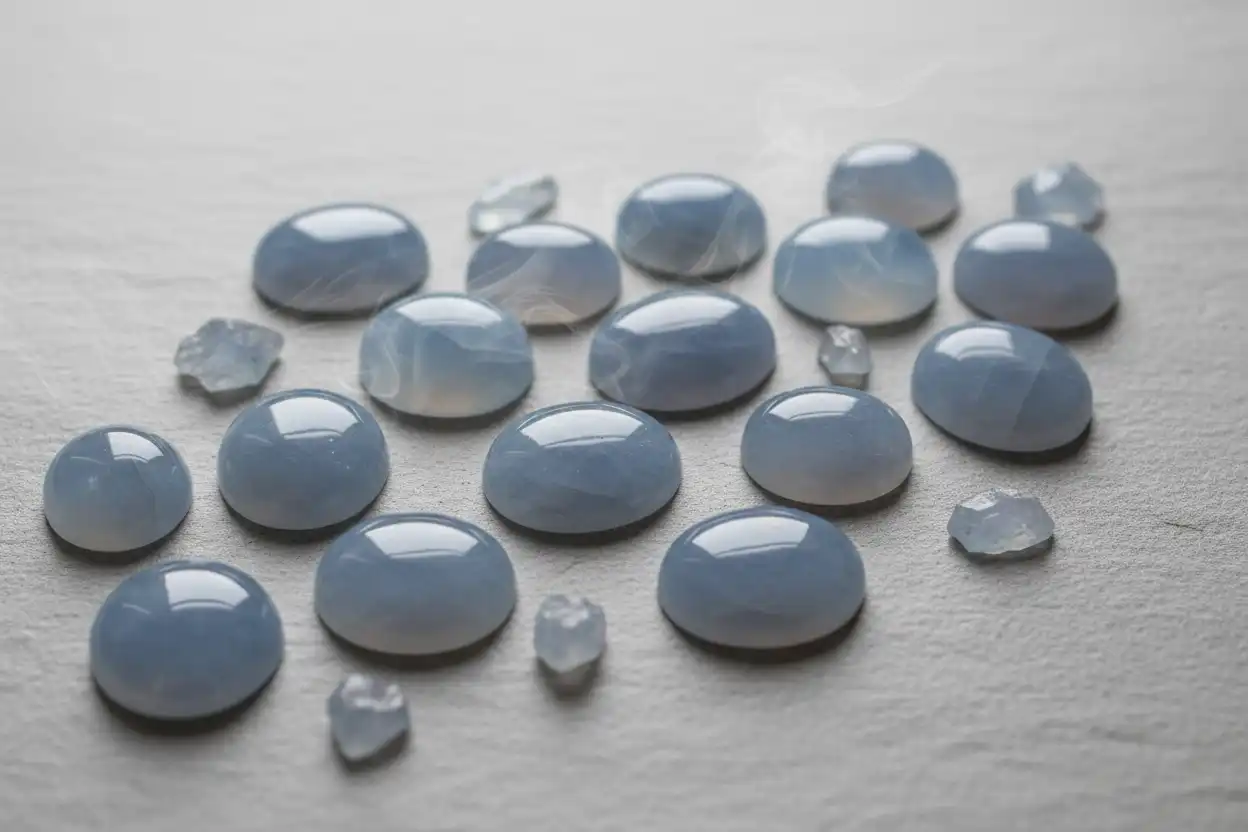
Its body color ranges from almost white with a faint bluish cast through pale sky blue, blue-gray, lavender-blue, and moderately saturated blue. Many specimens are translucent rather than transparent, and their finest color may depend strongly on thickness and illumination. Some material appears distinctly blue in reflected light while becoming grayish, yellowish, reddish, or otherwise warmer when strongly backlit.
| Property | Typical blue chalcedony characteristics |
|---|---|
| Material identity | Blue variety of chalcedony |
| Mineral family | Quartz |
| Principal chemistry | SiO₂ |
| Structure | Microcrystalline to cryptocrystalline silica aggregate |
| Common silica phases | Quartz with varying moganite content |
| Typical color | Pale blue, blue-gray, lavender-blue to medium blue |
| Mohs hardness | About 6.5–7 |
| Specific gravity | Commonly about 2.55–2.70 |
| Refractive index | Commonly around 1.530–1.543 |
| Cleavage | None |
| Fracture | Conchoidal to uneven |
| Typical luster | Waxy to vitreous when polished |
| Transparency | Commonly translucent to opaque |
| Separate mineral species | No |
These physical ranges are consistent with chalcedony generally and are substantially different from materials such as calcite, which is much softer and strongly cleavable.
Why Blue Chalcedony Can Look Blue
The color of natural blue chalcedony deserves more precision than the common statement that “trace minerals make it blue.” In some recognized blue chalcedony, the blue appearance is attributed primarily to light scattering by colloid-scale particles or microstructural features. Shorter blue wavelengths are preferentially scattered toward the observer, while transmitted light can appear warmer.
This is related to the Tyndall effect. A familiar analogy is the way very fine suspended particles can change the apparent color of light passing through or reflecting from a material, although the exact microstructure of chalcedony is mineralogically specific.
That mechanism also explains why lighting matters so much. A stone photographed against a dark background under directional illumination can look distinctly blue, yet the same specimen may appear grayer under flat indoor light. A thin edge illuminated from behind can behave differently again.
A detailed examination of scattering, translucency, refractive behavior, and lighting geometry belongs in the dedicated blue chalcedony optical properties and color behavior guide.
Not Every Blue Chalcedony Has the Same Color Origin
The trade uses chalcedony terminology for several materials that can look superficially similar while deriving color from different causes. This is one reason precise descriptions are preferable to sweeping claims.
A particularly important example is chrysocolla-bearing chalcedony, often called gem silica. Finely disseminated chrysocolla can produce blue to greenish-blue color through copper-bearing inclusions. GIA has documented both natural chrysocolla-bearing material and chalcedony dyed with copper compounds to imitate it, demonstrating that similar blue coloration can arise through fundamentally different pathways.
Blue chalcedony therefore describes appearance and material family, but a more specific statement such as “this stone is blue because of chrysocolla inclusions” requires evidence tied to the actual specimen.
Blue Chalcedony, Gem Silica, and Chrysocolla Chalcedony
These names are sometimes used loosely, yet they should not be treated as automatic synonyms.
Blue chalcedony
This is the broad descriptive term for chalcedony with a blue appearance. Classic material can owe its blue appearance substantially to scattering rather than to a visibly blue mineral pigment.
Gem silica
Gem silica commonly refers to translucent chalcedony colored blue to greenish blue by chrysocolla or closely associated copper-bearing material. It occupies a more specific gemological and commercial category.
Chrysocolla chalcedony
This term emphasizes the presence or association of chrysocolla with the chalcedony host. Analytical confirmation is preferable when that inclusion is central to identification or value.
Dyed blue chalcedony
This is chalcedony whose color has been artificially introduced or modified. The host can still be genuine chalcedony while the color is treated.
The material name and the color origin therefore answer two different questions. A stone can genuinely be chalcedony and still have treated color.
A Source-Reconciliation Table for Common Blue Chalcedony Claims
The table below separates statements that can be reasonably supported from those that require stronger specimen-specific evidence.
| Claim | Evidence status | Better interpretation |
|---|---|---|
| Blue chalcedony is quartz | Broadly supported | It is a chalcedony variety within the quartz family |
| Chalcedony is a single large quartz crystal | Incorrect | It is a fine microcrystalline silica aggregate |
| Every natural blue chalcedony contains blue pigment | Unsupported | Scattering can produce blue appearance without a conventional blue pigment |
| The Tyndall effect can produce blue color | Supported for recognized blue chalcedony | Fine-scale scattering can make reflected light appear blue |
| All blue chalcedony is colored by copper | Incorrect | Copper-related color is relevant to some materials, including chrysocolla-bearing chalcedony and certain dyes |
| Gem silica and all blue chalcedony are identical | Too broad | Gem silica is a more specific copper/chrysocolla-associated chalcedony category |
| Bright blue color automatically means treatment | Unsupported | Natural material can be strongly colored, although unusual color deserves examination |
| Dye concentrated in fractures can indicate treatment | Reasonable diagnostic clue | It supports further testing but is not universally decisive |
| Blue chalcedony has perfect cleavage | Incorrect | Chalcedony lacks the strong cleavage seen in minerals such as calcite |
| Blue chalcedony heals anxiety | Unsupported medical claim | Calmness belongs to symbolic interpretation, not established mineral efficacy |
| Blue chalcedony improves communication energy | Metaphysical interpretation | It can function as a personal communication symbol |
| Blue chalcedony has one universal ancient meaning | Unsupported without documentation | Historical claims need identifiable texts, objects, dates, and cultural context |
This framework is more useful than forcing every blue chalcedony description into a simple natural-versus-fake choice. Material identity, color origin, treatment, provenance, and symbolism are separate questions.
How Blue Chalcedony Forms
Chalcedony commonly develops when silica-rich fluids precipitate extremely fine silica within cavities, fractures, veins, porous rock, or other available spaces. Volcanic rocks are particularly familiar hosts because vesicles left by gas bubbles can later become filled with silica, sometimes producing nodules or geodes with chalcedony-rich interiors.
Silica deposition can occur through multiple stages rather than one instantaneous event. Changes in fluid chemistry, temperature, impurities, available space, and surrounding rock can produce layers, cloudy zones, color variation, associated quartz, or other minerals. Weathering can subsequently release durable chalcedony nodules from their original host, allowing them to accumulate as rounded pebbles in sediment.
The complete geological sequence and deposit variability are covered separately in blue chalcedony formation and deposit geology.
What Natural Blue Chalcedony Looks Like
Natural blue chalcedony frequently appears smoother and less structurally dramatic than coarse crystalline minerals. Rough material may form nodules, cavity fillings, irregular masses, crusts, or vein material rather than conspicuous crystal prisms.
Freshly broken or cut surfaces can reveal a much finer texture and stronger translucency than the weathered exterior suggests. Polishing further changes appearance because a smooth surface reduces diffuse surface scattering and allows light to enter the material more effectively.
Many attractive specimens show some combination of:
pale to moderate blue body color;
blue-gray or lavender undertones;
milky internal cloudiness;
irregular translucent and more opaque zones;
white silica-rich areas;
natural fractures;
subtle banding;
attached host material;
and differences between reflected and transmitted color.
Perfectly uniform color is not required for authenticity, and natural variation is normal.
An Original Blue Chalcedony Specimen and Photo Checklist
A careful visual examination cannot always establish color origin, but it can determine whether stronger testing is warranted.
Under neutral reflected light
Observe the stone against both light and dark neutral backgrounds. Record the actual blue intensity rather than relying on a seller’s photograph, which may use strong editing or highly favorable lighting.
Under transmitted light
Where the material is thin enough, shine a neutral white light through an edge or thinner area. Some scattering-colored blue chalcedony can shift toward warmer transmitted tones.
Examine color distribution
Look for natural cloudy variation, broad zoning, or gradual changes. Extremely concentrated color along surface-reaching fractures can raise the possibility of dye.
Inspect fractures and cavities
A loupe can reveal whether color follows fractures, whether transparent foreign material fills cavities, or whether polishing compounds and residues have accumulated.
Check surface texture
Natural rough chalcedony can show weathering, irregular fracture, botryoidal growth, rind-like surfaces, or remnants of host rock. A manufactured object may show molding or production features instead.
Look for glass indicators
Round gas bubbles, flow structures inconsistent with chalcedony, obvious mold seams, and a highly homogeneous glass body can justify further testing.
Compare hardness expectations
Chalcedony should behave approximately like quartz in hardness. A material that scratches extremely easily is inconsistent with ordinary chalcedony.
Do not identify exact color chemistry visually
A blue stone cannot reveal copper, chrysocolla, dye chemistry, or a particular trace element merely from hue.
Keep provenance separate
A specimen’s blue tone cannot prove a famous locality. Mine and geographic claims require records.
Record before testing
Photograph the object, note dimensions and weight, and preserve labels before conducting any procedure that could alter a collectible specimen.
For inclusion textures, filling clues, internal features, and the limits of magnification, see the blue chalcedony microscope inclusion notebook.
Hardness: Useful but Not Unique
Blue chalcedony generally has a Mohs hardness around 6.5–7, providing significantly better scratch resistance than materials such as calcite. That makes hardness useful when an unknown blue stone falls far outside the expected range.
It does not uniquely identify chalcedony. Numerous other silica-rich materials and minerals can approach similar hardness, while a treated chalcedony remains hard because the treatment may affect color rather than the quartz-rich host.
Intentional scratch testing can also damage finished stones. Whenever possible, observations, microscopy, density, refractive behavior, and non-destructive instrumental methods should precede destructive tests.
No Cleavage Is an Important Clue
Unlike calcite, chalcedony does not possess perfect mineral cleavage. When broken, it tends toward conchoidal or irregular fracture, sometimes producing curved surfaces associated with silica-rich materials.
This provides a useful distinction from blue calcite meaning, where excellent rhombohedral cleavage and Mohs hardness near 3 define a very different material despite overlapping pale-blue appearances.
A polished cabochon may conceal fracture behavior completely, so this clue is strongest when rough or broken surfaces remain visible.
Blue Chalcedony Versus Blue Kyanite
Blue kyanite is another material that can share the same broad color family while differing radically in structure and physical behavior. Kyanite is a crystalline aluminum silicate with pronounced directional hardness and cleavage, whereas blue chalcedony is a compact silica aggregate without the bladed crystal habit typical of kyanite.
That difference illustrates why color categories are poor identification systems. Readers dealing with elongated or bladed blue crystals should consult blue kyanite meaning rather than assuming every calm-looking blue material belongs to the chalcedony family.
Treatments and Filled Material
Chalcedony has a long history of color modification because its fine structure and fractures can accept dyes under suitable conditions. Blue treatment can range from obvious artificial coloration to material sophisticated enough to justify laboratory analysis.
GIA has also documented blue chalcedony containing epoxy resin filling, demonstrating that modification is not restricted to dye. Filling can be used to repair cavities or fractures, alter apparent transparency, or improve surface continuity.
This does not mean blue chalcedony should automatically be assumed treated. It means treatment status should be disclosed from evidence rather than guessed from color intensity.
Laboratory Identification and Its Limits
Standard gemological testing can establish whether an unknown stone behaves consistently with chalcedony. Refractive index, specific gravity, microscopy, optical response, and hardness can collectively provide strong evidence, while Raman spectroscopy can identify silica phases and some included minerals.
Advanced testing can also answer questions that visual inspection cannot. Raman spectroscopy may help determine whether a supposed chrysocolla-bearing material actually contains chrysocolla, while chemical mapping can reveal whether a coloring element is concentrated near the surface in a way consistent with dye.
However, a laboratory identification of chalcedony does not automatically prove a mine locality. Likewise, confirming copper does not by itself establish whether the copper belongs to natural chrysocolla inclusions or an introduced dye without additional context.
The test must match the question.
The History Behind the Chalcedony Name
The name chalcedony has traditionally been connected with ancient Chalcedon, a settlement on the Bosporus opposite what is now Istanbul. Historical gemstone terminology, however, rarely maps perfectly onto modern mineralogical definitions. Ancient authors grouped stones according to appearance, origin, supposed properties, or working characteristics rather than refractive index, spectroscopy, and crystallography.
It is therefore reasonable to discuss the long use of chalcedony-family materials in seals, carvings, beads, amulets, and ornament, but much less reliable to assume that every ancient reference described the exact modern category called blue chalcedony.
This is especially important when highly specific spiritual statements are attributed to an unnamed ancient civilization without an identifiable object, text, translation, or archaeological context.
Blue Chalcedony Meaning in Modern Symbolism
Modern blue chalcedony meaning commonly centers on calm communication, measured speech, thoughtful listening, emotional composure, patience, and reflective expression. The associations are easy to understand symbolically: soft blue colors are widely connected with sky, openness, quietness, and communication, while the stone’s smooth texture makes it suitable as a tactile object for meditation or contemplation.
Someone might keep a polished piece nearby during difficult conversations as a reminder not to respond impulsively, carry one when practicing public speaking, or use it during journaling about communication habits. In these situations, the stone functions as an intentional cue.
That is different from claiming that silica releases a communication frequency into the body.
Blue Chalcedony and the Throat Chakra
Contemporary metaphysical systems frequently associate blue chalcedony with the throat chakra, connecting its color with communication, truthfulness, listening, and self-expression.
This is a spiritual association rather than a gemological property. No mineralogical instrument measures whether a chalcedony specimen opens, balances, cleanses, activates, or aligns a chakra.
People who use chakra language can still choose blue chalcedony as a symbolic focus for deliberate speech or reflection. The claim remains within a spiritual framework rather than being presented as physiology.
Does Blue Chalcedony Have Healing Properties?
Blue chalcedony has accumulated modern claims involving stress reduction, anxiety, sleep, throat health, inflammation, circulation, memory, emotional healing, and other conditions. Those claims should not be treated as demonstrated medical effects of the mineral.
Its measurable properties include silica composition, microstructure, hardness, refractive behavior, density, inclusions, fracture, and optical scattering. None of those facts demonstrates that wearing a blue chalcedony pendant or holding a polished stone treats a medical condition.
A familiar object can still participate in meditation, breathing exercises, journaling, or other reflective practices that a person finds calming. The experience should be described accurately as personal practice rather than as gemstone therapy.
Color Psychology Is Not Mineral Energy
Blue is frequently associated in design and culture with calmness, distance, openness, water, sky, and communication. A person who responds positively to a soft blue stone may therefore find blue chalcedony visually soothing.
That subjective response does not require a hidden mineral energy field. Human perception of color, texture, personal memory, cultural symbolism, and context can provide sufficient reasons for why an object feels meaningful.
Keeping that distinction clear preserves the symbolism while avoiding unsupported claims.
Cutting Blue Chalcedony
Chalcedony takes an attractive polish and is widely used for cabochons, beads, carvings, tablets, seals, and ornamental pieces. Because its color can depend strongly on thickness, translucency, zoning, and orientation, cutting decisions affect the final appearance.
A cutter may choose a thinner profile to improve light transmission, preserve a stronger blue zone near one surface, position attractive clouding centrally, or avoid fractures and unwanted host material. Material displaying scattering-related color can also appear different after thickness changes.
These lapidary decisions are developed in blue chalcedony cutting, orientation and polish.
Blue Chalcedony in Jewelry
Its hardness makes sound chalcedony practical for many forms of jewelry, but durability depends on more than Mohs hardness. A heavily fractured carving or thin cabochon edge can chip even when the material resists ordinary scratches reasonably well.
Rings experience repeated impacts and abrasion, while pendants and earrings generally face less mechanical stress. Bezel protection, stone thickness, existing fractures, drilling quality, and treatment also affect real-world durability.
Those design considerations belong in the separate blue chalcedony setting and wear engineering guide.
Provenance and Famous Locality Claims
Blue chalcedony occurs in multiple geological regions. Attractive material has entered the gem market from various parts of the world, and visually similar stones from different deposits can be difficult or impossible to separate by casual inspection.
A locality should therefore not be inferred merely from color. Provenance evidence can include an original collection label, mine documentation, supplier records, acquisition history, specimen numbers, photographs from the source, or an otherwise traceable chain of custody.
The more a locality claim affects price, rarity, or collector importance, the more evidence it deserves. Use the blue chalcedony provenance disclosure checklist when evaluating those claims.
Buying Blue Chalcedony Without Buying the Story First
A seller’s spiritual description can explain how the seller markets a stone, but it cannot establish material identity. Useful purchasing information includes representative photographs, dimensions, weight, natural or treated color where known, condition, transparency, disclosed fillings, provenance documentation where claimed, and a reasonable return policy.
A listing dominated by phrases such as “high vibration,” “rare healing grade,” or “guaranteed communication crystal” provides almost no evidence about whether the stone is natural blue chalcedony, dyed chalcedony, gem silica, glass, or another blue material.
Seller-selection decisions are covered in where to buy blue chalcedony rather than turning this meaning reference into a buying guide.
Safe Ownership and Handling
Normal handling of intact blue chalcedony does not require treating a polished stone as inherently dangerous. The important safety distinction is between possessing solid material and producing fine dust through lapidary work.
Chalcedony is silica-rich. Sawing, drilling, dry grinding, and polishing can create respirable crystalline-silica dust, so lapidary work requires suitable wet methods, local extraction, eye protection, and appropriate respiratory controls. An intact cabochon sitting in jewelry is a different exposure condition from airborne workshop dust.
Blue chalcedony should not be ground into powder for consumption or placed into drinking water as a crystal elixir. Symbolic use does not require ingesting mineral material.
Important specimens can also benefit from baseline photographs showing fractures, chips, polish, matrix, and labels. The blue chalcedony specimen conservation record provides a structured approach to documenting those changes.
An Evidence Ladder for Blue Chalcedony Claims
A practical way to evaluate blue chalcedony meaning is to ask what kind of evidence could actually answer each question.
Direct observation: color, translucency, cloudiness, fracture, surface texture, dimensions, and visible inclusions can be recorded without interpretation.
Basic gemological testing: hardness behavior, refractive index, specific gravity, and optical observations can determine whether chalcedony is plausible.
Microscopy: fracture filling, dye concentrations, bubbles, inclusions, surface treatments, and textural features can be investigated more closely.
Spectroscopy and structural methods: Raman, FTIR, and related analytical tools can distinguish silica phases, some inclusions, polymers, glass, and treatment indicators.
Chemical analysis: copper or another element can be measured when a specific color-causing claim requires verification.
Provenance evidence: mine and locality claims require records that material testing alone may not establish.
Historical evidence: ancient-use claims require identifiable texts, objects, archaeological context, or credible scholarship.
Symbolic interpretation: communication, calmness, chakra associations, and emotional meaning describe human beliefs or practices and cannot be converted into laboratory properties by additional mineral testing.
The ladder prevents a common mistake: using a real mineral fact to lend scientific credibility to an unrelated metaphysical conclusion.
What Blue Chalcedony Meaning Can Reliably Include
Blue chalcedony meaning is most useful when three different layers remain visible.
The first is mineralogical. Blue chalcedony is a blue variety of microcrystalline silica, principally quartz with moganite commonly present, generally hard enough for practical jewelry use and lacking the cleavage that characterizes many softer blue stones. Its blue appearance can arise from fine-scale light scattering, although specific chalcedony materials can obtain blue or greenish-blue color from mineral inclusions or treatment.
The second layer is historical. Chalcedony-family materials have a long history in ornament and carving, but ancient terminology should not automatically be equated with today’s narrowly defined gem varieties. Claims about a specific ancient blue chalcedony spiritual tradition deserve documentary evidence.
The third layer is symbolic. Modern users may reasonably choose blue chalcedony to represent thoughtful communication, patience, composure, or reflection. Those meanings describe how people interact with the stone; they do not establish that the mineral medically changes emotions, physically activates a chakra, or emits a therapeutic frequency.
Gems Lore explains its fact-first approach to mineral and symbolic information on the About page. The limits of health, spiritual, and informational claims are described in the Disclaimer, factual corrections can be submitted through Contact, and site data practices are explained in the Privacy Policy.
Seen this way, blue chalcedony does not need exaggerated claims to be interesting. Its fine silica structure, unusual interaction with light, varied natural textures, treatment challenges, long lapidary use, and modern symbolism already provide several distinct stories. Blue chalcedony meaning becomes clearest when the geological material is identified first and the meanings people assign to it are allowed to remain human meanings rather than disguised mineral science.