Where to Buy Real Blue Chalcedony and Avoid Dyed Fakes
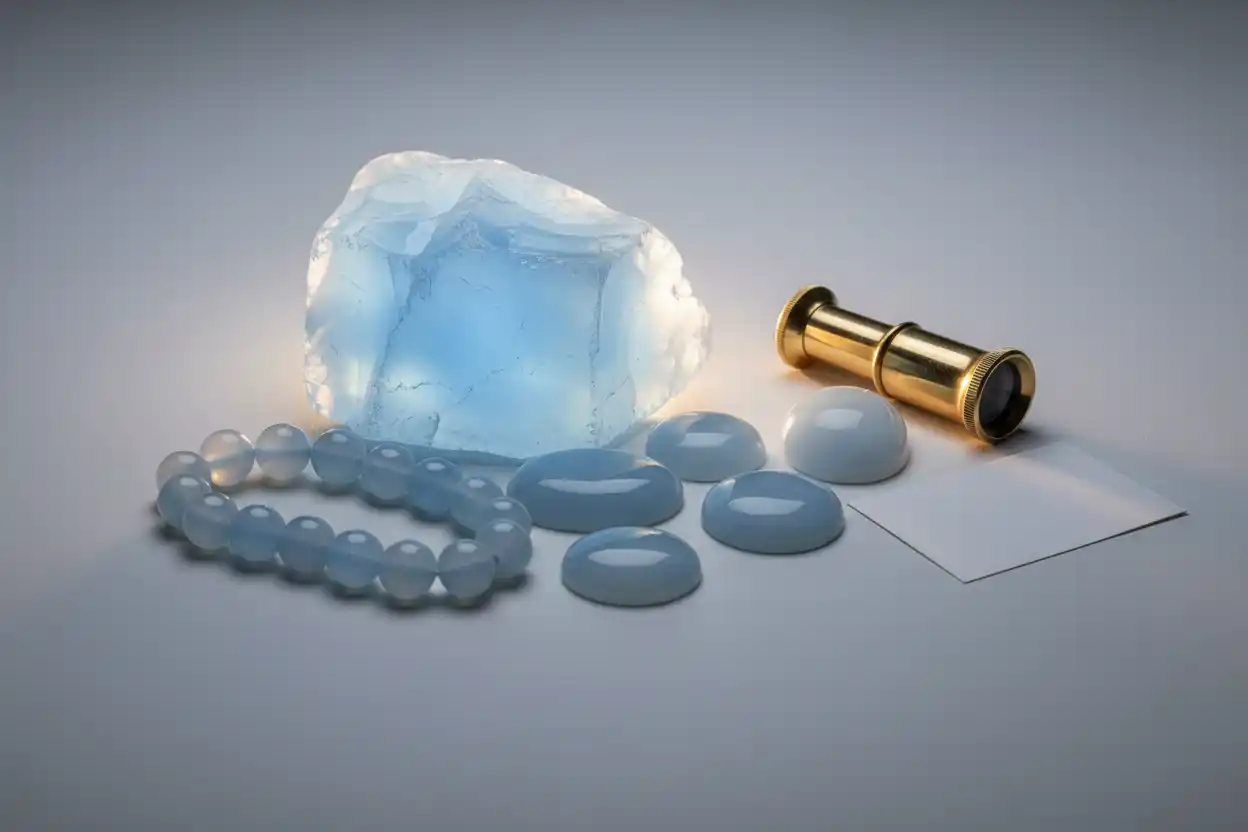
Real blue chalcedony is valued for a soft, diffused color rather than intense opaque saturation. Fine material can appear pale sky blue, lavender-blue, gray-blue or gently bluish white, often with a waxy glow that seems to come from within the stone.
The buying challenge is not a shortage of blue products. Dyed chalcedony, dyed agate, blue glass, resin, coated quartz, blue calcite, opalite and other pale-blue stones are widely available. Moreover, retailers sometimes use “blue chalcedony,” “blue agate,” “blue lace agate” and “gem silica” as though the names were interchangeable.
They are not. A good purchase begins with the correct chalcedony variety and a clear statement about natural color, dye, filling and backing.
The blue chalcedony meaning and properties guide covers its identity and traditional symbolism. This page focuses on sellers, treatment detection, quality, related materials and purchase documentation.
What Blue Chalcedony Is
Chalcedony is a microcrystalline to cryptocrystalline silica material composed mainly of very fine quartz with associated moganite. Unlike transparent rock crystal, its crystals are too small to distinguish without specialized magnification.
Blue chalcedony generally has a uniform or softly clouded body rather than strong agate banding. It can be translucent enough to glow at the edges while remaining milky through the center.
The chalcedony meaning guide covers the family, while the types of chalcedony guide separates agate, carnelian, chrysoprase, bloodstone and other varieties. The chalcedony color guide keeps symbolic color interpretation outside this buying discussion.
The planned general chalcedony buying guide will address the entire family. This page owns natural blue material and its specific lookalikes.
Choose the Product Form
| Blue chalcedony product | Best source | Main issue |
|---|---|---|
| Natural rough | Mineral or lapidary dealer | Surface dye, weak color and misleading wet photographs |
| Slabs | Lapidary supplier | Color zoning, fractures and low translucent yield |
| Cabochons | Gem dealer or skilled lapidary | Dye, backing, filling and poor orientation |
| Beads | Reputable bead supplier | Dyed agate, glass, resin and inconsistent drilling |
| Carvings | Lapidary retailer | Epoxy-filled cavities and coated surfaces |
| Faceted stones | Specialist colored-stone dealer | Mislabeling, windowing and glass substitutes |
| Jewelry | Jeweler with treatment disclosure | Backing, glue and exaggerated rarity |
| Collector specimens | Mineral dealer with locality records | Unsupported geographic and natural-color claims |
Cabochons display chalcedony’s glow most effectively, while rough buyers need enough experience to predict color after cutting.
Where to Buy Genuine Blue Chalcedony
Specialist colored-stone dealers
A dealer familiar with chalcedony can distinguish natural-color blue material from dyed agate and blue glass. Premium stones should include exact dimensions, weight, transparency, treatment and origin.
Ask whether “natural color” comes from laboratory evidence, mine provenance or supplier representation. The confidence of the language should match the evidence.
Lapidary suppliers
Lapidary suppliers are strong sources for rough, slabs and calibrated cabochons. They should show the material dry, since water and oil can deepen color and mask surface defects.
Request transmitted-light photographs when the slab is thin enough. Those views reveal clouding, color zoning, fractures and areas suitable for cabochons.
Gem and mineral shows
Shows allow side-by-side comparison with blue lace agate, gem silica, larimar, aquamarine, blue calcite and opalite. Place the stone over white paper, then view it under neutral daylight and directional indoor light.
A loupe can reveal dye concentration, glass bubbles, resin-filled cavities and surface coatings. Nevertheless, subtle dye may require laboratory testing.
Established online shops
Online sellers should show the exact cabochon or explain batch variation. Blue chalcedony color changes noticeably with white balance, background and lighting, so one saturated photograph is not enough.
Request images against white and neutral gray backgrounds. A hand photograph can provide scale, although skin tone should not replace color-calibrated images.
The online gemstone buying guide explains seller verification and protected payment options.
Jewelry retailers
A jewelry seller should name the stone as natural blue chalcedony, dyed chalcedony or another specific material. Vague wording such as “chalcedony color stone” may indicate glass or imitation.
Ask whether the setting has an open or closed back. A dark or reflective backing can alter the stone’s face-up color dramatically.
What Natural Blue Chalcedony Looks Like
Natural blue chalcedony commonly shows soft, cool color with a diffused translucency. Fine material can have an even body, while other pieces contain milky zones, pale bands, dendrites or minor inclusions.
Its luster is typically waxy to vitreous rather than metallic or intensely glass-like. Edges may glow when backlit, particularly in thin cabochons.
Color should exist within the stone rather than only in surface cracks. Under magnification, natural material can show cloud-like structures, tiny inclusions and subtle variations that cross the polished surface.
Not every natural stone is pale. Some deposits produce stronger blue or bluish-green material. Therefore, saturation alone does not prove dye; the distribution and gemological evidence matter.
Blue Chalcedony Versus Blue Lace Agate
Blue lace agate is a banded chalcedony variety recognized for delicate blue and white lace-like patterns. Blue chalcedony can be more uniform and may lack obvious banding.
The planned blue lace agate buying guide will address band quality, locality and imitations. This page should not absorb that intent.
Some stones sit between the definitions, especially when banding is faint. A seller should show the exact pattern and use a cautious name rather than digitally strengthening bands.
The wider agate guide explains how banding distinguishes many agates within the chalcedony family.
Blue Chalcedony Versus Gem Silica
Gem silica, also called chrysocolla chalcedony, is a valuable blue to bluish-green chalcedony colored by finely distributed copper-bearing material associated with chrysocolla.
Gem silica often shows stronger turquoise-blue or greenish-blue color than ordinary pale blue chalcedony. High-quality material can also have notable translucency.
The chrysocolla guide covers the associated copper mineral. Sellers should not use “gem silica” for every saturated blue chalcedony because the name implies a particular material and market.
Dyed chalcedony has been used to imitate chrysocolla-in-chalcedony. Therefore, expensive saturated pieces deserve stronger treatment evidence.
Blue Chalcedony Versus Dyed Agate
Agate is chalcedony with visible banding or related structural patterns. Because chalcedony accepts dye readily, pale agate slices and beads are commonly colored bright blue.
Dye may highlight bands, producing an appearance much stronger than most natural blue chalcedony. Concentrations can appear in fractures, porous layers and drill holes.
Dyed agate is not necessarily a bad product. It should simply be labeled as dyed blue agate rather than natural blue chalcedony.
Blue Chalcedony Versus Blue Calcite
Blue calcite is much softer and displays cleavage. It often has a cloudier carbonate appearance and may show white cleavage planes.
Chalcedony is harder, tougher and usually takes a smoother polish. However, buyers should not use destructive scratch or acid tests.
Professional refractive-index, specific-gravity and spectroscopy measurements can separate them.
Blue Chalcedony Versus Blue Aventurine
Blue aventurine should show reflective inclusions or an aventurine-like effect. Blue chalcedony normally has a softer uniform glow without platy sparkle.
Weakly included material can be confusing in photographs. Ask whether the stone is microcrystalline chalcedony or inclusion-bearing quartzite.
Blue Chalcedony Versus Larimar
Larimar is blue pectolite associated with the Dominican Republic. It often shows white cloud-like patterns, blue-green areas and fibrous structures.
Blue chalcedony usually has a more even microcrystalline texture. Nevertheless, pale cabochons can resemble one another, especially when sellers oversaturate photographs.
Origin claims matter particularly for larimar, while chalcedony occurs in many regions.
Blue Chalcedony Versus Aquamarine
Aquamarine is crystalline beryl, usually transparent to translucent and commonly faceted. Chalcedony has a microcrystalline texture and usually appears as cabochons, beads or carvings.
Transparent pale-blue glass can imitate both. A seller should not describe translucent blue chalcedony as “aquamarine chalcedony” without explaining that it is a color comparison rather than a mineral identity.
Blue Chalcedony Versus Sodalite and Lapis
Sodalite and lapis lazuli are generally more opaque and strongly colored. They may show white matrix, dark patches or pyrite in the case of some lapis.
Blue chalcedony is usually more evenly translucent and lacks lapis’s typical rock-like aggregate appearance.
Blue Chalcedony Versus Opalite
Opalite is commonly a manufactured glass with a milky blue body and orange glow in transmitted light. It can be sold incorrectly as blue chalcedony or moonstone.
Round bubbles, mold seams and highly uniform glassy appearance support an opalite identification. Natural chalcedony tends to show a more granular or clouded internal texture.
Common Treatments and Imitations
Dye
Chalcedony is one of the better-known dyeable gem materials. Dye can produce blue shades ranging from pale to electric.
Look for color concentration in cracks, porous bands, pits and drill holes. Nevertheless, well-executed dye may remain difficult to identify without spectroscopy or chemical analysis.
Epoxy and resin filling
Cavities and fractures can be filled with clear or colored epoxy. Filling may improve polish or stability, but it must be disclosed.
Wax and oil
Surface treatments can deepen color and improve luster. Their stability may vary with heat and cleaning products.
Glass
Glass can imitate translucent chalcedony. Round bubbles, flow lines and mold marks support manufacture, but some glass is visually convincing.
Resin
Resin may contain pigment, stone powder or suspended particles. It can show casting seams and soft surface scratches.
Coatings
Blue or iridescent coatings may sit on pale stone or glass. Wear around edges can reveal the underlying material.
The gemstone treatments guide explains disclosure language, while the fake-crystal guide covers broad imitation patterns.
How to Judge Rough and Slabs
Request dry photographs of the natural exterior, sawn face and edges. Color should continue into the material rather than forming only a surface stain.
Backlighting can reveal translucent zones and fractures. However, extremely strong light may make ordinary pale material look more vivid than it appears in jewelry.
Check usable yield. Cloudy, fractured or opaque sections can reduce the number of fine cabochons cut from a slab.
Ask whether sample cabochons have been cut from the same batch. Their appearance provides better evidence than a wet rough surface.
How to Judge Cabochons
A quality cabochon should have an even dome, smooth polish and attractive face-up color. Its glow should remain appealing in ordinary light rather than only over a light box.
Examine the girdle for chips and the back for dye, backing, resin or filler. A white or reflective backing can brighten pale material, while a dark backing can deepen color.
The best cut balances translucency and color. A stone cut too thin can appear washed out, while an overly thick cabochon may look gray or opaque.
Buying Faceted Blue Chalcedony
Faceted chalcedony is less common than cabochon material because its diffused translucency does not always reward faceting. Nevertheless, translucent stones can be cut into beads, rose cuts and conventional shapes.
Inspect for windowing, uneven polish and filled cavities. A faceted stone with completely glass-like transparency may require verification because glass is a common substitute.
Buying Beads
Natural blue chalcedony beads should show plausible variation in tone and translucency. Perfectly uniform electric-blue strands are often dyed.
Inspect drill holes for concentrated color, chips and white residues. Hole edges should be smooth enough not to damage cord.
Ask whether the strand is natural-color chalcedony, dyed chalcedony or blue agate. A reputable supplier should not hide treatment behind the generic phrase “genuine stone.”
Buying Carvings
Chalcedony’s toughness makes it suitable for carvings, yet cavities and natural fractures may still require repair. Request views of the underside and deep recesses.
A carving with a thick glossy surface may contain epoxy or coating. Color-matched filler can be difficult to see unless the object is tilted under strong light.
Large pieces should include accurate dimensions and weight so tightly cropped photographs do not create a false impression of scale.
Buying Jewelry
Blue chalcedony has useful durability for pendants, earrings, brooches and many rings. The gemstone hardness chart places chalcedony near the quartz range, while gemstone toughness versus hardness explains its relatively cohesive microcrystalline structure.
Even so, thin edges can chip. A bezel protects cabochons better than high prongs, particularly in rings.
Ask whether the stone is glued, backed or treated. In closed-back settings, request pre-setting photographs when buying expensive jewelry.
Locality and Provenance
Blue chalcedony comes from several regions, and commercial material may be associated with Africa, Turkey, the United States, Indonesia and other sources. However, visual appearance rarely proves origin.
A premium locality claim should come with supplier records, mine information or laboratory documentation. Country-level origin is more realistic for ordinary beads than a precise mine name.
Natural-color claims deserve equal care. An origin known for blue material supports the description but does not replace treatment testing.
Price and Value
Blue chalcedony value depends on natural color, translucency, evenness, usable size, treatment, polish, cut and provenance. Fine natural-color material can command substantially more than common dyed beads.
Soft medium-blue stones with an internal glow often receive the strongest interest. Gray, brown or heavily included areas may lower value unless they create an attractive pattern.
Gem silica occupies a separate high-value market and should not be priced as ordinary blue chalcedony without proper identification.
The gemstone pricing guide explains how natural color, treatment evidence, cutting yield and retail overhead interact.
Seller Questions
Ask whether the blue color is natural, dyed or uncertain. Determine whether the material is uniform chalcedony, banded agate, gem silica or another silica variety.
Request disclosure of epoxy, resin, wax, oil, coating, backing and repair. Ask whether photographs show the exact item and whether color or white balance was edited.
For rough, request dry and transmitted-light images. For jewelry, ask for back and side views. Finally, obtain a written inspection and return policy.
Professional Testing
A gemologist can identify chalcedony using refractive properties, specific gravity, microscopy and Raman spectroscopy. Visible and infrared spectroscopy may help assess color origin and polymer treatment.
Microscopy can reveal dye concentration, resin-filled cavities and glass bubbles. Chemical analysis may identify copper associated with gem silica or some dyed imitations.
Professional testing is most worthwhile for expensive natural-color cabochons, saturated gem-silica claims, antique carvings and large matched suites.
Responsible Buying
The supply chain may involve mining, rough trading, cutting and bead production in different countries. Mine-level traceability is uncommon for inexpensive strands, but sellers should not invent precise sourcing claims.
The ethical crystal sourcing guide provides practical questions about labor, environmental responsibility and origin transparency.
Cleaning and Storage
Untreated blue chalcedony can generally be cleaned with lukewarm water, mild soap and a soft cloth. Rinse briefly and dry completely.
Avoid prolonged soaking when the stone is dyed, filled, glued or backed. The planned water-safety guide provides broader material guidance.
Ultrasonic cleaning may be acceptable for some sound untreated chalcedony, but it is inappropriate when the stone contains fractures, filling, dye or adhesive. The planned ultrasonic-cleaner guide explains why construction matters.
Store jewelry away from harder gems and sharp metal edges. Protect carved surfaces from abrasion and sudden impacts.
Frequently Asked Questions
1. Is blue chalcedony naturally blue?
Yes. Naturally colored blue chalcedony exists, although dyed chalcedony is also common in the market.
2. What shade should natural blue chalcedony be?
Natural material can range from pale bluish white and gray-blue to stronger blue or bluish green. Color alone cannot establish treatment.
3. Is blue chalcedony the same as blue lace agate?
No. Blue lace agate is a banded chalcedony variety with lace-like blue and white patterns. Blue chalcedony can be more uniform.
4. Is gem silica a type of blue chalcedony?
Gem silica is a valuable blue to bluish-green chalcedony associated with finely distributed chrysocolla or copper-bearing material. It occupies a more specific category.
5. How can I recognize dyed blue chalcedony?
Dye may concentrate in fractures, porous bands, pits and drill holes. However, advanced dye can require professional spectroscopy or chemical analysis.
6. Can blue chalcedony contain epoxy?
Yes. Epoxy may fill cavities or fractures in carvings and cabochons. The treatment should be disclosed.
7. Is blue chalcedony the same as blue calcite?
No. Chalcedony is silica-rich and relatively hard, while calcite is soft calcium carbonate with prominent cleavage.
8. Is opalite natural blue chalcedony?
No. Opalite is commonly manufactured glass. It often has a uniform milky body and orange glow under transmitted light.
9. Is blue chalcedony suitable for everyday rings?
Sound material can work in rings, particularly with a protective bezel. Thin edges, filled fractures and high settings require more caution.
10. Why does blue chalcedony look different in photographs?
Background, white balance, light temperature and backlighting can significantly change the apparent color and translucency.
11. Do I need a laboratory report?
Usually not for inexpensive beads. Testing is more useful for premium natural-color stones, gem-silica claims, expensive carvings or matched jewelry suites.
12. What is the largest red flag in a listing?
Be cautious when an intensely blue stone is called untreated natural chalcedony but the seller provides no neutral photographs, treatment statement, side view or return option.
Buy the Glow You Can Verify
Fine blue chalcedony has a quiet, diffused appearance that does not need extreme saturation. Its value comes from natural-looking color, attractive translucency, clean cutting and honest treatment disclosure.
The B crystal directory, B gemstone directory and visual gemstone guide provide wider comparisons. Choose the stone that remains convincing in neutral light instead of the one made vivid by editing or hidden backing.