10 Important Blue Chalcedony Healing Claims: Hopeful Traditions, Proven Facts & Safe Use
Blue chalcedony healing properties are traditionally associated with calm communication, emotional steadiness, patience, confidence, thoughtful listening, self-expression, mental clarity, creativity, relationship understanding, and quiet reflection. These ideas come from crystal traditions rather than established medical or psychological evidence. Blue chalcedony does not treat anxiety, cure throat problems, lower blood pressure, improve lung function, change brain chemistry, or regulate the nervous system through ordinary jewelry wear or handling. Its most responsible use is symbolic, especially when the stone becomes a visual reminder to slow down, organize thoughts, listen carefully, or speak with greater precision.
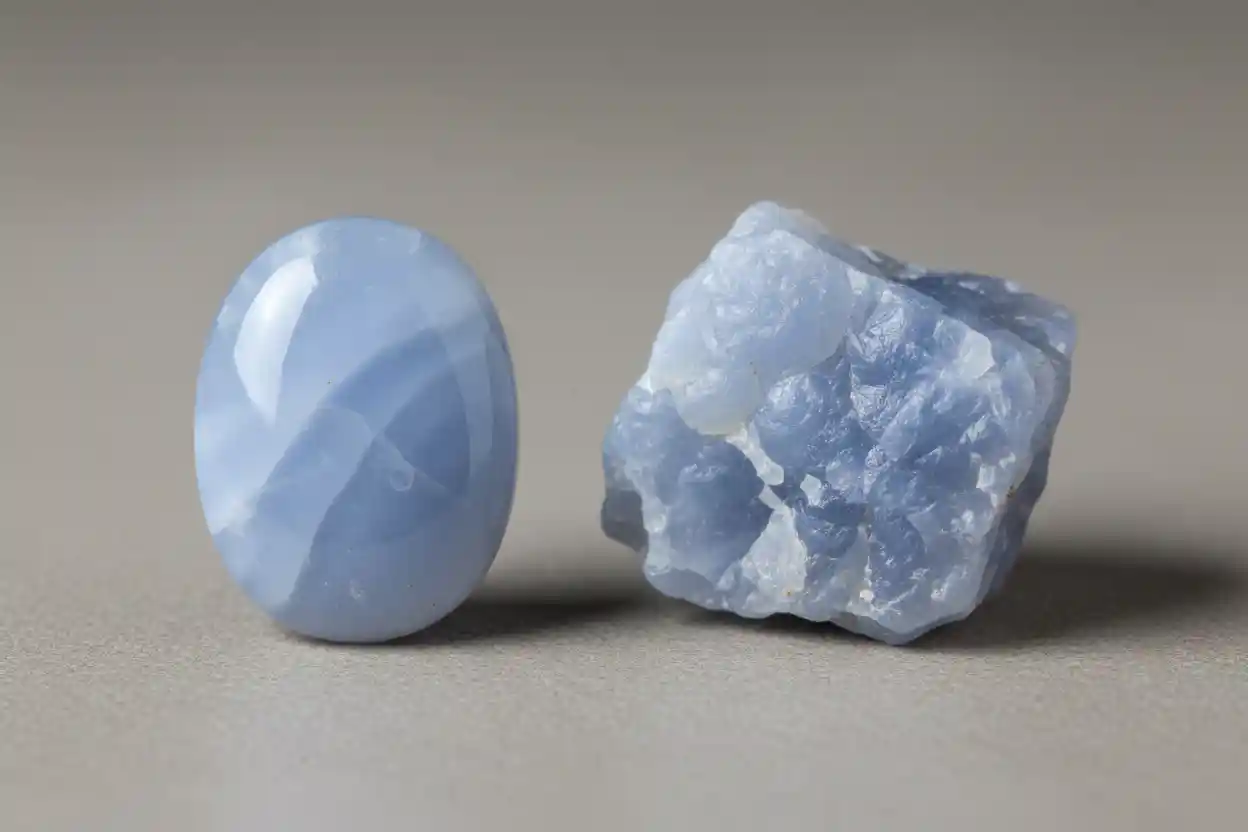
Blue chalcedony is a blue variety of chalcedony, a cryptocrystalline to microcrystalline form of silica within the quartz family. It often has a soft translucent appearance, fine internal texture, and a waxy to glassy luster rather than the obvious crystal faces seen in transparent quartz. Chalcedony generally falls around 6.5 to 7 on the Mohs scale, giving it useful resistance to scratching and making it suitable for cabochons, beads, carvings, and many jewelry designs. Natural blue chalcedony varies from pale gray-blue to stronger blue shades, while treatments and dyes can occur in the gem trade, so color alone is not enough to establish natural origin.
Blue Chalcedony Communication Claims Support Calm Speech, Better Listening, and Clearer Boundaries
Communication is the strongest symbolic theme attached to blue chalcedony. Its blue color places it among the stones traditionally associated with speech, listening, self-expression, and calm interpersonal exchange. Crystal descriptions often claim that blue chalcedony helps people speak more confidently or express difficult feelings, but there is no established evidence that the stone alters speech centers, social confidence, or nervous-system function. A more practical use is to connect the stone with preparation before conversations that are likely to become emotional or complicated.
Someone might keep a polished blue chalcedony stone beside a notebook and identify the central point they want to communicate before beginning a conversation. The goal is to replace vague frustration with specific language. Instead of saying that someone “never listens,” the person can describe the exact behavior that created the problem and explain what response would help. The crystals for communication tradition becomes more useful when speaking and listening are treated as related skills. Asking a clarifying question, waiting until the other person finishes, and checking whether an assumption is accurate can improve communication in ways that crystal symbolism alone cannot.
Blue chalcedony’s calm reputation should not be interpreted as a requirement to avoid disagreement. Clear communication can include saying no, correcting an error, asking for time, or ending a conversation that has become disrespectful. The stone can represent gentle language without turning gentleness into passivity.
Blue Chalcedony Emotional-Steadiness Claims Should Support Reflection Rather Than Anxiety Treatment
Blue chalcedony is frequently described as soothing, calming, or emotionally balancing. These descriptions are understandable because its pale translucent appearance can feel visually quiet, but there is no established evidence that the stone lowers stress hormones, regulates mood, or treats anxiety disorders. Its symbolic value becomes more useful when it is tied to a specific reflective routine.
A person might hold blue chalcedony while writing down what happened, what they assumed, and what they actually know. This can help reveal whether the emotional reaction came from uncertainty, a crossed boundary, disappointment, fear, or another identifiable source. The crystals for emotional healing tradition becomes safer when emotional healing means processing experience rather than expecting a stone to remove distress.
Persistent anxiety, depression, panic, trauma symptoms, or major disruption to ordinary life requires appropriate professional support. Blue chalcedony can remain personally meaningful during that process, but it should not become a substitute for care or a reason to delay it.
Blue Chalcedony Patience Claims Work Best as Deliberate Pauses Before Important Decisions
Patience is a natural extension of blue chalcedony’s communication and calm symbolism. The stone is often described as helping people avoid impulsive reactions or become more tolerant during disagreement. There is no evidence that chalcedony changes impulse control biologically, but it can become a reminder to slow the sequence between feeling and action.
Someone facing a frustrating email might decide not to answer immediately. A person considering a major purchase can use the stone as a cue to review the terms before committing. In a relationship, blue chalcedony can symbolize allowing enough time to understand what the other person actually meant instead of reacting to the first interpretation.
Patience should not mean delaying every decision indefinitely. Some situations require prompt action, especially where health, safety, or urgent responsibilities are involved. Blue chalcedony symbolism is most useful when it represents giving a decision enough thought for the consequences involved.
Blue Chalcedony Confidence Claims Support Prepared Self-Expression Rather Than Fear Removal
Blue chalcedony is often linked with confidence, particularly the quieter confidence needed to speak clearly rather than dominate a conversation. The stone does not remove nervousness or increase self-esteem through physical contact, but it can represent preparation.
Someone preparing for an interview might use blue chalcedony while reviewing examples that demonstrate their experience. A student could associate the stone with practicing an answer aloud rather than hoping confidence appears spontaneously. Traditional blue chalcedony benefits become more practical when confidence is treated as familiarity with the task and willingness to act despite some uncertainty.
This form of confidence leaves room for correction. Admitting that you do not know something, asking for clarification, or changing an opinion after seeing stronger evidence can all reflect confidence rather than weakness.
Blue Chalcedony Mental-Clarity Claims Fit Structured Thinking Better Than Cognitive Enhancement
Blue chalcedony is commonly associated with mental clarity, thoughtful decisions, and organized expression. There is no established evidence that it improves memory, intelligence, attention span, or executive function. A practical interpretation is to let the stone represent reducing a complicated problem into smaller, answerable questions.
The crystals for clarity tradition supports this approach when clarity comes from identifying what is known, what is assumed, and what information is missing. Someone considering two options can write down the likely consequences, costs, risks, and uncertainties instead of repeatedly thinking about the entire decision without structure.
The stone can also support clearer written communication. Placing it beside a notebook can become the cue to turn vague thoughts into one concise paragraph before sending an important message. The improvement comes from organizing the thought, not from a direct cognitive effect of chalcedony.
Blue Chalcedony Creativity and Self-Expression Traditions Encourage Low-Pressure Experimentation
Blue chalcedony is sometimes associated with creativity because communication and self-expression naturally overlap with writing, art, music, design, and other forms of creative work. Its quiet color makes it especially suitable symbolically for people who prefer a reflective creative environment rather than an intense motivational atmosphere.
A writer might use blue chalcedony to mark a brainstorming period where ideas are generated without immediate judgment. An artist may associate it with experimentation, while someone preparing a presentation might use it as a reminder to simplify complex information. The stone does not increase creative brain activity, but it can support a repeatable routine in which the person gives themselves permission to produce imperfect early work.
Creativity usually improves through observation, practice, revision, and willingness to try another approach after the first one fails. Blue chalcedony symbolism works best when it reinforces those behaviors instead of being treated as a source of inspiration by itself.
Blue Chalcedony Relationship Harmony Claims Depend on Mutual Communication and Respect
Blue chalcedony is often included in relationship practices because its communication themes fit conflict resolution, trust-building, and emotional honesty. The stone cannot make another person become more loving, loyal, patient, or cooperative. Relationship harmony depends on reciprocal behavior.
Someone may use blue chalcedony as a shared symbol for discussing problems before resentment becomes entrenched. It can represent asking rather than assuming, listening before defending, or explaining a need without expecting the other person to guess it. The stone can also symbolize choosing a calmer time for a difficult conversation rather than trying to resolve everything during the peak of an argument.
Harmony does not require tolerating manipulation, threats, intimidation, or repeated disrespect. A crystal should never be used to encourage someone to remain in a harmful situation simply because the relationship is described as spiritually significant.
Blue Chalcedony and General Chalcedony Share Quartz-Family Structure but Different Color Traditions
Blue chalcedony belongs within the wider chalcedony family, which includes many colors and commercially named varieties. Chalcedony is made of extremely fine intergrowths of silica phases and lacks the large visible crystal faces associated with macrocrystalline quartz. This fine structure produces the smooth, often waxy appearance typical of polished chalcedony.
Traditional chalcedony healing properties cover communication, harmony, and emotional steadiness across the wider family, while blue chalcedony places stronger emphasis on calm speech and reflective expression because of its color. These differences come from crystal culture rather than scientifically demonstrated therapeutic distinctions.
The relationship also helps explain care. Blue chalcedony shares much of the durability expected from quartz-family gems, making it considerably easier to wear than soft stones such as calcite or angelite.
Blue Chalcedony Color, Translucency, and Treatments Matter More Than Metaphysical Strength
Natural blue chalcedony can range from very pale gray-blue to more saturated blue, often with subtle clouding and soft translucency. High-quality pieces may show an even, attractive color and a smooth internal appearance when cut into cabochons. Some specimens may contain natural variations, small inclusions, or areas of uneven tone.
Dyeing and other color enhancement can occur in chalcedony because its fine structure can accept treatments. An unusually intense or uniform blue does not automatically mean a stone has been treated, but buyers should value clear disclosure when treatment matters to them. Traditional blue chalcedony meaning should remain separate from authenticity because metaphysical descriptions cannot establish whether a stone is natural, dyed, or correctly identified.
Claims that darker or more saturated stones have stronger healing power are not objectively measurable. Color can affect beauty and market appeal, but it does not establish greater therapeutic action.
Blue Chalcedony Jewelry Care Benefits From Quartz Durability but Still Requires Sensible Handling
Blue chalcedony’s hardness around 6.5 to 7 makes it suitable for rings, pendants, bracelets, beads, carvings, and earrings. Its fine-grained structure can also provide useful toughness compared with some brittle crystals, although thin edges and heavily fractured pieces can still chip.
Routine cleaning with lukewarm water, mild soap, and a soft cloth or brush is generally appropriate. Harsh chemicals and unnecessary heat are best avoided, particularly when dyeing or other treatment is possible. Jewelry containing adhesives, coatings, or additional stones should be cleaned according to the most delicate part of the piece.
There is no need to place blue chalcedony in drinking water or grind it for wellness use. Its symbolic value works fully through external wear, display, journaling, or meditation.
Blue Chalcedony Healing Claims Cannot Treat Throat, Lung, Blood Pressure, or Mental Health Conditions
Some wellness descriptions claim that blue chalcedony benefits the throat, vocal cords, lungs, blood pressure, immune system, anxiety, or sleep. These claims are not established therapeutic effects of silica stone. The blue color does not create a medical connection with the throat or respiratory system.
Blue chalcedony may feel calming because a person likes its appearance or connects it with a familiar routine, but that subjective comfort should not be transformed into a claim that the gemstone changes body function. Persistent throat problems, breathing difficulties, unusual blood pressure readings, anxiety, or other health concerns require assessment based on their actual cause.
The stone’s appeal does not depend on medical effectiveness. Its subtle translucency, quartz-family durability, soft blue color, and long association with communication already give it strong aesthetic and symbolic value.
Conclusion: Blue Chalcedony Healing Claims Stay Symbolic While Quartz-Family Structure Explains Its Real Durability
Blue chalcedony healing properties are best understood as traditional themes of communication, emotional steadiness, patience, confidence, listening, self-expression, clarity, creativity, relationship understanding, and quiet reflection. Blue chalcedony itself is a fine-grained silica stone within the quartz family, usually showing soft translucency, useful hardness, and a smooth waxy appearance. It can support meaningful routines and reflective habits, but it does not treat anxiety, throat problems, respiratory illness, blood pressure, or other physical or mental health conditions.
FAQs About Blue Chalcedony Healing Properties, Quartz Structure, and Safe Use
What are the main traditional blue chalcedony healing properties?
Blue chalcedony is commonly associated with communication, calm, patience, confidence, listening, mental clarity, creativity, self-expression, and relationship understanding.
Is blue chalcedony scientifically proven to heal?
No. There is no established evidence that blue chalcedony treats physical or mental health conditions through ordinary use.
What type of stone is blue chalcedony?
Blue chalcedony is a blue variety of fine-grained silica within the quartz family.
How hard is blue chalcedony?
Chalcedony is generally around 6.5 to 7 on the Mohs scale, giving it useful durability for jewelry.
Can blue chalcedony improve communication?
It can serve as a symbolic reminder to prepare, speak clearly, listen carefully, and use appropriate timing, but it does not directly change speech ability.
Can blue chalcedony reduce anxiety?
It may feel personally calming, but it is not an established treatment for anxiety disorders.
Is blue chalcedony naturally blue?
Natural blue chalcedony exists, but dyed or otherwise enhanced stones can also occur in the market.
Is blue chalcedony suitable for everyday jewelry?
Its quartz-family hardness makes many pieces suitable for regular wear, although strong impacts and harsh cleaning should still be avoided.
Can blue chalcedony treat throat problems?
No. Blue color symbolism does not give the stone a proven medical effect on the throat or respiratory system.
Can blue chalcedony go in drinking water?
There is no need to use blue chalcedony in drinking water for wellness purposes. External symbolic use is simpler.
Blue chalcedony healing meanings are traditional or personal practices, not established treatments for physical or mental health conditions.