Blue Chalcedony Benefits: 11 Real Uses, Helpful Symbolism & Verified Facts
Blue chalcedony benefits begin with a combination of useful quartz-family durability, soft translucent color, good toughness, smooth polish, historical lapidary value, and remarkable versatility in jewelry and carving. Chalcedony is a microcrystalline form of silica composed of extremely fine quartz structures, often with small amounts of moganite. Unlike transparent rock crystal, its microscopic texture produces a dense appearance that can range from nearly opaque to softly translucent.
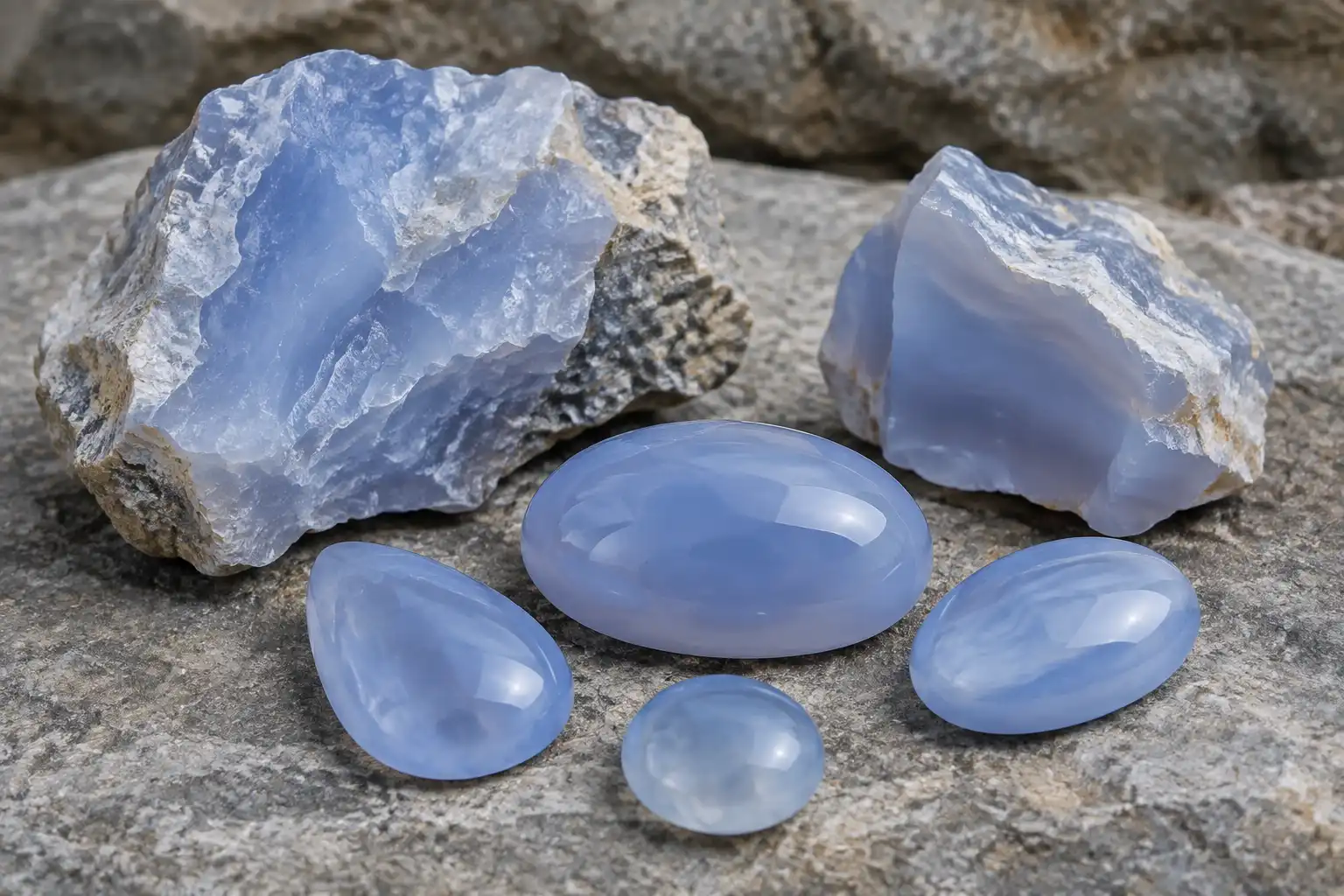
Natural blue chalcedony can show pale sky-blue, gray-blue, lavender-blue, or more saturated tones depending on the specimen and its geological origin. Fine examples often have a gentle waxy appearance before polishing and a smoother, more vitreous surface after finishing. The blue color and compact structure make the stone useful for cabochons, beads, carvings, seals, decorative objects, and collections.
Modern spiritual traditions add blue chalcedony benefits involving calm communication, emotional steadiness, listening, creativity, and reflection. Those themes may have personal value, but they should remain separate from medical claims. Blue chalcedony does not cure anxiety disorders, treat throat disease, improve neurological function, or regulate hormones simply because it is blue quartz.
11 Blue Chalcedony Benefits at a Glance
- Quartz-family hardness gives blue chalcedony useful scratch resistance for many jewelry applications.
- Fine microcrystalline texture gives the stone good toughness compared with many brittle crystalline gems.
- Soft translucent blue color creates an understated jewelry appearance.
- Dense structure allows smooth cabochon cutting, bead making, engraving, and carving.
- Natural variation gives collectors differences in color, translucency, texture, and geological character.
- Blue chalcedony helps students compare microcrystalline quartz with visible quartz crystals.
- Historical use of chalcedony in seals and carved objects adds cultural and lapidary interest.
- Identification practice teaches buyers to distinguish natural color, dye, glass, and similar blue gems.
- Jewelry designers gain a versatile blue stone that combines easily with many metals and gem colors.
- Modern symbolism can represent thoughtful communication or calm reflection without medical claims.
- Straightforward care makes stable untreated blue chalcedony practical for long-term ownership.
Quartz-Family Durability Is One of the Strongest Blue Chalcedony Benefits
Blue chalcedony benefits from physical properties that make it more practical than many soft decorative stones. Chalcedony generally falls around 6.5 to 7 on the Mohs hardness scale, giving it enough scratch resistance for rings, pendants, earrings, bracelets, beads, and other jewelry when worn with reasonable care.
Its structure also contributes useful toughness. Instead of being one large crystal with prominent cleavage planes, chalcedony consists of extremely fine intergrown silica structures. That compact texture helps it resist certain types of breakage better than some gems with strong cleavage.
This does not mean blue chalcedony is indestructible. A hard impact can still chip an edge or fracture a thin carving, while harder gemstones such as sapphire and diamond can scratch polished surfaces. Rings and bracelets are naturally exposed to more impacts than pendants or earrings.
For jewelry buyers, durability is among the most dependable blue chalcedony benefits because it directly affects how the gem can be used. A well-cut cabochon in a secure setting can tolerate ordinary wear far better than many softer blue stones.
The balance between durability, appearance, and relative ease of polishing also explains why chalcedony varieties have remained important lapidary stones across many cultures and historical periods.
Soft Blue Color Gives Jewelry a Distinctive but Understated Appearance
Blue chalcedony often appeals to people who prefer subdued color over intense saturation. Its appearance can range from delicate sky blue to grayish blue, bluish lavender, or richer translucent tones. Because the stone typically lacks the high brilliance of a transparent faceted gem, attention shifts toward color, translucency, shape, polish, and craftsmanship.
That makes blue chalcedony benefits particularly noticeable in cabochons and beads. A domed cabochon can allow soft light to move through the stone without requiring sharp facet reflections. Beads can show gentle variations from one piece to another, creating a more natural appearance in necklaces and bracelets.
Blue chalcedony pairs easily with white metals, yellow gold, rose gold, copper tones, pearl, moonstone, darker gems, and transparent quartz. Jewelry designers can use it as a quiet focal stone or as a color transition between stronger hues.
Its appearance also suits both modern minimalist designs and more traditional settings. An oval cabochon can feel classic, while geometric cuts or irregular polished shapes create a more contemporary effect.
These aesthetic blue chalcedony benefits arise from the stone itself rather than from claims about invisible energies.
Fine Texture Makes Blue Chalcedony Excellent for Carving and Engraving
Lapidary versatility is another important source of blue chalcedony benefits. The stone’s fine texture allows cutters to produce smooth surfaces, crisp outlines, beads, small carvings, seals, intaglios, cameos, and decorative forms.
Chalcedony has an especially long history in engraving because its compact structure can preserve detail. Ancient and later craftspeople used chalcedony and related quartz varieties for seals and carved gems, often choosing different colors and layers for artistic or practical reasons.
Blue chalcedony can be particularly attractive in relief carving because soft translucency may create subtle differences between thicker and thinner areas. A polished carving can also reveal cloudy regions, internal color zoning, or variations that were barely noticeable in rough stone.
Successful carving still requires judgment. Natural fractures, pits, color concentrations, and hidden weaknesses can affect the final shape. A cutter may need to remove an attractive section to preserve structural stability or change the design when internal features become visible.
These craft decisions make blue chalcedony benefits partly dependent on workmanship. The rough provides color and texture, while the cutter determines how effectively those qualities appear in the finished object.
Collecting Blue Chalcedony Reveals the Diversity of Microcrystalline Quartz
Collecting provides another lasting way to appreciate blue chalcedony benefits. Chalcedony occurs in many colors and forms, and blue specimens can be compared with agate, onyx, chrysoprase, carnelian, jasper, and other members of the wider microcrystalline quartz family.
Collectors may focus on natural color, translucency, botryoidal surfaces, rough nodules, polished specimens, unusual locality examples, or historically important cutting styles. A rough specimen can reveal growth texture that disappears after polishing, while a cabochon shows how the same stone responds to lapidary finishing.
Color itself can become an interesting study. Not every natural blue chalcedony has the same cause or appearance, and different geological environments can produce different tones and internal features. Some blue or greenish-blue chalcedonies may contain colored mineral inclusions, while other specimens derive their appearance from light scattering and microscopic structure.
This diversity is one reason careful identification matters. “Blue chalcedony” describes an appearance and quartz-family gem, but buyers should not assume every blue specimen has an identical microscopic color mechanism.
For collectors, these distinctions make individual stones more interesting rather than unnecessarily complicated.
Blue Chalcedony Benefits Mineral Education Through Its Microcrystalline Structure
Blue chalcedony provides an accessible way to understand the difference between macrocrystalline and microcrystalline quartz. A clear quartz point displays visible crystal faces formed by a large crystal, while chalcedony contains silica structures so small that individual components generally cannot be distinguished without specialized examination.
This difference affects appearance. Chalcedony often has a waxy luster on natural fractured surfaces, a dense texture, and translucency that diffuses light. After polishing, the surface can become considerably more reflective.
The stone also demonstrates why minerals with very similar chemistry can look completely different. Rock crystal, amethyst, smoky quartz, rose quartz, agate, jasper, and chalcedony all belong to the wider silica family, yet crystal size, inclusions, trace components, structural effects, and geological conditions create very different visual results.
These educational blue chalcedony benefits make the gem useful beyond decoration. A small specimen can introduce concepts involving silica chemistry, crystal size, fracture, inclusions, light scattering, color, and geological formation.
Understanding those features often increases appreciation because the stone stops being simply “a blue crystal” and becomes part of a complex quartz story.
Identification Skills Protect Buyers from Dye and Similar Blue Stones
One of the most practical blue chalcedony benefits is the opportunity to learn careful gemstone identification. Natural blue chalcedony exists, but chalcedony can also accept dye, and treated blue pieces occur in the gem market. Other blue stones and glass products may resemble it closely enough to confuse buyers from photographs alone.
Dye can sometimes concentrate in fractures, pores, or near surfaces, although visual inspection is not always enough to identify treatment confidently. Extremely uniform or unusually saturated color deserves additional questions, but appearance alone does not prove dyeing.
Blue chalcedony may also be confused with blue opal, dyed quartzite, glass, or other translucent blue gems. Professional gemological testing can distinguish many of these possibilities when identity matters.
A person deciding where to buy blue chalcedony should prioritize accurate descriptions, natural-looking photographs, treatment disclosure, dimensions, and seller transparency. Marketing terms such as rare, powerful, ancient, or high vibration do not establish whether the gemstone is natural.
These identification habits are useful far beyond blue chalcedony because they teach buyers to separate appearance from evidence.
Jewelry Versatility Extends Beyond a Single Style
Blue chalcedony’s practical jewelry range is one of the strongest blue chalcedony benefits. It can work in everyday pendants, bead strands, earrings, rings, brooches, cufflinks, carved pendants, and statement pieces without requiring the protective treatment demanded by much softer stones.
Its smooth color also allows designers to emphasize metalwork. A simple silver bezel can make pale blue chalcedony look clean and modern, while ornate yellow-gold settings can create a more traditional appearance. Larger cabochons remain wearable because chalcedony is not exceptionally dense for its size.
Blue chalcedony can also serve as an accent rather than the main gem. Small cabochons may sit beside diamonds, clear quartz, pearls, or contrasting dark stones. Beads can alternate with warmer colors to create a balanced palette.
The general usefulness of chalcedony helps explain why cut pieces have appeared in jewelry and ornament for such a long time. Good polish, toughness, attractive color, and carving potential create a flexible combination.
The best jewelry choice still depends on workmanship. Secure settings, smooth edges, even polish, and sensible proportions contribute more to long-term satisfaction than exaggerated claims about rarity or metaphysical power.
Historical Lapidary Use Gives Chalcedony Cultural Depth
Chalcedony has been carved and worn for centuries, giving blue chalcedony benefits a genuine historical dimension even though modern blue-specific spiritual claims should not automatically be projected into antiquity.
Various chalcedony varieties were used for seals, engraved gems, amulets, beads, and ornaments because their fine texture accepted carving and polish well. Historical naming was not always as precise as modern mineralogical terminology, so old references to chalcedony, agate, or related stones should be interpreted carefully.
This history demonstrates something more important than a single legend: people repeatedly valued chalcedony because it combined useful physical properties with visual appeal. The stone could carry an image, inscription, symbol, family mark, decorative motif, or personal significance.
Modern owners can appreciate blue chalcedony within that long lapidary tradition without claiming that ancient societies universally used blue specimens for communication, chakra work, or emotional healing.
Real craft history gives the stone cultural depth on its own.
Modern Symbolism Adds Calm Communication and Reflective Meaning
Contemporary crystal traditions frequently describe blue chalcedony benefits in terms of communication, listening, tranquility, emotional steadiness, creativity, and diplomacy. Blue color symbolism likely contributes heavily to these themes.
Someone can use the stone as a personal reminder to listen before replying, prepare carefully for a difficult conversation, or speak clearly without becoming unnecessarily confrontational. A pendant may symbolize the intention to communicate thoughtfully, while a polished stone beside a journal may represent reflection.
These uses keep agency with the individual. The gemstone does not supply communication skill, emotional regulation, or confidence automatically.
The symbolism surrounding blue chalcedony meaning can therefore coexist with practical gemstone appreciation when it remains clearly interpretive. Personal associations do not need scientific proof to function as symbols, but claims about health and physiology require a different standard.
This distinction allows spiritual and non-spiritual owners to enjoy blue chalcedony for different reasons without confusing preference with evidence.
Healing Claims Should Not Replace the Stone’s Real Qualities
Modern descriptions of blue chalcedony healing properties may associate the stone with throat health, emotional healing, anxiety relief, hormonal balance, inflammation, memory, nervous-system support, or energy flow. These ideas belong to spiritual and wellness traditions and have not been established as clinical effects of chalcedony.
Silica chemistry does not make blue chalcedony medicinal. Wearing a quartz-family gemstone does not deliver a therapeutic dose of silicon or other trace components into the body, and color does not create a biological mechanism for treating illness.
A person may still find comfort in wearing a familiar piece of jewelry or using a polished stone during meditation. The experience of an object can be personally meaningful, but that is different from demonstrating that the mineral treats a disease or disorder.
The real blue chalcedony benefits are already substantial: good durability, toughness, color, lapidary versatility, collecting interest, historical value, geological education, jewelry use, and personal symbolism.
Those qualities do not need medical exaggeration.
Proper Care Preserves Blue Chalcedony for Long-Term Wear
Blue chalcedony is relatively easy to care for compared with many softer gemstones. Warm water, mild soap, and a soft cloth or brush are generally suitable for stable untreated pieces, while thorough drying prevents residue from collecting around jewelry settings.
Hard impacts should still be avoided. A ring can chip if struck against a countertop or metal edge, and thin carvings can break if dropped. Separate storage also prevents harder gems from scratching polished surfaces.
Treatment status can change care requirements. Dyed, filled, coated, or otherwise enhanced stones may react differently to heat, chemicals, prolonged sunlight, or aggressive cleaning. When treatment is unknown, gentle cleaning is the safest choice.
Cutting and grinding create another consideration. Chalcedony contains silica, so lapidary work should use appropriate wet methods, ventilation, eye protection, and dust-control procedures. Fine silica dust should not be inhaled.
These practical blue chalcedony benefits and limitations make the stone suitable for regular ownership while reinforcing the importance of understanding what it actually is.
Conclusion
Blue chalcedony benefits include useful quartz-family durability, good toughness, attractive translucency, smooth polishing, carving and engraving potential, collecting value, mineral education, historical lapidary significance, jewelry versatility, identification practice, and personal symbolism.
The stone’s soft color can support modern themes of calm communication and reflection, but those interpretations should remain separate from medical claims. The most dependable blue chalcedony benefits come from appreciating its microcrystalline quartz structure, evaluating natural color and treatments carefully, choosing well-cut pieces, and caring for the gem according to its real physical properties.
FAQs
What are the main blue chalcedony benefits?
The most verifiable blue chalcedony benefits include jewelry durability, toughness, smooth polishing, carving, collecting, mineral education, historical lapidary interest, attractive color, and personal symbolism.
What is blue chalcedony made of?
Blue chalcedony is a microcrystalline silica gemstone in the quartz family. Its extremely fine internal structure gives it a dense, often translucent appearance.
Is blue chalcedony durable enough for jewelry?
Yes. Chalcedony generally has a Mohs hardness around 6.5 to 7 and good toughness, making it suitable for many rings, pendants, beads, earrings, and carvings with sensible care.
Is all blue chalcedony naturally blue?
No. Natural blue chalcedony exists, but dyed chalcedony also occurs in the market. Treatment disclosure and reliable identification matter when natural color is important to the buyer.
Does blue chalcedony sparkle?
Blue chalcedony generally displays soft translucency and a waxy-to-polished luster rather than the aventurescent sparkle of aventurine or the brilliance of a faceted transparent gem.
Is blue chalcedony good for carving?
Yes. Its fine texture, toughness, and ability to take a smooth polish have made chalcedony varieties important carving and engraving stones for centuries.
What does blue chalcedony symbolize?
Modern symbolism often connects blue chalcedony with communication, listening, patience, calmness, creativity, and diplomacy. These are cultural or personal interpretations rather than proven physiological effects.
Can blue chalcedony treat anxiety or throat problems?
There is no established clinical evidence that blue chalcedony treats anxiety disorders, throat disease, speech conditions, neurological problems, or other medical concerns.
How can I tell natural blue chalcedony from dyed stone?
Color concentration in fractures or pores can sometimes suggest dye, but visual clues are not always conclusive. Reliable seller disclosure and professional gemological testing provide stronger evidence when treatment status matters.
How should blue chalcedony be cleaned?
Use lukewarm water, mild soap, and a soft cloth or brush for stable untreated pieces. Avoid unnecessary heat, harsh chemicals, hard impacts, and aggressive cleaning when treatment status is uncertain.
Can blue chalcedony be worn every day?
Many well-set pieces are suitable for regular wear, especially pendants, earrings, and protected rings. Removing jewelry during heavy manual work helps preserve the polish and prevent impact damage.
Blue chalcedony benefits associated with healing, emotional regulation, chakra work, or physical effects remain spiritual and personal beliefs and should not replace qualified medical or mental-health care.