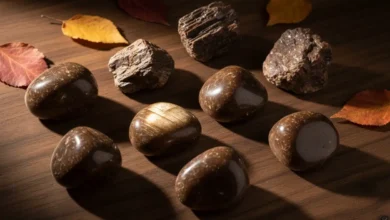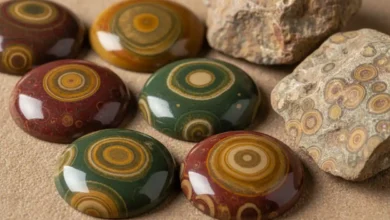

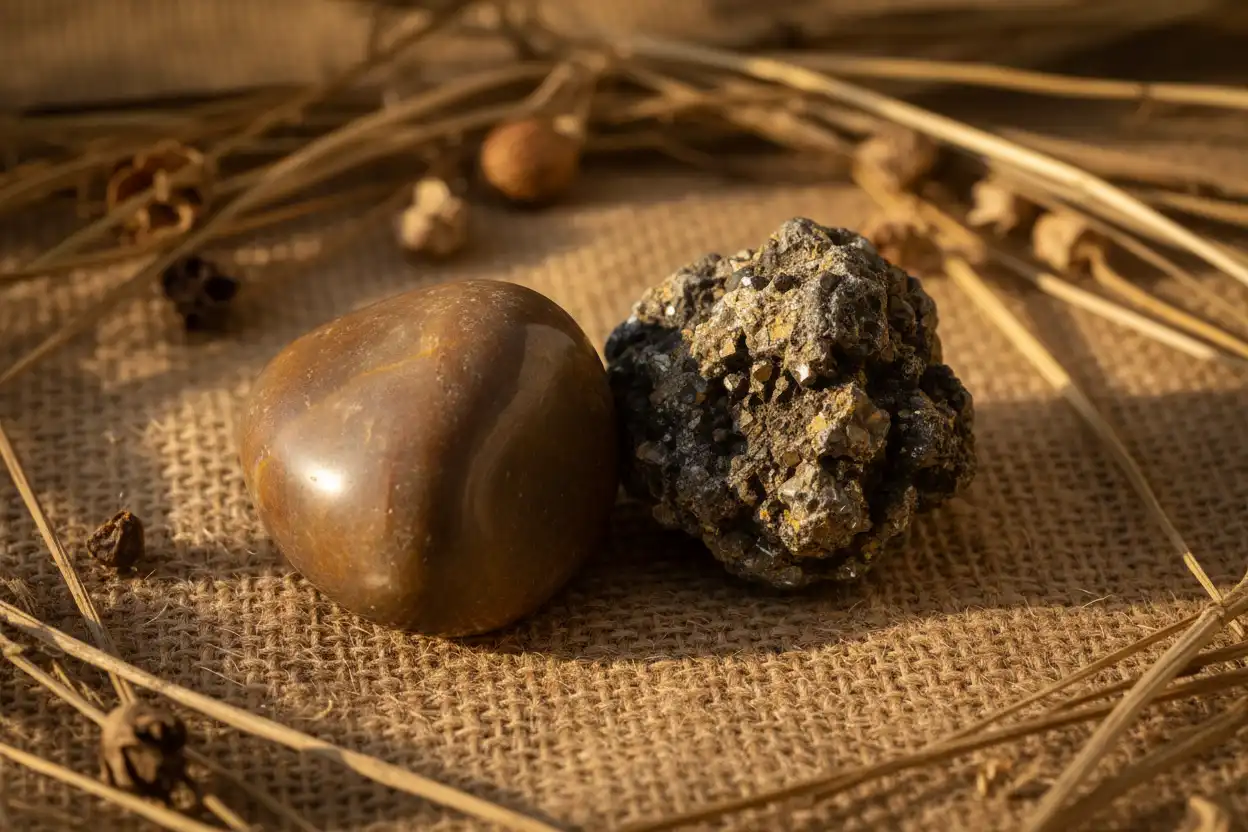

Boji Stones are rounded or irregular iron-rich concretions marketed from Kansas, United States. Although sellers often describe them as pyrite-bearing stones, their exact mineral composition can vary because oxidation may convert original iron sulfides into limonite, goethite, jarosite or related iron compounds.
Boji Stones at a Glance
| Property | Boji Stones |
|---|---|
| Material type | Iron-rich sedimentary concretions sold under a trademarked trade name |
| Composition | Variable; may include pyrite, marcasite and iron-oxide or iron-hydroxide alteration products |
| Colors | Dark brown, rusty brown, black, bronze and yellow-brown |
| Structure | Aggregate rather than one mineral crystal system |
| Habit | Rounded, flattened, knobby, botryoidal, spiky or concretionary |
| Luster | Dull, earthy, submetallic or locally metallic |
| Transparency | Opaque |
| Mohs hardness | Variable, commonly about 4–6.5 depending on mineral content and alteration |
| Cleavage | Not meaningful for the concretion as a whole |
| Tenacity | Brittle; altered specimens may become friable |
| Common use | Geological specimens, paired display pieces, pendants and metaphysical collections |
| Main care concern | Oxidation, crumbling, moisture, sulfide dust and inaccurate identification |
What Are Boji Stones?
Boji Stone is a trademarked commercial name rather than an approved mineral species.
Geologically similar objects appear under names such as Kansas Pop Rocks, iron-sulfide concretions and pyrite concretions. However, only authorized products with the appropriate documentation should carry the branded Boji name in a commercial setting.
The concretions formed within sediment before the surrounding material completely hardened into rock. During this process, chemical reactions concentrated iron and sulfur around small nuclei, sedimentary structures or organic material.
Later weathering altered many specimens. Consequently, one concretion may preserve pyrite or marcasite internally while its outer surface consists largely of brown iron oxides and hydroxides.
Are Boji Stones Pyrite?
Some Boji-type concretions contain pyrite, while others may include marcasite or alteration products created from either mineral.
Pyrite and marcasite share the formula FeS₂ but have different crystal structures. Moreover, marcasite generally deteriorates more readily under humid storage conditions.
As sulfides react with oxygen and moisture, they can produce yellow, brown or rusty alteration minerals. Therefore, an old specimen may no longer show the metallic brassy appearance commonly associated with fresh pyrite.
A visual inspection cannot determine the exact proportions of pyrite, marcasite, goethite, limonite or jarosite. Instead, X-ray diffraction or chemical analysis provides more reliable identification.
How Kansas Pop Rocks Formed
Kansas Pop Rocks occur within sedimentary rocks of the Smoky Hill Chalk Member of the Niobrara Formation in western Kansas.
During the Late Cretaceous, a broad inland sea covered the region. Fine calcareous mud accumulated on the seafloor and eventually hardened into chalk and chalky shale.
Before complete lithification, oxygen-poor conditions allowed iron sulfides to precipitate within the soft sediment. As growth continued, the concentrated material formed nodules, flattened masses and small polycrystalline aggregates.
Weathering later exposed the concretions as surrounding chalk eroded. Consequently, people may find loose examples in washes, slopes and gullies rather than attached to fresh bedrock.
These objects did not require metamorphism or volcanic heat. Instead, chemical precipitation within marine sediment produced the original concretions.
Where Do Boji Stones Come From?
Commercial Boji Stones are associated with western Kansas, particularly the Gove County region.
The wider landscape contains the Smoky Hill Chalk, which also preserves abundant marine fossils from the Western Interior Seaway. However, sellers often keep the precise branded collecting location private.
Similar concretions can occur elsewhere, including other parts of the Niobrara Formation. Nevertheless, a comparable iron nodule from another locality should not automatically receive the trademarked name.
A credible seller should distinguish among:
- A certified branded Boji Stone.
- An unbranded Kansas Pop Rock.
- A pyrite or marcasite concretion from another locality.
- A Moqui Marble from Utah.
- An unidentified iron-rich nodule.
Boji Stones and the “Male” and “Female” Labels
Retailers traditionally divide Boji Stones into rougher and smoother forms.
They often call the knobby or crystalline-looking pieces “male” stones and the smoother examples “female” stones. However, rocks do not have biological sex or gender.
Accordingly, those labels describe a commercial and metaphysical tradition rather than geological categories. Surface texture can reflect mineral growth, oxidation, breakage and weathering without implying different sexes.
Some buyers prefer using the terms rough and smooth instead. That wording describes the visible feature directly and avoids presenting symbolic language as mineral science.
Boji Stones Meaning and Symbolism
Modern crystal traditions associate Boji Stones with balance, stability and coordinating different parts of daily life.
Paired use often symbolizes cooperation between contrasting qualities, such as action and reflection or structure and flexibility. Meanwhile, their dense iron-rich composition can represent staying attentive to practical concerns.
Some people hold one stone in each hand during meditation. Others keep a pair near a workspace as a reminder to balance competing responsibilities.
These practices reflect personal or spiritual traditions. They do not demonstrate scientifically proven medical, psychological or energetic effects.
Boji Stones vs. Moqui Marbles
Boji Stones and Moqui Marbles are frequently confused because both appear as rounded brown iron-rich objects.
Moqui Marbles generally consist of an iron-oxide shell surrounding a sandstone center. Collectors associate them primarily with the Navajo Sandstone of Utah and nearby regions.
Boji-type Kansas concretions, by comparison, commonly originate from chalky marine sediment and may contain iron sulfides or their alteration products.
Additional differences include:
| Feature | Boji-type Kansas concretion | Moqui Marble |
|---|---|---|
| Typical source | Western Kansas | Utah and nearby sandstone regions |
| Geological host | Chalk and chalky shale | Sandstone |
| Common internal material | Iron sulfides and alteration products | Sand-rich core with iron-oxide shell |
| Surface | Smooth, knobby or crystalline-looking | Commonly rounded with a rough shell |
| Commercial tradition | Often sold in paired rough/smooth forms | Commonly sold as singles or pairs |
Trade names alone cannot confirm origin. Therefore, provenance matters more than superficial resemblance.
Boji Stones vs. Marcasite
Marcasite is an orthorhombic FeS₂ mineral that can occur in sedimentary concretions.
Fresh marcasite may show a pale brass metallic appearance. However, oxidation can turn it dull, brown, yellow or powdery.
A Boji-type concretion may contain marcasite, pyrite or both. Consequently, sellers should avoid claiming one uniform composition without testing.
Storage recommendations should follow the most sensitive possibility. For that reason, dry and stable conditions provide safer care than regular water cleansing.
Boji Stones vs. Bornite
Bornite is a copper-iron sulfide, while Boji-type concretions primarily contain iron-bearing materials.
Fresh bornite looks bronze-brown and can develop purple-blue tarnish. In contrast, Boji Stones usually show dark brown, black or rusty surfaces without bornite’s characteristic copper-rich interior.
The neighboring Bornite guide explains peacock-ore coloration and copper-sulfide identification.
Are Boji Stones Magnetic?
Untreated pyrite and marcasite concretions generally show little or no magnetic attraction.
However, heating can transform part of an iron sulfide into magnetic phases such as pyrrhotite or magnetite. Therefore, a magnetic specimen may have experienced heat treatment or contain another iron mineral.
A magnet test cannot establish authenticity. Additionally, some altered concretions respond weakly because their composition varies across the surface.
Use magnetism as one observation rather than a final conclusion.
Can Boji Stones Spark or “Pop”?
Iron-sulfide concretions can spark when struck or cut with suitable tools. Moreover, heating them may release sulfurous fumes or cause sudden breakage.
The term Kansas Pop Rocks refers partly to reports that some concretions crack or burst when placed in a fire.
Never test that behavior at home. Heat can produce sharp fragments, sulfur dioxide and other hazardous fumes.
Likewise, grinding a concretion can release silica, iron-sulfide and alteration-mineral dust. Professional dust controls remain essential.
Are Boji Stones Gemstones?
Boji Stones are collector and ornamental objects rather than conventional gemstones.
Their appeal comes from natural texture, Kansas provenance, paired presentation and metaphysical history. Transparent faceting material does not exist within this product category.
Jewelry makers occasionally use them as:
- Wire-wrapped pendants.
- Caged natural stones.
- Drilled pendants.
- Resin-protected components.
- Decorative brooch elements.
However, drilling can expose unstable sulfides and create hazardous dust. Natural holders or removable wire cages therefore provide a safer option than home drilling.
How Boji Stones Are Sold
The market contains both certified branded stones and unbranded geological equivalents.
| Commercial form | Typical description |
|---|---|
| Small unbranded concretion | Kansas Pop Rock or pyrite concretion |
| Certified single stone | Branded piece with authenticity documentation |
| Rough-and-smooth pair | Traditional commercial pairing |
| Unusual geometric pair | Selected for complementary shapes |
| Pendant | Natural concretion secured in a holder |
| Old-stock specimen | Earlier certified product with original paperwork |
Certification verifies the retail source and branded product. However, it does not independently prove metaphysical claims.
Boji Stones Price and Value
Indicative July 2026 retail asking-price ranges are:
| Boji Stones form | Approximate retail range |
|---|---|
| Small unbranded Kansas concretion | $10–$25 |
| Certified small single stone | $30–$50 |
| Standard certified pair | $60–$125 |
| Selected unusual or sculptural pair | $95–$250+ |
| Pendant | $35–$75 |
| Large old-stock or documented set | $125–$400+ |
| Unverified “rare” listing | Requires careful comparison |
Authorized current listings place small certified stones near $30–$40, while selected pairs commonly appear around $95–$125.
The certificate, trademark, presentation and retail history create much of this premium. Mineral rarity alone does not justify extremely high four- or five-figure prices.
What Makes Boji Stones Valuable?
Documentation
Original certificates, packaging and purchase records support branded provenance.
Condition
Stable surfaces matter because oxidized concretions can crack, flake or produce powder.
Shape
Balanced pairs and unusual natural forms may attract collectors.
Size
Large pieces can cost more, although stability and surface quality remain more important than weight alone.
Provenance
A documented Kansas source provides greater confidence than a generic iron nodule with no locality.
Market Category
Branded metaphysical products and ordinary geological concretions operate in different pricing markets.
How to Identify Boji Stones
Begin by documenting the specimen’s weight, dimensions, surface texture and provenance.
A likely Kansas iron concretion may show:
- Brown, black or rusty color.
- Rounded or knobby shape.
- Dense feel.
- Metallic grains beneath altered surfaces.
- Sedimentary rather than igneous matrix.
- Weak or absent magnetism.
- Iron-rich streak or residue.
- Kansas collection documentation.
Nevertheless, similar objects include slag, pyrite concretions, marcasite nodules, Moqui Marbles, limonite concretions and manufactured metal pieces.
Follow the broader process in How to Identify Crystals before considering laboratory analysis.
Can Boji Stones Go in Water?
Do not soak Boji Stones.
Moisture can accelerate sulfide oxidation, weaken altered surfaces and encourage powdering. Additionally, water may carry acidic oxidation products into cracks.
A dry cloth or soft brush provides safer routine care. Likewise, avoid saltwater, vinegar, lemon juice and chemical cleansers.
How to Clean Boji Stones
Use a soft, dry artist’s brush to remove loose dust.
Next, wipe stable surfaces gently with a dry microfiber cloth. If powder continues to appear, isolate the specimen from other minerals and reduce humidity.
Do not apply oil, wax or sealant without understanding the mineral composition. Although a coating may deepen the color, it can trap moisture or conceal ongoing deterioration.
How to Store Boji Stones
Keep each specimen in a dry, ventilated container.
Acid-free tissue or inert foam can protect it from impact. However, an airtight box may trap moisture unless the environment remains controlled.
Store the stone separately from silver jewelry, delicate minerals and paper labels. Sulfide oxidation products can stain nearby materials.
Frequently Asked Questions
Are Boji Stones a mineral?
No. The name describes a trademarked commercial product made from naturally occurring iron-rich concretions.
Are all Kansas Pop Rocks Boji Stones?
No. Boji is a branded name, while Kansas Pop Rock describes a broader geological type.
Are Boji Stones pyrite?
Some contain pyrite, marcasite or both, although oxidation may convert much of the surface into other iron minerals.
Are rough and smooth stones scientifically male and female?
No. Those terms belong to a retail and metaphysical tradition rather than geology.
Why is my Boji Stone crumbling?
Moisture and sulfide oxidation can weaken the concretion. Move it to a dry environment and avoid further cleaning with water.
Can Boji Stones be worn as jewelry?
A secure wire cage can hold a stable stone, although drilling and everyday impact may damage the material.
Explore additional iron-rich materials through Crystals That Start With B or browse the Gemstone Guides collection.
Disclaimer: Boji Stone symbolism reflects personal or spiritual traditions rather than scientifically proven medical or psychological effects. Do not ingest the material, place it in drinking water, heat it, burn it or inhale dust created during cutting or deterioration.