Boji Stones Meaning: Identity, History & Symbolism
Boji Stones meaning is commonly associated with balance, grounding, steadiness, perspective, and bringing opposing priorities into a more workable relationship. The objects themselves, however, are more complicated than the commercial name suggests. Boji Stones are not a formally recognized mineral species with one fixed composition or crystal system; they are iron-rich concretions associated with Kansas and may contain pyrite, marcasite, iron oxides or hydroxides, sedimentary material, and alteration products in proportions that vary from specimen to specimen. Mineral collectors discussing comparable Kansas material commonly describe the nodules as being largely pyrite and marcasite with weathered limonite-like outer alteration.
That distinction matters because simplified descriptions often treat every Boji Stone as though it were one homogeneous crystal. A concretion is instead a mineralized mass that developed within sediment as dissolved constituents precipitated around a nucleus or became concentrated in a localized zone. Weathering can subsequently alter the iron sulfides, darken or rust the exterior, create secondary minerals, open fractures, and change the stone’s stability. Two genuine Kansas iron-rich concretions can therefore differ significantly in surface texture, metallic content, hardness behavior, density, and long-term condition.
For a broader mineral-first approach to ornamental stones, see the Gemstone Guides.
What Are Boji Stones?
Boji Stones are best described as naturally occurring iron-rich concretions marketed under a commercial name rather than as a distinct mineral species comparable with quartz, calcite, pyrite, or garnet. Public descriptions of the material commonly connect it with Kansas and identify pyrite and marcasite as important constituents, with the outer portions often altered to brown iron-oxide or iron-hydroxide material.
Pyrite and marcasite are particularly important because they share the same overall chemical formula, FeS₂, but possess different crystal structures. Pyrite crystallizes in the cubic system, whereas marcasite is orthorhombic. That structural difference influences physical behavior and stability, especially during oxidation and storage.
| Feature | Boji Stones context |
|---|---|
| Material type | Iron-rich sedimentary concretion |
| Formal mineral species | No |
| Common important constituents | Pyrite, marcasite and weathering products |
| Common iron-sulfide chemistry | FeS₂ where pyrite or marcasite is present |
| Outer appearance | Brown, rusty brown, dark gray to black |
| Internal appearance | May contain dull to metallic iron-sulfide-rich material |
| Structure | Heterogeneous concretion rather than one uniform crystal |
| Typical surface | Smooth, irregular, knobby or locally angular |
| Crystal system | No single crystal system applies to the whole concretion |
| Hardness | Variable with mineral proportions and weathering |
| Density | Variable with composition |
| Major identification limitation | Exterior appearance cannot determine exact mineral percentages |
| Important storage concern | Oxidation of unstable iron sulfides in some specimens |
This variability means that copying the hardness, density, luster, and crystal system of pure pyrite onto every Boji Stone would be misleading. The actual object may contain several phases and may have been substantially altered since formation.
Are Boji Stones Pyrite?
Pyrite can be an important part of Boji Stones, but “Boji Stone” and “pyrite” are not interchangeable names. Pyrite is a defined mineral species with FeS₂ chemistry and cubic crystal structure. A Boji Stone is a concretion that may contain pyrite together with marcasite, weathering products, sedimentary matter, and other components.
A fresh fracture can sometimes reveal brassy or metallic iron-sulfide material beneath a darker weathered exterior. Conversely, a heavily oxidized stone may show little bright metallic material at the surface even if iron sulfides remain internally.
The same distinction applies when comparing Boji Stones with bornite. Both may look dark or metallic in certain states, but bornite is a copper-iron sulfide mineral with a different composition and characteristic alteration colors. Similar appearance does not establish related identity.
Pyrite and Marcasite Are Not the Same Mineral
Pyrite and marcasite are polymorphs. They have the same nominal FeS₂ chemistry but different atomic structures, which means they behave differently despite sharing the same constituent elements.
Pyrite is generally more stable under ordinary collection conditions. Marcasite is notorious among mineral collectors for deteriorating when exposed to unfavorable humidity and oxygen, producing acidic alteration products, powdery crusts, cracking, and eventual specimen breakdown. Pyrite can also oxidize, especially when finely divided, fractured, porous, or associated with reactive material, but marcasite-rich specimens deserve particular storage attention.
This difference is one reason a heterogeneous concretion should not be treated as chemically and mechanically predictable. If the precise pyrite-to-marcasite relationship matters, visual inspection alone is not sufficient.
How Boji Stones Form
Concretions form when mineral matter becomes concentrated within sediment rather than remaining evenly distributed throughout the host material. Dissolved chemical components migrate through pore water and precipitate around a nucleus, within a favorable chemical zone, or along localized structures. As mineralization proceeds, sediment grains can become cemented into a resistant nodule.
In iron-sulfide concretions, reducing sedimentary conditions can favor sulfide formation when available iron interacts with reduced sulfur. Pyrite and marcasite can crystallize in nodules, layers, radiating aggregates, or more irregular forms. Later uplift and weathering expose the concretions to oxygenated water and air, allowing sulfides near the surface to oxidize into brown, orange, yellow, or rusty secondary iron compounds.
That alteration can produce the characteristic contrast between a dull dark-brown exterior and more metallic material within. It can also make the stone chemically and mechanically less stable over time.
The detailed sedimentology, host-rock context, mineral transformations, and alteration sequence belong in the dedicated Boji Stones formation and deposit geology guide.
Why Do Some Boji Stones Look Smooth and Others Knobby?
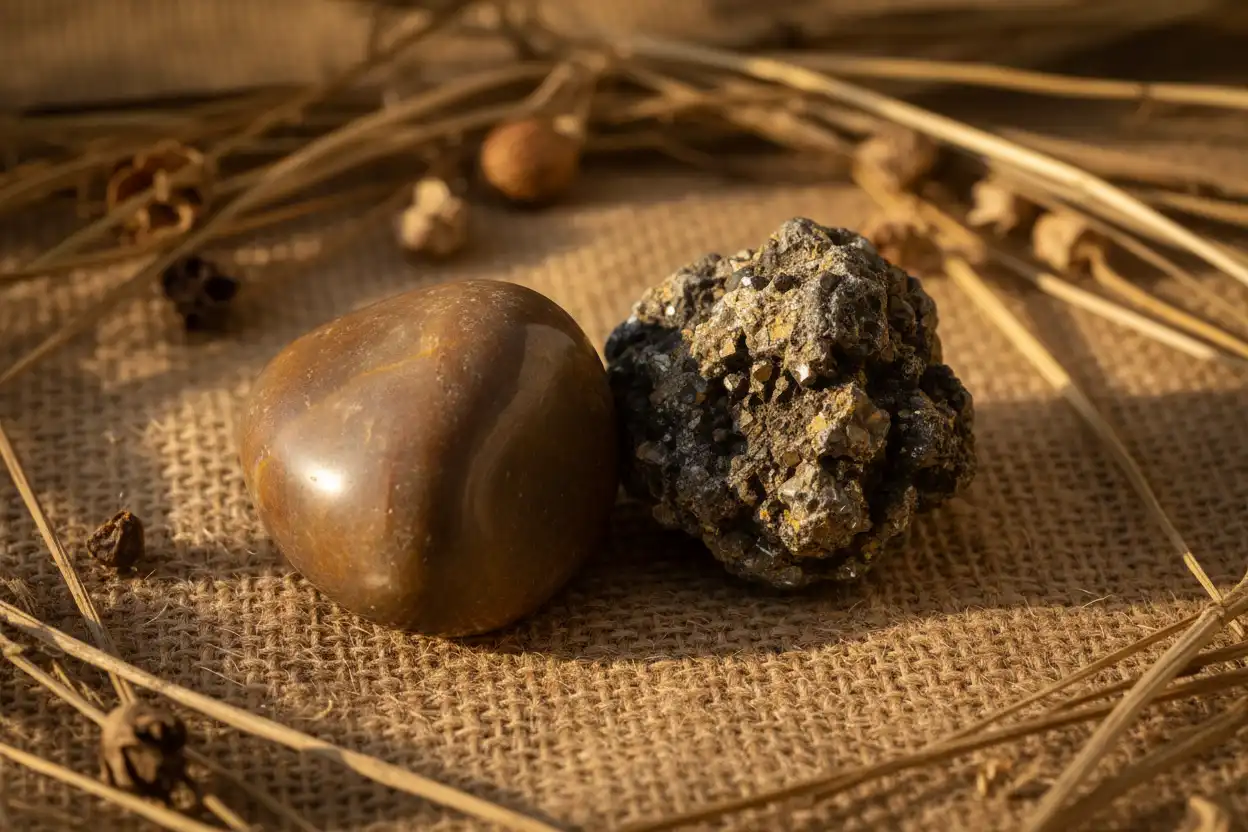
Commercial descriptions frequently divide Boji Stones into smoother and more strongly protruding forms, often calling them “female” and “male” respectively. The observable surface difference can be real, but the gender terminology is commercial or metaphysical rather than mineralogical.
A knobby surface can result from crystal growth, differential weathering, irregular concretion development, mineral projections, or the way harder zones resisted erosion. A smoother concretion may have formed differently, weathered more uniformly, or lost projections during geological exposure and transport.
The shape itself does not demonstrate biological sex, energetic polarity, emotional character, or a complementary male/female field.
The commercial Boji Stones site explicitly describes the “male” and “female” terminology as part of its own naming and metaphysical system, linking protruding specimens with one category and smoother specimens with another. That is evidence that the terminology exists in the trade; it is not geological evidence of sex or energy polarity.
A Source-Comparison Guide to Common Boji Stones Claims
Boji Stones are a useful case study in why geological statements, commercial naming, and metaphysical claims should be separated.
| Claim | Evidence status | Better interpretation |
|---|---|---|
| Boji Stones are a formally recognized mineral species | Unsupported | They are better described as iron-rich concretions sold under a commercial name |
| Pyrite commonly occurs in Boji-type material | Reasonable and widely reported | Pyrite can be an important constituent |
| Marcasite can occur with pyrite | Reasonable and widely reported | Exact proportions require specimen-specific analysis |
| Weathering can produce brown iron-rich alteration | Supported geologically | Oxidation changes the exterior and may affect stability |
| Every Boji Stone has one fixed chemical formula | Incorrect | A heterogeneous concretion can contain multiple minerals |
| Smooth and knobby stones represent biological female and male specimens | Unsupported | These are commercial/metaphysical categories based primarily on appearance |
| One category naturally carries positive polarity and the other negative polarity | Unsupported | No standard mineralogical test establishes such metaphysical polarity |
| Genuine Boji Stones magnetically repel or attract one another | Not expected from pyrite/marcasite alone | Strong movement would justify checking for magnetite or concealed magnetic material |
| Boji Stones are identical to Moqui Marbles | Misleading | Similar-looking concretions can have different mineralogy and geological origin |
| Boji Stones scientifically balance human energy | Unsupported | Balance is a symbolic interpretation |
| Their hardness decreases when spiritual energy is depleted | Unsupported | Physical deterioration is better explained through mineral alteration |
| Holding a pair removes pain | Medical claim without adequate evidence | It should not substitute for diagnosis or treatment |
| A certificate alone proves mineral composition | Insufficient | Provenance documentation and mineral analysis answer different questions |
This framework is more useful than treating every statement as either fully true or completely false. A commercial name can have a real history, a surface category can exist in the marketplace, and a symbolic practice can be personally meaningful while none of those things establishes a new mineral species or medical mechanism.
Boji Stones Versus Moqui Marbles
Boji Stones are often confused with Moqui Marbles or “shaman stones” because both can occur as dark, rounded iron-rich concretions sold in metaphysical markets. They are not automatically the same geological material.
Moqui Marbles are most famously associated with sandstone environments of the American Southwest and are generally described as sandstone-rich concretions coated or cemented by iron oxides. Boji-type Kansas concretions are associated more strongly with iron sulfides such as pyrite and marcasite and their oxidation products. The surface colors may overlap after weathering, but mineralogy and provenance matter far more than brown color or rounded shape.
A seller using the terms interchangeably should therefore provide geological and compositional evidence rather than relying on visual similarity.
Can Two Boji Stones Attract or Repel Each Other?
Pyrite, marcasite, and common limonite-like alteration products are not normally expected to make two hand specimens strongly attract or repel each other across a tabletop. A discussion among mineral specialists on Mindat noted that strong movement would be difficult to explain through pyrite and marcasite alone and suggested that magnetite replacement, another magnetic phase, or concealed manufactured material would need consideration.
This is an excellent example of an evidence-based diagnostic boundary. If two purported Boji Stones noticeably pull toward or push away from one another, the observation should be investigated physically rather than interpreted immediately as energetic polarity.
A simple compass or controlled magnetism test can establish whether a specimen has an unusually strong magnetic response. If so, further mineralogical investigation is more appropriate than a metaphysical conclusion.
What Natural Boji Stones May Look Like
There is no single perfect external shape. Iron-rich concretions can be rounded, flattened, irregular, nodular, knobby, or partly angular. Weathered surfaces may look matte brown, rusty, blackish, or dark gray, while protected areas and fresh fractures may preserve more metallic material.
Natural variation is expected because several factors interact:
original concretion geometry;
relative pyrite and marcasite content;
sediment incorporated during growth;
fractures;
degree of oxidation;
groundwater chemistry;
time exposed at the surface;
abrasion or weathering;
secondary mineral coatings.
A completely uniform product line in which every specimen has identical size, surface texture, color, and projections would deserve closer scrutiny because natural concretions generally vary.
Original Boji Stones Specimen and Photo Checklist
Use this checklist as a first-pass evidence framework rather than an authenticity guarantee.
Record the whole specimen before testing
Photograph all sides under neutral lighting and record dimensions, weight, labels, packaging, certificate details, and seller provenance claims.
Examine surface texture
Note whether the exterior is smooth, knobby, rusty, dark, granular, metallic, or powdery. Describe what is visible rather than assigning “male” or “female” identity as a geological fact.
Look for natural weathering
Irregular oxidation, sediment remnants, fractures, and varied surface color can be consistent with a weathered concretion. Perfectly painted-looking surfaces or obvious coatings deserve closer examination.
Inspect any natural break
A pre-existing chip or fracture may reveal more metallic iron-sulfide material beneath the altered exterior. Do not deliberately break an important specimen just to look inside.
Check for deterioration
Watch for new powder, cracking, sulfurous odor, yellowish or whitish alteration products, damp surfaces, or expanding fractures. These can indicate active sulfide decay.
Compare weight with size
Iron-rich concretions may feel relatively heavy, but density is variable. Weight alone cannot establish authenticity.
Check magnetic response carefully
Strong attraction to a magnet is not a defining property of pyrite or marcasite. An unusually magnetic specimen may contain magnetite or another magnetic component that deserves investigation.
Examine projections under magnification
Angular protrusions may reflect original mineral growth or weathering. Their presence does not establish metaphysical gender.
Look for mold seams
A seam, cast texture, resin-like interior, or repeated identical surface pattern can indicate manufacture.
Do not rely on sparks
Creating sparks by striking iron-sulfide material is not an appropriate authenticity test for a collectible object and introduces unnecessary impact and fragment hazards.
Do not use acid casually
A heterogeneous concretion may react unpredictably depending on included phases. Acid can permanently alter the specimen.
Keep provenance separate from mineral identity
A certificate can support a chain of sale or claimed source, but it does not independently establish exact mineral composition.
Treat strong energy claims separately
Claims of polarity, pain relief, chakra effects, or energetic balancing are not diagnostic mineral tests.
Escalate conflicting evidence
If appearance, density, magnetism, microscopy, and provenance do not align, avoid forcing an identification.
For internal textures, sulfide remnants, alteration products, coatings, fractures, and the limits of visual examination, use the Boji Stones microscope inclusion notebook.
What Magnification Can Tell You
A loupe or microscope can reveal significantly more than the unaided eye. Metallic grains, radiating sulfide textures, alteration along fractures, porous zones, secondary coatings, sedimentary material, tool marks, resin, and artificial surface treatments may become visible.
Magnification can also show whether a dark coating is simply superficial or whether mineral texture continues into damaged areas. If a concretion is actively degrading, newly formed crystals or powdery alteration may develop along fractures.
What microscopy usually cannot provide by itself is a reliable quantitative pyrite-to-marcasite ratio. The two minerals can require diffraction or spectroscopic methods for confident differentiation, particularly when grains are fine, altered, or intergrown.
How Exact Composition Can Be Tested
When composition genuinely matters, analytical methods provide much stronger evidence than a seller’s generic description.
X-ray diffraction can help distinguish crystalline pyrite, marcasite, and other mineral phases.
Raman spectroscopy can provide mineral-specific spectral fingerprints for many sulfides, oxides, and alteration products.
Reflected-light microscopy can help characterize metallic mineral textures in prepared material.
Elemental analysis can identify iron, sulfur, and associated elements but must be interpreted carefully because elemental composition alone does not distinguish polymorphs such as pyrite and marcasite.
Scanning electron microscopy with chemical analysis can examine fine-scale textures and associated elements when detailed characterization is necessary.
None of these methods establishes metaphysical polarity or whether a stone is “male” or “female.” They answer mineralogical questions.
Why Hardness Numbers for Boji Stones Are Often Misleading
Published commercial descriptions sometimes assign a single Mohs hardness to Boji Stones. That creates a false impression of uniformity.
Pure pyrite has one characteristic hardness range, marcasite has another, iron oxides and hydroxides differ again, and a weathered concretion may contain porous alteration zones or sedimentary material. Testing one projection can therefore produce a different result from testing a dense internal region.
The correct observation is that hardness is specimen- and location-dependent within a heterogeneous concretion. A number copied from one constituent should not be treated as the definitive hardness of the entire object.
The same reasoning applies to specific gravity.
Optical Appearance Is Also Variable
Boji Stones are primarily opaque geological objects rather than transparent gems, but their surface appearance still provides useful information. Fresh sulfide-rich regions may show metallic luster, while oxidized surfaces can become dull, earthy, brown, blackish, or rusty.
This visible transformation is fundamentally different from the optical behavior of a chatoyant gem such as blue tiger’s eye, where an aligned fibrous internal structure creates a moving light band. A dark surface alone therefore tells little about mineral identity.
Detailed discussion of luster, reflectance, weathered surfaces, and why certain specimens appear metallic belongs in Boji Stones optical properties and color behavior.
The Commercial History of the Boji Name
The word “Boji” is part of the commercial history of these stones rather than a traditional mineralogical species name. The current trademark-oriented Boji Stones site attributes the term to the person associated with marketing the material and recounts a personal childhood story as the origin of the name. The same commercial source promotes paired “male” and “female” categories and attaches energetic interpretations to them.
This history matters because it separates two questions that are often blended together: what the geological object is and how the modern trade name developed.
The geological object can be studied through mineralogy and sedimentary geology. The Boji name, paired-stone tradition, and energy claims belong to commercial and metaphysical history.
They should not be projected backward automatically into ancient geological or Indigenous traditions without evidence.
Are “Male” and “Female” Boji Stones Scientifically Different?
Not in the biological or energetic sense implied by the terminology.
Commercial descriptions usually call specimens with pronounced protrusions “male” and smoother examples “female.” Surface texture is observable. Gendered energy polarity is not a mineralogical classification.
A specimen with projections may differ texturally or mineralogically from a smoother specimen, but establishing why requires examination of growth structures, mineral phases, and weathering. The descriptive labels do not demonstrate complementary electrical polarity, hormone-like behavior, masculine force, feminine force, or a biologically meaningful sex.
If someone enjoys pairing a smooth and knobby stone as a symbol of contrast or balance, that is a legitimate personal interpretation. It should simply remain symbolic.
Boji Stones Meaning in Modern Symbolism
Modern Boji Stones meaning commonly emphasizes balance, grounding, stability, integration, resilience, and reconciling apparent opposites. Much of the symbolism is reinforced by the common practice of using two stones together, particularly a smoother and a more textured specimen.
A person might use the pair as a physical reminder that two competing priorities can coexist, place them beside a journal when evaluating a difficult decision, or hold one in each hand during a quiet reflection exercise. The tactile contrast between smooth and irregular surfaces can make the symbolic exercise memorable.
In that context, the stones function as objects of attention. Their usefulness depends on the meaning and behavior the user attaches to them rather than on a scientifically established energy exchange.
Grounding as a Metaphor
“Grounding” is often used ambiguously. In electrical engineering, grounding has a precise physical meaning involving electrical potential and conductive pathways. In mental-health or contemplative language, grounding can describe deliberate attention to present sensory experience. In crystal practice, grounding is often presented as an energetic property.
These meanings should not be conflated.
Holding a dense, textured geological object can certainly provide tactile sensory input. Someone may use that physical sensation as a cue to notice breathing, posture, surroundings, or immediate priorities. That is a practical reflective use.
It is different from claiming that the stone drains an invisible negative substance into the Earth.
Do Boji Stones Balance Energy?
No standard mineralogical, medical, or physical test has established that Boji Stones balance a human energy field. Terms such as balanced energy, masculine and feminine polarity, chakra harmonization, or energetic alignment belong to metaphysical systems.
The existence of iron sulfides does not validate those claims. Pyrite and marcasite have measurable electrical, magnetic, optical, and chemical properties, but a real physical property cannot be used automatically as evidence for a separate undefined biological or spiritual mechanism.
A person may still use a pair as a symbol of balance. That statement does not require a laboratory claim.
Can Boji Stones Relieve Pain?
Commercial metaphysical descriptions have attributed pain-relieving effects to Boji Stones. The branded seller site, for example, makes explicit statements that placement of the stones can remove pain.
That should be recognized as a health claim, not a mineralogical property. The mineral composition of an iron-rich concretion does not establish analgesic action through ordinary external contact.
Pain can have many causes, some minor and some requiring urgent medical evaluation. A stone should not replace diagnosis, medication, physical therapy, emergency assessment, or other appropriate healthcare.
Someone can use a stone during relaxation or meditation if they enjoy doing so, but subjective relaxation should not be presented as evidence that the specimen treats the underlying cause of pain.
Boji Stones and Chakras
Modern metaphysical sources sometimes associate Boji Stones with all chakras or use a pair to symbolize whole-body energetic balance. These ideas belong to contemporary spiritual practice.
A chakra is not a mineralogical characteristic. X-ray diffraction can distinguish mineral structures; spectroscopy can identify many mineral phases; microscopy can document textures. None determines that a chakra is activated, blocked, balanced, or cleansed.
The symbolism can therefore be discussed without presenting it as human anatomy.
Boji Stones Versus Other Dark Mineral Materials
The dark brown-to-black appearance can place Boji Stones visually alongside many unrelated materials. For example, Botswana agate is a silica-rich banded chalcedony, while blue kyanite is an aluminum silicate crystal with directional hardness. Neither is geologically comparable with an iron-sulfide-rich concretion despite occasionally overlapping in dark gray tones.
This reinforces a central identification rule: color is one observation, not a mineral name.
Provenance Is Especially Important
Because Boji is a commercial name connected with a particular source story, provenance matters more than it does for a generic iron concretion.
A seller claiming an authentic source should ideally be able to provide a coherent chain connecting the specimen to the documented Kansas material. Useful evidence can include older labels, source records, supplier documentation, acquisition information, collection history, or other traceable material.
A branded certificate may contribute to commercial provenance, but it answers a different question from mineral analysis. A document can say where a seller claims the stone came from; X-ray diffraction can say which crystalline phases are present. Neither automatically substitutes for the other.
The Boji Stones provenance disclosure checklist provides a structured approach to evaluating those claims.
Safe Ownership: Stability Matters More Than Metaphysics
An intact, stable Boji Stone does not need to be treated as inherently dangerous simply because it may contain iron sulfides. The more practical concern is whether the specimen is actively oxidizing.
Pyrite and especially marcasite can deteriorate in unfavorable storage conditions. Warning signs can include:
newly developing powder;
cracking or flaking;
yellow, white, greenish, or rusty alteration products;
sulfurous or acidic odors;
damp-looking areas;
staining of storage material;
corrosion of nearby metal;
damage to labels or boxes.
A deteriorating specimen should be isolated from unaffected collection pieces. Dry, stable storage and periodic inspection are more useful than mystical “cleansing.”
The Boji Stones specimen conservation record provides a structured way to document changes in condition.
Moisture Can Be a Real Problem
Iron-sulfide deterioration can be accelerated by moisture and oxygen. This is one reason soaking a Boji Stone simply because a crystal-care source recommends water for “cleansing” can be unwise.
A heterogeneous concretion may contain fractures and reactive sulfides that do not respond well to prolonged moisture. Any physical cleaning should therefore be conservative and should account for actual mineral condition.
Spiritual cleansing practices and specimen conservation answer different questions. A symbolic ritual can be performed without physically wetting or chemically treating the stone.
Cutting and Grinding Require More Caution
Boji Stones are generally valued as natural concretions rather than faceting rough, and cutting can destroy geological textures that make an important specimen useful to collectors. It can also expose fresh reactive sulfides.
Grinding, drilling, sawing, or polishing produces mineral dust and potentially exposes several phases at once. Dust should not be inhaled. Appropriate local extraction, eye protection, respiratory controls, and wet-working practices where suitable are preferable to uncontrolled dry grinding.
Detailed lapidary considerations belong in the Boji Stones cutting, orientation and polish guide rather than being expanded into a full workshop manual here.
Jewelry and Mounting
Some Boji Stones are sold as pendants or mounted specimens, but their irregular surfaces, variable stability, fractures, and potential sulfide alteration make them different from conventional durable gemstones.
A mounting should avoid unnecessary mechanical stress, moisture traps, and adhesives that obscure developing deterioration. Heavy concretions also need physically secure support if worn.
The dedicated Boji Stones setting and wear engineering guide addresses those practical mounting questions without treating jewelry suitability as evidence of metaphysical effect.
Do Not Ingest Boji Stones or Make Elixirs
Boji Stones should not be ground into powder, swallowed, or immersed in drinking water for crystal-elixir use.
The exact mineral mixture can vary, and iron sulfide oxidation can generate acidic products and dissolved constituents. A heterogeneous geological concretion is not a food-grade substance merely because it is sold in a spiritual context.
Indirect symbolic use eliminates the need for ingestion entirely.
An Evidence Ladder for Boji Stones Claims
A useful way to interpret Boji Stones meaning is to match each type of claim with the evidence capable of answering it.
Direct observation can document shape, surface texture, color, fractures, metallic areas, powdering, dimensions, and weight.
Microscopy can reveal mineral textures, alteration, coatings, sedimentary material, artificial seams, and deterioration features.
Physical testing can investigate density, magnetic response, hardness behavior, and electrical characteristics when appropriate.
Mineralogical analysis such as Raman spectroscopy or X-ray diffraction can identify pyrite, marcasite, oxides, sulfates, and other crystalline phases.
Chemical analysis can characterize elemental composition but does not by itself establish crystal structure.
Geological evidence can determine whether a concretion’s mineralogy and sedimentary setting are compatible with the claimed formation environment.
Provenance documentation is required for claims that a specimen came from a specific source or commercial lineage.
Historical documentation is needed before assigning the stones to an ancient or Indigenous tradition.
Symbolic interpretation covers grounding, balance, polarity, masculine/feminine symbolism, and chakra use. These are human meanings and are not converted into geological facts through additional mineral testing.
What Boji Stones Meaning Can Reliably Include
Boji Stones meaning becomes clearer when material identity, commercial history, and symbolism are treated as separate layers.
Materially, Boji Stones are best understood as variable iron-rich concretions rather than a single mineral species. Pyrite and marcasite are commonly associated with the material, while weathering can create brown iron-rich alteration products and change both appearance and stability. Exact mineral proportions cannot be established from surface color or commercial naming alone.
Historically, the Boji name and the familiar “male” and “female” pairing belong to a modern commercial and metaphysical tradition. The gender terminology corresponds loosely to visible differences in surface texture, but there is no mineralogical evidence that the stones possess biological sex or complementary energetic polarity. The commercial source itself presents these distinctions within its branded spiritual framework.
Symbolically, a pair of contrasting stones can represent balance, integration, steadiness, or considering two sides of a problem. Those meanings can be used deliberately without claiming that the concretion treats pain, adjusts chakras, changes molecular structure according to spiritual energy, or creates an invisible protective field.
Readers moving forward through neighboring mineral references can continue with bornite meaning, while the preceding blue tiger’s eye meaning guide illustrates a very different iron-bearing material whose visible properties arise from fibrous quartz structure rather than concretionary iron sulfides.
Gems Lore explains its material-first approach on the About page. Health, spiritual, and informational limitations are set out in the Disclaimer, and factual corrections or supporting evidence can be submitted through Contact.
Boji Stones do not need extraordinary claims to be geologically interesting. Their real story involves sedimentary concretion growth, iron-sulfide mineralogy, pyrite-marcasite polymorphism, oxidation, specimen stability, provenance, and the development of a distinctive modern commercial mythology. Understanding those layers separately produces a more useful interpretation of Boji Stones meaning than either dismissing the symbolism entirely or presenting it as mineral science.