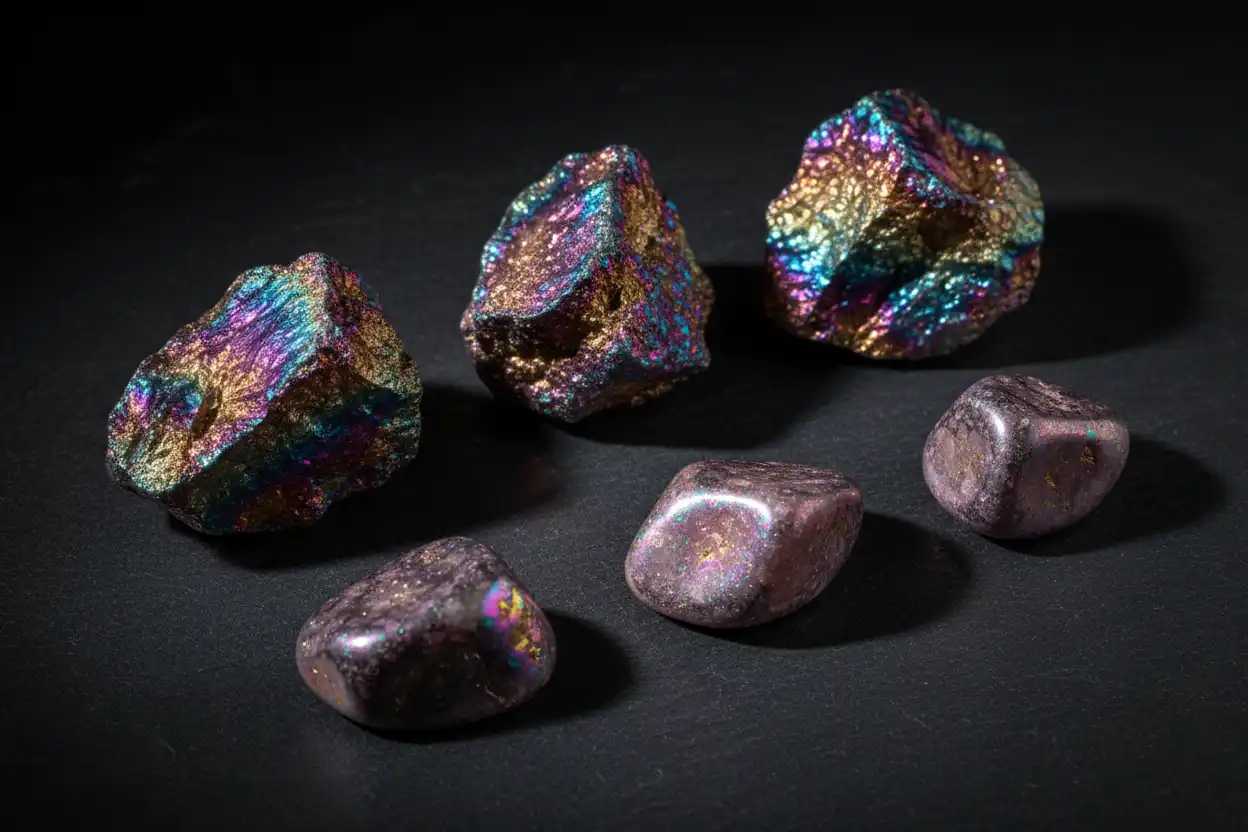
Bornite Meaning: Mineral Facts, History & Symbolism
Bornite meaning is often presented through modern themes such as transformation, confidence, optimism, creativity, and accepting change, largely because its metallic surface can develop dramatic purple, blue, violet, and bronze tarnish. Those interpretations belong to symbolism. Mineralogically, bornite is a copper-iron sulfide with the formula Cu₅FeS₄, an opaque metallic mineral important in copper deposits and historically valued far more for its copper content than for metaphysical use.
Fresh bornite is not necessarily rainbow-colored. A newly exposed surface is typically copper-red to bronze or brownish, then changes as atmospheric alteration develops on the surface. Mindat describes bornite as copper-red to brown and rapidly tarnishing toward an iridescent purplish appearance, with metallic luster, Mohs hardness around 3, and specific gravity a little above 5.
That distinction is essential because the familiar phrase “peacock ore” is used inconsistently. It can describe tarnished bornite, naturally tarnished chalcopyrite, or commercially treated chalcopyrite whose surface has been altered to produce bright iridescent colors. Colorful tarnish therefore does not establish bornite identity by itself.
Readers exploring other minerals through material identity first can browse the Gemstone Guides.
What Is Bornite?
Bornite is a naturally occurring copper-iron sulfide mineral with the ideal composition Cu₅FeS₄. At ordinary conditions it is commonly described as orthorhombic, although its crystal structure changes with temperature as copper and iron become more disordered at elevated temperatures. Well-formed crystals are comparatively uncommon; bornite more often occurs as massive, granular, disseminated, or irregular metallic material within copper-bearing ores.
It is opaque in ordinary specimens and has metallic luster. Fresh surfaces commonly show copper-red, bronze-brown, or pinkish-brown tones before oxidation modifies their appearance. The mineral is relatively soft compared with quartz-family gemstones, with a Mohs hardness around 3, and it is noticeably dense for its size because of its copper and iron content.
| Property | Bornite characteristics |
|---|---|
| Mineral species | Bornite |
| Chemical formula | Cu₅FeS₄ |
| Mineral class | Sulfide |
| Major elements | Copper, iron and sulfur |
| Crystal system at ordinary conditions | Orthorhombic |
| Typical fresh color | Copper-red, bronze-brown to brownish |
| Tarnished color | Commonly purple, blue, violet or darker iridescent tones |
| Luster | Metallic |
| Transparency | Opaque |
| Mohs hardness | About 3 |
| Specific gravity | Approximately 5.0 |
| Cleavage | Imperfect |
| Typical occurrence | Massive, granular or disseminated; distinct crystals are less common |
| Economic significance | Important copper-bearing mineral |
Bornite is therefore fundamentally an ore mineral, not a gemstone species defined by iridescence. Its dramatic surface colors are secondary features produced after the mineral has formed.
Why Bornite Is Called Peacock Ore
“Peacock ore” is an informal name inspired by rainbow-like tarnish. The problem is that the term has never been used exclusively for one mineral. Mineralogical references record it for both bornite and chalcopyrite because both copper sulfides can develop colorful surface films. Commercially, chalcopyrite is also sometimes chemically treated to produce particularly vivid blue, purple, gold, and green surfaces resembling highly tarnished copper minerals.
This creates three different objects that may all appear under the same retail label:
naturally tarnished bornite;
naturally tarnished chalcopyrite;
artificially tarnished or chemically treated chalcopyrite.
The label “peacock ore” therefore describes appearance more reliably than mineral identity.
A Source-Comparison Guide to Bornite Names and Claims
| Name or claim | Evidence status | More accurate interpretation |
|---|---|---|
| Bornite | Valid mineral species | Cu₅FeS₄ copper-iron sulfide |
| Peacock ore | Ambiguous informal term | Can refer to tarnished bornite or chalcopyrite |
| Peacock copper | Historical/common term associated with bornite | Useful historically but less precise than the mineral name |
| Purple copper ore | Historical descriptive terminology | Refers to bornite in older mineral literature |
| Bornite is naturally bright rainbow-colored throughout | Incorrect | Fresh bornite is usually copper-red to brown; iridescence develops mainly as surface tarnish |
| Every peacock ore specimen is bornite | Incorrect | Chalcopyrite can be sold under the same name |
| Very bright peacock colors prove high-quality bornite | Unsupported | Artificially treated chalcopyrite can be extremely colorful |
| Bornite and chalcopyrite are the same mineral | Incorrect | They have different formulas and structures |
| Tarnish proves exact composition | Unsupported | Surface films can hide or imitate the underlying mineral |
| Bornite changes color because it absorbs negative energy | Metaphysical interpretation | Tarnish is better explained through surface oxidation and chemical alteration |
| Bornite scientifically promotes transformation | Unsupported as a physical effect | Transformation is a modern symbolic association |
| Bornite provides medical healing | Unsupported medical claim | Mineral identity does not establish therapeutic efficacy |
The purpose of this comparison is not to make informal names unusable. “Peacock ore” can still be a convenient decorative description, but it should not replace a material identification when composition matters.
Fresh Bornite Looks Different From Tarnished Bornite
A newly broken bornite surface can surprise someone expecting a rainbow mineral. Fresh material commonly appears copper-red, reddish bronze, or brownish metallic. Exposure to air alters the outermost surface, and increasingly complex films can change the reflected color toward purple, violet, blue, dark blue, or combinations of these tones.
Research on fresh and atmospherically tarnished bornite shows that oxidation changes surface chemistry, including formation of iron-rich oxidation products and copper-sulfide-rich material beneath altered surface layers. The visible color therefore belongs to a chemically modified surface rather than representing the unaltered bulk color of the mineral.
This is one reason aggressive polishing can dramatically change a specimen. Removing tarnish can expose a much less colorful fresh surface, while continued environmental exposure may gradually create new alteration.
Tarnish Color Is Not a Reliable Identity Test
Thin surface films can produce strong interference colors, meaning very small changes in coating thickness alter which wavelengths are reinforced or suppressed in reflected light. Similar principles explain colorful oxide films on several metals and sulfide minerals.
As a result, purple or blue color does not prove bornite. Chalcopyrite can also tarnish naturally, and treated chalcopyrite is widespread in the decorative mineral market. Mindat specifically notes that commercially produced “peacock ore” has often been made by treating chalcopyrite so that its oxidized surface resembles naturally colorful bornite-type material.
A useful identification must therefore look beneath the color.
Bornite Versus Chalcopyrite
Bornite and chalcopyrite commonly occur together in copper deposits, making confusion especially understandable. Yet they are different mineral species.
Bornite has the ideal composition Cu₅FeS₄, whereas chalcopyrite is CuFeS₂. Fresh chalcopyrite is characteristically brassy yellow, while fresh bornite is more copper-red or brown. Both can become darker or iridescent after surface alteration.
The visual distinction becomes harder when specimens are massive, intermixed, weathered, or strongly tarnished. One documented mineral specimen, for example, contains intimate bornite and chalcopyrite together with conspicuous bluish-purple peacock tarnish, illustrating why a colorful ore surface cannot always be assigned confidently to a single phase without closer examination.
An Original Bornite Specimen and Photo Checklist
Use this checklist to organize evidence before assigning a specimen name. It is designed for non-destructive observation rather than as a substitute for analytical identification.
Look for a fresh natural break
If a specimen already has a small chipped area, compare its color with the weathered exterior. Copper-red to brownish metallic material beneath purple or blue tarnish is compatible with bornite.
Do not deliberately break an important specimen simply to create a fresh surface.
Examine whether the rainbow color is surface-bound
Look at scratches, chips, cavities, and fractured edges. If intense blue or purple disappears immediately below the surface, the color is likely a tarnish film rather than bulk coloration.
Compare metallic tone
Fresh chalcopyrite is generally more brassy yellow, while fresh bornite tends toward copper-red or brownish metallic tones. Mixed specimens can show both.
Use neutral lighting
Highly directional or warm lighting can exaggerate iridescence. Compare the specimen under diffuse white illumination before judging color.
Look for unrealistic saturation
Extremely vivid electric blue, hot purple, bright turquoise, and gold across a uniformly altered surface can justify closer examination for commercially treated chalcopyrite. It does not prove treatment on appearance alone.
Inspect matrix minerals
Quartz, calcite, pyrite, chalcopyrite, chalcocite, and other copper-deposit minerals can occur with bornite. Associations provide geological context but do not independently prove identity.
Examine crystal form cautiously
Well-formed bornite crystals are comparatively uncommon. A massive metallic specimen is not suspicious simply because it lacks obvious crystal faces.
Record density impression
Bornite is dense relative to many nonmetallic minerals. A lightweight rainbow-colored object may deserve additional investigation, although subjective heft is not a quantitative test.
Avoid relying on hardness alone
Bornite is soft, near Mohs 3, but weathering products, intergrown chalcopyrite, matrix, and coatings can complicate scratch observations.
Check for artificial coatings
Inspect for color pooling, residues, unusually uniform chemical etching, or abrupt boundaries between treated and untreated areas.
Use magnification
A loupe can reveal mixed mineral grains, altered fractures, surface films, polishing marks, and relationships between bornite and chalcopyrite.
Do not infer locality from tarnish
Blue-purple bornite from one famous mining district can resemble material from another. Color is not provenance.
Preserve old labels
Historic collection labels may contain mine, level, vein, collector, or acquisition information that cannot be recovered from the stone itself.
Separate symbolism from diagnostics
Words such as transformation, abundance, positivity, or chakra stone do not provide mineral identification evidence.
Escalate important specimens
If composition matters for collection, valuation, research, or provenance, use analytical methods rather than forcing an answer from color.
The dedicated bornite microscope inclusion notebook examines magnified textures and the limits of visual separation without duplicating the full identification discussion here.
How Bornite Forms
Bornite occurs in several copper-rich geological environments, particularly hydrothermal ore systems where hot mineral-bearing fluids transport and deposit copper, iron, sulfur, and associated elements. It can occur in veins, replacement deposits, skarns, porphyry-related copper systems, and other sulfide-rich mineral assemblages.
Its relationships with chalcopyrite, chalcocite, covellite, pyrite, and other copper minerals can record changing temperature, sulfur activity, fluid chemistry, and later alteration. In some deposits, bornite is primary; in others, complex replacement or exsolution textures show that the present mineral assemblage developed through several geological stages.
The deposit-scale story—including host rock, paragenesis, alteration, and relationships with other copper sulfides—is covered in bornite formation and deposit geology.
Bornite as a Copper Ore Mineral
Bornite contains a high proportion of copper and can be an economically significant ore mineral when present in sufficient quantity. Its importance in mining therefore has little to do with iridescence. A dull massive bornite-rich ore can be industrially more significant than a spectacular small collector specimen covered in colorful tarnish.
This distinction is useful when reading historic mining descriptions. Older miners and mineralogists often focused on bornite because it indicated valuable copper mineralization, not because they intended it as ornamental crystal material.
Aesthetic specimen value and ore value are separate concepts.
What Magnification Can Reveal
Under reflected light or a microscope, massive bornite may reveal grain boundaries, fractures, intergrowths, secondary copper minerals, tarnish layers, and neighboring sulfides that are invisible to the unaided eye.
Bornite and chalcopyrite can occur together so intimately that a hand specimen seems to be one mineral. Replacement by minerals such as chalcocite or covellite may also follow fractures or grain margins, producing additional color and texture.
Magnification can therefore answer questions such as “Is this surface homogeneous?” or “Are several metallic minerals present?” It cannot always establish composition with certainty, particularly when grains are extremely fine or alteration is extensive.
Laboratory Identification
When a specimen is important enough to justify analytical work, several methods can resolve uncertainty more reliably than visual color.
X-ray diffraction can distinguish crystalline mineral phases when suitable material is available.
Raman spectroscopy can help identify copper sulfides and associated minerals, although opaque metallic sulfides may require appropriate instrumentation and interpretation.
Reflected-light ore microscopy is particularly useful for sulfide mineral assemblages because polished sections reveal characteristic reflectance, color, texture, and mineral relationships.
Electron-microprobe or related chemical analysis can measure copper, iron, sulfur, and minor constituents at small spatial scales.
X-ray photoelectron spectroscopy and other surface-sensitive methods can investigate tarnish chemistry rather than merely the underlying bulk material.
Each method answers a different question. Identifying bornite does not automatically establish mine locality, while analyzing tarnish does not necessarily describe the composition of the specimen several millimeters beneath the surface.
Bornite’s Optical Appearance
Because bornite is opaque and metallic, its optical behavior differs fundamentally from transparent gemstones. Color is observed primarily through reflected light rather than transmitted light, and surface condition can dominate appearance.
Fresh bornite reflects a coppery-red to brownish metallic color. Tarnish changes that reflection dramatically. Polishing, oxidation, associated minerals, surface roughness, and even microscopic film thickness can alter the visible result.
The detailed behavior of fresh and altered surfaces is treated in bornite optical properties and color behavior.
The History Behind the Name Bornite
Bornite passed through several historical names before its modern mineral name became established. Early descriptions grouped it with other copper ores, while later European mineralogists used terms translated as purple copper ore, variegated copper ore, and related descriptions emphasizing its changing color.
The modern name honors Ignaz von Born, an Austrian mineralogist and naturalist. Mindat records the name bornite as having been introduced by Wilhelm Karl von Haidinger in honor of Born after earlier terminology had included several descriptive copper-ore names.
This is a documented mineralogical naming history. It should be distinguished from claims that ancient civilizations universally understood bornite as a transformation crystal under today’s metaphysical definitions.
Bornite Meaning in Modern Symbolism
Modern bornite meaning frequently centers on transformation, adaptability, optimism, creativity, confidence, and accepting change. The connection is easy to understand visually: a freshly exposed copper-brown mineral can develop an entirely different purple-blue surface, so physical change becomes an obvious metaphor.
Someone might keep bornite as a reminder that an altered appearance does not necessarily mean the underlying material has disappeared, use it during journaling about adapting to changing circumstances, or associate its shifting colors with examining a problem from more than one perspective.
These interpretations can be meaningful precisely because they are metaphors. They do not require bornite to emit a scientifically measurable transformation energy.
Transformation as a Mineral-Inspired Metaphor
Bornite offers a particularly strong example of the difference between observation and symbolism.
The observation is physical: the mineral’s surface changes chemically when exposed to its environment.
The symbolism is human: people may interpret visible change as a reminder of adaptability, reinvention, or transition.
What would be unsupported is the additional claim that the same oxidation process generates an invisible field capable of causing life events, accelerating emotional healing, changing luck, or forcing personal transformation.
The metaphor can stand on its own.
Creativity and Optimism
Bright iridescent surfaces are visually unusual, so modern crystal traditions often connect bornite with creativity, joy, curiosity, and optimism. A person may find the colors stimulating or choose the specimen as an object associated with experimental thinking.
Those responses can be explained through aesthetics, personal association, attention, expectation, and symbolism. There is no need to claim that Cu₅FeS₄ changes neurotransmitter activity or transfers creativity through skin contact.
A mineral can inspire without becoming a medical or neurological intervention.
Chakra and Energy Associations
Contemporary metaphysical descriptions sometimes associate bornite with several chakras rather than one specific energy center, often because its surface displays multiple colors. Some sources also describe it as an energy-balancing or positivity-enhancing stone.
Those statements belong to spiritual practice. A mineralogical instrument can measure chemistry, crystal structure, surface composition, or density; it cannot determine whether bornite opens, cleanses, balances, or aligns a chakra.
A user can still incorporate the stone into a symbolic meditation practice while keeping the claim in its proper category.
Does Bornite Have Healing Properties?
Bornite should not be presented as a medical treatment. Claims that it cures illness, alters blood chemistry, treats depression, removes toxins, improves metabolism, relieves chronic pain, or changes neurological function are not established by its mineralogical properties.
Bornite has measurable copper, iron, sulfur, density, hardness, surface chemistry, and crystal structure. Those properties explain the mineral. They do not demonstrate therapeutic action through ordinary contact.
Someone who enjoys using a specimen during reflection or relaxation may continue to view it as personally meaningful, but medical symptoms require appropriate healthcare rather than mineral-based treatment.
Copper Content Does Not Mean Copper Therapy
Bornite contains substantial copper, but this fact should not be translated into a health benefit from wearing or holding it.
Copper atoms in a sulfide mineral are chemically bound within a solid crystalline material. The existence of copper in the formula does not mean a medically appropriate dose enters the body through ordinary handling, nor does it demonstrate a therapeutic pathway.
The same principle applies broadly across mineralogy: elemental composition is not a treatment prescription.
Bornite Is Different From Boji Stones
Bornite can share dark metallic and oxidized appearances with other iron- or sulfide-bearing objects, but geological identity matters. Boji Stones are heterogeneous iron-rich concretions rather than a single Cu₅FeS₄ mineral species.
That difference affects chemistry, formation, texture, stability, and identification. A commercial metaphysical category should never replace the question of what material is actually present.
Bornite Is Different From Chatoyant Blue Tiger’s Eye
A colorful metallic bornite specimen and blue tiger’s eye could both appear blue in photographs, yet they produce that appearance in completely different ways. Bornite is an opaque copper-iron sulfide whose color is strongly influenced by surface tarnish, while blue tiger’s eye is quartz-rich fibrous material whose visual character includes chatoyancy.
One is principally a reflected-light metallic surface phenomenon; the other depends on oriented internal structure.
Botswana Agate Provides Another Useful Contrast
Botswana agate belongs to the chalcedony family and is silica-rich, nonmetallic, comparatively hard, and commonly banded. Bornite is soft, dense, opaque, metallic, sulfide-rich, and unrelated to chalcedony despite both materials appearing in ornamental or collector contexts.
Comparisons like this reinforce why physical identity should come before symbolic similarity.
Tarnish, Treatments, and Collector Specimens
A naturally tarnished bornite specimen can be aesthetically desirable, but preservation raises difficult questions. Cleaning may remove exactly the iridescent surface a collector values. Conversely, surface oxidation can continue and change color over time.
Artificially enhancing tarnish creates another issue. A chemically treated copper sulfide may still be a real mineral, but the surface appearance no longer represents untouched natural alteration. Treatment disclosure therefore matters if natural surface history affects collector interest.
Bornite itself should not be assumed treated merely because it is colorful. The evidence must come from surface characteristics, provenance, seller disclosure, or appropriate analysis rather than intuition.
Cutting and Polishing Bornite
Bornite’s softness and metallic appearance make it fundamentally different from conventional transparent faceting material. It can be cut or polished for educational, ornamental, or lapidary purposes, but polishing removes alteration layers and can expose fresh sulfide surfaces.
The material may also occur intergrown with harder or softer minerals, making uniform finishing difficult. Fractures and alteration zones can behave differently from fresh bornite.
Detailed lapidary considerations—including whether an important specimen should be cut at all—belong in bornite cutting, orientation and polish.
Bornite in Jewelry
Bornite is not an ideal high-wear jewelry material. Its Mohs hardness around 3 means it scratches much more readily than quartz, sapphire, or many conventional gems, while tarnish and surface alteration are part of its appearance.
A protected pendant or display-oriented piece generally presents fewer mechanical challenges than an exposed everyday ring. Mounting also needs to account for softness, fractures, associated minerals, and whether maintaining the existing tarnish is part of the design.
Detailed mounting and wear considerations are covered in bornite setting and wear engineering.
Provenance and Locality Claims
Bornite occurs in copper deposits around the world, so a specimen’s color does not establish locality. A blue-purple tarnished mass could come from multiple mining districts, and mixed copper ores can look remarkably similar after alteration.
Useful provenance may include an original mine label, collection catalogue, specimen number, dealer history, field notes, acquisition records, or other evidence connecting the object with the claimed source.
For significant collector material, use the bornite provenance disclosure checklist rather than assuming that a famous locality can be recognized from rainbow color.
Safe Ownership
An intact bornite specimen can generally be handled as a solid mineral specimen without treating ordinary brief contact as equivalent to ingesting copper compounds or inhaling mining dust. Exposure route matters.
The more relevant precautions arise during cutting, drilling, grinding, sanding, or crushing. These activities can create fine copper- and sulfur-bearing mineral dust, potentially alongside dust from quartz or other associated minerals. Appropriate wet methods where suitable, local extraction, eye protection, and suitable respiratory controls should be used for lapidary or preparation work.
Wash hands after prolonged handling of dusty or friable ore specimens, particularly before eating. Do not grind bornite into powder for ingestion, and do not place it into drinking water to prepare crystal elixirs.
Normal appreciation of an intact display specimen does not require alarmist handling, but deliberately creating dust or consuming mineral material is a different exposure scenario.
Conserving Bornite Specimens
A collector specimen may change visibly after acquisition because tarnish continues to respond to its environment. Finger oils, humidity, chemical vapors, cleaning agents, storage materials, and contact with other reactive minerals can influence surface appearance.
Baseline photographs are valuable because they document what the tarnish looked like when the specimen entered the collection. Record existing cracks, associated minerals, metallic fresh areas, labels, dimensions, and unusual surface colors before cleaning or coating.
An important specimen can be tracked using the bornite specimen conservation record so genuine alteration is distinguished from remembered appearance.
Boulder Opal Shows Why Iridescence Does Not Mean the Same Thing
Both bornite and boulder opal can display striking multicolored surfaces, yet the origins of those colors are unrelated. Bornite’s purple-blue appearance largely concerns metallic surface alteration, while precious opal produces play-of-color through interaction of light with ordered silica structures.
Calling both “rainbow stones” may be visually convenient, but it says nothing about their physics, chemistry, durability, or formation.
An Evidence Ladder for Bornite Claims
A practical bornite meaning reference should match every claim with the type of evidence capable of answering it.
Direct observation can record metallic luster, fresh color, tarnish, fractures, associated minerals, dimensions, and specimen condition.
Basic physical examination can consider hardness, density, streak, fracture, and whether the material behaves broadly like a dense metallic sulfide.
Reflected-light microscopy can reveal grain relationships, alteration, chalcopyrite intergrowths, secondary copper minerals, and microtextures.
Spectroscopy and diffraction can identify mineral phases when appearance is ambiguous.
Chemical microanalysis can establish copper, iron, sulfur, and minor-element composition at small scales.
Surface analysis can investigate the chemistry of iridescent tarnish rather than assuming visible color represents bulk composition.
Geological evidence can place bornite within a mineralization sequence and explain relationships with other copper sulfides.
Provenance documentation is required for mine, district, collector, and ownership claims.
Historical evidence establishes documented mineral names and uses; it does not automatically verify modern spiritual interpretations.
Symbolic interpretation includes transformation, optimism, creativity, balance, and chakra associations. These describe human meanings rather than intrinsic Cu₅FeS₄ properties.
What Bornite Meaning Can Reliably Include
Bornite meaning is most useful when three layers remain distinct.
The first is mineralogical. Bornite is Cu₅FeS₄, a dense, soft, opaque copper-iron sulfide with metallic luster. Fresh surfaces are copper-red to brownish rather than inherently rainbow-colored, while atmospheric alteration can create the purple and blue tarnish that makes collector specimens visually distinctive.
The second is historical. Bornite passed through several descriptive copper-ore names before receiving its modern name in honor of Ignaz von Born. “Peacock ore” remains useful informally but is ambiguous because the same expression is also applied to chalcopyrite, including commercially treated material.
The third is symbolic. Modern users may interpret bornite’s changing surface as a metaphor for transformation, adaptability, creative thinking, or accepting change. That symbolic layer can be meaningful without turning tarnish chemistry into evidence of medical healing, manifestation, energetic cleansing, or supernatural protection.
Gems Lore explains its material-first approach on the About page. Health, spiritual, and informational limitations are set out in the Disclaimer, and factual corrections or supporting evidence can be submitted through Contact.
Bornite needs little embellishment to be interesting. It is an economically significant copper mineral whose fresh color, surface oxidation, complex relationships with other copper sulfides, changing crystal structure, historical naming, and dramatic tarnish make it scientifically distinctive. Bornite meaning becomes clearer when that real mineral story comes first and symbolism is recognized as the human interpretation placed on top of it.