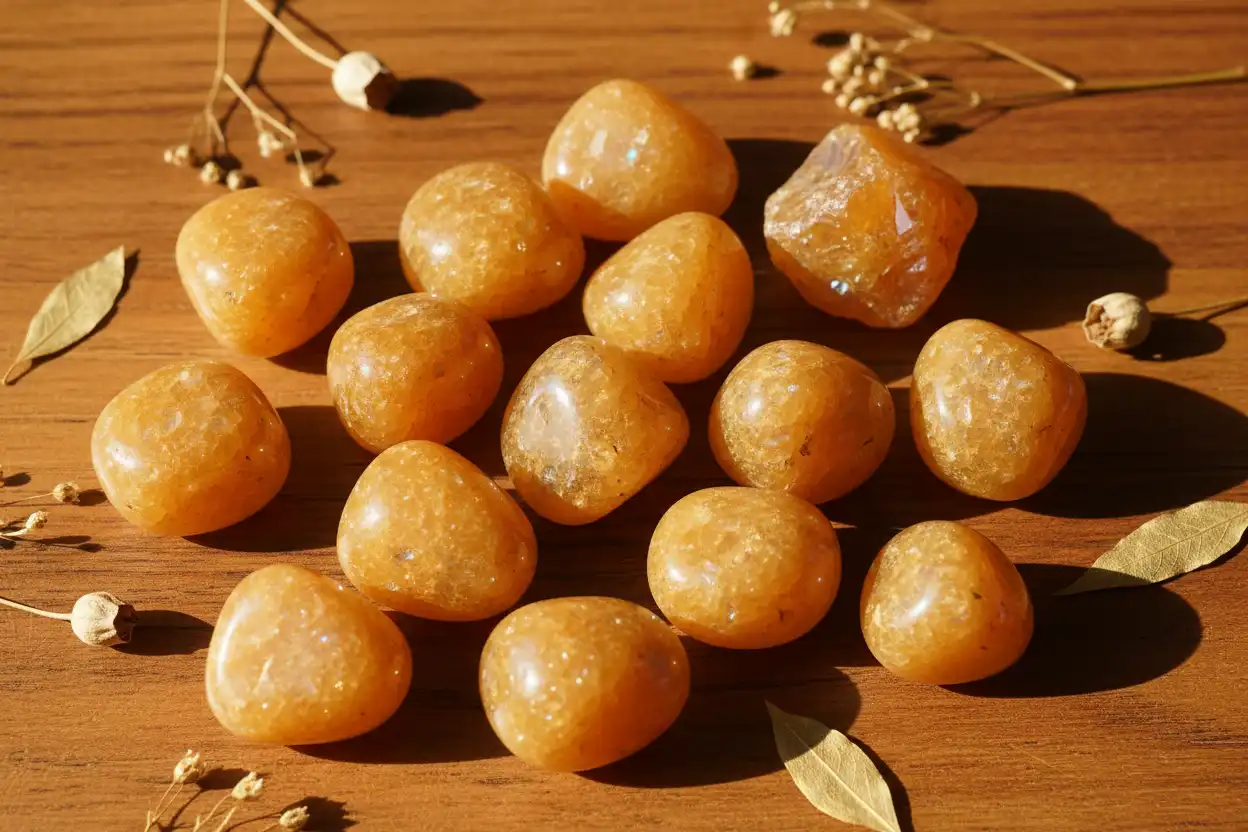
Bytownite Meaning: Feldspar Facts, History & Symbolism
Bytownite meaning is commonly associated in modern crystal practice with confidence, adaptability, independence, purposeful action, and maintaining perspective during change. Those ideas belong to symbolism. Mineralogically, bytownite is a calcium-rich compositional range within the plagioclase feldspar series, positioned between labradorite and anorthite. It is conventionally defined at approximately 70–90 mol% anorthite component and 10–30 mol% albite component rather than as an entirely independent mineral species with one invariant chemical composition.
That compositional identity is the key to understanding the stone. Plagioclase forms a continuous sodium-calcium solid-solution series, so the names albite, oligoclase, andesine, labradorite, bytownite, and anorthite mark useful composition ranges along that spectrum. Bytownite occupies the calcium-rich end but stops short of the most calcium-dominant compositions classified as anorthite. It crystallizes in the triclinic system, commonly has Mohs hardness around 6–6.5, and retains the characteristic cleavage, twinning, and optical behavior of plagioclase feldspar.
For other mineral-first references that separate physical identity from later interpretation, browse the Gemstone Guides.
What Is Bytownite?
Bytownite is calcium-rich plagioclase feldspar. A practical generalized formula is:
(Ca,Na)[Al(Al,Si)Si₂O₈]
The formula reflects variable calcium and sodium substitution rather than one exact ratio in every specimen. At the calcium-rich side of the plagioclase series, more calcium is coupled with greater aluminum substitution for silicon to maintain electrical charge balance within the feldspar structure.
Bytownite is commonly represented as An70–An90, where “An” denotes the anorthite component. In equivalent albite terms, that corresponds approximately to Ab30–Ab10. Mineral references therefore describe bytownite as plagioclase containing roughly 70–90% anorthite component.
| Property | Typical bytownite characteristics |
|---|---|
| Material identity | Calcium-rich plagioclase feldspar composition range |
| General formula | (Ca,Na)[Al(Al,Si)Si₂O₈] |
| Anorthite component | Approximately An70–An90 |
| Albite component | Approximately Ab10–Ab30 |
| Crystal system | Triclinic |
| Typical color | Colorless, white, gray, greenish-white; gem material may be yellowish or reddish brown |
| Transparency | Transparent to translucent |
| Luster | Usually vitreous to subvitreous |
| Mohs hardness | About 6–6.5 |
| Specific gravity | Commonly about 2.72–2.75 |
| Cleavage | Perfect in characteristic feldspar directions |
| Fracture | Uneven to locally conchoidal |
| Tenacity | Brittle |
| Refractive index | Approximately 1.561–1.583 across reported gem material |
| Optical character | Biaxial, commonly negative |
| Common geological occurrence | Mafic igneous rocks, anorthositic rocks and compositionally zoned plagioclase |
| Separate modern end-member species? | No; it is a traditional compositional subdivision within plagioclase |
Gemological data show why a single visual feature cannot identify bytownite confidently. Its hardness, density, refractive indices, cleavage, and optical properties overlap portions of the wider feldspar family and therefore need to be interpreted together.
Bytownite Sits Between Labradorite and Anorthite
The most useful way to visualize bytownite is as part of the albite-anorthite compositional series.
Albite → Oligoclase → Andesine → Labradorite → Bytownite → Anorthite
Moving toward anorthite generally means increasing calcium and decreasing sodium. Bytownite occupies the approximate An70–An90 interval, while labradorite occupies the less calcium-rich range below it and anorthite occupies the most calcium-rich end.
These names remain extremely useful in petrology and gemology, but nature does not create a sharp physical wall at every numerical boundary. A chemically zoned plagioclase crystal can pass through more than one traditional compositional field from core to rim.
That means a single crystal may contain areas chemically classifiable as labradorite and other zones falling within the bytownite range.
Is Bytownite a Mineral Species or a Feldspar Variety?
This question deserves precise wording because different sources use slightly different taxonomic conventions.
Bytownite is a traditional plagioclase compositional name rather than a discrete chemical end member equivalent to pure albite or anorthite. Modern mineral databases commonly place it as an anorthite variety or compositional subdivision, while general gem references continue to use “bytownite” as a practical gemstone and feldspar name.
The safest description is therefore:
Bytownite is the calcium-rich An70–An90 compositional range of plagioclase feldspar.
Calling it simply “a separate mineral with one exact formula” hides the solid-solution relationship. Calling the name meaningless would be equally unhelpful because it communicates a real compositional interval used in mineralogical and gemological discussion.
How Bytownite Forms
Bytownite forms where calcium-rich plagioclase crystallizes under geological conditions that favor compositions toward the anorthite side of the feldspar series. It is especially associated with mafic igneous rocks such as gabbro and norite and with anorthosite-related assemblages in which calcium-rich plagioclase can be a major rock-forming component. Gemological references also record occurrence in compositionally zoned feldspars and some metasomatic environments.
During cooling of magma, plagioclase composition can change as the melt evolves. Early plagioclase in suitable mafic systems may be strongly calcium-rich, while later growth becomes progressively more sodium-rich. This can produce chemical zoning inside a single crystal rather than one perfectly homogeneous composition.
Pressure, temperature, magma chemistry, cooling history, diffusion, and later alteration all influence the final feldspar.
The complete geological treatment—including zoning, host rocks, magmatic differentiation, recrystallization, and locality-specific assemblages—is covered in bytownite formation and deposit geology.
Why Plagioclase Composition Changes During Crystallization
The bytownite field makes more sense when plagioclase is treated as a dynamic solid solution rather than a collection of unrelated minerals.
Calcium-rich anorthite component and sodium-rich albite component can substitute through coupled changes in the feldspar framework. In a cooling igneous system, the equilibrium composition of the growing plagioclase can shift as the melt chemistry changes.
If the crystal grows faster than complete chemical re-equilibration can occur, earlier zones may preserve one composition while later zones preserve another.
That zoning is not a defect. It is a geological record.
A polished slice or microscopic section can therefore preserve information about the conditions under which the host rock evolved.
What Color Is Natural Bytownite?
The classic mineralogical description of bytownite includes colorless, white, gray and greenish-white material, while transparent gem-quality feldspar assigned to the bytownite range can also appear yellowish, golden, brownish, or reddish brown.
The difference is important because commercial gemstone photographs can create the impression that bytownite must always be transparent honey yellow.
It does not.
A calcium-rich plagioclase grain inside gabbro may look pale gray or white and still fall chemically within the bytownite field. Conversely, transparent golden gem rough can be visually attractive while preserving the same fundamental feldspar structural framework.
Color is therefore secondary to composition in defining bytownite.
What Causes Yellow or Golden Bytownite?
The exact cause of yellow, golden, reddish-brown, or greenish coloration should not be assigned from appearance alone. Trace elements, structural defects, microscopic inclusions, oxidation states, color centers, and internal scattering can influence feldspar color.
Iron is an obvious candidate in many naturally yellow or brown silicates, but the statement “iron causes all yellow bytownite” is too absolute without specimen-specific spectroscopic or chemical evidence.
A more defensible approach separates three levels of certainty:
the observed color can be documented directly;
plausible chromophores can be proposed from mineral chemistry;
the actual cause in one specimen requires analytical evidence.
That distinction prevents a general feldspar explanation from becoming a fictional laboratory result for an individual stone.
Can Bytownite Show Labradorescence?
Some bytownite can display labradorescent or related iridescent optical effects, although the phenomenon is much more strongly associated commercially with labradorite. Mindat specifically notes that bytownite may show labradorescence.
Labradorescence does not come from a mystical glow or pigment coating. In plagioclase, appropriately developed submicroscopic intergrowths or exsolution structures can interfere with light and produce directional flashes.
Not every bytownite specimen develops the necessary internal structure.
A transparent golden stone with no visible iridescence can still be bytownite, while a flashy feldspar should not automatically be assigned to bytownite rather than labradorite without compositional evidence.
The detailed distinction among body color, interference effects, transparency, refractive behavior, and viewing angle is covered in bytownite optical properties and color behavior.
Labradorescence Does Not Prove Labradorite
This is one of the more useful diagnostic boundaries in the plagioclase family.
Labradorite takes its name from a compositional interval, not from possession of labradorescence. Likewise, the optical effect can occur in plagioclase whose composition extends beyond the strict labradorite range.
A flashy plagioclase specimen therefore requires two separate observations:
What optical phenomenon does it display?
What is its actual plagioclase composition?
One question concerns microstructure and light. The other concerns sodium-calcium chemistry.
They overlap but are not identical.
Bytownite’s Characteristic Feldspar Cleavage
Bytownite shares the prominent cleavage behavior expected of plagioclase feldspar. Two strong cleavage directions intersect at angles close to a right angle, although the exact geometry is not perfectly ninety degrees.
This distinguishes feldspar fracture behavior from quartz, which lacks cleavage and more commonly breaks conchoidally.
Cleavage also affects durability. A bytownite gem may resist surface scratching reasonably well at Mohs 6–6.5 but can still chip along cleavage if struck in an unfavorable direction.
Hardness measures resistance to scratching.
It does not measure resistance to splitting.
Twinning and Fine Striations
Plagioclase feldspars are famous for polysynthetic twinning. Repeated albite-law twins can produce fine parallel striations visible on appropriate crystal or cleavage surfaces.
Those striations can be a valuable visual clue when examining rough feldspar. They are not guaranteed to be visible on every specimen, particularly once the material has been polished or faceted.
A regular set of fine parallel lines on a natural cleavage surface can therefore support plagioclase identification.
It cannot determine An70 versus An65 or An92 by itself.
Composition requires stronger evidence.
Original Bytownite Specimen and Photo Checklist
The following checklist is designed as a first-pass evidence framework for a rough crystal, polished gemstone, specimen photograph, or seller listing. It helps identify which observations are consistent with bytownite and where stronger testing is necessary.
Establish whether the material behaves like feldspar
Look for a vitreous surface, brittle character, cleavage-related planes, and morphology broadly compatible with plagioclase rather than relying on yellow color alone.
Search for fine twinning striations
Parallel striations on natural cleavage or crystal surfaces can strongly support plagioclase identity.
Their absence does not disprove bytownite.
Examine two cleavage directions
Where natural breaks are visible, look for intersecting planar surfaces characteristic of feldspar. Avoid deliberately breaking an important specimen to expose them.
Record transparency honestly
Bytownite may be transparent, translucent, or part of an opaque-looking rock aggregate depending on grain quality and inclusions.
Gem transparency is not required for mineral identity.
Compare color under neutral light
Golden, yellowish, reddish-brown, colorless, gray, white and greenish-white material may all occur within reported bytownite descriptions.
Do not require one commercial color.
Rotate any iridescent specimen
If the stone shows a blue, green, gold or multicolored flash, observe whether the effect is strongly directional. Record it as an optical feature rather than treating it as proof of composition.
Inspect inclusions and cleavage features
Fine internal planes, healed fractures, mineral inclusions, zoning, twinning and exsolution-related structures can be informative under magnification.
The dedicated bytownite microscope inclusion notebook develops those observations more fully.
Compare rough and polished areas
A polished golden surface can conceal the pale feldspar appearance visible on rough edges or cleavage surfaces.
Check for coatings
Inspect fractures, drill holes, facet junctions and damaged edges for color concentrations or surface films inconsistent with the interior.
Do not identify from hardness alone
Mohs 6–6.5 is compatible with many minerals. A scratch result can narrow possibilities but cannot prove an An70–An90 composition.
Measure specific gravity when appropriate
A value around 2.72–2.75 can support calcium-rich plagioclase identification in suitable clean loose material. Matrix-bearing specimens cannot be interpreted so simply.
Use refractive index on polished gem material
Reported bytownite gem values fall approximately within 1.561–1.583, but composition affects the exact position within the plagioclase series.
Do not assign the Bytown locality from the name
The word bytownite does not mean that every specimen came from the historical Bytown area.
Preserve original labels
Old locality information, collection numbers, geological context and acquisition documentation may contain evidence that the gemstone itself cannot reveal.
Separate symbolism from identification
Terms such as confidence stone, transformation crystal, solar plexus gem or manifestation feldspar provide no mineralogical evidence.
A Source-Reconciliation Table for Bytownite Claims
Bytownite is particularly vulnerable to confusion because the name sits at the intersection of historical mineral nomenclature, modern plagioclase composition ranges, gem-trade usage and labradorescent feldspar marketing.
| Claim | Evidence status | More accurate interpretation |
|---|---|---|
| Bytownite is calcium-rich plagioclase | Supported | It occupies approximately the An70–An90 range |
| Bytownite has one exact chemical formula | Too absolute | Sodium and calcium proportions vary within the compositional range |
| Bytownite is a completely separate feldspar end member | Misleading | It is a traditional subdivision within the albite-anorthite solid solution |
| Bytownite is always yellow | Incorrect | Colorless, white, gray and greenish-white material also occurs |
| Every yellow transparent feldspar is bytownite | Incorrect | Composition must be established rather than inferred from color |
| Every flashy plagioclase is labradorite | Incorrect | Labradorescence can occur outside the strict labradorite compositional interval |
| Every bytownite displays labradorescence | Incorrect | The effect requires suitable internal microstructure |
| Bytownite is harder than all other plagioclase | Unsupported | Its hardness broadly overlaps other feldspars |
| Fine striations can support plagioclase identity | Supported | Polysynthetic twinning commonly produces them |
| Twinning alone proves An70–An90 composition | Incorrect | Twinning identifies structural behavior, not precise chemistry |
| The original Bytown material is securely preserved and straightforward | Incorrect | The historical source material and locality have significant uncertainties |
| Modern gem bytownite can automatically be traced to the original locality | Incorrect | Provenance requires documentation |
| Bytownite scientifically increases confidence | Unsupported | Confidence is a modern symbolic association |
| Bytownite guarantees independence or success | Unsupported metaphysical claim | It cannot determine external outcomes |
| Bytownite heals emotional or medical disorders | Unsupported medical claim | Feldspar identity does not establish therapeutic efficacy |
The table shows why a useful bytownite meaning reference needs both mineralogical and historical boundaries. The name is legitimate, but several assumptions commonly attached to it are not.
The Historical Bytownite Story Is More Complicated Than the Name Suggests
Bytownite was named for Bytown, the historical name of the place now known as Ottawa in Canada. Modern mineral references report that the original greenish-white material was found in a boulder near Bytown. Later investigation concluded that the original material was a mixture rather than a simple homogeneous specimen corresponding neatly to the modern compositional definition.
The historical locality has also become uncertain, and original material is described as exceptionally scarce or possibly no longer represented clearly in collections. Mindat further cautions that gemmy feldspar is occasionally attributed incorrectly to the original Bytown locality.
This makes bytownite an unusually instructive example of the difference between a mineral name and a provenance claim.
A gemstone can be chemically bytownitic plagioclase without having any connection to the locality that supplied the historical name.
The Name Does Not Prove Canadian Origin
A seller calling a golden transparent gemstone “bytownite” is usually making a mineral-composition claim, not necessarily a geographic claim.
That distinction should be explicit.
Modern bytownite occurs in geological settings and specimens from locations far beyond the historical naming locality. Calcium-rich plagioclase is a rock-forming material, not a mineral restricted to one Canadian occurrence.
If a dealer specifically claims that a specimen came from the original Bytown occurrence, the evidentiary threshold becomes much higher.
The bytownite provenance disclosure checklist provides a structured framework for separating a compositional identification from a documented geographic origin.
How Bytownite Is Identified Gemologically
A faceted bytownite gemstone no longer retains many of the features that make rough plagioclase recognizable, so gemological measurements become more important.
Useful evidence can include:
refractive index;
birefringence;
optic character;
specific gravity;
microscopy;
feldspar cleavage;
twinning;
spectroscopy;
and quantitative chemical analysis.
Reported gemological values include refractive indices of approximately 1.561–1.583, specific gravity around 2.72–2.75, brittle tenacity, perfect cleavage and low birefringence relative to strongly birefringent gems.
These properties can establish that a gemstone is compatible with calcium-rich plagioclase.
Determining whether it lies specifically inside the bytownite interval may still require compositional analysis.
Chemical Analysis Matters More Near Composition Boundaries
Imagine two plagioclase gemstones whose anorthite components are approximately An69 and An71.
They may look essentially identical.
Under the conventional range system, one falls just below the bytownite boundary and the other just inside it.
No realistic photograph can resolve that distinction.
Even ordinary gemological measurements may overlap enough that an exact boundary assignment remains uncertain. Electron-microprobe analysis or another suitable quantitative chemical technique can provide much stronger evidence because the question is fundamentally compositional.
This illustrates why mineral names should not imply more precision than the available test supports.
Bytownite Versus Labradorite
Labradorite occupies a neighboring, less calcium-rich plagioclase interval. The conventional compositional boundary lies around An70, with labradorite extending approximately from An50 to An70 and bytownite from An70 to An90.
Visually, the distinction can be difficult or impossible.
Both can be gray, pale, transparent, translucent or iridescent. Both share feldspar cleavage, triclinic structure and plagioclase twinning. Labradorescence is not sufficient to separate them.
The strongest boundary is chemical composition.
That makes bytownite versus labradorite primarily a compositional question rather than a color comparison.
Bytownite Versus Anorthite
Anorthite represents the calcium-rich end member of plagioclase. Conventional classification places material above approximately An90 in the anorthite field, whereas bytownite occupies the range immediately below it.
Again, there is no dramatic visible wall separating An89 from An91.
A crystal can cross the boundary internally through compositional zoning.
This is why describing bytownite as “almost anorthite” is useful informally but incomplete scientifically. It identifies the general position in the series without establishing the exact chemistry of a particular grain.
Bytownite Versus Other Yellow Gems
Transparent yellow bytownite can overlap visually with numerous unrelated materials, including citrine, yellow beryl, topaz, scapolite and some transparent phosphates.
Its feldspar properties provide the distinction.
Compared with quartz, bytownite generally has slightly lower hardness and prominent cleavage. Compared with beryl or topaz, it occupies different refractive-index and density ranges. Compared with softer yellow minerals, its Mohs hardness may be considerably higher.
A yellow photograph therefore provides only a color observation.
It does not provide a mineral identification.
Bytownite and Calcite Are Structurally Unrelated
The mapped calcite color meaning reference provides a useful contrast because both calcite and feldspar occur in many colors and can look deceptively similar in polished photographs.
Calcite is calcium carbonate with much lower hardness, strong rhombohedral cleavage and characteristic double refraction in suitable transparent material. Bytownite is calcium-sodium aluminosilicate feldspar with significantly greater scratch resistance and a different cleavage geometry.
Shared calcium content has almost no value as an identification shortcut.
Chemical elements must be interpreted within the compounds and structures that contain them.
Bytownite Versus Brucite and Bustamite
The neighboring brucite meaning page concerns magnesium hydroxide, a very soft layered mineral with perfect basal cleavage. Bytownite is much harder and belongs to the framework-silicate feldspar family.
Bustamite meaning concerns a calcium-manganese silicate pyroxenoid, commonly pink to reddish rather than feldspar-white or golden, with a different structure, density and geological setting.
The comparison is useful because mineral identity is never determined by the presence of a single shared element such as calcium.
Bytownite, calcite and bustamite all contain calcium in some form while remaining fundamentally different materials.
Bytownite Versus Cacoxenite
The following cacoxenite meaning reference moves into an iron-aluminum phosphate mineral with a radically different fibrous crystal habit, chemistry, hardness and formation environment.
A golden color can occur in both materials.
That color similarity is superficial.
Bytownite is a rock-forming feldspar whose identity is tied to the albite-anorthite solid solution; cacoxenite is a secondary phosphate mineral. Their physical and geological stories barely overlap.
Treatments, Coatings and Disclosure
Most bytownite is valued for natural feldspar color, transparency, crystal form or optical effects rather than for widespread routine treatment. Nevertheless, a particular commercial stone can still be coated, filled, dyed, assembled, surface-enhanced or incorrectly identified.
The absence of a famous standard treatment does not justify assuming every specimen is untreated.
Useful observations include:
whether color penetrates the whole stone;
whether color concentrates in fractures;
whether an iridescent layer appears superficial;
whether resin fills open cracks;
whether two materials are joined;
and whether the seller discloses modification.
A treatment can alter appearance without changing the underlying fact that the host material is feldspar.
Disclosure remains part of accurate description.
Cutting Bytownite
Gem-quality bytownite can be faceted or polished, but feldspar cleavage requires careful orientation. A cutter must consider the direction of cleavage, internal fractures, twinning, optical effect, transparency, color zoning and the final face-up appearance.
If labradorescence or another directional sheen is present, orientation becomes even more important. Cutting across an unfavorable direction can suppress the effect, while another plane may reveal it strongly.
A well-formed natural crystal may also have more collector value intact than as faceting rough.
The detailed relationship among cleavage, orientation, twinning, color, optical effect and polish is covered in bytownite cutting, orientation and polish.
Bytownite in Jewelry
Bytownite’s hardness around 6–6.5 makes it reasonably resistant to light surface wear but not as scratch-resistant as quartz, topaz or corundum.
Cleavage is the more important limitation.
A hard blow can chip or split a feldspar gem even when its surface remains relatively unscratched. Rings and bracelets therefore expose bytownite to more risk than pendants or earrings.
Protective settings, adequate girdle thickness, careful prong pressure and avoidance of vulnerable cleavage orientations can improve durability.
Those mechanical considerations are explored in bytownite setting and wear engineering.
Conserving a Bytownite Specimen
A significant bytownite specimen may preserve more than an attractive crystal. It can record twinning, zoning, matrix relationships, weathering, cleavage, associated minerals and historic locality information.
Before cleaning, repairing, cutting or removing a crystal from matrix, document:
all visible crystal faces;
cleavage cracks;
dimensions;
matrix contacts;
color under neutral lighting;
any optical flash;
labels;
repairs;
collection numbers;
and acquisition records.
That baseline makes later changes easier to identify and protects provenance information that may be impossible to recreate.
A structured approach is available in the bytownite specimen conservation record.
Documented History Versus Invented Ancient Lore
Bytownite has a real naming history tied to mineralogical work on calcium-rich plagioclase and the historical Bytown locality. That history is more complicated than a simple discovery story because the original material was later shown to be mixed and the source locality itself became uncertain.
There is no need to replace that documented history with unsupported claims that ancient societies specifically recognized bytownite as a crystal for manifestation, courage, solar energy or chakra work.
Ancient peoples certainly used feldspars and feldspar-bearing rocks in various contexts, but demonstrating use of the specific modern An70–An90 compositional category would require mineral analysis of the artifact itself.
A broad statement about ancient feldspar cannot automatically become evidence for ancient bytownite symbolism.
Bytownite Meaning in Modern Symbolism
Modern bytownite meaning often centers on confidence, autonomy, purposeful change, decisiveness and acting from a clearer understanding of one’s circumstances.
Its position within a continuous compositional series creates a useful metaphor. Bytownite is not isolated from neighboring feldspars; it is defined by where its chemistry falls along a gradient.
Someone can interpret that as a reminder that identity does not always require a hard boundary.
A person may be moving gradually between roles, priorities or stages rather than crossing one dramatic dividing line.
The metaphor comes from the mineral’s compositional context.
It does not imply that the feldspar physically controls personal development.
Confidence as a Practical Symbol
Confidence is one of the more common modern interpretations attached to golden bytownite.
Used responsibly, that symbolism can be converted into concrete behavior rather than a supernatural promise.
A person might use a bytownite stone as a reminder to:
prepare evidence before making a claim;
communicate a decision clearly;
distinguish uncertainty from indecision;
act on what is known while identifying what still needs verification;
or take responsibility for a manageable next action.
The stone does not create confidence chemically.
It can function as the object chosen to represent those behaviors.
Independence Without Isolation
Because bytownite occupies a defined interval inside a continuous feldspar series, it also offers an interesting metaphor for independence.
The material has a recognizable compositional identity without existing separately from the broader plagioclase system.
Someone might use that idea to represent maintaining personal boundaries while remaining connected to a larger family, team or community.
This interpretation is more nuanced than treating independence as complete separation.
Again, it is symbolism inspired by mineral classification, not a measurable psychological effect of calcium-rich feldspar.
Adaptability and Compositional Zoning
Plagioclase zoning provides another useful modern metaphor.
A single crystal can preserve different chemical compositions from different stages of growth. Earlier zones do not disappear merely because later conditions changed.
As a symbolic idea, this can represent adapting to a new environment while retaining evidence of earlier experiences.
No metaphysical mechanism is required.
The geological fact supplies the analogy; the meaning is assigned by the person using it.
Does Bytownite Have Healing Properties?
Bytownite should not be presented as a medical treatment.
Claims that it treats anxiety, depression, hormonal disorders, digestive conditions, inflammation, fatigue, neurological disease or other health problems are not established by plagioclase chemistry.
The stone’s measurable properties include composition, refractive index, density, cleavage, hardness, twinning, optical behavior and crystal structure.
Those properties describe feldspar.
They do not demonstrate therapeutic effects through ordinary contact.
A person may still use a bytownite gem during reflection, journaling or meditation without substituting it for appropriate medical or mental-health care.
Calcium and Sodium Do Not Become Health Benefits Through Touch
Bytownite contains calcium and sodium as structural components of an aluminosilicate framework.
That fact does not make the stone a calcium or sodium supplement.
Nutritional availability depends on chemical form, dose, route of exposure and biological processing. Atoms locked within a feldspar crystal are not automatically transferred through the skin in a controlled therapeutic quantity.
The same principle applies to aluminum and silicon.
Mineral composition explains the stone.
It is not a medical ingredient list.
Chakra and Manifestation Associations
Modern metaphysical systems may associate yellow or golden bytownite with the solar plexus chakra, personal power, manifestation, abundance or purposeful action.
These claims belong to spiritual interpretation.
Gemological instruments can measure refractive index, birefringence, density and chemical composition. They cannot determine whether a chakra has opened, whether a stone attracts financial outcomes, or whether possession of a feldspar alters probability.
A person can include bytownite in a private spiritual practice while keeping that framework separate from mineral science.
Safe Ownership and Handling
Normal handling of an intact bytownite crystal or polished gemstone does not require unusual precautions. It is a stable feldspar in ordinary collecting and jewelry contexts.
The main practical concerns are mechanical.
Cleavage and brittleness mean that hard impacts can damage a crystal or gemstone. Loose specimens should not be allowed to strike harder minerals repeatedly, and valuable crystal faces should be protected from abrasion.
Lapidary work creates a different exposure situation. Cutting, grinding, drilling or polishing silicate material can generate fine mineral dust. Appropriate wet methods where suitable, local extraction, eye protection and respiratory controls should be used rather than uncontrolled dry grinding.
Do not intentionally grind bytownite for ingestion or use geological specimens to prepare drinking-water crystal elixirs.
An intact feldspar and respirable workshop dust are different exposure forms.
A Practical Evidence Ladder for Bytownite Claims
Different questions about bytownite require different types of evidence.
Direct observation can document color, transparency, cleavage, visible twinning, striations, optical flash, matrix, fractures and condition.
Basic gemological testing can establish whether hardness, specific gravity, refractive behavior and cleavage are compatible with plagioclase.
Microscopy can reveal polysynthetic twinning, zoning, inclusions, cleavage traces, exsolution structures, coatings, repairs and internal fractures.
Optical testing can evaluate biaxial behavior, refractive indices and birefringence in suitable material.
Spectroscopy can investigate absorption and some color-related features.
Quantitative chemical analysis is especially important when determining whether a specimen actually lies within the An70–An90 bytownite interval rather than an adjacent plagioclase range.
Structural methods can confirm feldspar crystallography when identification is uncertain.
Geological evidence can place the material within mafic, anorthositic, metamorphic or compositionally zoned plagioclase environments.
Provenance documentation is necessary for mine, locality, collector and ownership claims.
Historical evidence is particularly important because the original material associated with the Bytown name was later recognized as mixed and the locality has significant uncertainty.
Modern symbolism includes confidence, adaptability, independence, purpose and manifestation themes. These are human interpretations rather than intrinsic feldspar powers.
What Bytownite Meaning Can Reliably Include
Bytownite meaning becomes clearest when mineral identity, history and symbolism remain separate.
Materially, bytownite is the calcium-rich An70–An90 interval of plagioclase feldspar, with compositions extending between labradorite and anorthite rather than forming one chemically invariant mineral. It is triclinic, typically around Mohs 6–6.5, commonly has specific gravity around 2.72–2.75, displays characteristic feldspar cleavage and twinning, and can occur as pale rock-forming material or transparent yellowish gem rough.
Its optical story also requires nuance. Some bytownite can display labradorescence, but the effect does not define the bytownite composition range and does not automatically make the material labradorite. Composition and optical phenomenon are separate observations.
Historically, the name comes from Bytown, now Ottawa, yet the original material was later found to be mixed, the precise historical occurrence has become uncertain, and modern gemmy material should not be assigned to that source without evidence.
Symbolically, modern users may interpret bytownite as representing confidence, adaptability, independence or purposeful action. Its place within a continuous feldspar series and its ability to preserve compositional zoning provide particularly grounded metaphors for developing a distinct identity without pretending that every boundary in life is absolute.
Gems Lore explains its material-first approach on the About page. Health, spiritual and informational limitations are set out in the Disclaimer, while factual corrections or supporting mineralogical evidence can be submitted through Contact.
Bytownite does not need exaggerated claims to be distinctive. Its place near the calcium-rich end of the plagioclase series, compositional zoning, characteristic feldspar twinning, occasional labradorescence, gem-quality golden material and unusually complicated naming history provide a substantial story of their own. Bytownite meaning is strongest when that real feldspar identity comes first and symbolism remains the human interpretation inspired by it.