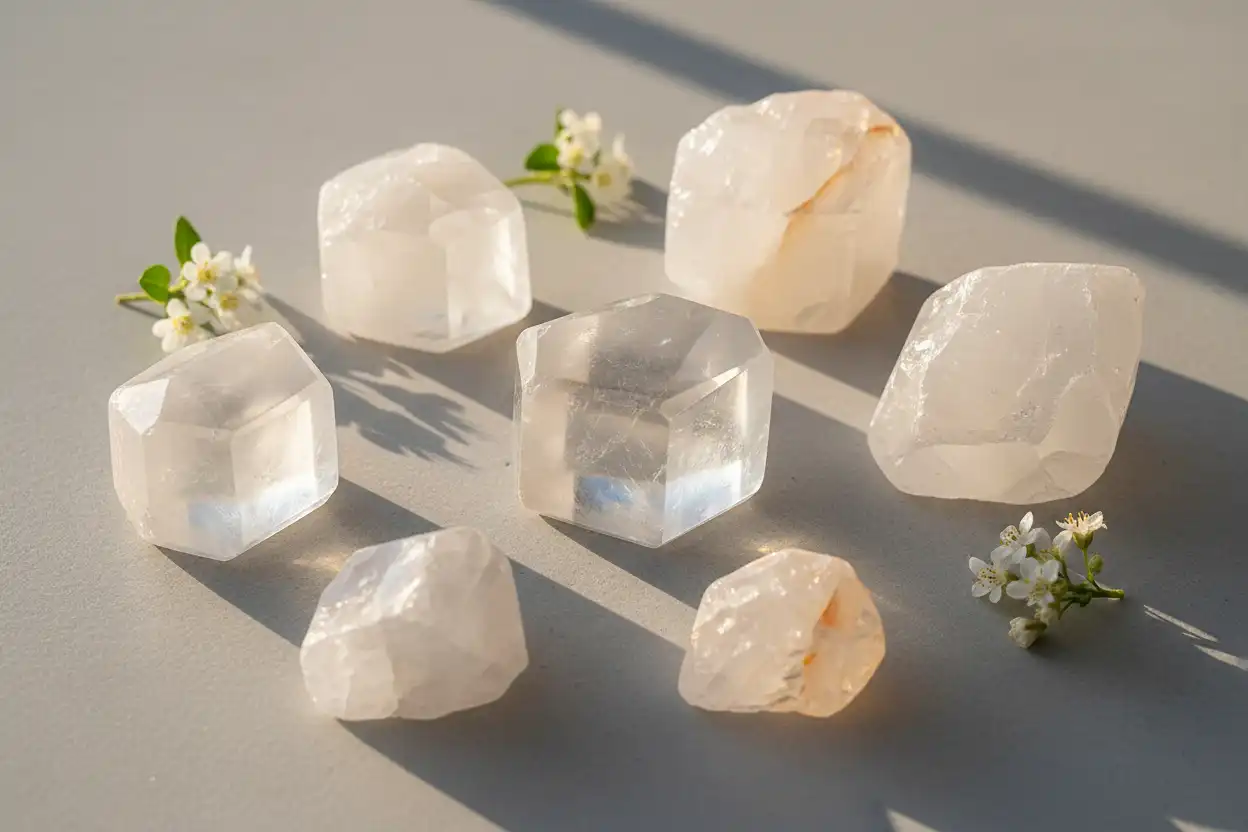
Calcite Meaning: Mineral Facts, Formation & Symbolism
Calcite meaning is commonly associated in modern crystal practice with clarity, renewal, perspective, emotional balance, motivation, and the idea of seeing a situation more clearly. Those associations are symbolic interpretations rather than measurable effects of the mineral. Materially, calcite is calcium carbonate, CaCO₃, one of the most widespread rock-forming and vein-forming minerals in Earth’s crust. It is the principal mineral in many limestones and marbles, forms spectacular crystals in cavities and hydrothermal veins, occurs in caves as stalactites and stalagmites, and is also produced biologically in shells and other carbonate structures.
Calcite is especially useful for understanding the difference between appearance and mineral identity because it occurs in an enormous range of colors and habits while retaining the same essential calcium-carbonate framework. Transparent rhombohedra, white limestone, honey-colored crystals, optical calcite, cave deposits, marble, and many colored collector specimens can all contain calcite even though they look radically different.
Its diagnostic properties are unusually accessible. Calcite is soft at Mohs 3, has perfect rhombohedral cleavage, commonly has specific gravity around 2.71, reacts readily with dilute acid, and can display exceptionally strong double refraction in transparent material. These measurable characteristics provide a far stronger basis for identification than color, trade name, or metaphysical description.
For other material-first references, browse the Gemstone Guides.
What Is Calcite?
Calcite is a calcium carbonate mineral with the formula CaCO₃. It crystallizes in the trigonal division of the hexagonal crystal family and is the stable common form of calcium carbonate under ordinary surface conditions.
Calcium carbonate can also occur in other crystal structures, most notably aragonite. Calcite and aragonite therefore demonstrate an important mineralogical principle: minerals can share the same basic chemistry while differing in crystal structure and physical behavior.
Calcite’s structure produces several of its most recognizable properties, including perfect rhombohedral cleavage and strong optical anisotropy.
| Property | Typical calcite characteristics |
|---|---|
| Mineral species | Calcite |
| Chemical formula | CaCO₃ |
| Mineral class | Carbonate |
| Crystal system | Trigonal |
| Common crystal habits | Rhombohedral, scalenohedral, prismatic, tabular, massive, fibrous and granular |
| Typical colors | Colorless, white, gray, yellow, orange, brown, pink, red, green, blue and black depending on impurities or inclusions |
| Transparency | Transparent to translucent or opaque |
| Mohs hardness | 3 |
| Specific gravity | About 2.71 |
| Cleavage | Perfect rhombohedral cleavage in three directions |
| Fracture | Uneven to conchoidal where cleavage does not dominate |
| Luster | Vitreous on crystal faces, pearly on cleavage surfaces |
| Streak | White |
| Optical character | Uniaxial negative |
| Notable optical property | Very strong birefringence and double refraction |
| Acid response | Effervesces readily in dilute acid |
| Common occurrence | Limestone, marble, veins, cavities, caves, hydrothermal deposits and biological carbonate material |
These traits make calcite one of the classic teaching minerals in mineralogy. It is simple enough to recognize with basic observations yet structurally and optically complex enough to demonstrate several important concepts.
Why Calcite Is So Common
Calcite is widespread because calcium, carbon, oxygen, water, and dissolved carbonate species participate in many geological and biological processes.
In marine environments, calcium carbonate can accumulate from shells, skeletal fragments, chemical precipitation, and microscopic organisms. Burial, compaction, cementation, recrystallization, and later alteration can transform those sediments into limestone.
When limestone is subjected to metamorphism, calcite grains recrystallize and grow, producing marble.
Groundwater moving through carbonate rock can dissolve calcite in one location and redeposit it elsewhere. This process contributes to caves, veins, fractures, stalactites, stalagmites, flowstone, and other carbonate formations.
Hydrothermal fluids can also deposit calcite alongside quartz, fluorite, sulfides, barite, zeolites, and numerous other minerals.
The mineral is therefore not tied to one geological environment. Its abundance reflects the many ways calcium carbonate can move, dissolve, precipitate, recrystallize, and interact with fluids.
The detailed relationships among sedimentary carbonate formation, metamorphism, hydrothermal activity, caves, veins, and replacement textures are covered in calcite formation and deposit geology.
Calcite and Limestone Are Not the Same Thing
Calcite is a mineral.
Limestone is a rock.
Many limestones consist predominantly of calcite, but a rock can also contain fossils, clay minerals, quartz, dolomite, organic matter, iron compounds, and other constituents.
This distinction matters because a limestone specimen does not necessarily behave exactly like one clean calcite crystal during testing. Impurities, grain boundaries, porosity, cement, and associated minerals affect the rock.
Likewise, identifying a crystal as calcite does not automatically identify the geological rock in which it formed.
Mineral and rock names answer different questions.
Calcite and Marble Are Not the Same Thing Either
Marble is a metamorphic rock produced when carbonate-rich rock recrystallizes under heat and pressure.
Many marbles are dominated by calcite. Others contain substantial dolomite or additional silicate minerals.
In calcitic marble, formerly fine carbonate grains recrystallize into interlocking calcite crystals. This can erase fossils and sedimentary textures while producing the sugary or crystalline appearance typical of marble.
A decorative marble slab can therefore consist largely of calcite without being correctly described as one giant calcite crystal.
The rock is an aggregate.
Calcite Versus Aragonite
Calcite and aragonite both have the chemical formula CaCO₃, but they have different crystal structures.
Calcite is trigonal.
Aragonite is orthorhombic.
That structural difference changes crystal habit, density, cleavage, stability, and other properties. Under many surface conditions, calcite is the more stable form, while aragonite can transform or recrystallize toward calcite over geological time.
This makes calcium carbonate another useful example of polymorphism: identical overall chemistry does not necessarily mean identical mineral species.
A chemical formula is only part of a mineral’s identity.
Calcite’s Perfect Rhombohedral Cleavage
One of the most recognizable calcite properties is perfect cleavage in three directions that do not intersect at right angles.
When a clean calcite crystal breaks along these planes, it tends to produce rhombohedral fragments. The resulting shape resembles a slanted box rather than a cube.
This cleavage occurs because some structural directions are mechanically weaker than others. Stress therefore propagates preferentially along those planes.
A natural calcite crystal does not need to begin as a rhombohedron to show rhombohedral cleavage. A pointed scalenohedral crystal can still break into cleavage fragments governed by the internal structure.
That difference between external crystal habit and internal cleavage is diagnostically useful.
Why Calcite Is the Standard Mohs Hardness 3 Mineral
The Mohs scale uses familiar reference minerals to compare scratch resistance, and calcite defines hardness 3.
A material harder than calcite can scratch it under appropriate test conditions. A softer mineral generally cannot.
Hardness does not tell the whole durability story.
Calcite also has excellent cleavage and relatively modest toughness, so it can scratch, chip, or split during handling much more easily than quartz-family stones.
This is one reason polished calcite objects require gentler care than visually similar quartz or chalcedony.
Deliberate scratch testing should still be avoided on valuable crystals or polished pieces. An identification method should not cause unnecessary damage when non-destructive alternatives exist.
Why Calcite Fizzes in Acid
Calcite’s reaction with dilute acid is one of the classic carbonate tests.
When an acid reacts with calcium carbonate, carbon dioxide gas is released. The visible bubbles are therefore evidence of a chemical reaction rather than trapped air simply escaping from the stone.
A simplified reaction can be represented as:
CaCO₃ + 2H⁺ → Ca²⁺ + CO₂ + H₂O
This behavior is useful diagnostically, especially when separating calcite-rich material from many silicate minerals.
However, acid testing is destructive at the surface.
It can etch a crystal, dull polish, remove material, or alter a specimen permanently. An attractive collector crystal should not be casually exposed to acid merely because the reaction is easy to demonstrate.
Calcite’s Famous Double Refraction
Transparent calcite can produce one of mineralogy’s most dramatic optical effects: strong double refraction.
Place a sufficiently clear rhombohedral calcite fragment over a printed line or dot and two images may appear through the crystal.
The reason is birefringence.
Calcite is optically anisotropic, meaning light does not propagate through the crystal identically in every direction. Incoming light can separate into two polarized rays traveling with different refractive behavior.
One ray behaves as the ordinary ray, while the other behaves as the extraordinary ray.
The visual separation can be large enough to see without sophisticated equipment.
This effect made exceptionally clear calcite historically important in the study of polarization and crystal optics.
The detailed physics of birefringence, refractive indices, polarization, extinction, fluorescence, and color behavior is covered in calcite optical properties and color behavior.
Iceland Spar Is Clear Optical Calcite
The term Iceland spar traditionally refers to exceptionally transparent calcite with excellent cleavage and optical quality, especially material historically associated with Iceland.
Its importance comes from clarity and strong birefringence rather than from a separate mineral composition.
Iceland spar is calcite.
The trade or historical variety name describes unusually clear optical material, not a separate species.
This distinction matters whenever a commercial name makes ordinary mineral variation sound chemically unique.
Calcite Can Form Many Crystal Shapes
Calcite is famous for producing an extraordinary variety of crystal habits.
Common forms include:
rhombohedra;
scalenohedra;
prismatic crystals;
tabular crystals;
flattened forms;
complex combinations;
fibrous aggregates;
stalactitic structures;
granular masses;
and massive material.
Scalenohedral calcite crystals are sometimes informally called dogtooth calcite because their pointed shape can resemble canine teeth.
The crystal’s outward geometry depends on which crystallographic faces grew fastest or slowest under the local conditions.
Chemistry, temperature, fluid composition, impurities, available space, supersaturation, and growth rate can all influence habit.
Different shapes therefore do not automatically represent different calcite varieties.
What Causes Calcite’s Many Colors?
Pure calcite is colorless or white, but natural specimens occur across a broad color range because of trace elements, structural defects, inclusions, organic matter, radiation-related effects, coatings, and microscopic intergrowths.
Iron-bearing material can contribute yellow, orange, brown, or reddish tones in appropriate states and environments. Manganese may contribute pink coloration in some material. Other colors can involve different trace constituents, inclusions, or structural mechanisms.
It is important not to reduce every calcite color to one universal cause.
A blue crystal cannot be diagnosed as cobalt-bearing merely because it is blue, and a pink crystal cannot be assigned a specific manganese concentration from appearance.
The dedicated calcite color meaning guide examines the color families and their modern symbolic associations without treating color alone as mineral identification.
For this reference, the key mineralogical point is simpler: color can vary enormously while the underlying mineral remains calcite.
Color Does Not Determine Calcite’s Species Identity
A transparent honey-yellow specimen and a white limestone grain can both be calcite.
A pink calcite crystal and a colorless Iceland-spar rhombohedron can both be calcite.
The mineral name depends primarily on composition and structure, not hue.
This makes calcite particularly useful for separating gem-trade terminology from mineralogical classification.
Commercial names can describe appearance effectively, but they should not be mistaken for new mineral species unless mineralogical evidence supports that distinction.
Original Calcite Specimen and Photo Checklist
The following checklist provides a practical first-pass evaluation of a purported calcite specimen. It is designed to collect evidence rather than force a conclusion from one dramatic feature.
Look for rhombohedral cleavage
Examine existing chips or broken surfaces for repeated flat planes forming slanted box-like geometry.
Do not break an intact specimen deliberately to create a test surface.
Check hardness indirectly
Calcite is relatively soft and can accumulate scratches from harder materials easily.
If the specimen is valuable, do not scratch-test it simply to confirm a property that can be investigated in less destructive ways.
Examine transparent areas for double refraction
Where clarity permits, look through a reasonably thick transparent section at a fine line or contrasting pattern.
Visible doubling can strongly support calcite identification.
Look at crystal habit without overvaluing it
Rhombohedral and scalenohedral crystals are common, but calcite has many habits.
An unusual form does not rule it out.
Compare luster on crystal and cleavage surfaces
Crystal faces are often vitreous, while fresh cleavage can look slightly pearly.
Inspect color under neutral illumination
Artificial warm lighting can make white calcite appear honey-colored, while intense photography can exaggerate blue, orange, or pink tones.
Examine matrix relationships
Calcite can occur with quartz, fluorite, sulfides, barite, dolomite, zeolites, limestone, marble, and many other minerals or rocks.
Association supports geological context but does not prove identity by itself.
Look for internal cleavage planes
Transparent calcite frequently shows planar internal reflections or cleavage-related fractures.
Use magnification
A loupe can reveal growth zoning, inclusions, cleavage, coatings, repairs, iron staining, fracture fillings, and surface alteration.
The calcite microscope inclusion notebook develops these observations more deeply.
Distinguish coating from body color
Some calcite crystals have iron oxide, manganese oxide, clay, or other material coating the surface.
Compare fresh chips, broken edges, and internal color before assuming the whole crystal has the same coloration.
Treat acid testing as destructive
A fizzing reaction is useful but can etch the specimen.
Do not apply acid casually to polished, historic, or collector-quality material.
Do not infer locality from crystal shape
Dogtooth, rhombohedral, nail-head, and other habits can occur at multiple deposits.
Preserve labels
Original locality cards, collection numbers, mine records, and acquisition history can contain information that crystal appearance cannot reconstruct.
Separate symbolism from identification
Words such as cleansing, abundance, confidence, amplification, emotional healer, or chakra stone have no diagnostic value.
A Claim-versus-Evidence Guide to Calcite
Calcite is so common that accurate mineral information and unsupported metaphysical claims are frequently mixed together.
| Claim | Evidence status | More accurate interpretation |
|---|---|---|
| Calcite is calcium carbonate | Supported | Its ideal formula is CaCO₃ |
| Calcite is trigonal | Supported | Crystal structure distinguishes it from aragonite |
| Calcite has Mohs hardness 3 | Supported | It defines hardness 3 on the Mohs scale |
| Calcite has perfect rhombohedral cleavage | Supported | This is one of its strongest diagnostic traits |
| Clear calcite can show double refraction | Supported | Strong birefringence can visibly split images |
| Calcite reacts with dilute acid | Supported | Carbon dioxide is released during carbonate-acid reaction |
| Every calcite crystal has the same shape | Incorrect | Calcite produces many habits |
| Every calcite specimen is white | Incorrect | Natural colors are highly variable |
| Each calcite color is a different mineral | Incorrect | Most color varieties retain calcite’s basic structure |
| Every blue calcite has one universal color cause | Too absolute | Color mechanisms can vary and require specimen-specific evidence |
| Clear optical calcite is a separate mineral species | Incorrect | Iceland spar is exceptionally clear calcite |
| Calcite scientifically amplifies energy | Unsupported | Strong optical effects do not establish metaphysical amplification |
| Calcite removes emotional blockages | Metaphysical interpretation | No mineralogical test measures this effect |
| Calcite heals bone because it contains calcium | Unsupported medical inference | Structural calcium carbonate is not automatically a therapeutic calcium dose |
| Calcite detoxifies the body | Unsupported medical claim | Mineral identity does not demonstrate detoxification |
| Calcite guarantees prosperity or motivation | Unsupported metaphysical claim | Symbolism cannot determine external outcomes |
The purpose of this framework is not to remove meaning from the stone. It is to keep each kind of statement within the evidence capable of supporting it.
Calcite Versus Quartz
Calcite and quartz frequently occur together and can both form transparent or white crystals.
Their diagnostic properties are very different.
Quartz has Mohs hardness 7, lacks cleavage, commonly fractures conchoidally, and does not effervesce in ordinary dilute acid.
Calcite has Mohs hardness 3, perfect rhombohedral cleavage, much stronger birefringence, and a strong acid reaction.
A transparent specimen with visible image doubling and rhombohedral cleavage therefore behaves very differently from quartz even if both look glassy at first glance.
This is one reason mineral identification should rely on physical properties rather than appearance alone.
Calcite Versus Dolomite
Calcite and dolomite can be difficult to distinguish in rocks because both are carbonate minerals and frequently occur together.
Dolomite has the ideal composition CaMg(CO₃)₂ and is slightly harder and denser than calcite. It also reacts more slowly with cold dilute acid unless powdered or otherwise prepared to increase reaction surface.
Crystal form can overlap.
In limestone, marble, and alteration zones, chemical or instrumental analysis may be necessary when exact carbonate composition matters.
Calling every pale carbonate crystal calcite is therefore not always justified.
Calcite Versus Aragonite
Because calcite and aragonite share CaCO₃ chemistry, they illustrate why structure matters.
Aragonite commonly develops orthorhombic prismatic, acicular, or radiating habits and is slightly denser and harder than calcite.
Calcite’s rhombohedral cleavage and optical properties provide useful distinctions.
However, fibrous or massive material can become more difficult to identify by hand.
Where species determination matters, diffraction or spectroscopy can separate their different crystal structures directly.
Calcite Versus Cacoxenite
The preceding cacoxenite meaning reference concerns a complex hydrated iron-aluminum phosphate commonly forming extremely fine golden sprays.
Calcite is a much simpler carbonate mineral and can occur as large rhombohedral or scalenohedral crystals.
The two may overlap in yellow or brown color, particularly where calcite is iron-stained, but their chemistry, hardness, structure, habit, density, and reaction behavior are fundamentally different.
A golden color is not a mineral family.
Calcite Versus Candle Quartz
The mapped candle quartz meaning reference concerns quartz with characteristic surface growth textures rather than carbonate mineralogy.
Quartz is considerably harder and lacks calcite’s perfect cleavage and strong acid reaction.
Both materials can be white, cream, yellowish, transparent, or translucent.
Again, color and broad crystal appearance provide less certainty than fundamental physical properties.
Treatments, Coatings, and Surface Alteration
Calcite can be dyed, coated, stabilized, impregnated, polished, acid-etched, irradiated in specialized contexts, or otherwise modified, although many natural collector crystals receive no intentional treatment.
Surface staining is particularly important.
Iron oxides, manganese oxides, clay, organic residues, and secondary mineral coatings can produce dramatic colors while leaving the underlying calcite comparatively pale.
A coating is not automatically artificial. Natural mineral coatings are common.
The useful question is whether color belongs to:
the calcite crystal lattice;
microscopic inclusions;
an internal growth zone;
a natural surface coating;
or an applied treatment.
That distinction requires observation and, in some cases, analysis.
Laboratory Identification
Calcite is usually straightforward to identify, but laboratory methods become useful when a specimen is fine-grained, mixed with other carbonates, unusually colored, altered, or commercially important.
Raman spectroscopy can provide a strong vibrational fingerprint for calcite and distinguish it from aragonite or other carbonates.
X-ray diffraction can establish the trigonal calcite structure directly.
Infrared spectroscopy can characterize carbonate-group vibrations.
Chemical analysis can quantify calcium, magnesium, manganese, iron, and other substitutions or associated phases.
Polarized-light microscopy can reveal high birefringence, cleavage, twinning, interference colors, and other diagnostic optical features.
Gemological refractive testing can support identification in clean polished material.
The appropriate technique depends on what uncertainty actually needs to be resolved.
What Microscopy Can Reveal
Under magnification, calcite can show:
cleavage planes;
growth zoning;
healed fractures;
fluid inclusions;
mineral inclusions;
twinning;
iron staining;
surface etching;
coatings;
repair materials;
and internal color boundaries.
These observations help distinguish natural growth from later alteration or treatment.
What microscopy cannot automatically prove is an exact mine locality or the precise chemical cause of every color.
A tiny reddish inclusion may look iron-rich without being identifiable to a specific mineral species by appearance alone.
That limit should be preserved in any serious description.
Documented History of Calcite
Calcite has been part of human material culture for far longer than the modern mineral name.
Limestone, marble, travertine, alabaster-like carbonate materials, shell-derived carbonate, and transparent calcite have been used in architecture, sculpture, lime production, pigments, optics, decorative objects, and scientific study.
The name calcite derives from a root associated with lime or limestone, reflecting its close relationship with calcium carbonate materials.
One of the mineral’s most important scientific roles came from exceptionally clear optical calcite. The strong double refraction visible through such material contributed to the study of polarized light and helped researchers understand that crystal structure could affect light directionally.
This documented scientific history is more specific and verifiable than generalized claims that all cultures assigned calcite one universal spiritual meaning.
Calcite Has No Single Ancient Symbolism
Because calcium-carbonate materials have been used across many regions and cultures, it is tempting to combine all historical limestone, marble, shell, and transparent crystal traditions into one ancient “calcite meaning.”
That approach is unreliable.
A carved marble object may have religious or cultural symbolism, but that meaning does not automatically apply to every calcite crystal.
Likewise, a historical reference to lime, chalk, limestone, alabaster, or spar may describe a material category that does not map perfectly onto modern mineralogical terminology.
Specific cultural claims require specific evidence.
Modern calcite symbolism should therefore be presented as modern unless a documented historical tradition identifies both the material and the interpretation clearly.
Calcite Meaning in Modern Symbolism
Modern calcite meaning commonly emphasizes clarity, renewal, perspective, confidence, motivation, emotional balance, and removing unnecessary complexity.
Some of these interpretations are inspired naturally by the mineral’s physical behavior.
Clear calcite can literally separate one visible image into two through double refraction. That makes perspective an especially intuitive metaphor: one object can appear differently because light is traveling through the structure in two distinct ways.
Someone might use a transparent calcite crystal during reflection as a reminder to examine more than one interpretation of a problem before deciding which explanation is strongest.
That is symbolism anchored in a real optical property without pretending that the crystal changes thought biologically.
Perspective and Double Refraction as Metaphor
Calcite offers one of the strongest material-inspired metaphors among common crystals.
When a printed line is viewed through suitable clear calcite, two images can appear.
A person can use this visually as a prompt:
What are two reasonable interpretations of this situation?
The exercise can be expanded:
Which facts support the first interpretation?
Which facts support the second?
What evidence would distinguish them?
Am I treating one viewpoint as obvious because I have not examined another?
The optical effect is physical and measurable.
The reflective exercise is human.
There is no need to claim the mineral emits mental-clarity energy.
Calcite and “Cleansing” Symbolism
Modern crystal practice frequently describes calcite as cleansing or clearing.
This language can be understood symbolically, but it should not be confused with a measurable decontamination process.
A person might use a calcite specimen as a prompt to clear a desk, organize unfinished tasks, revise an overloaded schedule, or identify assumptions that no longer serve a purpose.
Those actions can genuinely change an environment or routine.
The mineral itself does not remove toxins, pathogens, pollutants, or undefined negative energy merely by being placed nearby.
For physical and symbolic maintenance of the mineral itself, use the dedicated guide on how to cleanse calcite, which separates specimen-safe practices from ritual interpretations.
Calcite and Motivation
Yellow, orange, and honey-colored calcite are often associated with motivation, confidence, creativity, or productivity in modern crystal symbolism.
Used cautiously, a stone can serve as an environmental cue.
Someone may place it near a workspace and connect it with one defined behavior: begin a task before checking distractions, finish one small action before starting another, or review priorities before adding new obligations.
The behavioral cue is real.
The claim that calcium carbonate transmits motivation into the nervous system through ordinary proximity is not established.
Emotional Balance as Symbolism
Pink, blue, green, and colorless calcite are often assigned different emotional themes in modern metaphysical literature.
Those interpretations are cultural and personal rather than mineralogical.
Color can influence aesthetic preference and emotional response in ordinary human perception, but that is not equivalent to proving that a particular calcite color treats grief, trauma, anxiety, anger, or depression.
A person may find a familiar specimen calming.
That experience should not be converted into a universal medical mechanism.
Chakra Associations
Calcite colors are frequently mapped to different chakras in contemporary crystal traditions.
Yellow calcite may be assigned to the solar plexus, green or pink material to the heart, blue calcite to the throat, and clear material to upper energy centers depending on the system being used.
These assignments are spiritual interpretations.
Gemological instruments can measure calcite’s refractive indices, birefringence, cleavage, fluorescence, density, and chemistry.
They cannot determine whether a chakra is open, blocked, activated, aligned, cleansed, or healed.
A person can use color symbolism within a private spiritual practice while keeping the claim separate from mineral science.
Does Calcite Have Healing Properties?
Calcite should not be presented as a medical treatment.
Claims that it heals bones, corrects calcium deficiency, detoxifies organs, improves circulation, treats anxiety, repairs tissue, balances hormones, relieves chronic pain, or cures other medical conditions are not established by ordinary contact with a calcite crystal.
Its measurable properties describe calcium carbonate.
They do not establish therapeutic delivery into the human body.
A specimen can still be used as a personally meaningful object during meditation, journaling, or other reflective routines without replacing professional healthcare.
Calcium in Calcite Is Not a Supplement Through Touch
The calcium in calcite is chemically bound as calcium carbonate within a crystal lattice.
Simply touching the mineral does not provide a controlled nutritional calcium dose through the skin.
Biological availability depends on chemical form, dose, ingestion route, digestion, medical context, and other factors.
The fact that calcium is essential to bones therefore does not demonstrate that wearing or holding calcite strengthens bones.
This is a recurring error in crystal-health claims: a mineral’s elemental composition is treated as though the elements are automatically delivered therapeutically.
They are not.
Buying Calcite Requires Different Evidence
A meaning reference can explain what calcite is, but an actual purchase raises additional questions: specimen condition, treatment, color stability, locality evidence, repairs, matrix, crystal damage, seller disclosure, and whether the item is natural calcite at all.
Those purchasing questions are covered separately in where to buy calcite.
For this page, the key point is that symbolic descriptions such as “healing grade,” “high vibration,” or “master cleansing crystal” do not establish authenticity or quality.
Physical material evidence should come first.
Cutting and Polishing Calcite
Calcite can be cut and polished, but its combination of low hardness and perfect cleavage makes lapidary work demanding.
A cutter has to account for:
cleavage direction;
crystal orientation;
internal fractures;
transparency;
color zoning;
desired optical effect;
edge thickness;
polishing pressure;
and intended use.
Clear optical calcite is especially sensitive to cleavage orientation.
Decorative calcite objects are often cut from massive material rather than from sharp collector crystals whose natural form may carry greater specimen value.
Detailed lapidary considerations are covered in calcite cutting, orientation and polish.
Calcite in Jewelry
Calcite can be fashioned into pendants, beads, carvings, cabochons, earrings, and occasional collector jewelry, but it is not ideal for exposed everyday wear.
Mohs hardness 3 means it scratches readily.
Perfect cleavage adds impact vulnerability.
Rings and bracelets therefore face particularly high risk because they encounter frequent contact with hard surfaces. Earrings and protected pendants are mechanically less demanding.
Setting pressure also matters. A prong tightened against a vulnerable cleavage direction can damage the stone even without a dramatic impact.
The structural details are covered in calcite setting and wear engineering.
Provenance Cannot Be Proven From Color or Shape
Calcite occurs worldwide in an enormous range of geological environments.
A crystal’s color or habit may resemble material strongly associated with a famous locality, but visual similarity does not establish mine origin.
Reliable provenance can include:
original mine labels;
dealer records;
collection cards;
field documentation;
acquisition records;
specimen numbers;
old photographs;
or a traceable chain of custody.
The calcite provenance disclosure checklist provides a structured way to distinguish documented source information from visual inference.
This is especially important for specimens marketed at a premium because of a famous mine or district.
Conserving Calcite Specimens
Calcite deserves more conservative storage than its abundance might suggest.
Its softness makes polished and crystal surfaces susceptible to scratching, while its cleavage makes points, edges, and rhombohedral fragments vulnerable to impact.
Acids are another major concern. Even mildly acidic substances can etch calcite surfaces.
Collectors should avoid casually applying vinegar, lemon juice, strong cleaning products, or other acids to crystal specimens.
Before altering an important piece, document its crystal faces, cleavage cracks, coatings, labels, repairs, matrix contacts, dimensions, and existing surface condition.
The calcite specimen conservation record provides a structured framework for tracking those details.
Safe Ownership and Handling
Normal handling of intact calcite is generally straightforward.
Calcium carbonate is not a reason to treat a stable specimen as inherently hazardous.
The practical concerns are different: sharp broken edges, fragile cleavage, chemical damage from acids, and dust created during cutting or grinding.
Calcite-rich rock can generate fine particulate matter during lapidary or construction work, and matrix minerals may introduce additional dust hazards. Appropriate wet methods where suitable, local extraction, eye protection, and respiratory controls should be used when generating dust.
Do not grind calcite crystals into powder for casual ingestion or prepare drinking-water crystal elixirs from geological specimens.
A mineral specimen may contain inclusions, matrix minerals, coatings, polishing compounds, or contaminants not represented by the ideal CaCO₃ formula.
Normal ownership and intentional ingestion are different exposure scenarios.
A Practical Evidence Ladder for Calcite Claims
Calcite is an excellent mineral for illustrating how evidence quality changes with the question being asked.
Direct observation can document crystal habit, color, transparency, cleavage, matrix, fractures, luster, and visible condition.
Basic mineral testing can assess Mohs hardness, specific gravity, acid reaction, cleavage, and strong double refraction.
Microscopy can reveal growth zoning, inclusions, cleavage, coatings, repairs, twinning, surface alteration, and fracture fillings.
Optical mineralogy can measure birefringence, refractive indices, optic sign, extinction, and interference behavior.
Raman spectroscopy can identify calcite and distinguish it from aragonite or other carbonates.
X-ray diffraction can confirm trigonal calcite structure directly.
Chemical analysis can quantify calcium and identify magnesium, manganese, iron, strontium, and other substitutions or associated phases.
Geological context can establish whether the crystal formed in sedimentary carbonate rock, marble, hydrothermal veins, caves, ore deposits, or another environment.
Provenance documentation supports mine, district, collector, and ownership claims.
Historical evidence supports calcite’s role in carbonate materials, optics, architecture, and mineralogical study.
Modern symbolism includes clarity, cleansing, motivation, balance, manifestation, and chakra themes. These interpretations are human meanings rather than intrinsic calcium-carbonate powers.
What Calcite Meaning Can Reliably Include
Calcite meaning becomes clearest when measurable mineral facts, documented history, and modern symbolism remain distinct.
Materially, calcite is CaCO₃, a trigonal carbonate mineral characterized by Mohs hardness 3, perfect rhombohedral cleavage, relatively low density, ready acid reaction, and exceptionally strong birefringence in transparent crystals. It is one of the major minerals in limestone and marble and also forms in veins, caves, hydrothermal systems, cavities, and biological carbonate environments.
Its remarkable range of colors and habits does not create dozens of separate mineral species. Colorless rhombohedra, white massive calcite, honey crystals, pink material, blue specimens, scalenohedra, cave deposits, and optical calcite can all preserve the same fundamental mineral identity. Color-specific symbolism and appearances are treated separately in the mapped color guide rather than being used as the definition of calcite itself.
Historically, calcium-carbonate materials have had major practical roles in construction, sculpture, lime production, decoration, and science, while transparent calcite became especially important for studying double refraction and polarized light. Those documented uses provide a substantial historical record without inventing one universal ancient crystal-healing tradition.
Symbolically, modern users may reasonably associate calcite with clarity, perspective, organization, renewal, or examining more than one interpretation of a situation. Its visible double refraction offers an unusually grounded metaphor for looking at a problem from more than one angle. That symbolism can be useful without claiming that the mineral medically heals the body, removes invisible toxins, activates chakras, or transmits scientifically established motivation.
Gems Lore explains its material-first approach on the About page. Health, spiritual, and informational limitations are set out in the Disclaimer, factual corrections or supporting mineralogical evidence can be submitted through Contact, and site data practices are described in the Privacy Policy.
Calcite needs no exaggerated mythology to be remarkable. One simple carbonate mineral can build vast limestone formations, recrystallize into marble, line caves with crystalline deposits, split visible images through intense birefringence, dissolve and re-form through groundwater, and crystallize in an extraordinary range of habits. Calcite meaning is strongest when that real mineral story comes first and symbolism remains the human interpretation inspired by it.