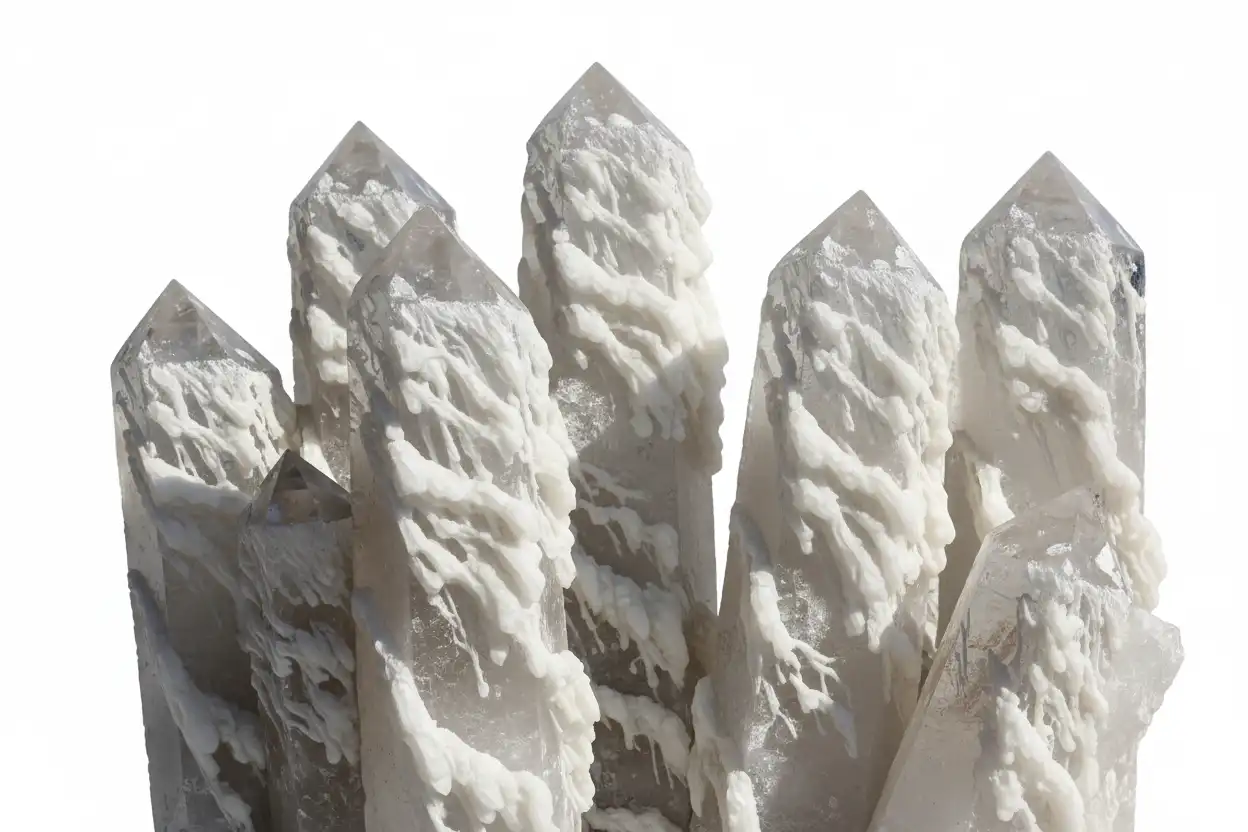
Candle Quartz Meaning: Mineral Facts, Growth & Symbolism
Candle quartz meaning is commonly associated in modern crystal practice with gradual growth, perseverance, renewal, reflection, and building something meaningful layer by layer. Those interpretations come from the stone’s unusual appearance rather than from a separate mineral chemistry. Candle quartz is quartz, SiO₂, whose main crystal is partly covered by secondary quartz growth that can resemble wax running down the sides of a candle.
The term is descriptive and commercial rather than a separate mineral species. A candle quartz specimen retains the fundamental physical and optical properties of macrocrystalline quartz: trigonal structure, vitreous luster, Mohs hardness 7, specific gravity near 2.65, conchoidal fracture, and no prominent easy cleavage.
Its distinctive character comes from growth morphology. Numerous smaller quartz crystals, stepped overgrowths, or textured layers develop along the sides of a larger central crystal, commonly leaving the upper termination more clearly visible. Depending on the specimen, those secondary crystals may look like dripping wax, scales, petals, small points, overlapping plates, or a rough crystalline sheath.
For other mineral-first references that distinguish scientific identity from trade names and symbolism, browse the Gemstone Guides.
What Is Candle Quartz?
Candle quartz is a descriptive quartz habit rather than a distinct mineral species. The central crystal and the secondary surface growth are fundamentally quartz unless additional minerals are independently identified.
Its basic composition is therefore:
SiO₂
That matters because commercial descriptions sometimes make candle quartz sound chemically different from ordinary rock crystal. Its unusual exterior does not create a new silica species.
| Property | Typical candle quartz characteristics |
|---|---|
| Material identity | Macrocrystalline quartz with distinctive secondary growth |
| Chemical formula | SiO₂ |
| Mineral group | Quartz / silica |
| Crystal system | Trigonal |
| Typical appearance | Central quartz point with layered or small secondary quartz growth |
| Common colors | Colorless, white, milky, pale smoky, cream or iron-stained variations |
| Mohs hardness | 7 |
| Specific gravity | About 2.65–2.66 |
| Refractive indices | Approximately 1.544 and 1.553 |
| Birefringence | Approximately 0.009 |
| Cleavage | None prominent in normal gemological use |
| Fracture | Conchoidal |
| Luster | Vitreous; secondary growth may appear frosted |
| Transparency | Transparent to translucent, sometimes locally opaque from inclusions or surface texture |
| Separate mineral species? | No |
| Meaning of the trade name | Refers primarily to growth appearance |
The wax-like texture is therefore a crystal-growth feature, not literal wax, resin, calcite drips, or another substance coating the quartz.
Why Is It Called Candle Quartz?
The trade name refers to the visual resemblance between the secondary crystal growth and hardened wax flowing down the side of a candle.
On a strong specimen, the main quartz point can resemble the candle itself while successive small crystals and stepped layers appear to cascade down the prism faces. Some pieces develop the texture over most of the central crystal, whereas others show it only on selected faces.
The resemblance is subjective, which is one reason the term is not a formal mineral classification.
A specimen does not need to look exactly like a manufactured candle to be sold under the name. Commercial usage varies, and collectors may apply related terms differently.
Candle Quartz, Pineapple Quartz, and Sprouting Quartz
The names candle quartz, pineapple quartz, celestial quartz, artichoke quartz, and sprouting quartz are sometimes used interchangeably in commercial listings, but their meanings are not completely standardized.
Some sellers use pineapple quartz as a broad synonym for any quartz whose sides are densely covered with small secondary crystals. Other collectors distinguish a more outwardly projecting “sprouting” habit from candle quartz whose secondary growth remains closer to, or more nearly parallel with, the central prism.
Mineral collectors discussing the habit have specifically noted this inconsistent terminology and the fact that visually similar quartz growth occurs in more than one locality.
The safest description therefore focuses on what can actually be seen:
Quartz with layered, stepped, or small secondary quartz crystals along the principal crystal faces, producing a wax-drip-like appearance.
That wording is more informative than assuming every pineapple, celestial, or candle trade label represents an identical growth morphology.
Candle Quartz Is Not a Quartz Variety Defined by Color
Amethyst, smoky quartz, and citrine are commonly distinguished primarily by color-producing mechanisms within quartz. Candle quartz is different.
Its name describes external growth morphology.
A candle quartz specimen could theoretically carry another quartz color descriptor if the evidence supported it. For example, pale smoky body color does not stop the material from showing candle-like growth.
The useful classification sequence is:
mineral identity — quartz;
color or internal variety where appropriate;
growth habit — candle-like secondary overgrowth;
locality — only when supported by provenance.
Keeping those levels separate prevents a trade term from being mistaken for a chemical species.
How Candle Quartz Develops Its Wax-Like Surface
The characteristic surface forms when quartz growth continues or resumes on an existing crystal in a manner that produces numerous secondary crystals or stepped overgrowths along its sides.
Instead of creating one perfectly smooth prism face, later silica deposition can generate many smaller crystallographic surfaces. Some secondary points remain closely aligned with the central crystal, while others project farther outward.
This produces a hierarchical structure: one major quartz crystal visually dominates the specimen, yet its sides carry many smaller quartz growth elements.
The exact sequence can vary from specimen to specimen. Some may record multiple growth stages, interruptions, changing fluid conditions, dissolution followed by regrowth, or local differences in the availability of silica-rich fluids.
A detailed discussion of growth environments, host rocks, mineralizing fluids, and possible overgrowth sequences is provided in candle quartz formation and deposit geology.
The Surface Did Not Melt
The melted-wax comparison is descriptive only.
Quartz does not need to melt and flow down the crystal to create candle quartz. Natural quartz crystallization from silica-bearing fluids can build repeated geometric surfaces that imitate flowing shapes even though the material grew as solid crystal.
This distinction is important because natural mineral morphology often resembles familiar objects without sharing their formation process.
Botryoidal minerals can resemble grapes without biological growth. Stalactitic minerals can resemble icicles without being frozen water. Candle quartz can resemble wax without ever having behaved as wax.
Why Some Specimens Look Frosted
The secondary crystals may scatter light strongly because their surfaces contain numerous tiny faces oriented in different directions.
A smooth clear quartz prism can reflect light in a relatively orderly way. Once that same surface becomes covered by hundreds of minute growth faces, reflection becomes visually more complex and may look frosted, sugary, pearly, or softly luminous.
This does not necessarily mean the material is microcrystalline chalcedony.
A specimen can remain macrocrystalline quartz while having a finely textured external surface.
Distinguishing true secondary crystals, etching, coatings, and internal scattering is easier under magnification. The candle quartz microscope inclusion notebook examines those features in greater detail.
Does Candle Quartz Come Only From Madagascar?
Madagascar is strongly associated with commercial candle quartz, and mineral collectors have specifically reported significant artichoke- or candle-style quartz from the Itremo region.
That does not make the growth habit geographically exclusive.
Quartz is extremely widespread, and comparable layered or sprouting habits have been reported from other geological regions. Collectors discussing unlabeled specimens have cautioned that visual resemblance to Madagascar material is not sufficient to establish origin.
The correct distinction is:
“Looks like material commonly sold from Madagascar” is an appearance statement.
“Mined in Madagascar” is a provenance statement.
Only the second requires documentary evidence connecting the actual specimen to that source.
Provenance Matters More Than a Familiar Shape
A candle quartz specimen can develop a morphology strongly associated with a commercial source and still lack reliable locality evidence.
Useful provenance includes:
original mine or regional labels;
supplier records;
collection cards;
parcel information;
field photographs;
acquisition notes;
specimen numbers;
or a traceable chain of custody.
A seller’s statement may be useful evidence, but the strength of the claim depends on how that seller obtained the material and whether documentation survives.
The candle quartz provenance disclosure checklist provides a more detailed framework for evaluating locality claims.
What Causes Candle Quartz Color?
The candle habit itself does not prescribe one color.
Many specimens are colorless, milky white, or pale gray because those are common quartz appearances. Other pieces may contain smoky coloration, iron-related surface staining, mineral inclusions, internal clouds, or associated coatings.
Three different kinds of color should be distinguished.
Body color
Color exists within the quartz itself.
Inclusion color
Another mineral or microscopic material inside the quartz contributes visible coloration.
Surface color
Iron oxides, clay, secondary minerals, coatings, or alteration affect the exterior.
These can look similar in photographs.
A yellow-brown candle quartz specimen, for example, should not automatically be classified as citrine. Surface iron staining can produce warm coloration without changing the internal quartz variety.
The detailed relationship among transparency, scattering, inclusions, surface texture, body color, and refractive behavior is covered in candle quartz optical properties and color behavior.
Quartz Properties Still Control Identification
No matter how elaborate the candle texture becomes, the central material should retain quartz-compatible properties if the identification is correct.
Quartz has Mohs hardness 7, specific gravity around 2.65–2.66, trigonal crystallography, vitreous luster on fresh crystal faces, and refractive indices near 1.544 and 1.553.
These characteristics provide a stronger diagnostic framework than the wax-drip appearance.
A glass imitation could be molded into a candle-like shape. A different mineral could develop a superficially similar crust. A coated quartz could have altered surface texture.
Morphology should therefore support quartz identification rather than replace it.
Original Candle Quartz Specimen and Photo Checklist
This checklist can be used to evaluate an unfamiliar candle quartz specimen or seller photograph without assuming that every textured quartz point deserves the trade name.
Confirm a recognizable central quartz crystal
Look for a dominant crystal whose basic geometry remains compatible with macrocrystalline quartz.
The secondary growth should modify that crystal rather than completely obscure all evidence of the underlying form.
Examine the main termination
Many candle quartz specimens preserve a more obvious main termination above the heavily textured sides.
Check whether that termination has realistic quartz faces and natural growth irregularities.
Follow the secondary growth down the prism
Look for repeated small crystals, stepped faces, layered protrusions, or wax-like growth attached directly to the central quartz.
The texture should have crystallographic structure rather than resemble a featureless molded coating.
Compare neighboring secondary crystals
Natural overgrowth usually contains variation in size, completeness, orientation, and contact relationships.
Perfectly identical repeated decorations would deserve closer examination.
Inspect broken edges
Where the specimen is already chipped, determine whether the textured material appears continuous with quartz beneath it.
Do not break a specimen deliberately.
Look for separate coatings
Iron oxides, clay, calcite, or other minerals may cover parts of the quartz.
A coating can coexist with candle growth, but it should not be mistaken for the quartz overgrowth itself.
Use directional lighting
Small crystal faces should brighten and darken individually as the specimen rotates.
A painted or resinous surface can reflect differently.
Inspect transparency differences
The central quartz may be clearer than the secondary growth because the many small crystals scatter more light.
That contrast can be entirely natural.
Check for etching
Dissolution can create stepped, skeletal, pitted, or frosted quartz surfaces.
Etching and secondary crystal growth can sometimes coexist, but they are not the same process.
Look for repairs
Large quartz points can be repaired or reattached to matrix. Under magnification, inspect suspicious contacts for adhesive.
A disclosed repair does not change the mineral identity, but it is part of specimen condition.
Do not assume all internal needles are part of the candle habit
The candle texture is primarily an external growth feature. Internal inclusions require separate identification.
Do not infer Madagascar origin automatically
Characteristic morphology may support comparison with known material but cannot establish locality.
Avoid destructive hardness tests on fine specimens
Quartz hardness is useful diagnostically, but there is no reason to scratch a good collector crystal when other observations are available.
Compare photographs under neutral lighting
Backlighting and intense directional lighting can exaggerate transparency, frostiness, and surface relief.
Ignore metaphysical language during identification
Terms such as ancient wisdom, abundance crystal, ascension quartz, master healer, or high-frequency candle quartz provide no evidence for mineral identity.
A Claim-versus-Evidence Guide to Candle Quartz
Because candle quartz is a trade term layered onto a familiar mineral, claims should be separated according to what evidence can actually support them.
| Claim | Evidence status | More accurate interpretation |
|---|---|---|
| Candle quartz is quartz | Supported | The term normally describes a quartz growth habit |
| Candle quartz has the formula SiO₂ | Supported when the material is quartz | The unusual surface does not create a new chemistry |
| It has Mohs hardness about 7 | Supported for quartz | Surface coatings or matrix minerals may behave differently |
| Candle quartz is a separate mineral species | Incorrect | It is a descriptive habit/trade term |
| The sides are covered with melted mineral material | Incorrect description | The wax-like appearance results from crystal growth morphology |
| Every pineapple quartz is identical to candle quartz | Too absolute | Commercial terminology is inconsistent |
| Every candle quartz specimen comes from Madagascar | Incorrect | Madagascar is a major commercial association, not the only possible source of similar growth |
| Wax-drip texture alone proves locality | Unsupported | Provenance requires documentation |
| Every yellow candle quartz is citrine | Incorrect | Surface staining or inclusions can also create yellow-brown color |
| Frosted surfaces prove chalcedony | Incorrect | Fine macrocrystalline quartz growth can scatter light strongly |
| Candle quartz records more than one growth stage | Plausible for many specimens | Exact growth history requires specimen-specific geological evidence |
| Candle quartz represents personal growth | Modern symbolism | A reasonable metaphor inspired by layered growth |
| Candle quartz stores ancient memories | Metaphysical belief | No standard mineralogical test establishes stored memory |
| Candle quartz raises spiritual frequency | Metaphysical interpretation | Quartz optics do not establish this claim |
| Candle quartz medically heals the body | Unsupported medical claim | Quartz identity does not establish therapeutic efficacy |
This framework leaves room for symbolism without allowing metaphysical descriptions to redefine the material.
Candle Quartz Versus Ordinary Quartz
There is no chemical boundary separating candle quartz from ordinary clear quartz.
The distinction is morphological.
A simple rock-crystal point may have comparatively smooth prism faces. Candle quartz adds abundant secondary growth, producing a much more complex outer surface.
Both remain quartz.
This is similar to the way mineral collectors distinguish skeletal, scepter, cathedral, artichoke, or Japan-law forms: the growth habit can be interesting and useful without becoming a separate mineral species.
Candle Quartz Versus Calcite
The mapped calcite meaning reference provides a useful diagnostic contrast because calcite can also form pale or colorless crystals with complex surfaces.
Calcite is CaCO₃, has Mohs hardness 3, possesses perfect rhombohedral cleavage, and can show very strong double refraction.
Quartz is SiO₂, has Mohs hardness 7, lacks comparable easy cleavage, and behaves very differently under physical and optical examination.
A textured white crystal therefore cannot be identified from color or surface complexity alone.
The chemistry and diagnostic properties are fundamentally different.
Candle Quartz Versus Colored Calcite
Color can make identification even more confusing. Honey, cream, orange, white, or iron-stained mineral specimens may superficially resemble one another in photographs.
The separate calcite color meaning guide illustrates how strongly color can vary inside another mineral species.
Candle quartz should therefore be identified from quartz-compatible structure and properties first.
Color comes afterward.
Candle Quartz Versus Cavansite
Cavansite meaning concerns a vivid blue calcium-vanadium silicate mineral commonly forming radiating aggregates on matrix.
Its crystal habit, hardness, chemistry, color, and geological context differ sharply from candle quartz.
Both can display visually complex secondary crystal growth, but similar surface intricacy is not evidence of mineral relationship.
This comparison is useful because habit names and visual resemblance are descriptive tools, not chemical classification.
Candle Quartz Versus Cerussite
Cerussite meaning concerns lead carbonate, a dense mineral capable of forming highly lustrous, twinned, and sometimes intricate crystals.
Colorless cerussite can look surprisingly quartz-like in photographs, yet its high density, much lower hardness, different crystal system, cleavage, chemistry, and optical behavior distinguish it readily under proper examination.
The comparison demonstrates why a clear crystal with impressive geometry should never be identified only by appearance.
How Laboratory Testing Would Confirm the Material
Most ordinary candle quartz does not require advanced testing because quartz is commonly recognizable from morphology and standard mineral properties.
Where identification is uncertain, useful methods can include:
Refractive-index testing on suitable polished material, yielding values consistent with quartz.
Specific-gravity measurement on a clean loose specimen without heavy matrix.
Polarized-light examination to assess quartz optical behavior.
Raman spectroscopy to confirm the silica structure and identify suspicious associated minerals.
X-ray diffraction where formal mineralogical confirmation is necessary.
Microscopy to examine secondary growth, coatings, repairs, inclusions, and dissolution textures.
The analytical method should answer the actual uncertainty. Confirming that the central crystal is quartz does not automatically identify every coating or inclusion attached to it.
Treatments and Artificial Alteration
The candle growth habit itself is normally valued as a natural crystallization feature, but an individual specimen can still be modified after mining.
Possible commercial modifications include:
removing iron staining;
applying oil or resin;
repairing broken crystals;
reattaching crystals to matrix;
coating surfaces;
artificially coloring quartz;
or enhancing photographs.
None should be assumed without evidence.
Cleaning can also alter appearance substantially. Removing an iron-rich coating may expose pale quartz beneath it, while aggressive chemical cleaning can damage associated minerals even when the quartz itself survives.
A specimen’s present appearance therefore reflects both geology and its handling history.
Documented History Versus Trade Lore
Quartz has an extensive documented human history, but the specific term candle quartz is a comparatively modern descriptive trade or collector name rather than a historically universal quartz category.
That distinction prevents a common historical error.
Evidence that quartz was used in an ancient culture does not prove that people recognized candle quartz as a separate type or assigned it the same meanings found in current crystal markets.
Likewise, the wax-drip appearance does not establish that older cultures interpreted it through candle symbolism.
Specific historical claims require specific documentation.
Where documentation is absent, candle quartz symbolism is best described as modern.
Candle Quartz Meaning in Modern Symbolism
Modern candle quartz meaning commonly emphasizes gradual growth, persistence, renewal, accumulated experience, and building progress in layers.
The association is visually intuitive.
A central quartz point remains visible beneath multiple stages of smaller growth. Instead of presenting one perfectly smooth surface, the specimen records complexity around a stable underlying structure.
Someone might use that appearance as a metaphor for developing new skills without losing earlier foundations, accumulating knowledge gradually, or recognizing that progress can look irregular while still moving forward.
The symbolism comes from observation.
It does not require a claim that the crystal transmits growth energy into the body.
Layered Growth as a Practical Metaphor
Candle quartz provides a particularly useful metaphor for incremental progress.
A large goal can be difficult to approach as one uninterrupted task. The crystal’s many smaller growth elements suggest a different model: build the larger result from repeated smaller additions.
A person might use the stone during planning and ask:
What is the central objective?
What smaller action can be added next?
Which previous layer already provides support?
Which complication is decorative rather than essential?
Has the project actually stalled, or has growth simply become less linear?
These questions can produce practical insight.
The quartz itself does not complete the work.
The Candle Image and Renewal
A candle can symbolize illumination, remembrance, continuity, ceremony, or renewal in many modern contexts, so the trade name naturally attracts similar associations.
Those ideas come from human cultural relationships with candles, not from silicon dioxide.
A person may choose candle quartz as a reminder to bring attention back to one priority, reconsider a difficult issue, or begin again after an interruption.
That is a symbolic use of resemblance.
It should not be presented as a universal property of the mineral.
Candle Quartz and “Ancient Wisdom”
Some metaphysical descriptions claim that candle quartz stores ancient knowledge, ancestral memories, Akashic information, or records from previous civilizations.
Quartz can contain real physical records of its growth history: zoning, inclusions, defects, fluid inclusions, overgrowth surfaces, and changes in crystal morphology can preserve geological information.
That scientific fact should not be converted into evidence that quartz stores recoverable human memories or supernatural records.
A mineral can preserve geological history without functioning as a metaphysical archive.
Candle Quartz and Spiritual Growth
Spiritual-growth symbolism is common because the specimen visibly grows in layers and small secondary crystals.
Within a personal belief system, someone may use the mineral as an object for meditation or reflection on patience, values, change, or long-term development.
What cannot be established mineralogically is that the quartz accelerates spiritual evolution, raises consciousness, opens dimensions, communicates with guides, or causes enlightenment.
Those are belief claims.
They should remain identified as such.
Chakra Associations
Modern crystal practices commonly connect clear or white quartz with the crown chakra and may extend that association to candle quartz.
Other systems describe candle quartz as affecting several chakras because quartz is treated metaphysically as an amplifier.
These are spiritual frameworks rather than gemological classifications.
Mineralogical instruments can measure refractive index, density, birefringence, crystal orientation, inclusions, and chemical composition. They cannot determine whether a chakra is open, blocked, balanced, activated, aligned, or cleansed.
A person can still use candle quartz in a private spiritual practice while keeping that interpretation distinct from mineral science.
Does Candle Quartz Have Healing Properties?
Candle quartz should not be presented as a medical treatment.
Claims that it heals organs, treats anxiety, repairs cells, balances hormones, improves immunity, relieves chronic pain, removes toxins, treats neurological disorders, or cures other conditions are not established by the properties of SiO₂.
The material’s measurable properties describe quartz.
They do not demonstrate therapeutic action through ordinary contact.
A familiar specimen may be used during meditation, journaling, breathing exercises, or other reflective routines without substituting it for appropriate medical or mental-health care.
Silicon and Oxygen Do Not Become Therapeutic Through Touch
Quartz consists of silicon and oxygen arranged in a crystalline silica structure.
The presence of these elements does not mean the body receives a controlled silicon or oxygen treatment by holding the crystal.
Biological effects depend on chemical form, dose, exposure route, metabolism, and physiological context.
A mineral formula is therefore an identity statement.
It is not a medical ingredient list.
Cutting Candle Quartz Can Destroy What Makes It Distinctive
The value of candle quartz as a collector specimen often lies in its natural external growth. Cutting the piece can remove precisely the morphology responsible for the name.
That creates a different lapidary decision from cutting ordinary massive quartz.
Before modifying a good specimen, consider:
completeness of the main termination;
quality of secondary growth;
rarity of the habit;
matrix relationships;
fractures;
specimen provenance;
transparency;
and whether cutting would reveal information or simply destroy natural structure.
The technical decisions around crystal orientation, fracture management, polish, and preserving surface growth are treated in candle quartz cutting, orientation and polish.
Candle Quartz in Jewelry
Quartz itself is sufficiently hard for many jewelry uses, but natural candle quartz crystal clusters are awkward for conventional everyday wear.
The many projecting secondary crystals create vulnerable edges and points that can catch, chip, or break even though quartz has Mohs hardness 7.
A polished or partially protected piece behaves differently from an untouched cluster.
For wearable designs, the important questions include how much natural texture remains exposed, whether the main crystal has fractures, how pressure is distributed by the setting, and whether projecting secondary points can strike hard surfaces.
Those mechanical considerations are covered in candle quartz setting and wear engineering.
Conserving the Natural Growth
Collector-quality candle quartz deserves handling that protects the secondary crystals rather than treating the specimen like a smooth quartz pebble.
Small overgrowths can chip when rubbed against packaging, dropped into a mixed specimen drawer, or handled repeatedly by their most textured surfaces.
Before cleaning or changing storage, record:
the main termination;
secondary crystal coverage;
existing chips;
repaired areas;
iron staining;
matrix contacts;
inclusions;
dimensions;
labels;
and provenance information.
A structured approach is available in the candle quartz specimen conservation record.
Safe Ownership and Handling
Normal handling of intact candle quartz is straightforward.
Quartz is not a reason to treat a stable specimen as inherently hazardous.
The important safety distinction is between an intact crystal and respirable crystalline-silica dust produced by cutting, grinding, drilling, or crushing. Lapidary work should control dust through suitable wet methods, local extraction, eye protection, and appropriate respiratory protection rather than uncontrolled dry grinding.
Matrix minerals may introduce additional considerations, so the ideal SiO₂ formula of the quartz does not describe every material present in a natural specimen.
Do not grind crystal specimens for consumption or use unknown geological material to prepare drinking-water crystal elixirs.
A Practical Evidence Ladder for Candle Quartz Claims
Different claims about candle quartz require different evidence.
Direct observation can document the central quartz crystal, wax-like secondary growth, crystal orientation, transparency, color, coatings, fractures, and condition.
Basic mineral testing can determine whether hardness, density, fracture, and other physical properties are compatible with quartz.
Microscopy can distinguish small secondary quartz crystals from coatings, etching, staining, repairs, or unrelated mineral growth.
Optical testing can evaluate refractive indices and birefringence in suitable material.
Raman spectroscopy can confirm quartz and identify sufficiently large associated minerals.
X-ray diffraction can provide structural confirmation when formal mineral identification is required.
Geological evidence can determine whether the overgrowth relationships are compatible with repeated quartz crystallization in the relevant deposit.
Provenance documentation supports locality claims, particularly when Madagascar or another specific source is used commercially.
Historical documentation supports the long history of quartz itself but should not be stretched into an undocumented ancient tradition specific to the modern candle quartz trade name.
Modern symbolism includes layered growth, perseverance, renewal, spiritual development, illumination, and reflection. These remain human interpretations rather than intrinsic physical powers.
What Candle Quartz Meaning Can Reliably Include
Candle quartz meaning becomes clearest when mineral identity, growth morphology, documented history, and modern symbolism remain separate.
Materially, candle quartz is quartz, SiO₂. It retains the characteristic hardness, density, trigonal structure, optical constants, and fracture behavior of macrocrystalline quartz. What distinguishes it visually is the development of numerous secondary quartz crystals or stepped overgrowths along the main prism, producing the wax-drip appearance behind the trade name.
The name itself is not a formal mineral species, and related commercial terms such as pineapple, celestial, artichoke, or sprouting quartz are not used consistently. Likewise, Madagascar is strongly associated with commercial candle quartz, but morphology by itself cannot establish geographic origin because comparable quartz growth occurs elsewhere.
Historically, quartz has an extensive cultural and mineralogical record, yet modern candle quartz symbolism should not be projected backward without evidence that a particular historical tradition recognized the same growth habit as a distinct material.
Symbolically, layered crystal growth lends itself naturally to ideas of persistence, accumulated experience, renewal, and gradual progress. Someone can use a specimen as a practical reminder that large changes are often built from smaller steps, without claiming that quartz medically heals the body, stores human memories, activates chakras, or transmits a scientifically established spiritual frequency.
Gems Lore explains its material-first approach on the About page. Health, spiritual, and informational limitations are set out in the Disclaimer, while factual corrections or supporting mineralogical evidence can be submitted through Contact.
Candle quartz does not need exaggerated mythology to be distinctive. Ordinary SiO₂ can record a complex sequence of crystal growth through hundreds of small secondary surfaces wrapped around a larger central point, transforming a familiar mineral into a highly recognizable collector habit. Candle quartz meaning is strongest when that real growth story comes first and symbolism remains the human interpretation inspired by it.