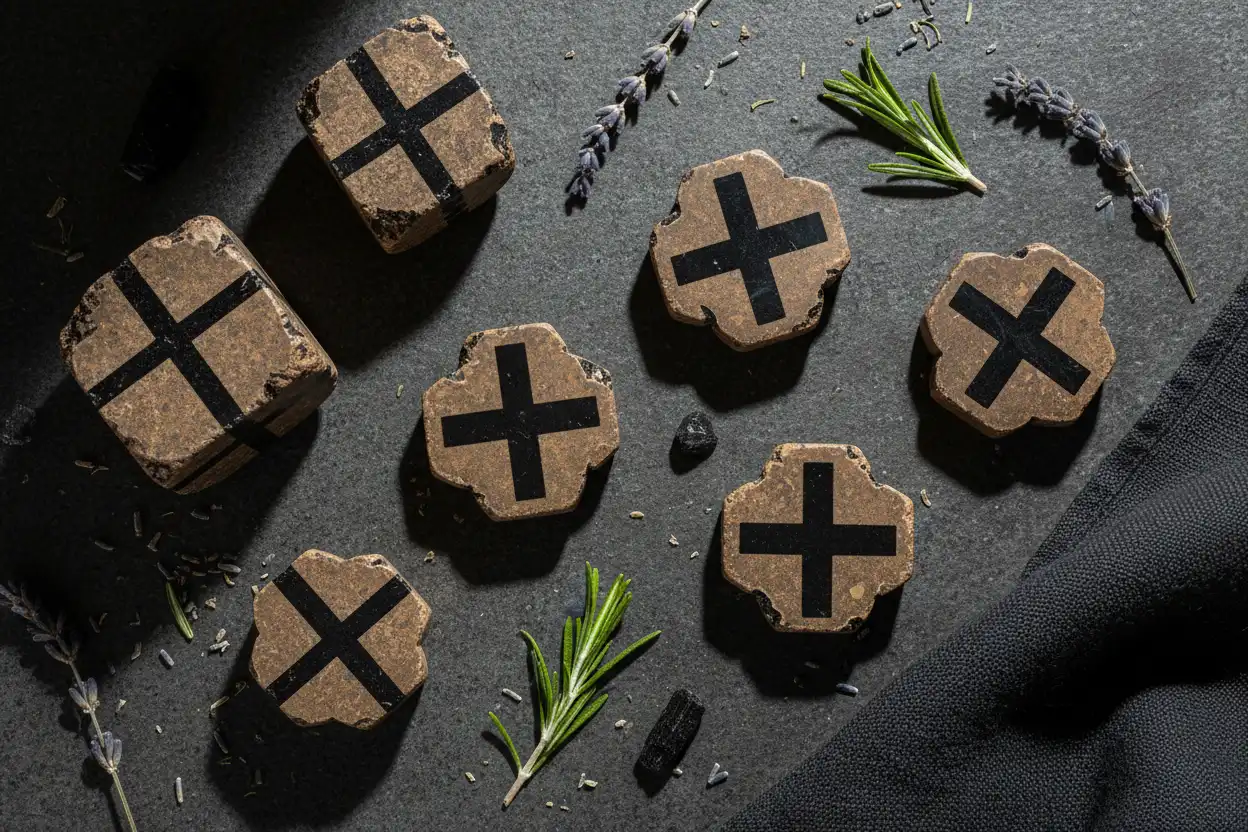
Chiastolite Meaning: Mineral Facts, Cross & Symbolism
Chiastolite meaning is commonly associated in modern crystal traditions with protection, balance, resilience, transition, perspective, and keeping a stable center when circumstances become complicated. Those interpretations are inspired largely by the stone’s most recognizable feature: a naturally occurring dark cross that can appear when certain crystals are cut across the correct direction. Materially, chiastolite is not a separate mineral species. It is a distinctive inclusion-bearing variety of andalusite, an aluminum silicate with the formula Al₂SiO₅.
The cross is real, but it is not painted onto the crystal and it is not a supernatural mark. It develops because dark carbonaceous and other fine inclusion material becomes concentrated in particular growth sectors as the andalusite crystal forms. When the crystal is sliced approximately perpendicular to its long axis, those inclusion-rich sectors can intersect the polished surface as a cross, X, or four-part pattern.
That combination of ordinary mineral chemistry and unusual natural geometry makes chiastolite scientifically interesting before any symbolism is added. Its mineral identity, metamorphic formation, optical behavior, inclusion pattern, and cutting orientation can all be examined directly. Historical and modern interpretations can then be discussed separately without using symbolism as evidence for identification.
For other material-first mineral references, browse the Gemstone Guides.
What Is Chiastolite?
Chiastolite is an inclusion-patterned variety of andalusite.
Andalusite has the chemical formula:
Al₂SiO₅
It belongs to a group of minerals that includes kyanite and sillimanite. All three share the same overall Al₂SiO₅ composition but have different crystal structures and become stable under different pressure-temperature conditions.
Chiastolite therefore illustrates two levels of classification:
Mineral species: andalusite
Variety name: chiastolite
The variety name is used when the andalusite contains the characteristic dark cross-like inclusion pattern.
| Property | Typical chiastolite characteristics |
|---|---|
| Mineral identity | Inclusion-bearing variety of andalusite |
| Chemical formula | Al₂SiO₅ |
| Mineral group | Andalusite group |
| Crystal system | Orthorhombic |
| Typical color | Brown, reddish brown, gray, yellowish, greenish, pinkish or pale neutral tones |
| Characteristic feature | Dark cross or X-shaped inclusion pattern in transverse section |
| Inclusion material | Commonly carbonaceous matter with other fine mineral material |
| Transparency | Usually translucent to opaque; clearer areas can occur |
| Mohs hardness | About 6.5–7.5 |
| Specific gravity | Roughly 3.1–3.2 |
| Cleavage | Distinct to good in certain directions |
| Fracture | Uneven to locally conchoidal |
| Luster | Vitreous on fresh or polished surfaces |
| Optical character | Biaxial |
| Pleochroism | Can be noticeable in sufficiently transparent andalusite |
| Common fashioned forms | Cabochons, beads, slices, pendants and carvings |
| Separate mineral species? | No |
The essential point is simple: chiastolite is andalusite whose inclusion arrangement creates an especially recognizable pattern.
Why Does Chiastolite Have a Cross?
The dark cross develops during crystal growth.
As an andalusite crystal enlarges in a metamorphic rock, foreign material can be incorporated differently in separate growth sectors. Fine carbonaceous particles, graphite-like matter, clay-rich material, and other inclusions may become preferentially concentrated along internal boundaries or sectors instead of being distributed uniformly through the growing crystal.
When several inclusion-rich zones extend lengthwise through the crystal, a transverse cut can intersect them as four dark arms.
The visual result depends on geometry.
A slice taken nearly perpendicular to the crystal’s long axis may reveal a clear cross.
A cut at another orientation may show:
dark parallel streaks;
irregular wedges;
triangular sectors;
elongated bands;
or no recognizable cross at all.
The pattern is therefore three-dimensional.
The familiar cross is one particular two-dimensional section through it.
The Cross Is Not a Surface Marking
A genuine chiastolite pattern should continue through the interior of the material.
If a cabochon is repolished slightly, the dark sectors should not disappear like surface paint. Their exact thickness or shape may change as polishing exposes a different internal level, but the structure belongs inside the stone.
This provides an important first distinction from decorated imitations.
A cross that exists only on one surface, follows scratches, sits inside a coating, or can be removed with polishing is not equivalent to natural sector inclusions.
The internal structure is examined in greater detail in the chiastolite microscope inclusion notebook.
Why Are Chiastolite Crosses Rarely Perfect?
Commercial photographs sometimes encourage the expectation that every chiastolite should contain a perfectly centered, evenly proportioned black cross.
Natural growth is less orderly.
Cross arms can be:
unequal in width;
slightly curved;
displaced from the center;
broken by fractures;
interrupted by pale mineral zones;
surrounded by dark corners;
shaped more like an X;
or merged into broad carbon-rich sectors.
Some polished slices contain one striking cross.
Others show several incomplete geometric zones.
Imperfection is not automatically evidence of low authenticity. In fact, natural variation is expected when inclusion trapping changes during growth.
The important question is whether the dark pattern makes geological and structural sense.
What Are the Dark Inclusions Made Of?
The dark material is commonly described broadly as carbonaceous matter and may include graphite-like material together with fine mineral inclusions.
It is tempting to simplify the description to “the cross is graphite,” but that can be more definite than the evidence supports for every specimen.
Natural chiastolite forms in different metamorphic rocks, and the precise inclusion assemblage can vary.
A responsible description therefore distinguishes:
what is visible: dark inclusion-rich sectors;
what is commonly reported: carbonaceous material;
what requires specimen-specific analysis: the exact mineral or carbon phases present.
Microscopy can document texture.
Raman spectroscopy or other analytical methods can identify individual components much more confidently where the inclusion chemistry matters.
How Chiastolite Forms
Chiastolite forms during metamorphism, particularly in aluminum-rich sedimentary rocks transformed under suitable temperature and pressure conditions.
A shale or mud-rich rock can contain abundant aluminum-bearing minerals, clay, quartz, carbonaceous matter, and other components. When heat and pressure reorganize that rock, new metamorphic minerals become stable.
Andalusite can grow where the pressure-temperature environment favors it.
As crystals enlarge within the surrounding metamorphic matrix, they may incorporate or push aside fine carbonaceous material.
The unusual inclusion sectors develop during that growth rather than being added afterward as decorative markings.
The complete relationship among metamorphic grade, pressure, temperature, protolith composition, crystal growth, andalusite stability, and associated minerals is covered in chiastolite formation and deposit geology.
Chiastolite Is a Metamorphic Mineral
Metamorphism alters existing rock without requiring complete melting.
Heat, pressure, deformation, and chemically active fluids can reorganize minerals and textures until a new assemblage becomes stable.
Chiastolite-bearing rocks can therefore preserve both:
newly grown andalusite crystals;
and remnants or inclusions derived from the earlier sedimentary material.
This is one reason the cross pattern is so informative.
The crystal grew while interacting with its surrounding rock.
Instead of excluding every impurity, it incorporated some material into an organized internal pattern.
The result records mineral growth and rock transformation simultaneously.
Andalusite, Kyanite, and Sillimanite
Andalusite belongs to the Al₂SiO₅ polymorph system with kyanite and sillimanite.
They share the same overall chemical formula:
Al₂SiO₅
but have different crystal structures.
Their stability depends strongly on pressure and temperature.
This relationship allows metamorphic geologists to use these minerals as evidence about the physical conditions rocks experienced.
Chiastolite remains andalusite regardless of the cross pattern.
It does not become a fourth Al₂SiO₅ polymorph.
The inclusions create the variety.
The underlying crystal structure remains that of andalusite.
Why Chiastolite Can Tell a Geological Story
A polished chiastolite slice contains more than a decorative symbol.
Its central crystal records conditions under which andalusite was stable.
Its inclusion-rich sectors reveal interaction between the growing crystal and surrounding fine material.
Its host rock can preserve foliation, mica growth, quartz, graphite-rich layers, and other metamorphic features.
When provenance is intact, the specimen can therefore contribute information about:
original sediment composition;
metamorphic conditions;
crystal-growth relationships;
deformation;
and mineral sequence.
Removing a crystal from all matrix can improve the cross display but may reduce geological context.
Collector aesthetics and geological information are not always maximized by the same preparation.
What Color Is Chiastolite?
Chiastolite commonly appears brown, grayish brown, reddish brown, tan, cream, muted greenish, or similarly earthy in polished material.
More transparent andalusite can show stronger variation and pleochroism.
The dark inclusion sectors provide much of the contrast responsible for the familiar cross.
Color in the andalusite body can be influenced by trace elements, structural defects, inclusions, and viewing orientation.
The detailed relationship among body color, pleochroism, transparency, refractive behavior, and inclusion contrast is covered in chiastolite optical properties and color behavior.
Pleochroism in Andalusite
Transparent andalusite can show strong pleochroism, meaning different colors or color intensities appear when the crystal is viewed along different crystallographic directions.
Depending on the material, the observer may see combinations involving:
greenish tones;
yellow;
brown;
reddish brown;
pinkish hues;
or related variations.
Chiastolite is often too inclusion-rich and translucent for spectacular gemstone-style pleochroism to dominate its appearance.
Nevertheless, the underlying andalusite structure retains anisotropic optical properties.
This is another reason color photographs should not be treated as a complete identification method.
Orientation matters.
Original Chiastolite Specimen and Photo Checklist
The following checklist can be used to examine rough crystals, transverse slices, cabochons, beads, pendants, carvings, and online listings.
Confirm that the cross is internal
Inspect the edge, reverse, drill hole, or existing chip.
The dark sectors should continue through the material rather than sitting only on the polished face.
Examine the cross for natural variation
Unequal arms, irregular margins, offset centers, and variable thickness are compatible with natural growth.
Perfect mechanical symmetry is not required.
Compare multiple slices if available
Slices from different positions along one crystal can show the cross changing in size and shape.
That is expected in a three-dimensional growth structure.
Look at longitudinal material
A lengthwise section may show dark inclusion zones extending along the crystal instead of forming a cross.
This is strong evidence that orientation creates the familiar transverse pattern.
Inspect the host matrix
Mica-rich schist, slate-like rock, quartz, carbonaceous material, and other metamorphic minerals can support plausible geological context.
Matrix is supportive evidence rather than species proof.
Check the luster
Fresh andalusite surfaces should be nonmetallic and generally vitreous where clean.
A metallic dark object with a painted cross is inconsistent with ordinary chiastolite.
Examine the polish
Chiastolite can accept a good polish but inclusion-rich zones may respond differently from cleaner andalusite.
Minor relief around inclusions can be natural.
Look for surface coatings
Resin, lacquer, wax, or dye can change appearance.
A treatment should not be confused with the natural inclusion pattern.
Inspect fractures
Natural cracks may interrupt the cross or follow structural weaknesses.
Large repaired fractures should be disclosed where they affect durability.
Use neutral lighting
Warm lighting can exaggerate brown and red tones.
Compare the same stone under consistent illumination.
Examine thin edges
Translucency may become easier to see where the andalusite body is thinner and less inclusion-rich.
Check hardness only when appropriate
The material should behave within the andalusite hardness range, but destructive testing of a finished piece is rarely justified.
Consider orientation before calling the stone fake
A weak cross can result simply from cutting away from the ideal transverse plane.
Preserve locality labels
Provenance may add geological and collector value that cannot be recreated from appearance.
Ignore symbolic terminology during identification
Descriptions such as protection stone, cross crystal, transition stone, spiritual shield, or grounding chiastolite provide no mineralogical evidence.
Claim Versus Evidence: Chiastolite
| Claim | Evidence status | More accurate interpretation |
|---|---|---|
| Chiastolite is a variety of andalusite | Supported | The defining feature is its characteristic inclusion pattern |
| Its formula is Al₂SiO₅ | Supported | This is the formula of andalusite |
| Chiastolite is a separate mineral species | Incorrect | It is an andalusite variety |
| The cross is painted onto natural stone | Incorrect for genuine material | The dark sectors occur internally |
| Every chiastolite has a perfect cross | Incorrect | Natural pattern quality varies |
| The cross depends on cutting orientation | Supported | Transverse sections commonly show it most clearly |
| The dark sectors commonly contain carbonaceous material | Supported broadly | Exact inclusion mineralogy can vary by specimen |
| Chiastolite is related to kyanite and sillimanite | Supported | All are Al₂SiO₅ polymorphs |
| Chiastolite forms mainly by ordinary sediment deposition | Incorrect | It is a metamorphic variety of andalusite |
| A natural cross proves supernatural formation | Unsupported | Crystal-growth processes explain the geometry |
| Chiastolite scientifically protects the wearer | Unsupported | Protection is symbolic |
| Chiastolite prevents accidents | Unsupported | No mineralogical mechanism establishes this |
| Chiastolite balances energy fields | Metaphysical interpretation | Energy-field claims are not gemological properties |
| Chiastolite medically reduces anxiety | Unsupported medical claim | Andalusite identity does not establish treatment efficacy |
| Historical religious use proves physical protective power | Incorrect inference | Cultural use documents meaning, not supernatural efficacy |
The natural cross is already unusual enough that it does not need unsupported claims to remain interesting.
Chiastolite Versus Ordinary Andalusite
All chiastolite is andalusite.
Not all andalusite is chiastolite.
Ordinary gem-quality andalusite may be relatively transparent, strongly pleochroic, and cut into faceted stones without conspicuous cross inclusions.
Chiastolite contains enough organized inclusion material for a cross-like pattern to become the defining visual feature.
Their fundamental mineral chemistry and crystal system remain the same.
This means hardness, density, and basic optical identity overlap.
The distinction is primarily inclusion morphology.
Chiastolite Versus Staurolite
Staurolite is famous for natural cross-shaped twins and can therefore be confused conceptually with chiastolite.
The origin of the cross is completely different.
In staurolite, separate crystals can twin together at characteristic angles and form an external cross-shaped crystal.
In chiastolite, the cross is an internal inclusion pattern revealed in section through one andalusite crystal.
The distinction is fundamental:
Staurolite cross — crystallographic twinning.
Chiastolite cross — organized internal inclusions.
A flat polished chiastolite slice and a naturally crossed staurolite crystal may share symbolic imagery without sharing the same mineral structure or formation mechanism.
Chiastolite Versus Chevron Amethyst
The neighboring chevron amethyst meaning reference concerns quartz containing repeated purple-and-white growth zones.
Both stones can display striking internal geometry.
Chevron amethyst commonly produces Vs, zigzags, or triangular bands caused by quartz growth and color zoning.
Chiastolite produces dark cross or X-shaped sectors within andalusite.
The comparison shows why pattern alone cannot define mineral identity.
Two natural stones can contain geometric designs created by entirely different processes.
Chiastolite Versus Charoite
Charoite meaning concerns a complex purple silicate commonly occurring as fibrous, swirling ornamental rock.
Its visual identity is dominated by flowing texture.
Chiastolite is an andalusite variety whose most recognizable feature is an organized inclusion cross.
Charoite can contain several contrasting mineral phases.
Chiastolite’s cross occurs within the andalusite crystal itself.
Their colors, structures, formation environments, and optical properties are fundamentally different.
Chiastolite Versus Chrome Diopside
Chrome diopside meaning concerns a chromium-colored green pyroxene.
Chrome diopside is generally valued for transparent green color rather than an inclusion pattern.
Chiastolite belongs to andalusite and typically emphasizes brown-to-neutral body color with a dark cross.
The two can be separated readily by crystal structure, optical properties, cleavage behavior, color causes, and geological context.
This comparison reinforces a larger rule:
Variety names may describe color, inclusions, pattern, or composition depending on the mineral.
They should not all be interpreted in the same way.
Chiastolite Versus Chrysanthemum Stone
The mapped chrysanthemum stone meaning reference provides another useful pattern comparison.
Chrysanthemum stone is an ornamental rock known for pale mineral aggregates that resemble flowers against a darker matrix.
The flower-like pattern involves contrasting minerals within a rock.
Chiastolite’s cross occurs inside an andalusite crystal as organized inclusion sectors.
Both patterns are natural.
Neither pattern requires a supernatural explanation.
Their geological mechanisms are simply different.
How Laboratory Identification Works
Typical chiastolite can often be recognized through a combination of cross pattern and andalusite-compatible properties.
When identification matters, useful methods include:
Refractive-index testing. Suitable polished surfaces can provide readings within the andalusite range.
Specific-gravity measurement. A clean loose specimen should be consistent with andalusite density.
Polarized-light examination. Anisotropic optical behavior can support identification.
Pleochroism observation. Sufficiently transparent portions may show directional color changes characteristic of andalusite.
Microscopy. This can document inclusion sectors, growth boundaries, fractures, host-rock remnants, and treatments.
Raman spectroscopy. Raman analysis can confirm andalusite and potentially characterize dark inclusions at suitable points.
X-ray diffraction. Structural analysis can distinguish andalusite from other Al₂SiO₅ polymorphs.
The analytical method should answer the uncertainty.
Seeing a cross does not eliminate the need to identify the surrounding mineral if the specimen is unusual or commercially important.
Why Chemistry Alone Is Not Enough to Separate Al₂SiO₅ Polymorphs
Andalusite, kyanite, and sillimanite share the same overall formula.
An elemental test detecting aluminum, silicon, and oxygen in the expected proportions may therefore establish an Al₂SiO₅ composition without automatically determining which polymorph is present.
Crystal structure resolves the distinction.
This is the same broader mineralogical principle seen in other polymorph systems: identical composition can produce different mineral species when atomic arrangement changes.
Chiastolite adds another level.
Once andalusite has been identified, the inclusion pattern determines whether the chiastolite variety name is appropriate.
Cutting Orientation Determines the Cross
Chiastolite is one of the clearest examples of a gem material whose familiar appearance depends strongly on orientation.
If the lapidary wants a cross, the rough crystal should generally be cut approximately perpendicular to its elongation.
A poorly oriented slice can turn a potentially attractive cross into an indistinct set of dark streaks.
Before cutting, examine:
crystal direction;
visible inclusion sectors;
fractures;
matrix;
shape of the rough;
thickness required for stability;
and how the cross changes along the crystal.
The detailed relationship between saw direction, cross placement, fracture avoidance, polishing, and yield is covered in chiastolite cutting, orientation and polish.
Why Cross Quality Changes From Slice to Slice
The inclusion pattern is not necessarily identical throughout the entire length of a crystal.
As growth conditions changed, the amount and distribution of carbonaceous material could change too.
One section may contain:
a sharp narrow cross;
another a broad X;
another four dark triangular sectors;
and another little recognizable pattern.
This variability explains why rough chiastolite crystals can produce polished pieces of very different visual quality.
It also creates a useful warning for online buying.
One attractive sample photograph does not guarantee that every bead or slice cut from the parcel will display the same cross.
Chiastolite in Jewelry
Chiastolite’s andalusite hardness makes it substantially more practical for jewelry than many soft collector minerals.
Cabochons, beads, pendants, earrings, and rings are all possible.
The main durability concerns are:
cleavage;
pre-existing fractures;
thin cross sections;
drilling;
sharp edges;
and differences between inclusion-rich and cleaner areas.
A thick rounded cabochon generally distributes impact better than a thin flat slice with exposed corners.
Rings and bracelets receive greater mechanical exposure than pendants.
The dedicated chiastolite setting and wear engineering guide addresses mounting pressure, stone orientation, edge protection, and use frequency without turning jewelry durability into part of the symbolic meaning.
Treatments and Imitations
Chiastolite’s natural cross pattern is unusual enough that imitations are possible.
Potential commercial concerns include:
painted or printed crosses;
assembled stones;
resin containing dark inserts;
dyed substitutes;
composite slices;
fracture filling;
and reconstructed material.
A genuine chiastolite does not need a perfectly black cross.
Natural inclusion sectors can be brownish black, charcoal, gray, irregular, or mixed with surrounding mineral material.
Suspicious features include a cross whose edges look printed, a pattern that exists only on the surface, or a mark that does not continue through a polished edge.
Magnification and examination from multiple directions are more informative than judging one face.
Is a Weak Cross Lower Quality?
Only relative to a particular purpose.
A jewelry buyer specifically seeking a dramatic symbolic cross may prefer high contrast and symmetrical arms.
A mineral collector may value:
unusual growth sectors;
attached metamorphic matrix;
a complete crystal;
geological provenance;
or complex inclusions
more than perfect pattern symmetry.
A lapidary may prefer large rough with enough thickness to produce multiple oriented slices.
There is therefore no universal scientific grading scale for cross quality.
Quality depends on whether the object is being evaluated as a mineral specimen, lapidary material, jewelry stone, or decorative symbol.
Historical Use of Chiastolite
Chiastolite has long attracted attention because the cross can be recognized without sophisticated laboratory equipment.
Naturally crossed stones have been collected and used as amulets, devotional objects, curiosities, and decorative pieces in cultural contexts where the cross carried religious or protective significance.
That historical association is understandable.
A natural geometric symbol that resembles an important cultural sign can acquire meaning quickly.
The responsible boundary is that use as a protective amulet documents human belief.
It does not demonstrate that the mineral physically prevented harm.
Likewise, historical use should not be generalized into a claim that every culture encountering chiastolite assigned it the same meaning.
The Name Chiastolite Refers to the Cross
The variety name derives from a term associated with crossing or crossed form.
That is consistent with the material’s defining appearance.
The name is descriptive rather than evidence of a specific supernatural tradition.
This matters because mineral names are sometimes reinterpreted as proof of metaphysical properties.
In this case, the linguistic connection simply reflects what people could see in the stone: an internal cross pattern.
Historical Symbolism Should Remain Specific
A cross can represent very different ideas according to cultural setting.
It may indicate:
religious faith;
protection;
sacrifice;
identity;
direction;
intersection;
balance;
or another locally meaningful concept.
A historical object therefore needs context.
Finding chiastolite in a pendant does not tell us exactly what its owner believed unless the archaeological, textual, or cultural evidence provides that information.
Material identification is one part of interpretation.
Meaning requires additional evidence.
Chiastolite Meaning in Modern Symbolism
Modern chiastolite meaning commonly emphasizes protection, balance, resilience, transition, perspective, and maintaining stability under pressure.
The cross provides the most obvious visual inspiration.
Four arms meet at one central region, so the stone can be interpreted as representing several directions connected through one point.
A grounded symbolic practice might use that geometry to ask:
What is the central issue?
Which competing pressures are acting on it?
Which direction deserves attention first?
Which boundary should remain stable?
What changes if the situation is viewed from another side?
The questions can be practically useful.
The mineral does not answer them.
Protection as a Symbolic Boundary
Chiastolite is frequently described as a protection stone.
A practical interpretation treats protection as preparation and boundary-setting rather than an invisible force field.
Someone might associate the stone with reminders to:
check an important decision before acting;
use protective equipment when required;
secure personal information;
leave an unsafe situation;
establish a clear boundary;
verify an unfamiliar claim;
or prepare for a foreseeable risk.
Those behaviors can reduce real-world risk.
Holding an andalusite crystal does not guarantee protection from accidents, illness, financial loss, or another person’s actions.
The Cross as a Decision Framework
The cross pattern can also function as a simple four-direction decision model.
When considering a difficult choice, assign each arm one question:
Evidence: What do I actually know?
Risk: What could go wrong?
Benefit: What would improve if this succeeds?
Action: What is the next reasonable step?
The center represents the decision after those four categories have been considered.
This is not an ancient chiastolite ritual.
It is a modern practical use of the natural geometry as a memory aid.
Such uses can give symbolism real behavioral value without claiming supernatural causation.
Balance Does Not Mean Perfect Symmetry
Natural chiastolite crosses are frequently uneven.
One arm may be thicker.
Another may fade.
The center may be offset.
A fracture may interrupt part of the pattern.
That makes the stone a more realistic symbol of balance than a perfectly manufactured cross.
Functional balance does not require every part of life, work, health, relationships, or responsibility to receive an identical share at all times.
It can mean recognizing competing demands and deciding deliberately which one needs more attention.
The uneven natural pattern reinforces that interpretation.
Transition and Metamorphism
Transition symbolism also has a direct geological metaphor.
Chiastolite forms through metamorphism.
The parent rock experiences new pressure-temperature conditions, minerals become unstable, new minerals grow, and the rock develops a different assemblage without simply disappearing.
A person might use that process as a reminder that change can involve reorganization rather than total replacement.
Useful questions include:
Which part of the old structure still works?
Which part no longer fits present conditions?
What new capability is becoming necessary?
Am I interpreting change as destruction when it is actually reorganization?
The metamorphism is geological.
The personal application is symbolic.
Resilience Without Magical Claims
Chiastolite’s durability compared with many softer collector minerals may reinforce modern resilience symbolism.
But resilience should not be translated into a biological claim.
A polished stone can serve as a reminder to return to a plan after disruption, revise a failed approach, or continue a difficult task in smaller steps.
It cannot make tissue, immunity, mental health, or physical endurance more resilient simply through contact.
Symbolic resilience is meaningful when connected to behavior.
It becomes misleading when converted into unsupported medical effects.
Chiastolite and Spiritual Protection
Metaphysical descriptions sometimes claim that chiastolite blocks negative energy, psychic attack, curses, harmful entities, or unwanted spiritual influence.
These claims cannot be evaluated through mineralogical testing.
Laboratory instruments can determine:
crystal structure;
composition;
density;
refractive behavior;
inclusion material;
andalusite identity;
and growth relationships.
They cannot measure whether a specimen blocks a curse or repels a non-physical entity.
Such statements belong to personal belief systems and should remain labeled accordingly.
Chiastolite and Chakra Associations
Modern crystal systems may associate chiastolite with the root chakra because of its earthy brown color and protection symbolism, while other interpretations connect the cross with broader energetic balance.
These associations are metaphysical.
A gemologist cannot determine whether a chakra is open, blocked, activated, cleansed, aligned, or healed through measurements of Al₂SiO₅.
Someone may still use chiastolite within a private spiritual practice.
The important boundary is not to present that framework as a physical property of andalusite.
Does Chiastolite Have Healing Properties?
Chiastolite should not be presented as a medical treatment.
Claims that it treats anxiety, inflammation, blood disorders, immune conditions, neurological disease, pain, circulation problems, fatigue, or other health concerns are not established by its mineralogical properties.
Its measurable characteristics describe:
aluminum-silicate chemistry;
orthorhombic structure;
inclusion pattern;
hardness;
density;
optical behavior;
and metamorphic formation.
Those facts do not demonstrate therapeutic action through ordinary physical contact.
A personally meaningful stone may still be used during reflection, meditation, or journaling without replacing appropriate healthcare.
Aluminum in Chiastolite Is Not a Therapeutic Ingredient
Chiastolite contains aluminum as an essential part of andalusite.
That does not mean the body receives a useful or harmful dose simply because a polished stone is handled normally.
Biological effects depend on:
chemical form;
dose;
solubility;
exposure route;
particle size;
and physiological context.
Aluminum locked within a stable silicate lattice is not equivalent to consuming an aluminum compound.
The mineral formula explains identity.
It is not a medical ingredient list.
Normal handling and deliberately generating fine mineral dust are also different exposure conditions.
Safe Ownership
Normal handling of intact polished chiastolite is generally straightforward.
The more important safety issue arises during cutting, drilling, grinding, sanding, or crushing.
Chiastolite is a silicate mineral and may occur in quartz-rich metamorphic rock. Lapidary processing can therefore create fine mineral dust, potentially including crystalline silica from associated rock components.
Use appropriate wet methods where suitable, effective local extraction, eye protection, and suitable respiratory controls rather than uncontrolled dry grinding.
Do not deliberately pulverize geological material for inhalation or ingestion.
There is also no mineralogical reason to place chiastolite into drinking water to obtain symbolic protection.
Conserving Chiastolite Specimens
An important chiastolite specimen can preserve more than its cross.
The host rock may contain foliation, mica orientation, carbonaceous layers, quartz veins, other metamorphic minerals, and crystal relationships that provide geological context.
Before cutting, cleaning, or removing matrix, document:
crystal dimensions;
host rock;
visible orientation;
inclusion pattern;
existing fractures;
cross quality;
matrix contacts;
repairs;
labels;
and provenance.
The chiastolite specimen conservation record provides a structured framework for preserving that information.
A complete rough crystal with imperfect cross expression can sometimes be geologically more informative than a highly polished isolated slice.
Cleaning Chiastolite
Andalusite is reasonably hard, but cleaning should be adapted to the entire object.
A solid polished cabochon is different from:
a fractured crystal;
a specimen in soft mica-rich matrix;
an antique pendant;
an assembled object;
or a stabilized slice.
Mild cleaning is usually a better starting point than aggressive chemistry.
Avoid unnecessary acids, harsh abrasives, extreme heat, or treatments that could damage associated minerals, adhesives, historic settings, or surface information.
A mineral does not need to look newly polished to be well conserved.
Provenance and Locality Claims
Chiastolite occurs in metamorphic terrains in multiple regions.
A strong black cross does not identify a particular mine or country.
Visual comparison can suggest consistency with known material but cannot establish geographic origin.
Useful provenance evidence includes:
original locality labels;
collector cards;
acquisition records;
dealer documentation;
specimen numbers;
field photographs;
and traceable ownership history.
The chiastolite provenance disclosure checklist provides a structured way to separate documented source information from appearance-based attribution.
The more strongly a famous locality affects value, the stronger the evidence should be.
An Evidence Ladder for Chiastolite Claims
Different claims require different evidence.
Direct observation can document body color, cross geometry, translucency, host rock, fractures, polish, and specimen condition.
Orientation examination can determine whether the cross corresponds logically with the crystal’s transverse section.
Basic gemological testing can assess whether hardness, density, optical behavior, and fracture are consistent with andalusite.
Microscopy can reveal carbon-rich sectors, growth boundaries, mineral inclusions, fractures, coatings, repairs, and surface treatments.
Pleochroism and optical testing can provide additional andalusite-compatible evidence in sufficiently transparent material.
Raman spectroscopy can confirm andalusite and characterize suitable inclusion phases.
X-ray diffraction can distinguish andalusite structurally from kyanite and sillimanite despite their shared chemistry.
Petrographic analysis can show how the crystal relates to its metamorphic matrix.
Geological context can establish whether the specimen formed in conditions consistent with andalusite-bearing metamorphism.
Provenance documentation supports specific mine, region, collection, and ownership claims.
Historical evidence can document use of naturally crossed stones as meaningful objects without proving physical protective effects.
Modern symbolism includes protection, resilience, transition, balance, spiritual boundaries, and chakra associations. These remain human interpretations.
What Chiastolite Meaning Can Reliably Include
Chiastolite meaning becomes clearest when mineral identity, metamorphic growth, historical symbolism, and modern belief are separated.
Materially, chiastolite is an inclusion-bearing variety of andalusite, Al₂SiO₅. Its famous cross develops because dark carbonaceous and other fine material becomes concentrated into organized growth sectors within the andalusite crystal. A transverse cut through those three-dimensional inclusion zones can expose a cross, X, or four-part pattern.
The cross is therefore a natural geological structure rather than a painted symbol or a separate mineral embedded afterward. Its exact appearance depends strongly on orientation, crystal growth, inclusion abundance, fractures, and where the specimen is sliced.
Geologically, chiastolite forms during metamorphism in aluminum-rich rocks under conditions favorable to andalusite. Its relationship with kyanite and sillimanite illustrates how minerals with the same overall chemical composition can develop different structures under different physical conditions.
Historically, naturally crossed stones have attracted cultural and devotional interest because the pattern resembles a powerful human symbol. That history can document the use of chiastolite as an amulet or meaningful object, but it does not prove that the mineral physically prevents harm.
Modern users may interpret chiastolite meaning through protection, balance, resilience, perspective, or transition. The cross can function as a practical reminder to examine evidence, risk, benefit, and action before making a decision, while the stone’s metamorphic origin provides a grounded metaphor for reorganizing under changing conditions.
Those symbolic uses can remain meaningful without claiming that chiastolite treats disease, blocks supernatural attacks, guarantees safety, alters the body through aluminum, or scientifically activates energy centers.
Gems Lore explains its material-first approach on the About page. Health, metaphysical, identification, and informational limitations are set out in the Disclaimer, while factual corrections or supporting mineralogical evidence can be submitted through Contact.
Chiastolite does not need exaggerated mythology to be distinctive. An ordinary aluminum silicate can grow through a carbon-rich metamorphic rock, organize dark inclusions into geometric internal sectors, and reveal a recognizable cross only when the crystal is viewed in the right orientation. Chiastolite meaning is strongest when that real mineral structure comes first and symbolism remains the human interpretation inspired by it.