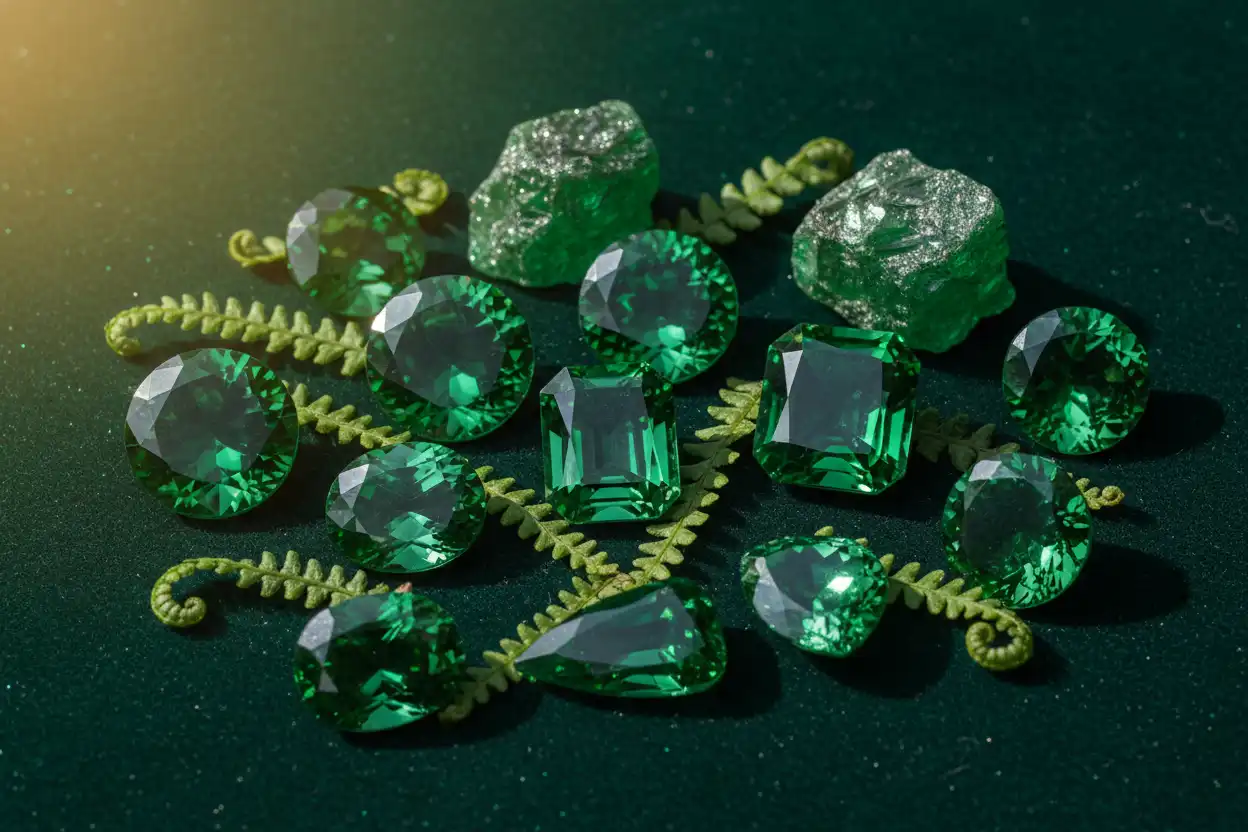
Chrome Diopside Meaning: Facts, Color & Symbolism
Chrome diopside meaning is commonly associated in modern crystal traditions with renewal, persistence, openness, perspective, connection with the natural world, and approaching personal growth without forcing immediate results, yet those ideas belong to symbolism rather than to measurable mineral effects because chrome diopside is fundamentally a green variety of the mineral diopside, a calcium-magnesium silicate in the pyroxene group whose ideal chemistry is represented by CaMgSi₂O₆ and whose vivid green color is produced primarily when chromium substitutes into the crystal structure. The material is monoclinic, commonly transparent to translucent, typically shows vitreous luster, has Mohs hardness around 5.5–6.5, possesses two prominent pyroxene cleavage directions that meet at nearly right angles, and is substantially less resistant to scratching and impact than sapphire, spinel, chrysoberyl, or quartz, which means that its bright green appearance should never be mistaken for the durability of harder green gemstones.
A material-first explanation of chrome diopside meaning therefore begins with mineral identity, color origin, crystal structure, optical behavior, geological formation, cleavage, inclusions, and practical limitations before moving into historical or symbolic interpretation, because the stone’s genuine mineralogical story is already substantial and does not need unsupported claims about healing frequencies, manifestation, chakras, detoxification, fertility, emotional treatment, or medically beneficial chromium transfer. Readers looking for the wider collection of mineral-focused references can browse the Gemstone Guides, while the discussion here remains centered on defining chrome diopside itself rather than duplicating dedicated pages on microscopy, optical behavior, deposit geology, cutting, jewelry engineering, conservation, or provenance.
Chrome Diopside Identity Profile
Chrome diopside belongs to the pyroxene family and is best understood as chromium-colored diopside rather than as a separate mineral species, so its basic mineral identity remains calcium magnesium silicate, CaMgSi₂O₆, crystallizing in the monoclinic system with the characteristic pyroxene chain-silicate structure and cleavage that can strongly influence both rough handling and finished jewelry durability. Fine transparent material can show intense green coloration ranging from bright yellowish green through saturated forest green to deeper bluish green, while very dark material may lose brightness because the same chromium-related absorption responsible for attractive color can also reduce light return when the stone is too thick, too deeply saturated, or cut with excessive pavilion depth. Specific gravity commonly falls around the low-to-mid 3.2 range, refractive indices are appreciably higher than quartz, birefringence is visible under appropriate gemological examination, and pleochroism can produce directional differences in green coloration, although the strength of these effects varies with chromium concentration, crystal orientation, transparency, thickness, and cut.
The word chrome in the trade name refers to chromium as an important color-causing element rather than to a metallic surface coating, so chrome diopside should not be confused with ordinary diopside that merely happens to be greenish because iron or other compositional factors can also create green tones within the broader mineral species. The most useful definition is therefore not simply “green diopside,” but chromium-rich or chromium-colored diopside showing the vivid green appearance commercially recognized as chrome diopside, while borderline material may require spectroscopy or compositional testing when the precise cause of color affects identification, value, or disclosure.
Why Chrome Diopside Is Green
The striking color of chrome diopside develops principally because chromium ions occupy positions within the pyroxene crystal structure and selectively absorb portions of visible light, leaving the transmitted and reflected light dominated by green wavelengths, yet the final face-up color depends on much more than chromium concentration alone because crystal thickness, orientation, cut, transparency, iron content, internal inclusions, and lighting conditions all influence how that absorption appears to the observer. A thin crystal edge can therefore look bright and lively while the center of a thick faceted stone appears nearly blackish green, and two stones of similar chromium content can present very different commercial appearances because one has been cut shallow enough to preserve brightness while another retains excessive depth that increases the optical path length through the colored material.
This relationship between chromium, absorption, pleochroism, birefringence, extinction, and apparent saturation is examined more fully in chrome diopside optical properties and color behavior, where the optical questions can be treated without turning this meaning reference into a duplicate technical page. For the purpose of identification, the important point is that vivid green color supports chrome diopside only when the rest of the mineralogical evidence is compatible with pyroxene, because chromium can color many unrelated minerals and green appearance alone cannot distinguish chrome diopside from emerald, tsavorite garnet, chrome tourmaline, green spinel, demantoid, peridot, or synthetic substitutes.
Chrome Diopside Is Not Emerald
Chrome diopside and emerald can overlap strongly in hue, especially in commercial photographs where saturation has been enhanced and subtle differences in brilliance have been suppressed, but the two materials are mineralogically unrelated because emerald is chromium- or vanadium-colored beryl with composition based on Be₃Al₂Si₆O₁₈, while chrome diopside is a pyroxene based on CaMgSi₂O₆. Emerald is harder, generally around Mohs 7.5–8, while chrome diopside is softer at approximately 5.5–6.5, and the cleavage behavior, refractive indices, density, crystal system, inclusion patterns, optical character, and geological settings also differ, which means that a vivid green transparent stone should never be identified from color alone when significant money depends on the conclusion.
Chrome diopside can sometimes appear more immediately saturated than many emeralds because it commonly develops strong green coloration without requiring the same inclusion tolerance that the emerald market accepts, yet that apparent visual advantage does not make it rarer or more durable, and price differences between the materials reflect a much broader combination of geological rarity, demand, size availability, durability, treatments, historic market position, geographic origin, and consumer recognition rather than one simple comparison of which stone looks greener.
Chrome Diopside Versus Tsavorite
Tsavorite is green grossular garnet and can overlap significantly with chrome diopside in bright medium-green material, although garnet generally lacks the prominent cleavage that affects pyroxene and commonly has different refractive, density, and optical behavior. Tsavorite is also usually harder and more suitable for frequent jewelry wear, while chrome diopside’s cleavage and lower hardness make protective settings more important, particularly in rings and bracelets where edge impacts and abrasion occur frequently. A visual comparison can provide clues because garnet commonly has a different style of brilliance and does not show the same biaxial optical behavior, but instrument-based testing remains more reliable than deciding that one shade of green “looks like garnet” and another “looks like diopside.”
The broader lesson is that green is shared by many gem species, so chrome diopside meaning should not be built around the assumption that color establishes identity, rarity, origin, or quality; instead, color belongs within a larger evidence framework that includes mineral family, physical properties, cleavage, refractive behavior, inclusions, and geological association.
Chrome Diopside Versus Chrysoberyl
The neighboring chrysoberyl meaning reference provides a particularly useful contrast because chrysoberyl is a much harder beryllium-aluminum oxide with a different structure, density, optical character, and durability profile, even though certain chrysoberyl varieties can show greenish coloration. Chrome diopside scratches more readily, cleaves more significantly, and generally requires greater care in exposed jewelry, while chrysoberyl can withstand substantially more abrasion and is better suited to frequent wear when cut and set properly. The comparison demonstrates why a green color name should never substitute for mineral identification, because two stones can share hue while behaving very differently during cutting, setting, cleaning, and daily use.
Chrome Diopside Versus Chiastolite
The preceding chiastolite meaning page concerns an inclusion-patterned variety of andalusite whose visual identity is dominated by a dark cross-like sector pattern rather than chromium-green transparency, and the comparison illustrates the different ways variety names can arise within mineralogy because chiastolite is defined mainly by a characteristic inclusion arrangement while chrome diopside is defined commercially by chromium-related color within diopside. Both names therefore modify a broader mineral identity, yet the underlying reasons are entirely different, which is why variety terminology must always be interpreted within the mineral species to which it belongs.
Chrome Diopside Versus Chevron Amethyst
The mapped chevron amethyst meaning reference concerns patterned quartz whose purple-and-white appearance develops from color zoning and cloudy quartz growth, while chrome diopside is a monoclinic pyroxene colored predominantly by chromium and does not owe its identity to banded growth. Quartz is harder, lacks the characteristic pyroxene cleavage, and has lower refractive indices and density, so even though both stones can be cut into attractive transparent or translucent ornaments, their practical behavior is significantly different. Comparing them reinforces a central principle of gemology: color and symbolic associations belong after species identification rather than before it.
Chrome Diopside Versus Chrysanthemum Stone
The chrysanthemum stone meaning reference offers an opposite kind of comparison because chrysanthemum stone is valued as an ornamental rock showing flower-like contrasting mineral aggregates within a darker matrix, while chrome diopside is a specific transparent-to-translucent mineral variety whose value is usually tied to green body color, clarity, cut, size, and optical performance. One material is appreciated primarily for a natural pattern produced by multiple mineral components, while the other is appreciated principally as a colored gem mineral, and neither should be reduced to its decorative appearance without recognizing the geology responsible for that appearance.
How Chrome Diopside Forms
Chrome diopside is strongly associated with geochemical environments in which chromium is available during pyroxene formation, particularly ultramafic rocks, mantle-derived assemblages, metamorphosed carbonate rocks, skarns, and related high-temperature geological settings where calcium, magnesium, silica, and chromium can participate in mineral growth. Commercially important material is especially associated with chromium-rich geological environments in which diopside develops sufficiently clear and well colored to be fashioned as gems, while less transparent material can occur as ordinary mineral specimens or within polymineralic rock assemblages.
The complete treatment of host rocks, mantle and ultramafic associations, metasomatism, metamorphism, skarn processes, chromium sources, and deposit relationships belongs in chrome diopside formation and deposit geology, because this page owns the mineral definition and interpretive meaning rather than a full deposit model. For readers evaluating a specific specimen, the most important geological lesson is that chromium-rich green pyroxene should occur within a mineral and rock context compatible with its formation, while an attractive seller story about a famous locality does not become evidence unless the specimen retains documentation linking it to that source.
Why Chrome Diopside Can Be Very Dark
Strong color is not always commercially desirable because green absorption increases with optical path length, which means that a large or deeply cut chrome diopside can absorb so much light that the center appears heavily extinct or nearly black, particularly under weak illumination. This explains why smaller stones often show brighter apparent color than much larger stones of similar composition, and it also explains why cutters may sacrifice weight to create a shallower stone that returns more light and displays a livelier face-up appearance.
Darkness should therefore be evaluated separately from saturation because a stone can possess strong chromium-related green color while displaying poor visual performance, and buyers comparing two stones should look for brightness across the face rather than treating the deepest possible green as automatically superior. The underlying rough, cut orientation, pavilion geometry, and thickness all influence this balance.
Chrome Diopside Pleochroism
Because chrome diopside is optically anisotropic, its color can vary according to viewing direction, producing pleochroic differences that may shift between green, yellow-green, and related tones depending on the specimen. In strongly colored material the effect can be less obvious to casual observers because saturation dominates the visual impression, while careful examination with controlled orientation and suitable gemological instruments can separate directional color behavior more clearly.
Pleochroism matters during cutting because the orientation chosen from the rough influences which color direction dominates the finished stone, and a cutter who maximizes weight without considering optical orientation may produce a gem that is darker, yellower, or less attractive than the rough could have yielded with a different approach.
Chrome Diopside Cleavage and Durability
The pyroxene structure produces two important cleavage directions that intersect at approximately right angles, and this characteristic is one of the most practically significant differences between chrome diopside and harder green gems such as sapphire or chrysoberyl. Cleavage means that a sufficiently forceful blow delivered in an unfavorable direction can cause the crystal to split along structurally controlled planes, while its moderate hardness also means that facet junctions and polished surfaces can accumulate abrasion more readily during repeated wear.
This does not make chrome diopside unsuitable for jewelry, but it does require more thoughtful use, and the detailed relationship among girdle thickness, prong pressure, protective bezels, ring exposure, pendant safety, edge protection, and ordinary wear is covered in chrome diopside setting and wear engineering. A well-cut stone in a protective pendant can remain attractive for a long time, while an exposed ring worn through constant impact-prone activity will face a much harsher mechanical environment.
Original Chrome Diopside Specimen and Photo Checklist
A useful specimen or photo evaluation begins by asking whether the stone presents a naturally plausible chromium-green pyroxene appearance under neutral lighting, whether the color remains within realistic yellow-green to rich forest-green ranges rather than digitally exaggerated neon emerald, whether transparency varies naturally with thickness, whether deeper areas show plausible extinction, whether existing fractures or cleavage traces follow believable internal directions, whether the polished surface has vitreous rather than resinous or glassy artificial character, whether the rough or matrix relationship makes geological sense, whether drill holes or fractures contain suspicious concentrations of dye, whether the back of a cabochon or cut stone shows the same body color as the face, whether seller images taken under different lighting remain reasonably consistent, whether natural inclusions disturb perfect optical uniformity, whether any locality claim is supported by documentation rather than appearance, whether strong color has been mistaken for proof of chromium without spectroscopic evidence, and whether metaphysical phrases such as abundance stone, heart-chakra crystal, healing green diopside, manifestation gem, or earth-energy stone have been kept entirely separate from the actual identification process.
This checklist is intentionally observational rather than destructive because a valuable specimen should not be scratched, chipped, heated, chemically exposed, or otherwise damaged simply to satisfy a test that could have been answered through refractive measurement, microscopy, spectroscopy, or other non-destructive methods. The detailed examination of inclusions, cleavage traces, growth features, internal fractures, polish, treatment indicators, and microscopic mineral associations belongs in the chrome diopside microscope inclusion notebook.
What Microscopy Can Reveal
Microscopy can show whether a transparent chrome diopside contains mineral inclusions, healed fractures, cleavage-related features, growth zoning, negative-crystal-like cavities, surface-reaching fissures, polish damage, coating residues, or other internal structures relevant to identification and quality, although no single inclusion should be treated as a universal proof of origin because similar features can develop in more than one geological environment. Magnification also helps distinguish genuine internal color from surface contamination and can reveal whether apparently dramatic dark areas are inclusions, fractures, extinction, or simply shadows produced by poor photography.
An important limitation remains that visual microscopy cannot always identify the chemistry of a microscopic inclusion, so Raman spectroscopy, electron-beam analysis, or other targeted methods may be required when the inclusion species itself matters to provenance or geological interpretation. Responsible identification therefore uses each method only as strongly as its evidence allows.
Chrome Diopside Treatments
Chrome diopside is not primarily known as a gem whose routine commercial appearance depends on extensive standardized treatment, which gives natural color an important position in the market, yet that should not be turned into the unsupported statement that treatment is impossible. Coatings, fracture filling, surface applications, composite construction, or misrepresentation of other green materials remain possible in the broader gem trade, and photographs can create substantial visual enhancement even when the stone itself has not been physically altered.
The safest approach is therefore to evaluate the actual specimen and disclosure rather than rely on generalized marketing language such as untreated by nature, completely pure, healing grade, or Siberian quality when documentation is absent. A gem can be naturally colored and still be misrepresented in origin, clarity, weight, or value.
Chrome Diopside and Locality Claims
Chrome diopside is strongly associated in the gem trade with material from northern regions of Russia, especially deposits that produced bright chromium-rich crystals from demanding climatic mining environments, but that commercial association should not become an automatic provenance assignment for every vivid green stone. A locality claim is stronger when supported by original rough documentation, mine or parcel records, collection labels, dealer chain of custody, laboratory evidence where useful, and acquisition history that actually connects the specimen to the named source.
The structured questions for evaluating origin claims are developed in the chrome diopside provenance disclosure checklist, where provenance can be treated independently from mineral identity. A stone can be genuine chrome diopside even when its geographic origin is unknown, and uncertainty about origin should be disclosed rather than replaced with a famous locality inferred from appearance.
Cutting Chrome Diopside
Chrome diopside rewards careful orientation because color, pleochroism, cleavage, fractures, and rough shape all influence the final gem, while excessive weight retention can produce a deep stone with strong extinction and insufficient face-up brightness. The cutter therefore has to balance yield against optical performance, choosing an orientation that displays attractive green color while minimizing cleavage risk and preserving enough thickness for durability without burying unnecessary carat weight below the girdle.
The detailed technical treatment belongs in chrome diopside cutting, orientation and polish, but the material-level principle is that the best-looking finished stone may require removing more rough than a purely weight-maximizing strategy would suggest. A larger dark gem is not automatically a better use of the crystal than a smaller bright one.
Conserving Chrome Diopside Specimens
A significant rough crystal or matrix specimen should be treated as geological evidence as well as a decorative object because crystal faces, matrix contacts, alteration, inclusions, associated minerals, fractures, and locality labels can all preserve information that disappears after cutting or aggressive cleaning. Before changing an important specimen, documenting its dimensions, color under neutral light, natural crystal surfaces, cleavage damage, matrix relationship, previous repairs, labels, and provenance creates a baseline that allows future collectors to distinguish original condition from later modification.
The chrome diopside specimen conservation record provides a dedicated framework for preserving those details, while this meaning page retains the simpler principle that conservation should protect information rather than automatically maximize polish or brightness.
Documented History and the Limits of Ancient Claims
Diopside as a mineral belongs to the documented development of modern mineralogical classification, while chromium-rich green varieties became commercially significant as gem materials through specific mining and trade histories rather than through a universally documented ancient chrome-diopside tradition. Claims that ancient civilizations specifically used chrome diopside for heart healing, fertility, wealth attraction, emotional cleansing, psychic awareness, or protection therefore require much more evidence than statements that green stones or pyroxene-group minerals existed historically.
This distinction matters because archaeological references to a green gemstone cannot automatically be converted into chrome diopside without mineralogical confirmation, especially when emerald, peridot, jade, green garnet, glass, serpentine, malachite, and numerous other materials could fit a broad visual description. Historical symbolism should follow reliable material identification rather than being assigned retrospectively because a modern trade narrative sounds plausible.
Chrome Diopside Meaning in Modern Symbolism
Modern chrome diopside meaning commonly centers on renewal, growth, openness, persistence, emotional perspective, connection with nature, and approaching change without assuming that every result must happen immediately, and the vivid green color understandably contributes to those themes because green is widely associated in contemporary symbolism with vegetation, spring growth, landscapes, restoration, and living systems. Someone may therefore use chrome diopside as a personal reminder to examine whether a difficult situation needs force or patience, whether progress is genuinely absent or simply slower than expected, whether an old plan should be revised rather than abandoned, or whether a decision would benefit from looking beyond immediate emotional reaction.
Those interpretations can be psychologically or personally meaningful because objects often function as cues for chosen habits, intentions, and reflective routines, yet the mineral itself does not need to radiate a measurable growth frequency or biologically alter emotional processing for that symbolism to be useful. The difference is between using a gemstone as a reminder and claiming that CaMgSi₂O₆ containing chromium directly changes a person’s physiology, relationships, or circumstances.
Renewal as a Practical Symbol
The green color of chrome diopside makes renewal one of its most intuitive modern symbolic associations, but a grounded interpretation connects renewal with observable action rather than mystical transformation, so the stone might represent revising one routine, rebuilding a neglected skill, repairing a practical relationship pattern, restarting a project with a smaller scope, or creating a new approach after evidence shows that the previous one was ineffective. This use preserves the symbolic appeal of the gem while keeping causation where it belongs: improvement comes from behavior, learning, circumstances, and decisions rather than from a mineral emitting an invisible force.
Renewal can also mean changing direction without treating the earlier effort as wasted, because geological systems themselves repeatedly reorganize material under new conditions, and chrome diopside’s formation within changing high-temperature or metamorphic environments provides a natural visual and geological prompt for that idea without proving any supernatural mechanism.
Growth Without Guaranteed Outcomes
Modern crystal descriptions often connect green stones with growth, abundance, fertility, or prosperity, but those words can become misleading when they are presented as predictions rather than symbols. Chrome diopside can represent growth in the sense of learning, practice, adaptation, patience, or gradual improvement, while financial abundance, reproductive outcomes, business success, investment returns, agricultural growth, or medical recovery cannot be guaranteed by wearing or owning the gemstone.
A more useful interpretation treats growth as a question of process, asking whether the person is repeatedly doing the actions that make the desired result more likely, whether current evidence supports continuing the same approach, and whether the environment provides the conditions required for progress. The stone can remind someone to ask those questions. It cannot answer them.
Chrome Diopside and Nature Symbolism
The intense green color naturally encourages associations with forests, leaves, landscapes, and environmental awareness, and for some people a green gemstone can function as a tangible reminder to spend more time outdoors, protect a local natural space, learn about geology, or notice seasonal and ecological patterns more carefully. These uses are consistent with symbolism because the connection is aesthetic and conceptual rather than a claim that the mineral transmits literal forest energy.
The distinction also protects geological accuracy because chrome diopside itself may have formed far below the kinds of leafy environments its color evokes, so the modern nature association arises from human color perception rather than from the ecological setting in which the crystal grew.
Chrome Diopside and the Heart Chakra
Contemporary metaphysical systems commonly associate vivid green gems with the heart chakra, so chrome diopside is frequently described as a stone for emotional healing, compassion, forgiveness, openness, or relationship balance, yet these concepts belong to spiritual practice rather than mineralogy because no gemological instrument can measure whether a chakra is blocked, open, activated, balanced, aligned, or cleansed. A person can still use the stone within a private chakra practice as long as that framework is presented as symbolic or metaphysical rather than as a scientifically established effect of chromium-bearing pyroxene.
The material facts remain measurable through refractive index, density, spectroscopy, pleochroism, birefringence, cleavage, chemical composition, and crystal structure, while chakra states belong to a different system of interpretation and should not be conflated with those physical measurements.
Does Chrome Diopside Have Healing Properties?
Chrome diopside should not be presented as a medical treatment because claims that it heals the heart, regulates blood pressure, treats lung disease, improves circulation, repairs emotional trauma, corrects mineral deficiencies, detoxifies the body, supports fertility, strengthens immunity, or treats neurological conditions are not established by identifying a gemstone as chromium-bearing diopside. Its measurable characteristics describe a pyroxene mineral with specific composition, crystal structure, hardness, cleavage, density, optical behavior, inclusions, and geological formation, while none of those properties demonstrate therapeutic action through ordinary skin contact or proximity.
A person may still find a familiar gemstone useful during meditation, journaling, reflection, or other personal routines, but such use should complement rather than replace evidence-based healthcare when health concerns are involved, and the site’s broader limitations regarding medical and metaphysical interpretation are stated in the Disclaimer.
Chromium in Chrome Diopside Is Not a Supplement
Chromium contributes substantially to the gemstone’s green color, but that mineralogical fact does not mean the stone delivers beneficial nutritional chromium through the skin, because biological effects depend on chemical form, dose, solubility, exposure route, metabolism, and physiological context rather than the mere presence of an element somewhere in a crystal structure. The chromium incorporated into diopside is structurally bound within a silicate mineral and should not be treated as equivalent to a medically or nutritionally controlled chromium compound.
The same reasoning applies to calcium, magnesium, silicon, and oxygen within the formula because naming familiar biological elements does not turn a gemstone into a supplement, and deliberately grinding or ingesting mineral material introduces unnecessary exposure rather than providing a controlled health benefit.
Safe Ownership and Handling
Normal handling of intact polished chrome diopside is generally straightforward, although its cleavage and moderate hardness require sensible physical care, while lapidary processing creates a different exposure scenario because cutting, drilling, grinding, sanding, or polishing silicate minerals can produce fine particulate matter that should be controlled through appropriate wet techniques where suitable, effective extraction, eye protection, and proper respiratory protection rather than uncontrolled dry dust generation. Geological specimens can also contain associated minerals or matrix components with compositions different from the ideal chrome-diopside formula, so processing safety should be based on the entire specimen rather than only the green crystal.
There is no mineralogical reason to grind chrome diopside for consumption, inhale powdered material, or place unknown geological specimens directly into drinking water for symbolic purposes, because any reflective or spiritual use can be performed without turning a durable object into unnecessary particulate exposure.
Chrome Diopside Meaning and Evidence
A reliable interpretation of chrome diopside meaning becomes strongest when each kind of claim is matched to the evidence capable of supporting it, so visual observation can establish green color, transparency, general habit, fractures, and specimen condition, basic gemological testing can determine whether refractive behavior, density, cleavage, hardness, and optical properties are compatible with diopside, microscopy can reveal inclusions and treatment clues, spectroscopy can investigate chromium-related absorption and species identity, structural methods can confirm pyroxene mineralogy when necessary, geological context can show whether the occurrence fits a chromium-bearing diopside environment, and provenance documents can support specific mine or geographic claims. Symbolic themes such as renewal, personal growth, nature connection, openness, heart-chakra work, and emotional reflection sit at a different evidentiary level because they represent human interpretations rather than intrinsic physical properties.
That distinction is central to the approach described on the About page, where mineral facts and cultural or symbolic material are treated as separate categories rather than blended into one unsupported narrative, while readers with corrections, specimen documentation, or technical evidence can use Contact to provide material that improves factual accuracy.
What Chrome Diopside Meaning Can Reliably Include
Chrome diopside meaning can reliably begin with the fact that the material is chromium-colored diopside, a monoclinic calcium-magnesium pyroxene whose ideal formula is CaMgSi₂O₆ and whose vivid green appearance develops primarily because chromium alters the way the crystal absorbs visible light, while additional differences in thickness, orientation, iron content, inclusions, pleochroism, and cutting proportions influence whether the finished stone appears bright yellow-green, rich forest green, bluish green, or excessively dark. Its moderate hardness and prominent cleavage make it less forgiving in daily wear than several harder green gemstones, while its relatively high refractive behavior and strong saturation can nevertheless create lively and attractive faceted material when cutting preserves sufficient brightness.
Geologically, chrome diopside belongs to chromium-rich high-temperature and metamorphic environments rather than to a universal green-stone category, while documented origin requires evidence separate from visual appearance. Historically, its modern gem identity should not be projected backward onto every ancient green stone without mineralogical proof, and modern symbolism should likewise remain clearly identified as interpretation rather than physical causation.
Within that symbolic boundary, chrome diopside can reasonably represent renewal, patience, growth, perspective, or connection with the natural world because its green color provides a strong visual metaphor for those ideas, while its real mineral properties provide an additional reminder that attractive outcomes depend on structure, orientation, environmental conditions, and appropriate handling rather than color alone. Chrome diopside meaning is therefore most useful when the mineral’s chemistry, crystallography, color, formation, cleavage, and practical limitations remain the foundation, while symbolism is allowed to remain what it actually is: a human layer of interpretation added to an already distinctive natural material.