
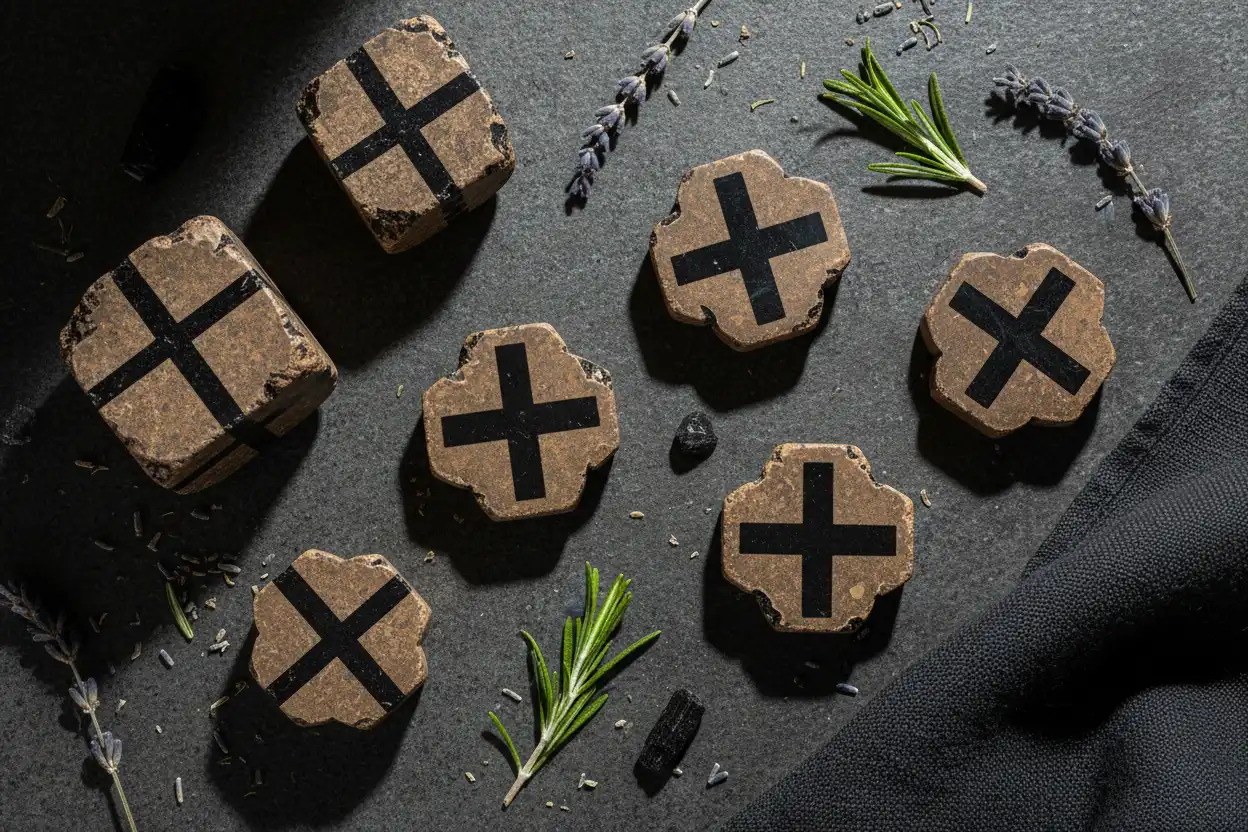

Chiastolite is a distinctive variety of Andalusite whose crystals contain dark carbon-rich inclusions arranged in a cross, X, or four-petaled pattern. As an aluminum silicate mineral, it combines Andalusite’s substantial hardness with a natural geometric feature that becomes most visible when the crystal is cut across its length.
Chiastolite at a Glance
| Property | Details |
|---|---|
| Mineral group or material type | Inclusion-bearing variety of Andalusite; aluminum silicate mineral |
| Composition | Aluminum silicate, Al₂SiO₅, with dark carbonaceous and mineral inclusions |
| Colors | Cream, beige, brown, reddish brown, gray, olive-brown, and pinkish brown with black or dark gray cross patterns |
| Crystal system | Orthorhombic |
| Habit | Elongated prismatic crystals with square, rectangular, or rhombic cross-sections; commonly occurs as porphyroblasts in metamorphic rock |
| Luster | Vitreous to subvitreous; occasionally greasy on rough surfaces |
| Transparency | Translucent to opaque; rarely transparent outside inclusion-rich zones |
| Mohs hardness | About 6.5–7.5 |
| Cleavage | Good in one principal direction and poor in another |
| Tenacity | Brittle |
| Common use | Cross-section cabochons, beads, pendants, polished slices, carvings, and mineral specimens |
| Main care concern | Cleavage, internal fractures, edge chipping, and damage to the cross pattern through poor cutting orientation |
What Is Chiastolite?
Chiastolite is not a separate mineral species. Instead, it is Andalusite distinguished by dark inclusions concentrated into a recognizable cross-shaped pattern.
The name comes from a Greek word associated with a cross or crossed arrangement. Consequently, older mineral and jewelry literature may call it cross stone, cross Andalusite, or a locality-specific variation of that name.
The parent Andalusite guide covers the broader mineral species, including transparent pleochroic gem material. This page focuses on the opaque-to-translucent cross-bearing variety, its inclusion structure, cutting, identification, value, and symbolism.
How the Cross Pattern Forms
Chiastolite develops while an Andalusite crystal grows inside fine-grained metamorphic rock. During growth, the advancing crystal faces displace or trap carbonaceous matter and other fine mineral particles.
Instead of spreading evenly through the crystal, some of that material concentrates along internal growth-sector boundaries. When the crystal is cut perpendicular to its long axis, those inclusion-rich zones appear as four dark arms extending from the center.
The cross is not always perfectly symmetrical. Some crystals show a narrow black X, while others contain broad triangular sectors, a central dark square, several nested outlines, or an irregular four-petaled form.
Inclusion composition also varies by locality. Carbonaceous matter is common, although mica, graphite, iron oxides, chlorite, clay-size particles, and other minerals may contribute to the dark pattern.
Therefore, the visible cross should be described as a natural growth-inclusion pattern rather than automatically identified as pure graphite.
How Chiastolite Forms
Chiastolite forms mainly during low-pressure regional or contact metamorphism of aluminum-rich sedimentary rocks. Shale, mudstone, and other clay-rich sediments provide the aluminum and silica needed to form Andalusite.
When magma heats the surrounding rock, new metamorphic minerals grow without completely melting the host. Andalusite may then develop as comparatively large porphyroblasts inside a much finer matrix.
Carbon-rich shale offers favorable conditions for Chiastolite because the growing crystal can capture abundant dark material. As a result, Chiastolite commonly occurs in slate, phyllite, mica schist, and hornfels.
Associated minerals may include Quartz, muscovite, biotite, cordierite, garnet, staurolite, feldspar, chlorite, and graphite. The exact assemblage reflects temperature, pressure, rock composition, and distance from the heat source.
Because Andalusite favors relatively low pressure, its presence can help geologists reconstruct metamorphic conditions. Chiastolite therefore has scientific value beyond its decorative cross.
Crystal Shape and Cutting Orientation
Natural Chiastolite crystals commonly form elongated prisms. Their outer cross-sections may look square or diamond-shaped, although the dark internal cross does not always align perfectly with the exterior faces.
Lapidaries cut the material across the long crystal axis to reveal the pattern. A cut parallel to the axis may instead show dark lengthwise stripes or wedges without the familiar cross.
Orientation determines the final design. Before cutting, a lapidary may grind a small window or inspect an exposed end to locate the center and predict the direction of the inclusion arms.
Thin slices display the cross clearly but can chip around the perimeter. Conversely, a thicker cabochon offers greater durability while preserving enough depth to show the pattern.
A poorly centered cut may leave one arm missing or move the cross toward an edge. Although asymmetrical material can remain attractive, a centered and balanced pattern usually receives higher market value.
Chiastolite Colors
The Andalusite host commonly appears beige, cream, tan, brown, reddish brown, or gray-brown. Olive, pinkish, and pale greenish undertones also occur.
Dark inclusions create black, charcoal, or brown cross patterns. Strong contrast between the host and the cross makes the design easier to recognize from normal viewing distance.
Color may vary within one crystal. For example, a pale center can transition toward a darker outer rim, while iron staining may add rusty patches near fractures.
The Andalusite color guide retains the broader comparison of Andalusite colors. Chiastolite value, however, depends more on cross definition and contrast than on the pleochroic colors prized in transparent faceted Andalusite.
Main Chiastolite Pattern Types
No universal grading system classifies Chiastolite crosses, yet several recurring appearances help buyers compare stones.
- Sharp cross: Four narrow, clearly separated arms meet near the center.
- Broad-sector cross: Large dark triangular areas create a bold cross between lighter host sections.
- Central-square pattern: A dark square or rectangle sits at the center with four arms extending outward.
- Nested pattern: Several inclusion outlines surround the central cross and record successive growth stages.
- Petaled pattern: Rounded or tapering arms resemble four dark petals rather than straight bars.
- Lengthwise stripe: A cut parallel to the crystal axis reveals dark lines instead of a complete cross.
- Partial cross: Fractures, weathering, or off-center cutting leave only two or three obvious arms.
A perfect cross is not necessary for scientific authenticity. Nevertheless, symmetry and completeness strongly affect ornamental value.
Important Chiastolite Localities
Boal and nearby areas of Asturias, Spain, are classic sources. Spanish material is often associated with dark carbon-rich metamorphic rock and has a long history of being polished into cross-bearing ornaments.
Lancaster and other localities in Massachusetts produced notable American Chiastolite crystals. Many older specimens remain in educational and regional mineral collections.
Chile supplies commercial cabochon and jewelry material, including Chiastolite associated with the Bío Bío Region. Brown host colors and strongly contrasting black patterns appear frequently in Chilean polished stones.
Australia contains several recognized occurrences, particularly in metamorphic terrains of South Australia. Historical Australian studies also documented complex dark inclusions rather than assuming that every cross consisted solely of graphite.
China, Russia, France, Portugal, Brazil, and other countries contain additional occurrences. Even so, a locality claim should come from a dependable label because polished pieces often lose their geological context during cutting and wholesale distribution.
Is Chiastolite a Gemstone?
Yes. Chiastolite qualifies as an ornamental gemstone and collector material because cutters polish its natural cross pattern for jewelry and decorative use.
Unlike transparent Andalusite, it is rarely faceted for brilliance. Instead, flat cabochons, tablets, beads, and slices provide the best view of the internal design.
The material’s value comes from a geological inclusion pattern rather than transparency. Therefore, an opaque stone with a centered cross may carry more Chiastolite appeal than a clearer stone with an indistinct pattern.
Complete natural crystals also interest collectors. In that market, crystal shape, matrix, locality, and an exposed cross-section can matter more than suitability for jewelry.
Jewelry Suitability
Chiastolite has enough hardness for pendants, earrings, brooches, beads, and carefully worn rings. Its surface resists scratching better than Calcite, Fluorite, and many softer ornamental stones.
However, good cleavage and brittle tenacity mean hardness does not guarantee resistance to breaking. A sharp impact can split a stone or remove an edge, especially when the cabochon contains natural fractures.
Bezel settings provide useful perimeter protection. Additionally, a jeweler should avoid drilling directly through a central inclusion junction or cleavage-sensitive area.
Daily-wear rings remain possible but require realistic care. A low-profile setting, protected edge, and removal during manual work improve longevity.
Thin slices work especially well in pendants because they face less impact than rings. Nevertheless, the mounting must support the entire stone rather than concentrating pressure at two narrow points.
How Chiastolite Is Sold
Chiastolite reaches the market as rough crystals, cross-cut slices, cabochons, beads, tumbled stones, pendants, rosaries, carvings, and matrix specimens.
Small slices may be sold individually or in matched lots. Since every cross develops differently, perfectly matching earrings and bead strands require more sorting than ordinary uniformly colored stone.
Cabochons are usually priced per piece rather than through a strict per-carat scale. The black inclusion contributes weight, while pattern quality matters more than total mass.
Specimen dealers may sell complete prismatic crystals with one polished end. This format preserves the natural habit while revealing the internal cross.
Chiastolite Price and Value
Small tumbled stones and basic slices commonly retail for approximately $3–$15. Commercial cabochons often range from about $8 to $40 per piece.
Larger stones with a sharp, centered cross commonly sell for $25–$75. Designer cuts, matched pairs, or unusually attractive patterns may exceed $100 per stone.
Finished silver pendants and rings often appear between $30 and $200, depending on metalwork and stone quality. Gold settings, historic pieces, or artist-made jewelry can cost considerably more.
Natural specimens may range from $10 for small study crystals to several hundred dollars for large, well-formed, documented examples. Rare locality provenance and an intact crystal with a clear exposed cross can justify higher asking prices.
The Andalusite price guide retains broader pricing for transparent faceted Andalusite and other species-level market forms. Chiastolite should instead be evaluated through pattern quality, cutting, and condition.
Chiastolite Value Factors
Several features influence price and desirability:
- Cross completeness: Four visible arms generally carry more demand than a partial or poorly positioned pattern.
- Centering: A cross placed near the middle supports balanced jewelry design.
- Contrast: Dark inclusions against a pale or warm brown host improve visibility.
- Symmetry: Evenly sized sectors often receive a premium, although naturally irregular crosses can remain distinctive.
- Stone condition: Open fractures, cleavage chips, and bruised edges reduce durability.
- Polish: A smooth finish should reveal the pattern without deep scratches or cloudy wax buildup.
- Thickness: Adequate depth supports the stone, while excessive thickness can make jewelry unnecessarily heavy.
- Crystal form: Natural specimens gain value from complete prisms, matrix association, and exposed cross-sections.
- Locality: Reliable Spanish, Chilean, American, Australian, or other provenance can interest specialist collectors.
- Craftsmanship: Matched patterns, precise bezels, and intentional orientation add value beyond the rough material.
A darker host does not automatically indicate higher quality. If the cross blends into the background, the design may look less distinct despite rich color.
Treatments and Enhancements
Most Chiastolite receives only cutting and polishing. The natural cross does not require heat treatment or irradiation.
Wax or oil may deepen the brown body color and improve surface luster temporarily. Resin can also fill fractures or stabilize weak slices.
Dye is possible, particularly in pale or porous material. Pigment concentrated around cracks and drill holes may indicate artificial color enhancement.
A dark line painted onto the surface can imitate a stronger cross. However, surface paint will not continue through the stone’s depth or appear naturally integrated with internal growth sectors.
Some jewelry uses a dark backing to improve contrast through a thin translucent slice. Backing should be disclosed because the stone may look different after removal from the setting.
Synthetic Andalusite is not a significant commercial Chiastolite source. Resin, glass, printed composites, and altered natural stones create more practical imitation concerns.
Imitations and Misidentification
Brown Jasper, slate, wood, resin, and other ornamental materials can receive painted or carved crosses. Their patterns usually remain limited to the surface.
Trapiche-style gems may also show radial sectors, but their chemistry, transparency, crystal form, and market identity differ. A natural four-part pattern does not automatically make a material Chiastolite.
Some Andalusite crystals contain dark inclusions without a complete cross. Those specimens remain Andalusite but may not meet the familiar trade expectation for Chiastolite.
Similarly, a polished metamorphic rock can contain several cross-bearing crystals. Sellers should clarify whether the product is one Chiastolite crystal, multiple crystals in matrix, or a rock slice containing Andalusite porphyroblasts.
How to Identify Chiastolite
Begin with the natural cross pattern and the shape of the host crystal. A genuine polished cross-section should show inclusion-rich sectors extending into the material rather than resting only on the surface.
Magnification may reveal fine dark grains, mica flakes, or carbonaceous material within the arms. Natural boundaries are usually slightly irregular instead of perfectly printed.
Andalusite hardness lies around 6.5–7.5. However, destructive scratch testing is unnecessary and could damage both the polish and the testing object.
Specific gravity usually falls near 3.13–3.16. Transparent edges may also show Andalusite’s optical properties, including birefringence and pleochroism, although most Chiastolite remains too included for straightforward readings.
Raman spectroscopy, X-ray diffraction, and chemical analysis can confirm Andalusite. Microscopy then documents the inclusion structure that supports the Chiastolite variety name.
The broader crystal identification guide provides a safer sequence for examining unknown material.
Buying Guidance
Inspect the actual stone rather than a representative photograph. Every Chiastolite pattern is unique, so a stock image cannot show the cross you will receive.
Request front and back photographs. A strong cross on one face may become partial, blurred, or off-center on the reverse.
Check the perimeter for cleavage chips and fractures. Additionally, examine drill holes because weak points commonly develop where drilling crosses inclusion-rich zones.
Ask whether the stone contains dye, resin, wax, backing, or surface paint. A seller should also distinguish solid Chiastolite from a cross-bearing rock slice.
Compare pattern quality before size. A smaller stone with a centered cross usually provides more visual value than a large piece with poorly defined arms.
For collectors, retain locality labels and purchase records. Polishing removes many diagnostic external features, so provenance becomes difficult to recover later.
Hardness and Durability
Chiastolite’s hardness makes it reasonably resistant to ordinary scratching. The gemstone hardness chart places it near Quartz and above many ornamental materials.
Nevertheless, its cleavage and brittle tenacity create impact risk. A stone can remain scratch-free yet split after one well-placed blow.
Internal inclusions may also weaken some pieces. Consequently, a heavily included cross-section can behave less predictably than cleaner transparent Andalusite.
Avoid dropping jewelry onto tile, concrete, or metal. Likewise, remove rings before gardening, exercise, repair work, or lifting heavy objects.
Water Safety, Cleaning, and Storage
An intact untreated Chiastolite can tolerate brief cleaning with lukewarm water. Prolonged soaking remains unnecessary because fractures, dye, resin, backing, and metal settings may create additional concerns.
Use mild soap, a soft cloth, and a soft brush. Afterwards, rinse briefly and pat the stone dry.
Ultrasonic cleaning can extend internal fractures or exploit cleavage. Steam introduces heat and pressure, so gentle hand cleaning provides the safer default.
Store each piece separately from harder gemstones. Diamond, Sapphire, Topaz, and abrasive dust can damage the polish, while unprotected contact can chip a thin slice.
Chiastolite Meaning and Symbolism
Cross-patterned Andalusite has carried religious and protective symbolism in several communities because the natural geometry resembles a cross. Historical interpretations varied by region and should not be treated as one universal tradition.
Contemporary spiritual practices often associate Chiastolite with remaining steady during transitions, recognizing several sides of a problem, and protecting personal boundaries. Its four-part pattern may also inspire individual meanings connected with direction, balance, or bringing separate priorities into one plan.
These interpretations remain cultural, spiritual, or personal. Mineral science explains the cross through crystal growth and inclusions but does not demonstrate medical, emotional, protective, or supernatural effects.
Frequently Asked Questions
Is Chiastolite the same as Andalusite?
Chiastolite is a variety of Andalusite. All Chiastolite is Andalusite, but most Andalusite does not contain the dark cross-shaped inclusions required for the Chiastolite name.
Is the cross inside Chiastolite natural?
Yes. Dark carbonaceous and mineral particles concentrate along growth-sector boundaries while the Andalusite crystal develops.
Is the cross always made of graphite?
Not necessarily. Carbonaceous matter is common, but mica, graphite, iron oxides, chlorite, clay-size particles, and other inclusions may contribute depending on the locality.
Can Chiastolite be faceted?
Transparent Andalusite can be faceted, but inclusion-rich Chiastolite is normally sliced or cut into cabochons to display the cross.
Is Chiastolite durable enough for rings?
A protected occasional-wear ring can work. However, cleavage, brittleness, and internal inclusions make exposed daily settings more vulnerable to chips and fractures.
How can I tell whether a Chiastolite cross is painted?
Inspect the edge, reverse, and internal depth under magnification. A natural cross continues through the stone, while paint or printed material remains concentrated at the surface.
Is Chiastolite rare?
Andalusite occurs widely, but crystals with a sharp, centered, high-contrast cross are less common. Fine jewelry stones and well-documented specimens therefore command more than ordinary partial-pattern material.
Can Chiastolite go in water?
A quick wash is generally acceptable for an intact untreated stone. Avoid prolonged soaking when the piece contains fractures, dye, resin, backing, or adhesive.
Explore related entries in the crystals that start with C directory and gemstones that start with C directory, or browse the complete Gemstone Guides collection.
Disclaimer: Chiastolite meanings are cultural or personal interpretations rather than scientifically proven effects. Do not ingest the mineral or use it to replace professional medical or psychological care. Cutting and polishing aluminum-silicate material can produce harmful mineral dust, so suitable extraction and respiratory protection are essential.