Chrysanthemum Stone Meaning: Properties, Uses & Symbolism
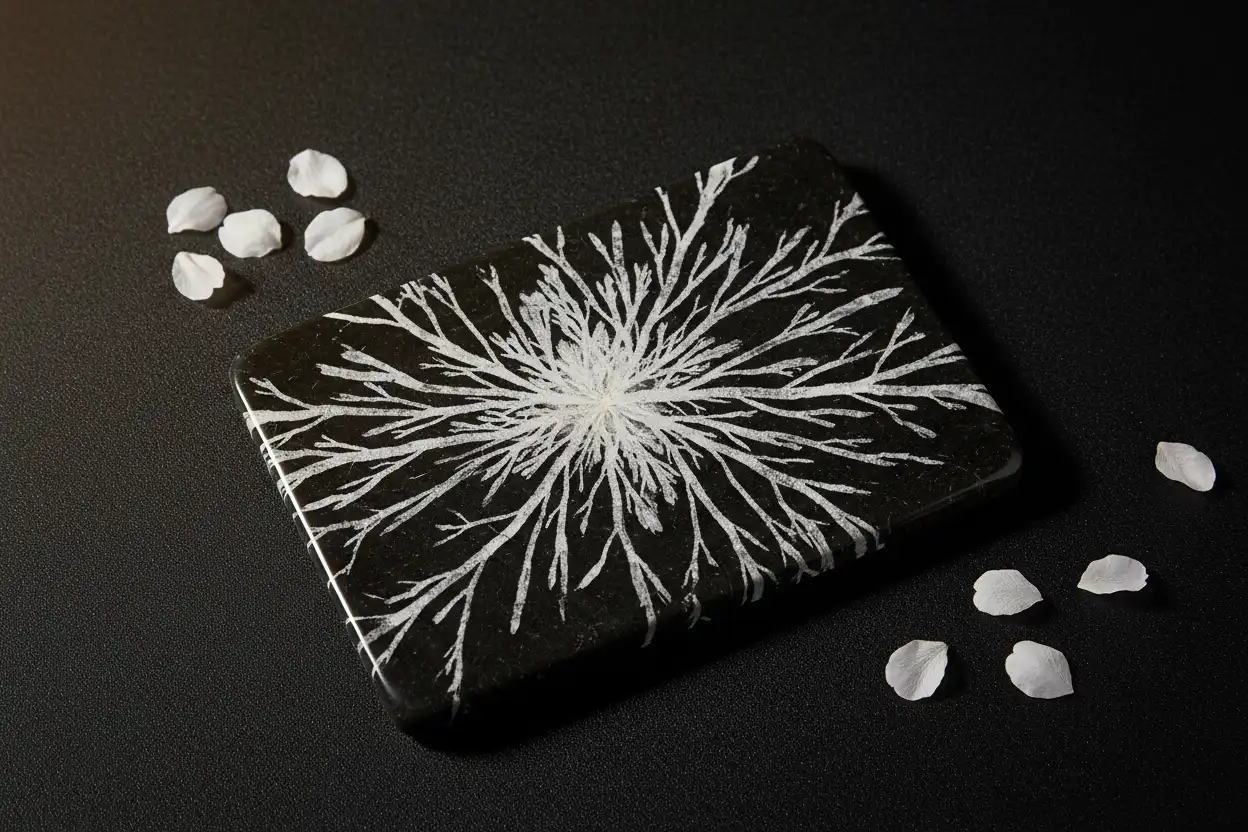
Chrysanthemum stone meaning is commonly associated with individuality, patient development, perspective, resilience, and recognizing beauty that develops through complex natural processes. The symbolism comes directly from the stone’s appearance: pale radial mineral aggregates spread through a contrasting dark matrix and resemble chrysanthemum flowers, sometimes so convincingly that polished specimens can look deliberately decorated.
Mineralogically, however, chrysanthemum stone is not one recognized mineral species with a single chemical formula. It is an ornamental trade name for rocks displaying flower-like radial mineral structures, and their actual composition varies by locality. Classic Chinese material may contain celestite, calcite, chalcedony, strontium-bearing carbonate phases, dolomite, and other associated minerals in a dark carbonate-rich matrix. Other material sold under the same general name can have a different mineralogical composition.
That variability is essential to understanding chrysanthemum stone meaning, durability, identification, and value. The flower pattern is real and naturally formed in genuine material, but buyers should not assume that every chrysanthemum stone has identical hardness, chemistry, formation history, or care requirements.
Chrysanthemum Stone at a Glance
| Property | Chrysanthemum Stone |
|---|---|
| Material type | Ornamental rock/trade name, not one mineral species |
| Defining feature | Radial flower-like mineral aggregates in contrasting matrix |
| Common flower minerals | Celestite, calcite and related replacement minerals depending on locality |
| Other possible components | Chalcedony, dolomite, strontianite and associated carbonate or silica phases |
| Matrix | Commonly dark carbonate-rich rock in classic material |
| Typical colors | Black, dark gray or brown matrix with white, cream or pale gray flowers |
| Transparency | Usually opaque |
| Luster | Varies by constituent minerals and polish |
| Hardness | Variable because the material is polymineralic |
| Common forms | Slabs, carvings, spheres, freeforms, polished displays and cabochons |
| Major treatment concern | Darkening, painting or dyeing matrix to increase flower contrast |
| Main care concern | Mixed hardness, fractures, soft carbonate phases and treatment sensitivity |
| Main symbolic themes | Individuality, patience, development, resilience and perspective |
Because chrysanthemum stone is a rock rather than a single mineral species, it belongs within the broader Gemstone Guides while requiring a different approach from uniform gemstones such as quartz or corundum.
What Is Chrysanthemum Stone?
Chrysanthemum stone is an ornamental rock characterized by pale radial crystal aggregates that resemble flowers against a darker matrix. The “petals” are natural mineral structures rather than fossilized flowers, painted designs, or biological remains.
The name describes appearance rather than one fixed composition.
This is the most important fact for chrysanthemum stone meaning and identification because simplified descriptions often claim that all chrysanthemum stone is one particular mineral. Detailed mineralogical studies show that the composition can vary considerably, even between deposits carrying the same commercial name.
Classic material from the Liuyang area of China is particularly famous. Some studied specimens contain chrysanthemum-like celestite aggregates with later calcite replacement, while other mineralogical work has documented calcite replacing earlier strontium-bearing carbonate structures together with small amounts of celestite, strontianite, barite, and silica.
Material from related occurrences may contain greater proportions of calcite and chalcedony, while other flower stones sold under the same trade name can have yet another composition.
Therefore, chrysanthemum stone meaning should never be paired with a universal chemical formula.
Are the Flowers in Chrysanthemum Stone Real?
Yes, in genuine chrysanthemum stone the flower-like structures are natural mineral growths.
They are not actual chrysanthemums trapped inside rock. The resemblance comes from radial crystal growth, where mineral structures spread outward from a central region and create petal-like shapes.
Individual flowers may appear:
- Round.
- Oval.
- Star-shaped.
- Irregular.
- Partially developed.
- Overlapping.
- Widely spaced.
- Densely clustered.
Some display dozens of narrow petals, while others contain broad pointed structures.
Natural variation is normal.
A perfectly symmetrical flower is visually attractive, but genuine specimens do not need to look as though they were drawn with a compass. Slight asymmetry, incomplete petals, uneven spacing, matrix interruptions, and replacement textures can all occur naturally.
This is one reason chrysanthemum stone meaning is often connected with individuality: the value of the pattern comes partly from the fact that natural flowers rarely repeat exactly.
What Are Chrysanthemum Stone Flowers Made Of?
There is no universal answer because composition depends on locality and geological history.
In well-known Chinese material, celestite can be important. Celestite is strontium sulfate, SrSO₄, and its physical properties are covered separately in the celestite meaning guide.
Calcite is also extremely important because mineral replacement can convert earlier flower structures partly or extensively into calcium carbonate. The calcite meaning guide explains the properties of that softer carbonate mineral.
Some studied chrysanthemum stone also contains chalcedony or quartz-rich material, dolomite, strontianite, barite, and other phases.
This produces a critical practical consequence: one flower may not behave exactly like another specimen carrying the same trade name.
Chrysanthemum stone meaning may remain broadly consistent as symbolism, but cleaning, hardness, cutting behavior, and identification should follow the actual material rather than the name alone.
How Chrysanthemum Stone Forms
The formation of chrysanthemum stone is more complicated than the simple idea of crystals suddenly growing into flower shapes.
In classic carbonate-hosted material, radial mineral aggregates developed during geological processes involving sedimentation, pore fluids, strontium, sulfate, carbonate chemistry, and later mineral replacement. The original structures could subsequently be altered while their flower-like geometry remained visible.
Some research on Liuyang material supports the formation of radial celestite aggregates followed by partial replacement with calcite.
Other detailed mineralogical interpretations suggest that an earlier strontium-bearing carbonate phase was replaced by calcite, with smaller celestite, strontianite, barite, and quartz-related phases developing during the alteration process.
These interpretations are not necessarily contradictory for every specimen because chrysanthemum stone is not one perfectly uniform material. Different locations and stages of replacement can preserve different mineral assemblages.
For chrysanthemum stone meaning, the geological lesson is especially interesting: an original structure can remain recognizable even when its mineral composition changes substantially.
That makes adaptation and continuity more fitting symbolic themes than claims of instant transformation.
Chrysanthemum Stone Meaning and Core Symbolism
Chrysanthemum stone meaning commonly centers on individuality, growth, patience, resilience, perspective, and allowing development to unfold without demanding perfect uniformity.
The flower structure makes these associations intuitive.
A natural chrysanthemum does not appear instantly, and the mineral pattern likewise records a geological process rather than a decorative event. Radial crystals developed, interacted with the surrounding matrix, and in some material were later partly replaced while their recognizable structure remained.
A practical interpretation of chrysanthemum stone meaning is therefore:
Growth can preserve direction even when the material circumstances change.
The stone does not cause personal growth. Instead, it can act as a visual reminder to continue developing while remaining willing to revise the method.
Chrysanthemum Stone Meaning for Individuality
Individuality is perhaps the strongest chrysanthemum stone meaning because every natural flower pattern is different.
Some flowers are large and sharply defined. Others are small, incomplete, crowded together, or partially hidden within the matrix.
A grounded symbolic interpretation is that distinctiveness does not require perfection.
This can be useful in creative work, personal development, or professional decisions where too much comparison makes useful differences look like defects.
A chrysanthemum stone on a desk can serve as a reminder to ask:
What is genuinely distinctive here, rather than merely different from someone else’s version?
The stone does not create confidence or self-worth. The useful part is the perspective attached to it.
Chrysanthemum Stone Meaning for Patience
The geological processes behind the flower pattern also make patience a natural part of chrysanthemum stone meaning.
Useful development is often gradual.
A skill improves through repeated practice. A project becomes stronger through revision. A relationship develops through consistent behavior. A difficult decision becomes clearer as reliable information accumulates.
Chrysanthemum stone meaning can represent allowing that process enough time without interpreting every delay as failure.
Patience should not mean inactivity.
The stronger interpretation is patient action: continue doing what can reasonably be done while accepting that some results cannot be forced immediately.
Chrysanthemum Stone Meaning for Growth
The flower imagery naturally connects chrysanthemum stone meaning with growth.
However, the stone is not a biological flower, so the symbolism works best as metaphor rather than as evidence of a supernatural growth property.
A useful practice is to identify one area that deserves development and define one observable action.
For example:
- Practice a skill regularly.
- Improve one part of a business process.
- Organize one neglected responsibility.
- Learn before making a larger decision.
- Correct one recurring communication problem.
The gemstone does not make these improvements happen.
Chrysanthemum stone meaning simply provides an unusually memorable image for development that becomes visible through accumulated structure.
Chrysanthemum Stone Meaning for Resilience
Resilience fits chrysanthemum stone meaning particularly well because some flower structures survive extensive mineral replacement while retaining their recognizable form.
The chemistry may change while the geometry remains identifiable.
As symbolism, this can represent changing what needs to change without abandoning every part of an earlier identity or goal.
Resilience does not mean remaining unaffected by difficulty.
It means recovering enough stability to continue making appropriate choices.
The stone should not be presented as a treatment for trauma, anxiety, depression, grief, or other psychological conditions. It may support personal reflection, but professional care remains the appropriate resource when mental-health concerns require it.
Chrysanthemum Stone Meaning for Perspective
A raw piece may look like ordinary dark rock until a flower-bearing surface is exposed and polished.
That makes perspective another distinctive chrysanthemum stone meaning.
The symbolic lesson is not that hidden beauty always exists in every difficult situation. Sometimes a problem is simply a problem.
A more grounded interpretation is that first impressions can be incomplete.
Before reaching a conclusion, ask:
- What am I seeing clearly?
- What remains hidden?
- Which assumption needs verification?
- Would another angle reveal useful information?
- Is the apparent flaw part of a larger structure?
The stone cannot reveal the correct answer. It can remind you to examine more than one surface.
Is Chrysanthemum Stone a Crystal?
Chrysanthemum stone contains crystals, but the finished material is better described as an ornamental rock.
This distinction matters.
A single celestite crystal has one mineral composition and crystal structure. A piece of chrysanthemum stone can contain a dark rock matrix plus several different mineral phases forming or replacing the flower structures.
Calling the entire object “a crystal” is common in retail language but mineralogically imprecise.
The same issue appears with other ornamental rocks composed of several minerals. Their durability and identification depend on the complete assemblage rather than one component.
Chrysanthemum Stone vs Chiastolite
Chrysanthemum stone and chiastolite can both contain striking natural internal patterns, but they are fundamentally different materials.
Andalusite is the host mineral for chiastolite, whose dark carbonaceous inclusions form a cross-like pattern inside individual andalusite crystals.
Chrysanthemum stone instead contains radial flower-like aggregates within a rock matrix. Its composition is variable and may include celestite, calcite, chalcedony, strontianite, or other phases depending on locality.
A cross pattern therefore suggests a very different growth structure from a radial chrysanthemum pattern.
Neither appearance should be used alone when an important specimen requires professional identification.
Is Chrysanthemum Stone a Fossil?
No. Genuine chrysanthemum stone flowers are mineral structures, not fossilized chrysanthemums.
The flower resemblance is morphological.
Mineral crystals grew into radial structures that happen to resemble petals. No flowering plant had to be present when the stone formed.
This distinction is important because sellers sometimes use poetic language that can make the pattern sound biological.
A natural shape can resemble a flower without being a fossil.
How Hard Is Chrysanthemum Stone?
There is no single reliable Mohs hardness number for all chrysanthemum stone because it is polymineralic.
Examples of relevant constituents illustrate the problem:
- Calcite is about 3.
- Celestite is about 3–3.5.
- Strontianite is around 3.5.
- Chalcedony is approximately 6.5–7.
The matrix may have another effective hardness again.
This means one part of a polished specimen can scratch more easily than another.
The gemstone hardness chart is useful for understanding the individual constituent minerals, but the finished chrysanthemum stone should be treated according to its softer and weaker components.
Hardness is also not the same as resistance to breaking. Mixed mineral boundaries, fractures, veins, replacement textures, and carving geometry can all affect toughness.
Is Chrysanthemum Stone Good for Jewelry?
Chrysanthemum stone is more commonly used for carvings and display objects than demanding jewelry.
Cabochons, pendants, beads, and decorative pieces are possible, particularly when the material is compact and well polished.
Rings and bracelets face greater risk because the stone can contain relatively soft carbonate and sulfate minerals along with harder silica-rich areas.
A ring surface may therefore wear unevenly.
Large fractures or flower-matrix boundaries can also create structural weaknesses.
For jewelry, a protective setting and occasional wear are generally more appropriate than assuming the stone will behave like quartz or sapphire.
Chrysanthemum Stone Carvings and Decorative Uses
Carving is one of the most important uses of chrysanthemum stone because skilled cutting can expose and frame the flower structures.
Common objects include:
- Freeforms.
- Polished slabs.
- Spheres.
- Vases.
- Decorative plaques.
- Sculptures.
- Cabochons.
- Pendants.
- Display stones.
The cutter must decide how much matrix to remove without cutting through the most attractive flowers.
A well-positioned flower can become the centerpiece of a carving, while careless orientation can slice away crucial petals or expose only part of the radial structure.
For that reason, craftsmanship can materially affect value.
Natural Chrysanthemum Stone vs Enhanced Contrast
One of the most important authenticity issues involves the dark matrix.
Some commercial chrysanthemum stone has been painted, dyed, or selectively darkened to increase contrast between the pale flowers and surrounding rock.
The underlying stone may still be natural.
However, artificially blackened matrix can make the flowers appear much sharper or brighter than they looked originally, and heavy treatment may obscure natural texture.
This means “natural chrysanthemum stone” and “completely untreated chrysanthemum stone” are not automatically the same claim.
Possible signs of enhancement include:
- Unnaturally uniform black matrix.
- Color concentrated inside cracks.
- Dark material collecting around carved recesses.
- Different color beneath chips.
- Surface color that does not continue into damaged areas.
- Staining on polishing cloths.
- Coating-like sheen.
None of these clues proves treatment alone.
The safest buying approach is to ask whether the matrix has been painted, dyed, waxed, coated, stabilized, or otherwise enhanced.
How to Identify Chrysanthemum Stone
Identification begins with the overall structure rather than one mineral property.
A typical specimen may show a dark matrix containing pale radial flower-like aggregates whose petals extend naturally into the surrounding rock.
Look for:
- Three-dimensional pattern continuity.
- Natural variation among flowers.
- Radial crystal structure.
- Irregular mineral boundaries.
- Different textures within petals and matrix.
- Plausible fracture behavior.
- Treatment evidence around cracks or edges.
The broader guide on how to identify crystals explains why several compatible observations are stronger than one visual test.
Do not rely on claims that every chrysanthemum stone must test as calcite, celestite, or andalusite.
The trade name covers variable mineral assemblages.
When scientific identification matters, laboratory methods such as Raman spectroscopy, X-ray diffraction, petrographic microscopy, or chemical analysis can identify the constituent minerals much more reliably than appearance.
How to Tell Real Chrysanthemum Stone From Imitations
Imitations can reproduce the basic visual idea of white flowers on dark stone using paint, resin, composite material, printed patterns, or assembled pieces.
Natural material usually shows geological irregularity.
Petals may narrow, split, disappear below the surface, intersect fractures, or change mineral texture as they extend through the rock.
A painted imitation may instead show a design sitting mainly on the surface with little structural continuation through edges or chips.
Resin can sometimes reveal:
- Mold seams.
- Bubbles.
- Unnaturally low weight.
- Soft surfaces.
- Repeated patterns.
Still, visual inspection is not infallible.
Natural chrysanthemum stone itself is sometimes deliberately darkened, meaning a specimen can be genuine rock but still have enhanced appearance.
That is why authenticity and treatment should be evaluated separately.
Chrysanthemum Stone Value
Chrysanthemum stone value depends heavily on aesthetics rather than traditional transparent-gem criteria.
Important factors include:
- Number of visible flowers.
- Flower completeness.
- Petal definition.
- Contrast.
- Pattern balance.
- Specimen size.
- Cutting quality.
- Polish.
- Structural stability.
- Natural matrix appearance.
- Treatment disclosure.
- Locality and provenance.
- Artistic carving quality.
A large stone is not automatically better.
One well-centered natural flower with excellent structure may create a more attractive piece than a much larger slab containing several poorly exposed patterns.
Highly elaborate carving can add workmanship value, although carving should not be confused with geological rarity.
Chrysanthemum stone meaning can add personal significance, but symbolism should remain separate from market valuation.
Buying Chrysanthemum Stone
When buying, first determine whether you want a mineralogical specimen, a polished natural flower stone, or an ornamental carving.
For collector material, provenance and mineral composition become especially important.
For decorative pieces, examine the pattern, polish, structural condition, and whether the matrix has been artificially darkened.
Ask the seller:
- Is the exact piece shown?
- Has the matrix been painted or dyed?
- Has resin or stabilizer been used?
- Are cracks repaired?
- What locality is claimed?
- Is the mineral composition known?
- Is the item natural rock throughout?
- Can the back and edges be inspected?
Avoid paying a premium solely because a seller describes every flower as extremely rare.
Chrysanthemum stone meaning does not prove authenticity, untreated status, locality, or value.
How to Clean Chrysanthemum Stone
Because composition varies, conservative cleaning is safest.
Use a soft dry cloth first. If the piece is stable and the treatment history is known, a slightly damp cloth can remove light surface residue, followed by immediate drying.
Avoid:
- Acids.
- Vinegar.
- Harsh cleaners.
- Bleach.
- Abrasive powders.
- Steam.
- Ultrasonic cleaners.
- Prolonged soaking.
- Aggressive brushes.
Acidic cleaners are especially inappropriate because calcite and other carbonate minerals may react.
Water can also affect paint, dye, resin, glue, fractures, porous matrix, and mixed mineral boundaries.
A display stone rarely needs aggressive cleaning.
Can Chrysanthemum Stone Go in Water?
Brief contact with water may be tolerated by some untreated compact specimens, but prolonged soaking is unnecessary and should not be the default.
The problem is not one universal water reaction.
Chrysanthemum stone may contain carbonate minerals, sulfate minerals, silica-rich phases, fractures, porous matrix, coatings, dyes, resin, or glue. Each can respond differently.
For symbolic cleansing, dry methods avoid these uncertainties.
Sound, visualization, intention, or simply placing the stone in a clean protected location can preserve chrysanthemum stone meaning without exposing the object to avoidable damage.
Do not use chrysanthemum stone to prepare drinking water.
Chrysanthemum Stone Safety
A polished intact display object is generally straightforward to handle, but cutting and grinding mixed rock require proper precautions.
Some chrysanthemum stone contains chalcedony or other silica-rich material, while the matrix and flower structures may generate additional mineral dust.
Lapidary dust should not be inhaled.
Wet cutting, extraction, appropriate respiratory protection, eye protection, and good workshop hygiene are important when sawing, drilling, sanding, or polishing.
Do not deliberately powder chrysanthemum stone for ingestion, cosmetics, supplements, or spiritual preparations.
The symbolism does not require consuming the rock.
Chrysanthemum Stone Meaning in Meditation
The natural flower pattern makes chrysanthemum stone useful as a visual meditation object.
Choose one flower and follow the petals outward from the center. Notice where the pattern remains symmetrical and where it becomes irregular.
Then connect chrysanthemum stone meaning with one practical question:
What am I developing patiently rather than forcing?
Another useful question is:
Which part of my direction should remain stable even if the method changes?
The stone does not provide an objective answer.
Its pattern simply creates a structured visual prompt for reflection.
Chrysanthemum Stone Meaning for Gifts
Chrysanthemum stone meaning works particularly well for gifts connected with individuality, patient progress, creative development, or navigating change.
A gift message can remain personal without promising supernatural results.
Instead of saying that the stone will cause success, a more grounded meaning is:
“I chose this because every natural flower is different, and it reminded me that meaningful progress does not have to look exactly like anyone else’s.”
That preserves the symbolism while keeping the achievement with the person rather than the object.
Frequently Asked Questions
What is chrysanthemum stone meaning?
Chrysanthemum stone meaning is commonly associated with individuality, patient growth, resilience, perspective, adaptability, and appreciating development that unfolds gradually. These meanings are symbolic rather than scientifically demonstrated effects.
Is chrysanthemum stone a real mineral?
Chrysanthemum stone is real natural material, but the name does not describe one recognized mineral species. It is an ornamental rock containing flower-like mineral aggregates whose composition varies by locality.
What are the flowers made of?
The composition varies. Classic material can contain celestite and calcite, while other specimens may include chalcedony, strontianite, dolomite, quartz-rich phases, and additional minerals.
Are chrysanthemum stone flowers fossils?
No. They are naturally formed mineral structures that resemble flowers. They are not fossilized chrysanthemums.
Is chrysanthemum stone the same as andalusite?
No. Some flower stones from different localities may involve other radial minerals, but classic chrysanthemum stone is not simply andalusite. The name covers variable ornamental rocks and should not be assigned one universal composition.
How hard is chrysanthemum stone?
There is no single hardness value because the rock can contain minerals with very different hardness. Calcite is about 3, celestite about 3–3.5, while chalcedony is approximately 6.5–7.
Is chrysanthemum stone suitable for jewelry?
It can be used in pendants, cabochons, beads, and other protected jewelry, but mixed hardness, fractures, and relatively soft mineral phases make demanding everyday rings less practical.
Is chrysanthemum stone naturally black and white?
Classic material commonly combines a dark gray-to-black matrix with pale flowers, but some commercial pieces are additionally darkened, painted, or dyed to increase contrast.
Can chrysanthemum stone be fake?
Yes. Resin, painted stone, composites, printed patterns, and other imitations can reproduce the appearance. Genuine natural rock can also be enhanced with dye or paint, so authenticity and treatment are separate questions.
Is chrysanthemum stone rare?
Well-formed natural flower structures are unusual, but not every commercial specimen should automatically be called extremely rare. Locality, pattern quality, size, condition, provenance, treatment, and carving quality influence desirability.
Can chrysanthemum stone go in water?
Prolonged soaking is not recommended because composition and treatment vary. Water may affect fractures, carbonate-rich areas, matrix, paint, dye, resin, glue, or other components.
Does chrysanthemum stone have healing properties?
Traditional crystal practices may connect chrysanthemum stone meaning with growth, balance, resilience, or emotional reflection, but there is no established evidence that the stone treats disease, changes hormones, alters neurological function, or replaces medical or psychological care.
What chakra is chrysanthemum stone associated with?
Modern crystal traditions may assign chrysanthemum stone to grounding, heart-centered, or broader spiritual symbolism depending on color and personal practice. Chakra associations are spiritual frameworks rather than scientifically verified anatomical effects.
How can I identify real chrysanthemum stone?
Look for genuine three-dimensional radial mineral structures, natural variation, pattern continuity into the rock, plausible mineral textures, and signs of surface enhancement. Important specimens may require laboratory mineral identification because composition varies.
Chrysanthemum Stone Meaning in Practical Terms
Chrysanthemum stone meaning becomes far more interesting when it follows the real geology of the material. This is not one mineral with one formula, one hardness, and one formation mechanism. It is an ornamental rock whose flower-like structures can contain celestite, calcite, chalcedony, strontium-bearing phases, and other minerals depending on locality and replacement history.
That complexity creates unusually fitting symbolism.
The flower pattern can represent individuality.
Radial growth can represent development.
Mineral replacement that preserves recognizable structure can represent adaptation.
A hidden flower revealed through cutting can represent looking beyond an incomplete first impression.
None of those themes requires claiming that chrysanthemum stone cures illness, guarantees success, attracts luck, controls relationships, or changes external events.
The strongest chrysanthemum stone meaning is practical: allow worthwhile development enough time, recognize what makes a path genuinely distinctive, adapt when circumstances change, and remember that a complex history can still produce a coherent result.