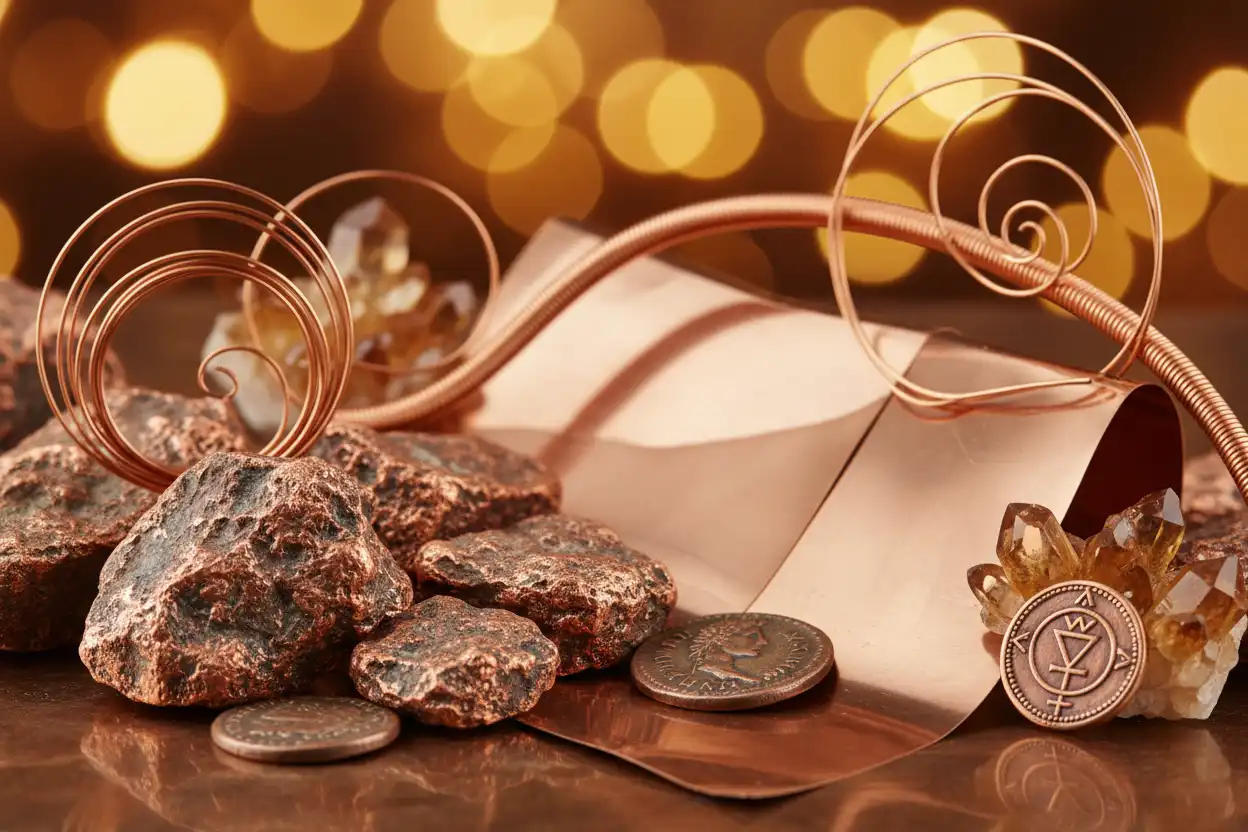
Copper Meaning: Mineral Identity, History & Symbolism
Copper meaning begins with an unusual fact that separates this material from most stones discussed in mineral collections: copper is a native element rather than a silicate, carbonate, oxide, or other compound-based mineral species. Native copper consists predominantly of elemental Cu and crystallizes in the isometric crystal system, although collectors far more often encounter irregular masses, wires, branching dendrites, sheets, flattened growths, and distorted crystals than perfectly geometric cubes. Fresh surfaces show the characteristic copper-red metallic color that gave the element its visual identity, while exposure to air, moisture, sulfur-bearing compounds, carbonates, chlorides, and other environmental chemistry can progressively alter the surface toward brown, black, blue-green, or green products. Within Gems Lore’s Gemstone Guides, those measurable mineral and chemical properties are kept separate from symbolic ideas about vitality, connection, prosperity, creativity, protection, or energetic flow.
That distinction is especially valuable with copper because the metal possesses genuine physical properties that can sound almost metaphysical when described loosely. Copper is an excellent conductor of electricity and heat, is highly malleable and ductile, and has played an enormous role in tools, vessels, wiring, architecture, coinage, alloys, art, and technology. None of those properties demonstrates that a native copper specimen conducts spiritual energy through the body, attracts money, transfers healing power between crystals, or corrects medical conditions. Copper can be materially remarkable and symbolically meaningful without converting engineering properties into evidence for supernatural effects.
Copper at a Glance
| Property | Practical reference |
|---|---|
| Material identity | Native element mineral composed predominantly of Cu |
| Mineral class | Native element |
| Crystal system | Isometric |
| Typical fresh color | Copper-red to reddish metallic |
| Common altered appearance | Brown, dark brown, black, green, or blue-green surface products may develop |
| Luster | Metallic on fresh or preserved surfaces |
| Mohs hardness | About 2.5–3 |
| Specific gravity | Around 8.9 when relatively pure |
| Mechanical behavior | Malleable and ductile rather than brittle like many minerals |
| Common habits | Massive, dendritic, arborescent, wire-like, sheet-like, irregular, and distorted crystals |
| Formation settings | Hydrothermal deposits, volcanic rocks, sediment-hosted systems, and secondary enrichment zones |
| Important associates | Cuprite, malachite, azurite, calcite, quartz, silver, and other copper-bearing minerals depending on deposit |
| Main identification limit | Metallic red color and photographs alone cannot establish purity, treatment, provenance, or every surface coating |
| Symbolic status | Modern meanings are interpretations rather than scientifically demonstrated effects |
Copper’s high density and malleability are particularly helpful for understanding how differently it behaves from most decorative stones. A native copper specimen can feel surprisingly heavy for its size, and thin projections may bend rather than snap cleanly. Yet neither characteristic should be tested destructively on a collectible specimen, because bending wires, scratching surfaces, or exposing fresh metal can permanently reduce condition and destroy geological information.
What Native Copper Actually Is
Native copper is the naturally occurring mineral form of elemental copper. Unlike malachite, azurite, chrysocolla, or cuprite, in which copper is chemically combined with other elements, native copper contains metallic copper as the defining mineral substance. Small amounts of other elements or attached mineral phases can occur in real specimens, so “native copper” does not mean that every object is chemically perfect laboratory-purity Cu from surface to core.
Its isometric crystal structure is capable of producing cubic, octahedral, and related forms, but crystal growth is commonly distorted. Branching dendrites and arborescent masses can develop as copper grows preferentially along particular directions or into available fractures and cavities, while flattened sheets, wires, and irregular masses may reflect limited space, replacement processes, fracture filling, or later deformation. These shapes are genuine expressions of mineral growth rather than evidence that copper behaves like a conventional transparent gemstone.
This distinction becomes useful when copper is compared with cobaltocalcite, where cobalt contributes color to a carbonate mineral, or clinochlore, a layered silicate whose green appearance and cleavage reflect a completely different crystal structure. A shared metallic element in the chemistry of different materials does not make those materials varieties of native copper.
How Native Copper Forms
Native copper forms when geological conditions reduce dissolved or chemically bound copper into its metallic state. This can happen in several kinds of mineral systems rather than through one universal process. Hydrothermal fluids can move copper through fractures and precipitate it when temperature, fluid chemistry, oxidation state, host-rock composition, or interaction with other fluids changes. In some volcanic environments, native copper occupies vesicles, fractures, and spaces within altered basaltic rocks, while sediment-hosted systems can produce copper where metal-bearing fluids encounter chemically reducing layers capable of destabilizing dissolved copper complexes.
Secondary enrichment can also generate native copper when weathering redistributes copper near the surface. Primary copper sulfides may oxidize and release copper into moving groundwater, after which changing chemical conditions allow new copper minerals—including, in suitable environments, metallic copper—to precipitate. This is why a single specimen can contain several generations of copper mineralization and why native copper may occur with oxides, carbonates, sulfides, or silicate minerals that formed before or after it.
The specialist guide to copper formation and deposit geology examines these geological settings in greater depth. For copper meaning, the important boundary is simpler: branching form, matrix color, or green alteration can support a geological interpretation, but none can independently prove a famous mine, country of origin, or exact sequence of formation.
Why Copper Has Its Distinctive Red Metallic Color
Most familiar metals look silvery because they reflect visible wavelengths relatively evenly, but copper’s electronic structure causes stronger absorption toward the blue portion of visible light while reflecting more red and orange wavelengths. The result is the characteristic warm metallic color visible on freshly exposed copper surfaces. This is a measurable optical property of the metal rather than a pigment layered over a colorless mineral.
Surface chemistry can quickly complicate that appearance. Fresh copper may darken as thin alteration products develop, and longer exposure under particular environmental conditions can produce red-brown cuprite, darker oxide or sulfide coatings, and green or blue-green corrosion products. A green surface is therefore not simply “green copper”; it may represent one or more secondary compounds whose chemistry depends on the environment.
This is why color should be interpreted carefully. The detailed copper optical properties and color behavior reference addresses reflectivity, tarnish, patina, and lighting in greater depth, while the practical identification lesson is that bright copper-red, dark brown, and green surfaces can all occur on copper-bearing objects for different reasons.
Diagnostic Traits and Their Limits
Native copper usually presents a distinctive combination of metallic luster, copper-red fresh color, high density, low hardness, malleability, ductility, and characteristic crystal or aggregate forms. These properties can make a good specimen recognizable, particularly when it occurs in a coherent mineral association. Yet a copper-colored object is not automatically native copper. Copper alloys, plated metals, manufactured wire, industrial fragments, metallic coatings, and copper-bearing minerals can all create superficially similar appearances.
The mineral’s malleability is unusual compared with many brittle mineral species. Native copper can flatten or bend rather than shatter under mechanical stress, but this should remain a descriptive property rather than a recommended authentication experiment. A collector specimen can lose significant scientific and aesthetic value if a wire, dendrite, or crystal is deliberately bent.
Density also provides useful context. Relatively pure copper is heavy, with specific gravity near 8.9, so a compact native copper mass can feel much heavier than quartz, calcite, or most common silicates of similar volume. Subjective heft is still not a laboratory measurement, particularly when specimens contain abundant rock matrix or cavities.
What Magnification Can Reveal
Magnification can show growth surfaces, distorted crystal faces, fine dendritic branches, surface corrosion, attached minerals, mechanical tool marks, polishing, casting textures, solder, fractures in the matrix, and interfaces between native copper and secondary copper minerals. These observations can help distinguish a geological specimen from an object that has been shaped, plated, assembled, or heavily cleaned after collection.
The copper microscope and inclusion notebook focuses on that small-scale evidence while maintaining an important limitation: microscopy cannot automatically establish chemical purity, mine locality, or the exact composition of every tarnish product. A green film may be visually consistent with a copper corrosion product without revealing its precise mineral identity from an image alone.
Manufactured forms deserve particular attention. Copper wire can resemble natural wire copper in a poor photograph, while mechanically flattened pieces can imitate sheet-like mineral growth. Natural specimens usually make more sense when crystal morphology, matrix relationships, branching geometry, mineral associations, and surface history are considered together rather than when one shape is examined in isolation.
An Original Specimen and Photo Evaluation Framework
Begin by deciding whether the object is a mineral specimen, a processed metal object, or a mixture whose status remains uncertain. Native copper attached to matrix preserves geological relationships that manufactured copper usually does not. Look for branching or irregular growth entering fractures, natural contacts with host rock, partial crystal faces, embedded secondary minerals, and transitions between fresh metallic areas and older altered surfaces. A perfectly smooth piece with regular machine-cut edges deserves a different interpretation from a copper mass growing through mineralized rock.
Next, examine morphology from several angles. Natural dendritic copper commonly branches in complex three-dimensional patterns rather than behaving like ordinary drawn electrical wire, while crystal groups may contain distorted geometric faces interrupted by later growth. Flattened forms can be natural, but a sheet should be checked for tool marks, uniform rolling texture, drilled holes, solder, or cut boundaries before it is interpreted as mineral growth.
Then evaluate the surface without cleaning it. Dark tarnish, reddish alteration, green coatings, attached calcite, quartz, or other minerals may contain valuable evidence about the specimen’s history. Polishing a small area simply to reveal bright copper can destroy patina and reduce collector significance. If an existing broken or naturally fresh surface is already present, it can provide more useful evidence without altering the specimen.
Photographs should be assessed under neutral lighting because copper is highly reflective. Warm light can exaggerate red tones, while strong white highlights can wash the metal toward yellow or silver. Green corrosion can also become unnaturally vivid after saturation editing. Multiple angles, realistic shadow detail, a scale reference, and photographs of the back and matrix are more informative than one dramatic hero image.
Finally, separate what the photographs support from what they cannot prove. An image can show metallic appearance, morphology, matrix, surface alteration, visible associates, and condition. It cannot establish elemental purity, exact trace chemistry, treatment, artificial cleaning history, geographic provenance, or the identity of every secondary mineral with certainty. When those claims materially affect value or scientific significance, analytical testing or credible documentation is stronger evidence than resemblance.
Copper, Cuprite, Malachite, and Other Copper Minerals Are Not the Same Material
A copper deposit can produce many vividly colored minerals, but the presence of copper in their chemistry does not make them interchangeable. Native copper is elemental Cu. Cuprite is copper oxide, malachite is a copper carbonate hydroxide, azurite is another copper carbonate hydroxide with different proportions and structure, and chrysocolla is a copper-bearing silicate material whose exact composition can be more complex.
These phases can occur together because they participate in the same broader geochemical system. A native copper specimen may develop red cuprite or green secondary copper minerals on its surface, while surrounding rock may contain several copper-bearing species formed during different stages of alteration.
Covellite provides another useful contrast because it is copper sulfide rather than native copper. Its metallic indigo-blue to violet appearance and sulfide chemistry are fundamentally different even though copper is central to both materials. Naming the actual mineral is more informative than grouping everything into a generic category of “copper crystals.”
Documented Human History of Copper
Copper has one of the longest material histories of any metal because native copper can sometimes be collected and shaped without first extracting it from an ore through complex smelting. Archaeological evidence shows that people worked naturally occurring copper into tools, ornaments, beads, hooks, decorative objects, and other forms before large-scale metallurgical processing became established. Hammering could reshape the metal, while heating and increasingly sophisticated metalworking techniques expanded what could be produced.
The development of copper smelting transformed the material from an unusual naturally occurring metal into a resource that could be extracted from copper-bearing ores. Alloying copper with other metals later produced materials such as bronze, dramatically expanding the possible combinations of hardness, casting behavior, tool design, weapon manufacture, sculpture, vessels, and architectural applications. Copper subsequently became important in coinage, roofing, plumbing, electrical systems, communications, machinery, art, and countless technologies.
This documented history is far stronger than generalized statements that copper possessed one universal spiritual meaning in all ancient societies. Different cultures used copper objects in economic, ceremonial, artistic, domestic, technological, and status-related contexts, but those meanings varied. A particular ritual use should be attributed only when archaeological, documentary, or material evidence supports it rather than turning the long history of copper into proof of a modern crystal-healing system.
Copper Meaning in Modern Symbolism
Modern copper meaning commonly draws from the metal’s color, conductivity, malleability, economic importance, and long relationship with craftsmanship. Symbolic themes may include connection, vitality, creativity, adaptability, prosperity, circulation, transformation, and the ability to carry an intention from one part of a system to another. These metaphors are understandable because copper genuinely conducts electricity and can be bent, drawn, hammered, and reshaped without behaving like a brittle mineral.
The symbolic interpretation should stop where measurable evidence stops. Copper’s electrical conductivity does not prove that a bracelet conducts healing energy through a person’s body or transfers metaphysical power between gemstones. Its historical use in money and trade does not mean that a native copper specimen attracts wealth. Its reddish metallic color does not demonstrate that it improves blood circulation or cardiovascular function.
A grounded symbolic practice can retain the metaphor. Someone might use copper as a reminder to communicate more directly, connect two parts of a project, adapt without abandoning a goal, or examine how resources move through a household or business. The practical effect comes from the person’s attention and behavior, not from a scientifically established spiritual field emitted by the metal.
Copper in the Body Does Not Make Native Copper a Supplement
Copper is genuinely an essential trace nutrient in human biology, where it participates in specific enzymes and physiological processes. That biological fact does not mean that holding, wearing, licking, soaking, or ingesting a mineral specimen provides a safe or useful nutritional dose.
Biological effects depend on chemical form, concentration, dose, solubility, exposure route, metabolism, nutritional status, and interactions with other substances. Metallic copper in a specimen, copper salts produced during corrosion, and copper supplied through food or a medically appropriate supplement are not interchangeable exposure scenarios.
This distinction matters because mineral-healing claims sometimes convert the presence of a biologically relevant element directly into a therapeutic promise. Native copper should not be described as correcting copper deficiency, treating anemia, improving immunity, relieving arthritis, repairing connective tissue, improving circulation, or treating any other health condition simply because copper has legitimate biochemical roles.
Safe Ownership of Native Copper
An intact native copper specimen can generally be handled normally with sensible mineral-collection hygiene. Frequent handling may change the surface because skin oils, salts, moisture, and environmental contaminants can accelerate tarnish, so collectors interested in preserving natural patina may prefer minimal direct contact. Washing hands after handling dusty, heavily altered, or matrix-rich specimens is also a reasonable precaution.
The exposure profile changes significantly when copper is cut, ground, drilled, sanded, crushed, heated, soldered, or chemically cleaned. Fine metallic and mineral dust should not be inhaled, while high-temperature work can generate fumes and can alter or mobilize associated materials. A specimen’s matrix may contain minerals that are less benign than native copper itself, including sulfides or other metal-bearing phases that are not obvious from appearance.
Direct-water crystal elixirs are not appropriate. Corrosion products, associated minerals, contamination, cleaning residues, and dissolved copper species may enter the water under conditions that cannot be evaluated visually. Symbolic practice does not require drinking mineral-contact water.
Cutting, Polishing, and Working Native Copper
Native copper behaves differently from brittle lapidary materials because it is metallic, ductile, and malleable. Cutting tools can smear or deform surfaces, thin branches can bend, and heat generated during mechanical work can change patina or stress neighboring matrix. Polishing can produce a bright metallic finish, but it also removes original surfaces that may carry crystallographic, geological, or provenance value.
Those tradeoffs are addressed in detail in copper cutting, orientation, and polish. A collectible dendrite, wire cluster, or crystal group should not automatically be polished merely because bright copper is visually striking. In many cases, preserving the original growth and patina has greater mineralogical value than creating a reflective surface.
The same principle applies to trimming. Removing matrix can reveal more metal but may destroy the geological context that explains how the specimen formed. The best decision depends on whether the object is being treated primarily as a mineral specimen, a decorative material, or a raw metal source.
Copper in Jewelry and Wear
Copper is widely used in jewelry because it is workable, visually distinctive, and capable of being formed into wire, sheet, cast components, chains, findings, and structural elements. Native copper mineral specimens, however, are not identical to fabricated jewelry copper. A delicate dendrite or crystal group can bend, snag, abrade, or detach from matrix even though bulk metallic copper is mechanically workable.
The specialist copper setting and wear engineering reference addresses those construction differences. For the meaning page, the important point is that skin discoloration from copper jewelry, surface patina, solder joints, coatings, and metal sensitivity questions belong to the complete jewelry object rather than to a generalized metaphysical interpretation of copper.
A person’s skin may develop temporary green or dark staining after contact with copper corrosion products, particularly where moisture, salts, cosmetics, or sweat accelerate surface reactions. Such staining is a chemical interaction at the metal-skin interface, not evidence that the copper is “pulling toxins” from the body.
Patina Is Evidence, Not Dirt
Collectors sometimes assume that a bright copper-red surface is automatically better than a dark or partially green one, but natural patina can be part of a specimen’s geological and collection history. Surface alteration may record long exposure to air and moisture, changes within a mineralized zone, storage conditions, or previous cleaning. Removing it aggressively can erase information that cannot be restored.
Not every patina is stable or desirable. Powdery corrosion, active chemical reactions, chloride-related deterioration, or contamination from storage materials may require conservation attention. The correct decision depends on identifying what is actually happening rather than automatically polishing everything bright or, conversely, assuming every green coating is harmless and original.
The copper specimen conservation record provides a focused framework for documenting surface condition, previous cleaning, detached fragments, repairs, environmental changes, and storage history without expanding this meaning page into a conservation manual.
Provenance and Locality Claims
Native copper can occur in many geological settings, and some localities are famous for distinctive crystal habits, large masses, matrix associations, or historically important mining. That reputation can influence collector value, but locality cannot reliably be established from copper-red color or dendritic form alone.
A specimen from an important deposit is better supported by an original mine label, old collection card, dealer documentation, field record, institutional history, or coherent chain of ownership than by visual resemblance. The copper provenance disclosure checklist provides a more appropriate framework for distinguishing documented origin from a seller’s unsupported locality claim.
This distinction becomes especially important after a specimen is cleaned, trimmed, removed from matrix, or separated from its original label. Physical appearance may survive while the evidence connecting the object to a particular mine disappears.
Copper and Other Materials With Very Different Origins
Native copper’s identity as an elemental mineral becomes clearer when compared with materials that can share color or historical decorative roles without sharing its origin. Coral is a biogenic calcium-carbonate material created by marine organisms rather than a native metallic element, so its formation, conservation, ethical context, and evidence requirements are fundamentally different.
Cobalt-bearing calcite can display vivid pink colors because metal ions influence a carbonate structure, while copper itself develops a warm metallic color from its electronic properties. Clinochlore may contain transition metals that influence green coloration, yet it remains a layered silicate. Covellite contains copper but combines it chemically with sulfur.
These contrasts demonstrate why a material’s story should begin with identity. “Contains copper,” “looks metallic,” “has a green patina,” and “is used symbolically” are not mineral species.
Frequently Asked Questions About Copper Meaning
What is native copper?
Native copper is the naturally occurring mineral form of elemental copper, composed predominantly of Cu. It belongs to the native-element mineral class and commonly occurs as masses, wires, dendrites, sheets, and distorted isometric crystals.
What does copper mean spiritually?
Modern symbolic traditions often associate copper with connection, vitality, creativity, adaptability, prosperity, and energetic movement. These are cultural or personal interpretations rather than scientifically demonstrated properties of a copper specimen.
Is copper a crystal?
Native copper is a crystalline mineral even though many specimens do not resemble transparent pointed crystals. It crystallizes in the isometric system and may form distorted cubes, octahedral forms, dendrites, wires, sheets, and irregular masses.
Why does copper turn green?
Copper can react with oxygen, moisture, carbon dioxide, sulfur compounds, chlorides, and other environmental substances to create surface alteration products. Green patina can therefore involve secondary copper compounds rather than a simple color change within unchanged metallic copper.
Is native copper magnetic?
Ordinary copper is not strongly attracted to a common magnet. Magnet response can still be complicated by attached matrix, included magnetic minerals, manufactured components, or contamination, so one observation should not be used to identify every specimen.
Is copper scientifically proven to heal?
No. Copper has legitimate biological and technological roles, but there is no established scientific evidence that holding or wearing a native copper specimen treats disease, removes toxins, balances spiritual energy, or substitutes for medical care.
Does wearing copper provide nutritional copper?
Wearing metallic copper should not be treated as a controlled nutritional method. Biological copper requirements depend on absorbed chemical forms and appropriate doses, while contact with a copper object does not provide a predictable therapeutic intake.
Does copper improve blood circulation?
There is no established evidence that a native copper specimen or ordinary copper bracelet improves circulation merely through contact with the skin. The reddish color of copper and the presence of copper in human biology do not establish that effect.
How can I identify native copper?
Look for a coherent combination of metallic copper-red color on fresh surfaces, high density, malleability, native-copper crystal or aggregate habits, and an appropriate geological association. Valuable specimens should not be scratched, bent, cut, or chemically cleaned merely to perform home tests.
Are green areas on native copper always malachite?
No. Green copper-bearing surface material can include several possible minerals or corrosion products. Color alone is insufficient to identify malachite, and precise identification may require additional mineralogical evidence.
Is native copper safe to handle?
An intact specimen is generally suitable for ordinary careful handling. Greater caution is needed during grinding, drilling, cutting, heating, crushing, or chemical cleaning because these activities can generate dust, fumes, dissolved copper compounds, or exposure to unidentified associated minerals.
Can copper go in drinking water for a crystal elixir?
A mineral specimen should not be used as a direct-water elixir ingredient. Dissolved copper, corrosion products, surface contamination, associated minerals, or treatment residues can enter water, and symbolic practice does not require ingestion.
What Copper Meaning Can Responsibly Mean
Copper meaning becomes more useful when four different kinds of information remain separate. Mineralogically, native copper is elemental Cu with measurable density, hardness, crystal structure, conductivity, color, malleability, and characteristic modes of occurrence. Geologically, it forms through specific hydrothermal, volcanic, sedimentary, and secondary enrichment processes whose evidence is preserved in its matrix, morphology, associates, and surface alteration. Historically, humans have shaped, smelted, alloyed, traded, engineered, and built with copper across an exceptionally long material tradition. Symbolically, modern users may connect those tangible qualities with ideas such as connection, adaptability, creativity, or resourcefulness without claiming that the metal produces supernatural outcomes.
That separation strengthens the story because copper does not need invented powers to be extraordinary. Few mineral materials combine a recognizable natural metallic color, high electrical conductivity, malleability, complex geological occurrence, major archaeological importance, artistic usefulness, and technological significance so clearly. A dendritic native copper specimen can therefore be appreciated simultaneously as geological evidence, an aesthetic object, part of mining history, and a personal symbol while each of those meanings remains grounded in the kind of evidence capable of supporting it.
Gems Lore explains its broader authorship and site context on the About page, while the Disclaimer clarifies the limits of mineral, symbolic, health, safety, and identification information. Questions, factual corrections, or documentation relevant to a specific copper specimen can be submitted through Contact, particularly when exact mineral associates, treatment history, or provenance cannot be established from photographs alone.