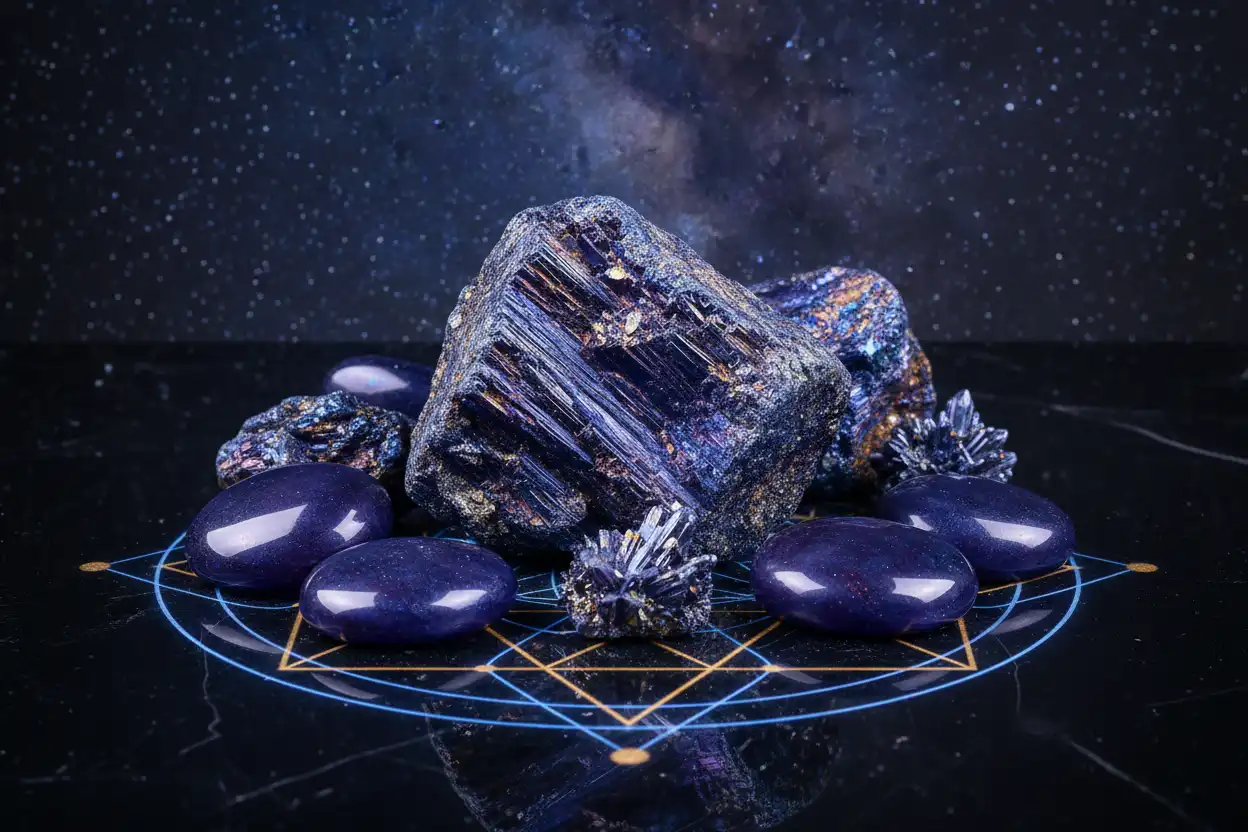
Covellite Meaning: Mineral Facts, History & Symbolism
Covellite meaning begins with a mineral that is visually dramatic enough to invite exaggerated explanations even before its actual properties are understood. Covellite is a copper sulfide mineral with the simplified formula CuS, characteristically opaque and indigo-blue to blue-black, often displaying violet, purplish, reddish, or brassy reflections that can make a fresh specimen appear almost artificially iridescent. It crystallizes in the hexagonal system and is remarkably soft for a metallic-looking mineral, with hardness around 1.5–2, perfect basal cleavage, and a relatively high density of roughly 4.6–4.8. Those measurable features distinguish covellite from many blue and metallic collector minerals and provide a much stronger basis for identification than descriptions involving “high vibration,” psychic activation, transformation, or spiritual communication. Within Gems Lore’s Gemstone Guides coverage, the physical mineral is therefore established first, while symbolic and metaphysical interpretations remain clearly identified as human meanings rather than properties demonstrated by CuS.
Covellite is important geologically because it participates in copper-ore systems and can form both as a primary hydrothermal sulfide and, very commonly, through secondary enrichment or alteration of earlier copper minerals. Its intense color is not evidence of dye, nor does its metallic appearance mean that it is native copper. The mineral contains copper chemically bonded with sulfur within a distinctive crystal structure, and real specimens can occur as thin platy crystals, foliated aggregates, massive material, coatings, or fine-grained replacements associated with other copper sulfides. Appreciating covellite meaning responsibly therefore involves four different stories that should not be blended together: measurable mineralogy, documented mineral history, modern symbolism, and personal metaphysical practice.
Covellite at a Glance
| Property | Practical reference |
|---|---|
| Material identity | Copper sulfide mineral |
| Simplified formula | CuS |
| Mineral class | Sulfide |
| Crystal system | Hexagonal |
| Typical color | Indigo blue, blue-black, dark metallic blue |
| Surface reflections | Violet, purplish-red, brassy, or other iridescent-looking reflections may occur |
| Transparency | Opaque |
| Luster | Submetallic to metallic-looking |
| Mohs hardness | About 1.5–2 |
| Specific gravity | Roughly 4.6–4.8 |
| Cleavage | Perfect basal cleavage |
| Typical habit | Thin plates, foliated material, massive aggregates, coatings, and distorted crystals |
| Common geological context | Copper-bearing hydrothermal systems and secondary enrichment zones |
| Main identification caution | Blue metallic color alone cannot establish covellite, treatment status, or provenance |
| Symbolic status | Modern meanings are cultural or personal interpretations rather than scientifically demonstrated effects |
The unusual combination of softness, density, cleavage, and dark blue metallic appearance is more informative than color by itself. A specimen can look hard and metallic while being soft enough for crystal surfaces to abrade readily, and thin covellite plates can be mechanically delicate despite the visual impression of solid metal. This contrast is one reason specimen conservation matters more than many first-time collectors expect.
What Covellite Actually Is
Covellite is a recognized copper sulfide mineral whose conventional formula is CuS, although its detailed crystal chemistry is more structurally complex than the simplicity of that formula suggests. Copper can occupy different bonding environments within the crystal, while sulfur occurs in more than one structural arrangement, so CuS is best understood as the useful overall composition rather than a complete explanation of every bond inside the mineral. The mineral belongs to the hexagonal crystal system and can form thin hexagonal plates or foliated masses whose flat surfaces reflect light strongly.
Fresh covellite is typically indigo-blue to blue-black rather than copper-red. That difference immediately separates it from copper, which is the native elemental form of Cu and displays the familiar reddish metallic color of the metal. Covellite instead contains sulfur as an essential part of its structure, and this chemical difference affects everything from color and crystal habit to alteration behavior and the way the material occurs in ore deposits.
Many specimens are not composed of covellite alone. They can include chalcocite, bornite, chalcopyrite, pyrite, quartz, calcite, secondary copper minerals, host rock, or other ore-related phases depending on locality and formation history. A dark blue patch on an ore specimen should therefore be treated as a candidate identification until its texture and mineral relationships are considered rather than automatically named covellite from color.
How Covellite Forms
Covellite can develop in several copper-bearing geological environments, but it is especially familiar from sulfide enrichment zones where copper is redistributed after earlier mineralization has already formed. Near-surface weathering can oxidize primary copper sulfides and mobilize copper in descending fluids. When those copper-bearing solutions encounter chemically reducing conditions deeper in the deposit, copper may be reprecipitated as secondary sulfides, including covellite and other enriched copper minerals.
Covellite can also occur in hydrothermal mineralization where hot mineral-bearing fluids directly precipitate copper sulfides through fractures, veins, breccias, or replacement zones. Temperature, sulfur activity, oxidation state, host-rock chemistry, and relationships with earlier sulfides influence which copper mineral is stable at a given stage. This means that a specimen may record several generations of mineralization, with covellite coating, replacing, or intergrowing with minerals that formed before it.
The detailed geological relationships belong in covellite formation and deposit geology, while the central point here is that covellite is not merely a blue coating that appears randomly on copper ore. Its position within a specimen can record chemical changes in the deposit, making replacement textures and mineral contacts scientifically useful evidence.
Why Covellite Looks Indigo Blue
Covellite’s intense indigo-blue appearance arises from its electronic structure and interaction with visible light rather than from a blue pigment embedded in a colorless host. Unlike transparent gemstones, where color is often discussed through selective absorption of light passing through the body of the stone, covellite is opaque and is evaluated largely through reflected-light behavior. Its reflectivity varies strongly with wavelength and crystallographic direction, contributing to the characteristic blue, purple, reddish, and brassy visual effects seen across crystal surfaces.
This optical behavior can be surprisingly dramatic. A thin plate may look deep navy from one direction and show violet or coppery highlights after a slight change in angle, while weathering, surface alteration, microscopic roughness, tarnish, and photography can further modify the effect. A brightly iridescent-looking covellite specimen is therefore not automatically coated or treated, but neither should every rainbow-metallic object be assumed natural simply because covellite can display unusual reflections.
The more technical treatment of reflected color, anisotropy, surface condition, and photographic behavior belongs in covellite optical properties and color behavior. For practical evaluation, neutral lighting and multiple viewing angles are much more informative than a single highly saturated seller photograph.
Diagnostic Traits That Matter
Covellite combines several properties that make a coherent identification possible. It is opaque, commonly indigo-blue or blue-black, relatively dense, extremely soft compared with most familiar gems, and capable of perfect cleavage parallel to its basal plane. Thin platy crystals can be somewhat flexible, while massive material may break irregularly and display surfaces that look more granular or compact.
The streak is dark, generally lead-gray to black rather than vivid blue. Although streak can be useful in mineral identification, grinding a collectible crystal across a porcelain plate is destructive and should not be treated as a routine authentication method. The same applies to hardness testing. A beautiful plate can be permanently scarred by an unnecessary scratch test when existing damage, matrix relationships, magnification, and analytical techniques could answer the question with less harm.
Density can provide supporting information because covellite is substantially heavier than quartz, calcite, or many common silicates of similar volume. Yet ore matrix complicates this observation, and a small platy crystal cannot be identified reliably from subjective heft alone. Strong identification comes from several properties agreeing rather than from one dramatic clue.
What Magnification Can Reveal
Magnification is especially useful with covellite because thin plates, cleavage surfaces, replacement textures, microscopic intergrowths, tarnish, scratches, and associated sulfides can be difficult to distinguish with the unaided eye. Crystal surfaces may show striations or growth features, while an ore sample may reveal that apparent “solid covellite” is actually a fine intergrowth of several copper minerals.
The covellite microscope and inclusion notebook is the appropriate place for detailed microscopic interpretation. For a meaning reference, the key limitation is that magnification can support a mineralogical hypothesis without necessarily proving every phase present. Metallic sulfides can be difficult to distinguish visually when fine-grained, altered, or intermixed, and exact identification may require reflected-light microscopy, Raman spectroscopy, X-ray diffraction, chemical analysis, or another suitable laboratory method.
Microscopy can also reveal post-collection changes. Polished surfaces, tool scratches, adhesives, repairs, coatings, or artificially enhanced areas may become obvious at higher magnification even when an overall photograph appears natural.
An Original Covellite Specimen and Photo Evaluation Framework
Begin with the specimen as an entire geological object rather than selecting the bluest patch. Record whether the suspected covellite occurs as thin plates, a surface coating, massive blue material, replacement rims around another sulfide, fracture fillings, or fine-grained material distributed through matrix. Then note the other visible phases without over-identifying them. A yellow metallic region may be consistent with a copper-iron sulfide, for example, but color alone does not justify naming it precisely.
Next, examine the shape and surfaces of the blue material. Genuine platy covellite can show broad flat faces and repeated basal cleavage, while thin crystals may have delicate edges that look almost sheet-like. Natural surfaces should not be expected to resemble polished metallic jewelry, and an unusually smooth high-gloss surface deserves inspection for cleaning, polishing, or coating rather than immediate rejection.
Then compare color under at least two neutral lighting conditions. Look at the same area from several angles and distinguish body appearance from angle-dependent reflections. If violet or brassy highlights move as the specimen rotates, the effect may be associated with real surface reflectivity rather than fixed pigment. In photographs, compare exposure and white balance across the whole image; aggressively saturated blue and purple shadows can make ordinary ore material look far more spectacular than it does in person.
Existing damage can offer useful clues without creating new damage. A naturally broken edge may reveal platy cleavage, darker internal material, or fine intergrowths that are hidden on the exposed surface. Do not intentionally split thin crystals to test cleavage. For collectible specimens, preserving condition is more important than reproducing a textbook experiment.
Finally, divide all claims into evidence categories. A photograph may support observations about visible color, crystal habit, matrix, apparent cleavage, relative scale, and surface condition. It cannot prove chemical purity, exact copper-to-sulfur chemistry, geographic origin, treatment history, mine identity, or the exact species of every associated sulfide. Those stronger claims require documentation or analytical evidence.
Disputed Names and Unsupported Claims
Covellite has occasionally been described under historical or regional names connected with its indigo color, and “copper indigo” or equivalent older terminology may appear in mineral literature or collections. Such expressions can be historically interesting, but they should not be interpreted as separate mineral species when the material is covellite.
Commercial descriptions create a different issue. Phrases such as “peacock covellite,” “rainbow covellite,” or “purple covellite” may be used to emphasize surface appearance, but these are not automatically standardized mineral varieties. Iridescent colors can arise naturally from covellite’s optical behavior or surface alteration, yet trade adjectives do not establish exceptional chemistry or rarity on their own.
The largest unsupported leap occurs when the mineral’s unusual appearance is translated directly into metaphysical mechanisms. Descriptions such as “interdimensional stone,” “DNA activator,” “psychic accelerator,” “cellular transformer,” or “high-frequency copper crystal” are modern belief or marketing language rather than mineralogical categories. The presence of copper and the mineral’s electrical properties do not demonstrate those effects.
Covellite Is Not Bornite Simply Because It Looks Iridescent
Many buyers learn the phrase “peacock ore” before learning individual copper sulfide minerals, which can create confusion between covellite, bornite, chalcopyrite, and artificially treated ore specimens. Bornite can develop vivid purple, blue, and reddish tarnish, while acid-treated chalcopyrite is also frequently sold with dramatic rainbow coloration. Covellite can naturally show intense blue and iridescent reflections of its own, so color alone cannot settle the identification.
A useful distinction is that fresh covellite is characteristically indigo-blue to blue-black, whereas fresh bornite and chalcopyrite have different underlying metallic colors and compositions. Weathering can blur these differences dramatically. Mixed specimens add another layer because covellite may replace or coat other copper sulfides, leaving several phases visible in one hand sample.
The correct response to an exceptionally colorful specimen is therefore not to declare it treated or natural from a photograph, but to examine mineral relationships, surface texture, color beneath altered areas, and—when the distinction materially matters—analytical evidence.
Covellite Compared With Unrelated Decorative Materials
Covellite’s dark blue metallic appearance is sufficiently unusual that comparisons with neighboring mineral pages help clarify what identity actually means. Crazy Lace Agate is a patterned chalcedony material dominated by silica and has a completely different hardness, transparency, fracture behavior, and geological history despite also being valued for visually striking patterns.
Coral is even further removed because it is biogenic skeletal material produced by marine organisms rather than a sulfide mineral. Its red and pink colors, low hardness, and organic growth structure demonstrate why visual attractiveness alone is not a useful material classification.
Creedite is a hydrous calcium-aluminum sulfate-fluoride mineral that forms very different transparent to translucent crystals, while covellite remains opaque metallic CuS. These contrasts are not intended as substitute identification tests; they reinforce the broader principle that a mineral name represents composition and structure, not a mood, color family, or decorative category.
Documented History of Covellite
Covellite’s recorded history belongs primarily to mineralogy and copper-ore science rather than to a securely documented ancient gemstone tradition. The mineral was named in honor of Italian mineralogist Niccolò Covelli, whose work was associated with mineral discoveries at Mount Vesuvius. The type locality is linked with that volcanic region, giving covellite a legitimate history within the development of systematic mineral identification.
This documented history should not be expanded into unsupported claims that ancient societies specifically used covellite for psychic communication, prophecy, chakra systems, or healing. Older cultures certainly worked copper and copper minerals, but a historical reference to a dark blue ore, metallic stone, or copper-bearing material does not automatically prove covellite unless the material evidence is sufficiently specific.
The distinction matters because modern metaphysical lore often acquires an “ancient” label simply through repetition. A responsible covellite meaning page should describe what is genuinely known about the mineral’s scientific naming and occurrence while labeling later spiritual associations as modern interpretations.
Covellite Meaning in Modern Symbolism
Modern covellite meaning commonly centers on transformation, intuition, self-reflection, communication, creativity, release of limiting habits, and a willingness to confront uncomfortable truths. Its dark indigo color and unusual metallic reflections encourage obvious symbolic comparisons with depth, hidden information, altered perspective, and the movement between darkness and bright flashes of color. Some crystal traditions additionally connect it with the third-eye or crown chakra.
These meanings can function as metaphors, but they are not measured properties of copper sulfide. Covellite does not scientifically activate psychic abilities, increase clairvoyance, open chakras, alter consciousness through emitted frequencies, repair DNA, treat depression, remove toxins, or guarantee spiritual transformation. A person can assign symbolic meaning to the mineral without presenting those interpretations as established physical or medical effects.
A grounded use might treat covellite as a reminder to review what has been overlooked. Someone could place a specimen near a journal and ask which assumption needs evidence, which difficult conversation is being avoided, or whether an appealing explanation has actually been verified. The reflection can be useful because of the behavior it prompts, not because the mineral causes insight.
Copper Chemistry Is Not Evidence of Healing
Covellite contains copper, and copper is a biologically essential trace element in specific chemical forms and carefully regulated amounts. That fact does not mean that touching covellite delivers nutritional copper or that wearing the mineral treats copper deficiency. Biological effects depend on chemical form, solubility, dose, concentration, exposure route, metabolism, and the complete material being encountered.
The same boundary applies to conductivity. Copper-containing compounds can have interesting electrical and electronic properties, but those facts do not establish an invisible healing current flowing between a covellite specimen and the human body. Mineral physics and metaphysical “energy” are different concepts that should not be presented as though the first proves the second.
Ingestion is particularly inappropriate. Covellite is an ore mineral specimen, not a nutritional product, and real pieces may contain other sulfides, oxidation products, matrix minerals, dust, surface contamination, or collecting residues.
Safe Ownership of Covellite
An intact covellite specimen can generally be owned and displayed using sensible mineral-collection hygiene, with the primary everyday concern being damage to the specimen rather than dramatic exposure during occasional careful handling. Its softness means crystal surfaces can scratch easily, and perfect basal cleavage makes thin plates vulnerable to splitting or flaking when pressed, rubbed, or stored against harder minerals.
Higher-exposure activities deserve substantially more caution. Cutting, sanding, drilling, crushing, or grinding copper-bearing sulfide ore can create fine dust containing covellite and whatever other sulfide or matrix minerals are present. Such work should use appropriate mineral-dust controls rather than casual dry processing. Heating or burning sulfide specimens is also inappropriate because thermal decomposition and oxidation can produce hazardous fumes and permanently alter the material.
Direct-water crystal elixirs should not be made from covellite. A real specimen may contain copper-bearing oxidation products, associated sulfides, matrix minerals, contaminants, or residues whose behavior in water is not known from appearance. Symbolic practice does not require ingestion.
Cutting and Polishing Covellite
Covellite is an unusual lapidary material because its low hardness, perfect cleavage, softness, and platy habit create challenges that differ sharply from quartz, agate, jasper, or corundum. Thin crystals can separate along cleavage, while massive ore material may undercut when intergrown minerals have different hardnesses. Polishing can also remove the very surfaces responsible for attractive natural reflections.
Detailed lapidary decisions belong in covellite cutting, orientation, and polish, but an important collector principle belongs here: exceptional natural crystal plates may be worth more scientifically and aesthetically when preserved rather than converted into cabochons.
Material selected for polishing should be evaluated as an aggregate, not assumed to be uniform covellite. Harder associated minerals can stand proud while softer covellite wears away, producing an uneven surface that reflects the specimen’s mixed mineralogy.
Jewelry and Wear Engineering
Covellite’s striking color makes jewelry visually tempting, but its hardness and cleavage mean it is not an ideal exposed everyday gem. A polished cabochon or stabilized composite may perform differently from a delicate natural crystal plate, and a seller should be clear about what material form has actually been set.
Low-impact pendants, protected collector jewelry, or enclosed designs are generally more realistic than an exposed daily-wear ring. The engineering considerations belong in covellite setting and wear engineering, where pressure points, edge protection, backing, mounting design, and mixed-mineral behavior can be considered without turning a meaning reference into a jewelry manual.
A setting cannot change Mohs hardness or eliminate cleavage. It can only reduce how often damaging forces reach the stone.
Conservation and Surface Preservation
Covellite specimens benefit from careful storage because soft metallic surfaces can acquire scratches that permanently change reflectivity. Thin platy crystals are particularly vulnerable to edge damage and cleavage separation, while ore specimens containing several sulfides may also respond differently to humidity, contamination, and previous cleaning.
Aggressive polishing is a poor default conservation strategy. Brightening a dark surface may remove natural alteration products, original crystal texture, or evidence about specimen history. Likewise, soaking an ore sample in household chemicals to intensify iridescence can create artificial surfaces that later become difficult to distinguish from natural ones.
The covellite specimen conservation record provides a more appropriate framework for documenting condition, detached plates, surface change, previous chemical cleaning, repairs, labels, and storage history. Preventing damage is generally easier than restoring a scratched or chemically altered sulfide specimen.
Provenance and Locality Claims
Locality can matter significantly to covellite collectors because some mines and districts are known for exceptional plate crystals, unusual associations, historical importance, or particularly aesthetic specimens. Yet an indigo color does not reveal the mine, and even distinctive crystal habit can occur at more than one locality.
Strong provenance may include original mine labels, old collection cards, dealer records, field notes, institutional documentation, or a coherent chain of ownership. The covellite provenance disclosure checklist offers a structured way to evaluate these claims without pretending that a photograph can establish geographic origin.
This boundary is especially important after a specimen has been heavily trimmed or removed from matrix. The more geological context is lost, the more the locality claim depends on surviving documentation rather than appearance.
Frequently Asked Questions About Covellite Meaning
What is covellite?
Covellite is an opaque copper sulfide mineral with the simplified formula CuS. It is typically indigo-blue to blue-black, has submetallic luster, crystallizes in the hexagonal system, and is unusually soft at roughly Mohs 1.5–2.
What does covellite mean spiritually?
Modern crystal traditions commonly associate covellite meaning with transformation, intuition, self-reflection, communication, creativity, and spiritual awareness. These are symbolic interpretations rather than scientifically demonstrated effects of copper sulfide.
Why is covellite blue?
Covellite’s indigo-blue appearance results from its electronic structure and wavelength-dependent reflected-light behavior. Violet, purplish, reddish, or brassy reflections can also occur depending on orientation and surface condition.
Is covellite naturally iridescent?
Covellite can naturally display strong color reflections and iridescent-looking surfaces. However, colorful appearance alone cannot prove natural surface condition because alteration, chemical cleaning, photography, and treatment can also change how metallic minerals look.
Is covellite the same as peacock ore?
No. “Peacock ore” is an imprecise commercial term frequently applied to tarnished bornite or treated chalcopyrite, although other colorful copper minerals may occasionally be marketed similarly. Covellite is a specific mineral species, CuS.
Is covellite the same as native copper?
No. Native copper is elemental Cu and normally shows copper-red metallic color, while covellite is copper sulfide, CuS, and is characteristically indigo-blue to blue-black.
Is covellite rare?
Covellite occurs in many copper deposits and is not exceptionally rare as a mineral species, but well-formed, undamaged, aesthetically strong crystal specimens can be much less common than massive or fine-grained ore material. Collector value depends on specimen quality and provenance rather than species rarity alone.
Is covellite safe to handle?
An intact specimen can generally be handled carefully with sensible mineral-collection hygiene. Greater caution is needed when drilling, grinding, sanding, crushing, or heating because these activities can generate sulfide-bearing dust or fumes and may expose associated ore minerals.
Can covellite be used in water?
Direct-water crystal elixirs are not appropriate for covellite. Copper-bearing sulfides, oxidation products, associated minerals, contamination, and other specimen components make ingestion an unnecessary exposure route.
Can covellite be used in jewelry?
It can be used selectively, but its very low hardness and perfect cleavage make it vulnerable to scratches, splitting, and abrasion. Protected pendants or collector jewelry are generally more realistic than exposed everyday rings.
How can you identify real covellite?
Look for several mutually consistent properties, including indigo-blue to blue-black opaque color, metallic or submetallic luster, softness, high relative density, perfect basal cleavage, characteristic platy or massive habit, and appropriate copper-ore associations. Laboratory analysis may be necessary when fine-grained sulfides are intergrown.
Does covellite have scientifically proven healing properties?
No. There is no established scientific evidence that covellite treats disease, activates psychic abilities, detoxifies the body, repairs DNA, opens chakras, or creates medical benefits through contact with the skin.
What Covellite Meaning Can Responsibly Mean
Covellite meaning becomes more useful when its different evidence layers remain distinct. Mineralogically, covellite is an opaque hexagonal copper sulfide whose indigo color, softness, density, cleavage, crystal habit, and ore associations can be investigated directly. Geologically, it records copper-bearing hydrothermal processes and secondary enrichment that may transform earlier sulfides into new mineral assemblages. Historically, its documented identity belongs to the development of mineral science and the work associated with Niccolò Covelli rather than to an unsupported universal ancient spiritual tradition.
Modern symbolism can coexist with those facts without replacing them. Covellite’s deep blue color and changing metallic reflections can serve as metaphors for introspection, transformation, changing perspective, or confronting hidden information. Those meanings may be valuable within personal reflective practice, but they do not demonstrate psychic activation, medical healing, biological detoxification, or a measurable spiritual field.
Covellite remains remarkable without those claims. Its unusual CuS crystal structure, striking indigo reflectivity, flexible platy crystals, perfect cleavage, role in copper enrichment, and sometimes spectacular specimen aesthetics provide substantial reasons to collect and study it. Gems Lore explains its broader authorship and site context on the About page, while the Disclaimer clarifies the limits of mineral, symbolic, safety, and identification information. Questions, corrections, or supporting documentation relevant to a particular covellite specimen can be submitted through Contact, especially when exact mineral identity, treatment, or provenance cannot be established from photographs alone.