
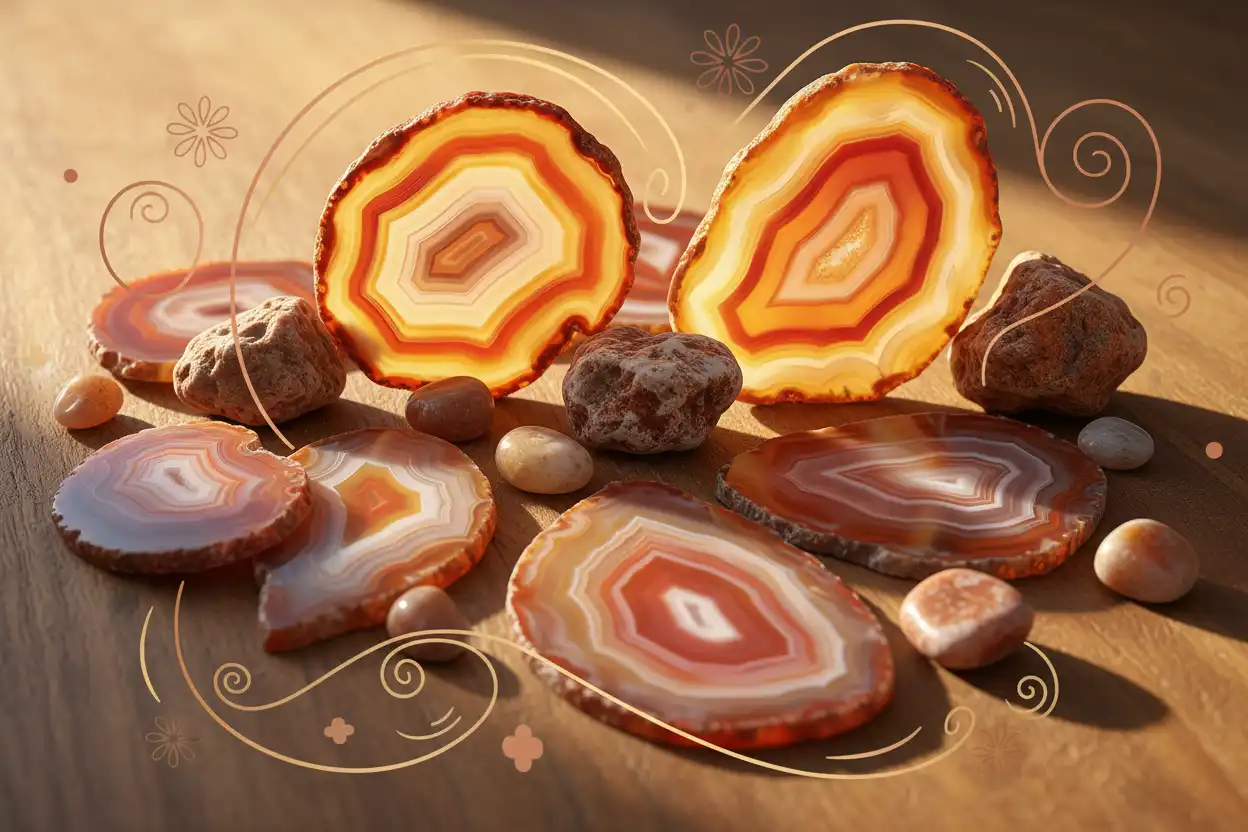

Crazy Lace Agate is a Mexican vein agate recognized by tangled bands, eyes, scallops, zigzags and circular patterns in white, gray, cream, yellow, orange, red and brown. Unlike most famous agates from Chihuahua, which formed in volcanic rocks, classic Crazy Lace Agate occurs in dark Cretaceous limestone in the Sierra Santa Lucia area.
Crazy Lace Agate at a Glance
| Property | Details |
|---|---|
| Mineral group or material type | Banded Chalcedony and microcrystalline Quartz; commercial Agate variety |
| Composition | Primarily SiO₂, commonly containing fibrous Chalcedony, microgranular Quartz, Moganite and iron-rich staining |
| Colors | White, gray, cream, yellow, ocher, orange, rust-red, brown, black and occasional pale pink |
| Structural system | Aggregate of trigonal Quartz with commonly present monoclinic Moganite |
| Habit | Veins, seams, brecciated fillings, curved bands, eyes, scallops, sunbursts and irregular nodules |
| Luster | Waxy on rough surfaces; vitreous to waxy after polishing |
| Transparency | Translucent to opaque |
| Mohs hardness | About 6.5–7 |
| Cleavage | None |
| Tenacity | Brittle but relatively tough in compact microcrystalline form |
| Common use | Cabochons, beads, rings, pendants, slabs, carvings, spheres and display freeforms |
| Main care concern | Hidden fractures, open pockets, dye, resin, poor pattern orientation and silica dust during cutting |
What Makes Crazy Lace Agate Different?
Crazy Lace Agate belongs to the broad Agate family, yet its pattern is less orderly than the concentric bands seen in many nodular agates.
Its bands bend, branch and intersect. One slab may contain a lace-like network of thin lines, circular eyes, tiny fortifications, plume-like sprays and broad stained zones.
The host is Chalcedony, a compact microcrystalline silica aggregate. Some areas contain visible fine Quartz, while others remain too tightly fibrous for individual crystals to be seen.
“Crazy Lace” is a trade name rather than a formally defined mineral species. Nevertheless, the name has a recognized locality and visual tradition tied to northern Chihuahua.
The types of Agate guide places it among lace, fortification, eye, moss, fire and other pattern varieties. The types of Chalcedony guide explains the wider silica family behind those names.
An Unusual Limestone-Hosted Agate
Many Mexican agates formed inside cavities in volcanic lava, tuff or andesite. Crazy Lace Agate is the notable exception.
Classic material comes from veins and mineralized zones in highly siliceous dark-gray Cretaceous limestone in the Sierra Santa Lucia, near Ejido Benito Juárez in Chihuahua.
Silica-rich fluids moved through fractures in the limestone. Instead of filling one round volcanic gas cavity, they deposited Chalcedony along irregular cracks, cavities and chemically altered zones.
Repeated fluid movement created new bands beside earlier material. Fracturing, partial dissolution and later mineral staining complicated the pattern further.
This host-rock difference helps explain the stone’s crowded appearance. The bands were forced through a fracture network rather than developing only as smooth shells around one open center.
How the Lace Pattern Forms
Agate banding develops through repeated silica deposition. The exact microscopic mechanism remains debated because several processes can operate together.
Silica-rich fluids enter an opening and begin depositing fibrous Chalcedony along the walls. Changes in concentration, temperature, impurities and fluid movement create visible boundaries between successive layers.
In Crazy Lace Agate, the opening is often irregular. One band follows a curved fracture, another bends around earlier silica and a later pulse cuts across both.
Tiny growth centers can form eyes and circular droplets. Curved bands around those centers create rosettes or sunburst-like structures.
Some white areas consist of relatively clean silica. Yellow, red and brown zones commonly reflect iron oxides, hydroxides or staining introduced during or after the primary Chalcedony growth.
The resulting design is a geological sequence rather than a printed surface. A genuine pattern continues through the slab, although its appearance changes at each cutting depth.
Most Natural Material Is Gray and White
Commercial photographs emphasize red, orange and yellow Crazy Lace Agate. In the deposit itself, gray and white silica is often more abundant.
Strong warm color may occur in narrow bands, broad stained patches or iron-rich fractures. A piece with modest color can therefore be completely natural and locality-correct.
Highly saturated red material usually carries more demand, but color alone does not determine quality. A gray-and-white cabochon with exceptionally sharp eyes and balanced lace can be more desirable than an orange slab with muddled patterning.
Water or oil deepens color temporarily. Sellers should identify wet photographs because dry rough may appear substantially paler.
Crazy Lace Agate vs Blue Lace Agate
Blue Lace Agate usually displays soft blue and white bands with a more open, cloud-like or lace-like rhythm. Classic material is strongly associated with Namibia.
Crazy Lace Agate has a warmer palette and more crowded geometry. Red, yellow, cream and gray zigzags often cross several eyes or fortification bands in one small area.
Both are Agate, but the trade names refer to different source traditions and appearances. A dyed blue Mexican lace stone should not be sold as genuine Namibian Blue Lace Agate.
Crazy Lace Agate vs Botswana Agate
Botswana Agate commonly has finely spaced gray, brown, pink and white bands. The layers are often smoother and more parallel than those of Crazy Lace Agate.
Crazy Lace material generally shows more abrupt turns, circular eyes and contrasting iron-stained zones. Botswana Agate tends toward restrained color transitions and evenly repeated banding.
Both can produce excellent cabochons, but cutting priorities differ. Botswana material rewards long, parallel layers; Crazy Lace rewards a face that captures several interacting patterns.
Crazy Lace Agate vs Fire Agate
Fire Agate is valued for iridescent spectral colors produced by thin iron-oxide layers within botryoidal Chalcedony.
Crazy Lace Agate may contain orange and red bands, but those colors usually come from mineral staining rather than diffraction-based fire.
A polished Crazy Lace stone should not be advertised as Fire Agate merely because it contains warm colors. True fire moves and changes as the viewing angle shifts.
Crazy Lace Agate vs Dendritic and Moss Agate
Dendritic Agate contains branching mineral inclusions that resemble trees or ferns. The host may be relatively plain compared with the dark dendrites.
Moss Agate contains moss-like inclusions without requiring visible banding. Green, brown or red inclusions float through translucent Chalcedony.
Crazy Lace Agate creates its design primarily through bands and stained silica rather than isolated plant-like inclusions. Some pieces contain plume or mossy areas, but those features do not replace the main lace structure.
Crazy Lace Agate vs Flower and Iris Agate
Flower Agate contains pale Chalcedony plumes resembling blossoms, often inside a translucent pink or gray host.
Iris Agate reveals spectral interference colors when thin slices are viewed in transmitted light. Its finest banding may be almost invisible until the lighting is correct.
Crazy Lace Agate shows its main design in normal reflected light. Eyes, scallops and zigzags remain visible without cutting the stone into an extremely thin slice.
Lapidary Orientation
Pattern selection begins before the first slab is cut. Rough Crazy Lace Agate may show only a weathered edge, leaving the best internal design hidden.
A saw cut perpendicular to the vein can reveal stacked bands, eyes and circular structures. A cut parallel to the vein may produce long flowing lines but miss the most complete eyes.
Lapidaries often examine both ends of a block before committing to a direction. One face can show bold red lace, while a cut only a centimeter away contains mostly gray silica.
Cabochon templates should follow the design rather than impose a standard oval on every slab. Freeforms work particularly well because the cutter can preserve a sunburst, eye or sweeping band without trimming it away.
A high dome strengthens translucent material but can distort thin lines. A low dome or tablet often presents the lace more clearly.
Open vugs require careful placement. Leaving a small druzy pocket can add character, but placing it at a thin girdle creates a breakage point.
Is Crazy Lace Agate Suitable for Jewelry?
Compact Crazy Lace Agate is durable enough for rings, pendants, earrings, bracelets and beads. Its hardness is close to 7, and it has no cleavage.
The gemstone hardness chart shows that Agate resists everyday scratches better than Calcite, Fluorite and Feldspar.
Microcrystalline texture also gives it practical toughness. A compact cabochon does not split along one predictable cleavage plane.
However, it remains brittle. A sharp blow can chip an edge, especially where a dark band follows a fracture or where the stone contains an open cavity.
A protective bezel is ideal for rings. Pendants can use larger slices because they experience less impact and show more of the pattern.
Crazy Lace Agate Price
Small tumbled stones commonly sell for approximately $3–$12. Their pattern may be attractive, but tumbling often rounds away the strongest directional design.
Commercial cabochons usually range from $10 to $40. Current listings frequently place medium-size ovals near $20–$30.
Designer cabochons with complete eyes, high-contrast lace and polished backs may cost $40–$100 or more. Matched pairs can receive a premium because adjacent patterns rarely repeat exactly.
Rough pieces and slabs commonly range from several dollars to $50, depending on size, color coverage and cutting potential. Large display slabs, spheres and freeforms may sell for $50–$250.
Fine carvings can exceed those levels because much of the price reflects labor and the difficulty of positioning the pattern.
Crazy Lace Agate is not scarce enough to justify precious-gem pricing. High value should come from exceptional design, cutting or provenance rather than claims that every Mexican piece is rare.
What Makes One Piece Better?
A strong stone gives the eye somewhere to rest. Dense pattern alone can become visually confused if every line has equal weight.
Complete eyes, scallops and fortification loops create focal points. Long white or gray bands can provide breathing space between red and yellow zones.
Contrast matters, but heavy saturation is not always better. Cream, charcoal and rust-red often create a more readable pattern than uniformly bright orange.
Polish should remain even across the silica. Pits, undercut seams and flat spots interrupt the lace and collect residue.
Cutting orientation can dominate material quality. A skilled cutter may produce a striking cabochon from ordinary rough, while a poor cut can turn a premium block into disconnected fragments.
Natural Color, Staining and Dye
Much of Crazy Lace Agate’s warm color comes from natural iron-rich staining. Red, orange, yellow and brown may cut across or soak into the silica bands.
Natural staining is often irregular. Color can fade gradually from a fracture or outline an eye rather than filling every pore evenly.
Dyed Agate may show pigment concentrated in cracks, drill holes and porous white zones. The dyed-crystal guide explains those signs in detail.
Bright purple, neon blue or uniformly fluorescent green Crazy Lace Agate should be treated as dyed unless credible evidence shows otherwise.
Heating can deepen some iron-related colors. Because Agate treatments are longstanding and difficult to identify visually, sellers should disclose heating when known.
Resin may fill fractures or stabilize porous material. A stabilized cabochon can remain useful, but it should not receive the price of equivalent solid untreated stone.
Imitations and Mislabeling
Printed resin can reproduce lace patterns superficially. Repeated designs, bubbles, mold seams and low weight expose many imitations.
Dyed banded Calcite may look convincing in photographs but scratches much more easily and reacts to acids.
Jasper can show red, cream and yellow swirls but is typically more opaque and inclusion-rich. The boundary between Jasper and Chalcedony can be gradual in mixed silica material.
Other Mexican agates are sometimes sold as Crazy Lace because the name is recognizable. Coyamito, Laguna, Agua Nueva and other Chihuahua varieties have their own colors and geological contexts.
The real-vs-fake Agate guide helps separate natural banding from glass, resin and manufactured composites.
How to Identify Crazy Lace Agate
First confirm the Agate structure. The stone should contain microcrystalline silica bands rather than paint or a surface print.
Under magnification, natural bands continue beneath the polish. Their widths and directions change subtly instead of repeating with machine-like regularity.
A waxy-to-vitreous luster is normal. Glass may look brighter and contain bubbles or flow lines.
Specific gravity generally falls near 2.6, though cavities and inclusions cause variation. Refractive testing uses a spot reading around the Chalcedony range rather than a clear facet reading.
Raman spectroscopy can identify Quartz and Moganite, while microscopy reveals dye and iron oxides. Exact Chihuahua provenance still depends on documentation rather than a laboratory test alone.
The broader crystal identification guide provides a safe testing sequence.
Buying Crazy Lace Agate
Use the dedicated Crazy Lace Agate buying guide when comparing sellers, but begin with the exact stone rather than a stock photograph.
Ask whether the listing shows the front and back. A dramatic face can hide a plain or fractured reverse.
Request dry photographs. Wet rough looks darker, glossier and more saturated.
Check pattern orientation. A seller should not charge a designer premium for a generic oval that cuts through every major eye.
Ask about dye, heat, resin and backing. “Natural stone” does not answer whether the color or fracture filling is natural.
Origin should be stated as Chihuahua, Mexico, when known. A precise Sierra Santa Lucia or Ejido Benito Juárez attribution is more useful than “Mexican stone.”
Cleaning and Storage
Clean intact Crazy Lace Agate with mild soap, lukewarm water and a soft brush. Rinse briefly and dry the setting thoroughly.
The crystal water-safety guide explains why short washing differs from prolonged soaking. Dye, fracture filling, adhesive and open cavities may not tolerate extended immersion.
Ultrasonic cleaning can worsen hidden cracks. Gentle manual cleaning is safer when the treatment history is unknown.
Store polished stones separately from Topaz, Sapphire and Diamond, which can scratch them. Agate can also scratch softer gems stored beside it.
Crazy Lace Agate Meaning and Symbolism
The stone’s pattern does not repeat predictably. Bands turn, split and rejoin around older structures, which makes Crazy Lace Agate a natural visual metaphor for complex processes rather than straight-line progress.
Modern sellers sometimes call it the laughter stone or happy lace. Those names are recent marketing and spiritual traditions, not mineralogical properties or ancient Mexican classifications.
A more material-specific interpretation connects the stone with adapting a plan when the underlying structure changes. The finished pattern remains coherent even though no individual band follows a simple route.
These meanings are personal or cultural. Crazy Lace Agate does not scientifically improve mood, confidence or social relationships.
Compare its warm palette with the orange gemstones guide and brown gemstones guide, then browse crystals that start with C or the Gemstone Guides collection.
Disclaimer: Cutting, drilling and polishing Crazy Lace Agate can release respirable crystalline silica. Use wet lapidary methods, effective extraction and appropriate respiratory protection.