Crazy Lace Agate Meaning: Identity, History & Symbolism
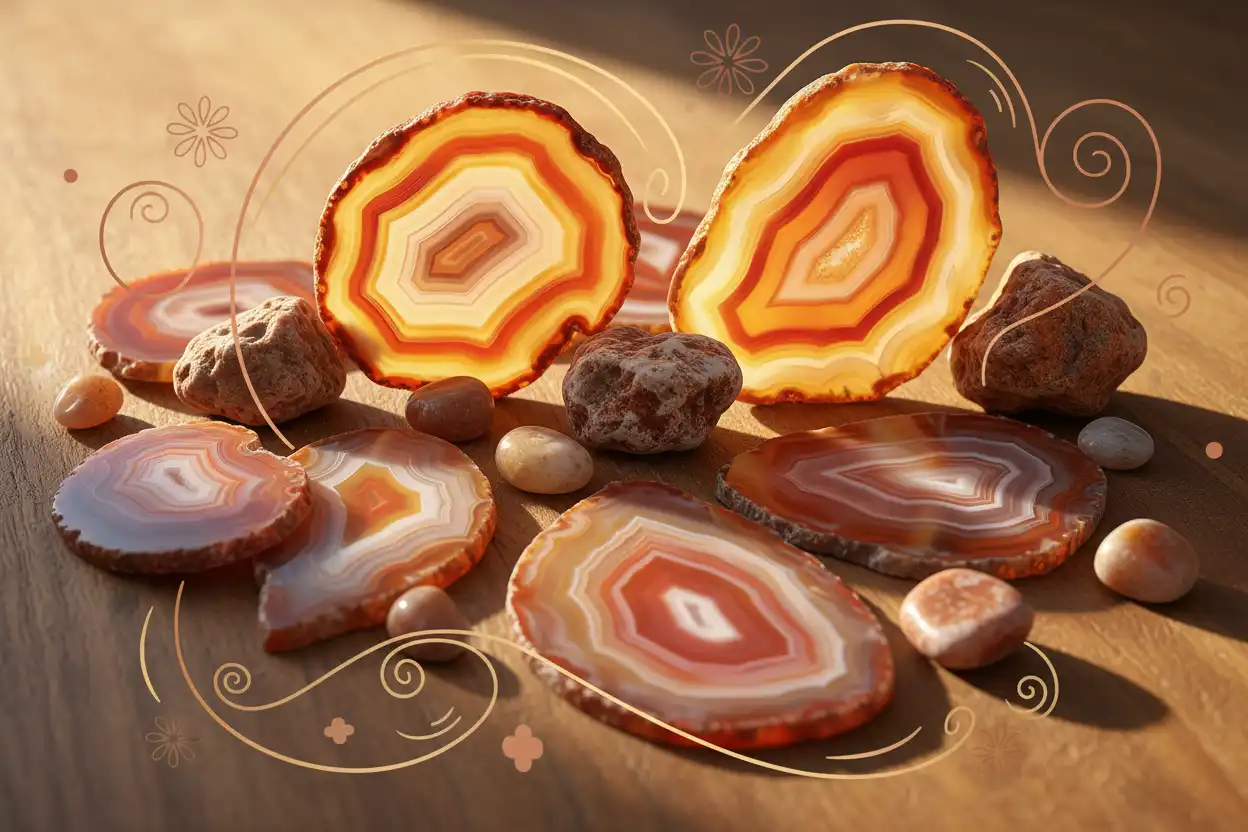
Crazy lace agate meaning is best understood by separating the stone’s distinctive physical pattern from the symbolic interpretations that have grown around it. Crazy Lace Agate is not an independent mineral species but a descriptive lapidary and trade name applied to intricately patterned agate, a form of microcrystalline silica dominated by chalcedony and quartz. Its most recognizable pieces contain dense networks of curved bands, loops, eyes, fortification-like structures, brecciated areas, and irregular layers in cream, white, gray, tan, yellow, orange, brown, and red. Those patterns are geological records created through repeated silica deposition, fracture development, chemical variation, and mineral staining rather than evidence of an energetic process. Within Gems Lore’s Gemstone Guides, the physical material comes first, while descriptions of joy, optimism, flexibility, grounding, or emotional resilience remain clearly identified as modern symbolism.
The name can also create unnecessary confusion because “Crazy Lace Agate,” “Mexican Crazy Lace Agate,” “Mexican agate,” and loosely related commercial labels are not equivalent mineralogical classifications. Much of the material strongly associated with the trade name comes from Mexico, particularly northern Mexico, but appearance alone cannot prove a precise mine or regional source. Similar complex banding can develop in agates from other locations, and a seller’s geographic label should therefore be treated as provenance information that requires documentation rather than as something visible directly in the pattern.
Crazy Lace Agate at a Glance
| Property | Practical reference |
|---|---|
| Material identity | Patterned agate composed predominantly of microcrystalline silica |
| Mineral family | Chalcedony/quartz |
| Simplified composition | Predominantly SiO₂, with minor impurities and associated mineral phases |
| Typical colors | White, cream, gray, tan, yellow, orange, red and brown |
| Characteristic pattern | Curved bands, loops, eyes, fortifications, brecciation and irregular lace-like structures |
| Mohs hardness | Commonly about 6.5–7 |
| Typical luster | Waxy on rough surfaces to vitreous when finely polished |
| Transparency | Usually opaque to translucent, especially around thinner bands and edges |
| Cleavage | No true cleavage |
| Typical fracture | Conchoidal to uneven |
| Color influences | Iron-bearing minerals and other impurities commonly contribute reds, yellows and browns |
| Main market issue | Trade naming and locality claims can be broader or less precise than mineralogical terminology |
| Jewelry suitability | Generally good because chalcedony is comparatively tough and abrasion resistant |
| Symbolic status | Modern meanings are interpretations rather than scientifically demonstrated effects |
This profile explains why Crazy Lace Agate works so well as a lapidary material. Its patterns remain visible after cutting, while microcrystalline silica usually provides enough toughness to produce cabochons, beads, carvings and polished display pieces. The same durability that makes the stone practical for jewelry should not be confused with absolute resistance to damage; hard impacts, abrasive contact, existing fractures and poor cutting orientation can still chip or break a piece.
What Crazy Lace Agate Actually Is
Agate is a patterned form of chalcedony in which microscopic silica growth produces recognizable banding or other organized structures. Chalcedony itself consists of extremely fine intergrowths of silica phases, principally quartz with variable structural contribution from moganite. Because the constituent crystals are microscopic, the stone usually appears compact rather than displaying the obvious crystal faces seen in rock crystal or amethyst.
Crazy Lace Agate is distinguished commercially by the complexity of its pattern rather than by a separate chemical formula. The term “crazy lace” describes the visual effect created when bands bend, intersect, fold around earlier structures, border cavities, surround fragments, or occur beside brecciated and re-cemented areas. Some specimens have relatively orderly fortification bands, while others appear chaotic enough to justify the “crazy” part of the trade name.
That diversity means no single pattern proves identity. Ordinary banded agate, jasper-rich material, brecciated chalcedony, and other patterned siliceous rocks can sometimes be marketed under overlapping names. A useful identification begins by establishing the chalcedony-agate character of the material and then deciding whether “Crazy Lace Agate” is a reasonable descriptive trade term for its pattern.
How Crazy Lace Agate Forms
The patterns in Crazy Lace Agate reflect repeated episodes of silica deposition rather than one uninterrupted growth event. Silica-bearing fluids can enter fractures, cavities, and porous zones in volcanic or related host rocks, where changing chemical conditions allow microcrystalline silica to precipitate along walls and earlier growth surfaces. As deposition continues, successive bands preserve variations in fluid chemistry, impurity content, growth conditions, available space, and structural disruption.
Fracturing can complicate the sequence. Earlier chalcedony may crack or break, after which later silica-rich fluids fill the new spaces and cement fragments together. This produces brecciated or disrupted structures that can coexist with curved bands, eyes, pockets and fortification patterns in a single slab. The result is not random decoration added after formation but a mineral record of repeated deposition and disturbance.
The detailed geological mechanisms belong in Crazy Lace Agate formation and deposit geology, where cavity development, host-rock context and silica movement can be examined more fully. For the meaning page, the essential point is that visual complexity may represent several geological stages, and a dramatic pattern should not be reduced to a simple claim that the stone “grew chaotically.”
Why Crazy Lace Agate Has So Many Colors
Pure silica is colorless, so the warm colors associated with Crazy Lace Agate arise from impurities, microscopic mineral phases and structural differences within the agate. Iron-bearing compounds commonly contribute red, orange, yellow and brown tones, while pale silica-rich zones create white, cream and gray bands. The precise mineral responsible for a particular color cannot always be identified from a photograph, because several iron oxides, hydroxides and finely dispersed inclusions can produce overlapping appearances.
Color can also vary across extremely small distances. A thin red band may border cream chalcedony, which then changes into yellow or brown material only millimeters away. These transitions can correspond to changes in fluid composition or oxidation conditions during successive growth episodes. Polishing intensifies the visual contrast because a smooth surface reduces scattering and reveals more of the internal pattern.
The specialist guide to Crazy Lace Agate optical properties and color behavior covers translucency, light scattering, polish and photographic color in more detail. The practical boundary is that attractive coloration can support a descriptive assessment but cannot by itself establish natural color, exact impurity chemistry or geographic provenance.
Diagnostic Traits That Matter
Crazy Lace Agate should first demonstrate the properties expected of chalcedony. It is relatively hard, compact, usually capable of taking a high polish, lacks true cleavage and commonly breaks with conchoidal to uneven fracture. Thin edges or pale bands may be translucent even when the overall piece looks opaque, while polished surfaces typically show a smooth waxy-to-vitreous appearance.
Pattern comes next. Authentic material commonly shows bands and structures that interact naturally with one another rather than appearing printed or painted onto the surface. Curved layers may follow cavity walls, bend around earlier fragments, create eye-like forms or become disrupted by later brecciation. However, an intricate pattern is not automatically proof of Crazy Lace Agate because other agates can also display complex banding.
Magnification can help reveal the relationship between bands, fractures, inclusions and polish. The Crazy Lace Agate microscope and inclusion notebook examines these small-scale structures more deeply. Microscopy may support the interpretation that a pattern exists throughout the material rather than only on its surface, but it cannot establish an undocumented Mexican locality simply by revealing natural-looking chalcedony.
An Original Specimen and Photo Evaluation Framework
Begin by examining the entire specimen rather than choosing the most dramatic patterned area. Note whether the object is rough material, a sliced slab, a cabochon, a bead, a carving or a fully polished freeform, because each format preserves different evidence. Rough material may show host rock, natural fracture surfaces and outer rind, while a cabochon sacrifices most geological context in exchange for a clearer view of internal banding.
Next, trace individual bands visually. Natural agate bands commonly curve around earlier growth structures, disappear beneath neighboring zones, vary gradually in width or color, and reconnect with broader geological features. A pattern that remains completely independent of internal structure or appears confined to an artificial surface coating deserves closer investigation. This is not a universal authenticity test, but following the bands across cut edges can reveal whether the pattern belongs to the stone itself.
Then examine brecciated areas. In genuine geological brecciation, fragments should sit within later material in ways that make structural sense, with fractures continuing between neighboring zones and later silica filling spaces between earlier pieces. Artificial composites can also contain fragments, so brecciation alone does not prove natural formation. The goal is to determine whether several observations tell the same geological story.
Color should be assessed under neutral illumination. Strong red, yellow and orange tones are possible naturally, but commercial images can intensify them through saturation, contrast and white-balance changes. Compare polished and rough areas where available, and look at the same section from multiple angles. Natural color variation should remain embedded in the material rather than disappearing when the viewing angle changes.
Finally, separate the claims a photograph can support from those it cannot. Images can show pattern, visible color, cutting style, surface condition, relative translucency and some geological relationships. They cannot conclusively establish exact iron-mineral chemistry, treatment status, mine locality, collection history or whether every color is natural. Where these stronger claims affect value, documentation or laboratory analysis is more persuasive than pattern recognition.
“Mexican Crazy Lace Agate” and Other Naming Problems
Crazy Lace Agate is strongly associated commercially with Mexico, and “Mexican Crazy Lace Agate” is a familiar market term. The association is meaningful, but it should not be interpreted as though the visual pattern itself is a geographic fingerprint. Patterned agates from separate deposits can converge visually because similar silica-deposition processes can create similar bands, eyes and brecciated structures.
“Mexican agate” is broader still. Mexico produces multiple kinds of agate, and not every Mexican agate should be called Crazy Lace Agate. Conversely, a seller may use “crazy lace” primarily as a pattern description rather than as a strict locality-controlled name. The safest language identifies the material first and treats locality as a separate provenance claim.
Color-based names create another problem. Terms such as “red crazy lace,” “yellow crazy lace,” “lace agate,” or “Mexican lace agate” may describe real visual differences but are not separate mineral species. They should not be used to imply unique chemistry or healing properties without evidence.
Crazy Lace Agate Is Not Jasper Simply Because It Is Opaque
Agate and jasper occupy related parts of the microcrystalline silica family, and natural materials can contain transitions or mixtures that make overly rigid visual classification difficult. Agate is classically associated with chalcedony banding and some degree of translucency, while jasper is more opaque because of abundant inclusions and fine-grained material dispersed through the silica.
Some Crazy Lace Agate pieces are strongly opaque and contain jasper-like regions, which can encourage sellers to use terms such as “agate jasper.” That wording may describe a mixed visual material reasonably, but it does not mean that every opaque band becomes an entirely separate rock. Precise classification is strongest when texture, translucency, microscopic structure and composition are considered together.
The key point is that the trade name Crazy Lace Agate refers primarily to patterned siliceous material. It does not guarantee that every square millimeter has identical microscopic composition.
Crazy Lace Agate Compared With Other Collector Minerals
The material becomes easier to understand when contrasted with minerals whose visual appeal comes from entirely different structures. Creedite forms discrete crystals in a hydrous calcium-aluminum sulfate-fluoride system, whereas Crazy Lace Agate is compact microcrystalline silica whose beauty comes predominantly from internal banding.
Covellite is an opaque metallic copper sulfide with a dark indigo appearance, very low hardness and perfect cleavage. Crazy Lace Agate is vastly harder, nonmetallic and mechanically more suitable for everyday lapidary objects. The comparison is useful because both can look visually dramatic while arriving at that appearance through completely different chemistry and structure.
These contrasts illustrate why pattern, color or perceived “energy” should never become substitutes for mineral identity. Material properties remain the foundation on which care, cutting, value and safe ownership depend.
Documented History and the Limits of “Ancient” Claims
Agate has a long documented history as an ornamental material, with banded chalcedony appearing in beads, seals, carvings, vessels and jewelry across numerous historical cultures. That broader agate history is legitimate, but it should not automatically be transferred intact to Crazy Lace Agate as a specific modern trade category.
A historical text that mentions agate does not prove that the author was describing the Mexican patterned material now marketed as Crazy Lace Agate. The distinctive commercial label is much more recent than humanity’s broader use of agate, and claims about ancient civilizations specifically using “Crazy Lace Agate” require material evidence rather than retrospective naming.
This distinction allows a more accurate historical story. Crazy Lace Agate belongs to the long human appreciation of patterned chalcedony, while its specific trade identity, modern collecting culture and locality associations should be described within the evidence actually available.
Crazy Lace Agate Meaning in Modern Symbolism
Modern Crazy Lace Agate meaning commonly emphasizes joy, optimism, flexibility, laughter, confidence, balance and the ability to remain grounded during complicated circumstances. The visual pattern encourages these interpretations naturally: dozens of twisting bands can be read metaphorically as complexity, movement or unexpected turns, while warm colors may evoke vitality and sociability.
These themes belong to personal and cultural symbolism rather than measurable physical effects. Crazy Lace Agate does not scientifically treat depression, eliminate anxiety, regulate hormones, improve circulation, strengthen immunity, cure disease or guarantee a happier emotional state. Its iron-bearing colors do not deliver useful iron to the body through skin contact, and its silica content does not create a therapeutic mineral transfer.
A grounded symbolic practice can use the visual pattern as a reminder rather than a causal agent. Someone might choose the stone while reflecting on how several competing priorities can coexist, how a complicated project can be broken into smaller decisions, or how humor helps maintain perspective during stressful situations. The value lies in the reflection and behavior prompted by the object.
The “Laughter Stone” Claim
Crazy Lace Agate is sometimes called a “laughter stone” or “happy lace,” phrases that have become common in modern crystal commerce. These names describe symbolic associations rather than mineralogical varieties or scientifically measured emotional effects.
The labels make intuitive sense because the swirling patterns and warm colors can appear lively or playful, but appearance cannot demonstrate that the material changes neurotransmitters, treats mood disorders or forces positive emotion. Someone may personally associate the stone with a cheerful memory or use it as a cue to interrupt an overly serious train of thought, but that subjective experience should remain separate from a therapeutic claim.
A stone can represent joy without medically producing it.
Chemistry Is Not Medicine
Crazy Lace Agate is dominated by silica and may contain iron-bearing phases and other minor mineral components that influence its colors. None of those ingredients means that the stone functions as a supplement. Biological effects depend on chemical form, concentration, dose, solubility, exposure route and metabolism.
The red and brown bands should therefore not be promoted as a source of iron, and silica in quartz or chalcedony does not provide a demonstrated wellness effect simply because silicon occurs in biological systems. The chemical composition explains geological properties, not a direct therapeutic mechanism.
This distinction is particularly important when commercial descriptions convert color-causing elements into statements about blood, vitality, detoxification or nutritional support. Those claims do not follow from mineral chemistry.
Safe Ownership
An intact Crazy Lace Agate cabochon, slab, bead or specimen is generally suitable for ordinary handling. Chalcedony is hard enough for routine jewelry and display use, while the absence of true cleavage gives it relatively good toughness compared with many softer or strongly cleavage-prone minerals.
The main safety distinction appears during lapidary work. Cutting, grinding, drilling or sanding agate can generate fine respirable crystalline silica dust. Dry grinding silica-rich material without appropriate controls is a substantially different exposure scenario from wearing or holding an intact polished stone. Lapidary work should use established wet methods, local extraction, ventilation and suitable respiratory controls.
Direct-water crystal elixirs are unnecessary. Even when the silica body itself is comparatively resistant, a specimen can contain unknown matrix material, surface residues, polishing compounds, dyes or other treatments. Symbolic practice does not require drinking water that has contacted an unidentified mineral object.
Cutting and Pattern Orientation
Crazy Lace Agate is especially dependent on cutting orientation because a slab taken through one direction can reveal completely different patterns from a cut only a few millimeters away. A lapidary may orient rough to emphasize fortification bands, eyes, brecciated zones, balanced color distribution or a dramatic transition across the face of a cabochon.
The full technical process belongs in Crazy Lace Agate cutting, orientation, and polish, but one principle matters here: the pattern seen in a finished gem is partly geological and partly a consequence of the cutter’s decisions. Good workmanship can reveal relationships already present in the rough without manufacturing the underlying bands.
This also explains why two cabochons cut from the same piece can look unrelated. Pattern distribution is three-dimensional, and a new slice intersects that structure along a different plane.
Jewelry and Wear
Crazy Lace Agate’s hardness and toughness make it practical for pendants, earrings, beads, bracelets and many rings. It is substantially more forgiving than calcite, gypsum or soft metallic sulfide specimens, although exposed edges can still chip and polished surfaces can eventually scratch under abrasive use.
Detailed protection strategies belong in Crazy Lace Agate setting and wear engineering, where bezel design, edge exposure, drill holes and impact patterns can be addressed properly. The important boundary here is that symbolic claims do not affect physical durability. A stone associated with “protection” still needs a mechanically appropriate setting.
Existing fractures deserve particular attention because some of the most attractive brecciated material naturally contains boundaries between fragments and later silica. A competent cutter and setter should distinguish stable healed structure from cracks likely to propagate during wear.
Buying Crazy Lace Agate
A purchase should begin with material identity, pattern quality and disclosure rather than metaphysical promises. Look for coherent internal banding, credible photographs, useful dimensions, a clear description of whether the stone is rough or polished, and disclosure of any dye, impregnation, filling or other treatment known to the seller.
The more detailed seller-evaluation process belongs in where to buy Crazy Lace Agate. For this page, the important principle is that a visually dramatic cabochon does not become more authentic because it is advertised as “high vibration,” and a famous Mexican origin should not be assumed from pattern alone.
Natural variation is expected. One piece may contain bright red fortifications while another is dominated by cream and gray loops, and neither appearance by itself establishes superior authenticity.
Provenance and Locality
Locality can influence collector interest, particularly because Crazy Lace Agate has a strong commercial association with Mexican deposits. Yet provenance is an evidence trail rather than a visual feature. A specimen’s color and banding may be consistent with material commonly sold from Mexico while remaining insufficient to establish a particular district or mine.
Original labels, invoices, collection records, dealer documentation and credible acquisition histories therefore matter more than pattern-based confidence. The Crazy Lace Agate provenance disclosure checklist provides a structured way to separate verified origin, inherited labels, seller statements and unsupported geographic claims.
This distinction becomes even more important after rough has been sliced into cabochons or beads. Cutting removes host-rock context that might otherwise provide geological clues, leaving documentation to carry more of the provenance claim.
Conservation and Long-Term Condition
Crazy Lace Agate is relatively durable, but a collector specimen can still lose value through unnecessary polishing, aggressive chemical cleaning, impact, poorly repaired fractures or removal of historically informative matrix. A rough specimen and a finished cabochon therefore require different conservation priorities.
The Crazy Lace Agate specimen conservation record provides a framework for recording fractures, repairs, old labels, surface treatments, cleaning history and condition changes. Such documentation is particularly useful when a specimen has unusual provenance or when treatment status may matter to future owners.
Routine polished jewelry is usually easier to maintain, but the complete object still determines care. Adhesives, metal finishes, neighboring gems and old repairs can impose limits that the agate itself would not.
Frequently Asked Questions About Crazy Lace Agate Meaning
What is Crazy Lace Agate?
Crazy Lace Agate is a trade and lapidary name for intricately patterned agate, a microcrystalline silica material dominated by chalcedony and quartz. It is recognized by complex looping, fortification-like, brecciated and lace-patterned bands rather than by a separate mineral species.
What does Crazy Lace Agate mean spiritually?
Modern crystal traditions commonly associate crazy lace agate meaning with joy, optimism, flexibility, confidence, emotional balance and staying grounded through complicated circumstances. These are symbolic interpretations rather than scientifically established effects.
Is Crazy Lace Agate a real agate?
Yes, material properly described as Crazy Lace Agate belongs to the agate/chalcedony family. “Crazy lace” is a descriptive trade name for its complex pattern rather than an independent mineral species.
Is Crazy Lace Agate always from Mexico?
The trade name is strongly associated with Mexican material, but pattern alone cannot prove geographic origin. A specific Mexican locality should be supported by provenance documentation rather than inferred solely from appearance.
Why is Crazy Lace Agate so colorful?
Its colors arise from variations within the silica and from minor mineral impurities or inclusions, particularly iron-bearing phases that can contribute red, orange, yellow and brown tones. Precise color-causing minerals may require analysis rather than visual guessing.
Is Crazy Lace Agate the same as jasper?
Not exactly. Agate and jasper are both silica-rich materials, but agate is classically associated with chalcedony banding and some translucency, while jasper is generally more opaque because of abundant inclusions. Some natural material can show transitional or mixed characteristics.
Is Crazy Lace Agate naturally patterned?
Yes. Its complex bands and brecciated structures can form naturally through repeated silica deposition, changes in fluid chemistry and episodes of fracturing and re-cementation. Cutting determines which part of that three-dimensional pattern becomes visible.
Does Crazy Lace Agate have healing properties?
There is no established scientific evidence that Crazy Lace Agate prevents, diagnoses, treats or cures medical or psychological conditions. Healing descriptions belong to modern metaphysical traditions.
Is Crazy Lace Agate good for jewelry?
Generally, yes. Chalcedony’s hardness of roughly 6.5–7 and lack of true cleavage make it practical for many jewelry types, although impact, abrasion and pre-existing fractures can still cause damage.
Can Crazy Lace Agate go in water?
Brief ordinary contact with clean water is usually less problematic for intact untreated agate than for many soft minerals, but prolonged soaking is unnecessary. Treatments, adhesives, jewelry components, matrix and surface contamination can impose additional limits.
How can I tell if Crazy Lace Agate is real?
Look for a coherent combination of chalcedony-like hardness, compact silica texture, natural internal banding, conchoidal fracture where already exposed and patterns that continue through the material. Photographs can support an assessment but cannot prove treatment or provenance in every case.
Is Crazy Lace Agate rare?
Agate itself is widespread, while visually exceptional Crazy Lace Agate can be more desirable because of pattern quality, color balance, usable rough, condition and provenance. “Rare” should therefore be applied to a specific specimen or documented material source rather than automatically to every item carrying the trade name.
What Crazy Lace Agate Meaning Can Responsibly Mean
Crazy lace agate meaning becomes more useful when geology, history, symbolism and personal practice remain separate. Materially, Crazy Lace Agate is patterned microcrystalline silica whose bands, brecciation, impurities and color record repeated geological processes. Historically, it belongs within the much broader human use of agate and chalcedony, while claims about a specific ancient tradition for the modern Crazy Lace Agate trade category require stronger evidence than general agate history.
Modern symbolism can add another layer without changing those facts. The stone’s intricate patterns may represent adaptability, complexity, humor, persistence or the ability to find coherence within disorder. Someone can use those ideas during journaling, meditation or personal reflection without claiming that silica chemically creates happiness, removes anxiety or controls external events.
Crazy Lace Agate remains distinctive without unsupported promises. Its complex natural patterns, lapidary potential, silica geology, warm color range and specimen-to-specimen variation offer substantial reasons to collect and study it. Gems Lore explains its broader authorship and editorial context on the About page, while the Disclaimer clarifies the limits of mineral, symbolic, health, safety and identification information. Questions or supporting documentation can be submitted through Contact, and information about site data practices is available in the Privacy Policy.