Eclogite Meaning: Rock Facts, Formation & Symbolism
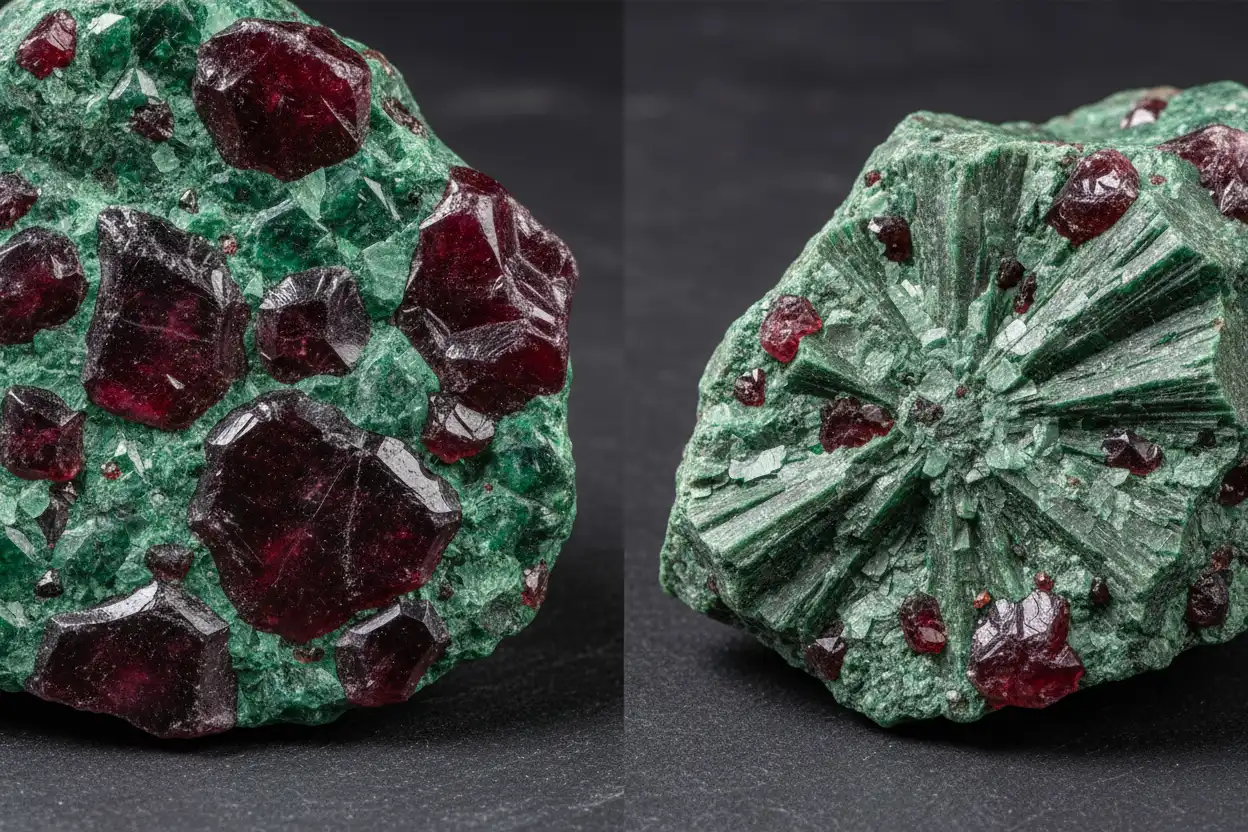
Eclogite meaning starts with a classification that is easy to miss in gemstone-oriented descriptions: eclogite is a metamorphic rock, not a single mineral species. A characteristic eclogite contains red, pink, orange, or burgundy garnet embedded in a green clinopyroxene called omphacite, often with smaller amounts of quartz, rutile, kyanite, phengite, amphibole, or other minerals depending on the rock’s composition and later history. The red-and-green contrast can make polished eclogite look like an intentionally designed ornamental stone, but those colors record a high-pressure mineral assemblage produced when suitable precursor rocks are transformed deep within Earth.
That high-pressure origin is the most important scientific foundation for eclogite meaning. Many eclogites begin as basaltic or gabbroic crustal material that is carried downward during tectonic processes, particularly subduction. As pressure rises, the mineral assemblage stable near Earth’s surface becomes unfavorable. Plagioclase-rich basaltic mineralogy can be replaced by denser high-pressure minerals, with garnet and omphacitic clinopyroxene becoming especially important. The resulting rock can later return toward the surface through uplift and exhumation, sometimes preserving minerals and textures formed at depths far greater than those at which the specimen is eventually collected.
Those geological changes have inspired modern themes of transformation, resilience, pressure, endurance, integration, and emerging from difficult conditions with a different internal structure. Such symbolism can be useful, but it should remain separate from physical claims. Eclogite does not transfer tectonic strength to the body, increase endurance because it formed under pressure, regulate stress hormones, or make a person more resilient through mineral contact. Within Gems Lore’s Gemstone Guides collection, eclogite meaning is therefore built from rock identity first, geological history second, and symbolism last.
Eclogite at a Glance
| Feature | Practical reference |
|---|---|
| Material identity | High-pressure metamorphic rock |
| Is eclogite one mineral? | No; it is a rock composed of multiple minerals |
| Defining visual assemblage | Garnet + green omphacitic clinopyroxene |
| Typical garnet colors | Red, burgundy, pinkish red, orange-red |
| Typical matrix colors | Green to dark green from omphacite-rich material |
| Common accessory minerals | Quartz, rutile, kyanite, phengite, amphibole and others depending on the rock |
| Common protolith | Basaltic or gabbroic material, though other precursors occur |
| Metamorphic setting | High-pressure conditions, frequently associated with subduction or deep crustal processes |
| Texture | Granular to porphyroblastic, commonly with conspicuous garnet crystals |
| Hardness | No single value applies to the entire rock; constituent minerals differ |
| Density | Commonly relatively high compared with many ordinary crustal rocks |
| Key identification issue | Red garnet in green rock does not automatically prove eclogite |
| Main geological clue | High-pressure assemblage with compatible clinopyroxene and absence or instability of ordinary plagioclase in the equilibrated assemblage |
| Common ornamental use | Slabs, cabochons, spheres, carvings, display specimens |
| Symbolic associations | Transformation, resilience, pressure, integration, endurance |
| Evidence boundary | Symbolism is interpretive rather than a scientifically demonstrated therapeutic property |
The most important practical implication is that no universal formula, hardness, refractive index, or chemical composition can describe an entire eclogite specimen. Garnet has one chemistry, omphacite another, quartz another, and accessory minerals may add still more variation. A rock must be interpreted through its mineral assemblage and texture rather than forced into the data sheet of a single crystal species.
Eclogite Is a Rock, Not a Crystal Species
Commercial mineral language often blurs the difference between rocks and minerals because both can be cut, polished, carried, collected, or sold as “crystals.” Eclogite makes that distinction particularly important.
A mineral is defined by characteristic composition and crystal structure.
A rock is an aggregate of one or more minerals with a geological history that explains why those minerals occur together.
Eclogite belongs to the second category.
Its identity depends largely on the assemblage created during high-pressure metamorphism. Garnet alone does not make eclogite. Green clinopyroxene alone does not make eclogite. The characteristic combination, whole-rock chemistry, metamorphic texture, and geological context matter together.
This is why eclogite meaning should never be represented by one chemical formula.
The Two Minerals That Define the Classic Look
Most visually recognizable eclogite has two dominant components: garnet and omphacite.
The garnet commonly forms red to burgundy porphyroblasts—crystals that grew comparatively large during metamorphism. Garnet composition can vary, and the crystals may contain proportions of pyrope, almandine, grossular, or other garnet components depending on the rock.
Omphacite is a sodium- and calcium-bearing clinopyroxene. It commonly forms the green matrix around the garnets and is itself compositionally complex.
Those two minerals give many eclogites their striking red-and-green appearance.
Yet visual color is only the beginning. A different metamorphic rock can contain red garnet and green minerals without satisfying the geological criteria for eclogite.
The assemblage must be evaluated, not merely the palette.
How Eclogite Forms
A common eclogite story begins with basalt or gabbro in oceanic crust. At relatively shallow conditions, those rocks contain mineral assemblages stable at lower pressure. If tectonic convergence carries the material into a subduction zone, pressure increases dramatically as the slab descends.
The original minerals progressively react.
Plagioclase, pyroxenes, amphiboles, and other phases may break down or be replaced as a denser high-pressure assemblage becomes stable. Garnet grows, and sodium-bearing clinopyroxene develops toward omphacitic compositions. Water-bearing minerals can release fluid during some reactions, affecting both the rock itself and the surrounding mantle or crust.
The result is not simply “basalt squeezed harder.”
It is a mineralogical reconstruction.
Atoms are redistributed into phases that are stable under the new pressure-temperature conditions. The detailed reactions, tectonic settings, facies boundaries, and exhumation histories belong in eclogite formation and deposit geology. For eclogite meaning, the essential idea is that pressure changes which mineral structures can exist together.
What “Eclogite Facies” Means
Geologists use metamorphic facies to describe characteristic mineral assemblages produced under particular ranges of pressure and temperature.
Eclogite facies represents relatively high-pressure metamorphism.
It is not defined simply by a certain depth printed on a chart, because actual mineral stability depends on rock composition, temperature, fluid availability, pressure, and reaction history. Different rocks entering comparable conditions may produce somewhat different mineral assemblages.
For basaltic compositions, the development of garnet plus sodium-bearing clinopyroxene is especially important.
This scientific usage is more precise than the popular statement that eclogite is “the stone of extreme pressure.”
Pressure is central, but pressure alone does not identify the rock.
Why Plagioclase Matters
One of the key transformations during the development of classic eclogite from basaltic material is the loss of plagioclase as an equilibrium major phase under sufficiently high pressure.
At lower pressure, plagioclase is common in basalt and gabbro.
At higher pressure, its components are accommodated in denser mineral structures, including garnet and clinopyroxene.
This change contributes to the higher density of eclogitized crust.
That density has major tectonic implications because oceanic crust transformed to eclogite can become substantially denser than its original basaltic form.
The significance extends far beyond ornamental stone collecting. Eclogite helps geologists understand subduction, crustal recycling, mountain belts, mantle processes, and how deep rocks return toward the surface.
How Deep Does Eclogite Form?
Many eclogites form at depths of tens of kilometers, and some record substantially deeper high-pressure or ultrahigh-pressure histories.
Exact depth should not be inferred from appearance alone.
Pressure estimates come from mineral compositions, reaction equilibria, inclusions, structural context, and thermodynamic calculations. Some exceptional rocks contain evidence that their geological journey reached conditions where minerals stable only at very high pressure could form.
This makes eclogite an unusually informative rock.
A hand specimen can eventually sit on a desk while preserving mineral evidence created far below the environment in which humans ordinarily live.
That contrast is one reason transformation and return are compelling symbolic themes within eclogite meaning.
How Eclogite Returns to the Surface
Formation at depth creates a second geological question: if eclogite forms deep underground, how does anyone collect it?
The rock must be exhumed.
Tectonic processes can return high-pressure rocks toward the surface during collision, faulting, crustal stacking, channelized flow, erosion, or other complex mechanisms. The precise path differs among metamorphic terranes.
Exhumation is not always chemically gentle.
As pressure falls and temperature changes, high-pressure minerals may begin reacting toward lower-pressure assemblages. Omphacite can partly break down, amphibole may develop, plagioclase can reappear, and original textures may become overprinted.
A specimen can therefore contain both evidence of peak eclogite conditions and later evidence of its return journey.
That makes alteration part of the geological record rather than automatically a defect.
Why Eclogite Is Red and Green
The classic red-and-green appearance is created by mineral contrast.
Garnet provides the red, burgundy, orange-red, or pinkish crystals.
Omphacitic clinopyroxene provides much of the green matrix.
The exact shades depend on mineral composition, grain size, inclusions, alteration, surface polish, and illumination.
A fresh sawn surface can look dramatically more saturated than a weathered exterior because surface alteration masks the underlying minerals.
Likewise, wet or polished material often appears darker and richer because surface scattering is reduced.
The deeper relationships among mineral color, grain size, polish, transparency, and reflected light belong in eclogite optical properties and color behavior.
Garnet Color Does Not Identify the Whole Rock
A large red garnet can dominate a polished eclogite piece visually, tempting sellers to describe the entire object primarily as garnet.
That loses the geological meaning of the assemblage.
The garnet is one constituent.
Its composition can itself vary considerably, and visual red color cannot determine an exact garnet end-member.
The surrounding clinopyroxene is equally important to establishing eclogitic identity.
This is a broader lesson in eclogite meaning: the most visually dramatic component is not always the most diagnostically important one.
A rock is defined by relationships.
Green Matrix Does Not Automatically Mean Omphacite
The reverse shortcut is equally risky.
Not every green mineral surrounding red garnet is omphacite.
Amphiboles, epidote-group minerals, chlorite, jadeite-bearing pyroxene, altered clinopyroxene, and other green phases can occur in metamorphic rocks. Retrograde alteration can also change original omphacite while leaving the overall red-and-green appearance partly intact.
A polished ornamental specimen may therefore look convincingly “eclogitic” while requiring mineralogical testing to establish what the green matrix actually contains.
The exact mineral is particularly important when a seller claims a high-pressure metamorphic classification rather than merely using eclogite as a decorative trade name.
An Original Assemblage-First Identification Matrix
A stronger eclogite assessment begins with the relationship among minerals, not with the question “Does it look red and green?”
| Observation | Supports eclogite interpretation? | What it does not prove |
|---|---|---|
| Red garnet crystals in green matrix | Yes, visually compatible | Green phase is not automatically omphacite |
| Green clinopyroxene confirmed as omphacitic | Strongly supportive | Does not alone establish peak pressure or full rock history |
| Garnet + omphacite dominate basaltic-composition rock | Strong support | Exact formation depth still requires further analysis |
| Abundant ordinary plagioclase as primary equilibrium phase | Can argue against classic peak eclogite assemblage | Later retrograde plagioclase may still occur |
| Rutile present as accessory mineral | Compatible | Rutile alone does not identify eclogite |
| Quartz present | Compatible in many eclogites | Quartz alone says little about pressure |
| Strong amphibole replacement around pyroxene | May record retrogression | Does not mean the rock was never eclogite |
| Red garnet + green amphibole only | May resemble eclogite visually | Could represent garnet amphibolite or another metamorphic rock |
| Decorative red-and-green polished stone | Commercially suggestive | Mineral assemblage remains unconfirmed |
| Seller states “deep mantle stone” | Not diagnostic | Provenance and pressure history require evidence |
This matrix is more useful than a photograph-matching approach because eclogite is fundamentally an assemblage-defined metamorphic rock. Two specimens can look almost identical at hand-sample scale while preserving different minerals and metamorphic histories.
A Practical Eclogite Specimen Checklist
Begin with an unpolished surface if one is available. Record the proportion, size, and distribution of red garnet relative to the green matrix. Note whether garnets are isolated, clustered, stretched, fractured, rimmed, or partially replaced.
Examine the green material closely. Is it granular, bladed, fibrous, or massive? Fresh clinopyroxene can look different from amphibole-rich retrograde zones.
Inspect pale grains. White or gray material can represent quartz, plagioclase formed during retrogression, kyanite, or another phase. Do not identify pale grains solely from color.
Look for accessory dark or metallic grains. Rutile can occur in eclogite, but a dark inclusion should remain an observed grain until its identity is supported.
Compare fresh and weathered surfaces. Weathering can preferentially alter some components, creating color contrast that does not match the fresh interior.
Use magnification to document mineral boundaries. Reaction rims, symplectites, fractures, exsolution textures, and fine replacement products can preserve part of the rock’s pressure-temperature history. Detailed grain-scale interpretation belongs in the eclogite microscope and inclusion notebook.
Finally, separate four conclusions: visual compatibility, mineral assemblage, metamorphic interpretation, and geographic provenance. A red-and-green rock can satisfy the first without proving the other three.
Eclogite Can Record More Than One Metamorphic Event
A hand specimen may preserve garnet formed during increasing pressure, omphacite representing peak high-pressure conditions, reaction textures created during exhumation, and later fractures or alteration caused near the surface.
Treating the specimen as though every visible mineral formed simultaneously erases that history.
Metamorphic rocks are often time-layered objects.
A dark rim around garnet may record a later reaction.
Fine intergrowths replacing clinopyroxene can record decompression.
A vein cutting the entire assemblage formed after the minerals it crosses.
This makes eclogite particularly useful for teaching relative geological sequence. The rock is not merely a fixed red-and-green composition; it can preserve a progression of events.
Eclogite Versus Garnet Amphibolite
Garnet amphibolite is one of the most important look-alikes because it can contain conspicuous red garnet within a dark green amphibole-rich matrix.
From a distance, that combination may resemble eclogite closely.
The mineral assemblage separates them.
Classic eclogite contains garnet plus omphacitic clinopyroxene as defining high-pressure components. Garnet amphibolite contains abundant amphibole and represents a different metamorphic assemblage.
The situation can become more complex during retrogression because an original eclogite may develop amphibole as it returns to lower pressure.
A specimen can therefore preserve evidence of both stages.
This is exactly why one green color or one mineral name is insufficient.
Eclogite Versus Elbaite
Elbaite is a tourmaline-supergroup mineral and can form green, pink, red, blue, colorless, or multicolored crystals.
It represents a completely different level of geological classification from eclogite.
Elbaite is one mineral species.
Eclogite is a rock defined by a high-pressure mineral assemblage.
A polished green elbaite crystal can have relatively uniform mineral composition, whereas a polished eclogite surface should reveal multiple distinct mineral grains.
The comparison helps prevent the common commercial habit of calling every attractive geological object a “crystal.”
Eclogite Versus Dumortierite
Dumortierite is an aluminum borosilicate mineral commonly found as blue or violet-blue fibrous material and often occurs as inclusions in quartz.
Dumortierite can therefore appear within an aggregate, but the mineral itself retains a defined species identity.
Eclogite, by contrast, requires multiple minerals.
The two also record different geological conditions. Dumortierite commonly reflects aluminum-rich, boron-bearing metamorphic or related environments, while eclogite is especially significant as a high-pressure assemblage.
Their comparison reinforces the distinction between a mineral that may occur inside a rock and a rock whose identity depends on an assemblage.
Eclogite Versus Enstatite
Enstatite is a magnesium-rich orthopyroxene mineral. It belongs to the pyroxene family but differs from the clinopyroxene that plays such an important role in classic eclogite.
Omphacite is a clinopyroxene.
Enstatite is an orthopyroxene.
Their crystal structures, compositions, optical behavior, and geological stability differ.
This comparison is useful because calling the green phase simply “pyroxene” may be too broad when determining whether a rock is truly eclogitic.
The pyroxene identity matters.
Eclogite Versus Druzy Quartz
Druzy Quartz provides a useful contrast between metamorphic assemblage and crystal-growth texture.
Druzy quartz consists of numerous small quartz crystals coating a cavity or surface. Its defining visual feature is the growth habit of quartz.
Eclogite consists of intergrown metamorphic minerals whose relationships were created by recrystallization under pressure and temperature.
A druzy surface grows into open space.
An eclogite texture develops through solid-state and fluid-assisted metamorphic reactions inside rock.
Both can be visually striking, but their geological stories operate in very different ways.
Why Eclogite Can Feel Heavy
Eclogite commonly feels relatively dense compared with many familiar crustal rocks because garnet and omphacitic clinopyroxene are comparatively dense minerals and because the transformation from lower-pressure basaltic mineralogy produces a denser assemblage.
This density is geologically consequential.
When oceanic crust is transformed during subduction, increasing density can influence how the slab behaves mechanically and gravitationally.
A hand specimen’s heft can therefore be consistent with eclogite, but it is not a sufficient identification test.
Dense garnet-rich rocks and other metamorphic materials can feel similarly heavy.
Weight should support the assemblage interpretation rather than replace it.
Why There Is No Single Mohs Hardness for Eclogite
Commercial stone pages sometimes assign eclogite one hardness value as though it were a homogeneous mineral.
That is misleading.
Garnet commonly has a different hardness from omphacite. Quartz, rutile, amphibole, or other accessory minerals introduce still more variation. Grain boundaries and fractures can be weaker than any of the individual minerals.
A scratch crossing a polished surface may therefore encounter several behaviors within a few millimeters.
For practical ownership, the entire rock must be considered.
A hard garnet grain cannot prevent a neighboring altered zone from scratching, undercutting, or breaking.
Cutting Eclogite Is About Mineral Contrast
Eclogite can produce striking slabs, spheres, cabochons, carvings, and polished display objects because red garnet contrasts strongly with green matrix.
Lapidary work is not always straightforward.
Large garnets may polish differently from the surrounding clinopyroxene-rich material. Fractures can run through or around garnets. Retrograde alteration can create softer zones. Grain boundaries may undercut, and pits can appear where weaker material pulls out.
Orientation also changes the pattern dramatically.
The eclogite cutting, orientation, and polish guide owns those technical decisions. For eclogite meaning, the key point is that polishing reveals the metamorphic assemblage but can also remove geological relationships from the specimen if carried too far.
Jewelry Use Depends on the Weakest Part
A polished eclogite cabochon may contain several minerals strong enough individually for ornamental use while still being vulnerable along fractures, altered zones, or grain contacts.
This is why jewelry durability cannot be predicted from garnet hardness alone.
A pendant usually experiences less impact than an exposed ring. Beads introduce drilling stresses. Large cabochons can contain internal fractures that are invisible until setting pressure is applied.
The specialized eclogite setting and wear engineering reference handles those design questions.
The geological symbolism of surviving pressure does not make every physical specimen impact-resistant.
Conservation Should Preserve Metamorphic Relationships
A scientifically interesting eclogite can contain more information than its polished pattern suggests.
Reaction rims may record decompression.
Mineral inclusions inside garnet may preserve earlier stages of metamorphism.
Fine replacement textures can document exhumation.
Matrix relationships may support the interpretation of the entire rock.
Aggressive grinding or polishing can remove exactly those features.
The eclogite specimen conservation record provides a framework for recording sawn surfaces, polishing, detached fragments, repairs, weathering, labels, and other changes when a specimen has geological or collector significance.
A rough metamorphic contact can be more informative than a flawless glossy finish.
Provenance Matters Because Tectonic Context Matters
Eclogite occurs in high-pressure metamorphic belts around the world, and locality can add substantial scientific context.
A specimen from a documented metamorphic complex can be interpreted within known tectonic relationships, pressure-temperature studies, structural mapping, and regional geological history.
A visually similar unlabeled specimen loses much of that context.
Appearance alone cannot restore it.
The eclogite provenance disclosure checklist provides the stronger evidence hierarchy: original labels, field records, mine or outcrop information, collection history, institutional documentation, and reliable chain of custody should support geographic claims.
A red-and-green pattern may suggest eclogite.
A locality record tells you which tectonic story the rock may belong to.
Documented History of Eclogite as a Geological Term
Eclogite entered geological classification as metamorphic petrology developed and researchers began distinguishing rocks by mineral assemblage rather than color alone.
Its scientific importance increased as pressure-temperature relationships became better understood. Garnet-plus-omphacite assemblages helped demonstrate that rocks exposed at Earth’s surface could preserve evidence of formation at much greater depths.
Later work on subduction zones and high-pressure metamorphism made eclogite central to understanding plate tectonics, deep crustal recycling, and mountain-building processes.
That documented geological history is distinct from modern crystal symbolism.
There is no need to backdate contemporary claims about “pressure energy” or transformation into ancient cultures unless direct evidence identifies eclogite itself.
The rock’s real scientific history is already unusually rich.
Eclogite Meaning and the Symbolism of Pressure
Pressure is the most obvious modern symbolic theme because high pressure is genuinely essential to eclogite formation.
The metaphor can be useful when handled carefully.
Under changing geological conditions, the original mineral assemblage becomes unstable and reorganizes into a different one. The resulting rock is not simply the same basalt compressed into smaller space; it contains new minerals better suited to its environment.
That can symbolize adaptation under constraint.
A person facing a demanding situation may use eclogite meaning as a reminder to ask whether the old way of operating still fits the conditions.
The rock does not create that adaptation.
Its geology provides an unusually concrete metaphor for it.
Transformation Does Not Mean Becoming Unrecognizable
A basaltic precursor can transform profoundly during eclogitization while retaining aspects of its broader chemical heritage.
This makes eclogite a useful symbol for change that preserves continuity.
New minerals appear.
Old minerals disappear.
Density changes.
Texture changes.
Yet the transformation still belongs to the history of the same piece of crustal material.
That idea can support personal reflection around changing roles, habits, or expectations without implying that a rock transmits transformational energy.
Geology supplies the analogy; the person supplies the decision.
Resilience Is Not the Same as Hardness
Eclogite meaning is frequently associated with resilience because the rock records extreme geological conditions and subsequent exhumation.
But resilience should not be confused with mechanical indestructibility.
An eclogite specimen can fracture.
Garnet can break.
Altered clinopyroxene can weaken.
Weathered surfaces can crumble.
A polished piece can chip along grain boundaries.
The symbolism therefore works better as persistence through changing conditions rather than as invulnerability.
That distinction mirrors human resilience more accurately as well: continuing or adapting after stress is different from being impossible to damage.
Integration Is Written Into the Rock Texture
Eclogite’s visual identity comes from several minerals existing together.
Red garnet without green matrix loses much of the familiar appearance.
Green omphacite without garnet no longer communicates the same assemblage.
Accessory minerals add additional layers.
This makes integration a more material-specific part of eclogite meaning than generic “strength” language.
A person can interpret the stone as a reminder that different components of a system do not need to become identical in order to function together.
The geological minerals retain separate compositions while forming one rock.
That is symbolism drawn directly from structure rather than from an invented healing mechanism.
Grounding Claims Need a Clear Boundary
Because eclogite comes from deep geological environments, modern metaphysical sources may describe it as especially grounding or connected to Earth’s deep energy.
The geological depth is real.
The energetic conclusion is not established by that fact.
A specimen that formed tens of kilometers below the surface does not retain a scientifically demonstrated “deep Earth frequency” after exhumation.
A grounded symbolic use is still possible. The rock can remind a person that the visible surface of a situation may hide a much longer underlying history.
That interpretation uses geological depth metaphorically rather than claiming an invisible force.
Chakra and Energy Interpretations
Red-and-green eclogite naturally attracts chakra symbolism because modern systems often associate red with the root chakra and green with the heart chakra.
Some practitioners therefore interpret the rock as combining grounding and emotional openness.
These associations are spiritual interpretations, not mineralogical measurements.
No laboratory test shows that red garnet grains activate one chakra while green omphacite activates another.
Likewise, the metamorphic pressure history does not prove that the rock stores unusual healing energy.
Eclogite can be used in meditation or personal ritual without presenting those practices as geology.
Iron, Magnesium, Calcium, and Other Elements Are Not Medicine
Eclogite can contain iron, magnesium, calcium, sodium, aluminum, silicon, titanium, and other elements across its different minerals.
Several of those elements are biologically familiar.
Their presence in a rock does not create a therapeutic delivery mechanism through skin contact.
Iron-bearing garnet does not treat iron deficiency.
Calcium-bearing pyroxene does not strengthen bones through touch.
Magnesium-containing minerals do not relax muscles by being carried in a pocket.
Elemental presence must never be confused with dose, bioavailability, or treatment.
The rock’s chemistry is valuable because it records metamorphism.
Safe Ownership
An intact eclogite specimen or polished object can generally be handled normally with standard mineral-collection hygiene.
Because it is a multi-mineral rock, safety and durability should be based on the whole specimen rather than one constituent.
Ordinary handling is different from cutting, grinding, drilling, or sanding. Lapidary processing generates fine mineral dust that can contain silicate and accessory mineral particles. Wet processing, appropriate local extraction, eye protection, and respiratory controls are preferable to uncontrolled dry grinding.
Natural specimens may also contain minor minerals that are not obvious from the red-and-green appearance.
Direct-contact drinking-water elixirs are unnecessary.
The site’s Disclaimer provides the broader boundary between general geological information and individualized medical, toxicological, or occupational-safety guidance.
Eclogite Meaning Should Not Become a Deep-Earth Myth
The rock’s real geological story is dramatic enough without embellishment.
Eclogite can form from crustal material transported deep into a tectonic system.
Its minerals reorganize under pressure.
Its density changes.
It can preserve evidence of subduction.
It may later travel back toward the surface while recording partial retrogression along the way.
Turning that history into claims that the rock absorbs stress, stores mantle power, raises physical endurance, or automatically transforms emotional patterns adds assertions that the geology does not demonstrate.
The evidence-first approach described on Gems Lore’s About page is particularly valuable here because genuine high-pressure science can sound mystical when stripped of context.
The more extraordinary the geological claim, the more important it is to describe exactly what the minerals establish.
Frequently Asked Questions About Eclogite Meaning
What is eclogite?
Eclogite is a high-pressure metamorphic rock typically characterized by garnet and omphacitic clinopyroxene. It is a rock composed of multiple minerals rather than one mineral species.
What does eclogite meaning symbolize?
Modern eclogite meaning commonly includes transformation, resilience, endurance, adaptation, integration, pressure, and emerging from difficult conditions changed but coherent. These are symbolic interpretations rather than scientifically demonstrated effects.
What minerals are in eclogite?
Classic eclogite contains garnet and omphacite as major components. Quartz, rutile, kyanite, phengite, amphibole, and other minerals may occur depending on composition and metamorphic history.
Why is eclogite red and green?
Red to burgundy colors usually come from garnet, while the green matrix is commonly dominated by omphacitic clinopyroxene.
Is eclogite a gemstone?
Eclogite is a metamorphic rock rather than a gemstone species. Attractive material can nevertheless be polished, carved, cut into cabochons, or collected ornamentally.
Is eclogite a crystal?
Not as a whole. Eclogite contains individual mineral crystals, especially garnet and pyroxene, but the complete specimen is a rock.
Does eclogite have a chemical formula?
No single formula accurately describes the whole rock. Each constituent mineral has its own composition.
Does eclogite have one Mohs hardness?
No. Garnet, omphacite, quartz, alteration minerals, and other components have different hardnesses, while fractures and grain boundaries affect whole-rock durability.
How does eclogite form?
Many eclogites form when basaltic or gabbroic rocks are metamorphosed under high-pressure conditions, often during subduction, causing lower-pressure mineral assemblages to recrystallize into garnet- and omphacite-rich assemblages.
How deep does eclogite form?
Many examples record formation at depths of tens of kilometers, while some high-pressure and ultrahigh-pressure rocks record even deeper conditions. Exact depth must be determined from mineralogical and geological evidence.
Is every red-and-green metamorphic rock eclogite?
No. Garnet amphibolite and other metamorphic rocks can resemble eclogite visually. Confirming the mineral assemblage—especially the green phase—is important.
What is omphacite?
Omphacite is a sodium- and calcium-bearing clinopyroxene characteristic of many eclogites and responsible for much of their green matrix.
Does eclogite have healing properties?
There is no established scientific evidence that eclogite treats disease, improves stress tolerance, strengthens the body, changes hormones, or produces medical effects through ordinary handling.
Is eclogite a grounding stone?
Grounding is a modern symbolic interpretation. Eclogite’s deep geological history can make it a meaningful personal symbol, but no established scientific evidence demonstrates a special grounding field.
How can I identify eclogite?
Look beyond red-and-green color. Mineral assemblage, petrographic texture, clinopyroxene identification, garnet chemistry, accessory minerals, geological context, spectroscopy, microscopy, and other mineralogical methods can establish the rock more reliably.
Eclogite Meaning Is Written in a Change of Mineral Structure
The strongest eclogite meaning comes from a geological fact more specific than the vague idea of “strength under pressure.” High pressure can make an existing mineral assemblage unstable. The rock responds by reorganizing its chemistry into minerals capable of existing under the new conditions. Garnet grows. Omphacitic clinopyroxene becomes important. Lower-pressure phases disappear or are transformed. The rock develops a new structure suited to a different environment.
That is a powerful metaphor because it does not suggest that resilience means staying unchanged.
Sometimes the conditions change enough that the old arrangement no longer works.
Eclogite can therefore symbolize adaptation, structural change, and integration without claiming that the rock itself alters human psychology. Its red garnet and green pyroxene remain separate minerals, yet together they define the rock. Its high-pressure history can survive even after later reactions partially modify the original assemblage. Its journey back toward the surface can leave new textures over older ones.
The specimen is meaningful because its geological record is complex, not because it needs invented powers.
When a red-and-green rock presents a genuine classification problem—such as uncertainty between eclogite and garnet amphibolite, a disputed green-matrix identification, unexplained retrograde textures, or locality information that has become separated from the specimen—photographs of fresh and weathered surfaces, close views of mineral boundaries, and surviving documentation can be submitted through Contact so the material can be evaluated as an assemblage rather than identified from color alone.