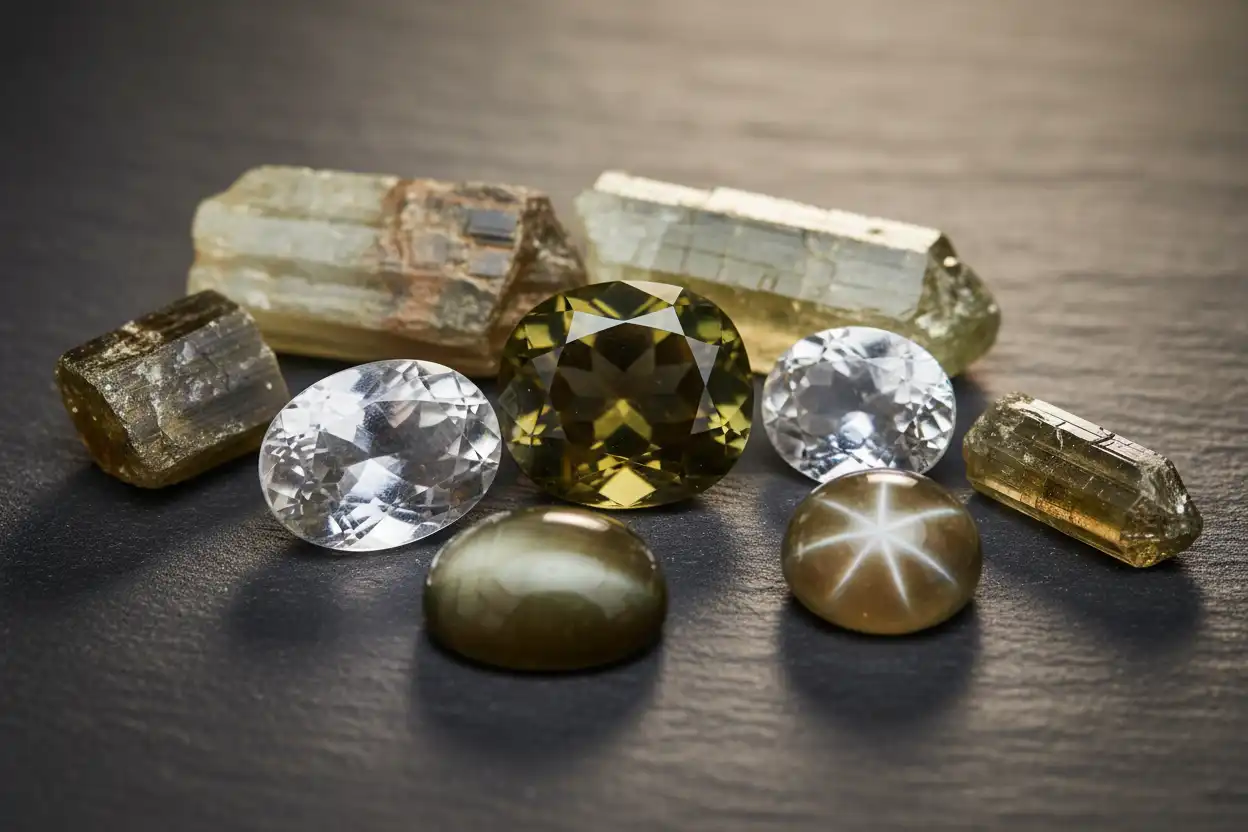
Enstatite Meaning: Properties, Uses & Symbolism
Enstatite meaning begins with the mineral itself. Enstatite is a magnesium-rich member of the pyroxene group and belongs specifically to the orthopyroxene subgroup. Its ideal composition is commonly simplified as MgSiO₃, although the doubled structural formula Mg₂Si₂O₆ is also used. Natural specimens rarely exist as chemically perfect end-members because iron and other elements can substitute within the crystal structure. That chemical variation helps explain why enstatite occurs in colors ranging from pale gray and yellowish green to olive green and brown rather than having one fixed appearance. Mineral references classify it as orthorhombic, typically around 5–6 on the Mohs hardness scale, with distinct to good cleavage and a vitreous to pearly luster.
Understanding those properties matters because the term enstatite meaning is often used online as though it refers mainly to spiritual symbolism. That reverses the useful order of explanation. Enstatite is first a naturally occurring silicate mineral with measurable chemistry, structure, optical behavior and geological context. Symbolic interpretations can be discussed afterward, provided they are clearly identified as cultural or personal beliefs rather than physical properties of the stone. Readers exploring other mineral-led references can browse the broader Gemstone Guides collection without treating superficially similar stones as interchangeable.
Enstatite Meaning at a Glance
| Feature | Grounded interpretation |
|---|---|
| Mineral identity | Magnesium-rich orthopyroxene |
| Ideal composition | MgSiO₃, also expressed structurally as Mg₂Si₂O₆ |
| Crystal system | Orthorhombic |
| Typical color range | White, gray, yellowish green, olive green, brown and related intermediate tones |
| Luster | Commonly vitreous; cleavage surfaces may appear pearly |
| Mohs hardness | Approximately 5–6 |
| Cleavage | Distinct to good |
| Common chemical variation | Iron and several minor or trace elements may substitute for ideal magnesium |
| Gem use | Transparent material can be faceted; other material is collected as crystals, rough or polished specimens |
| Symbolism | Modern reflective associations exist but are not measurable mineral properties |
| Identification limit | Color, photographs and trade names alone cannot establish mineral species, composition or origin |
These basic characteristics provide a much stronger foundation for enstatite meaning than color-based assumptions or metaphysical descriptions alone. Optical references for gem material report refractive indices roughly in the mid-1.6 range and relatively modest birefringence, but laboratory observations must be interpreted together rather than treated as a single decisive test.
What Enstatite Actually Is
Enstatite belongs to the enstatite–ferrosilite compositional series. At the magnesium-rich side is enstatite; increasing iron moves the chemistry toward ferrosilite. This relationship is important because a natural specimen can be chemically more complicated than a simplified label suggests. Two stones sold under the same commercial name may therefore differ in iron content, color, density, transparency and optical behavior. The mineral name is a compositional and structural classification, not merely a description of appearance.
That distinction also explains why visual identification has limits. A green-brown transparent stone may be compatible with enstatite, but compatible appearance is not equivalent to confirmed identity. Likewise, a dark polished orthopyroxene sold using an older varietal term may require compositional analysis before its most precise mineralogical label is known. A photograph can document color, shape, surface characteristics, inclusions and cutting style, but it cannot independently establish chemical composition.
Readers examining an unknown specimen should therefore treat the mineral name as a conclusion supported by evidence rather than a starting assumption. Detailed internal features can be recorded with the enstatite microscope inclusion notebook, while more specialized optical observations belong with the separate guide to enstatite optical properties and color behavior.
How Enstatite Forms
Enstatite is strongly associated with magnesium-rich geological environments. It occurs in igneous and metamorphic rocks and is especially characteristic of compositions in which magnesium-rich silicates are stable. Orthopyroxenes can be important constituents of ultramafic and mantle-derived rocks, while enstatite also appears in other terrestrial geological settings and extraterrestrial materials. Its presence therefore tells a geological story rather than merely supplying an attractive crystal for a collection.
Temperature, pressure, bulk-rock chemistry and later alteration all influence which pyroxene compositions develop and whether the original material remains preserved. A crystal may form as part of a larger rock assemblage alongside minerals such as olivine, feldspar, other pyroxenes or accessory phases. Consequently, surrounding matrix can sometimes provide useful geological context even when it cannot prove locality by itself. The mineral’s occurrence across many documented localities also makes unsupported claims that a specimen’s appearance uniquely identifies its geographic origin especially unreliable.
The geological mechanisms deserve fuller treatment than a meaning page can provide. Readers interested in host rocks, mineral associations and formation environments can continue to enstatite formation and deposit geology, which keeps that subject separate from the foundational enstatite meaning discussed here.
Why Enstatite Has Different Colors
Ideal chemistry does not mean every natural crystal looks identical. Enstatite can occur in pale, gray, greenish, olive and brown tones, while natural impurities and compositional variation can shift its appearance. Iron is particularly important across the enstatite–ferrosilite series, and additional trace constituents may contribute to color in particular specimens. Transparency, inclusions, weathering, surface alteration and cutting orientation can further change what the eye perceives. Mindat lists iron, calcium, aluminum, chromium, manganese, titanium and several other elements among reported impurities in natural enstatite.
This is why statements such as “all green enstatite has the same coloring agent” or “dark enstatite must be one specific variety” are too broad. Color interpretation becomes stronger when it combines mineral chemistry with spectroscopy, optical examination or other appropriate analysis. Even pleochroism—the change in apparent color seen along different crystallographic directions in some stones—must be interpreted in context rather than used as an isolated proof of identity.
For faceted material, orientation can affect both appearance and the way internal features are presented. That does not mean every stone should be recut simply to optimize color; altering a specimen can destroy weight, provenance information or collector value. Technical decisions about orientation and finish are covered separately in enstatite cutting, orientation and polish.
Diagnostic Traits: What Helps and What Does Not
A grounded approach to enstatite meaning includes knowing which observations are genuinely diagnostic. Hardness around 5–6, good cleavage, orthorhombic structure and the expected optical range can support identification, but none should normally stand alone. Gemological references list specific gravity around the low 3s for many gem-quality examples, while broader mineral data extend higher as composition varies. That difference itself illustrates why a single textbook number should not be treated as universal for every iron-bearing member of the series.
Visual clues are even less decisive. Olive-green color is not unique to enstatite. Brown stones occur in many unrelated mineral groups. A silky or bronzy reflection can be useful descriptive evidence but may reflect inclusions, internal structures, alteration or varietal terminology rather than a separate accepted mineral species. Photographs are therefore best used for documentation and comparison, not for final confirmation.
A professional identification may combine refractive index, optic character, specific gravity, microscopic features, spectroscopy and, where necessary, chemical or structural analysis. The correct combination depends on whether the material is a faceted gem, mounted jewelry, rough crystal, polished cabochon or geological specimen.
Original Enstatite Specimen and Photo Checklist
A useful specimen record should separate what is visible from what is inferred. The checklist below is designed so that collectors can document an enstatite candidate without turning an observation into an unsupported conclusion.
| Check | Record this | What it can tell you | What it cannot prove |
|---|---|---|---|
| Overall color | Color in neutral daylight and under a second ordinary light source | Whether color is consistent, zoned or lighting-dependent | Species or geographic origin |
| Transparency | Transparent, translucent or opaque areas | Which examination methods may be practical | Composition |
| Luster | Vitreous, pearly, silky or altered surfaces | Surface and cleavage character | Exact variety name |
| Crystal form | Faces, striations, broken surfaces and matrix relationships | Possible crystallographic clues | Identity without supporting tests |
| Cleavage/fracture | Existing natural breaks only | Whether break surfaces are compatible with pyroxene behavior | Permission to perform destructive testing |
| Directional color | Any obvious change when rotated | Possible pleochroic behavior | A unique identification |
| Inclusions | Needles, plates, fractures, particles or zoning visible under magnification | Internal structure worth documenting | Treatment, origin or species by appearance alone |
| Label history | Exact wording on old labels or dealer descriptions | Provenance history and terminology used at the time | Modern mineralogical validity |
| Name check | Whether the label says enstatite, bronzite, hypersthene or another term | Whether terminology needs verification | That old and modern names are equivalent |
| Origin claim | Mine, district or country stated by seller or label | A claim that can be researched | Provenance without documentation |
| Symbolic claim | Exact wording such as “grounding” or “manifestation” | What a seller or tradition asserts | A measurable physical effect |
| Photo record | Front, back, side, scale reference and close-up | Repeatable visual documentation | Laboratory identification |
This approach prevents a common problem: beginning with a commercial label and interpreting every observation to fit it. If a specimen is important enough for collection records or resale, retain invoices, old labels and chain-of-custody information instead of replacing them with a simplified story. The separate enstatite provenance disclosure checklist is the appropriate place for documenting those claims in greater depth.
Enstatite, Bronzite and Hypersthene: Names Need Context
One of the most important nuances in enstatite meaning is nomenclature. “Hypersthene” appears widely in historical literature, older collections and the gem trade, but modern mineral classification treats hypersthene as a discredited species name within the enstatite–ferrosilite series. Many specimens historically called hypersthene are better described compositionally within that series, frequently as ferroan enstatite or another appropriate orthopyroxene designation.
“Bronzite” is also encountered for iron-bearing material with characteristic bronze-like appearance. Gem references may describe bronzite as an iron-rich variety of enstatite, but the term should not be interpreted as proof that every bronze-colored pyroxene has identical chemistry.
Old labels should not automatically be discarded because terminology has changed. They can be valuable historical evidence. The better practice is to preserve the original wording, record the modern interpretation separately and avoid silently rewriting provenance. A century-old collection label saying “hypersthene,” for example, tells you something real about the specimen’s documentation even when that label no longer represents current species nomenclature.
Documented History Behind the Name
The name enstatite comes from a Greek root associated with the idea of an “opponent,” a reference traditionally connected with the mineral’s resistance to fusion during early blowpipe testing. That origin belongs to the history of mineral identification, not to metaphysical ideas about resistance, courage or personal boundaries. Turning an old mineralogical name explanation into psychological symbolism would be an interpretive leap rather than documented mineral history.
The naming history also illustrates how mineral science changes as analytical methods and classification systems improve. Terms once used as species names may later become obsolete, varietal, compositional or informal descriptions. For collectors, this means historical references should be read in the terminology of their period while current specimens should be described as precisely as available evidence permits.
That principle is especially useful when purchasing older collections. A handwritten label can be historically authentic while mineralogically outdated. Both facts can coexist.
Enstatite Meaning and the Symbolism Boundary
In contemporary crystal and metaphysical practice, enstatite meaning is sometimes associated with steadiness, practical thinking, self-discipline, persistence or a sense of being grounded. Those ideas can function as personal symbols, journaling themes or prompts for reflection. They are not measurable consequences of magnesium silicate chemistry, and there is no scientific basis for claiming that carrying enstatite automatically changes emotions, relationships, finances or health.
A responsible symbolic use therefore starts with language such as “I use this stone as a reminder to…” rather than “this stone causes…” Someone might place an enstatite specimen on a desk as a visual cue to finish one task before starting another, or use its geological stability as a metaphor for maintaining consistency. The useful effect in that situation comes from the person’s chosen practice and attention, not from a proven energy emitted by the mineral.
Enstatite should not be presented as treatment for anxiety, depression, cardiovascular problems, neurological conditions, hormonal disorders or any other health condition. Its magnesium, iron or other constituent elements are locked into a mineral structure; touching or wearing the stone does not make them nutritional supplements or medicines. Broader limits on symbolic and wellness claims are explained in the site’s editorial disclaimer.
Safe Ownership of Enstatite
Normal handling of an intact enstatite specimen is different from activities that create fragments, heat or airborne dust. A collector who picks up a stable polished stone or intact crystal for ordinary examination is not doing the same thing as someone cutting, grinding, sanding or drilling mineral material. Lapidary work requires appropriate equipment, dust control, eye protection and material-specific precautions.
Enstatite’s moderate hardness and cleavage also mean that “hard enough to scratch glass” or similar informal rules do not translate into indestructibility. Cleavage can allow a stone to break along structurally favorable directions, particularly when struck. Jewelry exposed to repeated knocks therefore needs thoughtful setting design rather than assumptions based on hardness alone. More detailed engineering considerations belong on the enstatite setting and wear engineering page rather than being duplicated here.
Collector specimens deserve similarly conservative treatment. Preserve old labels, avoid unnecessary coatings or aggressive cleaning, and do not alter a specimen merely to make it look more polished if its natural surface or provenance matters. Storage and documentation methods are covered more fully in enstatite specimen conservation and record keeping.
Comparing Enstatite With Other Minerals
Comparing mineral meaning pages is most useful when the underlying materials remain distinct. Epidote meaning concerns a different silicate mineral system with different chemistry, crystallography and identifying properties, even though both minerals may appear green in some specimens. Color resemblance alone is not a mineralogical relationship.
The same principle applies to elbaite meaning. Elbaite belongs to the tourmaline group and can display an enormous color range, so a green transparent stone should not be assigned to either material based only on hue. Erythrite meaning concerns a cobalt arsenate mineral whose composition, appearance and handling considerations differ substantially from enstatite.
Even a rock name can require a different interpretive framework. Eclogite meaning deals with a metamorphic rock composed of multiple minerals rather than a single mineral species. These distinctions matter because accurate symbolism begins with accurate material identity; two objects do not become mineralogical equivalents simply because a seller gives them similar metaphysical descriptions.
What Enstatite Meaning Can and Cannot Tell You
Enstatite meaning can tell you what the mineral is, how its chemistry fits within the pyroxene group, why its appearance varies, how mineralogical terminology has changed and where symbolic interpretations should be separated from measurable evidence. It can also provide a disciplined framework for examining a labeled or unlabeled specimen.
It cannot determine a stone’s exact chemical composition from a photograph, authenticate geographic origin from color, prove an old trade label correct, assign a market value, confirm treatment or predict what will happen to someone who wears the mineral. Those questions require different evidence and, in some cases, different specialist methods.
Gems Lore’s broader approach to separating measurable material properties from cultural or symbolic interpretation is described on About Gems Lore. Where a specimen raises a factual correction, unusual nomenclature issue or documentation question, readers can use the site’s contact page rather than treating an uncertain visual identification as settled fact.
FAQ
What is the simplest enstatite meaning?
The simplest enstatite meaning is first mineralogical: enstatite is a magnesium-rich orthopyroxene mineral. In modern symbolic practice, some people use it as a personal reminder of steadiness, discipline or grounded decision-making, but those associations are reflective beliefs rather than scientifically measured properties.
Is enstatite the same mineral as hypersthene?
Not exactly in modern nomenclature. Hypersthene is an older, now-discredited species name formerly used within the enstatite–ferrosilite compositional range. Many specimens carrying old hypersthene labels can fall within iron-bearing orthopyroxene compositions, so an old label should be preserved as historical documentation rather than assumed to be the current formal species name.
Is bronzite another name for enstatite?
Bronzite is commonly used for iron-bearing enstatite or related orthopyroxene material showing a characteristic bronze-like appearance. It is better treated as varietal or descriptive terminology than as evidence that every specimen bearing the name has identical chemistry.
Can enstatite be identified from its color?
No. Green, brown, gray and yellowish tones occur in many unrelated minerals. Color can support an examination, but reliable identification may require optical properties, density, microscopic features, spectroscopy or compositional analysis depending on the specimen.
Does enstatite have scientifically proven healing properties?
No established mineralogical property demonstrates that enstatite treats disease or produces a specific medical or psychological outcome. It can be used as a personal symbolic object or reflective prompt, but it should not replace appropriate medical or mental-health care.
A Grounded Way to Understand Enstatite
The most useful enstatite meaning comes from keeping several layers of information in the correct order. Enstatite is first a magnesium-rich orthopyroxene with a definable crystal structure, compositional range, physical properties and geological history. Its colors and visual effects arise from material factors that can be investigated. Historical names such as hypersthene need nomenclatural context, while commercial labels and claimed origins deserve documentation rather than automatic acceptance.
Symbolism can still have a place, but it works best when presented transparently. Enstatite may serve as a personal reminder of steadiness, persistence or deliberate action without requiring claims that the mineral emits a scientifically established healing force. That separation preserves both sides of the subject: the real mineral remains interesting on its own terms, and personal symbolism remains available without being mistaken for gemological evidence.