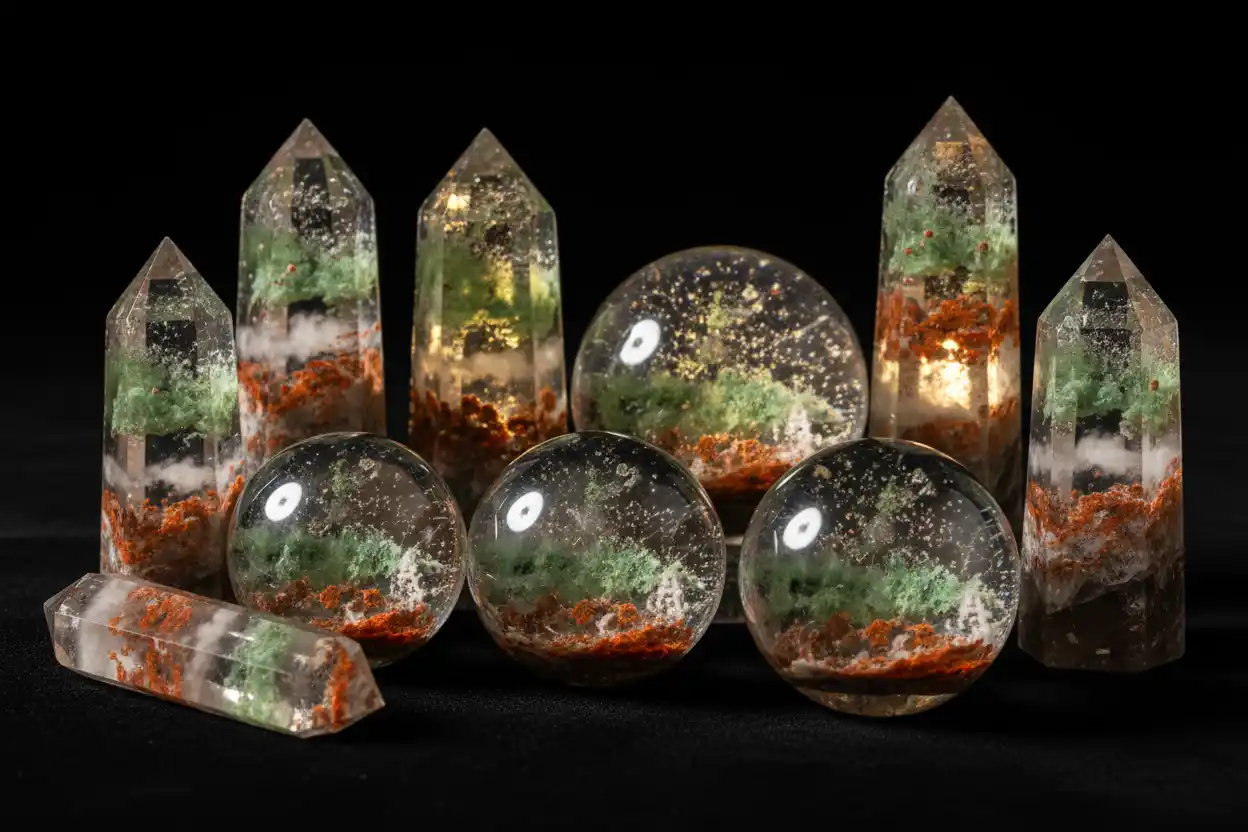
Garden Quartz Meaning: Properties, Uses & Symbolism
Garden quartz meaning begins with quartz containing natural mineral inclusions and internal growth features that happen to resemble landscapes, gardens, moss, clouds, forests, underwater scenes, or miniature terrain. Garden quartz is not a separate mineral species. The transparent or translucent host is generally rock crystal quartz, SiO₂, while the visible scenery can involve chlorite-group minerals, iron oxides or hydroxides, clay-like material, other mineral inclusions, growth coatings, healed fractures, fluid-related features, or combinations of these. The exact inclusion assemblage differs from specimen to specimen, so a picturesque appearance should never be mistaken for one standardized chemical composition.
This material is also widely sold under names such as lodolite, scenic quartz, landscape quartz, inclusion quartz, and sometimes shamanic dream stone. Those terms overlap inconsistently across the gem, mineral, and crystal trades. “Garden quartz” usually describes the visual effect rather than a formally defined mineral variety, while “lodolite” is often used for similar included quartz, especially material associated commercially with Brazil. Neither name proves one inclusion species, one mine, or one geological origin merely because the internal scene looks familiar.
A grounded garden quartz meaning therefore separates the quartz host from the inclusions, the measurable geology from the trade vocabulary, and both from modern symbolism. Quartz composition, hardness, fracture, optical properties, inclusion morphology, and geological relationships can be examined. Cultural and commercial naming can be documented. Modern associations with perspective, patience, imagination, personal growth, memory, or reflection are interpretive rather than scientifically measured forces. Related mineral-first references can be explored through the broader Gemstone Guides without treating every evocative crystal name as a formal mineral classification.
Garden Quartz Meaning at a Glance
| Feature | Grounded reference |
|---|---|
| Material identity | Included quartz sold under an appearance-based trade name |
| Host mineral | Quartz |
| Host composition | SiO₂ |
| Crystal system | Trigonal |
| Typical host appearance | Colorless to smoky, transparent to translucent quartz |
| Common internal colors | Green, brown, red, orange, cream, gray, white, black, or mixed |
| Possible inclusion types | Chlorite-group minerals, iron-rich phases, clay-like material, mineral coatings, healed fractures and other inclusions |
| Mohs hardness | About 7 for the quartz host |
| Cleavage | None |
| Fracture | Commonly conchoidal |
| Luster | Vitreous |
| Defining visual feature | Three-dimensional mineral inclusions resembling natural scenes or vegetation |
| Formal species status | “Garden quartz” is not a separate mineral species |
| Common overlapping terms | Lodolite, scenic quartz, landscape quartz, inclusion quartz |
| Identification limit | Appearance alone cannot determine every inclusion species or locality |
| Symbolic meaning | Modern personal or cultural interpretation rather than a measurable mineral effect |
| Main ownership concern | Internal fractures may weaken individual stones; cutting quartz creates respirable crystalline silica dust |
The most important principle in garden quartz meaning is that the “garden” is a human visual interpretation of geological structures. Nothing botanical needs to be inside the quartz for the stone to resemble moss, branches, soil, clouds, or a miniature landscape.
What Garden Quartz Actually Is
Garden quartz is macrocrystalline quartz containing conspicuous inclusions or growth-related internal features. The host quartz may be nearly water-clear, slightly smoky, milky, or unevenly transparent. Inside it, mineral particles and coatings can form plumes, sheets, clouds, branching structures, granular masses, wisps, layers, or three-dimensional accumulations.
Those inclusions may have entered the quartz at different stages of crystal growth. Some material can be trapped as the quartz encloses surrounding minerals. Other inclusions may represent earlier mineral coatings that became overgrown by later quartz. Fractures can open and later heal, trapping fluids or depositing additional minerals along the fracture surfaces. A single polished stone may preserve several events rather than one simple episode.
This complexity is what gives garden quartz its visual appeal, but it also creates identification problems. A green inclusion is often called chlorite, yet several green minerals can overlap visually. A red inclusion may be described as hematite, but iron-rich oxides and hydroxides are difficult to identify precisely from color alone. White clouds may be assigned to calcite, kaolinite, or another mineral without adequate testing.
The best garden quartz meaning reference therefore starts with a secure statement—quartz containing natural-looking inclusions—and becomes more specific only when evidence justifies it.
How Garden Quartz Forms
Garden quartz forms within the broader geological environments that produce quartz crystals. Silica-rich fluids can circulate through fractures, cavities, veins, and open spaces in rock. As physical and chemical conditions change, quartz begins to crystallize.
The crystal does not always grow in an empty cavity. Other minerals may already coat the walls, float as particles in the fluid, crystallize simultaneously, or appear during interruptions in quartz growth. If quartz continues growing around those materials, they become enclosed inside the crystal.
Imagine a quartz crystal growing in stages. During one interval, a fine green mineral coats part of its surface. Quartz growth resumes and encloses the coating. Later, iron-bearing fluids enter the system and deposit reddish material along another growth surface. Another quartz layer forms over that. The finished crystal now contains multiple inclusion horizons representing separate events.
This staged development can create dramatic internal depth. A photograph may show what looks like a green hill behind a red cloud, yet the apparent landscape is simply the visual intersection of separate mineral layers inside transparent quartz.
The detailed geological sequence—silica transport, hydrothermal fluids, growth interruption, mineral coatings, fracture healing, and host-rock relationships—is treated more fully in garden quartz formation and deposit geology rather than duplicated throughout this foundational page.
Why Garden Quartz Looks Like a Landscape
Human vision is exceptionally good at recognizing familiar patterns in irregular shapes. Clouds can look like animals, rock surfaces can resemble faces, and mineral inclusions can look like trees, gardens, mountains, underwater scenes, or forests.
Garden quartz meaning is strongly shaped by this phenomenon. The inclusions themselves are geological. The landscape is interpretive.
Green plumes may resemble moss or foliage. Brown mineral films can look like soil or hills. White clouds may appear like mist. Red iron-rich material can resemble autumn leaves or earth. Transparent gaps between inclusions create depth, making the scene appear three-dimensional when the quartz is rotated.
The effect changes with viewing direction because the inclusions occupy real volume. A formation that looks like a tree from the front may become an indistinct sheet when viewed from the side. This is one reason videos and multi-angle photographs provide more useful visual information than one carefully selected still image.
A deeper analysis of transparency, scattering, inclusion orientation, refractive effects, and how lighting changes apparent color belongs in garden quartz optical properties and color behavior.
Common Inclusion Colors and What They Can Suggest
Green is frequently associated commercially with chlorite-group minerals. Chlorite is plausible in many quartz-bearing geological systems and can form green coatings, sheets, flakes, and irregular masses. However, “green equals chlorite” is not a complete identification method.
Red and reddish-brown inclusions are commonly attributed to hematite or other iron-rich phases. Yellow-brown material may be associated with goethite, iron staining, clay-rich material, or mixtures. Black inclusions can include several opaque minerals depending on the geological environment.
Cream and white features are especially ambiguous because many pale minerals can occur with quartz. Fine mineral particles can also appear white because of light scattering even when their actual chemistry is different.
These uncertainties do not reduce the value of visual observation. They simply define its limit. A useful description can say “green platy inclusion compatible with chlorite” rather than claiming a precise species from a seller photograph.
Diagnostic Traits: Identify the Host First
The most efficient identification approach begins with the host quartz. Quartz has hardness 7, vitreous luster, no cleavage, characteristic conchoidal fracture, trigonal crystallography, and well-established refractive properties.
A natural rough crystal may preserve six-sided prismatic morphology and recognizable quartz terminations. Polished cabochons, spheres, and carvings remove that crystal habit, making gemological measurements more important if identity is uncertain.
Once the host is established as quartz, the inclusions become a second question. Magnification can reveal whether they are platy, fibrous, granular, crystalline, dendritic, fracture-bound, surface-reaching, or enclosed within growth zones.
These textures often tell more than color alone. A flat mineral film lying on a former quartz growth surface records a different relationship from a cluster of discrete crystals suspended inside the host. A reddish coating concentrated along a healed fracture records another event again.
The garden quartz microscope inclusion notebook provides a dedicated framework for documenting these internal relationships without assigning unsupported species names.
Original Garden Quartz Specimen and Name-Claim Audit
Garden quartz meaning is especially vulnerable to commercial name inflation because nearly every distinctive pattern can receive a new descriptive label. The table below separates common terminology from what it can actually prove.
| Name or claim | What it can reasonably describe | What should not be assumed |
|---|---|---|
| Garden quartz | Quartz containing scenic or garden-like inclusions | Separate mineral species |
| Lodolite | Trade name widely used for included scenic quartz | One standardized inclusion composition |
| Scenic quartz | Quartz with landscape-like inclusions | Specific locality |
| Landscape quartz | Appearance-based name for included quartz | Geological landscape preserved literally |
| Inclusion quartz | Broad term for quartz containing visible inclusions | Specific inclusion species |
| Chlorite quartz | Quartz containing or claimed to contain chlorite | That every green inclusion is chlorite |
| Hematite quartz | Quartz containing confirmed or strongly supported hematite | That every red inclusion is hematite |
| Moss quartz | Informal appearance-based wording | Relationship to moss agate or biological moss |
| Phantom garden quartz | Quartz containing phantom growth features plus scenic inclusions | That every layered inclusion is a true crystallographic phantom |
| Brazilian lodolite | Seller or provenance claim linking material to Brazil | Brazilian origin from appearance alone |
| Shamanic dream stone | Modern metaphysical trade term | Formal mineral classification |
| Natural untreated | Seller or laboratory treatment statement | Absence of polishing compounds, filling, coating, stabilization, dye, or repair solely from photographs |
| AAA garden quartz | Seller-specific quality language | Universal gemological grade |
| Rare landscape scene | Commercial description of unusual aesthetics | Measured geological rarity |
| Healing garden quartz | Metaphysical terminology | Medical efficacy |
The term “lodolite” deserves particular caution. It is widely recognized commercially, but it is not a formal mineral species. Different sellers may use it for different types of included quartz, often emphasizing green, brown, red, or cream scenic material.
“Phantom” creates another possible confusion. A true quartz phantom records a previous crystal-growth surface that was later overgrown. Not every layered mineral cloud inside quartz represents a crystallographically meaningful phantom.
Garden Quartz and Lodolite: Are They the Same?
In much of the modern gem and crystal market, garden quartz and lodolite overlap extensively. One seller may prefer “garden quartz” for pieces with green and brown botanical-looking inclusions while using “lodolite” for broader scenic material. Another may treat the names as synonyms.
There is no universal mineralogical standard that requires one naming convention.
For technical clarity, the strongest description begins with the host and then records the trade name: “natural included quartz sold as garden quartz/lodolite.” If inclusion minerals have been confirmed analytically, those can be added separately.
This approach preserves useful commercial vocabulary without pretending it defines a new mineral species.
Is Garden Quartz the Same as Phantom Quartz?
Not necessarily.
A quartz phantom forms when one stage of crystal growth is marked by mineral deposition or a change in conditions, after which clear or differently colored quartz resumes growth over the earlier crystal outline. The result can preserve a recognizable internal outline resembling a smaller crystal inside the larger one.
Garden quartz may contain true phantoms, but its defining commercial feature is scenic inclusion patterning rather than a specific crystallographic growth structure.
A stone can therefore be both garden quartz and phantom quartz. Another garden quartz specimen may contain no recognizable phantom at all.
The distinction matters because pattern words should describe the actual structure rather than merely add value to a listing.
Are the Green Inclusions Always Chlorite?
No.
Chlorite-group minerals are common in hydrothermal and metamorphic environments and are a plausible cause of many green inclusions in quartz. They can produce flaky, platy, earthy, or moss-like green structures that fit the garden quartz appearance well.
However, other green minerals can coexist with quartz, and visual identification from photographs has limits. Mineral species can overlap in color, grain size, and morphology.
If the exact inclusion identity matters for research, valuation, or an unusual specimen claim, laboratory methods such as Raman spectroscopy, X-ray diffraction, or electron-beam analysis provide a stronger basis than color matching.
The most responsible garden quartz meaning content therefore uses chlorite as a common example without turning it into a universal rule.
What Makes One Garden Quartz Specimen Visually Better Than Another?
Because garden quartz is collected largely for its inclusions, visual quality depends on different factors from a perfectly clear quartz gemstone.
Transparency matters because the host must reveal the internal scene. Yet complete clarity is not always desirable if internal veils contribute depth. Strong contrast between inclusions and the quartz host can improve readability. Three-dimensional arrangement can make the specimen interesting from several viewing angles.
Composition also matters aesthetically. One dense brown patch covering the entire stone may be less visually engaging than a layered arrangement of green, red, cream, and clear areas. Conversely, a minimalist specimen with one sharply defined plume may be more desirable than a crowded stone.
Cutting orientation can dramatically affect those qualities. A poorly chosen cabochon face may hide the strongest internal structure, while a thoughtful orientation can reveal a scene that was barely visible in rough form.
The specialized tradeoffs among orientation, transparency, fractures, inclusion exposure, and polish belong in garden quartz cutting, orientation and polish.
Garden Quartz History: Quartz Is Ancient, the Trade Name Is Modern
Quartz has an extensive archaeological, technological, decorative, religious, and gemological history across many cultures. Clear quartz crystals, chalcedony, agate, amethyst, and other quartz varieties have been collected and worked for very long periods.
Garden quartz as a specific commercial identity should not automatically inherit every one of those traditions.
The modern name is appearance-driven. It reflects how contemporary collectors and sellers interpret scenic mineral inclusions inside transparent quartz. “Lodolite” likewise belongs primarily to modern mineral and crystal commerce rather than constituting an ancient mineral species recognized under the same terminology.
This creates an important historical boundary. A statement that an ancient society valued quartz can be legitimate when supported. A statement that the same society specifically used “garden quartz for manifestation” requires direct evidence tied to the actual material and concept.
Modern symbolism can be meaningful without being projected backward into undocumented history.
Garden Quartz Meaning in Modern Symbolism
Modern garden quartz meaning commonly centers on perspective, imagination, patience, growth, memory, reflection, and seeing complexity as a whole rather than focusing on one isolated detail.
Those themes follow naturally from the material’s appearance. A garden quartz stone can contain many layers that only become understandable when viewed from several angles. What appears chaotic in one orientation can look organized in another. An inclusion that initially resembles a cloud may become a branching mineral sheet after rotation.
A grounded reflective use can build directly on this. Someone might use the stone as a reminder to examine a difficult decision from several perspectives before committing to one interpretation. Another person might associate the layered inclusions with the idea that visible outcomes often contain traces of earlier stages.
Garden quartz meaning can also support a useful distinction between clarity and emptiness. Clear quartz with no inclusions may appear visually pure, while included quartz demonstrates that internal complexity does not automatically reduce interest or value. As a metaphor, that can encourage reflection on whether imperfections are actually obstacles or simply part of a more complicated structure.
These are personal interpretations. There is no established scientific evidence that garden quartz manifests desired events, stores memories from previous lives, improves psychic ability, changes dreams, attracts wealth, or influences another person’s decisions.
The wider boundary between symbolism and medical or supernatural claims is explained in the site’s Disclaimer.
Garden Quartz Does Not Contain Literal Plants or Ecosystems
The botanical imagery can become so convincing that some descriptions imply real moss, plants, or preserved landscapes exist inside the quartz. That interpretation should be avoided unless biological material has actually been demonstrated.
The “garden” usually consists of minerals and growth structures. Green mineral plumes can resemble vegetation because human perception organizes unfamiliar shapes into familiar forms.
This is comparable to dendritic patterns in other stones. A manganese- or iron-rich dendrite can look like a fern or tree without having a botanical origin.
Recognizing that distinction does not make garden quartz less attractive. It reveals that geological processes can create forms complex enough to resemble living structures without copying them deliberately.
Garden Quartz Has No Scientifically Proven Healing Properties
Quartz is silicon dioxide, while the inclusions can contain various additional minerals. That chemistry does not establish medical effects through skin contact.
A green chlorite-like inclusion does not scientifically treat inflammation or cardiovascular conditions. Iron-rich material does not become an iron supplement. Quartz itself does not correct neurological function, anxiety, depression, hormonal balance, or immune disorders by being worn or held.
Garden quartz should therefore not be presented as a treatment for physical or mental-health conditions.
A person can still use the stone in meditation, journaling, reflection, or decorative practice. Any practical benefit from those routines should be attributed to the person’s behavior, attention, environment, or established psychological mechanisms rather than an unverified mineral emission.
Safe Ownership of Garden Quartz
Normal handling of an intact polished garden quartz or natural quartz crystal is fundamentally different from cutting, drilling, grinding, sanding, or crushing it.
Quartz is crystalline silica. Processes that create fine respirable silica dust require appropriate exposure controls. Wet cutting, effective local extraction, suitable respiratory protection, eye protection, and disciplined cleanup are more appropriate than uncontrolled dry grinding.
The inclusions add uncertainty rather than removing it. An included crystal may contain several mineral phases, and not every component is obvious from appearance. Processing should therefore be approached as work on a mixed geological material rather than assuming the quartz trade name tells the complete chemical story.
Finished stones are mechanically durable in terms of surface hardness, but internal fractures can reduce toughness. A quartz cabochon with a large surface-reaching fracture may chip more readily than a cleaner specimen despite both having hardness 7.
Garden Quartz in Jewelry
Garden quartz can work well in pendants, earrings, cabochons, beads, and many ring designs because the quartz host offers good scratch resistance and no cleavage.
The main durability variable is often internal structure. Dense inclusion zones, healed fractures, open fissures, cavities, or partly exposed mineral pockets can create weak points that are not obvious in a simple hardness number.
A highly included stone should therefore be examined from the side and back as well as face-up. A fracture that contributes beautiful visual depth may also extend to the surface. Setting pressure concentrated near that area can increase breakage risk.
Jewelry design should respond to the individual stone rather than assuming every included quartz behaves identically. Mechanical protection, girdle support, exposed inclusions, mounting pressure, and wear frequency are covered more fully in garden quartz setting and wear engineering.
Preserve Rough Garden Quartz Before Recutting It
Uncut garden quartz can preserve natural crystal faces, growth zoning, mineral coatings, contact surfaces, matrix, and the three-dimensional relationship between inclusions and the host crystal.
Polishing may reveal internal scenery beautifully, but it removes some of that geological context permanently.
A documented specimen with unusual inclusion morphology may be more informative intact than as a cabochon. Before recutting a significant crystal, photograph all sides, record dimensions, preserve labels, and consider retaining part of the natural surface.
Collectors who prioritize long-term documentation can use garden quartz specimen conservation and record keeping for storage, labeling, condition monitoring, and intervention decisions.
Provenance Should Not Be Reconstructed From the Landscape
Garden quartz is frequently associated commercially with Brazil, and important included quartz material does come from Brazilian localities. Yet a green-brown internal landscape does not prove Brazilian origin.
Similar geological processes can trap chlorite, iron-bearing minerals, clay-like material, and other inclusions inside quartz in multiple regions. Polishing further removes matrix and host-rock evidence that might otherwise help narrow the geological context.
When locality matters, retain invoices, old labels, collection records, mine information, dealer documentation, and earlier photographs. A seller’s country attribution can remain part of the record without being silently upgraded into independent verification.
The garden quartz provenance disclosure checklist provides a structured way to preserve these evidence levels.
An Original Garden Quartz Specimen and Photo Checklist
Before accepting a strong inclusion, locality, or rarity claim, record the specimen in a repeatable way.
| Observation | What it may support | What it cannot prove alone |
|---|---|---|
| Clear quartz host | Compatibility with included macrocrystalline quartz | Exact natural origin |
| Green plumes | Possible chlorite-group or other green mineral inclusions | Chlorite species from color alone |
| Red plates or clouds | Possible iron-rich material such as hematite | Exact mineral identity |
| Yellow-brown films | Possible goethite, iron staining, clay-rich material or mixtures | One universal composition |
| White clouds | Dense mineral inclusions or scattering structures | Calcite or another specific species without testing |
| Distinct internal crystal outline | Possible phantom growth | True phantom without examining geometry |
| Layered inclusions | Multiple growth or deposition stages | Exact chronology |
| Surface-reaching fracture | Durability and treatment consideration | Artificial origin |
| Internal cavity | Growth-space evidence | Specific deposit |
| Multiple-angle scene change | Three-dimensional inclusion architecture | Higher grade by itself |
| “Lodolite” label | Trade-name usage | Formal mineral variety |
| “Brazilian” label | Seller provenance claim | Geographic origin from appearance |
| “Natural untreated” | Seller or laboratory representation | Absence of all treatment visually |
| “Rare landscape” | Aesthetic seller description | Quantified rarity |
| “Healing garden quartz” | Modern symbolic terminology | Medical efficacy |
This checklist creates useful information even when exact inclusion chemistry remains unresolved. Observation should be preserved independently from interpretation so a later specialist can re-evaluate the specimen without inheriting unsupported assumptions.
Garden Quartz Compared With Garnet Color
The adjacent garnet color meaning topic demonstrates a different approach to color. Garnet colors occur within members of a mineral group whose chemistry and trace components control body color.
Garden quartz is different because much of its apparent color comes from visible inclusions rather than the host quartz itself. A red patch inside garden quartz may be an iron-rich mineral suspended within colorless quartz, while a red garnet’s color belongs to the garnet crystal.
The comparison shows why “red stone” or “green stone” is never a complete material description.
Garden Quartz Compared With Galena
Galena meaning concerns lead sulfide, PbS, an opaque metallic mineral with high density, low hardness, and perfect cubic cleavage.
Garden quartz is dominated by transparent to translucent SiO₂ with hardness 7 and no cleavage. A dark metallic inclusion inside garden quartz should not automatically be identified as galena merely because it reflects light.
If an opaque inclusion’s precise identity matters, analytical evidence is stronger than visual resemblance.
Buying Garden Quartz: The Scene Is Not the Whole Decision
The visual landscape is usually the first thing buyers notice, but purchase quality also depends on host transparency, fracture condition, polish, treatment disclosure, cut orientation, dimensions, provenance, and whether seller photographs represent the stone realistically.
One dramatic photograph taken at the perfect angle may exaggerate the strength of an internal scene. Multi-angle video is more informative because it reveals how the inclusions actually behave as the stone moves.
A buyer should also distinguish inclusion richness from structural weakness. Dense inclusions can be beautiful, but large surface-reaching fractures may influence durability. A clear, well-oriented stone with fewer inclusions can sometimes be more visually coherent than a crowded specimen.
Transaction-focused questions—including seller evaluation, documentation, return conditions, and comparing listings—belong in where to buy garden quartz rather than being duplicated inside this meaning reference.
What Garden Quartz Meaning Can Reliably Tell You
A grounded garden quartz meaning reference can establish that garden quartz is included macrocrystalline quartz rather than a separate mineral species. It can explain how mineral coatings, trapped particles, fracture-related material, and interrupted crystal growth create three-dimensional internal scenes, why green or red inclusions cannot always be identified from color, and why trade names such as garden quartz and lodolite overlap without defining one fixed composition.
It can also establish important limits. A photograph cannot determine every inclusion species, reconstruct the exact sequence of mineral growth, authenticate Brazilian or another origin, prove the absence of treatment, or turn an appearance-based term into formal mineral taxonomy.
No first-hand mine visit, laboratory analysis, treatment determination, or specialist identification is implied where supporting evidence does not exist.
Gems Lore’s broader evidence-first approach is described on About Gems Lore. Readers with analytical results, documented provenance, corrections to inclusion identification, or unusual specimens can provide supporting context through Contact Gems Lore. Information submitted through the site is handled according to the Privacy Policy.
FAQ
What is the basic garden quartz meaning?
The basic garden quartz meaning is mineralogical and descriptive: garden quartz is quartz containing scenic mineral inclusions or growth features that resemble landscapes, gardens, moss, clouds, or natural scenery. Modern symbolism commonly links it with perspective, growth, imagination, and reflection, but those associations are not measurable mineral properties.
Is garden quartz a real mineral?
Garden quartz is real natural quartz, but “garden quartz” is not a separate formal mineral species. The host is quartz, while the garden-like appearance comes from inclusions and growth structures.
Is garden quartz the same as lodolite?
The names overlap extensively in modern commerce. Lodolite is another trade term used for scenic included quartz, but neither name defines one standardized inclusion chemistry.
What are the green inclusions in garden quartz?
Chlorite-group minerals are commonly cited and are plausible in many specimens, but every green inclusion should not automatically be called chlorite. Exact identification may require mineralogical analysis.
What are the red inclusions in garden quartz?
Red and reddish-brown features are often associated with hematite or other iron-rich phases. Color alone cannot establish the exact mineral, particularly when inclusions are very fine.
Does garden quartz contain real plants or moss?
Usually no. The garden-like structures are mineral inclusions and growth features that resemble vegetation through natural pattern recognition. The resemblance does not imply botanical material.
Is garden quartz the same as phantom quartz?
Not necessarily. Some garden quartz contains true phantom growth structures, but many specimens contain scenic inclusions without a distinct internal quartz-crystal outline. The terms describe different features and can overlap.
Is all garden quartz from Brazil?
No. Brazil is strongly associated commercially with included quartz and lodolite material, but quartz with scenic mineral inclusions can occur elsewhere. Origin requires provenance rather than visual pattern matching.
Is garden quartz durable enough for jewelry?
The quartz host has hardness 7 and no cleavage, making it suitable for many jewelry applications. Internal fractures, cavities, or surface-reaching inclusions can still weaken individual stones, so durability should be assessed specimen by specimen.
Is garden quartz safe to handle?
Normal handling of an intact polished or natural specimen is fundamentally different from cutting or grinding it. Quartz processing can generate hazardous respirable crystalline silica dust and requires appropriate controls.
Does garden quartz have scientifically proven healing properties?
No. There is no established scientific evidence that garden quartz treats physical or mental-health conditions. It can be used as a personal reflective object without presenting that symbolism as medicine.
Can garden quartz manifest specific outcomes?
There is no scientific evidence that garden quartz alters external events or guarantees desired outcomes. It can function as a visual prompt for planning, reflection, or goal-setting, but practical results depend on decisions, actions, and circumstances.
Garden Quartz Meaning Is a Geological Scene, Not a Literal Garden
Garden quartz meaning becomes more interesting when its apparent landscapes are understood as geological records rather than miniature worlds trapped inside a crystal. Quartz grows. Mineral coatings appear. Fluids change. Inclusions become enclosed. Fractures open and heal. Later quartz seals earlier structures inside transparent silica, allowing several stages of mineral history to remain visible at once.
That process explains why no two convincing garden quartz specimens need to look identical. One may contain green plumes suspended in clear quartz. Another may preserve iron-rich red clouds. A third may contain layered mineral coatings and a true phantom. The trade name groups these objects by visual experience rather than requiring one universal inclusion recipe.
Modern symbolism can then build on something real. Garden quartz meaning may represent perspective because the internal scene changes as the stone rotates. It may suggest patience because complex structures can develop through multiple stages. It may symbolize growth because later quartz can preserve evidence of earlier mineral surfaces without erasing them.
Those meanings remain human interpretations. The measurable foundation is quartz plus a record of natural inclusions, mineral growth, and geological change—and that foundation is already rich enough to justify the fascination surrounding garden quartz.