Galena Meaning: Properties, Uses & Symbolism
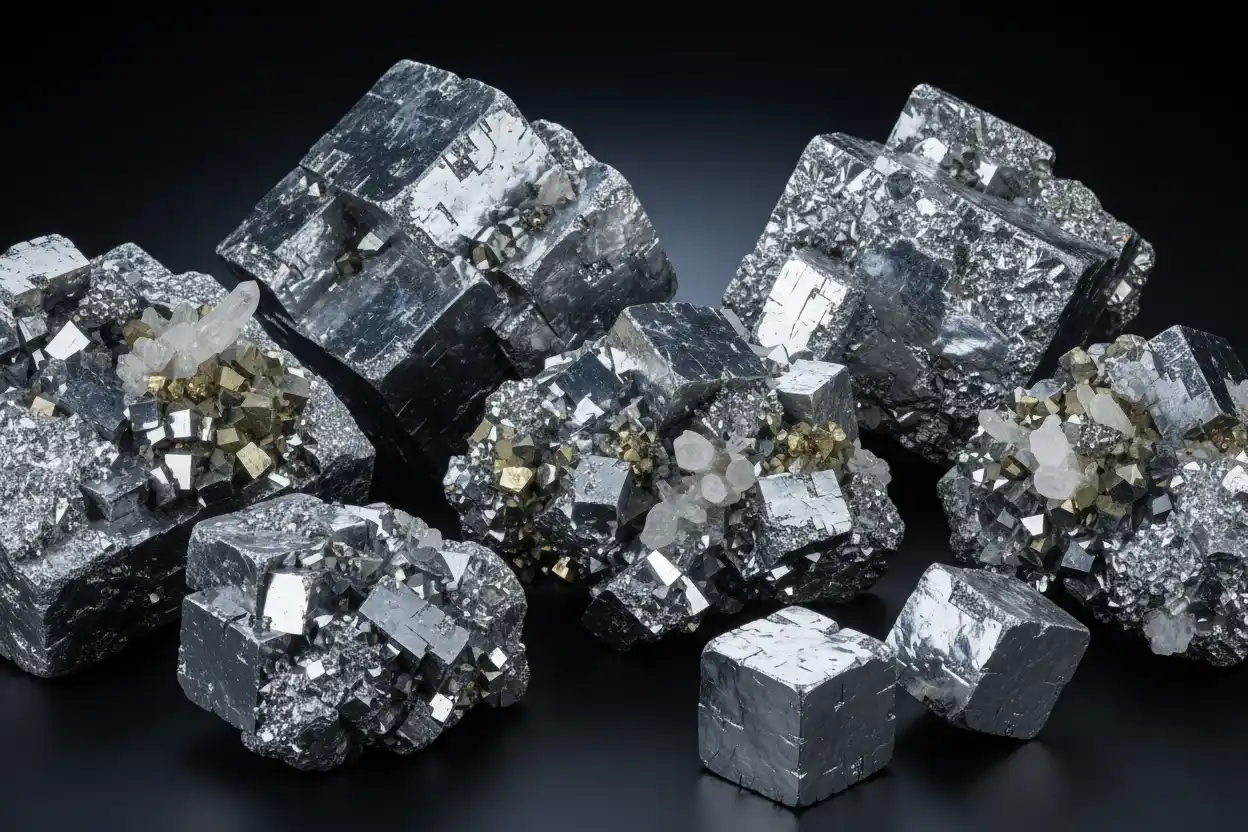
Galena meaning begins with lead sulfide, PbS, one of the most important natural lead minerals and a classic example of how crystal structure can shape both appearance and physical behavior. Galena commonly forms metallic lead-gray crystals in the cubic system, often as cubes, modified cubes, granular masses, or cleavage fragments with smooth reflective surfaces. Its unusually high density, soft hardness, metallic luster, gray streak, and perfect cubic cleavage make well-developed specimens visually distinctive. Historically, galena has also been one of the principal ores from which people obtained lead, giving it economic and technological significance far beyond the mineral-collecting world.
That factual identity needs to remain separate from modern symbolic interpretations. Galena meaning in contemporary crystal culture may involve grounding, stability, boundaries, responsibility, structure, or confronting difficult realities. Those themes are understandable metaphors for a dense, heavy, sharply cleaving metallic mineral, but they are not measurable energies or medically established effects of lead sulfide. The mineral’s real chemistry also creates safety considerations that should not be diluted by metaphysical language: galena contains lead, and responsible ownership means minimizing ingestion, dust, and unnecessary prolonged contamination.
This material-first approach is especially useful for galena because its appearance can encourage exaggerated claims in two directions. Some sellers describe every bright metallic cube as unusually pure or silver-rich, while metaphysical sources may treat density or electrical properties as evidence of healing power. Neither conclusion follows automatically. Readers exploring comparable evidence-led mineral references can use the broader Gemstone Guides while treating galena meaning as a combination of mineral identity, documented use, safe handling, and clearly labeled symbolism.
Galena Meaning at a Glance
| Feature | Grounded reference |
|---|---|
| Mineral identity | Lead sulfide |
| Formula | PbS |
| Mineral class | Sulfide |
| Crystal system | Cubic / isometric |
| Common crystal habit | Cubes, modified cubes, granular masses and cleavage blocks |
| Typical color | Lead gray to silver-gray metallic |
| Streak | Lead gray to dark gray |
| Mohs hardness | About 2.5–2.75 |
| Cleavage | Perfect cubic cleavage in three directions at right angles |
| Luster | Metallic |
| Specific gravity | Commonly around 7.4–7.6, making galena exceptionally dense |
| Transparency | Opaque |
| Common geological settings | Hydrothermal veins, carbonate-hosted lead-zinc deposits, replacement bodies and sediment-hosted systems |
| Common associations | Sphalerite, calcite, fluorite, quartz, pyrite, barite and other ore minerals |
| Economic significance | Major natural ore of lead; some deposits also contain recoverable silver |
| Symbolic associations | Modern themes such as grounding, boundaries, stability and responsibility |
| Main ownership concern | Lead-bearing mineral; avoid ingestion and dust exposure, and wash hands after handling |
The combination of metallic appearance, cubic cleavage, softness, and very high density gives galena meaning a strong physical foundation. A hand specimen can look visually similar to other metallic sulfides, but its weight often becomes immediately noticeable when compared with an ordinary rock of similar size.
What Galena Actually Is
Galena is the mineral form of lead sulfide. Its structure contains lead and sulfur arranged in a highly symmetrical cubic lattice, which helps explain why crystals frequently develop cubic forms and why broken specimens can separate along three perfect cleavage directions intersecting at approximately right angles.
This cleavage behavior is one of galena’s most characteristic traits. A massive piece can break into smaller cube-like blocks because fracture preferentially follows structurally weak planes. The smooth exposed faces may look almost manufactured, especially when fresh and highly reflective.
Galena is also unusually dense. Lead is a heavy element, so PbS has a specific gravity far above that of quartz, calcite, feldspar, and many common rock-forming minerals. A modest galena specimen can therefore feel unexpectedly heavy in the hand.
Its softness creates an interesting contrast with that density. Galena is only about 2.5–2.75 on the Mohs scale, so it scratches and abrades relatively easily despite feeling massive and substantial. Hardness and density describe different physical properties and should never be treated as synonyms.
Detailed internal textures, mineral intergrowths, cleavage features, tarnish, and associated phases can be documented using the galena microscope inclusion notebook rather than assuming that every shiny inclusion or dark metallic grain has the same identity.
How Galena Forms
Galena forms in several ore-forming environments, but hydrothermal mineralization is especially important. Mineral-rich fluids can move through fractures, faults, pores, and reactive rock. When temperature, pressure, sulfur availability, acidity, oxidation state, or fluid composition changes, lead transported in solution can combine with sulfur and precipitate as PbS.
Hydrothermal veins may contain galena together with sphalerite, pyrite, chalcopyrite, quartz, calcite, fluorite, barite, and other minerals. The exact assemblage provides clues about the chemistry and sequence of the mineralizing system. One mineral may crystallize first, another may fill later fractures, and still another may replace earlier material.
Galena is also important in carbonate-hosted lead-zinc deposits. In these systems, mineralizing fluids interact with limestone or dolostone, precipitating sulfide minerals within openings or replacing parts of the host rock. Large ore bodies can develop where fluid pathways, reactive rocks, and favorable chemistry intersect.
Sediment-hosted systems provide additional pathways for galena formation. Consequently, the simple statement that galena “forms in hydrothermal veins” is true for many specimens but not a complete description of the mineral’s geological range.
The detailed relationships among fluid movement, lead sources, sulfur chemistry, host rocks, replacement textures, and associated ore minerals belong in galena formation and deposit geology, preserving this article’s focus on foundational galena meaning.
Why Galena Looks Silver-Gray and Metallic
Galena’s classic lead-gray appearance is intrinsic to the way its electronic structure interacts with visible light. Unlike transparent minerals that transmit significant light through the crystal, galena is opaque and strongly reflective. Fresh surfaces can appear bright silver-gray, while older exposed surfaces may become darker, duller, or iridescent because of oxidation and secondary alteration.
The metallic luster is not evidence that a specimen contains native silver on its surface. Galena can contain silver as a trace or minor constituent in some deposits, and certain galena ores have historically been important silver sources, but a bright metallic appearance alone cannot establish silver content.
Tarnish can create additional color. Exposure to air, moisture, and environmental contaminants may produce dull gray, blackish, bluish, or occasionally iridescent films on the surface. Those colors reflect alteration rather than a completely different mineral identity.
Lighting is particularly deceptive with metallic minerals. A freshly cleaved face may look almost white under strong illumination and charcoal-gray when tilted away from the light. Photography can exaggerate this further because specular highlights may clip to pure white while surrounding surfaces remain very dark.
A deeper treatment of reflectivity, tarnish, optical behavior, and metallic appearance is covered in galena optical properties and color behavior.
Cubic Cleavage Is More Important Than Cubic Shape
Galena crystals often grow as cubes, but natural crystal habit and cleavage should not be confused.
A crystal face develops during growth. A cleavage face appears after the mineral breaks along a structurally favored plane. Because galena has perfect cubic cleavage, fragments can resemble small cubes even when those surfaces did not grow freely in an open cavity.
This distinction matters for specimen description. A perfectly blocky piece sold as a “natural galena cube” may be a naturally crystallized cube, a cleavage fragment, or a combination of original crystal faces and later breakage.
Growth faces can show steps, striations, modifications, attached matrix, contact surfaces, or other development features. Cleavage faces may appear smoother and can cut directly through a previously larger crystal.
Neither is fake. The question is whether the specimen’s morphology is being described accurately.
Diagnostic Traits That Support Galena Identification
Galena is relatively easy to recognize when several traits occur together. Metallic lead-gray color, high density, low hardness, perfect cubic cleavage, gray streak, and opaque appearance form a strong diagnostic combination.
Density is particularly useful. A galena specimen feels substantially heavier than quartz, calcite, fluorite, or most similarly sized rocks. However, high density alone is not enough because other metallic minerals can also be heavy.
Cleavage provides another strong clue. Repeated right-angle break surfaces are characteristic, especially when fresh faces show bright metallic luster. Yet intentionally breaking a collectible specimen simply to test cleavage is unnecessary and destructive.
Streak can support identification but also creates contamination and damage. Rubbing an unknown lead-bearing mineral against an unglazed plate generates powder, which is precisely the type of exposure responsible ownership should minimize. For a valuable or already well-characterized specimen, other nondestructive evidence is preferable.
Professional identification may use reflected-light microscopy, X-ray diffraction, Raman spectroscopy, chemical analysis, or electron microscopy when composition or associated minerals need confirmation. A photograph can strongly support a galena identification but cannot establish every trace-element or provenance claim.
Original Galena Specimen and Name-Claim Audit
Galena meaning becomes more reliable when mineralogical observations are separated from commercial claims.
| Name or claim | What it can reasonably indicate | What it does not prove |
|---|---|---|
| Galena | Lead sulfide, PbS | Exact purity or trace-element composition |
| Lead glance | Historical name for galena | Separate mineral species |
| Cubic galena | Galena showing cubic growth or cube-like cleavage | Naturally grown cube without surface examination |
| Silver-bearing galena | Galena known or claimed to contain economically relevant silver | Silver content from bright appearance alone |
| Argentiferous galena | Galena carrying silver in a geological or economic context | Exact silver percentage without analysis |
| Massive galena | Granular or non-free-crystal material dominated by galena | One homogeneous pure mass |
| Galena ore | Lead-bearing material containing economically relevant galena | Commercial ore grade from hand-specimen appearance |
| Mirror galena | Informal description emphasizing reflective surfaces | Special formal variety |
| Black galena | Tarnished or dark-appearing galena | Different mineral species |
| Natural untreated galena | Seller statement regarding modification | Absence of coatings or repairs solely from appearance |
| Museum-grade galena | Collector or seller quality language | Universal scientific grade |
| High-silver galena | Compositional or marketing claim | High Ag concentration without assay |
| Grounding galena | Modern symbolic terminology | Measurable grounding energy |
| Protection galena | Metaphysical wording | Physical protection from hazards |
| Healing galena | Metaphysical or commercial language | Medical efficacy |
The “silver-bearing” issue is especially important. Some galena deposits can contain meaningful silver, either within galena or associated minerals, and silver recovery from lead ores has substantial historical importance. Yet visually brilliant galena is not automatically silver-rich.
The reverse is also true: a dull specimen is not necessarily silver-poor. Trace-element chemistry cannot be estimated reliably from luster.
Is Galena the Same as Lead Ore?
Galena is one of the most important lead ore minerals, but “galena” and “lead ore” are not exact synonyms.
Galena identifies a mineral species, PbS. An ore is an economically defined material from which valuable components can be extracted under particular technical and market conditions. A rock containing galena may qualify as lead ore if the concentration, deposit geometry, mining conditions, processing costs, and economic context make extraction viable.
A beautiful crystal specimen containing only a small amount of galena can be mineralogically excellent without being an economically meaningful ore. Conversely, massive ore can be commercially important while having little collector appeal.
This distinction separates mineral identity from economic geology.
Galena and Silver: A Commonly Oversimplified Relationship
Some galena deposits have historically been major sources of silver as well as lead. Silver may occur in solid solution, microscopic inclusions, associated silver minerals, or more complex ore textures depending on the deposit.
That history has encouraged a common assumption that every galena specimen contains valuable quantities of silver. It does not.
An assay or appropriate chemical analysis is needed when silver concentration matters economically. Color, crystal size, density, cleavage, and reflectivity cannot provide a reliable silver grade.
This is another example of why galena meaning should resist attractive shortcuts. The mineral can be economically significant without every hand specimen being valuable ore.
The Documented History of Galena
Galena has played an important role in human technology because it is a major natural source of lead. Lead extracted from galena and other ores has been used historically in pigments, plumbing, metalwork, weights, alloys, architecture, ammunition, batteries, radiation shielding, and numerous industrial applications.
Some of those historical uses also created serious health consequences. Modern understanding of lead toxicity changes how older practices should be interpreted. A substance can have been technologically important while also carrying hazards that were poorly understood or inadequately controlled.
Galena also has a fascinating place in early electronics. Lead sulfide crystals were used in crystal radio detectors because certain mineral surfaces could function as semiconductor rectifiers. This is a real electrical property, but it should not be transformed into a claim that a galena crystal worn on the body regulates human electrical systems.
The mineral’s historical significance therefore spans mining, metallurgy, economic geology, technology, and public-health lessons. That documented record provides far more substance than generalized claims that ancient people universally regarded galena as a mystical grounding stone.
Galena Meaning in Modern Symbolism
Modern galena meaning commonly centers on grounding, structure, responsibility, boundaries, stability, honesty, and facing uncomfortable realities. The associations are understandable. Galena is exceptionally heavy for its size, visually dark and metallic, and characterized by strong geometric cleavage.
A person can use those qualities as reflective metaphors. Its weight can serve as a reminder to distinguish important obligations from distractions. Cubic geometry can represent the value of defining boundaries. The contrast between a tarnished exterior and bright freshly exposed cleavage can prompt reflection on how surface appearance and internal structure differ.
Another useful metaphor comes from galena’s role as ore. Valuable material is not simply “released” by intention; mining and metallurgy require identification, separation, processing, controls, and effort. Someone might use that historical reality as a reminder that potential alone does not create an outcome.
These interpretations can be meaningful without claiming that galena emits a grounding frequency or physically absorbs negativity. Personal symbolism belongs to attention and choice.
The boundary becomes particularly important with a lead-bearing mineral. The site’s Disclaimer distinguishes symbolic crystal traditions from medical or other professional claims.
Galena Does Not Have Scientifically Proven Healing Properties
Galena contains lead. That fact is a reason for sensible exposure control, not a basis for therapeutic claims.
There is no established scientific evidence that wearing or holding galena treats anxiety, depression, neurological conditions, cardiovascular disease, inflammation, pain, hormonal disorders, fatigue, or other health problems.
The mineral’s electrical and semiconductor history also does not change this conclusion. A crystal radio detector and a human nervous system are completely different physical systems. Demonstrating electrical behavior in a mineral does not establish a therapeutic interaction with the body.
Galena should never be ingested, licked, powdered for consumption, or used directly in drinking-water elixirs.
Its symbolic use does not require chemical exposure.
Lead in Galena Requires Responsible Handling
Lead sulfide is less soluble than many lead compounds, but “less soluble” does not mean “safe to ingest” or “safe to turn into dust.” The most sensible ownership approach minimizes routes by which material can enter the body.
After handling raw galena, wash hands before eating, drinking, smoking, applying cosmetics, or touching the mouth. Avoid storing specimens in food-preparation areas. Keep loose powder and broken fragments contained.
Extra caution is appropriate around children, who are more vulnerable to lead exposure and are more likely to place hands or objects in their mouths. Galena should not be treated as a children’s handling mineral.
A stable display specimen does not need to create panic. The distinction is between controlled possession of intact mineral material and unnecessary exposure to dust, residues, or ingestion pathways.
Cutting, Grinding, and Drilling Galena Create a Different Risk
Normal specimen ownership is not equivalent to lapidary processing.
Grinding, sanding, drilling, sawing, or crushing galena can generate lead-containing particles and fine dust. Those operations create an inhalation and contamination concern that an intact display crystal does not present to the same degree.
If professional processing is undertaken, exposure controls should be designed around lead-bearing dust rather than treating galena like ordinary decorative quartz. Effective local extraction, appropriate wet methods where technically suitable, suitable respiratory protection, dedicated work surfaces, protective clothing, and careful cleanup are important concepts.
Dry sweeping or compressed-air cleaning can redistribute fine particles and should not be treated as a sensible cleanup strategy for lead-bearing mineral dust.
The technical challenges of cleavage, softness, contamination control, surface preservation, and orientation are treated separately in galena cutting, orientation and polish.
Galena Is Usually a Better Specimen Than a Jewelry Stone
Galena’s metallic appearance can be striking, but several properties work against conventional jewelry use.
It is soft, so polished or bright surfaces abrade easily. It has perfect cleavage, increasing susceptibility to breakage. It is dense, making large pieces surprisingly heavy. Most importantly, it is lead-bearing, so jewelry that experiences repeated skin contact, abrasion, impacts, and environmental contamination deserves a more conservative risk assessment than a display specimen kept in a controlled cabinet.
That does not mean every historical or artistic use is impossible. It means galena is generally better suited to mineral collecting than routine wearable jewelry.
If someone is assessing an existing galena-mounted object, the galena setting and wear engineering guide addresses structural and exposure considerations without implying that the mineral is ideal for everyday wear.
Tarnish Does Not Mean the Specimen Is Ruined
Fresh galena can be brilliantly metallic, but surfaces can dull over time. Oxidation, humidity, sulfur chemistry, environmental pollutants, handling residues, and interactions with associated minerals may contribute to tarnish.
A collector may be tempted to polish a darkened surface back to bright silver-gray. That intervention can remove natural crystal faces, secondary minerals, old collection evidence, or historically meaningful surface alteration.
Aggressive chemical cleaning can also create unwanted exposure or damage associated matrix minerals.
For many specimens, preservation is more appropriate than cosmetic restoration. The galena specimen conservation and record keeping guide addresses storage, labeling, surface change, handling records, and intervention decisions in greater depth.
Provenance Matters for Collector Galena
Galena occurs in many mining districts, and famous localities can produce characteristic combinations of crystal habit, matrix, associated minerals, and mining history. Yet those characteristics rarely provide absolute proof of origin.
Large mirror-bright cubes may resemble material from one celebrated district while actually coming from another. Associations with fluorite, calcite, sphalerite, or pyrite can narrow possibilities but are not unique geographic fingerprints.
Collector value may depend heavily on mine, district, historical shaft, collection pedigree, or mining period. Those claims deserve documentation.
Original labels, dealer records, collection numbers, acquisition history, mine tags, old photographs, and other chain-of-custody information should remain associated with important specimens. The galena provenance disclosure checklist provides a structured way to separate documented origin from seller attribution and visual resemblance.
An Original Galena Specimen and Photo Checklist
Before assigning a strong technical, economic, or provenance claim, record what can actually be observed.
| Observation | What it may support | What it cannot establish alone |
|---|---|---|
| Lead-gray metallic surface | Compatibility with galena | PbS identity by color alone |
| Very high apparent heft | High-density mineral | Galena specifically |
| Cubic crystals | Isometric growth compatible with galena | Species without other evidence |
| Right-angle cleavage blocks | Strong support for cubic cleavage | Naturally grown crystal faces |
| Gray streak | Compatible with galena | Ore grade |
| Soft scratched areas | Compatible with low-hardness sulfide | Safe home testing on a valuable specimen |
| Bright fresh cleavage | Recent break exposing unoxidized material | Silver content |
| Dark tarnished surface | Surface alteration | Different mineral species |
| Sphalerite association | Common lead-zinc assemblage | Specific deposit |
| Calcite or fluorite matrix | Common hydrothermal association | Locality |
| “Silver galena” label | Silver-bearing claim | Quantitative silver concentration |
| “Ore grade” label | Economic claim | Profitability without assay and mining context |
| “Museum grade” label | Seller or collector quality language | Scientific grading standard |
| Famous mine label | Provenance information worth retaining | Authenticity if detached from records |
| “Healing galena” label | Modern symbolic or retail language | Medical effect |
This checklist deliberately avoids recommending destructive home tests. Galena’s lead content makes powder-generating tests particularly unattractive when visual, physical, documentary, or professional analytical alternatives are available.
Galena Compared With Garden Quartz
The adjacent garden quartz meaning reference concerns transparent or translucent macrocrystalline quartz containing visually complex inclusions and growth features. Quartz has hardness 7, no cleavage, comparatively low density, and a nonmetallic vitreous luster.
Galena occupies almost the opposite physical profile: metallic, opaque, soft, highly dense, and perfectly cleavable.
Both can be collected for visually striking internal or external structure, but their handling, identification, and safety considerations are fundamentally different.
Galena Compared With Gabbro
Gabbro meaning concerns a coarse-grained mafic igneous rock made from several minerals, commonly plagioclase and pyroxene.
Galena is one mineral species with a defined PbS composition. A metallic grain inside dark gabbro should not be identified as galena simply because it looks silvery. Opaque oxide minerals and other sulfides can produce superficially similar reflections.
The comparison reinforces a basic classification distinction: gabbro is a rock assemblage, whereas galena is a mineral.
Galena Compared With Garnet Color
Color alone becomes even less useful when compared with the framework in garnet color meaning. Garnets can occur in red, orange, green, yellow, brown, pink, purple, and other tones because several species and trace-element combinations occur within the garnet group.
Galena’s characteristic lead-gray metallic color belongs to an opaque sulfide rather than a transparent or translucent silicate gem system. A dark gemstone and a dark metallic mineral should not be grouped simply because both look visually intense.
Galena Compared With Fulgurite
Fulgurite meaning concerns event-generated geological material formed when lightning melts or alters sand, soil, or rock. It is compositionally variable and can contain natural glass, fused grains, bubbles, and surviving mineral fragments.
Galena is chemically defined PbS crystallized through geological mineralization. One is a mineral species; the other is a lightning-produced geological object.
The comparison is useful because both have attracted modern electrical symbolism. Fulgurite forms through lightning, while galena has genuine semiconductor history. Neither fact establishes a medical electrical effect on the human body.
What Galena Meaning Can Reliably Tell You
A grounded galena meaning reference can establish that galena is lead sulfide, explain its cubic crystal system, extraordinary density, metallic luster, perfect cleavage, low hardness, ore-forming environments, and historical importance as a source of lead.
It can also establish clear boundaries. A bright metallic surface does not prove high silver content. A cube-like fragment may represent cleavage rather than free crystal growth. A heavy gray specimen is not automatically galena. “Ore grade” is an economic claim requiring more than visual identification. Geographic origin requires provenance rather than pattern matching.
Most importantly, galena’s chemistry should be handled responsibly. An intact specimen and inhaled or ingested lead-bearing dust are not equivalent exposure situations. Sensible ownership minimizes residues and dust without turning ordinary mineral collecting into unnecessary alarm.
The editorial principles behind this separation of mineral fact, historical use, and interpretation are summarized on About Gems Lore. Readers with assay data, mine documentation, mineralogical corrections, or evidence concerning a disputed galena specimen can provide supporting material through Contact Gems Lore.
FAQ
What is the basic galena meaning?
The basic galena meaning is mineralogical: galena is lead sulfide, PbS, a dense metallic mineral with perfect cubic cleavage and major historical importance as a lead ore. Modern symbolism often associates it with grounding, boundaries, responsibility, or stability, but those associations are not measurable mineral effects.
Is galena a crystal?
Yes. Galena is a crystalline mineral belonging to the cubic system. It can form natural cubes and related crystal forms, although cube-like fragments can also result from its perfect cleavage.
Why is galena so heavy?
Galena contains lead, a high-atomic-mass element, and has a tightly packed crystal structure. Its specific gravity is commonly around 7.4–7.6, making it much heavier than most common rock-forming minerals.
Is galena silver?
No. Galena is lead sulfide. Some galena deposits contain silver, and certain lead ores have historically been important sources of silver, but metallic brightness does not mean the specimen is native silver or necessarily rich in silver.
How can I recognize galena?
A combination of lead-gray metallic luster, exceptional density, low hardness, gray streak, and perfect cubic cleavage strongly supports galena identification. Important specimens should not be damaged unnecessarily through destructive testing.
Is galena safe to touch?
An intact specimen can be handled conservatively, but galena contains lead. Wash hands after handling, avoid eating or touching the mouth during handling, keep specimens away from food areas, and prevent children from handling them casually.
Can I cut or polish galena?
Processing can generate lead-bearing dust and contamination, making it a different exposure situation from displaying an intact specimen. If work is undertaken, appropriate professional exposure controls are needed. Galena’s softness and perfect cleavage also make it mechanically challenging.
Should galena be used in jewelry?
Galena is generally better suited to mineral specimens than routine jewelry because it is soft, cleavable, heavy, and lead-bearing. Repeated abrasion and contact are unnecessary when many safer and more durable metallic-looking materials are available.
Does galena have scientifically proven healing properties?
No. There is no established scientific evidence that carrying or wearing galena treats physical or mental-health conditions. Lead content is a safety consideration, not a therapeutic mechanism.
Does galena absorb negative energy?
There is no measurable scientific evidence that galena absorbs a supernatural form of negative energy. A person may use the mineral symbolically as a reminder of boundaries or stability, but that is a reflective practice.
Can galena be placed in drinking water?
No. Galena should not be used in drinking-water crystal elixirs or intentionally ingested. It is a lead-bearing mineral, so avoid unnecessary routes of exposure.
Does galena conduct electricity?
Galena has real electronic properties and historically played a role in crystal radio detectors. That semiconductor behavior is a physical materials property and does not establish that wearing galena regulates biological electrical activity.
Galena Meaning Is Strongest When Weight, Structure, and History Stay Real
Galena meaning does not need exaggerated claims to feel substantial. The mineral is literally heavy, structurally ordered, sharply cleavable, economically important, and historically tied to technologies that changed human societies. Its cubic structure produces an immediately recognizable geometry, while fresh cleavage reveals brilliant metallic surfaces beneath darker weathered exteriors.
Those traits provide unusually coherent symbolic material. Weight can represent responsibility. Cubic structure can suggest boundaries and organization. Tarnish versus fresh cleavage can become a metaphor for the difference between surface appearance and underlying structure. Its history as an ore can remind us that potential requires identification and careful processing before it becomes useful.
Yet the same material demands limits. Galena is lead sulfide, not a wellness supplement. Its metallic luster does not prove silver content, its density does not create supernatural grounding, and its semiconductor behavior does not turn it into a medical electrical device. Responsible collecting means appreciating the mineral while controlling unnecessary lead exposure.
That balance gives galena meaning its clearest form: a scientifically distinctive sulfide mineral, an important record of ore-forming geology and human technology, and a legitimate source of personal symbolism when metaphor is allowed to remain metaphor.