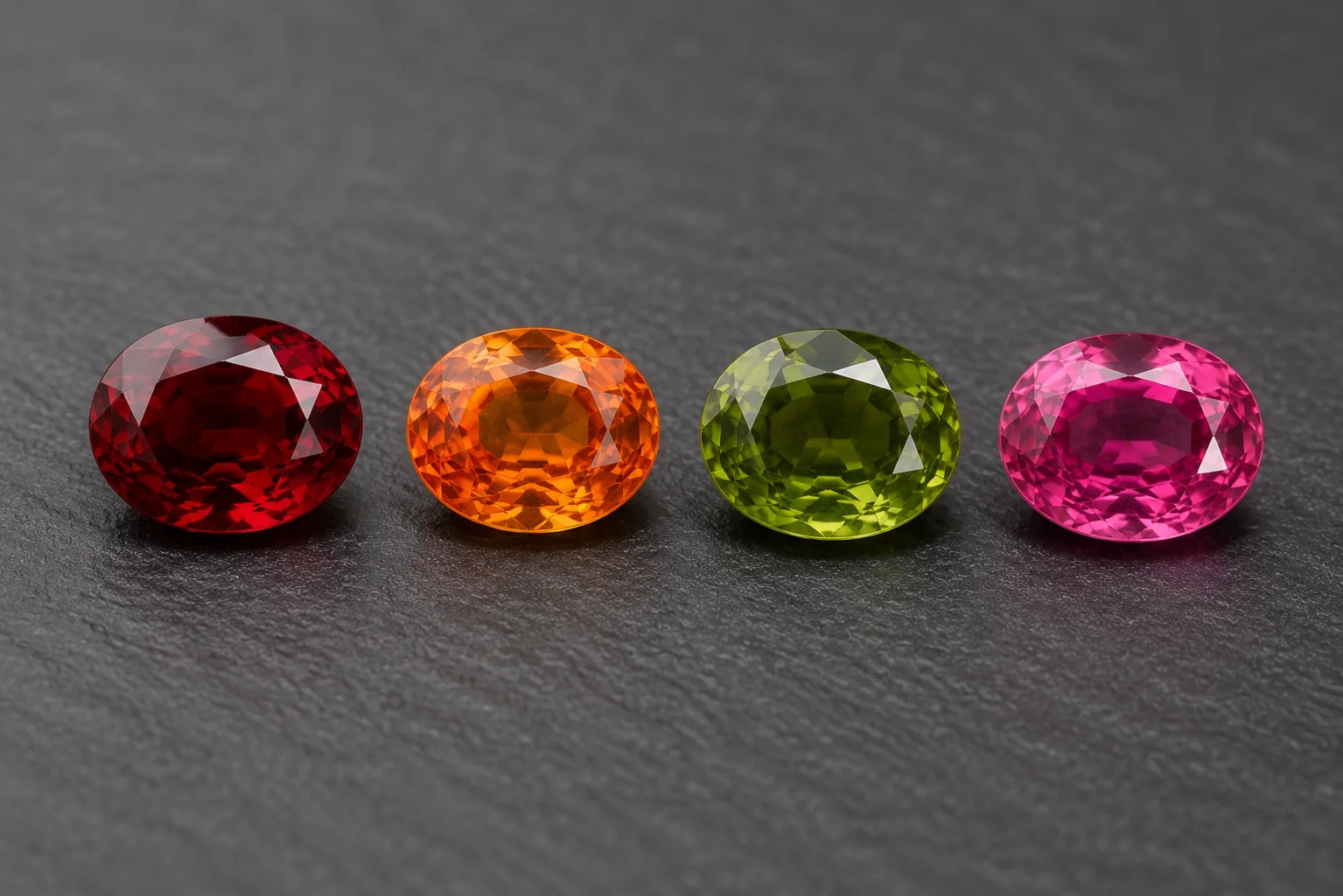
Garnet Color Meaning: Red, Orange, Green and More
Garnet is often imagined as a dark-red gemstone, but the mineral group occurs in nearly every major color family. Red, purple-red, orange, yellow, green and rare color-changing garnets each create a different visual identity and have attracted different symbolic interpretations.
In modern crystal practice, red garnet commonly represents grounding, vitality and commitment; orange emphasizes creativity and action; green represents growth and prosperity; and purple-red tones are often associated with emotional depth and devotion.
These color meanings are symbolic traditions rather than scientifically measurable gemstone effects. Mineralogically, garnet color results from composition, trace elements and interactions within different garnet species.
Garnet Color Meanings at a Glance
| Garnet color | Examples | Common symbolic meaning |
|---|---|---|
| Deep red | Almandine | Grounding, endurance and commitment |
| Bright red | Pyrope and mixtures | Courage, vitality and passion |
| Raspberry or purple-red | Rhodolite | Emotional depth, affection and self-respect |
| Orange | Spessartine, hessonite | Creativity, enthusiasm and action |
| Yellow to golden | Grossular and andradite varieties | Confidence, optimism and personal agency |
| Bright green | Tsavorite, demantoid | Growth, abundance and renewal |
| Emerald green crystal druse | Uvarovite | Appreciation, connection and sufficiency |
| Brown-red | Some almandine and hessonite | Stability, practicality and patience |
| Pink | Certain garnet mixtures | Gentleness, affection and emotional openness |
| Color-change | Mixed-composition garnets | Adaptability, perspective and transition |
Garnet Is a Group of Minerals
Color diversity exists because garnet is not one single mineral species.
The completed types of garnet guide explains the major gem species: almandine, pyrope, spessartine, grossular and andradite, along with uvarovite and important mixtures.
These minerals share the same broad crystal structure but differ chemically.
Those differences influence color, refractive index, density, hardness and other properties.
Therefore, red, orange and green garnets do not simply represent different dye-like versions of one identical material.
Why Garnet Comes in So Many Colors
Different combinations of iron, manganese, chromium, vanadium and other elements influence garnet color.
Iron contributes strongly to many red, orange, yellow and green appearances depending on oxidation state and mineral species.
Manganese is important in orange spessartine.
Chromium and vanadium contribute to intense greens in varieties such as tsavorite and demantoid.
Real garnets frequently contain chemical mixtures between ideal end-member compositions.
Consequently, color transitions can be gradual rather than fitting into perfectly separated categories.
Red Garnet Meaning
Red is garnet’s most famous color.
Modern symbolism associates red garnet with:
- Grounding
- Vitality
- Courage
- Commitment
- Passion
- Protection
- Physical presence
The recently drafted garnet chakra guide explains why red garnet is most often connected with root-chakra symbolism.
A grounded interpretation uses red as a reminder to address immediate responsibilities rather than expecting the gemstone to provide literal protective energy.
Almandine Garnet Color Meaning
Almandine garnet commonly ranges from deep red to brownish red or purplish red.
Its darker appearance has inspired symbolism involving endurance, stability and persistence.
A practical almandine intention might focus on sustaining one realistic commitment.
For example:
“I will continue this routine three times this week.”
The stone becomes a marker of consistency.
It does not biologically create endurance or remove fatigue.
Pyrope Garnet Color Meaning
Pyrope garnet is famous for rich red coloration.
Its fiery visual appearance makes courage, action and passion common modern symbolic themes.
Use pyrope symbolism when a situation requires deliberate action after reasonable preparation.
Passion should not be confused with impulsiveness.
A useful ritual asks what deserves energy and what does not.
The gemstone cannot make a risky action safe or guarantee a successful outcome.
Purple-Red Garnet Meaning
Purple-red garnets can create a softer or more complex appearance than conventional dark red.
Modern symbolism often connects these shades with emotional depth, devotion and a balance between passion and reflection.
Rhodolite is the best-known example.
Purple-red color can also suit themes of self-respect because it combines the visual warmth of red with cooler violet tones.
These meanings are modern interpretations rather than intrinsic mineral properties.
Rhodolite Garnet Color Meaning
Rhodolite garnet commonly shows raspberry, pinkish-red, purplish-red and wine-like shades.
Its color has inspired symbolic associations involving affection, compassion, commitment and emotional confidence.
A rhodolite ritual can focus on expressing care without abandoning personal boundaries.
That might involve appreciation, an honest request or a respectful refusal.
The stone cannot guarantee romantic love or repair a relationship independently.
Its value comes from appearance, mineral identity and personal symbolism.
Pink Garnet Meaning
Certain garnet mixtures may show distinctly pink or pinkish-red colors.
Pink symbolism is commonly associated with gentleness, friendship, affection and emotional openness.
Unlike stronger red symbolism, which may emphasize action and passion, pink can represent softer forms of connection.
A practical interpretation is to communicate appreciation without assuming that affection must become romantic.
Color does not determine how a garnet must be used.
Someone may choose a pink stone solely because they enjoy its appearance.
Orange Garnet Meaning
Orange garnet is commonly associated with creativity, enthusiasm, confidence and active self-expression.
Spessartine is one of the most important bright-orange garnets, while hessonite occupies warmer orange, cinnamon and brown-orange ranges.
Modern color symbolism connects orange with movement and experimentation.
A grounded orange-garnet practice can mark the start of a creative session.
The recently drafted garnet benefits guide explains how this type of symbolism can be converted into practical action.
Hessonite Garnet Color Meaning
Hessonite garnet is an orange-to-brownish-orange grossular variety.
Its warm appearance has inspired modern themes involving creativity, confidence and purposeful change.
Brownish undertones can also suggest practicality and stability.
Color preferences vary.
A bright orange stone is not inherently more spiritual than a cinnamon-colored one.
Gemological quality and metaphysical interpretation are separate questions.
Yellow Garnet Meaning
Yellow and golden garnets are less familiar to many casual buyers.
Within modern color symbolism, yellow represents confidence, optimism, decision-making and personal agency.
These themes often overlap with solar-plexus chakra traditions.
A yellow garnet can serve as a reminder to identify which part of a decision is under personal control.
It cannot create certainty or guarantee that a decision will succeed.
Evidence and consequences still need to guide important choices.
Green Garnet Meaning
Green garnet provides the greatest visual contrast with the mineral group’s red stereotype.
Modern symbolism frequently links green with:
- Growth
- Renewal
- Prosperity
- Compassion
- Opportunity
- Nature
- Emotional balance
The important gem varieties include tsavorite and demantoid, while uvarovite creates vivid green mineral specimens.
Green prosperity symbolism should be interpreted as a prompt for responsible resource management rather than a claim that garnet attracts money.
Green Grossular Garnet Meaning
Grossular garnet spans a broad color range.
Its green varieties have inspired symbolism involving growth, opportunity and personal development.
In a practical ritual, green grossular might accompany a learning goal.
Instead of asking the stone to create opportunity, identify one skill that would make a future opportunity easier to use.
This preserves the symbolic theme without converting it into a supernatural promise.
Demantoid Garnet Color Meaning
The drafted demantoid garnet meaning guide covers the green andradite variety famous for exceptional dispersion.
Its green color commonly inspires growth, vitality and prosperity symbolism, while its rainbow fire adds modern themes involving possibility and transformation.
A responsible interpretation focuses on noticing viable opportunities and acting thoughtfully.
Demantoid cannot change financial probability or guarantee personal transformation.
Its measurable distinction is optical: fine stones can display remarkable brilliance and spectral fire.
Uvarovite Garnet Color Meaning
Uvarovite garnet usually forms small vivid green crystals rather than large faceted gems.
Its sparkling druses have inspired symbolism involving appreciation, abundance and recognizing existing value.
That makes it particularly suited to gratitude practices.
However, gratitude should not become pressure to ignore genuine hardship.
A person can appreciate one aspect of life while still seeking change elsewhere.
The symbolism is most useful when it allows both truths to coexist.
Brown and Brown-Red Garnet Meaning
Brownish garnet shades occur in several compositions and varieties.
Modern color symbolism often links earth tones with patience, stability and practical decision-making.
A brown-red garnet may therefore fit an intention involving gradual progress.
For example, rather than setting an ambitious new routine, maintain one useful habit for a defined period.
The subdued color does not make the stone lower in symbolic value.
Metaphysical meaning is personal rather than determined by saturation.
Black-Looking Garnet
Some very dark red or brown garnets can appear almost black in ordinary lighting.
That visual effect has encouraged symbolism involving strong boundaries, grounding and protection.
Mineralogically, however, many such stones are not literally black.
Hold them under appropriate light and reddish or brownish transmission may become visible at thin edges.
Darkness should not be used as a species identification tool.
A stone that looks black may belong to several different mineral families.
Color-Change Garnet Meaning
Color-change garnet can shift appearance under different light sources.
Some material changes between greenish, brownish, reddish or purplish tones depending on composition and lighting.
The phenomenon has inspired symbolism involving flexibility, transition and the ability to view a situation from more than one perspective.
That interpretation fits the visual effect particularly well.
However, color change is a measurable optical phenomenon, while adaptability symbolism is interpretive.
The stone does not cause a person to become psychologically flexible.
Does Garnet Come in Blue?
Historically, gemological summaries often stated that garnet occurred in every major color except blue.
Rare color-change garnets complicated that simple statement because some material can show bluish or blue-green appearances under certain lighting.
For ordinary buyers, vivid stable blue garnet remains extremely unusual.
A seller offering inexpensive bright-blue garnet should provide convincing identification.
Unusual color deserves stronger evidence rather than automatic acceptance.
Which Garnet Color Is Most Valuable?
Color and value depend on variety.
Fine green tsavorite and demantoid can command high prices, particularly in larger sizes.
Rare color-change garnet can also be valuable.
Common dark-red almandine is generally more affordable because supply is much greater.
The completed garnet price guide explains these differences.
A gemstone should not be considered better simply because its color is more expensive in the market.
Which Garnet Color Is Best for Jewelry?
The answer depends on the jewelry style and budget.
Red almandine and pyrope provide classic birthstone colors. Rhodolite adds brighter raspberry tones, while green garnet suits buyers who want a less expected appearance.
The recently drafted garnet bracelet guide explains how variety affects wrist-jewelry durability.
Choose a color that remains attractive under normal lighting.
Extremely dark stones may photograph beautifully but look almost black during wear.
Garnet Color and January Birthstones
Garnet is January’s principal modern birthstone, but January jewelry does not need to be red.
The completed January birthstone guide explains the month-based tradition.
Green, orange and purple-red garnets all belong within the broader garnet group.
Therefore, someone born in January can choose according to personal color preference without losing the birthstone connection.
This flexibility is one of garnet’s strongest jewelry advantages.
Garnet Color and Chakra Symbolism
Modern chakra practice commonly connects red garnet with the root chakra, orange with the sacral or solar plexus and green with the heart.
Those associations arise largely through color symbolism.
They are not gemological classifications.
A garnet does not change chemical species because someone assigns it to a different chakra.
The symbolic system can still provide a useful framework for meditation when it is kept separate from medical claims.
How to Choose a Garnet by Color
First, decide whether the stone is primarily for jewelry, collecting or spiritual use.
For jewelry, inspect color under several lighting conditions.
For collecting, species, locality and crystal form may matter alongside color.
For symbolic use, choose the shade that communicates the intended idea most clearly.
The completed garnet buying guide explains the purchasing side in greater detail.
No metaphysical purpose requires buying the rarest or most expensive color.
Conclusion
Garnet color extends far beyond conventional dark red. Almandine and pyrope represent the classic red family, rhodolite adds raspberry and purple-red shades, orange appears in hessonite and spessartine-related material, while grossular and andradite produce some of garnet’s most celebrated greens.
Modern symbolism generally connects red with grounding and commitment, orange with creativity, yellow with agency, green with growth and prosperity, and color-change garnet with adaptability.
Those meanings are interpretive rather than scientific effects. Mineralogically, the colors reflect garnet chemistry, trace elements and species relationships, making garnet one of the most diverse major gemstone groups.
Frequently Asked Questions
1. What color is garnet?
Garnet occurs in red, orange, yellow, green, purple-red, pinkish and brown shades, as well as rare color-changing material.
2. What does red garnet symbolize?
Modern traditions commonly associate red garnet with grounding, courage, vitality, passion and commitment.
3. What does green garnet symbolize?
Green garnet is commonly associated with growth, renewal, prosperity, compassion and opportunity.
4. What does orange garnet mean?
Orange garnet symbolism generally emphasizes creativity, enthusiasm, confidence and action.
5. What does purple garnet symbolize?
Purple-red garnets such as rhodolite are often connected with emotional depth, affection and balanced commitment.
6. What does yellow garnet symbolize?
Modern color traditions commonly associate yellow garnet with optimism, confidence and personal agency.
7. Is all garnet red?
No. Garnet is a diverse mineral group with many colors.
8. What causes garnet’s colors?
Differences in mineral species, chemical composition and elements such as iron, manganese, chromium and vanadium influence garnet color.
9. Which garnet is bright green?
Tsavorite, demantoid and uvarovite are important green garnets, although they belong to different garnet species.
10. Which garnet color is most valuable?
Fine green demantoid and tsavorite and rare color-change garnets can be highly valuable, but individual quality determines price.
11. Is there blue garnet?
Strong stable blue is exceptionally unusual, although rare color-change garnets can show bluish or blue-green appearances in certain light.
12. Does garnet color change its healing power?
There is no scientific evidence that any garnet color has healing power. Color-specific meanings belong to spiritual and symbolic traditions.
Disclaimer: Garnet color meanings, chakra correspondences and metaphysical associations are cultural or spiritual interpretations rather than scientifically established effects. Garnet color cannot diagnose health conditions, determine personality or guarantee emotional, financial or relationship outcomes.