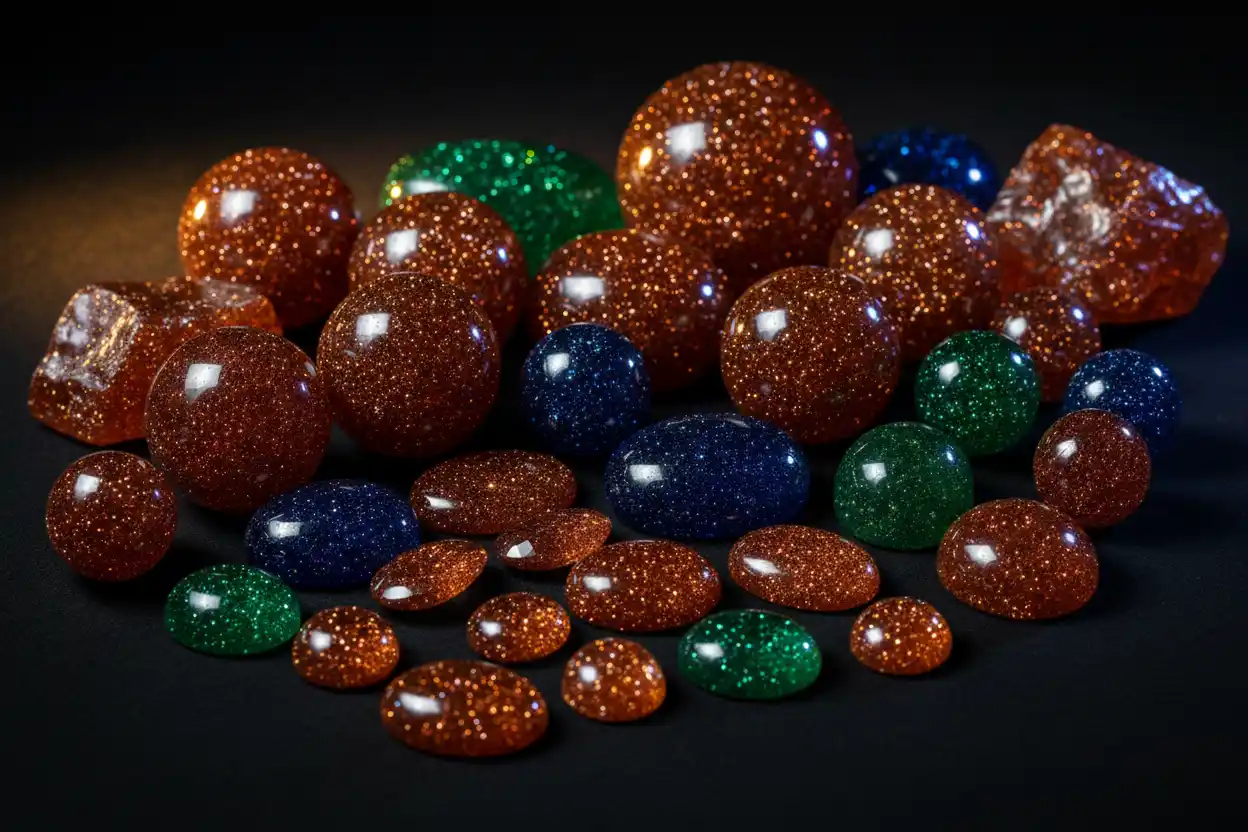
Goldstone Meaning: Properties, Uses & Symbolism
Goldstone meaning starts with an unusual fact that is frequently lost in crystal-market descriptions: goldstone is manufactured glass, not a naturally occurring mineral or rock. Its characteristic sparkle comes from numerous metallic crystals suspended through a glass matrix. In the classic reddish-brown form, those reflective inclusions are copper crystals produced during carefully controlled glassmaking. GIA describes goldstone as glass containing small, flat copper crystals, while museum collections use the older term aventurine glass for historic Venetian material made with glittering copper inclusions.
Its manufactured origin does not make goldstone meaningless, fraudulent, or unworthy of collection. Human-made materials can have genuine craftsmanship, historical significance, decorative value, and personal symbolism. The critical distinction is disclosure. Goldstone should be represented as glass rather than sold as a natural mineral, mined crystal, sandstone, or naturally formed metallic stone. Once that identity is clear, goldstone meaning can be discussed responsibly as a combination of glassmaking history, optical properties, decorative use, and modern symbolic interpretation.
Readers exploring material-first references can browse the Gemstone Guides collection. This page owns the definition, manufacture, color mechanism, broad diagnostic traits, documented history, symbolism boundary, and safe ownership of goldstone without duplicating the separate microscopy, optics, manufacturing, lapidary, setting, conservation, or provenance pages.
Goldstone Meaning at a Glance
| Question | Evidence-aware answer |
|---|---|
| What is goldstone? | Manufactured aventurine glass containing reflective metallic crystals |
| Is goldstone a natural mineral? | No |
| Is goldstone glass? | Yes |
| Classic reflective inclusion | Metallic copper crystals |
| Typical classic color | Reddish brown to warm copper-brown |
| Other commercial colors | Blue, green, purple, and other manufactured variants occur |
| Structure | Amorphous glass containing crystalline inclusions |
| Optical effect | Aventurescence: glittering reflections from numerous reflective particles |
| Refractive index | Published references commonly place classic material around the low-to-mid 1.5 range |
| Specific gravity | Common published values are roughly in the mid-2 range, with composition-dependent variation |
| Hardness | Generally comparable to many decorative glasses rather than natural quartz |
| Fracture | Glass-like, typically conchoidal |
| Main identification clues | Uniform metallic sparkle, glass matrix, copper crystals, possible bubbles and flow structures |
| Historical context | Strongly associated with Venetian aventurine-glass traditions |
| Modern symbolism | Often linked with ambition, optimism, motivation, confidence, or persistence |
| Scientific status of symbolism | Symbolic interpretations are not demonstrated medical or physiological effects |
| Safety boundary | Intact polished glass differs from broken sharp edges and dust-generating cutting or grinding |
GIA microscopy has directly documented copper crystals in goldstone glass, and historical GIA work reported a refractive index around 1.53 with density roughly 2.50–2.80 for studied aventurine glass. Those figures are useful reference ranges rather than universal constants because glass recipes and colored variants can differ.
What Is Goldstone?
Goldstone is a decorative glass made to contain a dense population of metallic reflective crystals. The classic reddish-brown material is often called aventurine glass, and its glittering appearance is so distinctive that the optical term aventurescence became associated with similar sparkling effects in natural gems. Modern gemological literature still uses goldstone as a standard example of manufactured aventurescent material.
Unlike quartz, feldspar, garnet, beryl, or other minerals, the glass host has no repeating long-range crystalline lattice. The copper particles inside it are crystalline, but their presence does not turn the entire object into a mineral crystal. Goldstone is therefore best described as an amorphous manufactured glass containing metallic crystals.
That structural distinction is useful because retail terminology can be confusing. Labels such as “goldstone crystal,” “blue sandstone,” or “gold sandstone” may imply natural geology where none exists. A shop can reasonably place goldstone alongside crystals for decorative or metaphysical retail purposes, but the physical description should still say glass.
Goldstone Identity Table
| Characteristic | Goldstone |
|---|---|
| Material class | Manufactured glass |
| Traditional descriptive name | Aventurine glass |
| Classic inclusion | Metallic copper crystals |
| Structure of host | Amorphous |
| Structure of sparkle particles | Crystalline metallic inclusions |
| Common classic body color | Warm reddish brown |
| Typical transparency | Translucent to semi-translucent depending on thickness and recipe |
| Luster | Vitreous |
| Optical phenomenon | Aventurescence |
| Typical products | Cabochons, beads, spheres, carvings, pendants, decorative objects |
| Natural deposit | None; it is manufactured |
| Major identification risk | Being misrepresented as natural sandstone, sunstone, aventurine quartz, or another mineral |
| Useful microscopic clues | Metallic crystals, bubbles, flow structure, glassy host |
| Historical association | Venetian/Murano glassmaking |
| Identification limit | Color and sparkle alone are insufficient for every unusual imitation or composite |
The Goldstone Microscope Inclusion Notebook owns the detailed study of copper crystal morphology, bubble populations, flow structures, and other microscopic features. Those features are diagnostically important, but the broader goldstone meaning remains centered on material identity rather than microscope technique.
How Goldstone Is Made
Goldstone does not form in a mine or geological deposit. It is created in a furnace. Traditional aventurine glassmaking involves preparing a molten glass batch containing copper-bearing ingredients and controlling oxygen conditions and cooling so that metallic copper can separate from the melt and grow as countless reflective crystals. The Victoria and Albert Museum describes a reducing, oxygen-poor environment that allows copper flakes to develop within the glass as it cools.
The manufacturing process is more sophisticated than simply stirring metallic glitter into finished glass. In classic copper goldstone, copper compounds are dissolved into the molten batch and metallic copper crystallizes during controlled cooling. The size, abundance, distribution, and shape of the reflective crystals depend on composition, temperature history, redox conditions, and cooling. Historic GIA microscopy shows that the inclusions can display distinct crystal faces rather than behaving like random glitter particles.
For a deeper treatment of furnace chemistry, reduction, cooling, and the absence of natural deposit geology, use the Goldstone Formation and Deposit Geology guide. In goldstone’s case, that page necessarily deals more with manufacturing origin and raw-material context than natural mineral formation.
What Causes Goldstone’s Sparkle?
The sparkle comes from light reflecting from numerous small metallic crystals distributed through the glass. In classic reddish-brown goldstone, those crystals are copper. Their relatively flat reflective faces flash strongly under direct or directional illumination, creating the glittering phenomenon called aventurescence. GIA’s recent photomicrography shows triangular copper-particle faces within goldstone glass and identifies them as the cause of the aventurescent effect.
The effect changes as the object, light source, or observer moves because only some copper faces are optimally oriented to reflect light toward the eye at any given moment. A polished sphere therefore appears to contain shifting points of metallic light rather than a uniform metallic surface.
Aventurescence should not be confused with adularescence, opalescence, chatoyancy, asterism, or the broad directional sheen seen in some natural glasses and minerals. Each phenomenon has a different optical and structural origin. The dedicated Goldstone Optical Properties and Color Behavior guide owns those distinctions in detail.
Does Goldstone Contain Real Gold?
Despite the name, classic goldstone does not need metallic gold to produce its characteristic appearance. The familiar reddish-brown variety is associated with copper crystals, not gold particles. GIA explicitly describes goldstone as glass containing copper crystals.
The name is therefore visual and commercial rather than chemical. The material looks as though golden sparks have been suspended in glass, but appearance does not establish elemental composition.
Claims such as “rich in natural gold,” “mined with gold particles,” or “contains precious gold dust” require independent analytical evidence and should not be inferred from the word goldstone.
Why Classic Goldstone Is Reddish Brown
Classic goldstone combines metallic copper reflections with a warm brown-to-red visual impression. The copper inclusions contribute strong reddish metallic reflections, while the glass composition and transmitted light influence the overall body appearance. Historic and modern aventurine glass commonly shows warm brown or reddish tones against which the copper crystals are especially visible.
The result is sometimes described inaccurately as “natural copper sandstone.” It is neither sandstone nor a naturally cemented granular rock. Its apparently grainy appearance comes from dispersed reflective crystals within glass.
This is an important identity boundary because natural geological texture should never be invented simply to make a manufactured decorative material sound more valuable.
Blue, Green, and Purple Goldstone
Goldstone is manufactured in multiple colors. Blue goldstone is especially common in beads, spheres, and metaphysical retail, where a deep blue glass matrix makes the reflective particles resemble a star-filled night sky. Green and purple variants also occur commercially.
The exact recipe can vary among manufacturers, so broad statements about one universal composition for every colored goldstone should be avoided. The safe material-level description is that these are colored manufactured glasses engineered to contain reflective inclusions or phases.
Different color variants should not be promoted as separate natural minerals merely because their body color changes. The underlying category remains manufactured decorative glass.
Diagnostic Traits of Goldstone
Goldstone is often visually recognizable because its reflective particles can be unusually abundant, evenly distributed, and consistently metallic compared with inclusions in many natural stones. Under magnification, classic examples can reveal angular or triangular faces of copper crystals at different depths within the transparent-to-translucent glass. Small gas bubbles and flow-related structures may also be visible.
GIA has documented goldstone-containing manufactured glass with geometric copper crystals, gas bubbles, and glass flow structures. These observations are especially useful when a glass product has been fashioned to imitate a natural gemstone.
A chipped or rough edge may show conchoidal glass fracture rather than mineral grain or cleavage. Refractive-index and density measurements can provide additional confirmation, while spectroscopy or chemical testing may be useful for unusual materials or high-stakes identification.
Uniform Sparkle: Useful Clue, Not a Universal Rule
The density and regularity of goldstone sparkle can make the material look engineered, which it is. Classic high-quality material often contains large numbers of similarly reflective crystals distributed throughout the body.
Yet manufacturing quality varies. Historic GIA discussion notes that poorer samples can show concentrations or swirls rather than perfectly even crystal distribution. This matters because “perfectly uniform glitter” should not become an absolute definition of genuine goldstone.
Likewise, a natural gem can show widespread reflective inclusions, and some manufactured glasses deliberately reproduce irregular natural-looking textures. Identification is strongest when inclusion style, optical properties, fracture, and material structure all agree.
Goldstone Versus Natural Aventurine
The word aventurine is one of the main naming traps surrounding goldstone. Aventurine glass is manufactured, while natural aventurine quartz is a quartz-rich natural material containing reflective mineral inclusions such as mica. The similar names arise because the sparkling visual effect is comparable.
Modern gemology uses aventurescence as the broader optical term for glittering reflections produced by distributed reflective inclusions. GIA notes that the word developed from aventurine glass before being extended to natural gem materials displaying similar phenomena.
A natural stone should therefore not be identified as goldstone because it sparkles, and goldstone should not be sold as natural aventurine quartz.
Goldstone Versus Sunstone
Goldstone is commonly encountered as a sunstone imitation because both materials can display warm coloration and sparkling reflections. GIA specifically warns that goldstone is a common sunstone imitation and identifies it as glass containing small flat copper crystals.
Natural sunstone is feldspar whose aventurescence can result from reflective mineral inclusions. Its crystal structure, refractive properties, hardness, cleavage, density, and geological origin differ from manufactured glass.
A copper-colored sparkle therefore cannot identify sunstone. Material testing must establish the host before the optical effect is interpreted.
Goldstone Versus Golden Obsidian
Golden Obsidian Meaning covers a natural volcanic glass rather than manufactured aventurine glass. This makes the comparison particularly useful: both materials are glass, yet one is geological and the other is manufactured.
Golden obsidian generally displays a broad directional sheen associated with internal volcanic flow structures and microscopic bubbles, whereas goldstone usually displays many discrete metallic sparkles from crystalline inclusions throughout a manufactured glass matrix.
Calling both “golden glass” would describe appearance while missing their radically different origins.
Goldstone Versus Golden Healer Quartz
Golden Healer Quartz Meaning concerns crystalline quartz with iron-related staining, coatings, or inclusions. Goldstone is amorphous manufactured glass containing metallic reflective particles.
They differ in atomic structure, manufacturing versus geological origin, hardness, fracture behavior, color mechanism, and internal texture. A warm golden appearance is the only superficial similarity.
This is why goldstone meaning should never be built from quartz lore simply because both materials are sold in crystal shops.
Goldstone Versus Goshenite
Goshenite Meaning covers colorless beryl, a naturally occurring crystalline mineral. Goshenite can be transparent and faceted, but it lacks the manufactured copper-crystal aventurescence that defines classic goldstone.
The comparison is useful because a polished object does not reveal its material category merely through shine. Natural crystals, synthetic crystals, manufactured glass, and natural volcanic glass can all take excellent polish.
Internal structure and measurable properties establish identity more reliably than retail presentation.
Goldstone Versus Grandidierite
Grandidierite Meaning concerns a natural mineral with a very different chemistry, crystal structure, optical behavior, and geological occurrence. Fine grandidierite can display blue-green coloration, while blue goldstone may occupy a superficially similar color family in jewelry photographs.
The resemblance ends at appearance. One material forms geologically; the other is manufactured glass. If an expensive natural gem is claimed, a glittering blue object should never be accepted as proof from color alone.
Documented History of Goldstone
Goldstone has a genuine glassmaking history connected with Venetian aventurine glass. Museum collections preserve aventurine-glass objects made in Venice and describe the characteristic effect as copper crystals forming in the glass during cooling. The Metropolitan Museum of Art, for example, catalogs Venetian objects containing glittering aventurine glass and directly attributes the sparkle to copper crystals.
The exact invention story is less secure than popular folklore suggests. The Victoria and Albert Museum describes aventurine glass as an accidental Muranese discovery in the early modern period, while GIA literature notes that historical accounts of its invention or rediscovery vary.
That uncertainty should be preserved rather than replaced with a dramatic but unsupported story about a particular monk, family, or secret formula unless the underlying historical documentation is available.
Goldstone and the “Monk’s Gold” Story
Retail and metaphysical sources sometimes claim goldstone was invented by monks working with alchemy or was created accidentally in a monastery. Versions of the story vary considerably, which is itself a reason for caution.
Museum evidence strongly supports historic Venetian aventurine-glass production, but the specific monastic narrative is not necessary to explain the material. Historic glassmakers already had the technical capability to manipulate metallic oxides, furnace atmosphere, temperature, and cooling to create complex decorative glass.
A responsible goldstone meaning page should therefore distinguish established Venetian glass history from later folklore about exactly who first created it.
Original Information Gain: Goldstone Name and Claim Audit
| Name or claim | What it reasonably describes | What should not be assumed | Stronger evidence required |
|---|---|---|---|
| Goldstone | Manufactured glittering glass | Natural mineral or rock | Material identification |
| Aventurine glass | Historic/technical name for glittering manufactured glass | Natural aventurine quartz | Glass identification and historical context |
| Natural goldstone | Usually contradictory for conventional gem-trade goldstone | A naturally occurring deposit | Geological and mineralogical evidence would be required |
| Blue sandstone | Common retail misnomer for blue goldstone in some markets | Natural sandstone | Petrographic evidence if sandstone is claimed |
| Gold sandstone | Marketing term | Sandstone containing gold | Geological examination |
| Copper glass | Broad descriptive phrase | Every colored goldstone uses identical composition | Composition-specific testing |
| “Contains real gold” | Precious-metal composition claim | Supported by golden color | Chemical analysis |
| “Ancient crystal” | Historical claim | Modern goldstone is a naturally mined ancient mineral | Traceable historical evidence |
| “Monk’s gold” | Folklore or trade story | Proven inventor or production context | Primary historical documentation |
| “Stone of ambition” | Modern metaphysical label | Measurable psychological effect | Remains symbolic interpretation |
| “Healing glass” | Spiritual marketing | Medical treatment | Clinical evidence would be required |
| “High vibration” | Metaphysical language | Measurable therapeutic energy | Reproducible physical evidence |
| “Untreated” | Not especially meaningful in the same way as natural gems because goldstone is manufactured | Natural unaltered origin | Manufacturing disclosure |
| “Rare” | Could describe an unusual historic object or artisan production | Goldstone glass as a category is geologically rare | Market, historical, or production evidence |
| Venetian goldstone | Historical or provenance description | Every modern goldstone was made in Venice | Maker documentation or provenance |
This framework resolves the central naming problem: goldstone is real goldstone precisely because it is manufactured glass. Calling it natural does not make it more genuine; it makes the description less accurate.
Original Source-Comparison Framework
| Source type | Best question it can answer | Main limitation |
|---|---|---|
| Gemological laboratory | Is the object glass, and what are its inclusions and properties? | Usually specimen-specific rather than complete manufacturing history |
| Museum glass collection | How aventurine glass was historically made and used | May not cover modern metaphysical terminology |
| Historical glassmaking study | Manufacturing techniques and chronology | Some invention narratives remain disputed |
| Chemical/materials analysis | Metallic inclusion composition and glass chemistry | Does not establish cultural symbolism |
| Retail listing | Current names, colors, shapes, and market terminology | Marketing claims need independent verification |
| Metaphysical source | Documents modern symbolic interpretations | Does not establish mineralogical, historical, or medical facts |
| Personal testimony | Records subjective experience | Cannot establish universal physiological effects |
| Social-media post | Shows contemporary trends in naming | Weak evidence for technical identity or history |
The strongest article uses each source within its competence. A museum is useful for glass history. GIA is useful for gemological identification. A retailer can show that “blue sandstone” is being used commercially but cannot transform goldstone into sedimentary rock.
Goldstone Meaning in Modern Symbolism
Modern goldstone meaning commonly centers on ambition, optimism, persistence, confidence, creativity, and motivation. The interpretation is easy to understand visually: countless bright metallic reflections inside a dark or warm-colored glass can suggest sparks, stars, opportunity, momentum, or small actions accumulating into something more noticeable.
A person may choose to use goldstone as a desk object, jewelry piece, journaling cue, or visual reminder of a goal. That kind of symbolic use depends on the meaning assigned by the person rather than on a scientifically demonstrated property of the glass.
The fact that goldstone is manufactured does not prevent it from carrying symbolism. Human-made objects—rings, medals, artworks, religious objects, photographs, and heirlooms—can hold deep meaning without being natural minerals.
Goldstone and Ambition
“Stone of ambition” is one of the most repeated modern goldstone meanings. It can be reframed into a practical, non-magical use: let the object represent one goal, then define the actions that actually move that goal forward.
For example, a person might associate the repeating copper flashes with incremental progress. Each visible point can serve metaphorically as one small completed task rather than as evidence that the glass itself generates success.
Goldstone cannot guarantee promotions, business growth, examination results, wealth, or career advancement.
Goldstone and Motivation
The dense sparkle can also make goldstone an appealing motivational symbol. A polished sphere or bead may function as a physical cue to return attention to a planned task, particularly when used consistently in a workspace or personal routine.
The important mechanism is behavioral association. People can train themselves to connect an object with an action, but that does not mean copper-bearing glass changes neurotransmitters, increases physical energy, or treats fatigue.
Motivation remains a human psychological and behavioral process.
Goldstone and Confidence
Goldstone meaning is sometimes associated with confidence because the material is visually bright, attention-catching, and deliberately decorative. Someone might wear it as a reminder to speak clearly, prepare carefully, or stop minimizing their own work.
That symbolic use can be personally useful, but goldstone cannot force confidence, eliminate social anxiety, alter another person’s perception, or guarantee that a risky decision will succeed.
A meaningful reminder is not the same as a medical or behavioral intervention.
Goldstone and Creativity
Goldstone itself is evidence of human creativity. It is a manufactured artistic material whose appeal depends on controlling molten glass, chemistry, atmosphere, crystallization, and finishing. In that sense, associating it symbolically with creative experimentation has a concrete historical foundation even though the psychological effect remains interpretive.
A glass artist had to solve a technical problem to create the material. A modern owner may reasonably let that craftsmanship symbolize experimentation, iteration, or making something valuable from controlled process.
That is a stronger and more interesting interpretation than pretending goldstone was formed naturally underground.
Goldstone and Prosperity Claims
Some modern metaphysical descriptions connect goldstone with money, wealth, luck, business success, or manifestation. Those themes should remain symbolic. No evidence establishes that carrying copper-bearing glass changes financial probability, creates income, attracts customers, or guarantees investment performance.
A grounded prosperity ritual could use goldstone as a cue to review a budget, send an invoice, study a business metric, or complete a practical task. The resulting outcome comes from the action, not from a supernatural effect of the glass.
Guaranteed-money claims should be treated as marketing rather than gemological fact.
Safe Ownership of Goldstone
Polished goldstone is suitable for ordinary handling as a decorative glass object, but glass remains capable of chipping and breaking. A damaged piece can develop sharp conchoidal edges, particularly around fractures, drilled holes, thin bead walls, and broken corners.
The material should therefore not be intentionally dropped, struck, or snapped as an authenticity test. If a jewelry piece develops a chip, examine it before continued wear because sharp glass edges can cut skin or catch fabric.
Ordinary ownership of an intact piece is fundamentally different from breaking or processing glass.
Cutting, Grinding, and Drilling
Goldstone is routinely cut into cabochons, beads, spheres, pendants, and carvings, but lapidary processing introduces different hazards from ordinary handling. Sawing, grinding, sanding, and drilling produce glass particles and can create sharp fragments.
The practical manufacturing and workmanship details belong in the Goldstone Cutting, Orientation and Polish guide. Appropriate eye protection, equipment guards, wet working methods where suitable, ventilation or dust controls, careful cleanup, and competent lapidary practice are more important than metaphysical claims about the material.
No one should deliberately crush or powder goldstone for ritual use.
Goldstone in Jewelry
Goldstone’s rich color and strong sparkle make it particularly effective in cabochons and beads. The dense reflective particles remain visible even in relatively small components, allowing a modest piece of glass to create a strong decorative effect.
Its jewelry performance should nevertheless be evaluated as glass. Rings and bracelets receive more impacts and surface contact than earrings or many pendants. Drill holes can become stress concentrators in beads, and thin edges are more vulnerable to chipping.
The detailed mechanical decisions are covered in the Goldstone Setting and Wear Engineering guide.
Does Goldstone Scratch?
Yes. Goldstone is not as scratch resistant as quartz, sapphire, or diamond. Like other decorative glass materials, repeated contact with harder mineral particles, metal edges, countertops, abrasive cleaners, or harder gemstones can gradually mark the polished surface.
This does not make goldstone unsuitable for jewelry. It simply means that an owner should apply realistic expectations and avoid storing it loose against much harder stones.
A scratch-resistant display object and an impact-resistant daily-wear ring are different durability problems.
Cleaning Goldstone
A conservative cleaning approach is appropriate for uncomplicated goldstone jewelry: mild soap, lukewarm water, and a soft cloth generally avoid many unnecessary risks. Jewelry construction still matters because adhesives, plated findings, coatings, strings, and other components may impose additional restrictions.
Harsh abrasives should be avoided because they can scratch glass. Sudden impact and large thermal shocks are also unnecessary risks.
The safest care decision is based on the complete object rather than assuming every piece marketed as goldstone has identical construction.
Specimen and Object Conservation
Goldstone is manufactured, so “specimen conservation” often means preserving an artisan object, historic glass fragment, bead, decorative carving, or documented commercial sample rather than protecting geological locality evidence.
Older aventurine glass can have genuine historical significance, especially when maker, workshop, geographic origin, ownership history, or object context is documented. Original labels, receipts, catalog records, photographs, and collection notes should therefore remain associated with important examples.
The Goldstone Specimen Conservation Record provides the mapped framework for preserving condition and documentation.
Provenance Still Matters for a Manufactured Material
Goldstone does not have a mine locality, but provenance can still be meaningful. Questions may include where the glass was made, which workshop produced it, whether the object is modern or historic, who fashioned the final piece, and whether it came from a documented Venetian, Chinese, studio-glass, jewelry, or commercial production context.
The Metropolitan Museum of Art documents aventurine glass not only in Venetian objects but also in Chinese Qing-period snuff bottles, illustrating how the material and technique traveled beyond its European production history.
The Goldstone Provenance Disclosure Checklist is the appropriate place to separate documented maker history from seller stories.
Why “Natural Goldstone” Is a Red Flag
Conventional goldstone is manufactured glass. A seller describing an ordinary glittering goldstone cabochon as “100% natural mined goldstone crystal” is therefore contradicting the established material identity unless the seller actually means an unrelated natural material with a confusing commercial name.
The correct response is not to assume malicious intent immediately. Retail terminology is often inherited from wholesalers, marketplace templates, or informal crystal vocabulary.
However, if natural geological origin materially influences price, the seller should be able to identify the actual mineral or rock rather than relying on goldstone as though it were a natural species.
Goldstone Is Not “Fake” When Disclosed Properly
Calling goldstone fake simply because it is manufactured is also imprecise. A genuine piece of goldstone is genuine manufactured aventurine glass. It becomes deceptive only when represented as something else.
This distinction parallels synthetic and imitation gem terminology. A laboratory-grown crystal can be a genuine synthetic version of a mineral, while glass may be used as an imitation of a natural gemstone. Goldstone itself does not need to imitate anything to be appreciated as decorative material.
Its aesthetic value comes from intentional human manufacture.
Can Goldstone Be Used Spiritually?
A person can use goldstone in meditation, journaling, altar displays, intention-setting, or other spiritual practices if the material carries personal meaning. The responsible boundary is simply to label those uses as spiritual or symbolic rather than scientific.
A manufactured origin does not invalidate symbolic practice. Many spiritually important human objects are intentionally made rather than naturally formed.
The site-wide distinction between material facts and unsupported health or metaphysical claims is explained in the Gems Lore Disclaimer.
Goldstone Should Not Be Ingested
Goldstone should not be powdered, swallowed, mixed into supplements, or deliberately placed into drinking-water preparations. It is manufactured glass containing metallic or metal-bearing components, and there is no nutritional rationale for ingestion.
Copper being present as metallic crystals does not make the material a safe dietary copper source. Elements in decorative materials are not automatically medicines, nutrients, supplements, or transdermal treatments.
Symbolic engagement does not require consuming the object.
Evidence Limits
This guide does not claim first-hand Venetian furnace work, private manufacturing experiments, unpublished chemical analysis, personal laboratory testing, or authentication of a reader’s individual object. Its material definition is grounded in established gemological and museum descriptions of goldstone and aventurine glass.
The broader editorial and evidence approach used by Gems Lore is described on About Gems Lore.
Where an expensive historic object, unusual colored glass, suspected composite, disputed maker attribution, or technically unusual inclusion materially affects a decision, appropriate glass-science, gemological, conservation, historical, or laboratory expertise may be needed.
Documented corrections or evidence that materially improves a technical or historical claim can be submitted through Contact Gems Lore.
Frequently Asked Questions About Goldstone Meaning
What is goldstone meaning?
Goldstone meaning usually combines the material’s identity as glittering manufactured glass with modern symbolic themes such as ambition, confidence, optimism, creativity, and persistence. These symbolic themes are interpretations rather than scientifically demonstrated properties.
Is goldstone a natural crystal?
No. Conventional goldstone is manufactured glass containing reflective crystals, most famously copper crystals in the classic reddish-brown form.
Is goldstone real?
Yes, if “real” means genuine goldstone. It is a genuine manufactured decorative glass. It should not, however, be represented as a naturally mined mineral.
What makes goldstone sparkle?
Classic goldstone sparkles because numerous metallic copper crystals are suspended through the glass and reflect light from their crystal faces.
Does goldstone contain actual gold?
Classic goldstone does not require gold metal. Its characteristic warm metallic sparkle is associated with copper crystals.
Is goldstone the same as aventurine?
Goldstone is historically called aventurine glass. Natural aventurine quartz or feldspar is different because it is a naturally occurring crystalline material containing reflective inclusions. The similar terms refer to a shared sparkling appearance rather than identical composition.
Is blue goldstone natural?
No. Blue goldstone is manufactured colored glass. It should not be described as naturally mined blue sandstone or natural blue crystal merely because it is sold in crystal shops.
Why is goldstone called sandstone?
Names such as blue sandstone or gold sandstone are commercial misnomers sometimes applied to goldstone. The material is glass, not sedimentary sandstone.
Where was goldstone invented?
The strongest historical association is with Venetian aventurine-glass production. Museum and gemological sources agree on the Venetian tradition, but detailed invention stories and exact chronology vary, so highly specific origin legends should be treated cautiously.
Was goldstone discovered by monks?
The popular monk-origin story is difficult to establish from high-quality historical evidence. Documented Venetian glassmaking history is much stronger than the more dramatic folklore surrounding a monastic accidental discovery.
Does goldstone have healing properties?
There is no established scientific evidence that goldstone treats disease, anxiety, depression, hormonal conditions, cardiovascular problems, fertility issues, neurological conditions, immune disorders, or pain.
Can goldstone bring money or success?
It can be used symbolically as a reminder of ambition or financial goals, but it cannot guarantee income, career success, wealth, investment returns, or manifestation.
Is goldstone safe to wear?
Intact, well-finished goldstone is widely used in jewelry. Because it is glass, it can scratch, chip, or break, and damaged edges can become sharp.
Is goldstone safe to cut?
Goldstone is routinely worked by lapidaries, but cutting, drilling, grinding, and sanding create sharp fragments and particulate matter. Appropriate glass-working and lapidary safety controls should be used.
How can I identify goldstone?
Look for a glassy body containing numerous metallic reflective particles, possible gas bubbles or flow structures, and glass-like fracture. Refractive index, specific gravity, microscopy, spectroscopy, or other laboratory methods can provide stronger confirmation when necessary.
Is historic goldstone collectible?
Yes. Aventurine glass has genuine decorative-arts history, and documented historic objects can have artistic, cultural, and collecting significance beyond the intrinsic value of the glass itself.
Final Perspective
Goldstone meaning becomes more accurate—and more interesting—once the material’s manufactured identity is treated as a strength rather than something to conceal. Goldstone is aventurine glass engineered so that reflective metallic crystals develop within the melt. In the classic reddish-brown variety, copper crystals create the dense sparkling effect that made the material famous and helped give gemology the term aventurescence.
Its history is therefore a history of craftsmanship, chemistry, furnace control, and decorative glassmaking rather than geological mineral formation. Venetian glass traditions provide strong historical evidence for aventurine glass, while surviving museum objects show that the technique also became part of decorative traditions beyond Venice. The exact romantic story of its invention is less certain and should remain secondary to what the surviving objects and technical evidence actually establish.
Modern themes of ambition, optimism, motivation, creativity, and confidence can remain part of goldstone meaning when they are clearly presented as symbolism. Goldstone does not need to be a natural crystal to be beautiful, historically interesting, collectible, or personally meaningful. The evidence-aware approach is simply to call it what it is: a deliberately manufactured glass whose remarkable metallic sparkle comes from skilled control of materials and cooling, not from a mine, supernatural process, or hidden gold deposit.